By
M. SCUNZIANO, MD, NMD
04/03/2014
1
FOOD OF LIFE…
FOR LIFE:
YOUR BODY IS WORTH NOTHING LESS
2
WHAT IS FOOD OF LIFE?
It is the WHOLE FOOD created by nature and nothing less.
As a human being, it is essential that you take in whole food that
is grown in nutrient-rich soil and minimally processed.
Anything that is not consumed from this natural process is not a
food of wholeness or wholesomeness and your body knows the
difference. Once this basic concept is understood, we can then
begin to see why it is so critical to have whole food to have whole
health.
3
A general comment can be made here about the current state of
the “developed world” and that is that our lives have been
negatively impacted because industries allied with governing
institutions have taken many steps to ALTER AND CHANGE THE
NATURAL PROCESSES that our earth has offered to us.
There is now a world in which we have witnessed and participated
in the DENATURATION of our food sources. The combination of
manufactured foods, additives, preservatives, genetic
modifications, artificial chemicals and sweeteners and pesticide
residues in highly technical processing factories has led to
significant negatively-impacting consequences for all living
creatures, from the single-cell organisms to humans.
4
The wild animals of this earth are not consumers of the manmade or
artificial types. We ourselves need pay attention to this very fact and
understand that we are not unlike the other members of the
mammalian species. We too must not consume that which is not
nature-made. We know well the consequences and yet there is
seemingly no end to the lack of sensitivity to this concept.
There is an urgent need for all people to become more conscious of
what they are choosing to do each and every day for the sake of saving
and protecting the health of their bodies and that of all living creatures
on this earth.
Today, we will look at whole foods- the food of life, and make every
effort to appreciate their essentiality and value.
5
Whole Foods
Legumes: Beans, Lentils and Peas (Legume and fruit
classification), Grains, Nuts, Seeds, Fruits, Land and Sea
Vegetables, Algae, Flowers, Fish, Mother’s milk, Eggs, Meat
6
When choosing a food to attain optimal health, it is best to keep
in mind what the true need is for the food and if it may do more
harm than good for your body. For example, if you are not a very
active person who is engaged in physical labor and requiring a lot
of fuel for your lifestyle, then meat should be minimized or
eliminated from the diet.
Reason: meat has intrinsic hormones, fats and possibly other
added chemicals that can contribute to health deterioration. Be
mindful of these constituents and choose wisely.
7
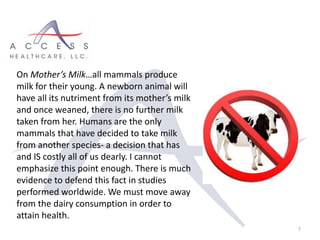
On Mother’s Milk…all mammals produce
milk for their young. A newborn animal will
have all its nutriment from its mother’s milk
and once weaned, there is no further milk
taken from her. Humans are the only
mammals that have decided to take milk
from another species- a decision that has
and IS costly all of us dearly. I cannot
emphasize this point enough. There is much
evidence to defend this fact in studies
performed worldwide. We must move away
from the dairy consumption in order to
attain health.
8
Pesticides, herbicides, insecticides and all “cidal” compounds made from
artificial or powerful chemicals are in our soils and in our foods. This is a
fact. We need to make every effort to either GROW OUR OWN foods or
select from farmers and growers who are using natural products for control
of the insects and other creatures who may affect crop production.
Also, an organic crop sold in retail outlets such as an apple or zucchini has a
4-digit number that identifies it that begins with “4”. One that is not will
begin with “9”.
CHOOSE ORGANIC (OR ANY PRODUCT GROWN
CONSCIOUSLY)
9
Watch for the “natural” labels. Any company can call its
product natural as long as it has at least one component that
is “derived” from a piece of earth! All the rest can be junk.
If a product is “organic”, make sure it has a green and white
label that says USDA ORGANIC. Otherwise, it is not and you
do not know what is really in it.
BE AWARE OF LABELLING AND SUPPORT
GMO LABELLING
Stay informed on GMO issues. This is a serious matter and
will impact on the health of every human being. Any support
of GMO is not good. We have evidence that the modified
crops are already causing major health problems around the
world. Either we fight to protect our foods or we succumb to
the industries that are manufacturing these products on a
constant basis. Say NO to GMOs and ask your governing
people to pass laws that force GMO labels on foods.
10
Here are lists of whole foods and their
products that are ideally lightly processed
for health:
11
Adzuki beans, black- eyed peas, black soybeans, black turtle
beans, broad beans, chickpeas, great Northern beans, kidney
beans, lentils, lima beans, mung beans, navy beans, pinto beans,
soybeans, split peas, dried peas…
Miso, natto, tempeh, tofu, tamari or soy sauce
Beans & bean products
12
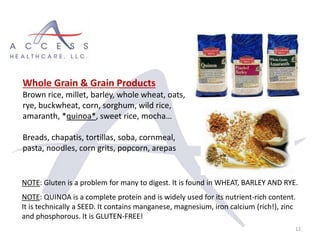
Whole Grain & Grain Products
Brown rice, millet, barley, whole wheat, oats,
rye, buckwheat, corn, sorghum, wild rice,
amaranth, *quinoa*, sweet rice, mocha…
Breads, chapatis, tortillas, soba, cornmeal,
pasta, noodles, corn grits, popcorn, arepas
NOTE: Gluten is a problem for many to digest. It is found in WHEAT, BARLEY AND RYE.
NOTE: QUINOA is a complete protein and is widely used for its nutrient-rich content.
It is technically a SEED. It contains manganese, magnesium, iron calcium (rich!), zinc
and phosphorous. It is GLUTEN-FREE!
13
Almonds, chestnuts, filberts, peanuts, pecans, pine nuts,
pistachios, poppy seeds, pumpkin seeds, sesame seeds, squash
seeds, sunflower seeds, quinoa, walnuts…
Seeds & Nuts
NOTE: ideally, nuts should be eaten whole and chewed very well for the benefits.
Soaking or roasting them is a means of helping to digest their contents even better.
Nut butters
14
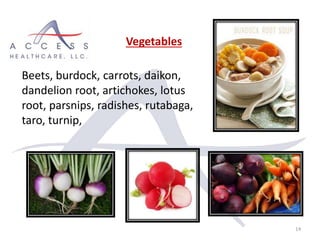
Beets, burdock, carrots, daikon,
dandelion root, artichokes, lotus
root, parsnips, radishes, rutabaga,
taro, turnip,
Vegetables
15
Roots: Carp, clams, crab, cod,
flounder, haddock, herring,
lobster, octopus, oysters, red
snapper, salmon, scallops,
shrimp, scrod, sole, tuna,
trout, other white meat fish
and seafood.
Fish & Seafood- wild not farmed
CAUTION: shellfish products are not recommended for arthritis sufferers. Joints are
aggravated. Be aware. Keep consumption in control or eliminate.
16
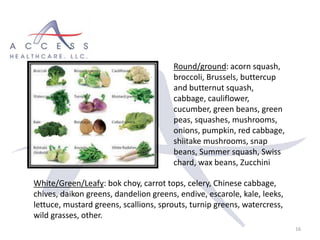
White/Green/Leafy: bok choy, carrot tops, celery, Chinese cabbage,
chives, daikon greens, dandelion greens, endive, escarole, kale, leeks,
lettuce, mustard greens, scallions, sprouts, turnip greens, watercress,
wild grasses, other.
Round/ground: acorn squash,
broccoli, Brussels, buttercup
and butternut squash,
cabbage, cauliflower,
cucumber, green beans, green
peas, squashes, mushrooms,
onions, pumpkin, red cabbage,
shiitake mushrooms, snap
beans, Summer squash, Swiss
chard, wax beans, Zucchini
17
Fruits
Fresh & dried: apples, apricots, blackberries, blueberries,
cantaloupe, grapes, honeydew melons, lemon,
mulberries, nectarines, olives, oranges, peaches, pears,
plums, raisins, raspberries, strawberries, tangerines,
watermelon, wild berries, others temperate-climate
varieties…
Fresh juiced drinks are best; avoid commercially prepared
Sea Vegetables
Agar agar, arame, dulse, hijiki, irish moss,
kelp, kombu, nori, wakame, others…
Seaweed flakes, snacks, chips
18
Garnishes
Grated daikon, grated radish, grated horseradish, chopped
scallions, grated ginger, red pepper, seaweed flakes, other
traditional garnishes
Condiments
Yellow mustard, green mustard, cooked nori, good quality
salsa and ketchup, chutney
Pickles
Bran, brine, miso, salt, salt water, sauerkraut, apple cider
vinegar, tamari soy sauce, umeboshi plum
19
Seasonings
Unrefined sea salt, tamari soy sauce, miso, rice vinegar,
brown rice vinegar, sauerkraut brine, mirin (rice wine),
gingerroot, daikon radish or radish (grated), umeboshi plum,
lemon juice, orange juice, fresh black pepper, red pepper,
yellow and green mustard, sesame oil, safflower oil, mustard
seed oil, olive oil, coconut oil, sake (rice wine)
NOTE: Mirin and sake are both rice wines used in cooking. Mirin has a LOWER
alcohol content but a HIGHER sugar content than sake. Sake is often taken as a
beverage in certain cultures. It should not be used regularly.
Umeboshi Plums
20
Sweeteners
Barley malt, rice syrup, maple syrup, cooked
fruit, dried fruit, fresh fruit juice, stevia leaf,
xylitol
NOTE: do not use sweeteners if you can avoid them;
sugar intake is very high in this and other countries and
the intake is contributing to/causing diabetes at
alarming rates.
Beverages
Spring water, alkaline water, well water (filtered), twig tea,
kombucha tea, grain teas, organic decaf coffee, organic coffee,
fresh coconut water, coconut milk, almond milk prepared at
home, fresh lemon added to waters and teas, cinnamon added
to coffees and teas.
Occasional use: almond milk that is commercially prepared
INFREQUENT USE: cider, soy milk, beer, wine
AVOID: sugared drinks, sodas and diet varieties, artificially colored and sweetened
items, strong liquors
21
Processed foods, frozen foods, irradiated
foods, instant foods, caffeine products,
sugars in general, all artificial
sweeteners, chocolate in general, corn
syrup, tomatoes, eggplants, fructose,
molasses, refined salt, eggs from
unknown sources, meat/poultry in
general and especially from inhumane
sources, bluefish, swordfish, other red
and blue-skin fish, white (bleached)
flour, margarine, lard, excess spices
Foods to avoid for better health:
22
Healthful ingredients in the CRUCIFEROUS
VEGETABLE family of: broccoli, brussels sprouts,
kale, cabbage, Chinese cabbage, collards, bok
choy, watercress, arugula are:
Glutathione, quercetin, indole-3-carbinol, iron, sulfur, sulphoraphane,
vitamins A,B,C and E, isothiocyanate, glucosinolates (crambene), chromium.
These ingredients are responsible for antiviral and anticancer properties of
these vegetables. They also help remove excess estrogen from the body, a
definite health benefit to reduce cancer risk.
23
On Dairy products…
24
Be aware that dairy milk and all its products are full
of intrinsic hormones. The bovine sources are also
injected with growth hormones and antibiotics. If you
use organic milk, you are also receiving hormones. All
the hormone exposure is related to if not directly
involved in the development of two of the most
commonly seen cancers in this country: BREAST AND
PROSTATE. Evidential research has made note of this
problem. This is not a tale. This is reality and it has
not been revealed to the public at large. It is up to
the consumer to make his/her decision to take such
products. (Please see references at the end of this
discussion for details.)
25
The food of life can be taken in as raw or cooked. Most foods for
humans should have some form of heat applied, especially
when preparing grains, beans, fish or meat products. The
cooking vessels and the type of heating are very important for
one’s health. It is recommended that the following cookware
and heating are used by anyone, anywhere:
Earthenware, cast iron, stainless steel, clay, glass, porcelain with
the use of brick oven, fire oven, flame on stovetops or in the
field, convection oven, steaming vessels.
It is best to avoid electric stoves and microwave ovens. Both
distribute heat extremely rapidly. Microwaves will destroy
nutriments of foods and, in effect, devitalize it.
26
The food of life is that which belongs in the body of the consumer
and not that which has been assumed or accepted as the right
material. Even our wild animals on this planet know. They can
teach us so much and we best learn from these creatures who do
not survive on foods that naturally do not enter their bodies or are
of artificial or genetically modified types.
We are not ready and never will be ready to take in those products
which nature herself has not provided. Moreover, as long as we
continue to choose products that are of the non-nature made
ingredients and/or those that are not recommended for regular
use or use at all, we are putting our lives at risk.
27
CHOOSE FOODS FOR LIFE PLEASE
28
References:
Campbell, Colin, PhD, et al. The China Study: Startling Implications
for Diet, Weight Loss and Long-Term Health; Benbella Books,
Dallas, Tx, 2006
Kushi, M. The Book of Macrobiotics: The Universal Way to Health
and Happiness; Japan Publications, Inc., Japan and New York,
1986
Plant, J., PhD. The No-Dairy Breast Cancer Prevention Program:
How One Scientist’s Discovery Helped her Defeat her Breast
Cancer; Thomas Dunne Books, USA, 2001

Food

  • 1.
    By M. SCUNZIANO, MD,NMD 04/03/2014 1 FOOD OF LIFE… FOR LIFE: YOUR BODY IS WORTH NOTHING LESS
  • 2.
    2 WHAT IS FOODOF LIFE? It is the WHOLE FOOD created by nature and nothing less. As a human being, it is essential that you take in whole food that is grown in nutrient-rich soil and minimally processed. Anything that is not consumed from this natural process is not a food of wholeness or wholesomeness and your body knows the difference. Once this basic concept is understood, we can then begin to see why it is so critical to have whole food to have whole health.
  • 3.
    3 A general commentcan be made here about the current state of the “developed world” and that is that our lives have been negatively impacted because industries allied with governing institutions have taken many steps to ALTER AND CHANGE THE NATURAL PROCESSES that our earth has offered to us. There is now a world in which we have witnessed and participated in the DENATURATION of our food sources. The combination of manufactured foods, additives, preservatives, genetic modifications, artificial chemicals and sweeteners and pesticide residues in highly technical processing factories has led to significant negatively-impacting consequences for all living creatures, from the single-cell organisms to humans.
  • 4.
    4 The wild animalsof this earth are not consumers of the manmade or artificial types. We ourselves need pay attention to this very fact and understand that we are not unlike the other members of the mammalian species. We too must not consume that which is not nature-made. We know well the consequences and yet there is seemingly no end to the lack of sensitivity to this concept. There is an urgent need for all people to become more conscious of what they are choosing to do each and every day for the sake of saving and protecting the health of their bodies and that of all living creatures on this earth. Today, we will look at whole foods- the food of life, and make every effort to appreciate their essentiality and value.
  • 5.
    5 Whole Foods Legumes: Beans,Lentils and Peas (Legume and fruit classification), Grains, Nuts, Seeds, Fruits, Land and Sea Vegetables, Algae, Flowers, Fish, Mother’s milk, Eggs, Meat
  • 6.
    6 When choosing afood to attain optimal health, it is best to keep in mind what the true need is for the food and if it may do more harm than good for your body. For example, if you are not a very active person who is engaged in physical labor and requiring a lot of fuel for your lifestyle, then meat should be minimized or eliminated from the diet. Reason: meat has intrinsic hormones, fats and possibly other added chemicals that can contribute to health deterioration. Be mindful of these constituents and choose wisely.
  • 7.
    7 On Mother’s Milk…allmammals produce milk for their young. A newborn animal will have all its nutriment from its mother’s milk and once weaned, there is no further milk taken from her. Humans are the only mammals that have decided to take milk from another species- a decision that has and IS costly all of us dearly. I cannot emphasize this point enough. There is much evidence to defend this fact in studies performed worldwide. We must move away from the dairy consumption in order to attain health.
  • 8.
    8 Pesticides, herbicides, insecticidesand all “cidal” compounds made from artificial or powerful chemicals are in our soils and in our foods. This is a fact. We need to make every effort to either GROW OUR OWN foods or select from farmers and growers who are using natural products for control of the insects and other creatures who may affect crop production. Also, an organic crop sold in retail outlets such as an apple or zucchini has a 4-digit number that identifies it that begins with “4”. One that is not will begin with “9”. CHOOSE ORGANIC (OR ANY PRODUCT GROWN CONSCIOUSLY)
  • 9.
    9 Watch for the“natural” labels. Any company can call its product natural as long as it has at least one component that is “derived” from a piece of earth! All the rest can be junk. If a product is “organic”, make sure it has a green and white label that says USDA ORGANIC. Otherwise, it is not and you do not know what is really in it. BE AWARE OF LABELLING AND SUPPORT GMO LABELLING Stay informed on GMO issues. This is a serious matter and will impact on the health of every human being. Any support of GMO is not good. We have evidence that the modified crops are already causing major health problems around the world. Either we fight to protect our foods or we succumb to the industries that are manufacturing these products on a constant basis. Say NO to GMOs and ask your governing people to pass laws that force GMO labels on foods.
  • 10.
    10 Here are listsof whole foods and their products that are ideally lightly processed for health:
  • 11.
    11 Adzuki beans, black-eyed peas, black soybeans, black turtle beans, broad beans, chickpeas, great Northern beans, kidney beans, lentils, lima beans, mung beans, navy beans, pinto beans, soybeans, split peas, dried peas… Miso, natto, tempeh, tofu, tamari or soy sauce Beans & bean products
  • 12.
    12 Whole Grain &Grain Products Brown rice, millet, barley, whole wheat, oats, rye, buckwheat, corn, sorghum, wild rice, amaranth, *quinoa*, sweet rice, mocha… Breads, chapatis, tortillas, soba, cornmeal, pasta, noodles, corn grits, popcorn, arepas NOTE: Gluten is a problem for many to digest. It is found in WHEAT, BARLEY AND RYE. NOTE: QUINOA is a complete protein and is widely used for its nutrient-rich content. It is technically a SEED. It contains manganese, magnesium, iron calcium (rich!), zinc and phosphorous. It is GLUTEN-FREE!
  • 13.
    13 Almonds, chestnuts, filberts,peanuts, pecans, pine nuts, pistachios, poppy seeds, pumpkin seeds, sesame seeds, squash seeds, sunflower seeds, quinoa, walnuts… Seeds & Nuts NOTE: ideally, nuts should be eaten whole and chewed very well for the benefits. Soaking or roasting them is a means of helping to digest their contents even better. Nut butters
  • 14.
    14 Beets, burdock, carrots,daikon, dandelion root, artichokes, lotus root, parsnips, radishes, rutabaga, taro, turnip, Vegetables
  • 15.
    15 Roots: Carp, clams,crab, cod, flounder, haddock, herring, lobster, octopus, oysters, red snapper, salmon, scallops, shrimp, scrod, sole, tuna, trout, other white meat fish and seafood. Fish & Seafood- wild not farmed CAUTION: shellfish products are not recommended for arthritis sufferers. Joints are aggravated. Be aware. Keep consumption in control or eliminate.
  • 16.
    16 White/Green/Leafy: bok choy,carrot tops, celery, Chinese cabbage, chives, daikon greens, dandelion greens, endive, escarole, kale, leeks, lettuce, mustard greens, scallions, sprouts, turnip greens, watercress, wild grasses, other. Round/ground: acorn squash, broccoli, Brussels, buttercup and butternut squash, cabbage, cauliflower, cucumber, green beans, green peas, squashes, mushrooms, onions, pumpkin, red cabbage, shiitake mushrooms, snap beans, Summer squash, Swiss chard, wax beans, Zucchini
  • 17.
    17 Fruits Fresh & dried:apples, apricots, blackberries, blueberries, cantaloupe, grapes, honeydew melons, lemon, mulberries, nectarines, olives, oranges, peaches, pears, plums, raisins, raspberries, strawberries, tangerines, watermelon, wild berries, others temperate-climate varieties… Fresh juiced drinks are best; avoid commercially prepared Sea Vegetables Agar agar, arame, dulse, hijiki, irish moss, kelp, kombu, nori, wakame, others… Seaweed flakes, snacks, chips
  • 18.
    18 Garnishes Grated daikon, gratedradish, grated horseradish, chopped scallions, grated ginger, red pepper, seaweed flakes, other traditional garnishes Condiments Yellow mustard, green mustard, cooked nori, good quality salsa and ketchup, chutney Pickles Bran, brine, miso, salt, salt water, sauerkraut, apple cider vinegar, tamari soy sauce, umeboshi plum
  • 19.
    19 Seasonings Unrefined sea salt,tamari soy sauce, miso, rice vinegar, brown rice vinegar, sauerkraut brine, mirin (rice wine), gingerroot, daikon radish or radish (grated), umeboshi plum, lemon juice, orange juice, fresh black pepper, red pepper, yellow and green mustard, sesame oil, safflower oil, mustard seed oil, olive oil, coconut oil, sake (rice wine) NOTE: Mirin and sake are both rice wines used in cooking. Mirin has a LOWER alcohol content but a HIGHER sugar content than sake. Sake is often taken as a beverage in certain cultures. It should not be used regularly. Umeboshi Plums
  • 20.
    20 Sweeteners Barley malt, ricesyrup, maple syrup, cooked fruit, dried fruit, fresh fruit juice, stevia leaf, xylitol NOTE: do not use sweeteners if you can avoid them; sugar intake is very high in this and other countries and the intake is contributing to/causing diabetes at alarming rates. Beverages Spring water, alkaline water, well water (filtered), twig tea, kombucha tea, grain teas, organic decaf coffee, organic coffee, fresh coconut water, coconut milk, almond milk prepared at home, fresh lemon added to waters and teas, cinnamon added to coffees and teas. Occasional use: almond milk that is commercially prepared INFREQUENT USE: cider, soy milk, beer, wine AVOID: sugared drinks, sodas and diet varieties, artificially colored and sweetened items, strong liquors
  • 21.
    21 Processed foods, frozenfoods, irradiated foods, instant foods, caffeine products, sugars in general, all artificial sweeteners, chocolate in general, corn syrup, tomatoes, eggplants, fructose, molasses, refined salt, eggs from unknown sources, meat/poultry in general and especially from inhumane sources, bluefish, swordfish, other red and blue-skin fish, white (bleached) flour, margarine, lard, excess spices Foods to avoid for better health:
  • 22.
    22 Healthful ingredients inthe CRUCIFEROUS VEGETABLE family of: broccoli, brussels sprouts, kale, cabbage, Chinese cabbage, collards, bok choy, watercress, arugula are: Glutathione, quercetin, indole-3-carbinol, iron, sulfur, sulphoraphane, vitamins A,B,C and E, isothiocyanate, glucosinolates (crambene), chromium. These ingredients are responsible for antiviral and anticancer properties of these vegetables. They also help remove excess estrogen from the body, a definite health benefit to reduce cancer risk.
  • 23.
  • 24.
    24 Be aware thatdairy milk and all its products are full of intrinsic hormones. The bovine sources are also injected with growth hormones and antibiotics. If you use organic milk, you are also receiving hormones. All the hormone exposure is related to if not directly involved in the development of two of the most commonly seen cancers in this country: BREAST AND PROSTATE. Evidential research has made note of this problem. This is not a tale. This is reality and it has not been revealed to the public at large. It is up to the consumer to make his/her decision to take such products. (Please see references at the end of this discussion for details.)
  • 25.
    25 The food oflife can be taken in as raw or cooked. Most foods for humans should have some form of heat applied, especially when preparing grains, beans, fish or meat products. The cooking vessels and the type of heating are very important for one’s health. It is recommended that the following cookware and heating are used by anyone, anywhere: Earthenware, cast iron, stainless steel, clay, glass, porcelain with the use of brick oven, fire oven, flame on stovetops or in the field, convection oven, steaming vessels. It is best to avoid electric stoves and microwave ovens. Both distribute heat extremely rapidly. Microwaves will destroy nutriments of foods and, in effect, devitalize it.
  • 26.
    26 The food oflife is that which belongs in the body of the consumer and not that which has been assumed or accepted as the right material. Even our wild animals on this planet know. They can teach us so much and we best learn from these creatures who do not survive on foods that naturally do not enter their bodies or are of artificial or genetically modified types. We are not ready and never will be ready to take in those products which nature herself has not provided. Moreover, as long as we continue to choose products that are of the non-nature made ingredients and/or those that are not recommended for regular use or use at all, we are putting our lives at risk.
  • 27.
  • 28.
    28 References: Campbell, Colin, PhD,et al. The China Study: Startling Implications for Diet, Weight Loss and Long-Term Health; Benbella Books, Dallas, Tx, 2006 Kushi, M. The Book of Macrobiotics: The Universal Way to Health and Happiness; Japan Publications, Inc., Japan and New York, 1986 Plant, J., PhD. The No-Dairy Breast Cancer Prevention Program: How One Scientist’s Discovery Helped her Defeat her Breast Cancer; Thomas Dunne Books, USA, 2001