+   PDC
                      Module 4 of the PDC+++
 +   +       Energy & EcoTechnology
                               We dedicate this Module to the Mother &
                                Father of Integral Permaculture: Dana
  Class                        Meadows & Howard Odum, two original
                                 pioneers who helped humanity make
  M4.2                          great strides in understanding systemic
Resources                            thinking, in all four quadrants.


               We could say that the key to the sustainability of any society (or indeed
            any design) is simply to make optimum use of resources - so this is a very
              important subject to clarify for ourselves as designers. In this class we
            will explore how often, instead of using rational criteria for appropriateness
               when choosing resources (materials, fuels or technologies), like energy
             trade-off, we tend to use subjective & superficial criteria, like appearance,
            fashion & emotional attachments.         This class is about how we can learn
                        to make wiser judgements & choices in these matters.
M4.2 How can we make optimum
      use of resources?

  Hierarchies of resources

  Invisible resources

  8rs and Emergy

  Resources culture
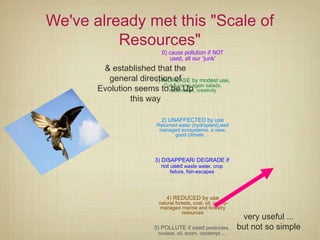
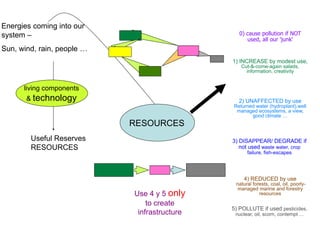
We've already met this "Scale of
          Resources"
                            0) cause pollution if NOT
                               used, all our 'junk'
        & established that the
         general direction of by modest use,
                       1) INCREASE
                           Cut-&-come-again salads,
       Evolution seems to information, creativity
                              be Up
                this way

                            2) UNAFFECTED by use
                          Returned water (hydroplant),well
                           managed ecosystems, a view,
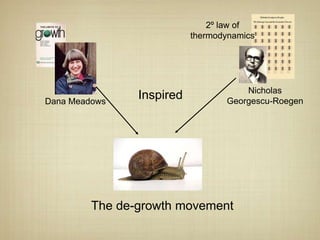
                                 good climate …


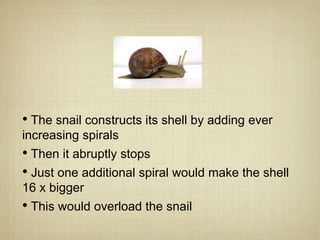
                          3) DISAPPEAR/ DEGRADE if
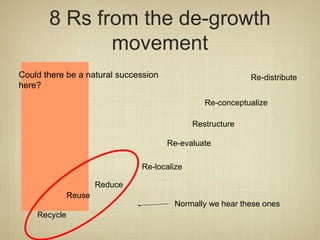
                             not used waste water, crop
                                failure, fish-escapes


                               4) REDUCED by use
                           natural forests, coal, oil, poorly-
                            managed marine and forestry
                                      resources
                                                                  very useful ...
                         5) POLLUTE if used pesticides,          but not so simple
                           nuclear, oil, scorn, contempt ...
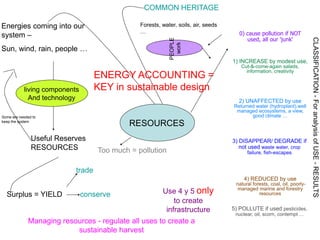
COMMON HERITAGE

Energies coming into our                        Forests, water, soils, air, seeds
                                                …                                      0) cause pollution if NOT
system –
                                                                                          used, all our 'junk'


                                                                                                                           CLASSIFICATION - For analysis of USE - RESULTS
                                                            PEOPLE
                                                              work
Sun, wind, rain, people …
                                                                                    1) INCREASE by modest use,
                                                                                       Cut-&-come-again salads,
                                                                                         information, creativity
                                    ENERGY ACCOUNTING =
           living components        KEY in sustainable design
             And technology                                                           2) UNAFFECTED by use
                                                                                    Returned water (hydroplant),well
                                                                                     managed ecosystems, a view,
Some are needed to                                                                         good climate …
keep the system
                                             RESOURCES
               Useful Reserves                                                      3) DISAPPEAR/ DEGRADE if
               RESOURCES            Too much = pollution
                                                                                       not used waste water, crop
                                                                                          failure, fish-escapes


                            trade
                                                                                         4) REDUCED by use
                                                                                     natural forests, coal, oil, poorly-
                                                                                      managed marine and forestry
  Surplus = YIELD              conserve                  Use 4 y 5 only                         resources
                                                             to create
                                                          infrastructure            5) POLLUTE if used pesticides,
                                                                                     nuclear, oil, scorn, contempt ...
              Managing resources - regulate all uses to create a
                           sustainable harvest
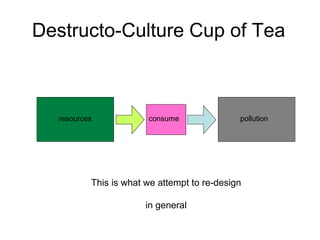
Destructo-Culture Cup of Tea


  resources            consume               pollution


          This is what we attempt to re-design

                       in general
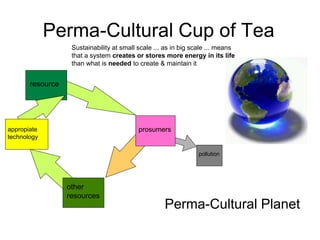
Perma-Cultural Cup of Tea
                   Sustainability at small scale ... as in big scale ... means
                   that a system creates or stores more energy in its life
                   than what is needed to create & maintain it


       resource


appropiate                                 prosumers
technology

                                                                pollution


                  other
                  resources
                                                    Perma-Cultural Planet
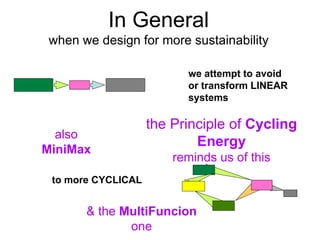
In General
 when we design for more sustainability

                          we attempt to avoid
                          or transform LINEAR
                          systems

                    the Principle of Cycling
  also
                            Energy
MiniMax
                        reminds us of this
 to more CYCLICAL


       & the MultiFuncion
              one
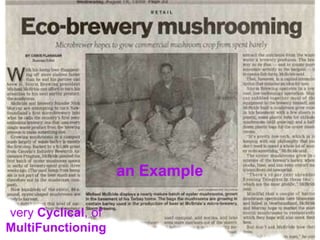
an Example

very Cyclical, of
MultiFunctioning
water
                                                  water         0) cause pollution if NOT used
                                                  waste
                                    grains
                      BEER
                                                                waste
                                             used
                                             grains

                                  feed

             not digestible
                                              desechos      0) cause pollution if NOT used
              = pollution
              (methane)                       (basura)
0) cause pollution if NOT used

                                                          more waste


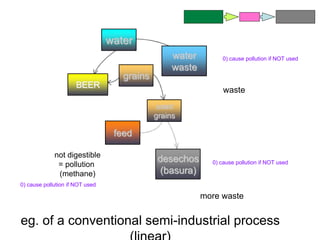
eg. of a conventional semi-industrial process
waste >
       water                                FISH          more produce
                                                        + more employment
                            water
                            waste
           grains                                      agae
BEER

                                            digestor
                     granos
                     usados                                GAS
         substrato                            waste
                      BREA           PIGS
                       D
 SETAS
                  used
                                    feed
                substrate

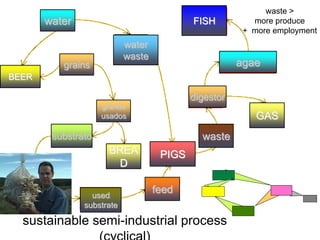
  sustainable semi-industrial process
Energies coming into our
system –                                         0) cause pollution if NOT
                                                    used, all our 'junk'
Sun, wind, rain, people …
                                              1) INCREASE by modest use,
                                                 Cut-&-come-again salads,
                                                   information, creativity


      living components
       & technology                             2) UNAFFECTED by use
                                              Returned water (hydroplant),well
                                               managed ecosystems, a view,
                                                     good climate …
                            RESOURCES
        Useful Reserves                       3) DISAPPEAR/ DEGRADE if
        RESOURCES                                not used waste water, crop
                                                    failure, fish-escapes


                                                   4) REDUCED by use
                                               natural forests, coal, oil, poorly-
                                                managed marine and forestry
                            Use 4 y 5 only                resources

                                to create
                                              5) POLLUTE if used pesticides,
                             infrastructure    nuclear, oil, scorn, contempt ...
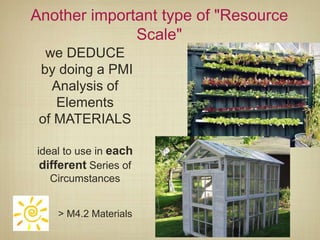
Another important type of "Resource
              Scale"
  we DEDUCE
 by doing a PMI
   Analysis of
    Elements
 of MATERIALS

ideal to use in each
 different Series of
   Circumstances


    > M4.2 Materials
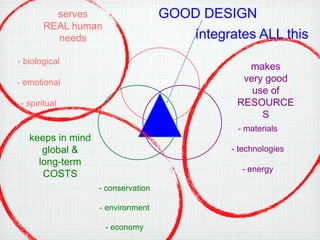
serves                     GOOD DESIGN
       REAL human
         needs                         íntegrates ALL this
- biological
                                                 makes
- emotional                                     very good
                                                  use of
- spiritual                                    RESOURCE
                                                    S
                                               - materials
   keeps in mind
      global &                                - technologies
     long-term
                                                - energy
      COSTS
                   - conservation

                   - environment

                    - economy
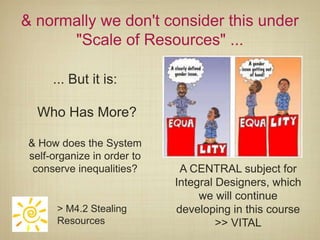
& normally we don't consider this under
      "Scale of Resources" ...

      ... But it is:

  Who Has More?

 & How does the System
 self-organize in order to
  conserve inequalities?      A CENTRAL subject for
                             Integral Designers, which
                                  we will continue
       > M4.2 Stealing       developing in this course
       Resources                      >> VITAL
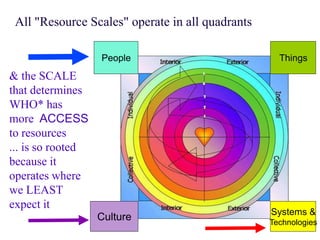
All "Resource Scales" operate in all quadrants

                   People                           Things
& the SCALE
that determines
WHO* has
more ACCESS
to resources
... is so rooted
because it
operates where
we LEAST
expect it
                                                  Systems &
                   Culture                        Technologies
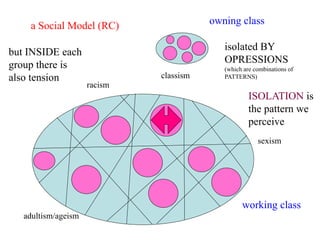
a Social Model (RC)                  owning class

                                            isolated BY
but INSIDE each
                                            OPRESSIONS
group there is                              (which are combinations of
also tension                  classism      PATTERNS)
                     racism
                                                     ISOLATION is
                                                     the pattern we
                                                     perceive
                                                        sexism


                                                  working class
   adultism/ageism
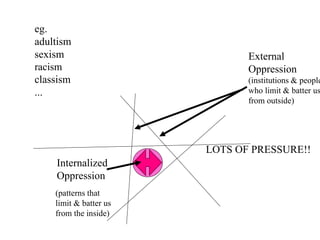
eg.
adultism
sexism                         External
racism                         Oppression
classism                       (institutions & people
...                            who limit & batter us
                               from outside)


                        LOTS OF PRESSURE!!
    Internalized
    Oppression
    (patterns that
    limit & batter us
    from the inside)
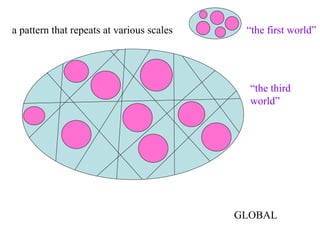
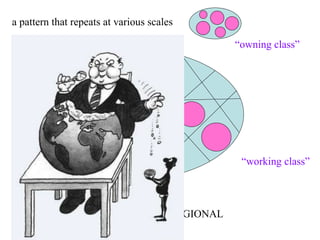
a pattern that repeats at various scales    “the first world”


                                             “the third
                                             world”


                                           GLOBAL
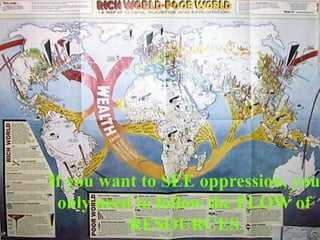
If you want to SEE oppression, you
 only need to follow the FLOW of
          RESOURCES
a pattern that repeats at various scales

                                                  “owning class”


                                                   “working class”


                                       REGIONAL
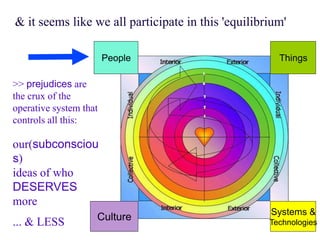
& it seems like we all participate in this 'equilibrium'

                        People                        Things

>> prejudices are
the crux of the
operative system that
controls all this:

our(subconsciou
s)
ideas of who
DESERVES
more
                                                    Systems &
                    Culture
... & LESS                                          Technologies
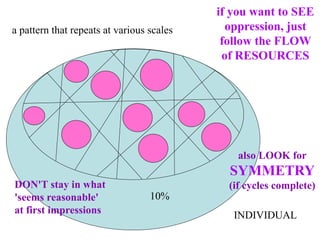
if you want to SEE
a pattern that repeats at various scales     oppression, just
                                            follow the FLOW
                                            of RESOURCES


                                               also LOOK for
                                             SYMMETRY
DON'T stay in what                           (if cycles complete)
'seems reasonable'                10%
at first impressions                          INDIVIDUAL
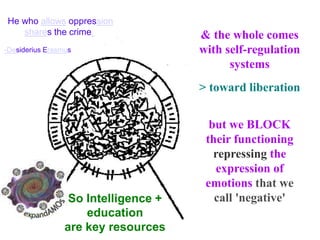
He who allows oppression
   shares the crime.                  & the whole comes
-Desiderius Erasmus                   with self-regulation
                                            systems
                                      > toward liberation


                                        but we BLOCK
                                       their functioning
                                         repressing the
                                         expression of
                                       emotions that we
                  So Intelligence +      call 'negative'
                     education
                 are key resources
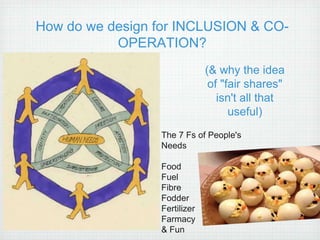
How do we design for INCLUSION & CO-
           OPERATION?
                              (& why the idea
                               of "fair shares"
                                 isn't all that
                                    useful)
                 The 7 Fs of People's
                 Needs

                 Food
                 Fuel
                 Fibre
                 Fodder
                 Fertilizer
                 Farmacy
                 & Fun
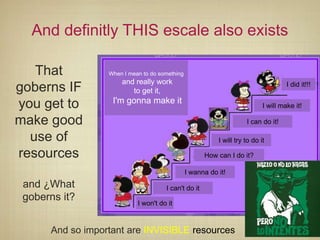
And definitly THIS escale also exists

   That           When I mean to do something
                      and really work
goberns IF               to get it,
                                                                                      I did it!!!

                   I'm gonna make it
you get to                                                                   I will make it!

make good                                                             I can do it!

  use of                                                   I will try to do it

resources                                             How can I do it?

                                                I wanna do it!
 and ¿What                            I can't do it
 goberns it?                I won't do it


      And so important are INVISIBLE resources
M4.2 How can we make optimum
      use of resources?

  Hierarchy of resources

  Invisible resources

  8rs and Emergy

  Resources culture
Creativity, intelligence, ideas, wisdom,
                 knowledge...
all are Invisible Resources that we will re-
  visit in more detail in class 4.8 (Social
                    Capital)

  Here we want to focus on the Integral
    Approach to invisible resources
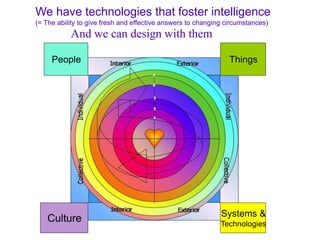
We have technologies that foster intelligence
(= The ability to give fresh and effective answers to changing circumstances)
           And we can design with them

     People                                                     Things


                                                             Systems &
   Culture                                                   Technologies
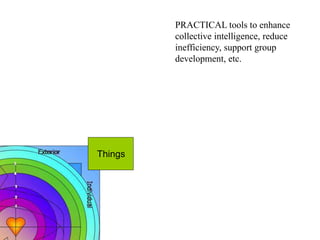
PRACTICAL tools to enhance
         collective intelligence, reduce
         inefficiency, support group
         development, etc.


Things
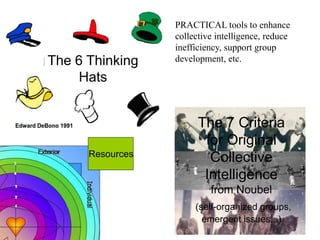
PRACTICAL tools to enhance
                  collective intelligence, reduce
                  inefficiency, support group
The 6 Thinking    development, etc.

    Hats


                        The 7 Criteria
                         for Original
      Resources
                          Collective
                         Intelligence
                           from Noubel
                       (self-organized groups,
                         emergent issues...)
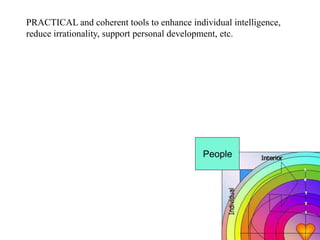
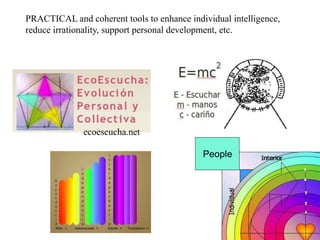
PRACTICAL and coherent tools to enhance individual intelligence,
reduce irrationality, support personal development, etc.


                                            People
PRACTICAL and coherent tools to enhance individual intelligence,
reduce irrationality, support personal development, etc.


              ecoescucha.net

                                            People
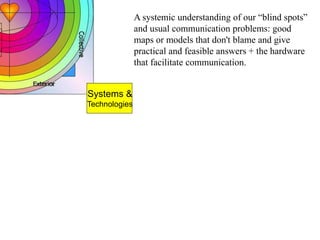
A systemic understanding of our “blind spots”
               and usual communication problems: good
               maps or models that don't blame and give
               practical and feasible answers + the hardware
               that facilitate communication.


Systems &
Technologies
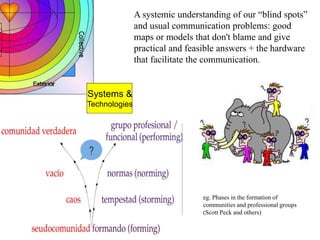
A systemic understanding of our “blind spots”
               and usual communication problems: good
               maps or models that don't blame and give
               practical and feasible answers + the hardware
               that facilitate the communication.


Systems &
Technologies


                                eg. Phases in the formation of
                                communities and professional groups
                                (Scott Peck and others)
Culture

   There is no need to
  “re-invent the wheel”:
“Local Agenda 21” is still
   The conversation
     of the century
          join in!
M4.2 How can we make optimum
      use of resources?

  Hierarchy of resources

  Invisible resources

  8rs and Emergy

  Resources culture
2º law of
                           thermodynamics


                                      Nicholas
Dana Meadows
                Inspired          Georgescu-Roegen


         The de-growth movement
• The snail constructs its shell by adding ever
increasing spirals
• Then it abruptly stops
• Just one additional spiral would make the shell
16 x bigger
• This would overload the snail
8 Rs from the de-growth
                movement
 Re-evaluate
Could there be a natural succession                         Re-distribute
here?
 Re-conceptualize
Restructure                                      Re-conceptualize

 Re-localize
                                              Restructure
 Re-distribute
                                      Re-evaluate
 Recycle
                                Re-localize
 Reuse
                       Reduce
 Reduce        Reuse
                                        Normally we hear these ones
    Recycle
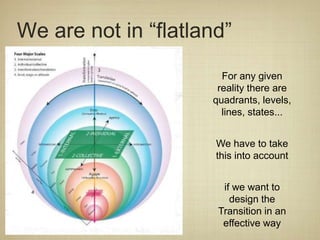
We are not in “flatland”
                       For any given
                      reality there are
                     quadrants, levels,
                       lines, states...


                      We have to take
                      this into account


                       if we want to
                         design the
                      Transition in an
                       effective way
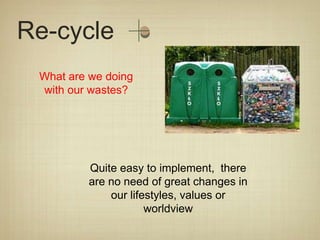
Re-cycle
 What are we doing
 with our wastes?


         Quite easy to implement, there
         are no need of great changes in
             our lifestyles, values or
                     worldview
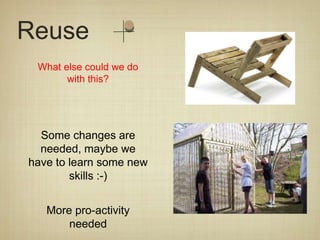
Reuse
 What else could we do
       with this?


  Some changes are
  needed, maybe we
have to learn some new
        skills :-)


   More pro-activity
       needed
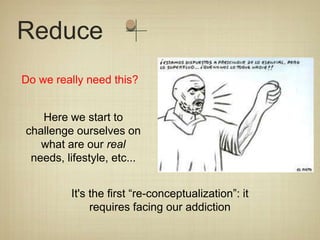
Reduce
Do we really need this?


   Here we start to
challenge ourselves on
   what are our real
 needs, lifestyle, etc...


         It's the first “re-conceptualization”: it
              requires facing our addiction
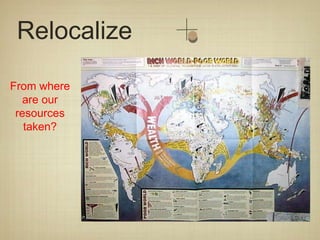
Relocalize

From where
   are our
 resources
   taken?
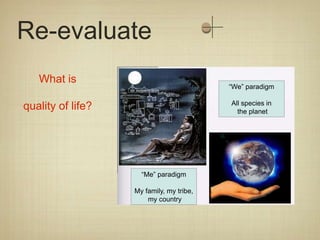
Re-evaluate
   What is
                                          “We” paradigm

                                          All species in
quality of life?                            the planet


                     “Me” paradigm

                   My family, my tribe,
                       my country
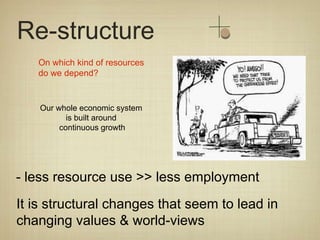
Re-structure
   On which kind of resources
   do we depend?


    Our whole economic system
           is built around
         continuous growth


- less resource use >> less employment
It is structural changes that seem to lead in
changing values & world-views
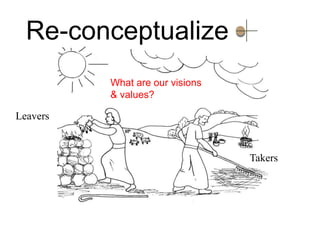
Re-conceptualize
          What are our visions
          & values?

Leavers


                                 Takers
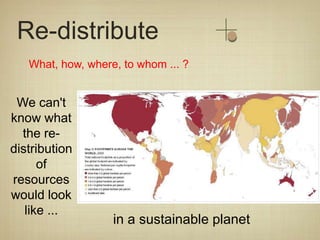
Re-distribute
   What, how, where, to whom ... ?


 We can't
know what
  the re-
distribution
      of
resources
would look
   like ...
                   in a sustainable planet
M4.2 How can we make optimum
      use of resources?

  Hierarchy of resources

  Invisible resources

  8rs and Emergy

  Resources culture
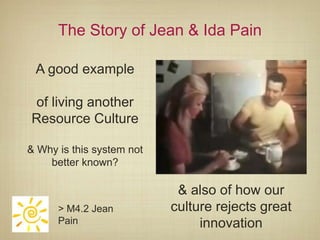
The Story of Jean & Ida Pain

 A good example

of living another
Resource Culture

& Why is this system not
    better known?

                            & also of how our
      > M4.2 Jean          culture rejects great
      Pain                      innovation
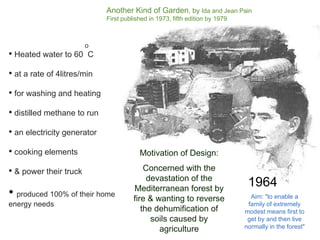
Another Kind of Garden, by Ida and Jean Pain
                             First published in 1973, fifth edition by 1979


                        o
• Heated water to 60 C
• at a rate of 4litres/min
• for washing and heating
• distilled methane to run
• an electricity generator
• cooking elements                       Motivation of Design:

• & power their truck                      Concerned with the
                                            devastation of the
                                                                               1964
• produced 100% of their home          Mediterranean forest by
                                       fire & wanting to reverse                Aim: "to enable a
energy needs                                                                   family of extremely
                                          the dehumification of               modest means first to
                                             soils caused by                   get by and then live
                                               agriculture                    normally in the forest"
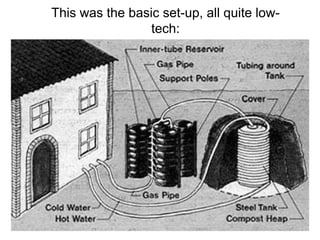
This was the basic set-up, all quite low-
                 tech:
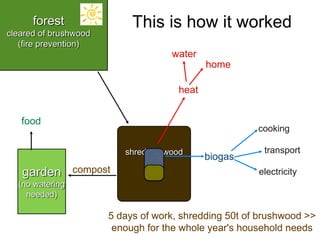
forest                This is how it worked
cleared of brushwood
   (fire prevention)
                                    water
                                             home

                                      heat


   food
                                                       cooking

                          shredded wood                 transport
                                             biogas
   garden compost                                      electricity
  (no watering
    needed)

                       5 days of work, shredding 50t of brushwood >>
                        enough for the whole year's household needs
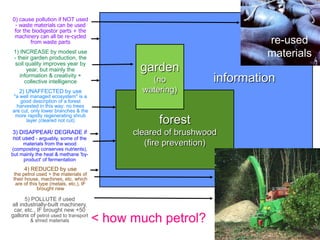
0) cause pollution if NOT used
 - waste materials can be used
 for the biodigestor parts + the
 machinery can all be re-cycled
        from waste parts                                                  re-used
 1) INCREASE by modest use
 - their garden production, the
                                                                          materials
 soil quality improves year by
       year, but mainly the                    garden
    information & creativity +
      collective intelligence                     (no            information
   2) UNAFFECTED by use                         watering)
"a well managed ecosystem" is a
   good description of a forest
  harvested in this way: no trees
are cut, only lower branches & the
 more rapidly regenerating shrub
      layer (cleared not cut)                       forest
3) DISAPPEAR/ DEGRADE if                      cleared of brushwood
not used - arguably, some of the
     materials from the wood                     (fire prevention)
(composting conserves nutrients),
but mainly the heat & methane 'by-
     product' of fermentation
      4) REDUCED by use
 the petrol used + the materials of
 their house, machines, etc. which
  are of this type (metals, etc.), IF
             brought new

      5) POLLUTE if used
all industrially-built machinery,
 car, etc., IF brought new +50
gallons of petrol used to transport
         & shred materials              < how much petrol?
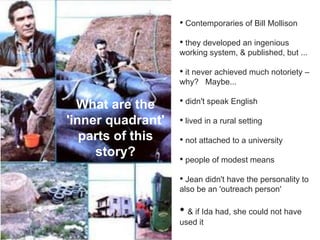
• Contemporaries of Bill Mollison
                   • they developed an ingenious
                   working system, & published, but ...

                   • it never achieved much notoriety –
                   why? Maybe...

  What are the     • didn't speak English

'inner quadrant'   • lived in a rural setting
   parts of this   • not attached to a university
     story?
                   • people of modest means
                   • Jean didn't have the personality to
                   also be an 'outreach person'

                   • & if Ida had, she could not have
                   used it
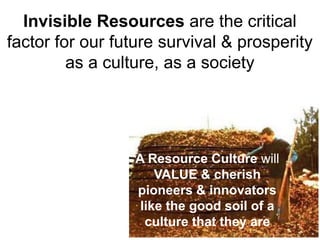
Invisible Resources are the critical
factor for our future survival & prosperity
         as a culture, as a society


                  A Resource Culture will
                      VALUE & cherish
                  pioneers & innovators
                   like the good soil of a
                    culture that they are
M4.2 How can we make optimum
      use of resources?

  Hierarchy of resources

  Invisible resources

  8rs and Emergy

  Resources culture

PDC+++ Module 4 Class 2. Resources

  • 1.
    + PDC Module 4 of the PDC+++ + + Energy & EcoTechnology We dedicate this Module to the Mother & Father of Integral Permaculture: Dana Class Meadows & Howard Odum, two original pioneers who helped humanity make M4.2 great strides in understanding systemic Resources thinking, in all four quadrants. We could say that the key to the sustainability of any society (or indeed any design) is simply to make optimum use of resources - so this is a very important subject to clarify for ourselves as designers. In this class we will explore how often, instead of using rational criteria for appropriateness when choosing resources (materials, fuels or technologies), like energy trade-off, we tend to use subjective & superficial criteria, like appearance, fashion & emotional attachments. This class is about how we can learn to make wiser judgements & choices in these matters.
  • 2.
    M4.2 How canwe make optimum use of resources? Hierarchies of resources Invisible resources 8rs and Emergy Resources culture
  • 3.
    We've already metthis "Scale of Resources" 0) cause pollution if NOT used, all our 'junk' & established that the general direction of by modest use, 1) INCREASE Cut-&-come-again salads, Evolution seems to information, creativity be Up this way 2) UNAFFECTED by use Returned water (hydroplant),well managed ecosystems, a view, good climate … 3) DISAPPEAR/ DEGRADE if not used waste water, crop failure, fish-escapes 4) REDUCED by use natural forests, coal, oil, poorly- managed marine and forestry resources very useful ... 5) POLLUTE if used pesticides, but not so simple nuclear, oil, scorn, contempt ...
  • 4.
    COMMON HERITAGE Energies cominginto our Forests, water, soils, air, seeds … 0) cause pollution if NOT system – used, all our 'junk' CLASSIFICATION - For analysis of USE - RESULTS PEOPLE work Sun, wind, rain, people … 1) INCREASE by modest use, Cut-&-come-again salads, information, creativity ENERGY ACCOUNTING = living components KEY in sustainable design And technology 2) UNAFFECTED by use Returned water (hydroplant),well managed ecosystems, a view, Some are needed to good climate … keep the system RESOURCES Useful Reserves 3) DISAPPEAR/ DEGRADE if RESOURCES Too much = pollution not used waste water, crop failure, fish-escapes trade 4) REDUCED by use natural forests, coal, oil, poorly- managed marine and forestry Surplus = YIELD conserve Use 4 y 5 only resources to create infrastructure 5) POLLUTE if used pesticides, nuclear, oil, scorn, contempt ... Managing resources - regulate all uses to create a sustainable harvest
  • 5.
    Destructo-Culture Cup ofTea resources consume pollution This is what we attempt to re-design in general
  • 6.
    Perma-Cultural Cup ofTea Sustainability at small scale ... as in big scale ... means that a system creates or stores more energy in its life than what is needed to create & maintain it resource appropiate prosumers technology pollution other resources Perma-Cultural Planet
  • 7.
    In General whenwe design for more sustainability we attempt to avoid or transform LINEAR systems the Principle of Cycling also Energy MiniMax reminds us of this to more CYCLICAL & the MultiFuncion one
  • 8.
    an Example very Cyclical,of MultiFunctioning
  • 9.
    water water 0) cause pollution if NOT used waste grains BEER waste used grains feed not digestible desechos 0) cause pollution if NOT used = pollution (methane) (basura) 0) cause pollution if NOT used more waste eg. of a conventional semi-industrial process
  • 10.
    waste > water FISH more produce + more employment water waste grains agae BEER digestor granos usados GAS substrato waste BREA PIGS D SETAS used feed substrate sustainable semi-industrial process
  • 11.
    Energies coming intoour system – 0) cause pollution if NOT used, all our 'junk' Sun, wind, rain, people … 1) INCREASE by modest use, Cut-&-come-again salads, information, creativity living components & technology 2) UNAFFECTED by use Returned water (hydroplant),well managed ecosystems, a view, good climate … RESOURCES Useful Reserves 3) DISAPPEAR/ DEGRADE if RESOURCES not used waste water, crop failure, fish-escapes 4) REDUCED by use natural forests, coal, oil, poorly- managed marine and forestry Use 4 y 5 only resources to create 5) POLLUTE if used pesticides, infrastructure nuclear, oil, scorn, contempt ...
  • 12.
    Another important typeof "Resource Scale" we DEDUCE by doing a PMI Analysis of Elements of MATERIALS ideal to use in each different Series of Circumstances > M4.2 Materials
  • 13.
    serves GOOD DESIGN REAL human needs íntegrates ALL this - biological makes - emotional very good use of - spiritual RESOURCE S - materials keeps in mind global & - technologies long-term - energy COSTS - conservation - environment - economy
  • 14.
    & normally wedon't consider this under "Scale of Resources" ... ... But it is: Who Has More? & How does the System self-organize in order to conserve inequalities? A CENTRAL subject for Integral Designers, which we will continue > M4.2 Stealing developing in this course Resources >> VITAL
  • 15.
    All "Resource Scales"operate in all quadrants People Things & the SCALE that determines WHO* has more ACCESS to resources ... is so rooted because it operates where we LEAST expect it Systems & Culture Technologies
  • 16.
    a Social Model(RC) owning class isolated BY but INSIDE each OPRESSIONS group there is (which are combinations of also tension classism PATTERNS) racism ISOLATION is the pattern we perceive sexism working class adultism/ageism
  • 17.
    eg. adultism sexism External racism Oppression classism (institutions & people ... who limit & batter us from outside) LOTS OF PRESSURE!! Internalized Oppression (patterns that limit & batter us from the inside)
  • 18.
    a pattern thatrepeats at various scales “the first world” “the third world” GLOBAL
  • 19.
    If you wantto SEE oppression, you only need to follow the FLOW of RESOURCES
  • 20.
    a pattern thatrepeats at various scales “owning class” “working class” REGIONAL
  • 21.
    & it seemslike we all participate in this 'equilibrium' People Things >> prejudices are the crux of the operative system that controls all this: our(subconsciou s) ideas of who DESERVES more Systems & Culture ... & LESS Technologies
  • 22.
    if you wantto SEE a pattern that repeats at various scales oppression, just follow the FLOW of RESOURCES also LOOK for SYMMETRY DON'T stay in what (if cycles complete) 'seems reasonable' 10% at first impressions INDIVIDUAL
  • 23.
    He who allowsoppression shares the crime. & the whole comes -Desiderius Erasmus with self-regulation systems > toward liberation but we BLOCK their functioning repressing the expression of emotions that we So Intelligence + call 'negative' education are key resources
  • 24.
    How do wedesign for INCLUSION & CO- OPERATION? (& why the idea of "fair shares" isn't all that useful) The 7 Fs of People's Needs Food Fuel Fibre Fodder Fertilizer Farmacy & Fun
  • 25.
    And definitly THISescale also exists That When I mean to do something and really work goberns IF to get it, I did it!!! I'm gonna make it you get to I will make it! make good I can do it! use of I will try to do it resources How can I do it? I wanna do it! and ¿What I can't do it goberns it? I won't do it And so important are INVISIBLE resources
  • 26.
    M4.2 How canwe make optimum use of resources? Hierarchy of resources Invisible resources 8rs and Emergy Resources culture
  • 27.
    Creativity, intelligence, ideas,wisdom, knowledge... all are Invisible Resources that we will re- visit in more detail in class 4.8 (Social Capital) Here we want to focus on the Integral Approach to invisible resources
  • 28.
    We have technologiesthat foster intelligence (= The ability to give fresh and effective answers to changing circumstances) And we can design with them People Things Systems & Culture Technologies
  • 29.
    PRACTICAL tools toenhance collective intelligence, reduce inefficiency, support group development, etc. Things
  • 30.
    PRACTICAL tools toenhance collective intelligence, reduce inefficiency, support group The 6 Thinking development, etc. Hats The 7 Criteria for Original Resources Collective Intelligence from Noubel (self-organized groups, emergent issues...)
  • 31.
    PRACTICAL and coherenttools to enhance individual intelligence, reduce irrationality, support personal development, etc. People
  • 32.
    PRACTICAL and coherenttools to enhance individual intelligence, reduce irrationality, support personal development, etc. ecoescucha.net People
  • 33.
    A systemic understandingof our “blind spots” and usual communication problems: good maps or models that don't blame and give practical and feasible answers + the hardware that facilitate communication. Systems & Technologies
  • 34.
    A systemic understandingof our “blind spots” and usual communication problems: good maps or models that don't blame and give practical and feasible answers + the hardware that facilitate the communication. Systems & Technologies eg. Phases in the formation of communities and professional groups (Scott Peck and others)
  • 35.
    Culture There is no need to “re-invent the wheel”: “Local Agenda 21” is still The conversation of the century join in!
  • 36.
    M4.2 How canwe make optimum use of resources? Hierarchy of resources Invisible resources 8rs and Emergy Resources culture
  • 37.
    2º law of thermodynamics Nicholas Dana Meadows Inspired Georgescu-Roegen The de-growth movement
  • 38.
    • The snailconstructs its shell by adding ever increasing spirals • Then it abruptly stops • Just one additional spiral would make the shell 16 x bigger • This would overload the snail
  • 39.
    8 Rs fromthe de-growth movement Re-evaluate Could there be a natural succession Re-distribute here? Re-conceptualize Restructure Re-conceptualize Re-localize Restructure Re-distribute Re-evaluate Recycle Re-localize Reuse Reduce Reduce Reuse Normally we hear these ones Recycle
  • 40.
    We are notin “flatland” For any given reality there are quadrants, levels, lines, states... We have to take this into account if we want to design the Transition in an effective way
  • 41.
    Re-cycle What arewe doing with our wastes? Quite easy to implement, there are no need of great changes in our lifestyles, values or worldview
  • 42.
    Reuse What elsecould we do with this? Some changes are needed, maybe we have to learn some new skills :-) More pro-activity needed
  • 43.
    Reduce Do we reallyneed this? Here we start to challenge ourselves on what are our real needs, lifestyle, etc... It's the first “re-conceptualization”: it requires facing our addiction
  • 44.
    Relocalize From where are our resources taken?
  • 45.
    Re-evaluate What is “We” paradigm All species in quality of life? the planet “Me” paradigm My family, my tribe, my country
  • 46.
    Re-structure On which kind of resources do we depend? Our whole economic system is built around continuous growth - less resource use >> less employment It is structural changes that seem to lead in changing values & world-views
  • 47.
    Re-conceptualize What are our visions & values? Leavers Takers
  • 48.
    Re-distribute What, how, where, to whom ... ? We can't know what the re- distribution of resources would look like ... in a sustainable planet
  • 49.
    M4.2 How canwe make optimum use of resources? Hierarchy of resources Invisible resources 8rs and Emergy Resources culture
  • 50.
    The Story ofJean & Ida Pain A good example of living another Resource Culture & Why is this system not better known? & also of how our > M4.2 Jean culture rejects great Pain innovation
  • 51.
    Another Kind ofGarden, by Ida and Jean Pain First published in 1973, fifth edition by 1979 o • Heated water to 60 C • at a rate of 4litres/min • for washing and heating • distilled methane to run • an electricity generator • cooking elements Motivation of Design: • & power their truck Concerned with the devastation of the 1964 • produced 100% of their home Mediterranean forest by fire & wanting to reverse Aim: "to enable a energy needs family of extremely the dehumification of modest means first to soils caused by get by and then live agriculture normally in the forest"
  • 52.
    This was thebasic set-up, all quite low- tech:
  • 53.
    forest This is how it worked cleared of brushwood (fire prevention) water home heat food cooking shredded wood transport biogas garden compost electricity (no watering needed) 5 days of work, shredding 50t of brushwood >> enough for the whole year's household needs
  • 54.
    0) cause pollutionif NOT used - waste materials can be used for the biodigestor parts + the machinery can all be re-cycled from waste parts re-used 1) INCREASE by modest use - their garden production, the materials soil quality improves year by year, but mainly the garden information & creativity + collective intelligence (no information 2) UNAFFECTED by use watering) "a well managed ecosystem" is a good description of a forest harvested in this way: no trees are cut, only lower branches & the more rapidly regenerating shrub layer (cleared not cut) forest 3) DISAPPEAR/ DEGRADE if cleared of brushwood not used - arguably, some of the materials from the wood (fire prevention) (composting conserves nutrients), but mainly the heat & methane 'by- product' of fermentation 4) REDUCED by use the petrol used + the materials of their house, machines, etc. which are of this type (metals, etc.), IF brought new 5) POLLUTE if used all industrially-built machinery, car, etc., IF brought new +50 gallons of petrol used to transport & shred materials < how much petrol?
  • 55.
    • Contemporaries ofBill Mollison • they developed an ingenious working system, & published, but ... • it never achieved much notoriety – why? Maybe... What are the • didn't speak English 'inner quadrant' • lived in a rural setting parts of this • not attached to a university story? • people of modest means • Jean didn't have the personality to also be an 'outreach person' • & if Ida had, she could not have used it
  • 56.
    Invisible Resources arethe critical factor for our future survival & prosperity as a culture, as a society A Resource Culture will VALUE & cherish pioneers & innovators like the good soil of a culture that they are
  • 57.
    M4.2 How canwe make optimum use of resources? Hierarchy of resources Invisible resources 8rs and Emergy Resources culture