Millennium Development Goals United Nations Development Programme
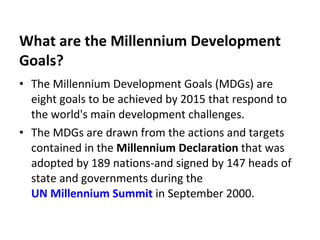
What are the Millennium Development Goals? The Millennium Development Goals (MDGs) are eight goals to be achieved by 2015 that respond to the world's main development challenges. The MDGs are drawn from the actions and targets contained in the  Millennium Declaration  that was adopted by 189 nations-and signed by 147 heads of state and governments during the  UN Millennium Summit   in September 2000.
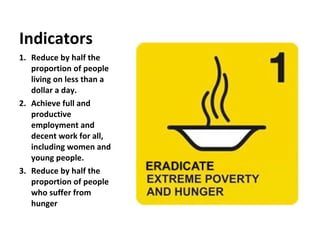
Reduce by half the proportion of people living on less than a dollar a day. Achieve full and productive employment and decent work for all, including women and young people. Reduce by half the proportion of people who suffer from hunger Indicators
Ensure that all boys and girls complete a full course of primary schooling. Indicators
Eliminate gender disparity in primary and secondary education preferably by 2005, and at all levels by 2015. Indicators
Reduce by two thirds the mortality rate among children under five Indicators
Reduce by three quarters the maternal mortality ratio. Achieve, by 2015, universal access to reproductive health. Indicators
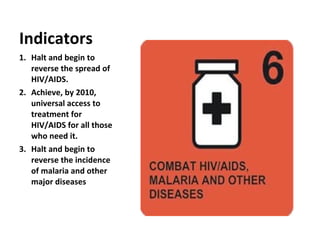
Halt and begin to reverse the spread of HIV/AIDS. Achieve, by 2010, universal access to treatment for HIV/AIDS for all those who need it. Halt and begin to reverse the incidence of malaria and other major diseases Indicators
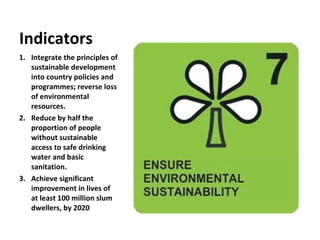
Integrate the principles of sustainable development into country policies and programmes; reverse loss of environmental resources. Reduce by half the proportion of people without sustainable access to safe drinking water and basic sanitation. Achieve significant improvement in lives of at least 100 million slum dwellers, by 2020 Indicators
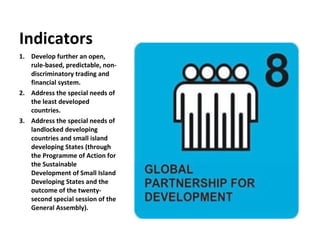
Develop further an open, rule-based, predictable, non-discriminatory trading and financial system. Address the special needs of the least developed countries. Address the special needs of landlocked developing countries and small island developing States (through the Programme of Action for the Sustainable Development of Small Island Developing States and the outcome of the twenty-second special session of the General Assembly). Indicators
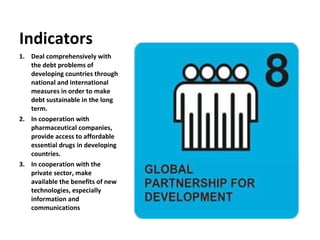
Deal comprehensively with the debt problems of developing countries through national and international measures in order to make debt sustainable in the long term. In cooperation with pharmaceutical companies, provide access to affordable essential drugs in developing countries. In cooperation with the private sector, make available the benefits of new technologies, especially information and communications Indicators
Global Commitment to the Millennium Development Goals In September 2000, one hundred and eighty-nine UN member-countries -- rich and poor alike -- reaffirmed their commitment to peace and security, good governance, and attention to the most vulnerable with the adoption of the Millennium Declaration.
Containing commitments to achieve the eight MDGs and the specific targets under them by 2015, the Millennium Declaration reflects the vision of entire nations, working together with international and country-based organizations, to wipe out poverty and the worst forms of human deprivation, and lay the foundations for sustainable human development by the year 2015. Global Commitment to the Millennium Development Goals
The overarching need is to ensure that the MDGs are integrated into and given top priority in each committed country's development planning efforts: with efficient monitoring, localization, and advocacy systems put in place; crucial financing secured; multisectoral support mobilized; and an enabling environment created with an MDG-responsive policy framework and legislation. Global Commitment to the Millennium Development Goals
Philippine Commitment to the Millennium Development Goals Since the Philippines first resolved to adopt the MDGs, it has made encouraging strides, particularly towards the attainment of targets on reducing extreme poverty; child mortality; the incidence of HIV/AIDS, tuberculosis and malaria; on improving gender equality in education; and improving households' adequate dietary intake as well as access to safe drinking water.
Underpinning these gains are two facts. First, the MDGs have been tightly integrated into the Medium-Term Philippine Development Plan (MTPDP) 2004-2010, thus allowing government strategies, policies and action plans to simultaneously address national and MDG targets.  Second, the government has continually closely monitored its own rate of progress in MDG indicators, and used this information to fine-tune its planning and implementation, especially to ensure effective implementation at the local level.
Nevertheless, serious challenges and threats remain with regard to targets on maternal health, access to reproductive health services, nutrition, primary education, and environmental sustainability. And glaring disparities across regions persist, as do severe funding constraints.
The overall probability of attaining the targets remains high, though dependent largely on the confluence of several factors, among them: scaling up of current efforts on all target areas; more efficient synchronization and allocation of available limited resources, including mobilization of additional resources; and stronger advocacy for and enhanced capability to implement the MDGs at the local level.
Thank you

Millenium Development Goals

  • 1.
    Millennium Development GoalsUnited Nations Development Programme
  • 2.
    What are theMillennium Development Goals? The Millennium Development Goals (MDGs) are eight goals to be achieved by 2015 that respond to the world's main development challenges. The MDGs are drawn from the actions and targets contained in the Millennium Declaration that was adopted by 189 nations-and signed by 147 heads of state and governments during the UN Millennium Summit in September 2000.
  • 3.
    Reduce by halfthe proportion of people living on less than a dollar a day. Achieve full and productive employment and decent work for all, including women and young people. Reduce by half the proportion of people who suffer from hunger Indicators
  • 4.
    Ensure that allboys and girls complete a full course of primary schooling. Indicators
  • 5.
    Eliminate gender disparityin primary and secondary education preferably by 2005, and at all levels by 2015. Indicators
  • 6.
    Reduce by twothirds the mortality rate among children under five Indicators
  • 7.
    Reduce by threequarters the maternal mortality ratio. Achieve, by 2015, universal access to reproductive health. Indicators
  • 8.
    Halt and beginto reverse the spread of HIV/AIDS. Achieve, by 2010, universal access to treatment for HIV/AIDS for all those who need it. Halt and begin to reverse the incidence of malaria and other major diseases Indicators
  • 9.
    Integrate the principlesof sustainable development into country policies and programmes; reverse loss of environmental resources. Reduce by half the proportion of people without sustainable access to safe drinking water and basic sanitation. Achieve significant improvement in lives of at least 100 million slum dwellers, by 2020 Indicators
  • 10.
    Develop further anopen, rule-based, predictable, non-discriminatory trading and financial system. Address the special needs of the least developed countries. Address the special needs of landlocked developing countries and small island developing States (through the Programme of Action for the Sustainable Development of Small Island Developing States and the outcome of the twenty-second special session of the General Assembly). Indicators
  • 11.
    Deal comprehensively withthe debt problems of developing countries through national and international measures in order to make debt sustainable in the long term. In cooperation with pharmaceutical companies, provide access to affordable essential drugs in developing countries. In cooperation with the private sector, make available the benefits of new technologies, especially information and communications Indicators
  • 12.
    Global Commitment tothe Millennium Development Goals In September 2000, one hundred and eighty-nine UN member-countries -- rich and poor alike -- reaffirmed their commitment to peace and security, good governance, and attention to the most vulnerable with the adoption of the Millennium Declaration.
  • 13.
    Containing commitments toachieve the eight MDGs and the specific targets under them by 2015, the Millennium Declaration reflects the vision of entire nations, working together with international and country-based organizations, to wipe out poverty and the worst forms of human deprivation, and lay the foundations for sustainable human development by the year 2015. Global Commitment to the Millennium Development Goals
  • 14.
    The overarching needis to ensure that the MDGs are integrated into and given top priority in each committed country's development planning efforts: with efficient monitoring, localization, and advocacy systems put in place; crucial financing secured; multisectoral support mobilized; and an enabling environment created with an MDG-responsive policy framework and legislation. Global Commitment to the Millennium Development Goals
  • 15.
    Philippine Commitment tothe Millennium Development Goals Since the Philippines first resolved to adopt the MDGs, it has made encouraging strides, particularly towards the attainment of targets on reducing extreme poverty; child mortality; the incidence of HIV/AIDS, tuberculosis and malaria; on improving gender equality in education; and improving households' adequate dietary intake as well as access to safe drinking water.
  • 16.
    Underpinning these gainsare two facts. First, the MDGs have been tightly integrated into the Medium-Term Philippine Development Plan (MTPDP) 2004-2010, thus allowing government strategies, policies and action plans to simultaneously address national and MDG targets. Second, the government has continually closely monitored its own rate of progress in MDG indicators, and used this information to fine-tune its planning and implementation, especially to ensure effective implementation at the local level.
  • 17.
    Nevertheless, serious challengesand threats remain with regard to targets on maternal health, access to reproductive health services, nutrition, primary education, and environmental sustainability. And glaring disparities across regions persist, as do severe funding constraints.
  • 18.
    The overall probabilityof attaining the targets remains high, though dependent largely on the confluence of several factors, among them: scaling up of current efforts on all target areas; more efficient synchronization and allocation of available limited resources, including mobilization of additional resources; and stronger advocacy for and enhanced capability to implement the MDGs at the local level.
  • 19.