


Dr Moazzam A Khan.

MSPH 2014-15

Health services academy Islamabad,Pakistan
.
Outline
 MDG,s history
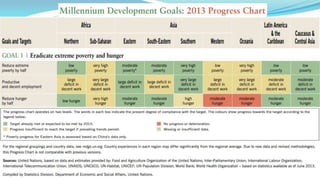
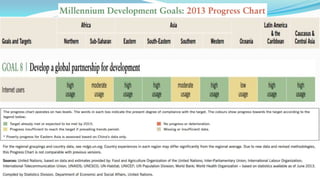
 MDG,s and 2013 progress chart
 Regional targets achievement south Asia
 MDG,s and Pakistan ,2013 planning commission report

summery
 Recommendations
MDGs History
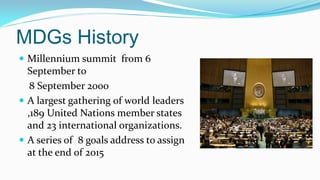
 Millennium summit from 6

September to
8 September 2000
 A largest gathering of world leaders
,189 United Nations member states
and 23 international organizations.
 A series of 8 goals address to assign
at the end of 2015
Road map towards the implementation
 The complete list of Millennium Development Goals,

Targets and Indicators first appeared in September 2001 in
a UN Document called “Road map towards the
implementation of the United Nations Millennium
Declaration”. The declaration had been approved in
September 2000 and the goals were a follow up to ideas in
the section on ‘Development and Poverty Eradication’.
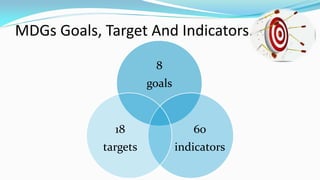
MDGs Goals, Target And Indicators.
8
goals

18

60

targets

indicators
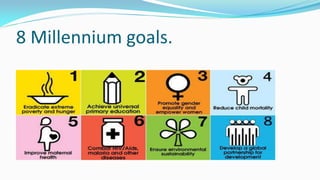
8 Millennium goals.
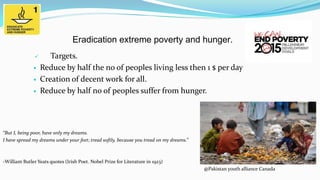
Eradication extreme poverty and hunger.





Targets.
Reduce by half the no of peoples living less then 1 $ per day
Creation of decent work for all.
Reduce by half no of peoples suffer from hunger.

“But I, being poor, have only my dreams.
I have spread my dreams under your feet; tread softly, because you tread on my dreams.”

-William Butler Yeats quotes (Irish Poet. Nobel Prize for Literature in 1923)

@Pakistan youth alliance Canada
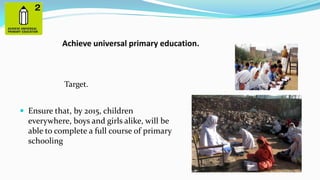
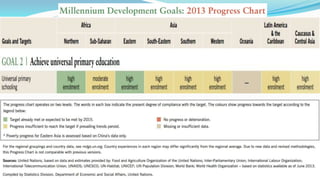
Achieve universal primary education.

Target.
 Ensure that, by 2015, children

everywhere, boys and girls alike, will be
able to complete a full course of primary
schooling
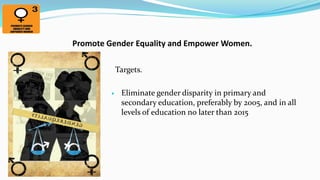
Promote Gender Equality and Empower Women.
Targets.


Eliminate gender disparity in primary and
secondary education, preferably by 2005, and in all
levels of education no later than 2015
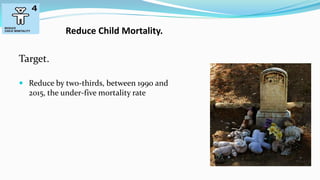
Reduce Child Mortality.

Target.
 Reduce by two-thirds, between 1990 and

2015, the under-five mortality rate
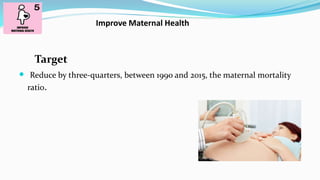
Improve Maternal Health

Target
 Reduce by three-quarters, between 1990 and 2015, the maternal mortality
ratio.
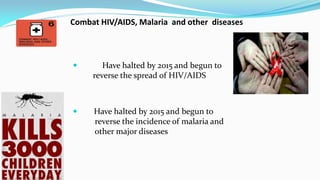
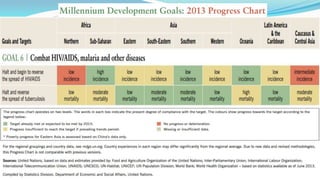
Combat HIV/AIDS, Malaria and other diseases



Have halted by 2015 and begun to
reverse the spread of HIV/AIDS



Have halted by 2015 and begun to
reverse the incidence of malaria and
other major diseases
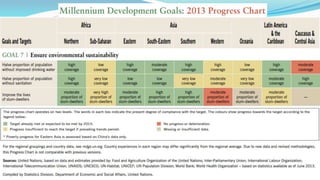
Ensure Environmental Sustainability
 Integrate the principles of sustainable development
into country policies and programs and reverse the loss
of environmental resources
 Halve, by 2015, the proportion of people without
sustainable access to safe drinking water and basic
sanitation
 Have achieved by 2020 a significant improvement in

the lives of at least 100 million slum dwellers
Develop a Global Partner for Development.
South Asian perspective
 South Asia with GNI per capita at $460
 Rapid GDP growth has been observed, average 5.4% a year

since 1990 in this region
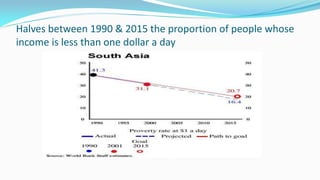
 People living on less than 1 dollar a day in South Asia is 428

million (31.1%) in 2001 compared to 462 million (40.1%) in
1990
Eradication of poverty and hunger
 The rapid growth in GDP of south Asia helped substantially in

reduction of poverty
 Remarkable poverty reduction noticed in India, 5-10% since

1990
 Only exception is Pakistan, which is an early achiever of

income poverty target, still there is slow improvement in
reduction of hunger
Halves between 1990 & 2015 the proportion of people whose
income is less than one dollar a day
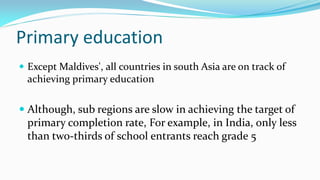
Primary education
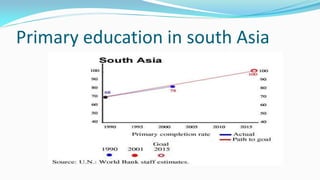
 Except Maldives', all countries in south Asia are on track of

achieving primary education

 Although, sub regions are slow in achieving the target of

primary completion rate, For example, in India, only less
than two-thirds of school entrants reach grade 5
Primary education in south Asia
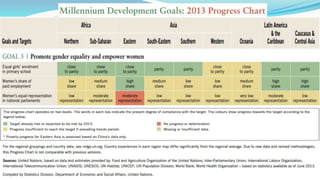
Gender equality and women
empowerment
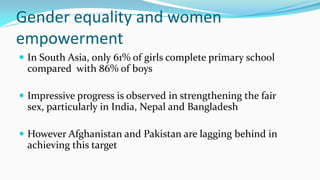
 In South Asia, only 61% of girls complete primary school

compared with 86% of boys
 Impressive progress is observed in strengthening the fair

sex, particularly in India, Nepal and Bangladesh
 However Afghanistan and Pakistan are lagging behind in

achieving this target
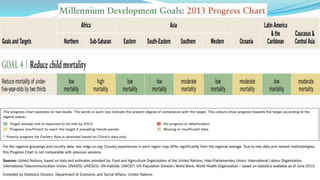
CMR
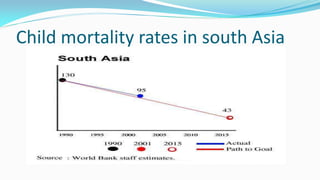
 Remarkable progress is observed in child mortality rate
 It drops from 130 to 95/1000 live births between 1990-2002

 IMR in Bangladesh reduced significantly from 144-73/1000

live births
Child mortality rates in south Asia
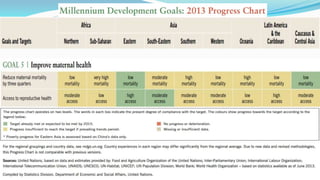
Improve maternal health
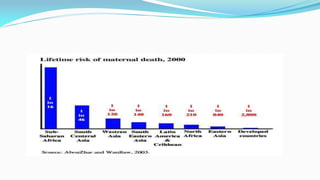
 About 250,000 mothers in Asia pacific pass away each year

during pregnancy and child birth
 Hub of tragedy is India and Pakistan (2/3rd)
 This reflects minor importance is given to maternal health in

south Asia except Bangladesh
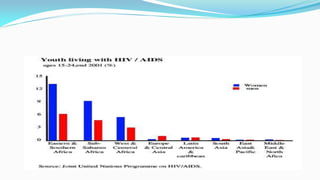
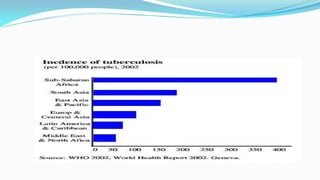
HIV/AIDS, Malaria and Tuberculosis
 Remarkable progress is made by south Asia in the context of

HIV/AIDS, only exception is India with highest number of
infected cases
 Malaria and TB still stick to the region despite efforts had

been made in recent years
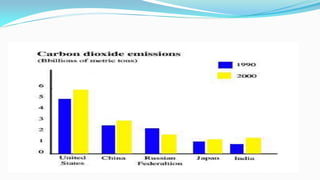
Ensure environmental sustainability
 In south Asia environmental sustainability is remarkably

affected with deforestation and industrialization
 All south Asian countries are unable to on track in reducing

CO2 emission
 While Bhutan, Sri Lanka and India had implemented

sustainable development strategies
Key Challenges for South Asia
 Highest growth rate (more than 6%/anum) during last decade
 Governance Issues

 Weakness of institutional setups
 Regional cooperation
PAKISTAN-MGS’s an overview
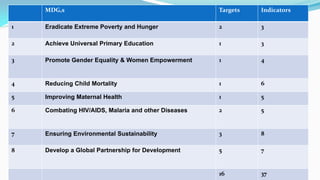
MDG,s

Targets

MDG,s Pakistan

Indicators

1

Eradicate Extreme Poverty and Hunger

2

3

2

Achieve Universal Primary Education

1

3

3

Promote Gender Equality & Women Empowerment

1

4

4

Reducing Child Mortality

1

6

5

Improving Maternal Health

1

5

6

Combating HIV/AIDS, Malaria and other Diseases

2

5

7

Ensuring Environmental Sustainability

3

8

8

Develop a Global Partnership for Development

5

7

16

37
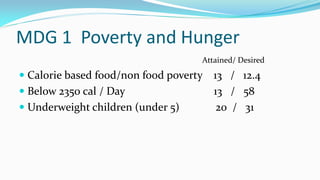
MDG 1 Poverty and Hunger
Attained/ Desired

 Calorie based food/non food poverty
 Below 2350 cal / Day
 Underweight children (under 5)

13 / 12.4
13 / 58
20 / 31
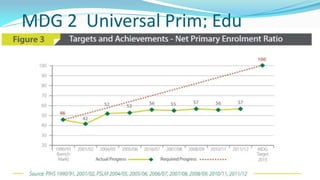
MDG 2 Universal Prim; Edu
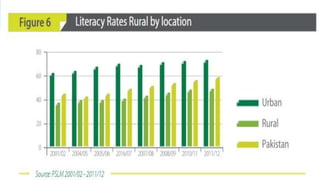
EDUCATION-RURAL URBAN DEVIDE
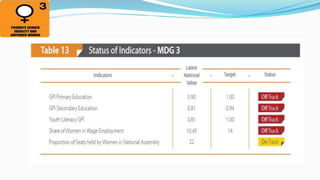
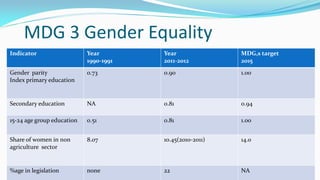
MDG 3 Gender Equality
Indicator

Year
1990-1991

Year
2011-2012

MDG,s target
2015

Gender parity
Index primary education

0.73

0.90

1.00

Secondary education

NA

0.81

0.94

15-24 age group education

0.51

0.81

1.00

Share of women in non
agriculture sector

8.07

10.45(2010-2011)

14.0

%age in legislation

none

22

NA
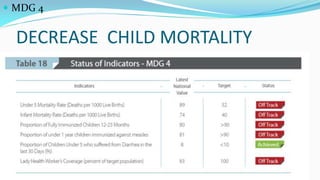
 MDG 4

DECREASE CHILD MORTALITY
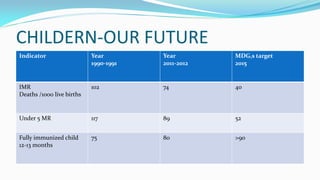
CHILDERN-OUR FUTURE
Indicator

Year
1990-1991

Year
2011-2012

MDG,s target
2015

IMR
Deaths /1000 live births

102

74

40

Under 5 MR

117

89

52

Fully immunized child
12-13 months

75

80

>90
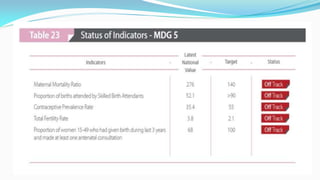
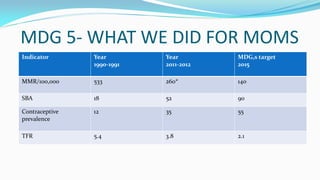
MDG 5- WHAT WE DID FOR MOMS
Indicator

Year
1990-1991

Year
2011-2012

MDG,s target
2015

MMR/100,000

533

260*

140

SBA

18

52

90

Contraceptive
prevalence

12

35

55

TFR

5.4

3.8

2.1
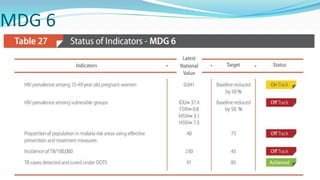
MDG 6
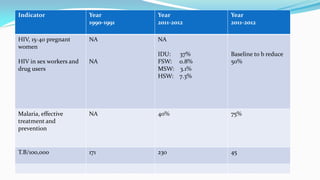
Indicator

Year
1990-1991

A RAYOF HOPE
HIV, 15-40 pregnant
women

NA

Year
2011-2012

Year
2011-2012

NA

IDU:
FSW:
MSW:
HSW:

37%
0.8%
3.1%
7.3%

Baseline to b reduce
50%

HIV in sex workers and
drug users

NA

Malaria, effective
treatment and
prevention

NA

40%

75%

T.B/100,000

171

230

45
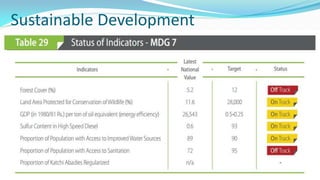
Sustainable Development
IN NUTSHELL
 ONLY TWO TARGETS ACHIEVED


MDG 6 - combat HIV/AIDS, malaria , TB



MDG 7 – Ensure environment sustainability

Develop Global Partnership for Dev:



No data is available on UNDP web site. Visit UNDP.ORG for
details
MDG infographic-November13.pdf
UNDER ACHIEVMENT-REASONS
 INTERNAL
Low growth and investment

Underemployment

Governance issues

Unequal public expenditure and its quality

EXTERNAL
Natural and manmade disasters
Global recession
Food price hike
Building the global partnership
 Develop a transparent, principled, predictable, non

discriminatory process of lending money
 Needs and issues of least developed countries should be at top
priority
 Deal effectively with the debt problem of developing
countries
 In cooperation with pharmaceutical companies affordable
drugs should be provided to developing countries
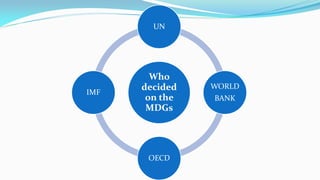
UN

IMF

Who
decided
on the
MDGs

OECD

WORLD
BANK
plans into action?
 Local communities
 Private sector organizations
 Elected politicians and government officials
 Civil society organizations

 Employees in the UN family organization

www.emoclear.com
LOCALIZATION should be first.
“To accelerate the progress towards the Millennium Development
Goals (MDGs), it is necessary to localize the MDGs - to translate the
national goals into goals that are relevant, applicable and attainable at
the local level. MDGs need to be meaningful for people living in these
communities, so that they have ownership of their development
plans, can hold their governments accountable and are involved in
local action to achieve these goals”
Reference
http://www.undp.org/content/undp/en/home/ourwork/povertyreduction/focus_areas/focus_mdg_strategies/mdg_localization/
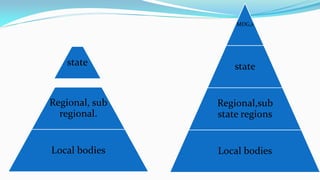
MDG,s

state

state

Regional, sub
regional.

Regional,sub
state regions

Local bodies

Local bodies
How can the UN be assured that we are following the
MDGs?
 UNDP works with its partners to support governments through the







four steps of preparing an MDG-based national development
strategy:
Launching an inclusive planning process;
Reviewing existing strategies and defining the baseline;
Conducting a detailed, long-term assessment to estimate the
infrastructure, human resources, and financial requirements required
to achieve the MDGs;
Developing a short-to-medium-term national strategy drawing
upon the MDG needs assessment.
How will we know if the plans are working?
 The UN Development Group will act as ‘scorekeeper’ and

‘campaign manager’ for the MDGs.
 It will produce special reports on global progress every year
and comprehensive reports every five years. These reports will
remind the world when things are working and will point to
areas which need to be improved.
 The task is to spread awareness within the system and across
the world and to make the MDGs an essential part of the UN
system’s work.
References
 http://www.unmillenniumproject.org
 http://en.wikipedia.org/wiki/Millennium_Development_Goals

 UNDP Pakistan
 http://www.undp.org/content/pakistan/en/home.html
 http://pyacanada.wordpress.com/,.
 Planning commission report 2013 MDG,s
Millennium development goals final

Millennium development goals final

  • 1.
    Dr Moazzam AKhan. MSPH 2014-15 Health services academy Islamabad,Pakistan .
  • 2.
    Outline  MDG,s history MDG,s and 2013 progress chart  Regional targets achievement south Asia  MDG,s and Pakistan ,2013 planning commission report summery  Recommendations
  • 3.
    MDGs History  Millenniumsummit from 6 September to 8 September 2000  A largest gathering of world leaders ,189 United Nations member states and 23 international organizations.  A series of 8 goals address to assign at the end of 2015
  • 4.
    Road map towardsthe implementation  The complete list of Millennium Development Goals, Targets and Indicators first appeared in September 2001 in a UN Document called “Road map towards the implementation of the United Nations Millennium Declaration”. The declaration had been approved in September 2000 and the goals were a follow up to ideas in the section on ‘Development and Poverty Eradication’.
  • 5.
    MDGs Goals, TargetAnd Indicators. 8 goals 18 60 targets indicators
  • 6.
  • 7.
    Eradication extreme povertyand hunger.     Targets. Reduce by half the no of peoples living less then 1 $ per day Creation of decent work for all. Reduce by half no of peoples suffer from hunger. “But I, being poor, have only my dreams. I have spread my dreams under your feet; tread softly, because you tread on my dreams.” -William Butler Yeats quotes (Irish Poet. Nobel Prize for Literature in 1923) @Pakistan youth alliance Canada
  • 9.
    Achieve universal primaryeducation. Target.  Ensure that, by 2015, children everywhere, boys and girls alike, will be able to complete a full course of primary schooling
  • 11.
    Promote Gender Equalityand Empower Women. Targets.  Eliminate gender disparity in primary and secondary education, preferably by 2005, and in all levels of education no later than 2015
  • 13.
    Reduce Child Mortality. Target. Reduce by two-thirds, between 1990 and 2015, the under-five mortality rate
  • 15.
    Improve Maternal Health Target Reduce by three-quarters, between 1990 and 2015, the maternal mortality ratio.
  • 17.
    Combat HIV/AIDS, Malariaand other diseases  Have halted by 2015 and begun to reverse the spread of HIV/AIDS  Have halted by 2015 and begun to reverse the incidence of malaria and other major diseases
  • 19.
    Ensure Environmental Sustainability Integrate the principles of sustainable development into country policies and programs and reverse the loss of environmental resources  Halve, by 2015, the proportion of people without sustainable access to safe drinking water and basic sanitation  Have achieved by 2020 a significant improvement in the lives of at least 100 million slum dwellers
  • 21.
    Develop a GlobalPartner for Development.
  • 24.
    South Asian perspective South Asia with GNI per capita at $460  Rapid GDP growth has been observed, average 5.4% a year since 1990 in this region  People living on less than 1 dollar a day in South Asia is 428 million (31.1%) in 2001 compared to 462 million (40.1%) in 1990
  • 25.
    Eradication of povertyand hunger  The rapid growth in GDP of south Asia helped substantially in reduction of poverty  Remarkable poverty reduction noticed in India, 5-10% since 1990  Only exception is Pakistan, which is an early achiever of income poverty target, still there is slow improvement in reduction of hunger
  • 26.
    Halves between 1990& 2015 the proportion of people whose income is less than one dollar a day
  • 27.
    Primary education  ExceptMaldives', all countries in south Asia are on track of achieving primary education  Although, sub regions are slow in achieving the target of primary completion rate, For example, in India, only less than two-thirds of school entrants reach grade 5
  • 28.
  • 29.
    Gender equality andwomen empowerment  In South Asia, only 61% of girls complete primary school compared with 86% of boys  Impressive progress is observed in strengthening the fair sex, particularly in India, Nepal and Bangladesh  However Afghanistan and Pakistan are lagging behind in achieving this target
  • 30.
    CMR  Remarkable progressis observed in child mortality rate  It drops from 130 to 95/1000 live births between 1990-2002  IMR in Bangladesh reduced significantly from 144-73/1000 live births
  • 31.
    Child mortality ratesin south Asia
  • 32.
    Improve maternal health About 250,000 mothers in Asia pacific pass away each year during pregnancy and child birth  Hub of tragedy is India and Pakistan (2/3rd)  This reflects minor importance is given to maternal health in south Asia except Bangladesh
  • 34.
    HIV/AIDS, Malaria andTuberculosis  Remarkable progress is made by south Asia in the context of HIV/AIDS, only exception is India with highest number of infected cases  Malaria and TB still stick to the region despite efforts had been made in recent years
  • 37.
    Ensure environmental sustainability In south Asia environmental sustainability is remarkably affected with deforestation and industrialization  All south Asian countries are unable to on track in reducing CO2 emission  While Bhutan, Sri Lanka and India had implemented sustainable development strategies
  • 39.
    Key Challenges forSouth Asia  Highest growth rate (more than 6%/anum) during last decade  Governance Issues  Weakness of institutional setups  Regional cooperation
  • 40.
  • 41.
    MDG,s Targets MDG,s Pakistan Indicators 1 Eradicate ExtremePoverty and Hunger 2 3 2 Achieve Universal Primary Education 1 3 3 Promote Gender Equality & Women Empowerment 1 4 4 Reducing Child Mortality 1 6 5 Improving Maternal Health 1 5 6 Combating HIV/AIDS, Malaria and other Diseases 2 5 7 Ensuring Environmental Sustainability 3 8 8 Develop a Global Partnership for Development 5 7 16 37
  • 42.
    MDG 1 Povertyand Hunger Attained/ Desired  Calorie based food/non food poverty  Below 2350 cal / Day  Underweight children (under 5) 13 / 12.4 13 / 58 20 / 31
  • 43.
    MDG 2 UniversalPrim; Edu
  • 44.
  • 46.
    MDG 3 GenderEquality Indicator Year 1990-1991 Year 2011-2012 MDG,s target 2015 Gender parity Index primary education 0.73 0.90 1.00 Secondary education NA 0.81 0.94 15-24 age group education 0.51 0.81 1.00 Share of women in non agriculture sector 8.07 10.45(2010-2011) 14.0 %age in legislation none 22 NA
  • 47.
     MDG 4 DECREASECHILD MORTALITY
  • 48.
    CHILDERN-OUR FUTURE Indicator Year 1990-1991 Year 2011-2012 MDG,s target 2015 IMR Deaths/1000 live births 102 74 40 Under 5 MR 117 89 52 Fully immunized child 12-13 months 75 80 >90
  • 50.
    MDG 5- WHATWE DID FOR MOMS Indicator Year 1990-1991 Year 2011-2012 MDG,s target 2015 MMR/100,000 533 260* 140 SBA 18 52 90 Contraceptive prevalence 12 35 55 TFR 5.4 3.8 2.1
  • 51.
  • 52.
    Indicator Year 1990-1991 A RAYOF HOPE HIV,15-40 pregnant women NA Year 2011-2012 Year 2011-2012 NA IDU: FSW: MSW: HSW: 37% 0.8% 3.1% 7.3% Baseline to b reduce 50% HIV in sex workers and drug users NA Malaria, effective treatment and prevention NA 40% 75% T.B/100,000 171 230 45
  • 53.
  • 54.
    IN NUTSHELL  ONLYTWO TARGETS ACHIEVED  MDG 6 - combat HIV/AIDS, malaria , TB  MDG 7 – Ensure environment sustainability Develop Global Partnership for Dev:   No data is available on UNDP web site. Visit UNDP.ORG for details MDG infographic-November13.pdf
  • 55.
    UNDER ACHIEVMENT-REASONS  INTERNAL Lowgrowth and investment  Underemployment  Governance issues  Unequal public expenditure and its quality EXTERNAL Natural and manmade disasters Global recession Food price hike
  • 56.
    Building the globalpartnership  Develop a transparent, principled, predictable, non discriminatory process of lending money  Needs and issues of least developed countries should be at top priority  Deal effectively with the debt problem of developing countries  In cooperation with pharmaceutical companies affordable drugs should be provided to developing countries
  • 58.
  • 59.
    plans into action? Local communities  Private sector organizations  Elected politicians and government officials  Civil society organizations  Employees in the UN family organization www.emoclear.com
  • 60.
    LOCALIZATION should befirst. “To accelerate the progress towards the Millennium Development Goals (MDGs), it is necessary to localize the MDGs - to translate the national goals into goals that are relevant, applicable and attainable at the local level. MDGs need to be meaningful for people living in these communities, so that they have ownership of their development plans, can hold their governments accountable and are involved in local action to achieve these goals” Reference http://www.undp.org/content/undp/en/home/ourwork/povertyreduction/focus_areas/focus_mdg_strategies/mdg_localization/
  • 61.
  • 62.
    How can theUN be assured that we are following the MDGs?  UNDP works with its partners to support governments through the     four steps of preparing an MDG-based national development strategy: Launching an inclusive planning process; Reviewing existing strategies and defining the baseline; Conducting a detailed, long-term assessment to estimate the infrastructure, human resources, and financial requirements required to achieve the MDGs; Developing a short-to-medium-term national strategy drawing upon the MDG needs assessment.
  • 63.
    How will weknow if the plans are working?  The UN Development Group will act as ‘scorekeeper’ and ‘campaign manager’ for the MDGs.  It will produce special reports on global progress every year and comprehensive reports every five years. These reports will remind the world when things are working and will point to areas which need to be improved.  The task is to spread awareness within the system and across the world and to make the MDGs an essential part of the UN system’s work.
  • 64.
    References  http://www.unmillenniumproject.org  http://en.wikipedia.org/wiki/Millennium_Development_Goals UNDP Pakistan  http://www.undp.org/content/pakistan/en/home.html  http://pyacanada.wordpress.com/,.  Planning commission report 2013 MDG,s