United Nations Millennium Development Goals & Population Presentation  by  Deniz Susar SOGA 6506 - Population Processes and Development Issues Prof. Donald Heisel  Fall, 2008 Fordham University
1.  Background 2.  MDGs & Population 3.  Conclusion
Background
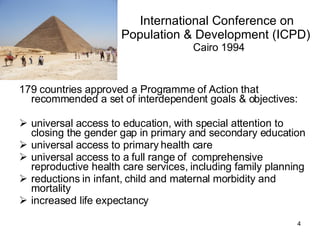
International Conference on  Population & Development (ICPD)   Cairo 1994 179 countries approved a Programme of Action that recommended a set of interdependent goals & objectives: universal access to education, with special attention to closing the gender gap in primary and secondary education universal access to primary health care universal access to a full range of  comprehensive reproductive health care services, including family planning reductions in infant, child and maternal morbidity and mortality increased life expectancy
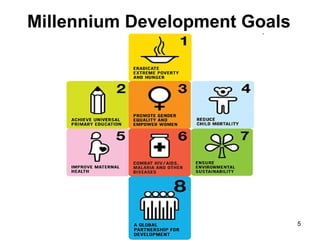
Millennium Development Goals
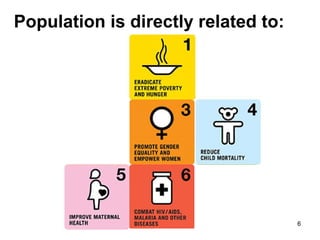
Population is directly related to:
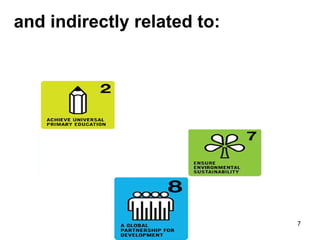
and indirectly related to:
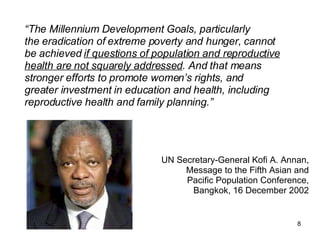
“ The Millennium Development Goals, particularly the eradication of extreme poverty and hunger, cannot be achieved  if questions of population and reproductive health are not squarely addressed . And that means stronger efforts to promote women’s rights, and greater investment in education and health, including reproductive health and family planning.” UN Secretary-General Kofi A. Annan, Message to the Fifth Asian and Pacific Population Conference, Bangkok, 16 December 2002
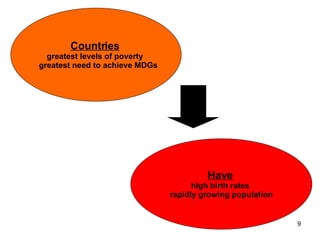
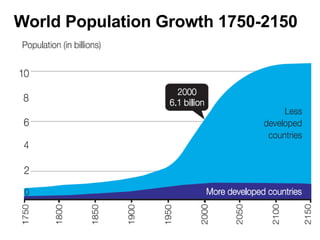
Countries   greatest levels of poverty  greatest need to achieve MDGs Have   high birth rates  rapidly growing population
World Population Growth 1750-2150
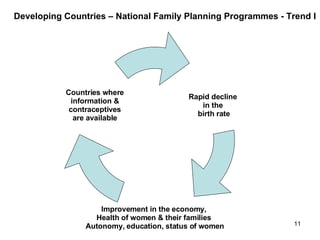
Developing Countries – National Family Planning Programmes - Trend I Rapid decline  in the  birth rate Improvement in the economy,  Health of women & their families  Autonomy, education, status of women Countries where  information &  contraceptives  are available
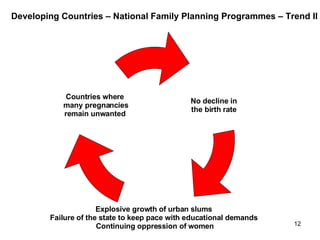
Developing Countries – National Family Planning Programmes – Trend II No decline in the birth rate Explosive growth of urban slums  Failure of the state to keep pace with educational demands  Continuing oppression of women Countries where  many pregnancies remain unwanted
The evidence is  overwhelming the MDGs are difficult or impossible to achieve with the current levels of population growth in the least developed countries and regions
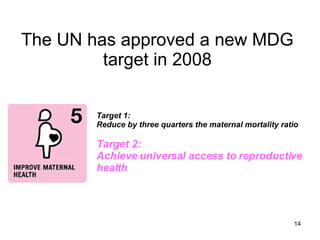
The UN has approved a new MDG target in 2008 Target 1:  Reduce by three quarters the maternal mortality ratio Target 2: Achieve universal access to reproductive health
MDGs  &  Population
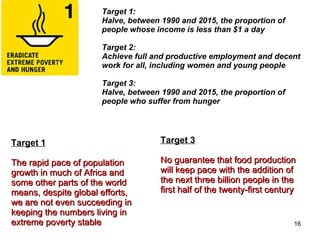
Target 1:  Halve, between 1990 and 2015, the proportion of people whose income is less than $1 a day Target 2:  Achieve full and productive employment and decent work for all, including women and young people Target 3:  Halve, between 1990 and 2015, the proportion of people who suffer from hunger Target 1 The rapid pace of population growth in much of Africa and some other parts of the world means, despite global efforts,  we are not even succeeding in keeping the numbers living in extreme poverty stable Target 3 No guarantee that food production will keep pace with the addition of the next three billion people in the first half of the twenty-first century
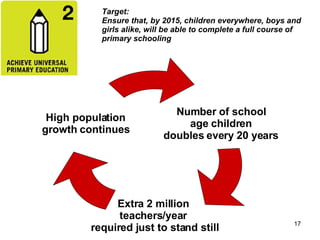
Target:  Ensure that, by 2015, children everywhere, boys and girls alike, will be able to complete a full course of primary schooling Number of school  age children  doubles every 20 years  Extra 2 million  teachers/year  required just to stand still High population  growth continues
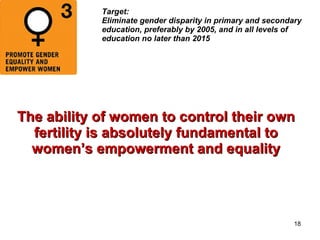
Target:  Eliminate gender disparity in primary and secondary education, preferably by 2005, and in all levels of education no later than 2015 The ability of women to control their own fertility is absolutely fundamental to women’s empowerment and equality
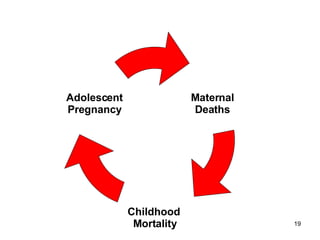
Maternal  Deaths  Childhood  Mortality Adolescent  Pregnancy
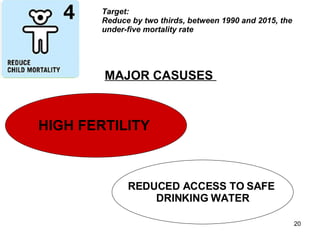
Target:  Reduce by two thirds, between 1990 and 2015, the under-five mortality rate HIGH FERTILITY  REDUCED ACCESS TO SAFE  DRINKING WATER MAJOR CASUSES
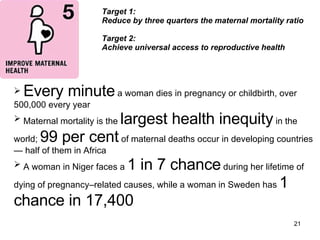
Target 1:  Reduce by three quarters the maternal mortality ratio Target 2: Achieve universal access to reproductive health  Every minute  a woman dies in pregnancy or childbirth, over 500,000 every year Maternal mortality is the  largest health inequity  in the world;  99 per cent  of maternal deaths occur in developing countries — half of them in Africa A woman in Niger faces a  1 in 7 chance  during her lifetime of dying of pregnancy–related causes, while a woman in Sweden has  1 chance in 17,400
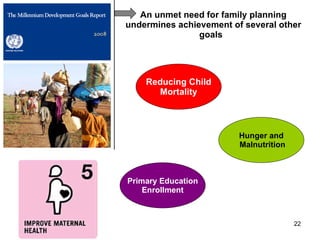
An unmet need for family planning undermines achievement of several other goals   Reducing Child Mortality Hunger and Malnutrition Primary Education Enrollment
Target 1:  Have halted by 2015 and begun to reverse the spread of HIV/AIDS Target 2: Achieve, by 2010, universal access to treatment for HIV/AIDS for all those who need it Target 3: Have halted by 2015 and begun to reverse the incidence of malaria and other major diseases Population growth has a negative impact on gaining control over the spread of HIV/AIDS through two main routes:  Increased urbanization  Persistence of poverty
Target 1:  Integrate the principles of sustainable development into country policies and programmes and reverse the loss of environmental resources Target 2: Reduce biodiversity loss, achieving, by 2010, a significant reduction in the rate of loss Target 3: Halve, by 2015, the proportion of the population without sustainable access to safe drinking water and basic sanitation Target 4:  By 2020, to have achieved a significant improvement in the lives of at least 100 million slum dwellers As population grows, 2/3 of  world population will face  moderate to high water  shortages by 2025 By 2007, half the world’s  population will live in towns and cities
Target 1:  Address the special needs of least developed countries, landlocked countries and small island developing states Target 2: Develop further an open, rule-based, predictable, non-discriminatory trading and financial system Target 3: Deal comprehensively with developing countries’ debt Target 4:  In cooperation with pharmaceutical companies, provide access to affordable essential drugs in developing countries Target 5:  In cooperation with the private sector, make available benefits of new technologies, especially information and communications
Conclusion
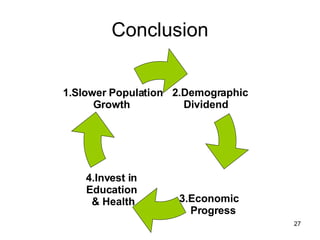
Conclusion 2.Demographic  Dividend  3.Economic    Progress 1.Slower Population Growth  4.Invest in  Education  & Health
Conclusion Governments should “meet the family planning needs of their populations as soon as possible and should, in all cases by the year 2015, seek to provide universal access to a full range of safe and reliable family-planning methods…” International Conference on Population and Development (ICPD) Programme of  Action para 7.16
Conclusion Poverty cannot and will not be eradicated without achieving ICPD goals Universal access to education and reproductive health care are crucial steps that can help to eradicate poverty Meeting these ICPD goals will pave a straight road directly toward reaching the MDGs
Questions ? Slide is available at:  http://www.slideshare.net/denizsusar/millenium-development-goals-population-presentation/ [email_address]

Millenium Development Goals & Population

  • 1.
    United Nations MillenniumDevelopment Goals & Population Presentation by Deniz Susar SOGA 6506 - Population Processes and Development Issues Prof. Donald Heisel Fall, 2008 Fordham University
  • 2.
    1. Background2. MDGs & Population 3. Conclusion
  • 3.
  • 4.
    International Conference on Population & Development (ICPD) Cairo 1994 179 countries approved a Programme of Action that recommended a set of interdependent goals & objectives: universal access to education, with special attention to closing the gender gap in primary and secondary education universal access to primary health care universal access to a full range of comprehensive reproductive health care services, including family planning reductions in infant, child and maternal morbidity and mortality increased life expectancy
  • 5.
  • 6.
  • 7.
  • 8.
    “ The MillenniumDevelopment Goals, particularly the eradication of extreme poverty and hunger, cannot be achieved if questions of population and reproductive health are not squarely addressed . And that means stronger efforts to promote women’s rights, and greater investment in education and health, including reproductive health and family planning.” UN Secretary-General Kofi A. Annan, Message to the Fifth Asian and Pacific Population Conference, Bangkok, 16 December 2002
  • 9.
    Countries greatest levels of poverty greatest need to achieve MDGs Have high birth rates rapidly growing population
  • 10.
  • 11.
    Developing Countries –National Family Planning Programmes - Trend I Rapid decline in the birth rate Improvement in the economy, Health of women & their families Autonomy, education, status of women Countries where information & contraceptives are available
  • 12.
    Developing Countries –National Family Planning Programmes – Trend II No decline in the birth rate Explosive growth of urban slums Failure of the state to keep pace with educational demands Continuing oppression of women Countries where many pregnancies remain unwanted
  • 13.
    The evidence is overwhelming the MDGs are difficult or impossible to achieve with the current levels of population growth in the least developed countries and regions
  • 14.
    The UN hasapproved a new MDG target in 2008 Target 1: Reduce by three quarters the maternal mortality ratio Target 2: Achieve universal access to reproductive health
  • 15.
    MDGs & Population
  • 16.
    Target 1: Halve, between 1990 and 2015, the proportion of people whose income is less than $1 a day Target 2: Achieve full and productive employment and decent work for all, including women and young people Target 3: Halve, between 1990 and 2015, the proportion of people who suffer from hunger Target 1 The rapid pace of population growth in much of Africa and some other parts of the world means, despite global efforts, we are not even succeeding in keeping the numbers living in extreme poverty stable Target 3 No guarantee that food production will keep pace with the addition of the next three billion people in the first half of the twenty-first century
  • 17.
    Target: Ensurethat, by 2015, children everywhere, boys and girls alike, will be able to complete a full course of primary schooling Number of school age children doubles every 20 years Extra 2 million teachers/year required just to stand still High population growth continues
  • 18.
    Target: Eliminategender disparity in primary and secondary education, preferably by 2005, and in all levels of education no later than 2015 The ability of women to control their own fertility is absolutely fundamental to women’s empowerment and equality
  • 19.
    Maternal Deaths Childhood Mortality Adolescent Pregnancy
  • 20.
    Target: Reduceby two thirds, between 1990 and 2015, the under-five mortality rate HIGH FERTILITY REDUCED ACCESS TO SAFE DRINKING WATER MAJOR CASUSES
  • 21.
    Target 1: Reduce by three quarters the maternal mortality ratio Target 2: Achieve universal access to reproductive health Every minute a woman dies in pregnancy or childbirth, over 500,000 every year Maternal mortality is the largest health inequity in the world; 99 per cent of maternal deaths occur in developing countries — half of them in Africa A woman in Niger faces a 1 in 7 chance during her lifetime of dying of pregnancy–related causes, while a woman in Sweden has 1 chance in 17,400
  • 22.
    An unmet needfor family planning undermines achievement of several other goals Reducing Child Mortality Hunger and Malnutrition Primary Education Enrollment
  • 23.
    Target 1: Have halted by 2015 and begun to reverse the spread of HIV/AIDS Target 2: Achieve, by 2010, universal access to treatment for HIV/AIDS for all those who need it Target 3: Have halted by 2015 and begun to reverse the incidence of malaria and other major diseases Population growth has a negative impact on gaining control over the spread of HIV/AIDS through two main routes: Increased urbanization Persistence of poverty
  • 24.
    Target 1: Integrate the principles of sustainable development into country policies and programmes and reverse the loss of environmental resources Target 2: Reduce biodiversity loss, achieving, by 2010, a significant reduction in the rate of loss Target 3: Halve, by 2015, the proportion of the population without sustainable access to safe drinking water and basic sanitation Target 4: By 2020, to have achieved a significant improvement in the lives of at least 100 million slum dwellers As population grows, 2/3 of world population will face moderate to high water shortages by 2025 By 2007, half the world’s population will live in towns and cities
  • 25.
    Target 1: Address the special needs of least developed countries, landlocked countries and small island developing states Target 2: Develop further an open, rule-based, predictable, non-discriminatory trading and financial system Target 3: Deal comprehensively with developing countries’ debt Target 4: In cooperation with pharmaceutical companies, provide access to affordable essential drugs in developing countries Target 5: In cooperation with the private sector, make available benefits of new technologies, especially information and communications
  • 26.
  • 27.
    Conclusion 2.Demographic Dividend 3.Economic Progress 1.Slower Population Growth 4.Invest in Education & Health
  • 28.
    Conclusion Governments should“meet the family planning needs of their populations as soon as possible and should, in all cases by the year 2015, seek to provide universal access to a full range of safe and reliable family-planning methods…” International Conference on Population and Development (ICPD) Programme of Action para 7.16
  • 29.
    Conclusion Poverty cannotand will not be eradicated without achieving ICPD goals Universal access to education and reproductive health care are crucial steps that can help to eradicate poverty Meeting these ICPD goals will pave a straight road directly toward reaching the MDGs
  • 30.
    Questions ? Slideis available at: http://www.slideshare.net/denizsusar/millenium-development-goals-population-presentation/ [email_address]

Editor's Notes

  • #2 3 sections of the presentation Background MDGs & population Conclusion