Media Literacy
Presented By:
Kamal Bahadur Budha
Roll No.: 11
MPH (HPE)
School of Health and Allied Sciences
Pokhara University
1
Media Literacy -1
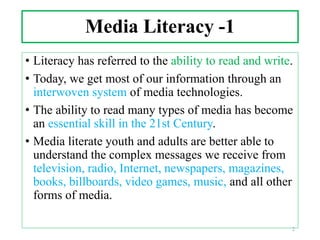
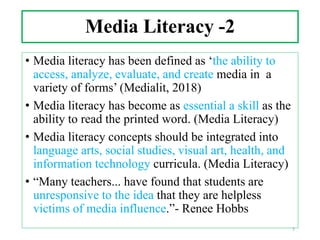
• Literacy has referred to the ability to read and write.
• Today, we get most of our information through an
interwoven system of media technologies.
• The ability to read many types of media has become
an essential skill in the 21st Century.
• Media literate youth and adults are better able to
understand the complex messages we receive from
television, radio, Internet, newspapers, magazines,
books, billboards, video games, music, and all other
forms of media.
2
Media Literacy -2
• Media literacy has been defined as ‘the ability to
access, analyze, evaluate, and create media in a
variety of forms’ (Medialit, 2018)
• Media literacy has become as essential a skill as the
ability to read the printed word. (Media Literacy)
• Media literacy concepts should be integrated into
language arts, social studies, visual art, health, and
information technology curricula. (Media Literacy)
• “Many teachers... have found that students are
unresponsive to the idea that they are helpless
victims of media influence.”- Renee Hobbs
3
Media Literacy -3
• Media literacy skills are included in the educational
standards of every state in language arts, social
studies, health, science, and other subjects.
• Media literacy has been recommended as an
effective health promotion strategy by a number of
respected organizations
• In this scenario, media literacy is an important
response to a media saturated society.
4
Media Literacy -4
• Health professionals have increasingly recognized
that the media have a significant influence on the
health of young people. (Bergsma, 2008)
• Some research estimated that youth spend 33– 50%
of their waking hours with some form of mass
media.
• According to the Kaiser Family Foundation children
and teens are spending an increasing amount of time
using ‘new media’ like computers, the Internet and
video games, without cutting back on the time they
spend with ‘old’ media like television, print and
music.
5
Media Literacy -5
• Media literacy education has come a long way since
the 1970s, when the first “critical thinking” courses
were introduced in a few American schools. (Media
literacy)
6
History of Media Literacy-1
• The history of media education cannot be told
without correlating it with the rise and development
of the mass media themselves
• 1833: modern day Zoetrope (a device that produces
the illusion of motion from a rapid succession of
static pictures)
• 1877: the Praxinoscope, an early animation device,
was invented
• 1888: One of the first patented motion-picture film
cameras was designed by Louis Le Prince
7
History of Media Literacy-2
• 1891: Thomas Edison creates/patents the
kineotographic camera: The first motion picture camera
patented in the United States
• 1900: The first known public exhibition of projected
sound films took place in Paris
• 1905: Variety begins covering entertainment industries
such as films, television, radio, music, and theater
8
History of Media Literacy-3
• .
• 1993: New Mexico Media
literacy Project formed
• Health literacy is a term introduced in the 1970s and of
increasing importance in public health and healthcare.
• Manganello (2008) added media literacy as functional
health literacy; Interactive health literacy; Critical
health literacy
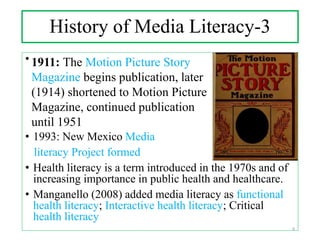
1911: The Motion Picture Story
Magazine begins publication, later
(1914) shortened to Motion Picture
Magazine, continued publication
until 1951
9
Eight basic concepts of media literacy
• All media are constructions
• The media construct reality
• Audiences negotiate meaning in media
• Media have commercial implications
• Media contain ideological and value messages
• Media have social and political implications
• Form and content are closely related in the media
• Each medium has a unique aesthetic form
(Ontario Ministry of Education, 1989)
10
Media Literacy Process Skills-1
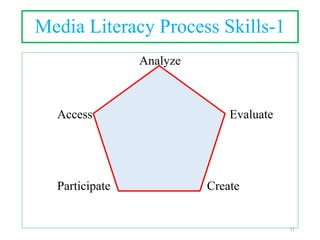
Analyze
Access Evaluate
Participate Create
11
Media Literacy Process Skills-2
Access
When people access messages, they are able to collect
relevant and useful information and comprehend its
meaning effectively. They can:
• Recognize and understand a rich vocabulary of
words, symbols and techniques of communication
• Develop strategies for locating information from a
wide variety of sources.
• Select an assortment of types of information
relevant to the purpose of a task
12
Media Literacy Process Skills-3
Analyze
Able to examine the design of the message’s form,
structure and sequence. People can make use of
artistic, literary, social, political and economic
concepts to understand the context in which the
message occurs. For example,
• Use prior knowledge and experiences to predict
outcomes.
• Interpret a message using concepts such as purpose,
audience, point of view, format, genre, character,
plot, theme, mood, setting, context.
• Use strategies including compare, fact/opinion,
cause/effect, listing and sequencing.
13
Media Literacy Process Skills-4
Evaluate
People are able to relate messages to their own
experience and make judgments about the veracity,
quality and relevance of messages. This includes
being able to:
• Appreciate and take pleasure in interpreting
messages in different genres and forms.
• Evaluate the quality of a message based on its
content and form.
• Judge the value of a message based on one’s ethical,
religious or democratic principles.
• Respond orally, in print, or electronically to
messages of varying complexity and content.
14
Media Literacy Process Skills-5
Create
• Able to “write” their ideas, using words, sounds
and/or images effectively for a variety of purposes,
and people are able to make use of various
technologies of communication to create, edit and
disseminate their message.
• Make use of brainstorming, planning, composing and
revising processes.
• Use writing and oral language effectively with mastery
of rules of language usage.
• Create and select images effectively to achieve various
goals.
• Use technologies of communication in the construction
of messages.
15
Media Literacy Process Skills-6
Participate
• People participate in constructing messages, they
are in a constant process of engagement and
interaction which results in sometimes exponential
dissemination, circulation, connections and
collaboration
• Require interaction and engagement with others,
• Interplay between media users and usages,
• Use the work of others to create new forms and
new expressions, building on the ideas of
productions,
• Interact responsibly and ethically
16
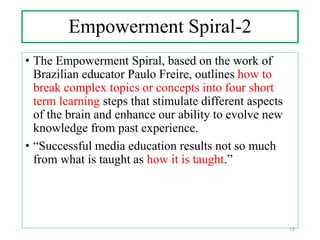
Empowerment Spiral-1
Awareness
Action
Reflection
Analysis
17
Empowerment Spiral-2
• The Empowerment Spiral, based on the work of
Brazilian educator Paulo Freire, outlines how to
break complex topics or concepts into four short
term learning steps that stimulate different aspects
of the brain and enhance our ability to evolve new
knowledge from past experience.
• “Successful media education results not so much
from what is taught as how it is taught.”
18
Empowerment Spiral-3
• Awareness step, people participate in an activity that
leads to observations and personal connections for
potential insight
• Analysis, provides time for participants to figure out
“how” an issue came to be.
• Reflection step, the group looks deeper to ask “So
what?” or “What ought we to do or think?”
• Action step gives participants an opportunity to
formulate constructive action ideas, to “learn by
doing, individually or collectively.”
19
Benefits of Media Literacy Education-1
1. Meets the needs of students to be wise consumers of
media, ideas using the powerful multimedia tools to
actively participate in a global media culture.
2. Engages students bringing the world of media into the
classroom connects learning with “real life” and
validates their media culture as a rich environment for
learning,
3. Common approach to critical thinking that, when
internalized, becomes second nature for life,
4. Provides an opportunity for integrating all subject areas
5. Helps meet state standards while, at the same time
using fresh contemporary media content
20
Benefits of Media Literacy Education-2
6. Increases the ability and proficiency of participants
to communicate and share their thoughts and ideas
7. Media literacy’s “inquiry process”
8. By focusing on process skills rather than content
knowledge, participats gain the ability to analyze
9. By using a replicable model for implementation,
media literacy avoids becoming a “fad” and,
instead,
10. Not only benefits individuals but benefits society
by providing tools and methods that encourage
respectful discourse
21
Constructs of Health-Promoting
Media Literacy Education
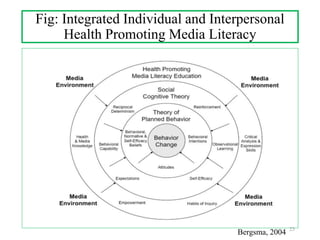
• From a public health perspective, Bergsma (2004)
shows that the pedagogical links between health
promotion and media literacy can be traced to
Freire’s (1970, 1973) empowerment education
model.
• In addition to empowerment, three other constructs
literacy education intervention to change beliefs,
attitudes, intentions, and behaviors. These include:
1) knowledge about the media and the health issue
2) habits of inquiry,
3) critical analysis and expression skills (National
Association for Media Literacy Education 2007).
22
Fig: Integrated Individual and Interpersonal
Health Promoting Media Literacy
23
Bergsma, 2004
References
• Bergsma, L.J., 2004. Empowerment education: The link between media
literacy and health promotion. American Behavioral Scientist, 48(2),
pp.152-164.
• Committee on Public Education, American Academy of Pediatrics.
Children, adolescents, and television. Pediatrics 2001; 107: 423–6.
• Thoman E, Jolls T. MediaLit Kit—Literacy for the 21st Century:
• An Overview and Orientation Guide to Media Literacy Education.
Available at: http://medialit.org/medialitkit.html. Accessed: Jan 2018.
• Kaiser Family Foundation. Generation M: Media in the Lives of 8–18
Year-Olds. Available at: http://www.kff.org/entmedia/upload/Generation-
M-Media-in-the-Lives-of-8-18-Year-olds-Report.pdf. Accessed: Jan
2018.
• Ontario Ministry of Education, Media Literacy Resource Guide (Toronto,
Ontario: Ministry of Education, 1989): 8-10.
• DOHS, MoHP. Annual report 2072/73. DoHS: Kathmandu: Feb. 2017.
Accessed date: Jan 2018. Available at: http://dohs.gov.np/wp-
content/uploads/2017/06/DoHS_Annual_Report_2072_73.pdf
24
References
• Gonzales, R., Glik, D., Davoudi, M. and Ang, A., 2004.
Media literacy and public health: Integrating theory,
research, and practice for tobacco control. American
Behavioral Scientist, 48(2), pp.189-201.
• Sørensen, K., Van den Broucke, S., Fullam, J., Doyle,
G., Pelikan, J., Slonska, Z. and Brand, H., 2012. Health
literacy and public health: a systematic review and
integration of definitions and models. BMC public
health, 12(1), p.80.
• Bergsma, L.J. 2004. “Empowerment Education: the
Link Between Media Literacy and Health Promotion.”
American Behavioral Scientist 48: 152-164.
25
26

Media Health Literacy

  • 1.
    Media Literacy Presented By: KamalBahadur Budha Roll No.: 11 MPH (HPE) School of Health and Allied Sciences Pokhara University 1
  • 2.
    Media Literacy -1 •Literacy has referred to the ability to read and write. • Today, we get most of our information through an interwoven system of media technologies. • The ability to read many types of media has become an essential skill in the 21st Century. • Media literate youth and adults are better able to understand the complex messages we receive from television, radio, Internet, newspapers, magazines, books, billboards, video games, music, and all other forms of media. 2
  • 3.
    Media Literacy -2 •Media literacy has been defined as ‘the ability to access, analyze, evaluate, and create media in a variety of forms’ (Medialit, 2018) • Media literacy has become as essential a skill as the ability to read the printed word. (Media Literacy) • Media literacy concepts should be integrated into language arts, social studies, visual art, health, and information technology curricula. (Media Literacy) • “Many teachers... have found that students are unresponsive to the idea that they are helpless victims of media influence.”- Renee Hobbs 3
  • 4.
    Media Literacy -3 •Media literacy skills are included in the educational standards of every state in language arts, social studies, health, science, and other subjects. • Media literacy has been recommended as an effective health promotion strategy by a number of respected organizations • In this scenario, media literacy is an important response to a media saturated society. 4
  • 5.
    Media Literacy -4 •Health professionals have increasingly recognized that the media have a significant influence on the health of young people. (Bergsma, 2008) • Some research estimated that youth spend 33– 50% of their waking hours with some form of mass media. • According to the Kaiser Family Foundation children and teens are spending an increasing amount of time using ‘new media’ like computers, the Internet and video games, without cutting back on the time they spend with ‘old’ media like television, print and music. 5
  • 6.
    Media Literacy -5 •Media literacy education has come a long way since the 1970s, when the first “critical thinking” courses were introduced in a few American schools. (Media literacy) 6
  • 7.
    History of MediaLiteracy-1 • The history of media education cannot be told without correlating it with the rise and development of the mass media themselves • 1833: modern day Zoetrope (a device that produces the illusion of motion from a rapid succession of static pictures) • 1877: the Praxinoscope, an early animation device, was invented • 1888: One of the first patented motion-picture film cameras was designed by Louis Le Prince 7
  • 8.
    History of MediaLiteracy-2 • 1891: Thomas Edison creates/patents the kineotographic camera: The first motion picture camera patented in the United States • 1900: The first known public exhibition of projected sound films took place in Paris • 1905: Variety begins covering entertainment industries such as films, television, radio, music, and theater 8
  • 9.
    History of MediaLiteracy-3 • . • 1993: New Mexico Media literacy Project formed • Health literacy is a term introduced in the 1970s and of increasing importance in public health and healthcare. • Manganello (2008) added media literacy as functional health literacy; Interactive health literacy; Critical health literacy 1911: The Motion Picture Story Magazine begins publication, later (1914) shortened to Motion Picture Magazine, continued publication until 1951 9
  • 10.
    Eight basic conceptsof media literacy • All media are constructions • The media construct reality • Audiences negotiate meaning in media • Media have commercial implications • Media contain ideological and value messages • Media have social and political implications • Form and content are closely related in the media • Each medium has a unique aesthetic form (Ontario Ministry of Education, 1989) 10
  • 11.
    Media Literacy ProcessSkills-1 Analyze Access Evaluate Participate Create 11
  • 12.
    Media Literacy ProcessSkills-2 Access When people access messages, they are able to collect relevant and useful information and comprehend its meaning effectively. They can: • Recognize and understand a rich vocabulary of words, symbols and techniques of communication • Develop strategies for locating information from a wide variety of sources. • Select an assortment of types of information relevant to the purpose of a task 12
  • 13.
    Media Literacy ProcessSkills-3 Analyze Able to examine the design of the message’s form, structure and sequence. People can make use of artistic, literary, social, political and economic concepts to understand the context in which the message occurs. For example, • Use prior knowledge and experiences to predict outcomes. • Interpret a message using concepts such as purpose, audience, point of view, format, genre, character, plot, theme, mood, setting, context. • Use strategies including compare, fact/opinion, cause/effect, listing and sequencing. 13
  • 14.
    Media Literacy ProcessSkills-4 Evaluate People are able to relate messages to their own experience and make judgments about the veracity, quality and relevance of messages. This includes being able to: • Appreciate and take pleasure in interpreting messages in different genres and forms. • Evaluate the quality of a message based on its content and form. • Judge the value of a message based on one’s ethical, religious or democratic principles. • Respond orally, in print, or electronically to messages of varying complexity and content. 14
  • 15.
    Media Literacy ProcessSkills-5 Create • Able to “write” their ideas, using words, sounds and/or images effectively for a variety of purposes, and people are able to make use of various technologies of communication to create, edit and disseminate their message. • Make use of brainstorming, planning, composing and revising processes. • Use writing and oral language effectively with mastery of rules of language usage. • Create and select images effectively to achieve various goals. • Use technologies of communication in the construction of messages. 15
  • 16.
    Media Literacy ProcessSkills-6 Participate • People participate in constructing messages, they are in a constant process of engagement and interaction which results in sometimes exponential dissemination, circulation, connections and collaboration • Require interaction and engagement with others, • Interplay between media users and usages, • Use the work of others to create new forms and new expressions, building on the ideas of productions, • Interact responsibly and ethically 16
  • 17.
  • 18.
    Empowerment Spiral-2 • TheEmpowerment Spiral, based on the work of Brazilian educator Paulo Freire, outlines how to break complex topics or concepts into four short term learning steps that stimulate different aspects of the brain and enhance our ability to evolve new knowledge from past experience. • “Successful media education results not so much from what is taught as how it is taught.” 18
  • 19.
    Empowerment Spiral-3 • Awarenessstep, people participate in an activity that leads to observations and personal connections for potential insight • Analysis, provides time for participants to figure out “how” an issue came to be. • Reflection step, the group looks deeper to ask “So what?” or “What ought we to do or think?” • Action step gives participants an opportunity to formulate constructive action ideas, to “learn by doing, individually or collectively.” 19
  • 20.
    Benefits of MediaLiteracy Education-1 1. Meets the needs of students to be wise consumers of media, ideas using the powerful multimedia tools to actively participate in a global media culture. 2. Engages students bringing the world of media into the classroom connects learning with “real life” and validates their media culture as a rich environment for learning, 3. Common approach to critical thinking that, when internalized, becomes second nature for life, 4. Provides an opportunity for integrating all subject areas 5. Helps meet state standards while, at the same time using fresh contemporary media content 20
  • 21.
    Benefits of MediaLiteracy Education-2 6. Increases the ability and proficiency of participants to communicate and share their thoughts and ideas 7. Media literacy’s “inquiry process” 8. By focusing on process skills rather than content knowledge, participats gain the ability to analyze 9. By using a replicable model for implementation, media literacy avoids becoming a “fad” and, instead, 10. Not only benefits individuals but benefits society by providing tools and methods that encourage respectful discourse 21
  • 22.
    Constructs of Health-Promoting MediaLiteracy Education • From a public health perspective, Bergsma (2004) shows that the pedagogical links between health promotion and media literacy can be traced to Freire’s (1970, 1973) empowerment education model. • In addition to empowerment, three other constructs literacy education intervention to change beliefs, attitudes, intentions, and behaviors. These include: 1) knowledge about the media and the health issue 2) habits of inquiry, 3) critical analysis and expression skills (National Association for Media Literacy Education 2007). 22
  • 23.
    Fig: Integrated Individualand Interpersonal Health Promoting Media Literacy 23 Bergsma, 2004
  • 24.
    References • Bergsma, L.J.,2004. Empowerment education: The link between media literacy and health promotion. American Behavioral Scientist, 48(2), pp.152-164. • Committee on Public Education, American Academy of Pediatrics. Children, adolescents, and television. Pediatrics 2001; 107: 423–6. • Thoman E, Jolls T. MediaLit Kit—Literacy for the 21st Century: • An Overview and Orientation Guide to Media Literacy Education. Available at: http://medialit.org/medialitkit.html. Accessed: Jan 2018. • Kaiser Family Foundation. Generation M: Media in the Lives of 8–18 Year-Olds. Available at: http://www.kff.org/entmedia/upload/Generation- M-Media-in-the-Lives-of-8-18-Year-olds-Report.pdf. Accessed: Jan 2018. • Ontario Ministry of Education, Media Literacy Resource Guide (Toronto, Ontario: Ministry of Education, 1989): 8-10. • DOHS, MoHP. Annual report 2072/73. DoHS: Kathmandu: Feb. 2017. Accessed date: Jan 2018. Available at: http://dohs.gov.np/wp- content/uploads/2017/06/DoHS_Annual_Report_2072_73.pdf 24
  • 25.
    References • Gonzales, R.,Glik, D., Davoudi, M. and Ang, A., 2004. Media literacy and public health: Integrating theory, research, and practice for tobacco control. American Behavioral Scientist, 48(2), pp.189-201. • Sørensen, K., Van den Broucke, S., Fullam, J., Doyle, G., Pelikan, J., Slonska, Z. and Brand, H., 2012. Health literacy and public health: a systematic review and integration of definitions and models. BMC public health, 12(1), p.80. • Bergsma, L.J. 2004. “Empowerment Education: the Link Between Media Literacy and Health Promotion.” American Behavioral Scientist 48: 152-164. 25
  • 26.

Editor's Notes

  • #8 The history of media education cannot be told without correlating it with the rise and development of the mass media themselves (cameras, radio, television, film, the Internet). 1833: modern day Zoetrope (a device that produces the illusion of motion from a rapid succession of static pictures) invented by British mathematician William George Horner. 1877: the Praxinoscope, an early animation device, was invented in France in 1877 by Charles-Émile Reynaud. (source) 1888: One of the first patented motion-picture film cameras was designed by Louis Le Prince
  • #21 Meets the needs of students to be wise consumers of media, managers of information, responsible producers of their ideas using the powerful multimedia tools to actively participate in a global media culture. Engages students bringing the world of media into the classroom connects learning with “real life” and validates their media culture as a rich environment for learning. Gives students and teachers alike a common approach to critical thinking that, when internalized, becomes second nature for life. Provides an opportunity for integrating all subject areas and creating a common vocabulary that applies across all disciplines. Helps meet state standards while, at the same time using fresh contemporary media content which students love.
  • #22 Increases the ability and proficiency of students to communicate (express), and share their thoughts and ideas in a wide range of media forms Media literacy’s “inquiry process” transforms teaching and frees the teacher to learn along with students By focusing on process skills rather than content knowledge, students gain the ability to analyze any message in any media By using a replicable model for implementation, media literacy avoids becoming a “fad” and, instead, becomes sustainable over time because students are able to build a platform with a consistent framework that goes with them from school to school, grade to grade, teacher to teacher and class to class. Not only benefits individual students but benefits society by providing tools and methods that encourage respectful discourse that leads to mutual understanding and builds the citizenship skills needed to participate in and contribute to the public debate.