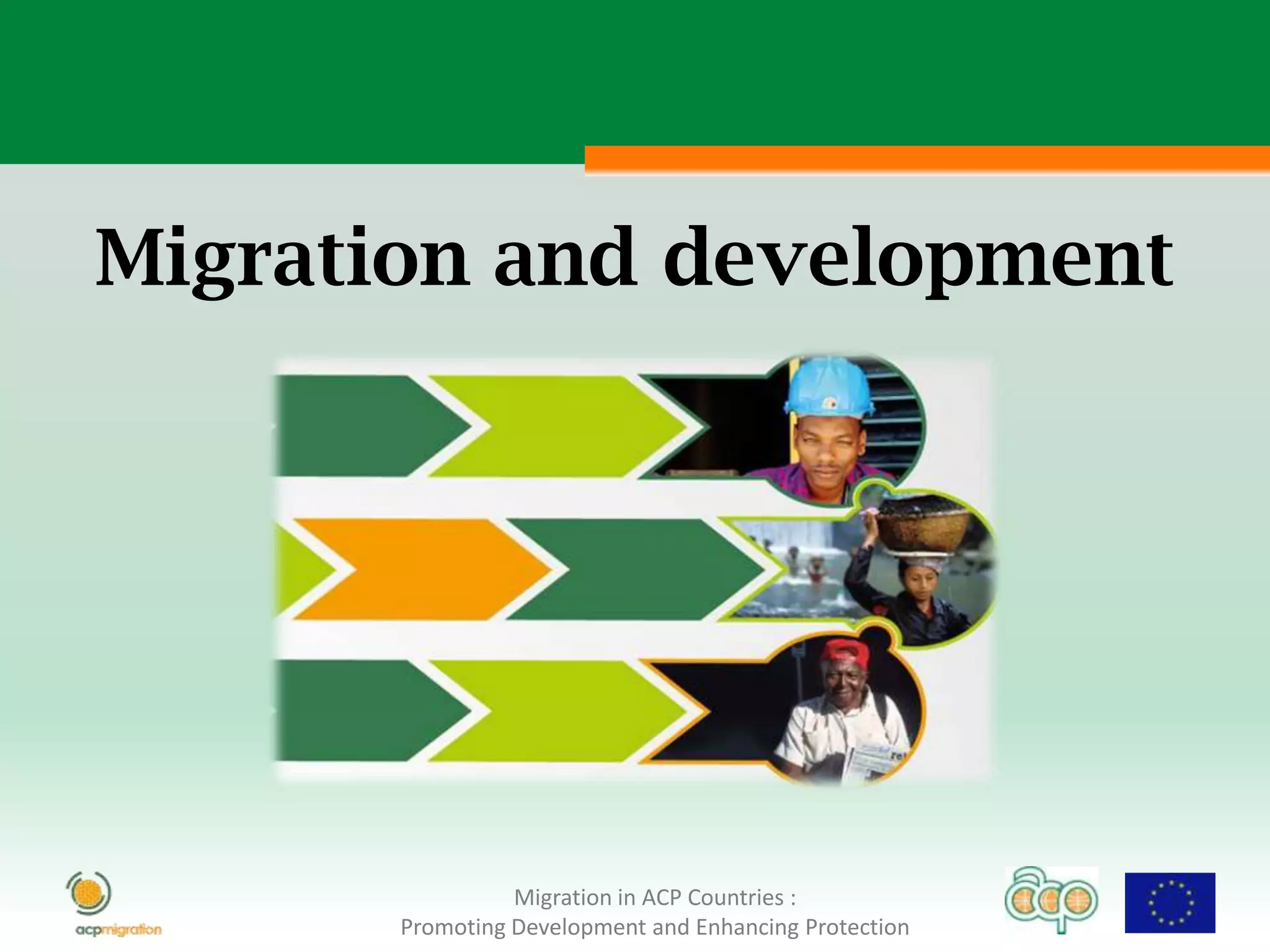
Migration and development


                 Migration in ACP Countries :
       Promoting Development and Enhancing Protection
Introduction
                                      Facts
Migration of persons across international boundaries in search of decent
work, opportunities to survive or as a result of war, conflict and political
instability has risen substantially over the years

As technological, structural and demographic changes intensify, this trend is
likely to continue in the foreseeable future

Emerging consensus that if migration is properly governed by both countries of
origin and countries of destination, it has a positive impact on countries of
destination as well as origin countries.

Migration should be regulated and migrants protected in manners that support
its positive impact, particularly in the economic sphere


                                  Migration in ACP Countries :
                        Promoting Development and Enhancing Protection
Introduction
                         Debates and arguments
                 Globalisation debate
Recognition that migration is inevitable
expressed need for it to be regulated and
governed, rather than just allowing 'market forces' to
push and pull it without concern for the protection
and welfare of human beings involved.
                 Concept of development
Usually expressed in narrow terms, synonymous with
economic growth; namely, an increase in the
production of goods and services.
It is in reality much broader: the elaboration of
productive means, forces, and capacities to provide
goods, services, technology and knowledge to meet
human needs for sustenance and well being.
'human        development'        -       enhancing              the
political, economic, social, intellectual, educational, tec
hnical and cultural capacity of individuals and
communities
Not just generation of income and wealth, but also the
                                    Migration in ACP Countries :
redistribution thereof    Promoting Development and Enhancing Protection
Development and Human Rights
                               Human development
•   „Rights based approach' to development that goes beyond economic growth.
•   Human rights and development not separate spheres, but development a
    subset of human rights
                                             Right to development
                             •   Emphasis on the centrality of the human person
                                 as a subject of the development process.
                             •   Discrepancies between demands of economic
                                 globalisation and the requirements of human
                                 development
                                                Argument:
                              Globalization marginalisation of the developing
                              world. Causes deeper levels of poverty and
                              prevent state interventions that support the
                              human development envisaged


                                   Migration in ACP Countries :
                         Promoting Development and Enhancing Protection
Skilled migration
                           "Brain Drain"
                                  Definition:
      Cross-border migration of highly skilled persons out of developing
      countries, most of whom possess a university degree or equivalent
        experience, and generally stay abroad for long periods of time
Impact:
Difficult to gage due to a lack of data in both source and destination
countries, particularly data on skills, qualifications, economic activity and employment, of
both emigrants and immigrants. Also differing policy definitions of immigration
worldwide, and a dearth of research on who skilled migrants are, specific skills and
qualifications that migrate with them, and why they decide to migrate
Who they are?
•persons whose occupations are “vital to the functional core of a national economy”,
•Persons who have generally “received specialised training that results in superior
technical competence, talent, or abilities that are applied in professional occupations
•Persons with less formal education or training, but have gained skills, experience and
qualifications 'on the job,' have developed successful businesses, or play a critical role in
the public sector”, and whose skills may be therefore “in short supply in relation to the
labour market as a whole

                                      Migration in ACP Countries :
                            Promoting Development and Enhancing Protection
Remittances
Significant ties between migrants and their home countries.

At household level, particular in rural areas, remittances usually finance day-to-day
consumption of goods and services essential for survival and welfare.
Health care, education, housing, nutrition, as well as income and income-generating
activities, and social security

Remittances seen as “new development finance” despite being individual earnings
Remittances have become the second largest international capital flow behind Foreign
Direct Investment (FDI), and volumes have surpassed Overseas Development Assistance
(ODA).
However they are individuals' earnings from work, just as are earnings for workers 'at
home'

Sizeable proportion of the GDP in many developing countries
Enormous impacts on economic growth, poverty reduction and development, albeit at
costs of losing skilled workers, labour power, family disintegration, social and community
disruption.


                                     Migration in ACP Countries :
                           Promoting Development and Enhancing Protection
Diaspora Networks
                       Impact on source country

      Beyond financial benefits, migration can offer source countries a
    range of other benefits, primarily related to nationals returning from
                                   abroad

When return to source country
•     Bring back international work experience and a network of new contacts

•     Skills and experiences can be applied to specific, key sectors in the source
      country

•     New knowledge and connections with partners can lead to poverty
      reduction policies and strategies.

•     Economic, social, cultural and political impacts
           new ideas and ways of doing things


                                       Migration in ACP Countries :
                             Promoting Development and Enhancing Protection
Unskilled Migration


•   Many of the issues pertaining to skilled migration are equally applicable to
    unskilled migration

•   Harnessing of the actual or potential benefits of unskilled migration
    usually overshadowed by exploitation, abuse and lack of protection of
    unskilled migrants


                                   Migration in ACP Countries :
                         Promoting Development and Enhancing Protection
Concluding comments
                                       pros
        Relationship between migration and development is complex
                              PROS & CONS
Pros:
   •Migration  is an important sustainable livelihood strategy used as a means
   to alleviate poverty and advance development on micro and macro scales

   •Resourcessent to families used for consumption and human capital
   development: health, education, nutrition, housing etc.

   •Remittances may allow a household to develop its economic potential
   through investments in land and enterprises

   •Skilledmigrants contributes to the economy brings new skills, ideas, and
   can replace emigrating skilled labour

   •Migrants (including unskilled) are also consumers of services and spend
   money on commodities, all of which has a cumulative positive effect on
   destination as well as origin countries

                                 Migration in ACP Countries :
                       Promoting Development and Enhancing Protection
Cons:
•Migrants may return home ill, disabled or old and while the country of origin
has not had the economic benefit of their labour (and taxes) to contribute to
pension funds and health care services, they have to bear the costs of having to
provide for and take care of these migrants
•Sending countries have to bear the social costs of migration and separated
families
                                   Final note
          Restricting migration is a waste of resources, not least because
     of the potential benefits it provides. It must be recognised that
    increasingly, all countries are part of a globalized labour market
    demand and supply and thus, the thrust of policies should be to
facilitate mobility, ensure protection and decent work for migrants, and
thus ameliorate relationships between development and migration. This
may include facilitating aspects that alleviate poverty and contribute to
           national and household economies and development


                                  Migration in ACP Countries :
                        Promoting Development and Enhancing Protection
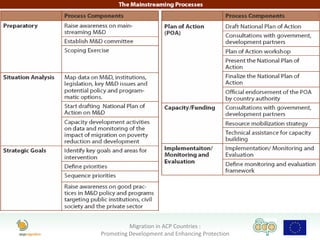
Mainstreaming migration into
   development planning


                  Migration in ACP Countries :
        Promoting Development and Enhancing Protection
Definition

Mainstreaming migration in development planning
may be defined as the process of assessing the
implications of migration on any action (or goals)
planned in a development and poverty reduction
strategy. This means mainstreaming M&D
concerns into legislation, policies and programmes
at    all  levels    (local,   national    and,  if
applicable, regional). It also means integrating
M&D concerns at all stages of development
planning, including design, implementation, and
monitoring and evaluation.


                        Migration in ACP Countries :
              Promoting Development and Enhancing Protection
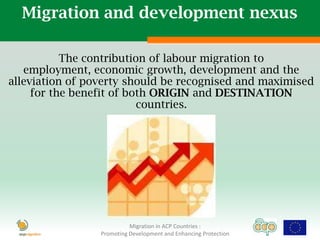
Migration and development nexus

           The contribution of labour migration to
   employment, economic growth, development and the
alleviation of poverty should be recognised and maximised
     for the benefit of both ORIGIN and DESTINATION
                          countries.


                           Migration in ACP Countries :
                 Promoting Development and Enhancing Protection
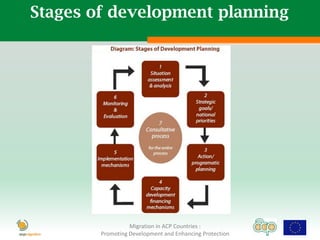
Stages of development planning


                  Migration in ACP Countries :
        Promoting Development and Enhancing Protection
Ensure involvement of all relevant
                 actors
•   Inter-Ministerial Committee

•   Ministries of
    Labour, Finance, Education, Health, Planning, etc.

•   National Consultative Committee

•   Social partners, NGOs, migrant and diaspora
    representatives, human rights associations, research
    institutions, etc.

•   UN Country Team


                              Migration in ACP Countries :
                    Promoting Development and Enhancing Protection
Migration in ACP Countries :
Promoting Development and Enhancing Protection
Role-play

Advocating Mainstreaming Migration
  One participant convinces other participants of the
  relevance of Mainstreaming Migration into Development
  Planning.

  The other participants represent:
  Ministry for Labour/Employment
  Ministry of Industry/Entreprise
  Ministry of Finance
  Planning Ministry (PM office)


                           Migration in ACP Countries :
                 Promoting Development and Enhancing Protection

Migration, Development and Mainstreaming

  • 1.
    Migration and development Migration in ACP Countries : Promoting Development and Enhancing Protection
  • 2.
    Introduction Facts Migration of persons across international boundaries in search of decent work, opportunities to survive or as a result of war, conflict and political instability has risen substantially over the years As technological, structural and demographic changes intensify, this trend is likely to continue in the foreseeable future Emerging consensus that if migration is properly governed by both countries of origin and countries of destination, it has a positive impact on countries of destination as well as origin countries. Migration should be regulated and migrants protected in manners that support its positive impact, particularly in the economic sphere Migration in ACP Countries : Promoting Development and Enhancing Protection
  • 3.
    Introduction Debates and arguments Globalisation debate Recognition that migration is inevitable expressed need for it to be regulated and governed, rather than just allowing 'market forces' to push and pull it without concern for the protection and welfare of human beings involved. Concept of development Usually expressed in narrow terms, synonymous with economic growth; namely, an increase in the production of goods and services. It is in reality much broader: the elaboration of productive means, forces, and capacities to provide goods, services, technology and knowledge to meet human needs for sustenance and well being. 'human development' - enhancing the political, economic, social, intellectual, educational, tec hnical and cultural capacity of individuals and communities Not just generation of income and wealth, but also the Migration in ACP Countries : redistribution thereof Promoting Development and Enhancing Protection
  • 4.
    Development and HumanRights Human development • „Rights based approach' to development that goes beyond economic growth. • Human rights and development not separate spheres, but development a subset of human rights Right to development • Emphasis on the centrality of the human person as a subject of the development process. • Discrepancies between demands of economic globalisation and the requirements of human development Argument: Globalization marginalisation of the developing world. Causes deeper levels of poverty and prevent state interventions that support the human development envisaged Migration in ACP Countries : Promoting Development and Enhancing Protection
  • 5.
    Skilled migration "Brain Drain" Definition: Cross-border migration of highly skilled persons out of developing countries, most of whom possess a university degree or equivalent experience, and generally stay abroad for long periods of time Impact: Difficult to gage due to a lack of data in both source and destination countries, particularly data on skills, qualifications, economic activity and employment, of both emigrants and immigrants. Also differing policy definitions of immigration worldwide, and a dearth of research on who skilled migrants are, specific skills and qualifications that migrate with them, and why they decide to migrate Who they are? •persons whose occupations are “vital to the functional core of a national economy”, •Persons who have generally “received specialised training that results in superior technical competence, talent, or abilities that are applied in professional occupations •Persons with less formal education or training, but have gained skills, experience and qualifications 'on the job,' have developed successful businesses, or play a critical role in the public sector”, and whose skills may be therefore “in short supply in relation to the labour market as a whole Migration in ACP Countries : Promoting Development and Enhancing Protection
  • 6.
    Remittances Significant ties betweenmigrants and their home countries. At household level, particular in rural areas, remittances usually finance day-to-day consumption of goods and services essential for survival and welfare. Health care, education, housing, nutrition, as well as income and income-generating activities, and social security Remittances seen as “new development finance” despite being individual earnings Remittances have become the second largest international capital flow behind Foreign Direct Investment (FDI), and volumes have surpassed Overseas Development Assistance (ODA). However they are individuals' earnings from work, just as are earnings for workers 'at home' Sizeable proportion of the GDP in many developing countries Enormous impacts on economic growth, poverty reduction and development, albeit at costs of losing skilled workers, labour power, family disintegration, social and community disruption. Migration in ACP Countries : Promoting Development and Enhancing Protection
  • 7.
    Diaspora Networks Impact on source country Beyond financial benefits, migration can offer source countries a range of other benefits, primarily related to nationals returning from abroad When return to source country • Bring back international work experience and a network of new contacts • Skills and experiences can be applied to specific, key sectors in the source country • New knowledge and connections with partners can lead to poverty reduction policies and strategies. • Economic, social, cultural and political impacts new ideas and ways of doing things Migration in ACP Countries : Promoting Development and Enhancing Protection
  • 8.
    Unskilled Migration • Many of the issues pertaining to skilled migration are equally applicable to unskilled migration • Harnessing of the actual or potential benefits of unskilled migration usually overshadowed by exploitation, abuse and lack of protection of unskilled migrants Migration in ACP Countries : Promoting Development and Enhancing Protection
  • 9.
    Concluding comments pros Relationship between migration and development is complex PROS & CONS Pros: •Migration is an important sustainable livelihood strategy used as a means to alleviate poverty and advance development on micro and macro scales •Resourcessent to families used for consumption and human capital development: health, education, nutrition, housing etc. •Remittances may allow a household to develop its economic potential through investments in land and enterprises •Skilledmigrants contributes to the economy brings new skills, ideas, and can replace emigrating skilled labour •Migrants (including unskilled) are also consumers of services and spend money on commodities, all of which has a cumulative positive effect on destination as well as origin countries Migration in ACP Countries : Promoting Development and Enhancing Protection
  • 10.
    Cons: •Migrants may returnhome ill, disabled or old and while the country of origin has not had the economic benefit of their labour (and taxes) to contribute to pension funds and health care services, they have to bear the costs of having to provide for and take care of these migrants •Sending countries have to bear the social costs of migration and separated families Final note Restricting migration is a waste of resources, not least because of the potential benefits it provides. It must be recognised that increasingly, all countries are part of a globalized labour market demand and supply and thus, the thrust of policies should be to facilitate mobility, ensure protection and decent work for migrants, and thus ameliorate relationships between development and migration. This may include facilitating aspects that alleviate poverty and contribute to national and household economies and development Migration in ACP Countries : Promoting Development and Enhancing Protection
  • 11.
    Mainstreaming migration into development planning Migration in ACP Countries : Promoting Development and Enhancing Protection
  • 12.
    Definition Mainstreaming migration indevelopment planning may be defined as the process of assessing the implications of migration on any action (or goals) planned in a development and poverty reduction strategy. This means mainstreaming M&D concerns into legislation, policies and programmes at all levels (local, national and, if applicable, regional). It also means integrating M&D concerns at all stages of development planning, including design, implementation, and monitoring and evaluation. Migration in ACP Countries : Promoting Development and Enhancing Protection
  • 13.
    Migration and developmentnexus The contribution of labour migration to employment, economic growth, development and the alleviation of poverty should be recognised and maximised for the benefit of both ORIGIN and DESTINATION countries. Migration in ACP Countries : Promoting Development and Enhancing Protection
  • 14.
    Stages of developmentplanning Migration in ACP Countries : Promoting Development and Enhancing Protection
  • 15.
    Ensure involvement ofall relevant actors • Inter-Ministerial Committee • Ministries of Labour, Finance, Education, Health, Planning, etc. • National Consultative Committee • Social partners, NGOs, migrant and diaspora representatives, human rights associations, research institutions, etc. • UN Country Team Migration in ACP Countries : Promoting Development and Enhancing Protection
  • 16.
    Migration in ACPCountries : Promoting Development and Enhancing Protection
  • 17.
    Role-play Advocating Mainstreaming Migration One participant convinces other participants of the relevance of Mainstreaming Migration into Development Planning. The other participants represent: Ministry for Labour/Employment Ministry of Industry/Entreprise Ministry of Finance Planning Ministry (PM office) Migration in ACP Countries : Promoting Development and Enhancing Protection