MIDFACE FRACTURE
(LEFORT FRACTURE)
-G.Kathirvel
PG OMFS
Contents:
• Introduction
• Classification
• Le Fort Type I Fractures
• Le Fort Type II Fractures
• Le Fort Type III Fractures
• Management
• Complications
Introduction:
Middle third of the facial skeleton is defined as “an area
bounded
Superiorly - a line drawn across the skull from the
Frontozygomatic (FZ) suture of one side, across the frontonasal
and frontomaxillary sutures to the FZ suture on the opposite side
Inferiorly - by the occlusal plane of the upper teeth, or, if the
patient is edentulous, by the upper alveolar ridge
Posteriorly - by the spheno-ethmoidal junction, but includes
the pterygoid laminae of the sphenoid bone inferiorly “
Middle third of the facial skeleton can also be divided into two
zones:
1. Central midface
2. Lateral midface
Middle Third of the Face
Paired bones - 8
Unpaired bones - 2
• The two maxillae
• The two palatine bones
• The two zygomatic bones and their temporal processes
• The two zygomatic processes of temporal bones
• The two nasal bones
• The two lacrimal bones
• The two inferior conchae
• The two pterygoid plates of the sphenoid
• The ethmoid bone -unpaired
• The vomer—unpaired single bone
Vertical and Horizontal Pillars of the Maxillary Skeleton:
• These bones are arranged in such a way that it can protect the associated functional
units like brain, orbit and airway.
• Around these important functional units dense bony struts are arranged in a system of
vertical, transverse and horizontal buttresses, act as energy-absorbing shields.
Vertical Pillars
• Anterior or the canine pillar
• Middle or zygomatic pillar
• Posterior or pterygoid pillar
Horizontal Pillars
• Supraorbital rims with frontal bone
• Infraorbital rims
• Alveolar process
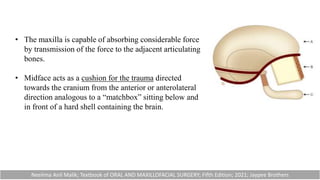
• The maxilla is capable of absorbing considerable force
by transmission of the force to the adjacent articulating
bones.
• Midface acts as a cushion for the trauma directed
towards the cranium from the anterior or anterolateral
direction analogous to a “matchbox” sitting below and
in front of a hard shell containing the brain.
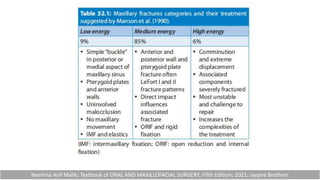
Neelima Anil Malik; Textbook of ORAL AND MAXILLOFACIAL SURGERY; Fifth Edition; 2021; Jaypee Brothers
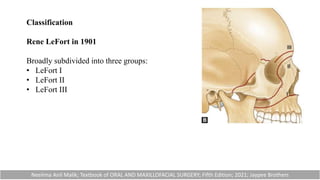
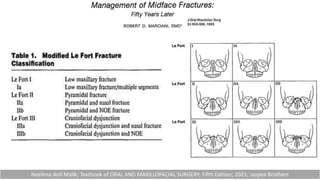
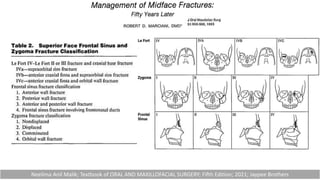
Classification
Rene LeFort in 1901
Broadly subdivided into three groups:
• LeFort I
• LeFort II
• LeFort III
Neelima Anil Malik; Textbook of ORAL AND MAXILLOFACIAL SURGERY; Fifth Edition; 2021; Jaypee Brothers
Erich’s (1942)
• Horizontal fracture
• Pyramidal fracture
• Transverse fracture
Neelima Anil Malik; Textbook of ORAL AND MAXILLOFACIAL SURGERY; Fifth Edition; 2021; Jaypee Brothers
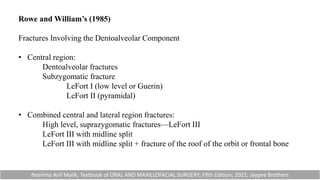
Rowe and William’s (1985)
Fractures not Involving the Dentoalveolar Component
• Central region:
Fractures of the nasal bones and/or nasal septum.
Lateral nasal injuries
Anterior nasal injuries
Fractures of the frontal process of the maxilla.
Fractures of nasoethmoid
Fractures of Fronto-orbito-nasal
• Lateral region:
Fractures involving the zygomatic bone, arch and maxilla [zygomaticomaxillary
complex (ZMC)] excluding the dentoalveolar component.
Rowe and Williams; Maxillofacial Injuries; Volume 2; 1985
Rowe and William’s (1985)
Fractures Involving the Dentoalveolar Component
• Central region:
Dentoalveolar fractures
Subzygomatic fracture
LeFort I (low level or Guerin)
LeFort II (pyramidal)
• Combined central and lateral region fractures:
High level, suprazygomatic fractures—LeFort III
LeFort III with midline split
LeFort III with midline split + fracture of the roof of the orbit or frontal bone
Neelima Anil Malik; Textbook of ORAL AND MAXILLOFACIAL SURGERY; Fifth Edition; 2021; Jaypee Brothers
Hendrickson Classification (1998)
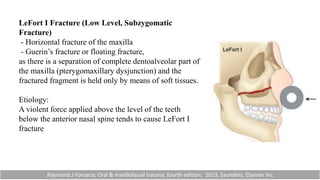
LeFort I Fracture (Low Level, Subzygomatic
Fracture)
- Horizontal fracture of the maxilla
- Guerin’s fracture or floating fracture,
as there is a separation of complete dentoalveolar part of
the maxilla (pterygomaxillary dysjunction) and the
fractured fragment is held only by means of soft tissues.
Etiology:
A violent force applied above the level of the teeth
below the anterior nasal spine tends to cause LeFort I
fracture
Raymond.J Fonseca; Oral & maxillofacial trauma; fourth edition; 2013, Saunders, Elsevier Inc
LeFort I Fracture
The fracture line extends backwards along the maxilla
from the pyriform fossa.
• Medially—lower third of the nasal septum—lateral
margin of the anterior nasal aperture proceeding
posteriorly to join the lateral fracture behind the tuberosity.
• Laterally—lateral margin of the anterior nasal aperture—
lateral wall of maxillary sinus below the zygomatic
buttress—the lower one-third of the pterygoid laminae and
associated palatine bone
Raymond.J Fonseca; Oral & maxillofacial trauma; fourth edition; 2013, Saunders, Elsevier Inc
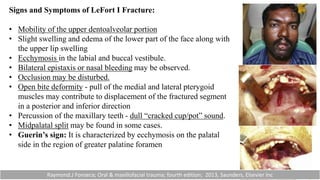
Signs and Symptoms of LeFort I Fracture:
• Mobility of the upper dentoalveolar portion
• Slight swelling and edema of the lower part of the face along with
the upper lip swelling
• Ecchymosis in the labial and buccal vestibule.
• Bilateral epistaxis or nasal bleeding may be observed.
• Occlusion may be disturbed.
• Open bite deformity - pull of the medial and lateral pterygoid
muscles may contribute to displacement of the fractured segment
in a posterior and inferior direction
• Percussion of the maxillary teeth - dull “cracked cup/pot” sound.
• Midpalatal split may be found in some cases.
• Guerin’s sign: It is characterized by ecchymosis on the palatal
side in the region of greater palatine foramen
Raymond.J Fonseca; Oral & maxillofacial trauma; fourth edition; 2013, Saunders, Elsevier Inc
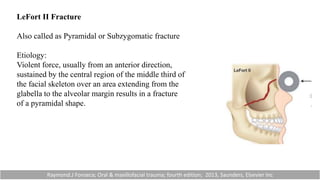
LeFort II Fracture
Also called as Pyramidal or Subzygomatic fracture
Etiology:
Violent force, usually from an anterior direction,
sustained by the central region of the middle third of
the facial skeleton over an area extending from the
glabella to the alveolar margin results in a fracture
of a pyramidal shape.
Raymond.J Fonseca; Oral & maxillofacial trauma; fourth edition; 2013, Saunders, Elsevier Inc
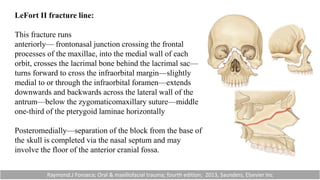
LeFort II fracture line:
This fracture runs
anteriorly— frontonasal junction crossing the frontal
processes of the maxillae, into the medial wall of each
orbit, crosses the lacrimal bone behind the lacrimal sac—
turns forward to cross the infraorbital margin—slightly
medial to or through the infraorbital foramen—extends
downwards and backwards across the lateral wall of the
antrum—below the zygomaticomaxillary suture—middle
one-third of the pterygoid laminae horizontally
Posteromedially—separation of the block from the base of
the skull is completed via the nasal septum and may
involve the floor of the anterior cranial fossa.
Raymond.J Fonseca; Oral & maxillofacial trauma; fourth edition; 2013, Saunders, Elsevier Inc
Signs and Symptoms of LeFort II Fracture:
• Gross edema of the middle third of the face known as ballooning or
moon face.
• Presence of bilateral circumorbital edema and ecchymosis (black eye).
• Bilateral subconjunctival hemorrhage confined to medial half of the eye.
• The bridge of the nose will be depressed (flat face).
• If there is impaction of the fragment against the cranial base, then
shortening of the face with anterior open bite will be seen.
• If there is gross downward and backward displacement of the fragment,
then elongation or lengthening of the face will be seen with posterior
gagging of the occlusion with anterior open bite (dish-shaped face).
Raymond.J Fonseca; Oral & maxillofacial trauma; fourth edition; 2013, Saunders, Elsevier Inc
• Mobility of the midface.
• Bilateral epistaxis may be present.
• Loss of occlusion may be seen.
• Airway obstruction may be seen due to posterior and downward
displacement of the fragment impinging on the dorsum of the tongue.
• Surgical emphysema—crackling sensation transmitted to the fingers due to
escape of air from the paranasal sinuses is seen.
• CSF rhinorrhea/leak may be present.
• Step deformity at the infraorbital margins may be seen. Helps to
differentiate from LeFort III fracture.
• Paresthesia of the cheek is noted.
Raymond.J Fonseca; Oral & maxillofacial trauma; fourth edition; 2013, Saunders, Elsevier Inc
LeFort III Fracture
It is also known as high level fracture or Transverse or
Suprazygomatic Fracture
Etiology:
• The force is usually applied from the lateral direction with a severe
impact.
• The fracture line extends above the zygomatic bones on both sides
as a result of trauma being inflicted over a wider area, at the orbital
level.
• Initial impact is taken by the zygomatic bone resulting in
depressed fracture
• Severe degree of the impact, the entire middle third will hinge
about the fragile ethmoid bone and the impact will then be
transmitted on the contralateral side resulting in laterally displaced
zygomatic fracture of the opposite side (craniofacial dysjunction)
Raymond.J Fonseca; Oral & maxillofacial trauma; fourth edition; 2013, Saunders, Elsevier Inc
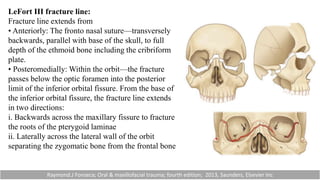
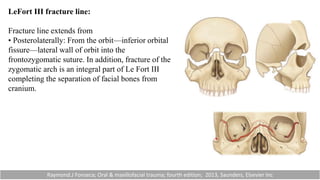
LeFort III fracture line:
Fracture line extends from
• Anteriorly: The fronto nasal suture—transversely
backwards, parallel with base of the skull, to full
depth of the ethmoid bone including the cribriform
plate.
• Posteromedially: Within the orbit—the fracture
passes below the optic foramen into the posterior
limit of the inferior orbital fissure. From the base of
the inferior orbital fissure, the fracture line extends
in two directions:
i. Backwards across the maxillary fissure to fracture
the roots of the pterygoid laminae
ii. Laterally across the lateral wall of the orbit
separating the zygomatic bone from the frontal bone
Raymond.J Fonseca; Oral & maxillofacial trauma; fourth edition; 2013, Saunders, Elsevier Inc
LeFort III fracture line:
Fracture line extends from
• Posterolaterally: From the orbit—inferior orbital
fissure—lateral wall of orbit into the
frontozygomatic suture. In addition, fracture of the
zygomatic arch is an integral part of Le Fort III
completing the separation of facial bones from
cranium.
Raymond.J Fonseca; Oral & maxillofacial trauma; fourth edition; 2013, Saunders, Elsevier Inc
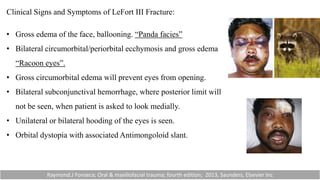
Clinical Signs and Symptoms of LeFort III Fracture:
• Gross edema of the face, ballooning. “Panda facies”
• Bilateral circumorbital/periorbital ecchymosis and gross edema
“Racoon eyes”.
• Gross circumorbital edema will prevent eyes from opening.
• Bilateral subconjunctival hemorrhage, where posterior limit will
not be seen, when patient is asked to look medially.
• Unilateral or bilateral hooding of the eyes is seen.
• Orbital dystopia with associated Antimongoloid slant.
Raymond.J Fonseca; Oral & maxillofacial trauma; fourth edition; 2013, Saunders, Elsevier Inc
• Characteristic “dish face” deformity.
• May be enophthalmos, diplopia or impairment of vision,
temporary blindness, etc.
• Flattening and widening, deviation of the nasal bridge.
• Epistaxis, CSF rhinorrhea.
• Battles’s sign-mastoid ecchymosis- Suggestive of fracture of
posterior cranial fossa of the skull and brain trauma.
• Disturbed/deranged occlusion, posterior gagging anterior
open bite and retroposition of maxilla will cause airway
obstruction
Raymond.J Fonseca; Oral & maxillofacial trauma; fourth edition; 2013, Saunders, Elsevier Inc
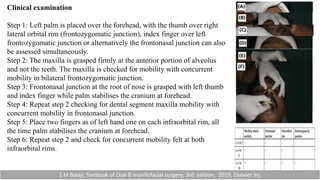
Clinical examination
Step 1: Left palm is placed over the forehead, with the thumb over right
lateral orbital rim (frontozygomatic junction), index finger over left
frontozygomatic junction or alternatively the frontonasal junction can also
be assessed simultaneously.
Step 2: The maxilla is grasped firmly at the anterior portion of alveolus
and not the teeth. The maxilla is checked for mobility with concurrent
mobility in bilateral frontozygomatic junction.
Step 3: Frontonasal junction at the root of nose is grasped with left thumb
and index finger while palm stabilises the cranium at forehead.
Step 4: Repeat step 2 checking for dental segment maxilla mobility with
concurrent mobility in frontonasal junction.
Step 5: Place two fingers as of left hand one on each infraorbital rim, all
the time palm stabilises the cranium at forehead.
Step 6: Repeat step 2 and check for concurrent mobility felt at both
infraorbital rims.
S M Balaji; Textbook of Oral & maxillofacial surgery; 3rd edition; 2019, Elsevier Inc
Radiographic examination
• Waters’ view (occipito-mental)
• Caldwell view (PA view)
• lateral view and
• submentovertex view.
Waters’ projection gives a detailed evaluation of the facial skeleton.
S M Balaji; Textbook of Oral & maxillofacial surgery; 3rd edition; 2019, Elsevier Inc
McGrigor and Campbell (1950)
Described a system for examining the occipito-mental film by
following four lines, which cover most of the sites of injury.
1. First line across the zygomaticofrontal sutures, the superior
margin of the orbit and the frontal sinus
2. Second line across the zygomatic arch, zygomatic body,
inferior orbital margin and nasal bone
3. Third line across the condyles, coronoid process and the
maxillary sinus
4. Fourth line across the mandibular ramus, occlusal plane
5. Fifth line (Trapnell’s line) across the inferior border of the
mandible from angle to angle
S M Balaji; Textbook of Oral & maxillofacial surgery; 3rd edition; 2019, Elsevier Inc
On occipitomental skull radiograph
Dolan’s lines
1 orbital
2 zygomatic
3 maxillary
Elephant’s of Rogers
The zygomatic and maxillary lines together form visual
appearance resembling head of elephant
• Thus, a fracture of the zygomatic process appears as a
break in the elephant’s trunk and a fracture of the orbital
rim appears as an irregularity in the elephant’s ear.
Computed tomography (CT)
• Conventional radiographic examination is uncertain and
sometimes misleading.
• CT scan of the face provides a vivid evaluation of facial
pathology than the conventional radiography.
• Axial and reconstructed coronal images.
• 3D reconstruction of the CT scan aids in diagnosis and
treatment planning.
S M Balaji; Textbook of Oral & maxillofacial surgery; 3rd edition; 2019, Elsevier Inc
Pre-operative planning
1. The type of fixation required, i.e. internal or external skeletal fixation
2. The need for open reduction and the application of direct transosseous wiring or bone
plates
3. The type of intermaxillary fixation required i.e. interdental eyelets, arch bars, silver cap
splints or 'Gunning-type’ splints
4. The need for tracheostomy; this should be agreed with the anaesthetist
Rowe and Williams; Maxillofacial Injuries; Volume 2; 1985
Neelima Anil Malik; Textbook of ORAL AND MAXILLOFACIAL SURGERY; Fifth Edition; 2021; Jaypee Brothers
METHODS OF REDUCTION FOR MIDFACE FRACTURES
• Closed reduction: Alignment without visualization of fracture
Reduction by instruments manipulation
Reduction by traction
Intraoral traction reduction
Extraoral traction reduction
• Open reduction: Direct surgical exposure of the fracture
Neelima Anil Malik; Textbook of ORAL AND MAXILLOFACIAL SURGERY; Fifth Edition; 2021; Jaypee Brothers
Reduction by using special instruments
Rowe’s maxillary disimpaction forceps
• Available as pairs - right and left forceps.
• These are two pronged forceps, where one
prong fits into the nasal floor and another one
on the hard palate.
Hayton Williams forceps
• Anterior traction in the case of a split palate
may be facilitated
• These are applied to the buccal aspect of the
alveolar process and medial compression
exerted until the two halves of the upper jaw
are approximated.
Neelima Anil Malik; Textbook of ORAL AND MAXILLOFACIAL SURGERY; Fifth Edition; 2021; Jaypee Brothers
Reduction by Traction
When attempted manual reduction is met with failure, then reduction by elastic
traction is tried to interdigitate the fractured fragments.
In delayed cases, where the fracture is 10–14 days old and no longer sufficiently
mobile.
Intraoral elastic traction
• Intermaxillary elastic traction
• Once the satisfactory occlusion is achieved, it is replaced by IMF.
Extraoral elastic traction
• Extension bars and side bars.
Neelima Anil Malik; Textbook of ORAL AND MAXILLOFACIAL SURGERY; Fifth Edition; 2021; Jaypee Brothers
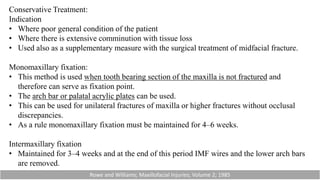
Conservative Treatment:
Indication
• Where poor general condition of the patient
• Where there is extensive comminution with tissue loss
• Used also as a supplementary measure with the surgical treatment of midfacial fracture.
Monomaxillary fixation:
• This method is used when tooth bearing section of the maxilla is not fractured and
therefore can serve as fixation point.
• The arch bar or palatal acrylic plates can be used.
• This can be used for unilateral fractures of maxilla or higher fractures without occlusal
discrepancies.
• As a rule monomaxillary fixation must be maintained for 4–6 weeks.
Intermaxillary fixation
• Maintained for 3–4 weeks and at the end of this period IMF wires and the lower arch bars
are removed.
Rowe and Williams; Maxillofacial Injuries; Volume 2; 1985
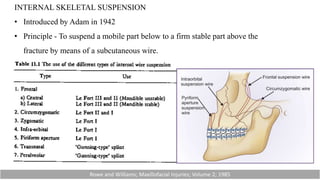
INTERNAL SKELETAL SUSPENSION
• Introduced by Adam in 1942
• Principle - To suspend a mobile part below to a firm stable part above the
fracture by means of a subcutaneous wire.
Rowe and Williams; Maxillofacial Injuries; Volume 2; 1985
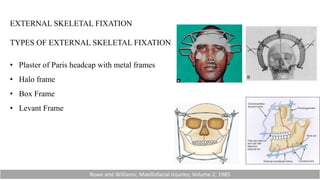
EXTERNAL SKELETAL FIXATION
TYPES OF EXTERNAL SKELETAL FIXATION
• Plaster of Paris headcap with metal frames
• Halo frame
• Box Frame
• Levant Frame
Rowe and Williams; Maxillofacial Injuries; Volume 2; 1985
INTERNAL SKELETAL FIXATION
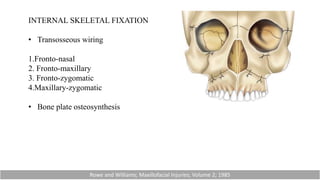
• Transosseous wiring
1.Fronto-nasal
2. Fronto-maxillary
3. Fronto-zygomatic
4.Maxillary-zygomatic
• Bone plate osteosynthesis
Rowe and Williams; Maxillofacial Injuries; Volume 2; 1985
ORIF OF LE FORT TYPE I FRACTURES
Maxillary vestibular approach
• Incision are made in the buccal vestibule in a circumvestibular fashion, from the first
premolar to the first premolar on the opposite side.
• This approach allows visualization of the lateral antral wall and zygomatic buttresses.
• A Rowe or Hayton-Williams forceps can then be used to complete the reduction, if
necessary.
• The patient is first placed in MMF to reestablish the
pretraumatic occlusal relationship.
• Four-point fixation along the pyriform and
zygomaticomaxillary buttresses is routinely provided
for stability of this fracture pattern.
• Occlusion should be immediately rechecked
following release of MMF.
Raymond.J Fonseca; Oral & maxillofacial trauma; fourth edition; 2013, Saunders, Elsevier Inc
ORIF OF LE FORT TYPE II FRACTURES
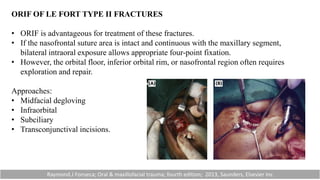
• ORIF is advantageous for treatment of these fractures.
• If the nasofrontal suture area is intact and continuous with the maxillary segment,
bilateral intraoral exposure allows appropriate four-point fixation.
• However, the orbital floor, inferior orbital rim, or nasofrontal region often requires
exploration and repair.
Approaches:
• Midfacial degloving
• Infraorbital
• Subciliary
• Transconjunctival incisions.
Raymond.J Fonseca; Oral & maxillofacial trauma; fourth edition; 2013, Saunders, Elsevier Inc
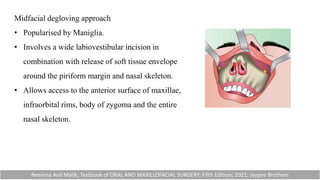
Midfacial degloving approach
• Popularised by Maniglia.
• Involves a wide labiovestibular incision in
combination with release of soft tissue envelope
around the piriform margin and nasal skeleton.
• Allows access to the anterior surface of maxillae,
infraorbital rims, body of zygoma and the entire
nasal skeleton.
Neelima Anil Malik; Textbook of ORAL AND MAXILLOFACIAL SURGERY; Fifth Edition; 2021; Jaypee Brothers
ORIF OF LE FORT TYPE III FRACTURES
Gruss et al
• Reconstruction begins with the outer framework and progresses to the inward
facial structures, from stable to unstable areas.
• A stable outer framework - reduction and fixation of the zygomaticofrontal,
zygomaticotemporal and nasofrontal sutures
• Once the outer framework has been established - the nasal skeleton and floors of
the orbits, correct any lacrimal system disorders and reestablish the proper
positioning of the medial canthal ligaments.
• Therefore, one works from the lateral superior to inferior medial direction to
correct the Le Fort type III deformity.
Markowitz and Manson,
• Focused on reestablishing facial width at the NOE complex and proceeding in
laterally
Raymond.J Fonseca; Oral & maxillofacial trauma; fourth edition; 2013, Saunders, Elsevier Inc
Coronal approach
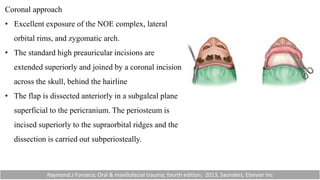
• Excellent exposure of the NOE complex, lateral
orbital rims, and zygomatic arch.
• The standard high preauricular incisions are
extended superiorly and joined by a coronal incision
across the skull, behind the hairline
• The flap is dissected anteriorly in a subgaleal plane
superficial to the pericranium. The periosteum is
incised superiorly to the supraorbital ridges and the
dissection is carried out subperiosteally.
Raymond.J Fonseca; Oral & maxillofacial trauma; fourth edition; 2013, Saunders, Elsevier Inc
• The temporalis fascia is also incised superiorly to
the supraorbital rims, extending from the
preauricular incision medially to join the superior
dissection.
• This technique allows reflection of the superficial
flap containing the temporalis branch of the facial
nerve and thereby prevents injury.
• The zygomaticofrontal, zygomaticotemporal and
nasofrontal sutures are well exposed
Raymond.J Fonseca; Oral & maxillofacial trauma; fourth edition; 2013, Saunders, Elsevier Inc
Special Considerations
High-Force or Avulsive Injuries
• Preserve as much of the remaining tissue as possible.
• Should be thoroughly evaluated for bleeding, foreign bodies, and extent of damage.
Extensive irrigation with pulsed fluids should be used to remove debris.
• Fractures should be repaired with rigid fixation.
Soft tissue lacerations:
• To cover exposed bone or to correct oronasal or oroantral fistulas - Advancement flaps
• If too little soft tissue exists - vascularized free flaps
Peterson’s Principles of Oral and Maxillofacial Surgery - Third Edition; 2011; PEOPLE’S MEDICAL PUBLISHING HOUSE—USA
Injuries to Geriatric Patients:
• The geriatric maxilla is less vascular and has more pneumatized antra, less alveolar
bone, and less dense trabeculation.
• Existing dentures may be modified by relining and affixing arch bars or intermaxillary
fixation buttons.
• Gunning splint may also be fabricated.
• Splint may be fixed to the zygoma, the anterior nasal spine, the piriform rim, or the
palate, with either wires or cortical bone screws.
• For geriatric patients, additional medical illnesses and disabilities may increase the risk
of morbidity due to general anesthesia.
Peterson’s Principles of Oral and Maxillofacial Surgery - Third Edition; 2011; PEOPLE’S MEDICAL PUBLISHING HOUSE—USA
Pediatric Maxillary Fractures
• The pediatric sinuses are not highly pneumatized - tend to be less comminuted in children
than in adults.
• The use of occlusal splints and skeletal fixation should be considered.
• Skeletal fixation is indicated for mobile, displaced maxillary fractures in pediatric patients.
• Avoiding the developing permanent tooth buds is an obvious concern when fixation
devices are placed.
• Metal fixation systems - complications of translocation, extrusion, and growth restriction
and consideration should be given to the removal of hardware in the growing patient.
• Resorbable plating systems - potential complications of translocation, extrusion and growth
restriction can be avoided.
Peterson’s Principles of Oral and Maxillofacial Surgery - Third Edition; 2011; PEOPLE’S MEDICAL PUBLISHING HOUSE—USA
Complications Associated with Maxillary Fractures
Peterson’s Principles of Oral and Maxillofacial Surgery - Third Edition; 2011; PEOPLE’S MEDICAL PUBLISHING HOUSE—USA
Mid facial units:
a single nasal unit, two symmetric alveolar,
paranasal and zygomatic units.
Thank you

Midface fracture.pptx

  • 1.
  • 2.
    Contents: • Introduction • Classification •Le Fort Type I Fractures • Le Fort Type II Fractures • Le Fort Type III Fractures • Management • Complications
  • 3.
    Introduction: Middle third ofthe facial skeleton is defined as “an area bounded Superiorly - a line drawn across the skull from the Frontozygomatic (FZ) suture of one side, across the frontonasal and frontomaxillary sutures to the FZ suture on the opposite side Inferiorly - by the occlusal plane of the upper teeth, or, if the patient is edentulous, by the upper alveolar ridge Posteriorly - by the spheno-ethmoidal junction, but includes the pterygoid laminae of the sphenoid bone inferiorly “ Middle third of the facial skeleton can also be divided into two zones: 1. Central midface 2. Lateral midface
  • 4.
    Middle Third ofthe Face Paired bones - 8 Unpaired bones - 2 • The two maxillae • The two palatine bones • The two zygomatic bones and their temporal processes • The two zygomatic processes of temporal bones • The two nasal bones • The two lacrimal bones • The two inferior conchae • The two pterygoid plates of the sphenoid • The ethmoid bone -unpaired • The vomer—unpaired single bone
  • 5.
    Vertical and HorizontalPillars of the Maxillary Skeleton: • These bones are arranged in such a way that it can protect the associated functional units like brain, orbit and airway. • Around these important functional units dense bony struts are arranged in a system of vertical, transverse and horizontal buttresses, act as energy-absorbing shields. Vertical Pillars • Anterior or the canine pillar • Middle or zygomatic pillar • Posterior or pterygoid pillar Horizontal Pillars • Supraorbital rims with frontal bone • Infraorbital rims • Alveolar process
  • 6.
    • The maxillais capable of absorbing considerable force by transmission of the force to the adjacent articulating bones. • Midface acts as a cushion for the trauma directed towards the cranium from the anterior or anterolateral direction analogous to a “matchbox” sitting below and in front of a hard shell containing the brain. Neelima Anil Malik; Textbook of ORAL AND MAXILLOFACIAL SURGERY; Fifth Edition; 2021; Jaypee Brothers
  • 7.
    Classification Rene LeFort in1901 Broadly subdivided into three groups: • LeFort I • LeFort II • LeFort III Neelima Anil Malik; Textbook of ORAL AND MAXILLOFACIAL SURGERY; Fifth Edition; 2021; Jaypee Brothers
  • 8.
    Erich’s (1942) • Horizontalfracture • Pyramidal fracture • Transverse fracture Neelima Anil Malik; Textbook of ORAL AND MAXILLOFACIAL SURGERY; Fifth Edition; 2021; Jaypee Brothers
  • 9.
    Rowe and William’s(1985) Fractures not Involving the Dentoalveolar Component • Central region: Fractures of the nasal bones and/or nasal septum. Lateral nasal injuries Anterior nasal injuries Fractures of the frontal process of the maxilla. Fractures of nasoethmoid Fractures of Fronto-orbito-nasal • Lateral region: Fractures involving the zygomatic bone, arch and maxilla [zygomaticomaxillary complex (ZMC)] excluding the dentoalveolar component. Rowe and Williams; Maxillofacial Injuries; Volume 2; 1985
  • 10.
    Rowe and William’s(1985) Fractures Involving the Dentoalveolar Component • Central region: Dentoalveolar fractures Subzygomatic fracture LeFort I (low level or Guerin) LeFort II (pyramidal) • Combined central and lateral region fractures: High level, suprazygomatic fractures—LeFort III LeFort III with midline split LeFort III with midline split + fracture of the roof of the orbit or frontal bone Neelima Anil Malik; Textbook of ORAL AND MAXILLOFACIAL SURGERY; Fifth Edition; 2021; Jaypee Brothers
  • 11.
    Neelima Anil Malik;Textbook of ORAL AND MAXILLOFACIAL SURGERY; Fifth Edition; 2021; Jaypee Brothers
  • 12.
    Neelima Anil Malik;Textbook of ORAL AND MAXILLOFACIAL SURGERY; Fifth Edition; 2021; Jaypee Brothers
  • 13.
  • 14.
    LeFort I Fracture(Low Level, Subzygomatic Fracture) - Horizontal fracture of the maxilla - Guerin’s fracture or floating fracture, as there is a separation of complete dentoalveolar part of the maxilla (pterygomaxillary dysjunction) and the fractured fragment is held only by means of soft tissues. Etiology: A violent force applied above the level of the teeth below the anterior nasal spine tends to cause LeFort I fracture Raymond.J Fonseca; Oral & maxillofacial trauma; fourth edition; 2013, Saunders, Elsevier Inc
  • 15.
    LeFort I Fracture Thefracture line extends backwards along the maxilla from the pyriform fossa. • Medially—lower third of the nasal septum—lateral margin of the anterior nasal aperture proceeding posteriorly to join the lateral fracture behind the tuberosity. • Laterally—lateral margin of the anterior nasal aperture— lateral wall of maxillary sinus below the zygomatic buttress—the lower one-third of the pterygoid laminae and associated palatine bone Raymond.J Fonseca; Oral & maxillofacial trauma; fourth edition; 2013, Saunders, Elsevier Inc
  • 16.
    Signs and Symptomsof LeFort I Fracture: • Mobility of the upper dentoalveolar portion • Slight swelling and edema of the lower part of the face along with the upper lip swelling • Ecchymosis in the labial and buccal vestibule. • Bilateral epistaxis or nasal bleeding may be observed. • Occlusion may be disturbed. • Open bite deformity - pull of the medial and lateral pterygoid muscles may contribute to displacement of the fractured segment in a posterior and inferior direction • Percussion of the maxillary teeth - dull “cracked cup/pot” sound. • Midpalatal split may be found in some cases. • Guerin’s sign: It is characterized by ecchymosis on the palatal side in the region of greater palatine foramen Raymond.J Fonseca; Oral & maxillofacial trauma; fourth edition; 2013, Saunders, Elsevier Inc
  • 17.
    LeFort II Fracture Alsocalled as Pyramidal or Subzygomatic fracture Etiology: Violent force, usually from an anterior direction, sustained by the central region of the middle third of the facial skeleton over an area extending from the glabella to the alveolar margin results in a fracture of a pyramidal shape. Raymond.J Fonseca; Oral & maxillofacial trauma; fourth edition; 2013, Saunders, Elsevier Inc
  • 18.
    LeFort II fractureline: This fracture runs anteriorly— frontonasal junction crossing the frontal processes of the maxillae, into the medial wall of each orbit, crosses the lacrimal bone behind the lacrimal sac— turns forward to cross the infraorbital margin—slightly medial to or through the infraorbital foramen—extends downwards and backwards across the lateral wall of the antrum—below the zygomaticomaxillary suture—middle one-third of the pterygoid laminae horizontally Posteromedially—separation of the block from the base of the skull is completed via the nasal septum and may involve the floor of the anterior cranial fossa. Raymond.J Fonseca; Oral & maxillofacial trauma; fourth edition; 2013, Saunders, Elsevier Inc
  • 19.
    Signs and Symptomsof LeFort II Fracture: • Gross edema of the middle third of the face known as ballooning or moon face. • Presence of bilateral circumorbital edema and ecchymosis (black eye). • Bilateral subconjunctival hemorrhage confined to medial half of the eye. • The bridge of the nose will be depressed (flat face). • If there is impaction of the fragment against the cranial base, then shortening of the face with anterior open bite will be seen. • If there is gross downward and backward displacement of the fragment, then elongation or lengthening of the face will be seen with posterior gagging of the occlusion with anterior open bite (dish-shaped face). Raymond.J Fonseca; Oral & maxillofacial trauma; fourth edition; 2013, Saunders, Elsevier Inc
  • 20.
    • Mobility ofthe midface. • Bilateral epistaxis may be present. • Loss of occlusion may be seen. • Airway obstruction may be seen due to posterior and downward displacement of the fragment impinging on the dorsum of the tongue. • Surgical emphysema—crackling sensation transmitted to the fingers due to escape of air from the paranasal sinuses is seen. • CSF rhinorrhea/leak may be present. • Step deformity at the infraorbital margins may be seen. Helps to differentiate from LeFort III fracture. • Paresthesia of the cheek is noted. Raymond.J Fonseca; Oral & maxillofacial trauma; fourth edition; 2013, Saunders, Elsevier Inc
  • 21.
    LeFort III Fracture Itis also known as high level fracture or Transverse or Suprazygomatic Fracture Etiology: • The force is usually applied from the lateral direction with a severe impact. • The fracture line extends above the zygomatic bones on both sides as a result of trauma being inflicted over a wider area, at the orbital level. • Initial impact is taken by the zygomatic bone resulting in depressed fracture • Severe degree of the impact, the entire middle third will hinge about the fragile ethmoid bone and the impact will then be transmitted on the contralateral side resulting in laterally displaced zygomatic fracture of the opposite side (craniofacial dysjunction) Raymond.J Fonseca; Oral & maxillofacial trauma; fourth edition; 2013, Saunders, Elsevier Inc
  • 22.
    LeFort III fractureline: Fracture line extends from • Anteriorly: The fronto nasal suture—transversely backwards, parallel with base of the skull, to full depth of the ethmoid bone including the cribriform plate. • Posteromedially: Within the orbit—the fracture passes below the optic foramen into the posterior limit of the inferior orbital fissure. From the base of the inferior orbital fissure, the fracture line extends in two directions: i. Backwards across the maxillary fissure to fracture the roots of the pterygoid laminae ii. Laterally across the lateral wall of the orbit separating the zygomatic bone from the frontal bone Raymond.J Fonseca; Oral & maxillofacial trauma; fourth edition; 2013, Saunders, Elsevier Inc
  • 23.
    LeFort III fractureline: Fracture line extends from • Posterolaterally: From the orbit—inferior orbital fissure—lateral wall of orbit into the frontozygomatic suture. In addition, fracture of the zygomatic arch is an integral part of Le Fort III completing the separation of facial bones from cranium. Raymond.J Fonseca; Oral & maxillofacial trauma; fourth edition; 2013, Saunders, Elsevier Inc
  • 24.
    Clinical Signs andSymptoms of LeFort III Fracture: • Gross edema of the face, ballooning. “Panda facies” • Bilateral circumorbital/periorbital ecchymosis and gross edema “Racoon eyes”. • Gross circumorbital edema will prevent eyes from opening. • Bilateral subconjunctival hemorrhage, where posterior limit will not be seen, when patient is asked to look medially. • Unilateral or bilateral hooding of the eyes is seen. • Orbital dystopia with associated Antimongoloid slant. Raymond.J Fonseca; Oral & maxillofacial trauma; fourth edition; 2013, Saunders, Elsevier Inc
  • 25.
    • Characteristic “dishface” deformity. • May be enophthalmos, diplopia or impairment of vision, temporary blindness, etc. • Flattening and widening, deviation of the nasal bridge. • Epistaxis, CSF rhinorrhea. • Battles’s sign-mastoid ecchymosis- Suggestive of fracture of posterior cranial fossa of the skull and brain trauma. • Disturbed/deranged occlusion, posterior gagging anterior open bite and retroposition of maxilla will cause airway obstruction Raymond.J Fonseca; Oral & maxillofacial trauma; fourth edition; 2013, Saunders, Elsevier Inc
  • 26.
    Clinical examination Step 1:Left palm is placed over the forehead, with the thumb over right lateral orbital rim (frontozygomatic junction), index finger over left frontozygomatic junction or alternatively the frontonasal junction can also be assessed simultaneously. Step 2: The maxilla is grasped firmly at the anterior portion of alveolus and not the teeth. The maxilla is checked for mobility with concurrent mobility in bilateral frontozygomatic junction. Step 3: Frontonasal junction at the root of nose is grasped with left thumb and index finger while palm stabilises the cranium at forehead. Step 4: Repeat step 2 checking for dental segment maxilla mobility with concurrent mobility in frontonasal junction. Step 5: Place two fingers as of left hand one on each infraorbital rim, all the time palm stabilises the cranium at forehead. Step 6: Repeat step 2 and check for concurrent mobility felt at both infraorbital rims. S M Balaji; Textbook of Oral & maxillofacial surgery; 3rd edition; 2019, Elsevier Inc
  • 27.
    Radiographic examination • Waters’view (occipito-mental) • Caldwell view (PA view) • lateral view and • submentovertex view. Waters’ projection gives a detailed evaluation of the facial skeleton. S M Balaji; Textbook of Oral & maxillofacial surgery; 3rd edition; 2019, Elsevier Inc
  • 28.
    McGrigor and Campbell(1950) Described a system for examining the occipito-mental film by following four lines, which cover most of the sites of injury. 1. First line across the zygomaticofrontal sutures, the superior margin of the orbit and the frontal sinus 2. Second line across the zygomatic arch, zygomatic body, inferior orbital margin and nasal bone 3. Third line across the condyles, coronoid process and the maxillary sinus 4. Fourth line across the mandibular ramus, occlusal plane 5. Fifth line (Trapnell’s line) across the inferior border of the mandible from angle to angle S M Balaji; Textbook of Oral & maxillofacial surgery; 3rd edition; 2019, Elsevier Inc
  • 29.
    On occipitomental skullradiograph Dolan’s lines 1 orbital 2 zygomatic 3 maxillary Elephant’s of Rogers The zygomatic and maxillary lines together form visual appearance resembling head of elephant • Thus, a fracture of the zygomatic process appears as a break in the elephant’s trunk and a fracture of the orbital rim appears as an irregularity in the elephant’s ear.
  • 30.
    Computed tomography (CT) •Conventional radiographic examination is uncertain and sometimes misleading. • CT scan of the face provides a vivid evaluation of facial pathology than the conventional radiography. • Axial and reconstructed coronal images. • 3D reconstruction of the CT scan aids in diagnosis and treatment planning. S M Balaji; Textbook of Oral & maxillofacial surgery; 3rd edition; 2019, Elsevier Inc
  • 32.
    Pre-operative planning 1. Thetype of fixation required, i.e. internal or external skeletal fixation 2. The need for open reduction and the application of direct transosseous wiring or bone plates 3. The type of intermaxillary fixation required i.e. interdental eyelets, arch bars, silver cap splints or 'Gunning-type’ splints 4. The need for tracheostomy; this should be agreed with the anaesthetist Rowe and Williams; Maxillofacial Injuries; Volume 2; 1985
  • 33.
    Neelima Anil Malik;Textbook of ORAL AND MAXILLOFACIAL SURGERY; Fifth Edition; 2021; Jaypee Brothers
  • 34.
    METHODS OF REDUCTIONFOR MIDFACE FRACTURES • Closed reduction: Alignment without visualization of fracture Reduction by instruments manipulation Reduction by traction Intraoral traction reduction Extraoral traction reduction • Open reduction: Direct surgical exposure of the fracture Neelima Anil Malik; Textbook of ORAL AND MAXILLOFACIAL SURGERY; Fifth Edition; 2021; Jaypee Brothers
  • 35.
    Reduction by usingspecial instruments Rowe’s maxillary disimpaction forceps • Available as pairs - right and left forceps. • These are two pronged forceps, where one prong fits into the nasal floor and another one on the hard palate. Hayton Williams forceps • Anterior traction in the case of a split palate may be facilitated • These are applied to the buccal aspect of the alveolar process and medial compression exerted until the two halves of the upper jaw are approximated. Neelima Anil Malik; Textbook of ORAL AND MAXILLOFACIAL SURGERY; Fifth Edition; 2021; Jaypee Brothers
  • 36.
    Reduction by Traction Whenattempted manual reduction is met with failure, then reduction by elastic traction is tried to interdigitate the fractured fragments. In delayed cases, where the fracture is 10–14 days old and no longer sufficiently mobile. Intraoral elastic traction • Intermaxillary elastic traction • Once the satisfactory occlusion is achieved, it is replaced by IMF. Extraoral elastic traction • Extension bars and side bars. Neelima Anil Malik; Textbook of ORAL AND MAXILLOFACIAL SURGERY; Fifth Edition; 2021; Jaypee Brothers
  • 37.
    Conservative Treatment: Indication • Wherepoor general condition of the patient • Where there is extensive comminution with tissue loss • Used also as a supplementary measure with the surgical treatment of midfacial fracture. Monomaxillary fixation: • This method is used when tooth bearing section of the maxilla is not fractured and therefore can serve as fixation point. • The arch bar or palatal acrylic plates can be used. • This can be used for unilateral fractures of maxilla or higher fractures without occlusal discrepancies. • As a rule monomaxillary fixation must be maintained for 4–6 weeks. Intermaxillary fixation • Maintained for 3–4 weeks and at the end of this period IMF wires and the lower arch bars are removed. Rowe and Williams; Maxillofacial Injuries; Volume 2; 1985
  • 38.
    INTERNAL SKELETAL SUSPENSION •Introduced by Adam in 1942 • Principle - To suspend a mobile part below to a firm stable part above the fracture by means of a subcutaneous wire. Rowe and Williams; Maxillofacial Injuries; Volume 2; 1985
  • 39.
    EXTERNAL SKELETAL FIXATION TYPESOF EXTERNAL SKELETAL FIXATION • Plaster of Paris headcap with metal frames • Halo frame • Box Frame • Levant Frame Rowe and Williams; Maxillofacial Injuries; Volume 2; 1985
  • 40.
    INTERNAL SKELETAL FIXATION •Transosseous wiring 1.Fronto-nasal 2. Fronto-maxillary 3. Fronto-zygomatic 4.Maxillary-zygomatic • Bone plate osteosynthesis Rowe and Williams; Maxillofacial Injuries; Volume 2; 1985
  • 41.
    ORIF OF LEFORT TYPE I FRACTURES Maxillary vestibular approach • Incision are made in the buccal vestibule in a circumvestibular fashion, from the first premolar to the first premolar on the opposite side. • This approach allows visualization of the lateral antral wall and zygomatic buttresses. • A Rowe or Hayton-Williams forceps can then be used to complete the reduction, if necessary. • The patient is first placed in MMF to reestablish the pretraumatic occlusal relationship. • Four-point fixation along the pyriform and zygomaticomaxillary buttresses is routinely provided for stability of this fracture pattern. • Occlusion should be immediately rechecked following release of MMF. Raymond.J Fonseca; Oral & maxillofacial trauma; fourth edition; 2013, Saunders, Elsevier Inc
  • 42.
    ORIF OF LEFORT TYPE II FRACTURES • ORIF is advantageous for treatment of these fractures. • If the nasofrontal suture area is intact and continuous with the maxillary segment, bilateral intraoral exposure allows appropriate four-point fixation. • However, the orbital floor, inferior orbital rim, or nasofrontal region often requires exploration and repair. Approaches: • Midfacial degloving • Infraorbital • Subciliary • Transconjunctival incisions. Raymond.J Fonseca; Oral & maxillofacial trauma; fourth edition; 2013, Saunders, Elsevier Inc
  • 43.
    Midfacial degloving approach •Popularised by Maniglia. • Involves a wide labiovestibular incision in combination with release of soft tissue envelope around the piriform margin and nasal skeleton. • Allows access to the anterior surface of maxillae, infraorbital rims, body of zygoma and the entire nasal skeleton. Neelima Anil Malik; Textbook of ORAL AND MAXILLOFACIAL SURGERY; Fifth Edition; 2021; Jaypee Brothers
  • 44.
    ORIF OF LEFORT TYPE III FRACTURES Gruss et al • Reconstruction begins with the outer framework and progresses to the inward facial structures, from stable to unstable areas. • A stable outer framework - reduction and fixation of the zygomaticofrontal, zygomaticotemporal and nasofrontal sutures • Once the outer framework has been established - the nasal skeleton and floors of the orbits, correct any lacrimal system disorders and reestablish the proper positioning of the medial canthal ligaments. • Therefore, one works from the lateral superior to inferior medial direction to correct the Le Fort type III deformity. Markowitz and Manson, • Focused on reestablishing facial width at the NOE complex and proceeding in laterally Raymond.J Fonseca; Oral & maxillofacial trauma; fourth edition; 2013, Saunders, Elsevier Inc
  • 45.
    Coronal approach • Excellentexposure of the NOE complex, lateral orbital rims, and zygomatic arch. • The standard high preauricular incisions are extended superiorly and joined by a coronal incision across the skull, behind the hairline • The flap is dissected anteriorly in a subgaleal plane superficial to the pericranium. The periosteum is incised superiorly to the supraorbital ridges and the dissection is carried out subperiosteally. Raymond.J Fonseca; Oral & maxillofacial trauma; fourth edition; 2013, Saunders, Elsevier Inc
  • 46.
    • The temporalisfascia is also incised superiorly to the supraorbital rims, extending from the preauricular incision medially to join the superior dissection. • This technique allows reflection of the superficial flap containing the temporalis branch of the facial nerve and thereby prevents injury. • The zygomaticofrontal, zygomaticotemporal and nasofrontal sutures are well exposed Raymond.J Fonseca; Oral & maxillofacial trauma; fourth edition; 2013, Saunders, Elsevier Inc
  • 48.
    Special Considerations High-Force orAvulsive Injuries • Preserve as much of the remaining tissue as possible. • Should be thoroughly evaluated for bleeding, foreign bodies, and extent of damage. Extensive irrigation with pulsed fluids should be used to remove debris. • Fractures should be repaired with rigid fixation. Soft tissue lacerations: • To cover exposed bone or to correct oronasal or oroantral fistulas - Advancement flaps • If too little soft tissue exists - vascularized free flaps Peterson’s Principles of Oral and Maxillofacial Surgery - Third Edition; 2011; PEOPLE’S MEDICAL PUBLISHING HOUSE—USA
  • 49.
    Injuries to GeriatricPatients: • The geriatric maxilla is less vascular and has more pneumatized antra, less alveolar bone, and less dense trabeculation. • Existing dentures may be modified by relining and affixing arch bars or intermaxillary fixation buttons. • Gunning splint may also be fabricated. • Splint may be fixed to the zygoma, the anterior nasal spine, the piriform rim, or the palate, with either wires or cortical bone screws. • For geriatric patients, additional medical illnesses and disabilities may increase the risk of morbidity due to general anesthesia. Peterson’s Principles of Oral and Maxillofacial Surgery - Third Edition; 2011; PEOPLE’S MEDICAL PUBLISHING HOUSE—USA
  • 50.
    Pediatric Maxillary Fractures •The pediatric sinuses are not highly pneumatized - tend to be less comminuted in children than in adults. • The use of occlusal splints and skeletal fixation should be considered. • Skeletal fixation is indicated for mobile, displaced maxillary fractures in pediatric patients. • Avoiding the developing permanent tooth buds is an obvious concern when fixation devices are placed. • Metal fixation systems - complications of translocation, extrusion, and growth restriction and consideration should be given to the removal of hardware in the growing patient. • Resorbable plating systems - potential complications of translocation, extrusion and growth restriction can be avoided. Peterson’s Principles of Oral and Maxillofacial Surgery - Third Edition; 2011; PEOPLE’S MEDICAL PUBLISHING HOUSE—USA
  • 51.
    Complications Associated withMaxillary Fractures Peterson’s Principles of Oral and Maxillofacial Surgery - Third Edition; 2011; PEOPLE’S MEDICAL PUBLISHING HOUSE—USA
  • 52.
    Mid facial units: asingle nasal unit, two symmetric alveolar, paranasal and zygomatic units.
  • 53.

Editor's Notes

  • #7 Matchbox Violent forces to this region are dissipated or absorbed by fractures of the maxilla and other facial bones, and thus offer protection to the brain and spinal cord
  • #32 Coronal nonenhanced CT image shows bilateral Le Fort I, II, and III fractures. The lateral and medial maxillary buttresses (white lines) are fractured inferiorly and superiorly (junctions of white lines and black lines). To confirm the diagnosis, pterygomaxil_x0002_lary disjunction and fractures of the zygomatic arches would need to be observed on axial images.
  • #36 It is possible to combine the use of this forceps with Rowe’s maxillary disimpaction forceps. The stabilized maxillary block may then be disimpacted by rocking movement and brought forward