
• The middle third of the face consists of orbit,The middle third of the face consists of orbit,
nose, maxilla, zygoma, and nasoethmoidnose, maxilla, zygoma, and nasoethmoid
bone.bone.
• In 1901, René LeFort used 32 cadaversIn 1901, René LeFort used 32 cadavers
skulls and subjected them to various types ofskulls and subjected them to various types of
trauma, then he removed soft tissues andtrauma, then he removed soft tissues and
examined skulls:examined skulls:
• He found that generally if the face wasHe found that generally if the face was
fractured, the skull was not.fractured, the skull was not.
• He then stated that fractures occurredHe then stated that fractures occurred
through three weak lines in the facial bonythrough three weak lines in the facial bony
structures that protect the cranial cavity andstructures that protect the cranial cavity and
circumscribe the midfacecircumscribe the midface
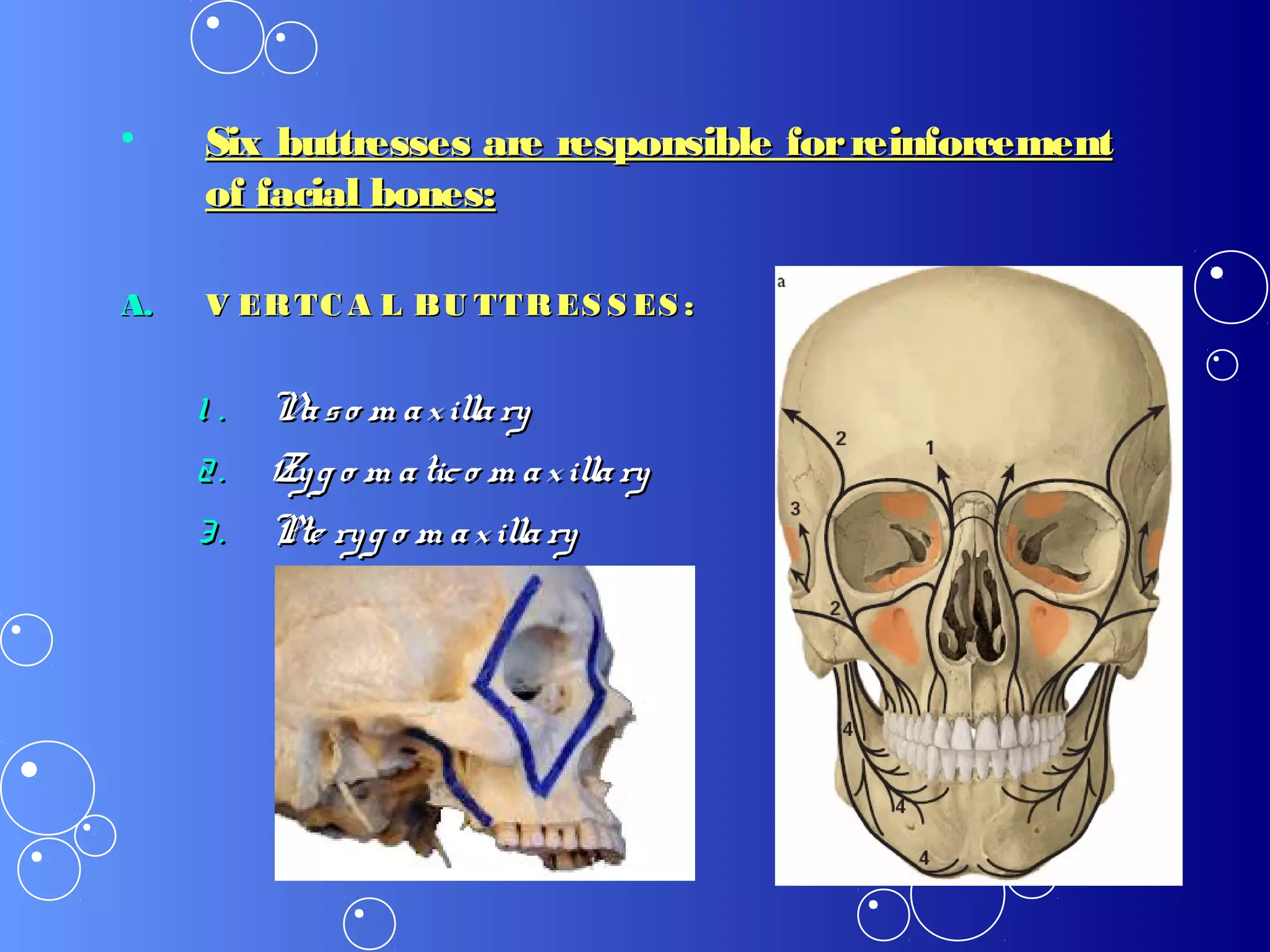
• Six buttresses are responsible forreinforcementSix buttresses are responsible forreinforcement
of facial bones:of facial bones:
A.A. V ERTC A L BU TTRES S ES :V ERTC A L BU TTRES S ES :
1 .1 . Naso m axillaryNaso m axillary
2.2. Zyg o m atico m axillaryZyg o m atico m axillary
3.3. Pte ryg o m axillaryPte ryg o m axillary
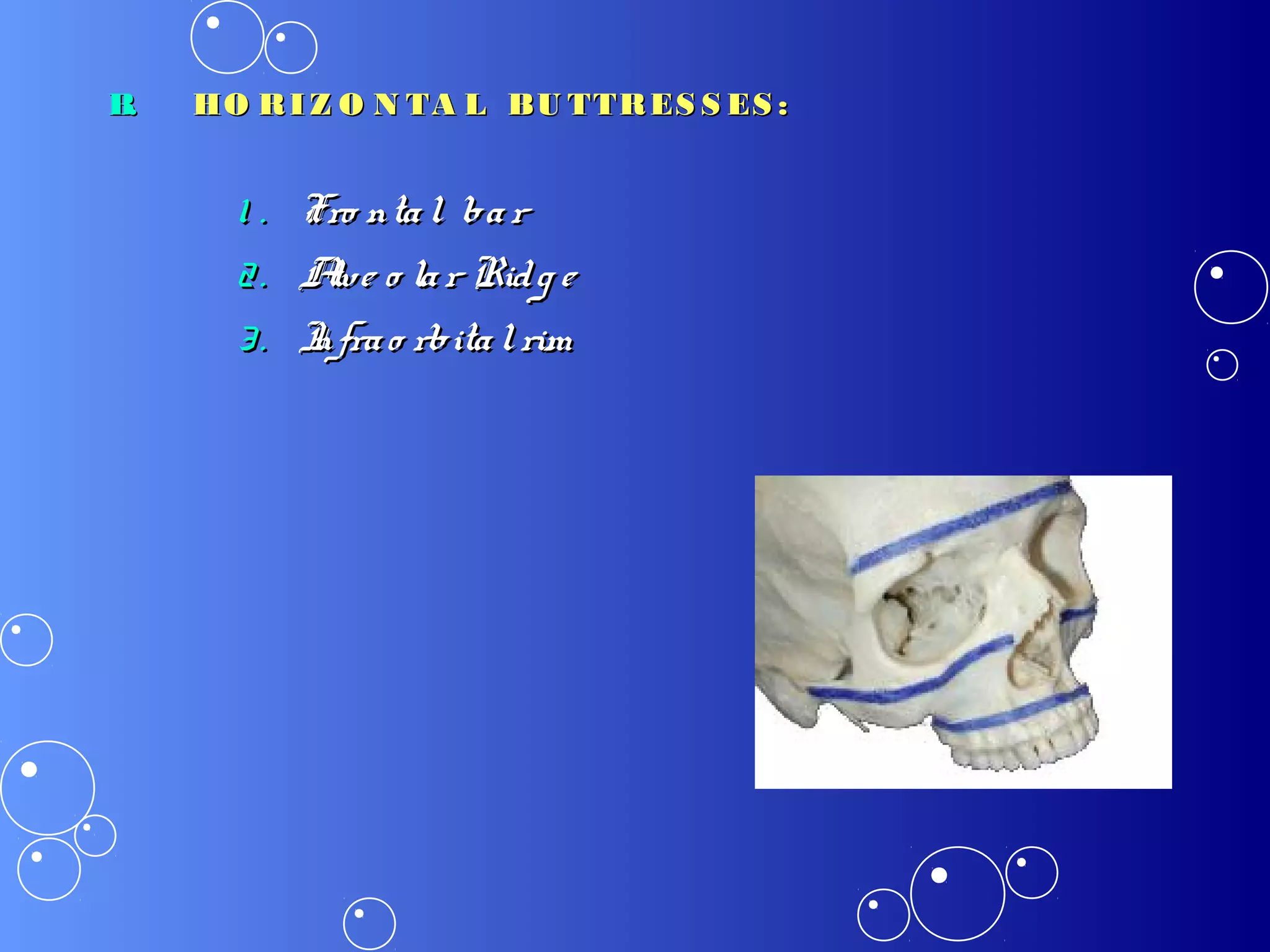
B.B. HO RIZ O N TA L BU TTRES S ES :HO RIZ O N TA L BU TTRES S ES :
1 .1 . Fro ntal barFro ntal bar
2.2. Alve o lar Ridg eAlve o lar Ridg e
3.3. Infrao rbitalrimInfrao rbitalrim
LeFort classification system
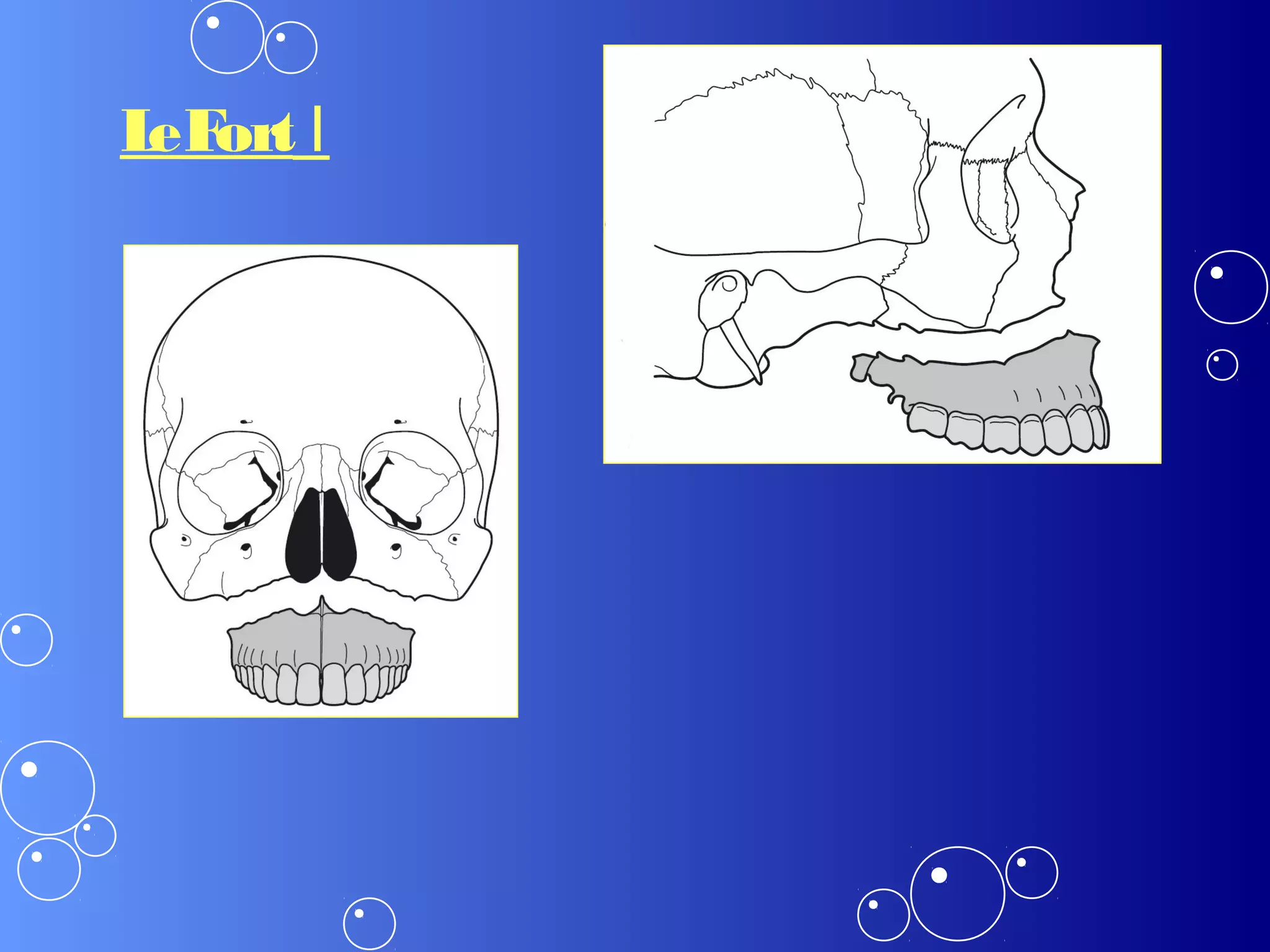
1.1. LeFortLeFort I (horizontal or transversefracture) :I (horizontal or transversefracture) :
• The fracture line extends above the rootThe fracture line extends above the root
apices from the piriform aperture of the nose.apices from the piriform aperture of the nose.
• The fractured segment includes:The fractured segment includes:
 MaxillaryMaxillary teethteeth
 alveolar bone,alveolar bone,
 part of the basal bone,part of the basal bone,
 lowerthird of nasal septumlowerthird of nasal septum
 lowerthird of pterygoid plates posteriorly.lowerthird of pterygoid plates posteriorly.
LeFort I
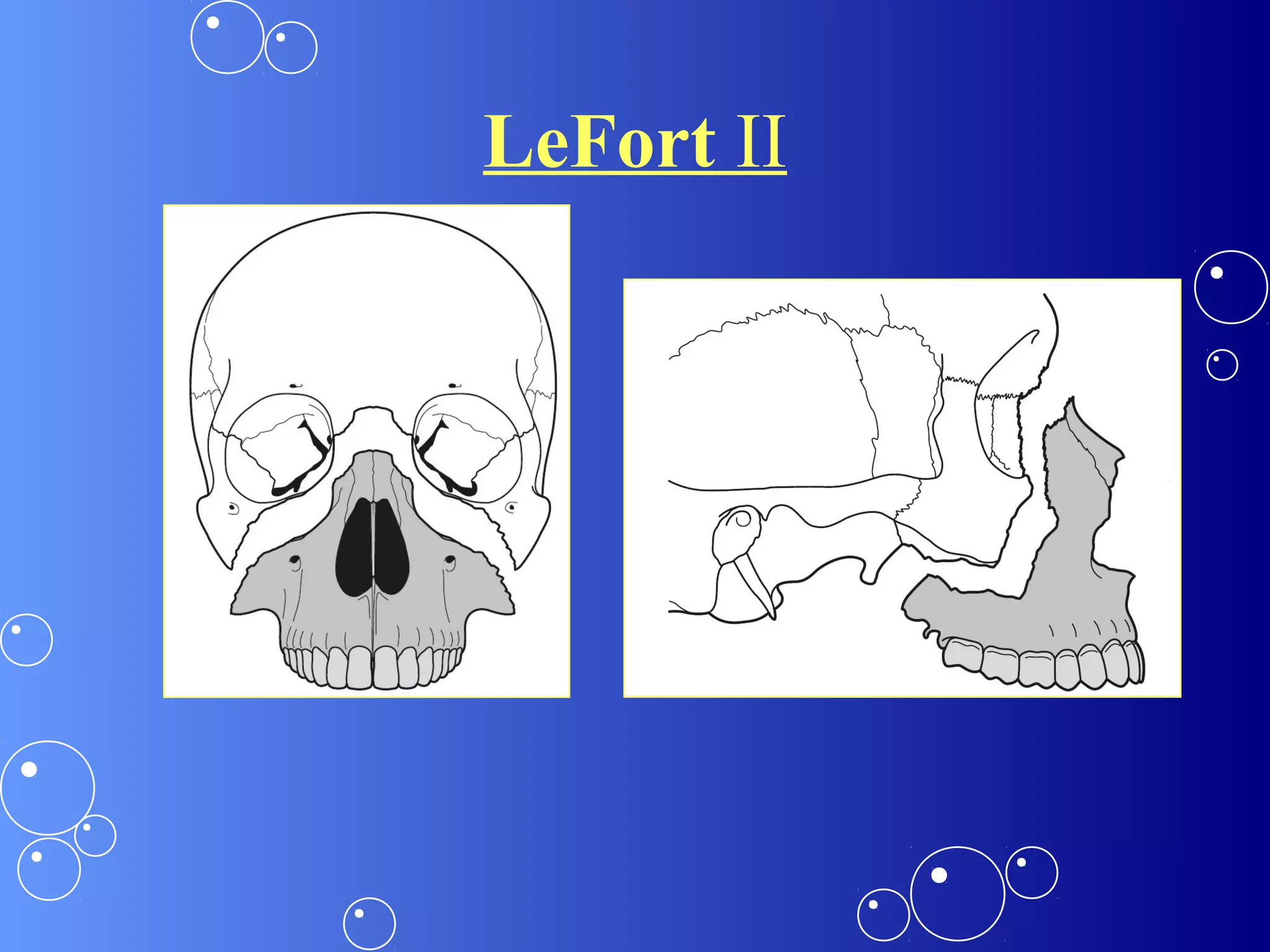
2.2. LeFortLeFort II:II:
• It involves most of the nasal bone.It involves most of the nasal bone.
• The fracture line extends from below theThe fracture line extends from below the
nasofrontal suture, through the nasal bonenasofrontal suture, through the nasal bone
along the maxilla to the zygomatico-maxillaryalong the maxilla to the zygomatico-maxillary
suture (suture (below the zygoma which is intact)below the zygoma which is intact) andand
include the medial inferior third of the orbit theninclude the medial inferior third of the orbit then
the fracture continuous till the pterygoid platesthe fracture continuous till the pterygoid plates
at a higher level thanat a higher level than lefort I.lefort I.
LeFort II
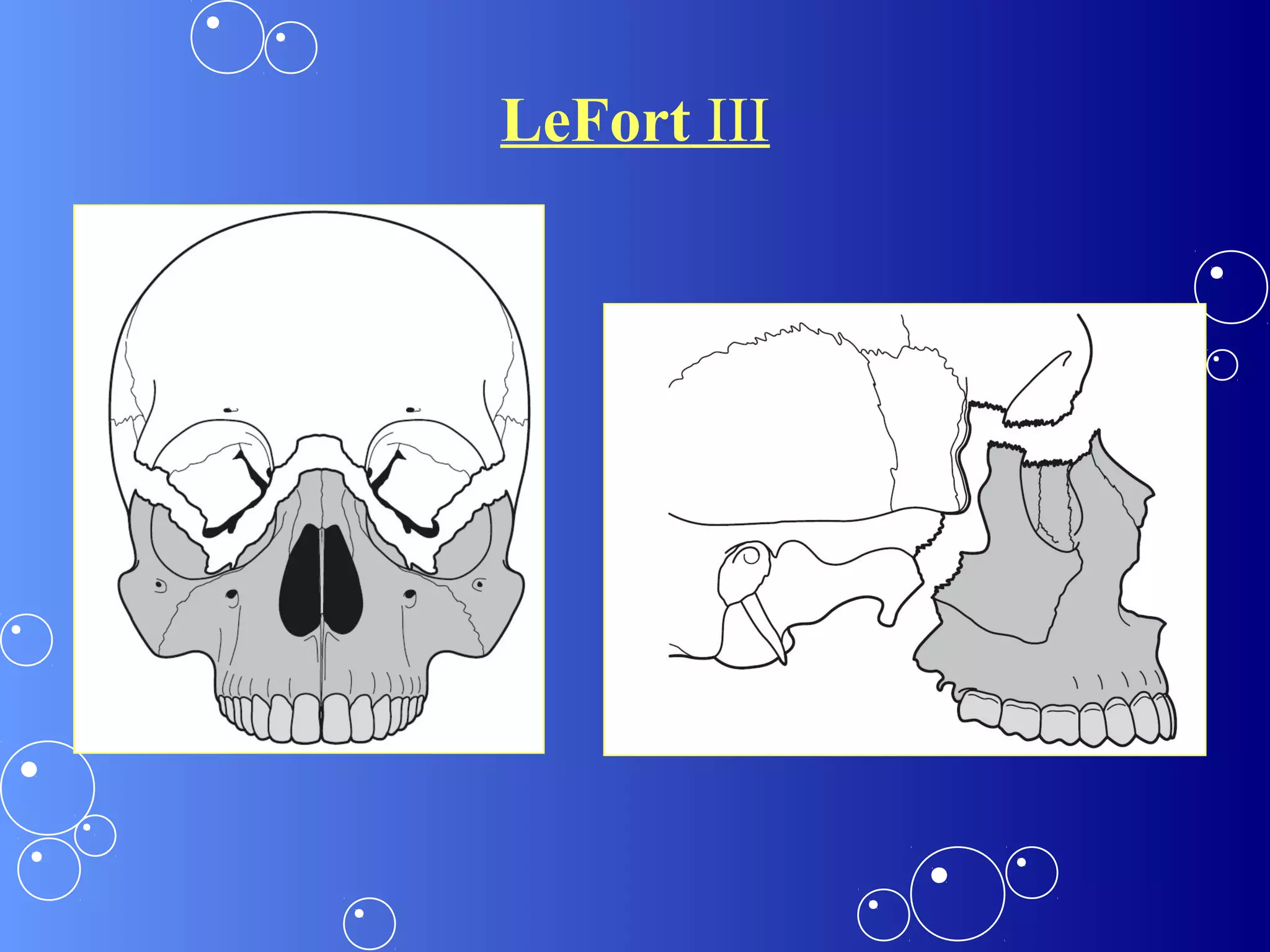
3.3. LeFort III:LeFort III:
• It separates the middle third from the cranium.It separates the middle third from the cranium.
• It involves most of the orbital bone.It involves most of the orbital bone.
• The fracture line extends from the nasofrontalThe fracture line extends from the nasofrontal
suture along the medial wall of the orbit throughsuture along the medial wall of the orbit through
the superior orbital fissure.the superior orbital fissure.
• It then extends along the inferior orbital fissuresIt then extends along the inferior orbital fissures
and the lateral orbital wall to theand the lateral orbital wall to the zygomatico-zygomatico-
frontalfrontal suture; thesuture; the zygomatico-temporalzygomatico-temporal suture issuture is
also separated.also separated.
• Then the fracture extend along the sphenoid boneThen the fracture extend along the sphenoid bone
separating the pterygoid plates.separating the pterygoid plates.
LeFort III
Clinical examination :
A.A. E X T R A O R A L E X A M I N A T I O N :E X T R A O R A L E X A M I N A T I O N :
• InspectionInspection
 Laceration of the skinLaceration of the skin..
 Abrasion& ecchymosis areasAbrasion& ecchymosis areas..
 Facial edemaFacial edema..
 EpistaxisEpistaxis..
 Cerebrospinal fluid leakageCerebrospinal fluid leakage..
 Asymmetry of the noseAsymmetry of the nose..
 Flat nasal bridgeFlat nasal bridge..
 Dish-shaped faceDish-shaped face..
• PalpationPalpation
 Bilateral palpation over the expected lines of fracture isBilateral palpation over the expected lines of fracture is
performed to feel bony steps or deformitiesperformed to feel bony steps or deformities
• ..
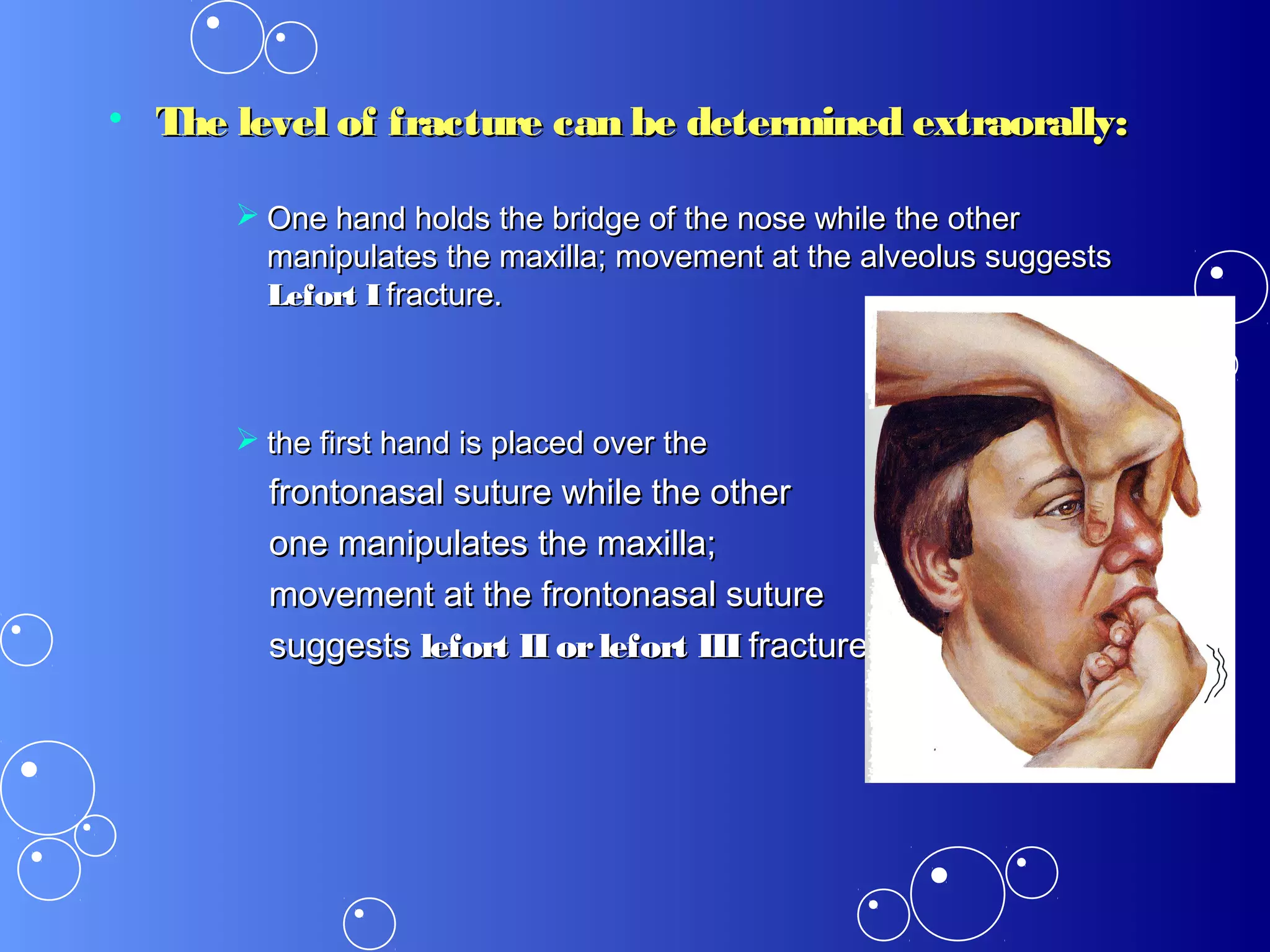
• The level of fracture can be determined extraorally:The level of fracture can be determined extraorally:
 One hand holds the bridge of the nose while the otherOne hand holds the bridge of the nose while the other
manipulates the maxilla; movement at the alveolus suggestsmanipulates the maxilla; movement at the alveolus suggests
Lefort ILefort I fracture.fracture.
 the first hand is placed over thethe first hand is placed over the
frontonasal suture while the otherfrontonasal suture while the other
one manipulates the maxilla;one manipulates the maxilla;
movement at the frontonasal suturemovement at the frontonasal suture
suggestssuggests lefort II orlefort IIIlefort II orlefort III fractures.fractures.
B.B. I N T R A O R A L E X A M I N A T I O N :I N T R A O R A L E X A M I N A T I O N :
• InspectionInspection
 Fractured teethFractured teeth..
 Vestibular ecchymosis & edemaVestibular ecchymosis & edema..
 Mucosal laceration & bleedingMucosal laceration & bleeding..
 Steps or diastema in the maxillary teethSteps or diastema in the maxillary teeth..
 MalocclusionMalocclusion..
• PalpationPalpation
 Step deformity in the occlusal plane or theStep deformity in the occlusal plane or the
alveolar ridge in case of edentulous patient.alveolar ridge in case of edentulous patient.
Imaging:
1.1. Axial & coronal CT scan:Axial & coronal CT scan:
 The coronal CT scan is the best diagnostic radiographThe coronal CT scan is the best diagnostic radiograph
in case of suspected orbital floor fractures.in case of suspected orbital floor fractures.
 It can demonstrate soft tissue differences of hematomaIt can demonstrate soft tissue differences of hematoma..
 it can demonstrate edema of subcutaneous tissue,it can demonstrate edema of subcutaneous tissue,
muscle and fat.muscle and fat.
2.2. Postero-anteriorviewPostero-anteriorview
3.3. Waters viewWaters view
4.4. Lateral viewLateral view
5.5. Occipitomental viewOccipitomental view
Treatment
I.I. ReductionReduction ::
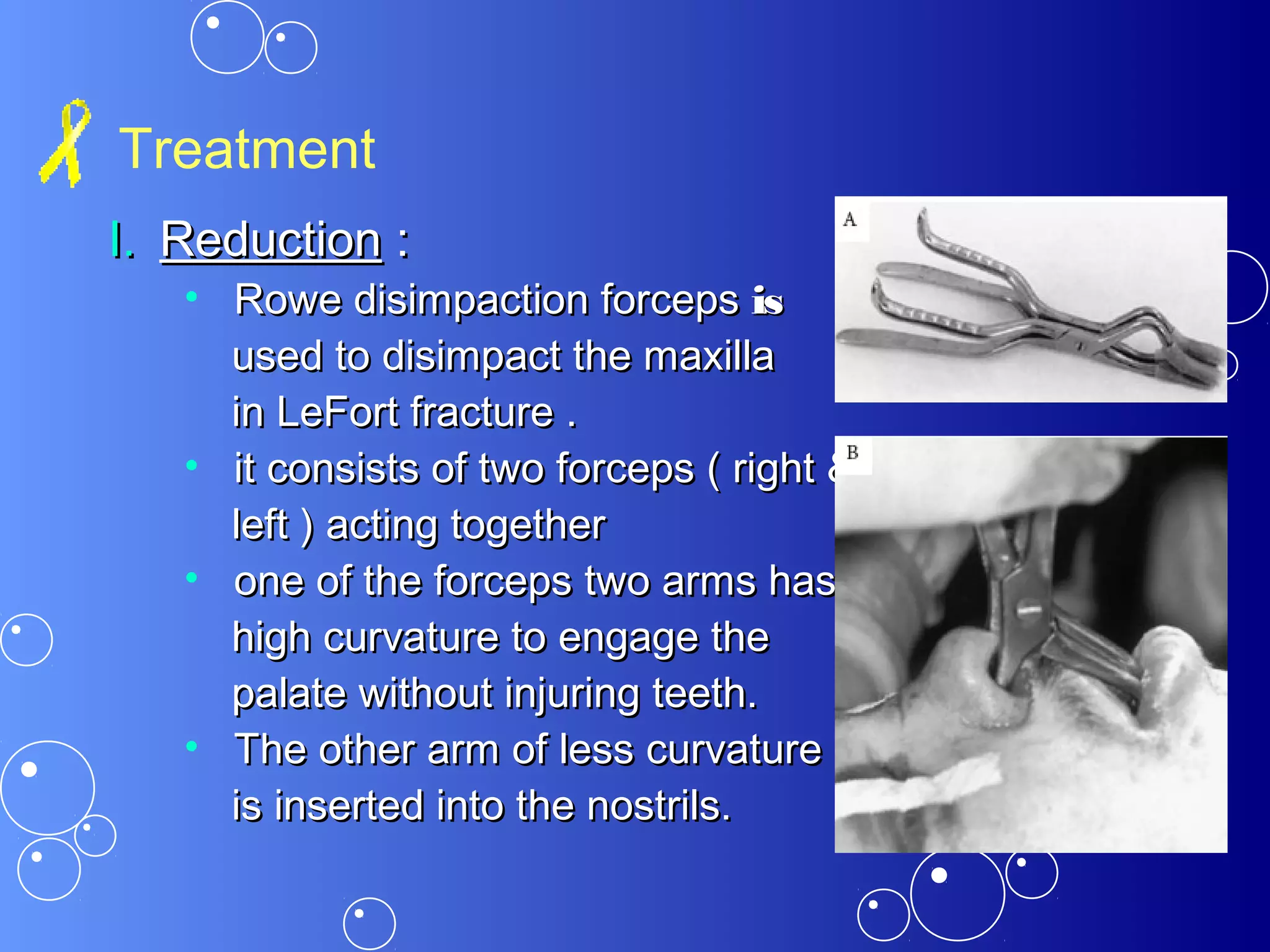
• Rowe disimpaction forcepsRowe disimpaction forceps isis
used to disimpact the maxillaused to disimpact the maxilla
in LeFort fracture .in LeFort fracture .
• it consists of two forceps ( right &it consists of two forceps ( right &
left ) acting togetherleft ) acting together
• one of the forceps two arms hasone of the forceps two arms has
high curvature to engage thehigh curvature to engage the
palate without injuring teeth.palate without injuring teeth.
• The other arm of less curvatureThe other arm of less curvature
is inserted into the nostrils.is inserted into the nostrils.
II. Fixation :II. Fixation :
1.1. Wire OsteosynthesisWire Osteosynthesis
2.2. Rigid fixationRigid fixation
3.3. Semi-rigid fixationSemi-rigid fixation
4.4. Lag screwsLag screws
• It is an old but yet a successfully usedIt is an old but yet a successfully used
method.method.
• Many designs are available:Many designs are available:
 One design includes drilling of four holes forOne design includes drilling of four holes for
wiring.wiring.
 Another design use two holes onlyAnother design use two holes only
 Another design use two holes & circumscribe theAnother design use two holes & circumscribe the
bony edge.bony edge.
• The main disadvantage of wireThe main disadvantage of wire
osteosynthesis is that it does not maintainosteosynthesis is that it does not maintain
three dimensional stability.three dimensional stability.
11 Wire OsteosynthesisWire Osteosynthesis
• By m e ans o f arch bars o r wiringBy m e ans o f arch bars o r wiring to anto an
intact m andibleintact m andible
• It is the m o st re liable te chniq ueIt is the m o st re liable te chniq ue fo rfo r
e stablishing ante rio r pro je ctio n o f thee stablishing ante rio r pro je ctio n o f the
m andible .m andible .
 Intermaxillary fixationIntermaxillary fixation
• It had been introduced specifically for long boneIt had been introduced specifically for long bone
fracture as it is cortical bone with decreasedfracture as it is cortical bone with decreased
amount of blood supply &amount of blood supply & subjected tosubjected to highhigh
stresses, so rigid fixation is needed to ensurestresses, so rigid fixation is needed to ensure
intimate contact between fractured parts andintimate contact between fractured parts and
enhance healing.enhance healing.
• Types:Types:
A.A. Dynamic compression platesDynamic compression plates
B.B. Eccentric dynamic compression plateEccentric dynamic compression plate
22 Rigid fixationRigid fixation
A. Dynamic compression plates :
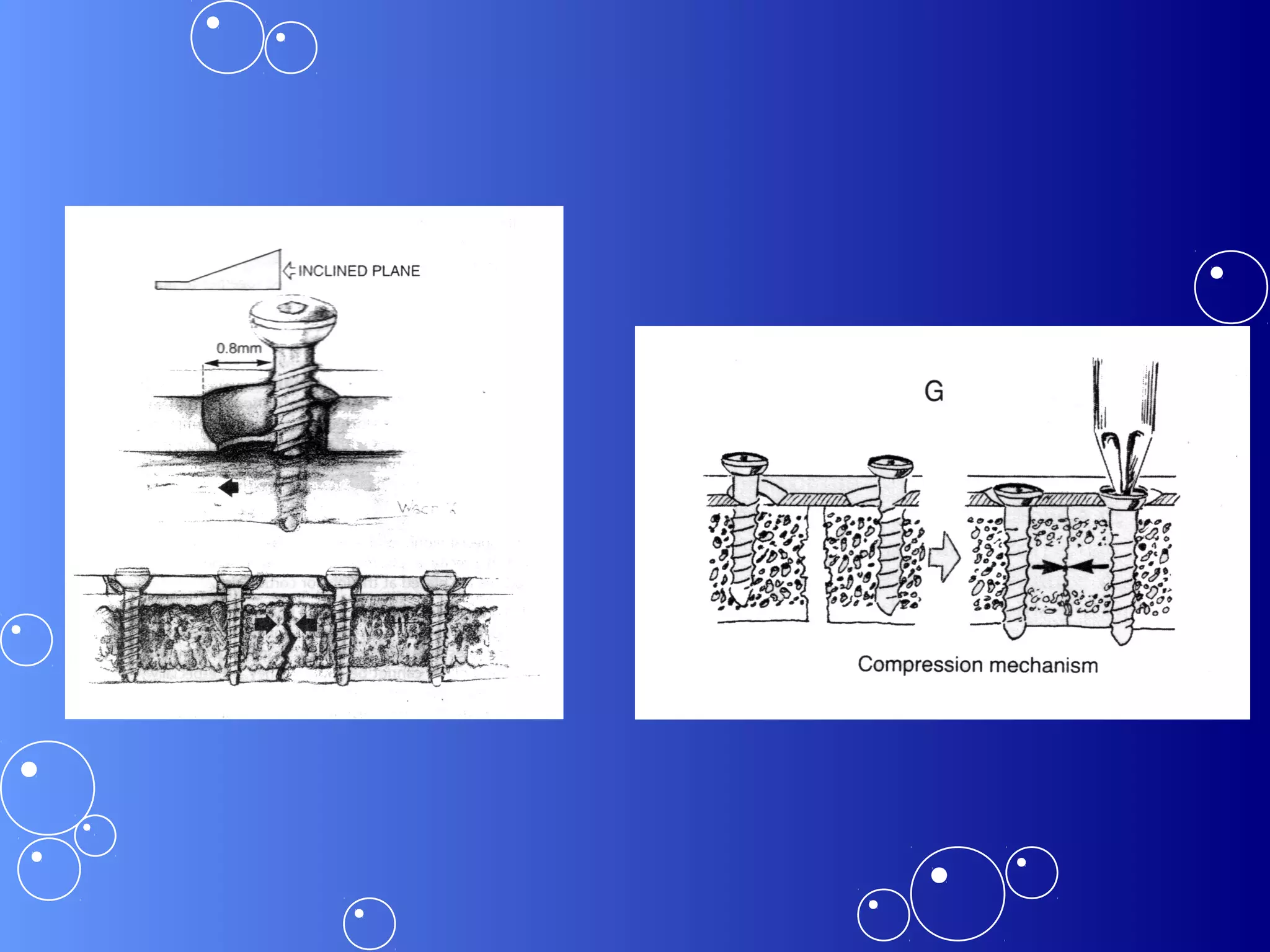
• Provided with oval holes.Provided with oval holes.
• The pointed tip of the oval shape is directedThe pointed tip of the oval shape is directed
outward while the wide portion is directed towardoutward while the wide portion is directed toward
the midline of the plate.the midline of the plate.
• When the screw is introduced into the thin portionWhen the screw is introduced into the thin portion
of the hole it will escape toward the wide portionof the hole it will escape toward the wide portion
(midline)(midline) pushing bony fragments toward thepushing bony fragments toward the
midline.midline.
• The action of screws on both sides helps toThe action of screws on both sides helps to
approximate bony fragments and enhances theirapproximate bony fragments and enhances their
union.union.
• It had been proved that force affecting onIt had been proved that force affecting on
bone will produce both tension andbone will produce both tension and
compression, and so; two plates are neededcompression, and so; two plates are needed
one plate to resist compression and the otherone plate to resist compression and the other
to resist tension.to resist tension.
• One plate can be used separately if placed inOne plate can be used separately if placed in
the neutral zonethe neutral zone
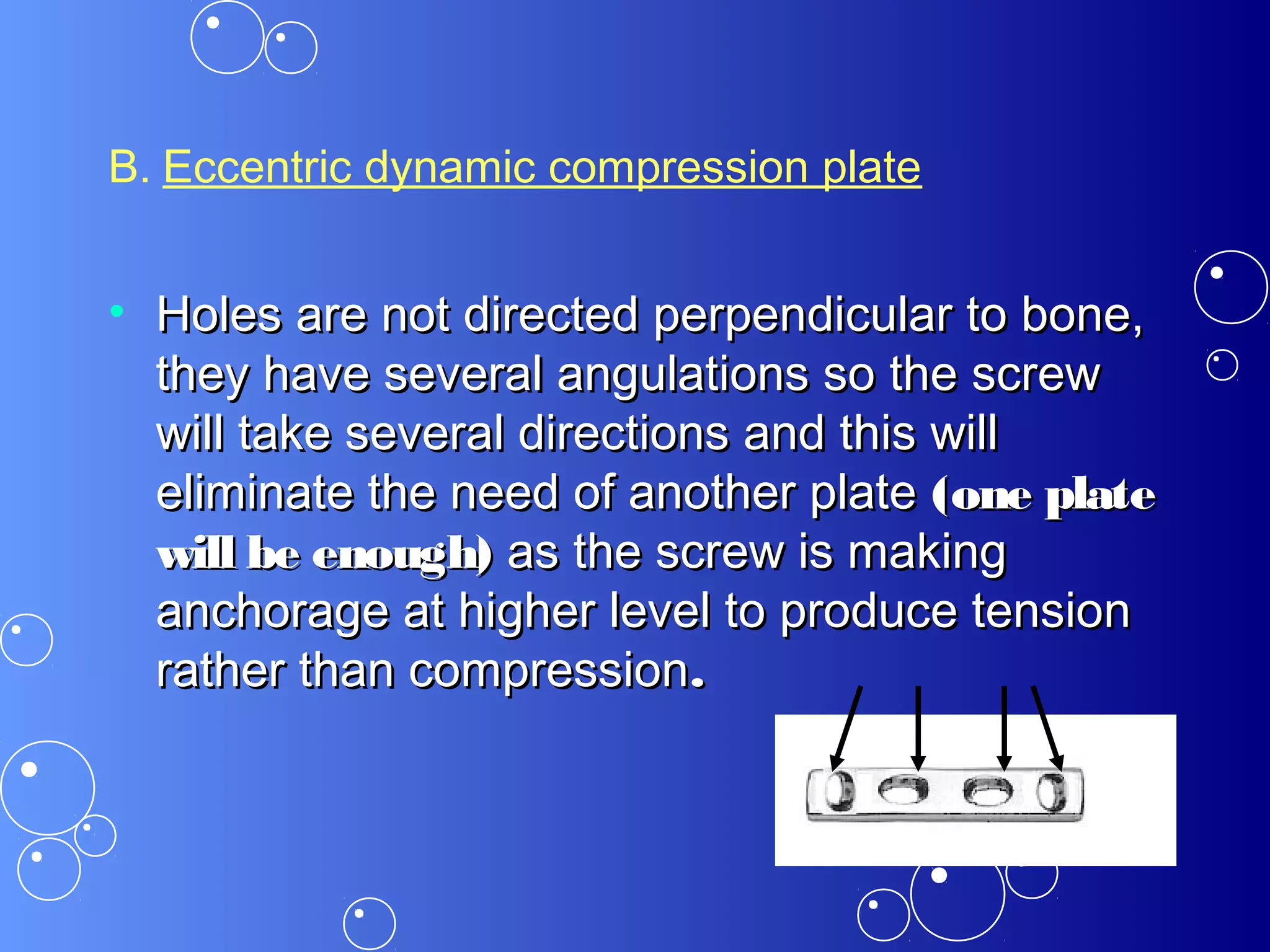
B. Eccentric dynamic compression plate
• Holes are not directed perpendicular to bone,Holes are not directed perpendicular to bone,
they have several angulations so the screwthey have several angulations so the screw
will take several directions and this willwill take several directions and this will
eliminate the need of another plateeliminate the need of another plate (one plate(one plate
will be enough)will be enough) as the screw is makingas the screw is making
anchorage at higher level to produce tensionanchorage at higher level to produce tension
rather than compressionrather than compression..
• Specific for maxillofacial region as maxillary bone isSpecific for maxillofacial region as maxillary bone is
spongy and highly vascularspongy and highly vascular bone.bone.
• Maxilla is not subjected to high stresses as in long bone soMaxilla is not subjected to high stresses as in long bone so
semi-rigid fixation may be used.semi-rigid fixation may be used.
• Types of semi-rigid fixationTypes of semi-rigid fixation
A.A. Miniplates:Miniplates:
 The most commonly used plates specially in theThe most commonly used plates specially in the
mandiblemandible (about 1.5 mmthickness)(about 1.5 mmthickness)
A.A. Microplates:Microplates:
 used in very thin placesused in very thin places(about 0.6 mmthickness)(about 0.6 mmthickness)
A.A. Resorbable plates:Resorbable plates:
 Recently introduced for treatment of fractures.Recently introduced for treatment of fractures.
33 Semi Rigid fixationSemi Rigid fixation
• AdvantagesAdvantages ::
 Eliminate the need for another surgery as in youngEliminate the need for another surgery as in young
patients (The plate may prevent growth of bone andpatients (The plate may prevent growth of bone and
should be removed after 6 months)should be removed after 6 months)
 Provide good esthetic appearanceProvide good esthetic appearance
 Prevent pain sensation at the site of plates specially inPrevent pain sensation at the site of plates specially in
cold environment and thin areas.cold environment and thin areas.
• DisadvantagesDisadvantages ::
ExpensiveExpensive
ThickThick
• Used without plates.Used without plates.
• A hole is drilled in the fractured bonyA hole is drilled in the fractured bony
segment, the screw is forced through thesegment, the screw is forced through the
hole to penetrate the fixed segment , thehole to penetrate the fixed segment , the
large diameter head of the screw willlarge diameter head of the screw will
prevent its passage through the hole.prevent its passage through the hole.
44 Lag Screws :Lag Screws :
Complications associated with maxillary fracture and their
repair:
• Infraorbital nerve paresthesia.Infraorbital nerve paresthesia.
• Enophthalmos.Enophthalmos.
• Infection.Infection.
• Deviated septum.Deviated septum.
• Nasal obstruction.Nasal obstruction.
• Altered vision.Altered vision.
• Nonunion.Nonunion.
• Malunion or malocclusion.Malunion or malocclusion.
• Epiphora.Epiphora.
• Foreign body reaction.Foreign body reaction.
• Scarring.Scarring.
• Sinusitis.Sinusitis.
Thank You

Middle face fracture

  • 4.
    • The middlethird of the face consists of orbit,The middle third of the face consists of orbit, nose, maxilla, zygoma, and nasoethmoidnose, maxilla, zygoma, and nasoethmoid bone.bone. • In 1901, René LeFort used 32 cadaversIn 1901, René LeFort used 32 cadavers skulls and subjected them to various types ofskulls and subjected them to various types of trauma, then he removed soft tissues andtrauma, then he removed soft tissues and examined skulls:examined skulls: • He found that generally if the face wasHe found that generally if the face was fractured, the skull was not.fractured, the skull was not. • He then stated that fractures occurredHe then stated that fractures occurred through three weak lines in the facial bonythrough three weak lines in the facial bony structures that protect the cranial cavity andstructures that protect the cranial cavity and circumscribe the midfacecircumscribe the midface
  • 5.
    • Six buttressesare responsible forreinforcementSix buttresses are responsible forreinforcement of facial bones:of facial bones: A.A. V ERTC A L BU TTRES S ES :V ERTC A L BU TTRES S ES : 1 .1 . Naso m axillaryNaso m axillary 2.2. Zyg o m atico m axillaryZyg o m atico m axillary 3.3. Pte ryg o m axillaryPte ryg o m axillary
  • 6.
    B.B. HO RIZO N TA L BU TTRES S ES :HO RIZ O N TA L BU TTRES S ES : 1 .1 . Fro ntal barFro ntal bar 2.2. Alve o lar Ridg eAlve o lar Ridg e 3.3. Infrao rbitalrimInfrao rbitalrim
  • 7.
    LeFort classification system 1.1.LeFortLeFort I (horizontal or transversefracture) :I (horizontal or transversefracture) : • The fracture line extends above the rootThe fracture line extends above the root apices from the piriform aperture of the nose.apices from the piriform aperture of the nose. • The fractured segment includes:The fractured segment includes:  MaxillaryMaxillary teethteeth  alveolar bone,alveolar bone,  part of the basal bone,part of the basal bone,  lowerthird of nasal septumlowerthird of nasal septum  lowerthird of pterygoid plates posteriorly.lowerthird of pterygoid plates posteriorly.
  • 8.
  • 9.
    2.2. LeFortLeFort II:II: •It involves most of the nasal bone.It involves most of the nasal bone. • The fracture line extends from below theThe fracture line extends from below the nasofrontal suture, through the nasal bonenasofrontal suture, through the nasal bone along the maxilla to the zygomatico-maxillaryalong the maxilla to the zygomatico-maxillary suture (suture (below the zygoma which is intact)below the zygoma which is intact) andand include the medial inferior third of the orbit theninclude the medial inferior third of the orbit then the fracture continuous till the pterygoid platesthe fracture continuous till the pterygoid plates at a higher level thanat a higher level than lefort I.lefort I.
  • 10.
  • 11.
    3.3. LeFort III:LeFortIII: • It separates the middle third from the cranium.It separates the middle third from the cranium. • It involves most of the orbital bone.It involves most of the orbital bone. • The fracture line extends from the nasofrontalThe fracture line extends from the nasofrontal suture along the medial wall of the orbit throughsuture along the medial wall of the orbit through the superior orbital fissure.the superior orbital fissure. • It then extends along the inferior orbital fissuresIt then extends along the inferior orbital fissures and the lateral orbital wall to theand the lateral orbital wall to the zygomatico-zygomatico- frontalfrontal suture; thesuture; the zygomatico-temporalzygomatico-temporal suture issuture is also separated.also separated. • Then the fracture extend along the sphenoid boneThen the fracture extend along the sphenoid bone separating the pterygoid plates.separating the pterygoid plates.
  • 12.
  • 13.
    Clinical examination : A.A.E X T R A O R A L E X A M I N A T I O N :E X T R A O R A L E X A M I N A T I O N : • InspectionInspection  Laceration of the skinLaceration of the skin..  Abrasion& ecchymosis areasAbrasion& ecchymosis areas..  Facial edemaFacial edema..  EpistaxisEpistaxis..  Cerebrospinal fluid leakageCerebrospinal fluid leakage..  Asymmetry of the noseAsymmetry of the nose..  Flat nasal bridgeFlat nasal bridge..  Dish-shaped faceDish-shaped face.. • PalpationPalpation  Bilateral palpation over the expected lines of fracture isBilateral palpation over the expected lines of fracture is performed to feel bony steps or deformitiesperformed to feel bony steps or deformities • ..
  • 14.
    • The levelof fracture can be determined extraorally:The level of fracture can be determined extraorally:  One hand holds the bridge of the nose while the otherOne hand holds the bridge of the nose while the other manipulates the maxilla; movement at the alveolus suggestsmanipulates the maxilla; movement at the alveolus suggests Lefort ILefort I fracture.fracture.  the first hand is placed over thethe first hand is placed over the frontonasal suture while the otherfrontonasal suture while the other one manipulates the maxilla;one manipulates the maxilla; movement at the frontonasal suturemovement at the frontonasal suture suggestssuggests lefort II orlefort IIIlefort II orlefort III fractures.fractures.
  • 15.
    B.B. I NT R A O R A L E X A M I N A T I O N :I N T R A O R A L E X A M I N A T I O N : • InspectionInspection  Fractured teethFractured teeth..  Vestibular ecchymosis & edemaVestibular ecchymosis & edema..  Mucosal laceration & bleedingMucosal laceration & bleeding..  Steps or diastema in the maxillary teethSteps or diastema in the maxillary teeth..  MalocclusionMalocclusion.. • PalpationPalpation  Step deformity in the occlusal plane or theStep deformity in the occlusal plane or the alveolar ridge in case of edentulous patient.alveolar ridge in case of edentulous patient.
  • 16.
    Imaging: 1.1. Axial &coronal CT scan:Axial & coronal CT scan:  The coronal CT scan is the best diagnostic radiographThe coronal CT scan is the best diagnostic radiograph in case of suspected orbital floor fractures.in case of suspected orbital floor fractures.  It can demonstrate soft tissue differences of hematomaIt can demonstrate soft tissue differences of hematoma..  it can demonstrate edema of subcutaneous tissue,it can demonstrate edema of subcutaneous tissue, muscle and fat.muscle and fat. 2.2. Postero-anteriorviewPostero-anteriorview 3.3. Waters viewWaters view 4.4. Lateral viewLateral view 5.5. Occipitomental viewOccipitomental view
  • 17.
    Treatment I.I. ReductionReduction :: •Rowe disimpaction forcepsRowe disimpaction forceps isis used to disimpact the maxillaused to disimpact the maxilla in LeFort fracture .in LeFort fracture . • it consists of two forceps ( right &it consists of two forceps ( right & left ) acting togetherleft ) acting together • one of the forceps two arms hasone of the forceps two arms has high curvature to engage thehigh curvature to engage the palate without injuring teeth.palate without injuring teeth. • The other arm of less curvatureThe other arm of less curvature is inserted into the nostrils.is inserted into the nostrils.
  • 18.
    II. Fixation :II.Fixation : 1.1. Wire OsteosynthesisWire Osteosynthesis 2.2. Rigid fixationRigid fixation 3.3. Semi-rigid fixationSemi-rigid fixation 4.4. Lag screwsLag screws
  • 19.
    • It isan old but yet a successfully usedIt is an old but yet a successfully used method.method. • Many designs are available:Many designs are available:  One design includes drilling of four holes forOne design includes drilling of four holes for wiring.wiring.  Another design use two holes onlyAnother design use two holes only  Another design use two holes & circumscribe theAnother design use two holes & circumscribe the bony edge.bony edge. • The main disadvantage of wireThe main disadvantage of wire osteosynthesis is that it does not maintainosteosynthesis is that it does not maintain three dimensional stability.three dimensional stability. 11 Wire OsteosynthesisWire Osteosynthesis
  • 20.
    • By me ans o f arch bars o r wiringBy m e ans o f arch bars o r wiring to anto an intact m andibleintact m andible • It is the m o st re liable te chniq ueIt is the m o st re liable te chniq ue fo rfo r e stablishing ante rio r pro je ctio n o f thee stablishing ante rio r pro je ctio n o f the m andible .m andible .  Intermaxillary fixationIntermaxillary fixation
  • 21.
    • It hadbeen introduced specifically for long boneIt had been introduced specifically for long bone fracture as it is cortical bone with decreasedfracture as it is cortical bone with decreased amount of blood supply &amount of blood supply & subjected tosubjected to highhigh stresses, so rigid fixation is needed to ensurestresses, so rigid fixation is needed to ensure intimate contact between fractured parts andintimate contact between fractured parts and enhance healing.enhance healing. • Types:Types: A.A. Dynamic compression platesDynamic compression plates B.B. Eccentric dynamic compression plateEccentric dynamic compression plate 22 Rigid fixationRigid fixation
  • 22.
    A. Dynamic compressionplates : • Provided with oval holes.Provided with oval holes. • The pointed tip of the oval shape is directedThe pointed tip of the oval shape is directed outward while the wide portion is directed towardoutward while the wide portion is directed toward the midline of the plate.the midline of the plate. • When the screw is introduced into the thin portionWhen the screw is introduced into the thin portion of the hole it will escape toward the wide portionof the hole it will escape toward the wide portion (midline)(midline) pushing bony fragments toward thepushing bony fragments toward the midline.midline. • The action of screws on both sides helps toThe action of screws on both sides helps to approximate bony fragments and enhances theirapproximate bony fragments and enhances their union.union.
  • 24.
    • It hadbeen proved that force affecting onIt had been proved that force affecting on bone will produce both tension andbone will produce both tension and compression, and so; two plates are neededcompression, and so; two plates are needed one plate to resist compression and the otherone plate to resist compression and the other to resist tension.to resist tension. • One plate can be used separately if placed inOne plate can be used separately if placed in the neutral zonethe neutral zone
  • 25.
    B. Eccentric dynamiccompression plate • Holes are not directed perpendicular to bone,Holes are not directed perpendicular to bone, they have several angulations so the screwthey have several angulations so the screw will take several directions and this willwill take several directions and this will eliminate the need of another plateeliminate the need of another plate (one plate(one plate will be enough)will be enough) as the screw is makingas the screw is making anchorage at higher level to produce tensionanchorage at higher level to produce tension rather than compressionrather than compression..
  • 26.
    • Specific formaxillofacial region as maxillary bone isSpecific for maxillofacial region as maxillary bone is spongy and highly vascularspongy and highly vascular bone.bone. • Maxilla is not subjected to high stresses as in long bone soMaxilla is not subjected to high stresses as in long bone so semi-rigid fixation may be used.semi-rigid fixation may be used. • Types of semi-rigid fixationTypes of semi-rigid fixation A.A. Miniplates:Miniplates:  The most commonly used plates specially in theThe most commonly used plates specially in the mandiblemandible (about 1.5 mmthickness)(about 1.5 mmthickness) A.A. Microplates:Microplates:  used in very thin placesused in very thin places(about 0.6 mmthickness)(about 0.6 mmthickness) A.A. Resorbable plates:Resorbable plates:  Recently introduced for treatment of fractures.Recently introduced for treatment of fractures. 33 Semi Rigid fixationSemi Rigid fixation
  • 27.
    • AdvantagesAdvantages :: Eliminate the need for another surgery as in youngEliminate the need for another surgery as in young patients (The plate may prevent growth of bone andpatients (The plate may prevent growth of bone and should be removed after 6 months)should be removed after 6 months)  Provide good esthetic appearanceProvide good esthetic appearance  Prevent pain sensation at the site of plates specially inPrevent pain sensation at the site of plates specially in cold environment and thin areas.cold environment and thin areas. • DisadvantagesDisadvantages :: ExpensiveExpensive ThickThick
  • 28.
    • Used withoutplates.Used without plates. • A hole is drilled in the fractured bonyA hole is drilled in the fractured bony segment, the screw is forced through thesegment, the screw is forced through the hole to penetrate the fixed segment , thehole to penetrate the fixed segment , the large diameter head of the screw willlarge diameter head of the screw will prevent its passage through the hole.prevent its passage through the hole. 44 Lag Screws :Lag Screws :
  • 29.
    Complications associated withmaxillary fracture and their repair: • Infraorbital nerve paresthesia.Infraorbital nerve paresthesia. • Enophthalmos.Enophthalmos. • Infection.Infection. • Deviated septum.Deviated septum. • Nasal obstruction.Nasal obstruction. • Altered vision.Altered vision. • Nonunion.Nonunion. • Malunion or malocclusion.Malunion or malocclusion. • Epiphora.Epiphora. • Foreign body reaction.Foreign body reaction. • Scarring.Scarring. • Sinusitis.Sinusitis.
  • 30.