INSTITUTE FOR

        Industrial Productivity
        Sharing best practices for low carbon enterprises   e   info@iipnetwork.org   w   iipnetwork.org


Pathways	
  to	
  Energy	
  Management	
  
Programmes	
  
-­‐	
  Gaining	
  through	
  Saving	


IPEEC	
  pre-­‐sessional	
  workshop	
  
EE	
  Global,	
  Orlando,	
  FL	
  
Amélie	
  Goldberg	
  
March	
  27,	
  2012	
  
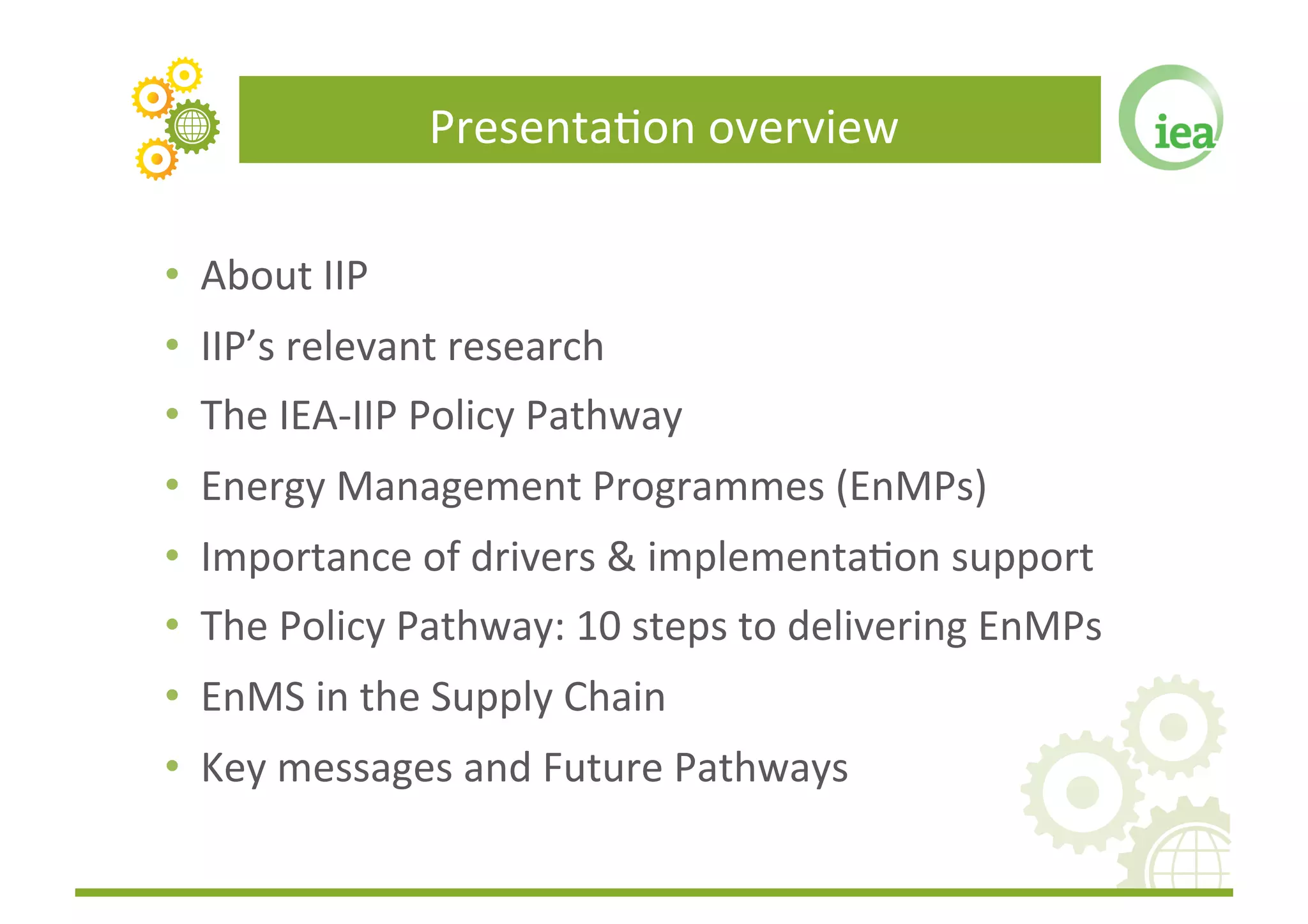
PresentaFon	
  overview	
  

•  About	
  IIP	
  
•  IIP’s	
  relevant	
  research	
  
•  The	
  IEA-­‐IIP	
  Policy	
  Pathway	
  	
  
•  Energy	
  Management	
  Programmes	
  (EnMPs)	
  
•  Importance	
  of	
  drivers	
  &	
  implementaFon	
  support	
  
•  The	
  Policy	
  Pathway:	
  10	
  steps	
  to	
  delivering	
  EnMPs	
  
•  EnMS	
  in	
  the	
  Supply	
  Chain	
  
•  Key	
  messages	
  and	
  Future	
  Pathways	
  
IIP	
  at	
  a	
  glance…	
  

     The	
  Ins(tute	
  for	
  Industrial	
  Produc(vity	
  provides	
  
     companies	
  and	
  governments	
  with	
  the	
  best	
  energy	
  
     efficiency	
  prac(ces	
  to	
  reduce	
  energy	
  costs	
  and	
  
     prepare	
  for	
  a	
  low	
  carbon	
  future.	


•       Sharing	
  and	
  disseminaFng	
  best	
  pracFces,	
  
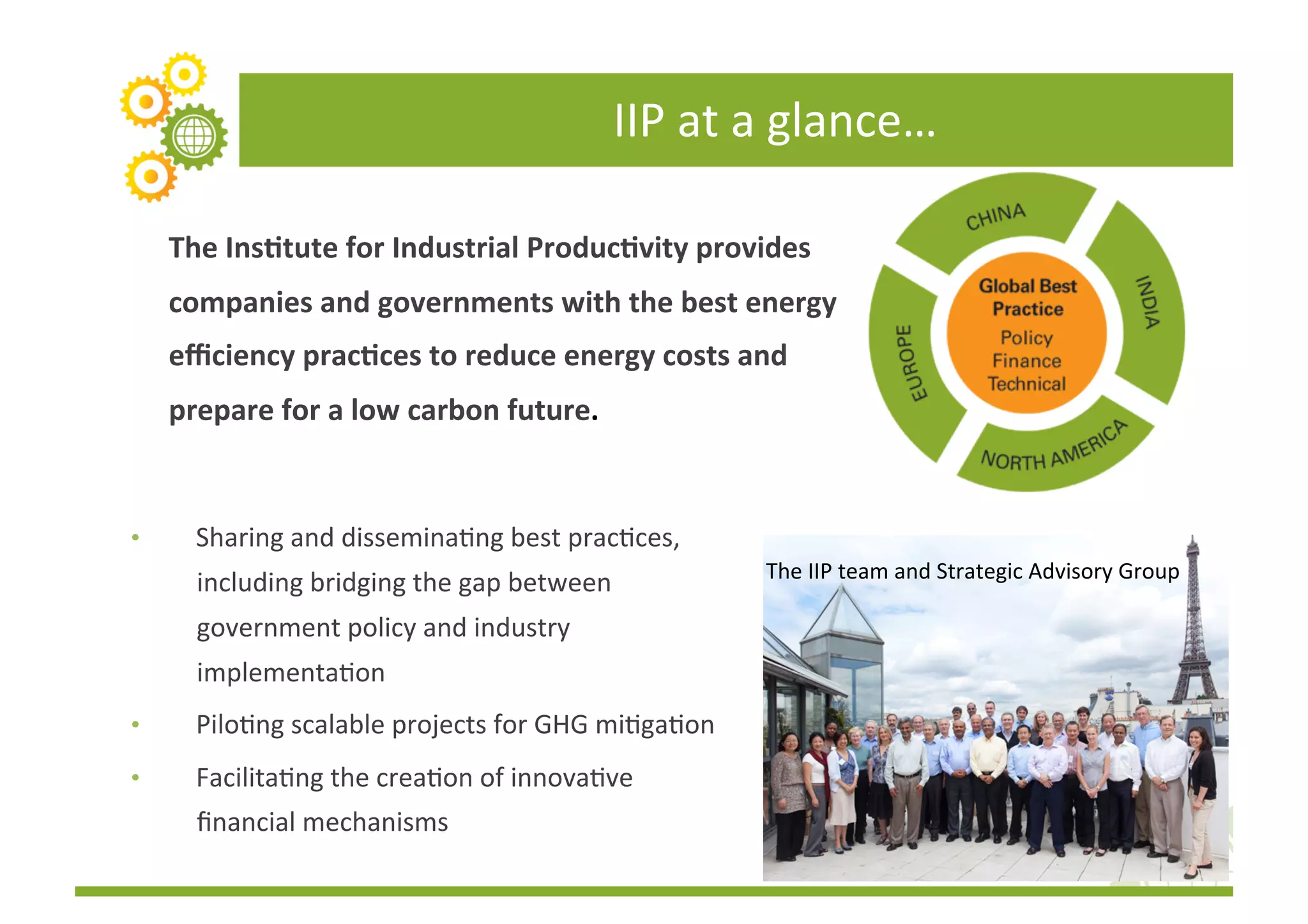
                                                                        The	
  IIP	
  team	
  and	
  Strategic	
  Advisory	
  Group	
  
        including	
  bridging	
  the	
  gap	
  between	
  
        government	
  policy	
  and	
  industry	
  
        implementaFon	
  
•       PiloFng	
  scalable	
  projects	
  for	
  GHG	
  miFgaFon	
  
•       FacilitaFng	
  the	
  creaFon	
  of	
  innovaFve	
  
        financial	
  mechanisms	
  
IIP’s	
  Relevant	
  Research	
  

 1.  Promo(ng	
  EnMS	
  through	
  Programmes,	
  Incen(ves	
  and	
  Support	
  
      –  Experiences	
  Denmark,	
  Sweden	
  and	
  Ireland	
  	
  
      –  Lessons	
  learnt	
  and	
  technical	
  assistance	
  for	
  EnMP	
  implementaFon	
  in	
  China	
  

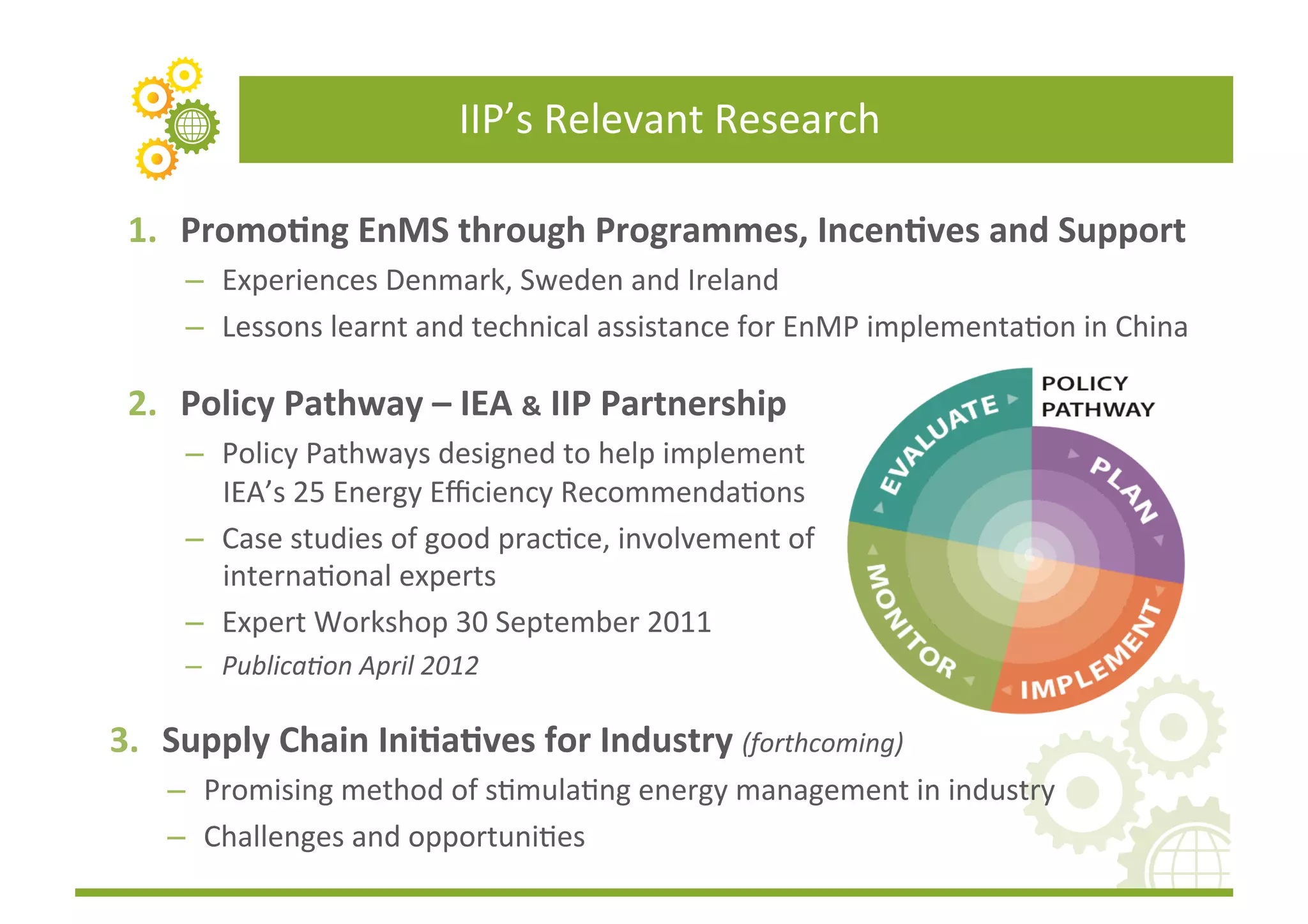
 2.  Policy	
  Pathway	
  –	
  IEA	
  &	
  IIP	
  Partnership	
  	
  
      –  Policy	
  Pathways	
  designed	
  to	
  help	
  implement	
  
         IEA’s	
  25	
  Energy	
  Efficiency	
  RecommendaFons	
  
      –  Case	
  studies	
  of	
  good	
  pracFce,	
  involvement	
  of	
  
         internaFonal	
  experts	
  
      –  Expert	
  Workshop	
  30	
  September	
  2011	
  	
  
      –  Publica3on	
  April	
  2012	
  

3.  Supply	
  Chain	
  Ini(a(ves	
  for	
  Industry	
  (forthcoming)	
  
     –  Promising	
  method	
  of	
  sFmulaFng	
  energy	
  management	
  in	
  industry	
  
     –  Challenges	
  and	
  opportuniFes	
  
Decision-­‐makers	
  Ma]er!	
  
                  Need	
  to	
  make	
  a	
  compelling	
  business	
  case	
  to	
  the	
  board	
  
                                         Produc(vity	
  gains	
  “sell”	
  
                                    Chief Technology Officer
                                “Do we know what energy efficiency
                                  practices and technologies are
                                            available?”                    Financial Director
                                       Driver: knowledge              Do we have the money to invest
                                                                     and are we willing to spend it on
                                                                                  EE?
                                                                           Driver: Financials


                CEO
  Are we committed to prioritize EE
     above other investments?
       Driver: Commitment


                                                                                                                             Source:	
  Ecofys	
  	
  
                                                                                                    in	
  Reinaud	
  and	
  Goldberg,	
  2011	
  

      Marketing Director
Do the public and market demand
    us taking EE measures?
  Driver: Public and market                                                             Regulatory Affairs Officer
            demand                                                                       Does this government policy
                                                                                      require us to take EE measures?
                                                                                         Driver: Policy obligation
Co-­‐benefits	
  -­‐	
  a	
  significant	
  driver	
  for	
  companies	


•       Co-­‐benefits	
  o_en	
  exceed	
  the	
  value	
  of	
  energy	
  savings	
  	
  
•       Including	
  co-­‐benefits	
  reduces	
  payback	
  Fmes	
  for	
  investments	
  

Examples:	
  
•  Value	
  of	
  non-­‐energy	
  benefits	
  (NEBs)	
  equal	
  to	
  about	
  2.5	
  (mes	
  the	
  
     projected	
  energy	
  savings	
  for	
  the	
  installed	
  measures	
  (Hall	
  &	
  Roth,	
  2003)	
  
•  Inclusion	
  of	
  quanFfied	
  co-­‐benefits	
  in	
  an	
  energy-­‐conservaFon	
  supply	
  curve	
  
     for	
  the	
  US	
  iron	
  and	
  steel	
  industry	
  doubled	
  the	
  poten(al	
  for	
  cost-­‐effec(ve	
  
     savings	
  (Worrell	
  et	
  al.	
  2001	
  &	
  2003)	
  
•  An	
  iniFal	
  cost	
  of	
  $5000	
  in	
  consulFng	
  fees	
  for	
  purchasing	
  a	
  three-­‐fan,	
  
     variable	
  inlet	
  valve	
  controlled	
  system,	
  created	
  a	
  potenFal	
  incremental	
  
     annual	
  revenue	
  $375	
  000	
  for	
  Alcoa.	
  
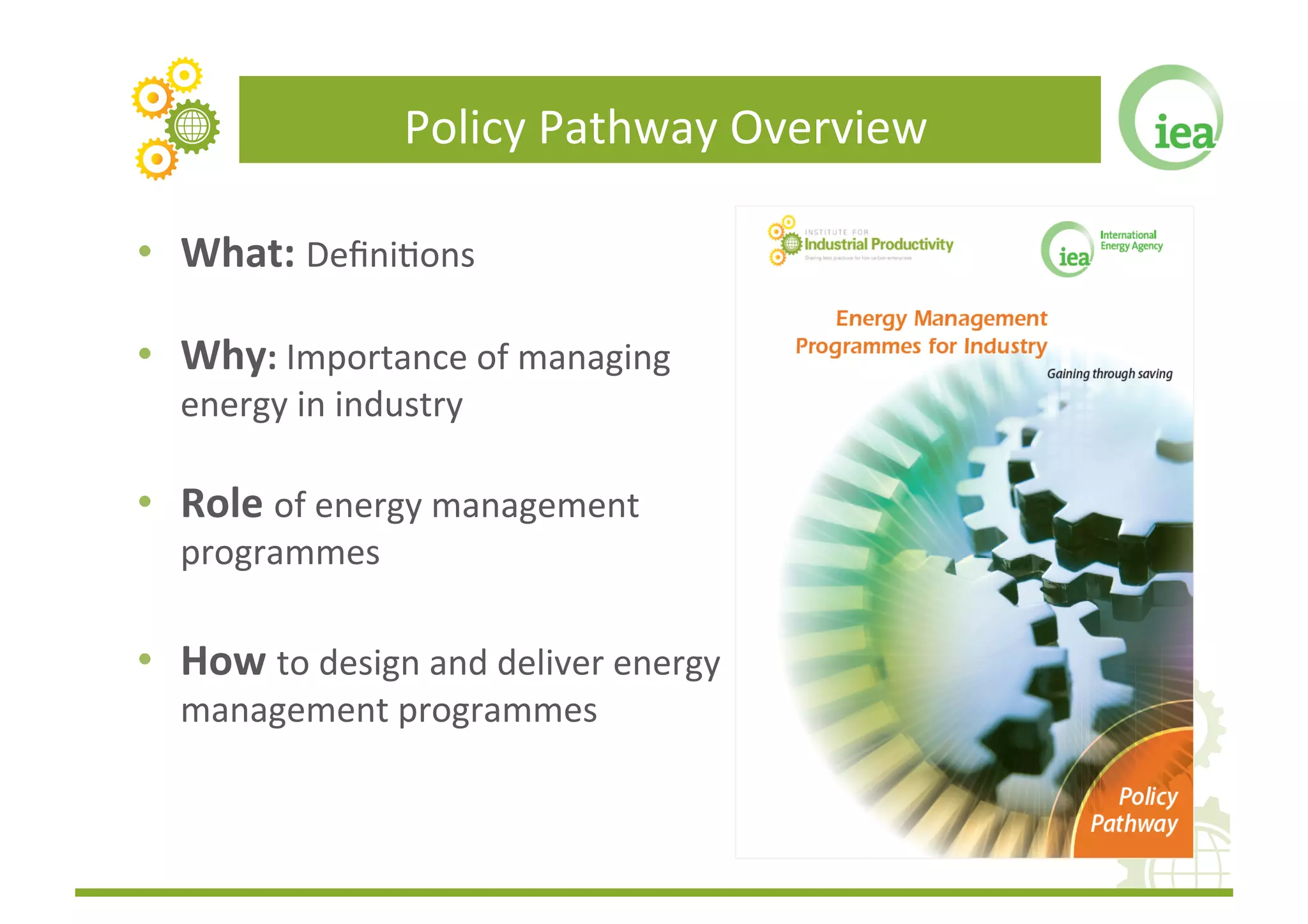
Policy	
  Pathway	
  Overview	
  

•  What:	
  DefiniFons	


•  Why:	
  Importance	
  of	
  managing	
  
   energy	
  in	
  industry	


•  Role	
  of	
  energy	
  management	
  
   programmes	


•  How	
  to	
  design	
  and	
  deliver	
  energy	
  
   management	
  programmes	
  	
  
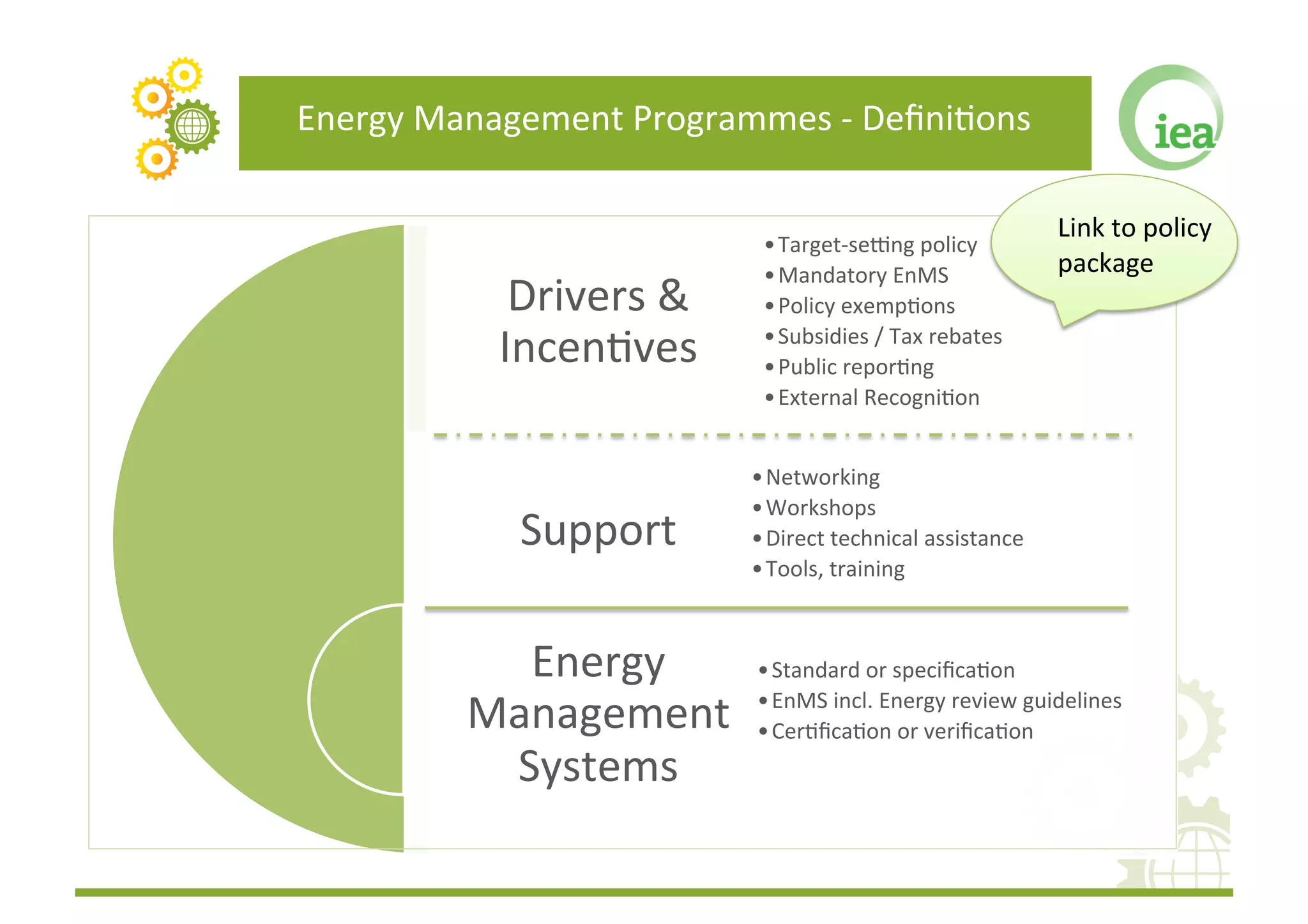
Energy	
  Management	
  Programmes	
  -­‐	
  DefiniFons	
  

                                                                             Link	
  to	
  policy	
  
                                    • Target-­‐sehng	
  policy	
  
                                    • Mandatory	
  EnMS	
                    package	
  
                Drivers	
  &	
      • Policy	
  exempFons	
  

               IncenFves	
          • Subsidies	
  /	
  Tax	
  rebates	
  
                                    • Public	
  reporFng	
  
                                    • External	
  RecogniFon	


                                   • Networking	
  
                                   • Workshops	
  
                 Support	
         • Direct	
  technical	
  assistance	
  
                                   • Tools,	
  training	


               Energy	
            • Standard	
  or	
  specificaFon	
  

             Management	
          • EnMS	
  incl.	
  Energy	
  review	
  guidelines	
  
                                   • CerFficaFon	
  or	
  verificaFon	
  
              Systems	
  
Why	
  Energy	
  Management?	
  
                        =>	
  Save	
  Energy	
  and	
  Realise	
  Co-­‐Benefits	
  

Why	
  EnMS?	
  
•    Overcome	
  a	
  range	
  of	
  barriers	
  to	
  energy	
  efficiency	
  
•    Measurement	
  of	
  baseline	
  energy	
  use,	
  energy	
  reviews,	
  KPIs,	
  etc.	
  
•    ConFnuous	
  idenFficaFon	
  of	
  energy	
  saving	
  opportuniFes	
  &	
  implementaFon	
  
•    Involvement	
  of	
  top	
  management	
  and	
  staff	


Why	
  EnMPs?	
  
•  Energy	
  saving	
  acFons	
  in	
  industry	
  are	
  relaFvely	
  cost	
  effecFve	
  
•  EnMPs	
  can	
  be	
  linked	
  to	
  and	
  support	
  policy	
  objecFves	
  e.g.,	
  energy	
  security	
  	
  
•  Isolated	
  adopFon	
  of	
  EnMS	
  may	
  lead	
  to	
  varying	
  degrees	
  of	
  quality	
  and	
  durability,	
  
   and	
  low	
  up-­‐take	
  
•  Overcome	
  company	
  barriers	
  to	
  the	
  implementaFon	
  of	
  EnMSs,	
  and	
  provide	
  
   guidance	
  and	
  support	
  for	
  the	
  implementaFon	
  process	
  
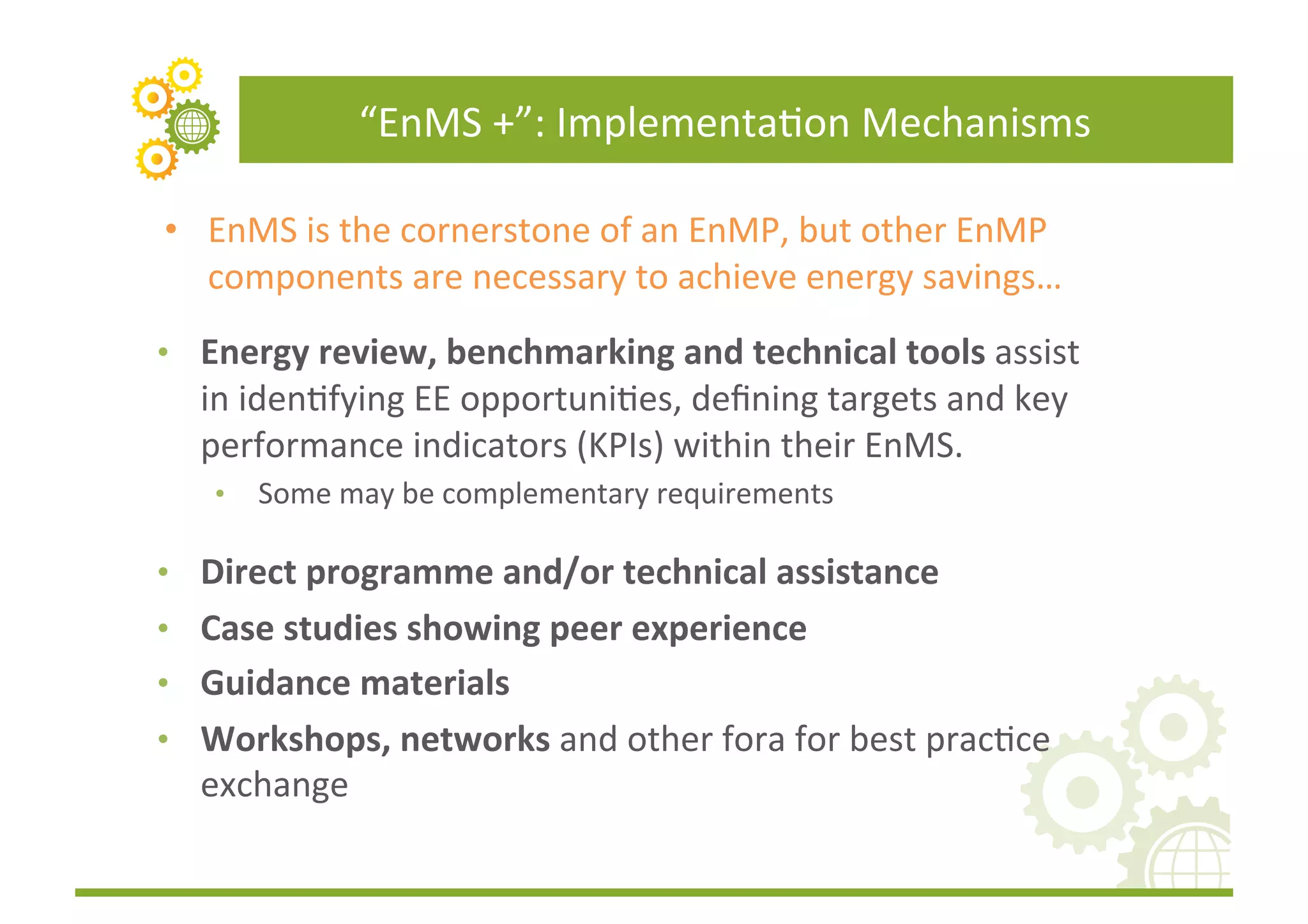
“EnMS	
  +”:	
  ImplementaFon	
  Mechanisms	
  

•  EnMS	
  is	
  the	
  cornerstone	
  of	
  an	
  EnMP,	
  but	
  other	
  EnMP	
  
   components	
  are	
  necessary	
  to	
  achieve	
  energy	
  savings…	
  
•  Energy	
  review,	
  benchmarking	
  and	
  technical	
  tools	
  assist	
  
   in	
  idenFfying	
  EE	
  opportuniFes,	
  defining	
  targets	
  and	
  key	
  
   performance	
  indicators	
  (KPIs)	
  within	
  their	
  EnMS.	
  
     •    Some	
  may	
  be	
  complementary	
  requirements	
  

•  Direct	
  programme	
  and/or	
  technical	
  assistance	
  	
  
•  Case	
  studies	
  showing	
  peer	
  experience	
  
•  Guidance	
  materials	
  	
  
•  Workshops,	
  networks	
  and	
  other	
  fora	
  for	
  best	
  pracFce	
  
   exchange	
  	
  
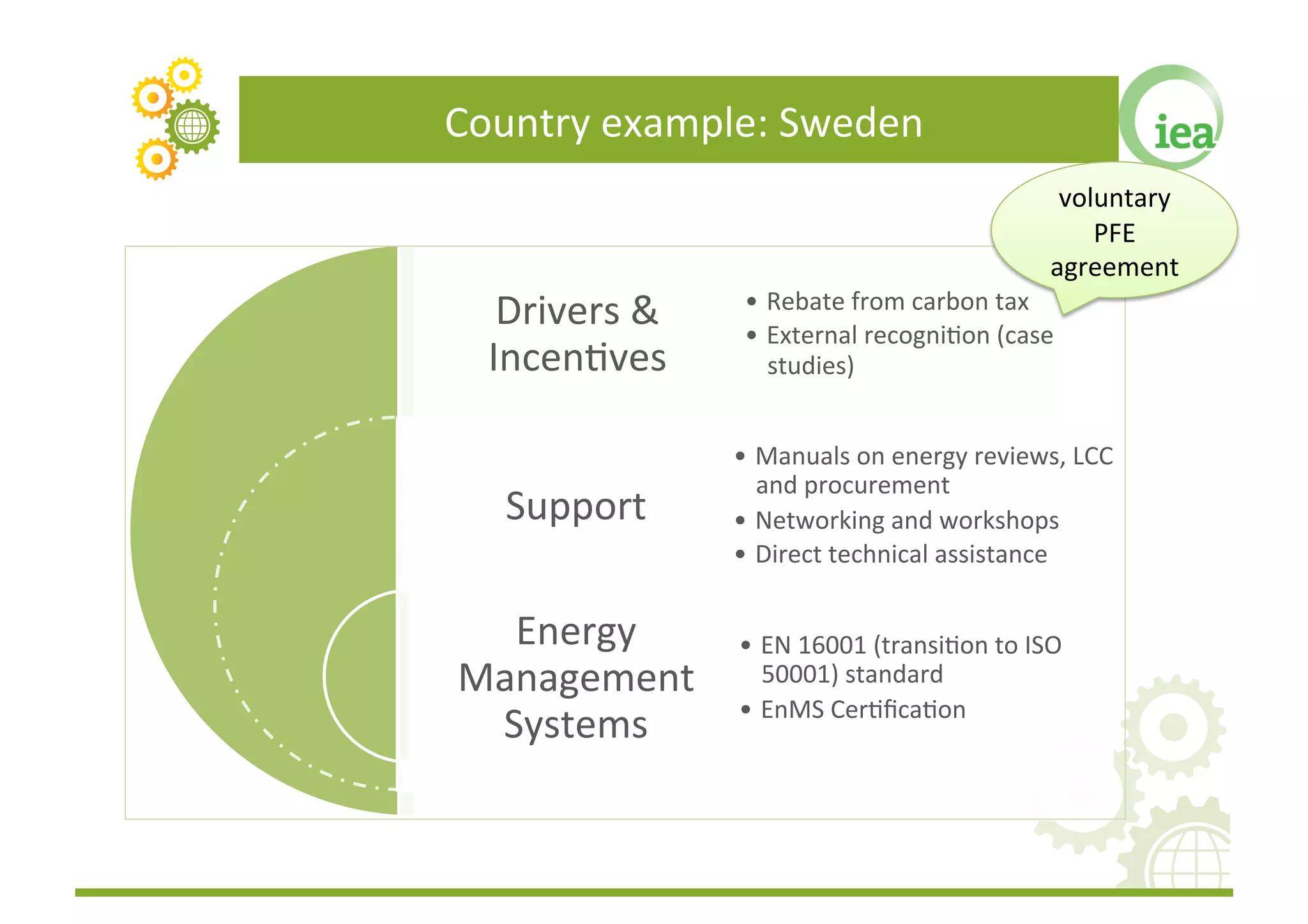
Country	
  example:	
  Sweden	
  
                                                                 voluntary	
  
                                                                    PFE	
  
                                                                agreement	
  
   Drivers	
  &	
      •  Rebate	
  from	
  carbon	
  tax	
  
                       •  External	
  recogniFon	
  (case	
  
  IncenFves	
             studies)	


                      •  Manuals	
  on	
  energy	
  reviews,	
  LCC	
  
                         and	
  procurement	
  
    Support	
         •  Networking	
  and	
  workshops	
  
                      •  Direct	
  technical	
  assistance	
  

  Energy	
            •  EN	
  16001	
  (transiFon	
  to	
  ISO	
  
Management	
             50001)	
  standard	
  
                      •  EnMS	
  CerFficaFon	
  
 Systems	
  
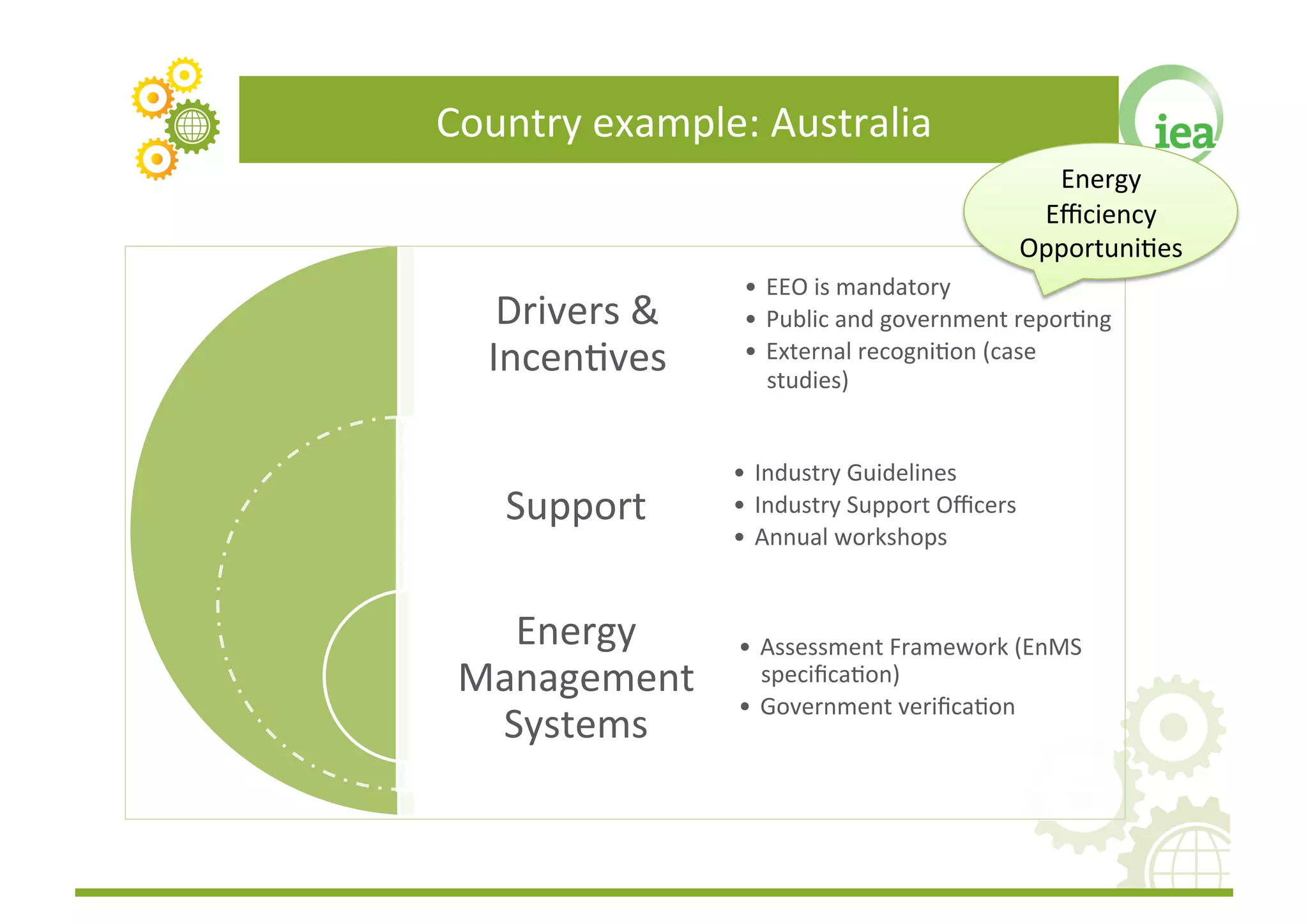
Country	
  example:	
  Australia	
  
                                                            Energy	
  
                                                           Efficiency	
  
                                                          OpportuniFes	
  
                        •  EEO	
  is	
  mandatory	
  
    Drivers	
  &	
      •  Public	
  and	
  government	
  reporFng	
  
   IncenFves	
          •  External	
  recogniFon	
  (case	
  
                           studies)	


                       •  Industry	
  Guidelines	
  
    Support	
          •  Industry	
  Support	
  Officers	
  
                       •  Annual	
  workshops	


   Energy	
            •  Assessment	
  Framework	
  (EnMS	
  
 Management	
             specificaFon)	
  
                       •  Government	
  verificaFon	
  
  Systems	
  
EnMS	
  in	
  the	
  Supply	
  Chain	
  

What	
  is	
  the	
  role	
  of	
  EnMS	
  in	
  supply	
  chain	
  ini(a(ves?	
  
•  Successful	
  examples	
  of	
  large	
  buyers/retailers	
  engaging	
  their	
  
   manufacturing	
  base	
  in	
  energy	
  or	
  GHG	
  saving	
  acFviFes,	
  e.g.:	
  
     •  Ikea	
  audits	
  and	
  capacity	
  building	
  with	
  its	
  manufacturing	
  suppliers	
  
        (partnership	
  with	
  WWF	
  Climate	
  PosiFve	
  OpportuniFes	
  for	
  Suppliers)	
  
     •  Ford	
  and	
  SKF	
  require	
  suppliers	
  to	
  be	
  ISO	
  14001	
  cerFfied	
  

•  IIP	
  Database	
  on	
  Supply	
  Chain	
  IniFaFves	
  for	
  Industry	
  (April)	
  
•  ISO	
  50001	
  –	
  an	
  internaFonally	
  recognised	
  a	
  framework	
  for	
  
   organisaFons	
  to	
  encourage	
  suppliers	
  to	
  be]er	
  manage	
  energy	
  
Key	
  Messages	
  and	
  Future	
  Pathways	
  

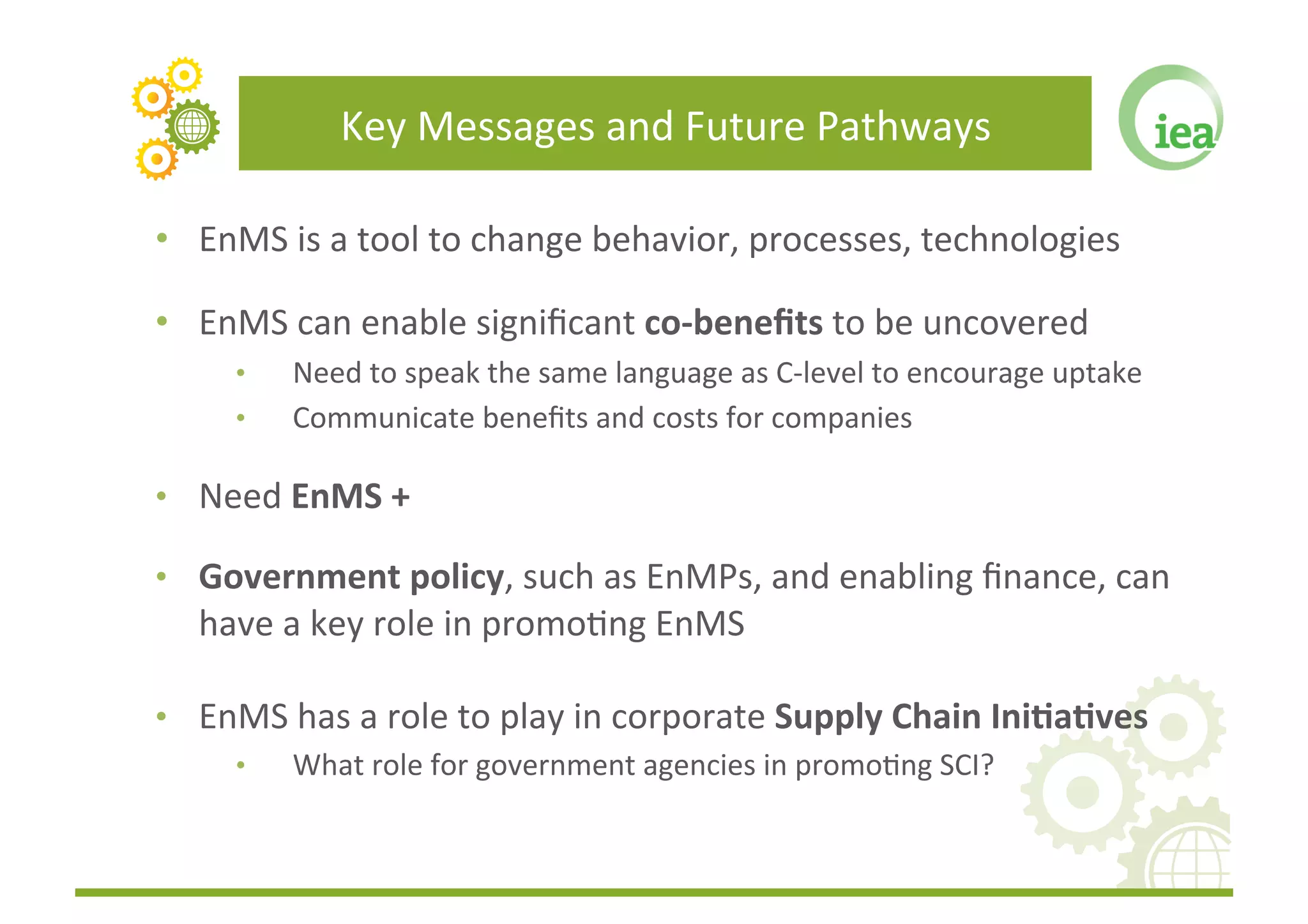
•  EnMS	
  is	
  a	
  tool	
  to	
  change	
  behavior,	
  processes,	
  technologies	
  

•  EnMS	
  can	
  enable	
  significant	
  co-­‐benefits	
  to	
  be	
  uncovered	
  
       •     Need	
  to	
  speak	
  the	
  same	
  language	
  as	
  C-­‐level	
  to	
  encourage	
  uptake	
  
       •     Communicate	
  benefits	
  and	
  costs	
  for	
  companies	
  

•  Need	
  EnMS	
  +	
  

•  Government	
  policy,	
  such	
  as	
  EnMPs,	
  and	
  enabling	
  finance,	
  can	
  
    have	
  a	
  key	
  role	
  in	
  promoFng	
  EnMS	
  

•  EnMS	
  has	
  a	
  role	
  to	
  play	
  in	
  corporate	
  Supply	
  Chain	
  Ini(a(ves	
  
       •     What	
  role	
  for	
  government	
  agencies	
  in	
  promoFng	
  SCI?	
  
INSTITUTE FOR

      Industrial Productivity
      Sharing best practices for low carbon enterprises   e   info@iipnetwork.org   w   iipnetwork.org


Thank	
  you!	
  
IIP	
  
Amelie.goldberg@iipnetwork.org	
  
Julia.reinaud@iipnetwork.org	
  

IEA	
  
Vida.Rozite@iea.org	
  
Lisa.Ryan@iea.org	
  
Jungwook.Park@iea.org	
  

Pathways to Energy Management Programmes – Gaining through Saving, Amelie Goldberg

  • 1.
    INSTITUTE FOR Industrial Productivity Sharing best practices for low carbon enterprises e info@iipnetwork.org w iipnetwork.org Pathways  to  Energy  Management   Programmes   -­‐  Gaining  through  Saving   IPEEC  pre-­‐sessional  workshop   EE  Global,  Orlando,  FL   Amélie  Goldberg   March  27,  2012  
  • 2.
    PresentaFon  overview   • About  IIP   •  IIP’s  relevant  research   •  The  IEA-­‐IIP  Policy  Pathway     •  Energy  Management  Programmes  (EnMPs)   •  Importance  of  drivers  &  implementaFon  support   •  The  Policy  Pathway:  10  steps  to  delivering  EnMPs   •  EnMS  in  the  Supply  Chain   •  Key  messages  and  Future  Pathways  
  • 3.
    IIP  at  a  glance…   The  Ins(tute  for  Industrial  Produc(vity  provides   companies  and  governments  with  the  best  energy   efficiency  prac(ces  to  reduce  energy  costs  and   prepare  for  a  low  carbon  future.   •  Sharing  and  disseminaFng  best  pracFces,   The  IIP  team  and  Strategic  Advisory  Group   including  bridging  the  gap  between   government  policy  and  industry   implementaFon   •  PiloFng  scalable  projects  for  GHG  miFgaFon   •  FacilitaFng  the  creaFon  of  innovaFve   financial  mechanisms  
  • 4.
    IIP’s  Relevant  Research   1.  Promo(ng  EnMS  through  Programmes,  Incen(ves  and  Support   –  Experiences  Denmark,  Sweden  and  Ireland     –  Lessons  learnt  and  technical  assistance  for  EnMP  implementaFon  in  China   2.  Policy  Pathway  –  IEA  &  IIP  Partnership     –  Policy  Pathways  designed  to  help  implement   IEA’s  25  Energy  Efficiency  RecommendaFons   –  Case  studies  of  good  pracFce,  involvement  of   internaFonal  experts   –  Expert  Workshop  30  September  2011     –  Publica3on  April  2012   3.  Supply  Chain  Ini(a(ves  for  Industry  (forthcoming)   –  Promising  method  of  sFmulaFng  energy  management  in  industry   –  Challenges  and  opportuniFes  
  • 5.
    Decision-­‐makers  Ma]er!   Need  to  make  a  compelling  business  case  to  the  board   Produc(vity  gains  “sell”   Chief Technology Officer “Do we know what energy efficiency practices and technologies are available?” Financial Director Driver: knowledge Do we have the money to invest and are we willing to spend it on EE? Driver: Financials CEO Are we committed to prioritize EE above other investments? Driver: Commitment Source:  Ecofys     in  Reinaud  and  Goldberg,  2011   Marketing Director Do the public and market demand us taking EE measures? Driver: Public and market Regulatory Affairs Officer demand Does this government policy require us to take EE measures? Driver: Policy obligation
  • 6.
    Co-­‐benefits  -­‐  a  significant  driver  for  companies   •  Co-­‐benefits  o_en  exceed  the  value  of  energy  savings     •  Including  co-­‐benefits  reduces  payback  Fmes  for  investments   Examples:   •  Value  of  non-­‐energy  benefits  (NEBs)  equal  to  about  2.5  (mes  the   projected  energy  savings  for  the  installed  measures  (Hall  &  Roth,  2003)   •  Inclusion  of  quanFfied  co-­‐benefits  in  an  energy-­‐conservaFon  supply  curve   for  the  US  iron  and  steel  industry  doubled  the  poten(al  for  cost-­‐effec(ve   savings  (Worrell  et  al.  2001  &  2003)   •  An  iniFal  cost  of  $5000  in  consulFng  fees  for  purchasing  a  three-­‐fan,   variable  inlet  valve  controlled  system,  created  a  potenFal  incremental   annual  revenue  $375  000  for  Alcoa.  
  • 7.
    Policy  Pathway  Overview   •  What:  DefiniFons     •  Why:  Importance  of  managing   energy  in  industry     •  Role  of  energy  management   programmes     •  How  to  design  and  deliver  energy   management  programmes    
  • 8.
    Energy  Management  Programmes  -­‐  DefiniFons   Link  to  policy   • Target-­‐sehng  policy   • Mandatory  EnMS   package   Drivers  &   • Policy  exempFons   IncenFves   • Subsidies  /  Tax  rebates   • Public  reporFng   • External  RecogniFon   • Networking   • Workshops   Support   • Direct  technical  assistance   • Tools,  training   Energy   • Standard  or  specificaFon   Management   • EnMS  incl.  Energy  review  guidelines   • CerFficaFon  or  verificaFon   Systems  
  • 9.
    Why  Energy  Management?   =>  Save  Energy  and  Realise  Co-­‐Benefits   Why  EnMS?   •  Overcome  a  range  of  barriers  to  energy  efficiency   •  Measurement  of  baseline  energy  use,  energy  reviews,  KPIs,  etc.   •  ConFnuous  idenFficaFon  of  energy  saving  opportuniFes  &  implementaFon   •  Involvement  of  top  management  and  staff     Why  EnMPs?   •  Energy  saving  acFons  in  industry  are  relaFvely  cost  effecFve   •  EnMPs  can  be  linked  to  and  support  policy  objecFves  e.g.,  energy  security     •  Isolated  adopFon  of  EnMS  may  lead  to  varying  degrees  of  quality  and  durability,   and  low  up-­‐take   •  Overcome  company  barriers  to  the  implementaFon  of  EnMSs,  and  provide   guidance  and  support  for  the  implementaFon  process  
  • 10.
    “EnMS  +”:  ImplementaFon  Mechanisms   •  EnMS  is  the  cornerstone  of  an  EnMP,  but  other  EnMP   components  are  necessary  to  achieve  energy  savings…   •  Energy  review,  benchmarking  and  technical  tools  assist   in  idenFfying  EE  opportuniFes,  defining  targets  and  key   performance  indicators  (KPIs)  within  their  EnMS.   •  Some  may  be  complementary  requirements   •  Direct  programme  and/or  technical  assistance     •  Case  studies  showing  peer  experience   •  Guidance  materials     •  Workshops,  networks  and  other  fora  for  best  pracFce   exchange    
  • 11.
    Country  example:  Sweden   voluntary   PFE   agreement   Drivers  &   •  Rebate  from  carbon  tax   •  External  recogniFon  (case   IncenFves   studies)   •  Manuals  on  energy  reviews,  LCC   and  procurement   Support   •  Networking  and  workshops   •  Direct  technical  assistance   Energy   •  EN  16001  (transiFon  to  ISO   Management   50001)  standard   •  EnMS  CerFficaFon   Systems  
  • 12.
    Country  example:  Australia   Energy   Efficiency   OpportuniFes   •  EEO  is  mandatory   Drivers  &   •  Public  and  government  reporFng   IncenFves   •  External  recogniFon  (case   studies)   •  Industry  Guidelines   Support   •  Industry  Support  Officers   •  Annual  workshops   Energy   •  Assessment  Framework  (EnMS   Management   specificaFon)   •  Government  verificaFon   Systems  
  • 14.
    EnMS  in  the  Supply  Chain   What  is  the  role  of  EnMS  in  supply  chain  ini(a(ves?   •  Successful  examples  of  large  buyers/retailers  engaging  their   manufacturing  base  in  energy  or  GHG  saving  acFviFes,  e.g.:   •  Ikea  audits  and  capacity  building  with  its  manufacturing  suppliers   (partnership  with  WWF  Climate  PosiFve  OpportuniFes  for  Suppliers)   •  Ford  and  SKF  require  suppliers  to  be  ISO  14001  cerFfied   •  IIP  Database  on  Supply  Chain  IniFaFves  for  Industry  (April)   •  ISO  50001  –  an  internaFonally  recognised  a  framework  for   organisaFons  to  encourage  suppliers  to  be]er  manage  energy  
  • 15.
    Key  Messages  and  Future  Pathways   •  EnMS  is  a  tool  to  change  behavior,  processes,  technologies   •  EnMS  can  enable  significant  co-­‐benefits  to  be  uncovered   •  Need  to  speak  the  same  language  as  C-­‐level  to  encourage  uptake   •  Communicate  benefits  and  costs  for  companies   •  Need  EnMS  +   •  Government  policy,  such  as  EnMPs,  and  enabling  finance,  can   have  a  key  role  in  promoFng  EnMS   •  EnMS  has  a  role  to  play  in  corporate  Supply  Chain  Ini(a(ves   •  What  role  for  government  agencies  in  promoFng  SCI?  
  • 16.
    INSTITUTE FOR Industrial Productivity Sharing best practices for low carbon enterprises e info@iipnetwork.org w iipnetwork.org Thank  you!   IIP   Amelie.goldberg@iipnetwork.org   Julia.reinaud@iipnetwork.org   IEA   Vida.Rozite@iea.org   Lisa.Ryan@iea.org   Jungwook.Park@iea.org