Fortnightly Technical Talk For Project Management

ENERGY EFFICIENCY PROJECTS :
FINANCING &
EVALUATION CRITERIA
By
Zaini Abdul Wahab
Director of Operation
CNS GROUP

14th June 2012
Menara SME Bank
Outline
1. Existing EE Related Funds & Incentives In Malaysia
2. Financing Options To Implement EE Projects
3. EE Project Evaluation
4. Examples Of EE Solutions & Technologies

5. Conclusions
6. What’s Next?
EXISTING EE RELATED FUNDS &
INCENTIVES IN MALAYSIA
Green Technology Fund Scheme(GTFS)
 Initial RM1.5 billion fund shared by government and banks to improve the
supply and utilization of green technologies in Malaysia
 2% subsidized interest rate of the total interest/profit rate
 Any technology that suitable for the identified project criteria provided it is a
proven technology
FEATURES

PRODUCER OF GREEN
TECHNOLOGY

USER OF GREEN
TECHNOLOGY

Financing size

Maximum: RM50 million per
company

Maximum: RM10 million
per company

Financing tenure

Up to 15 years

Up to 10 years

Eligibility criteria

Legally registered Malaysian owned companies (at least 51%)
in all economic sectors

Legally registered
Malaysian -owned
companies (at least 70%)
in all economic sector

www.gtfs.my
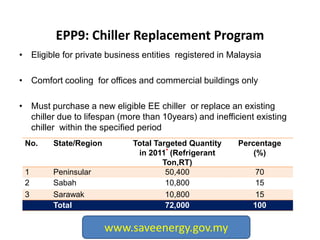
EPP9: Chiller Replacement Program
• Eligible for private business entities registered in Malaysia
• Comfort cooling for offices and commercial buildings only
• Must purchase a new eligible EE chiller or replace an existing
chiller due to lifespan (more than 10years) and inefficient existing
chiller within the specified period
No.

State/Region

1
2
3

Peninsular
Sabah
Sarawak
Total

Total Targeted Quantity
in 2011* (Refrigerant
Ton,RT)
50,400
10,800
10,800
72,000

www.saveenergy.gov.my

Percentage
(%)
70
15
15
100
Fiscal Incentives For EE & RE
Projects
 Introduced by the government to
promote EE & RE
 Companies implementing EE
measures in their premises
(…2015)
•
Investment Tax Allowance
•
Accelerated capital
allowance
•
import duty exemption
•
sales tax exemption
 GBI Certified Buildings(…2014)
 Implementing Agencies:
•
•

MIDA – Business & Other Services
Division(Application)
Energy Commission(Technical
assessment)

www.kettha.gov.my
www.st.gov.my
Green Buildings
Owners Of Buildings Awarded
With The GBI Certificate

Tax exemption
equivalent to
100% of the
additional capital
expenditure
incurred to obtain
the GBI
Certificate

Buyers Of Buildings And Residential
Properties Awarded With The GBI
Certificates Bought From Real
Property Developers

 Stamp duty exemption on
instrument of transfer of
ownership of such building.
 Amount of stamp duty
exemption is on the
additional cost incurred and
is given only once to the
first owner of the building
7
How is the progress of the funds
and incentives?
FINANCING OPTIONS TO
IMPLEMENT EE PROJECTS
Considering EE Financing?
 It is worth asking why the public or private sector would
consider financing EE investments over other options
 Financing programs are almost always more complex to
operate than the most common alternative—rebate
programs
 Financing programs require a long-term commitment of
financial and human resources to collect principal and
interest

 In most cases they also require a credit evaluation
process that is not necessary for a straight forward
Why Use Financing for Energy Efficiency?
1.

Financing expands the amount of capital available to invest by attracting new sources of
capital for EE &RE projects.
 Financing energy efficiency investments gives a return on capital to investors that is
unavailable in rebate or grant programs

2.

Financing expands the number of players that can support EE or RE
 Utilities and some government entities operate rebate programs because they have access
to capital that does not require a return;
 Financing programs allow lending institutions, ranging from banks to consumer credit
companies and others, to administer loan programs and bring their own capital to those loan
programs.

3.

Financing means “skin in the game” for customer/borrowers.
 Financing implies that customer/borrowers must pay back the money that they have
borrowed to install EE measures.
 This ―skin in the game may encourage them to operate and maintain equipment better
than if simply given it to them.

4.

Financing programs extend the life of limited government funds
 A rebate or grant program-funding with no return.
 A financing program that generates a return of both the capital invested as well as a return
on that capital through a revolving fund can finance new investments in EE&RE many times
over.

5.

Financing programs can complement rebate or grant programs
 For further long term saving for existing and future equipment/facilities
Key Challenges in EE Financing
 Still “ high risk”- banks still using the same guidelines for all
industries and sectors
 Risk management and credit enhancement is critical. Default
rates for efficiency programs have been low in many
countries(Thailand, USA)
• results of careful underwriting in a small number of programs
and the fact that EE measures actually reduce borrowers’ day to
day expenses, thus making loan repayments affordable

 However, it is unlikely that EE lending has a long or strong
enough credit history to attract a large amount of outside
capital and investors without additional credit enhancements
(loan loss reserves and guarantees, for instance) to secure
payment
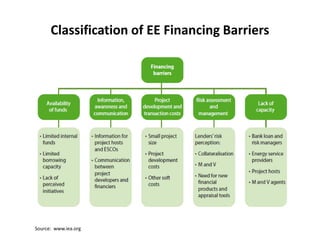
Classification of EE Financing Barriers

Source: www.iea.org
Key Risk Assessment Factors For EE in Asean
 Risk aversion to finance new technologies-EE projects
have yet to show sustainable commercial potentials
 Applicant(mainly SMEs) have low capital compare to
amount of loans requested
 Risk assessment-base on performance & track records
rather than potential of the technology
 Applicants have yet to secure long-term contracts from
reputable clients
 In Malaysian GTFS: 60% guarantee by the government
considered low compare to risks involved-Suggested 80%
Source: Green Prospects Asia, June 2012
Options for EE Private Funding
Internal Sources: Companies’
Internal Budget

External Sources
 Local and international
commercial banks
 International banks
 International
organizations
• GEF, UNDP

Fund for EE projects
 -With guarantee from the
government

Distribution Mechanism
 With low interest loan for
approved applicants
 Approved/endorsed by the
competent body appointed
by the government
Option 1:
Dedicated Credit Line Structure

Source: www.iea.org
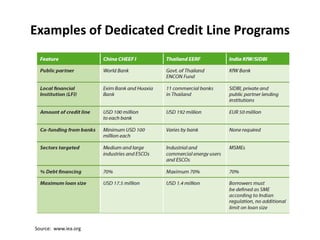
Examples of Dedicated Credit Line Programs

Source: www.iea.org
Option 2: Risk Sharing Facilities
Objectives
providing access to finance from commercial
Local Financial Institutions(LFIs)
reducing the cost of capital by reducing the risk
faced by the lender;
expanding the loan tenor or grace period to
match project cash flows; and
helping create a long-term sustainable market
for financing of EE projects.
Risk Sharing Facilities Structure

Source: www.iea.org
Examples Risk Sharing Programs

Source: www.iea.org
Examples Of EE Fund
Revolving Fund: Thailand
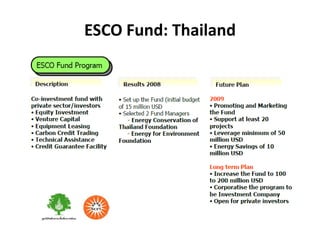
ESCO Fund: Thailand
What is Energy Services?
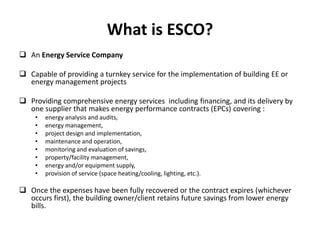
What is ESCO?
 An Energy Service Company
 Capable of providing a turnkey service for the implementation of building EE or
energy management projects

 Providing comprehensive energy services including financing, and its delivery by
one supplier that makes energy performance contracts (EPCs) covering :
•
•
•
•
•
•
•
•

energy analysis and audits,
energy management,
project design and implementation,
maintenance and operation,
monitoring and evaluation of savings,
property/facility management,
energy and/or equipment supply,
provision of service (space heating/cooling, lighting, etc.).

 Once the expenses have been fully recovered or the contract expires (whichever
occurs first), the building owner/client retains future savings from lower energy
bills.
Barriers to ESCOs in Developing Countries
 Most independent ESCOs have a small capital base
•
•

have difficulties accessing project funding from commercial financial institutions (FIs)
recycling capital is needed through bond issuances.

 New Concept among FIs
•
•

project financing for ESCO projects is not commonly accepted by FIs in developing countries
ESCO model is new in developing countries

 Smaller compare to other investment
•

EE projects are generally small relative to other investment projects being considered by the FIs
have a relatively large proportion of “soft costs” that cannot be easily collaterised.

 Immaturity of the EE market in developing countries
•
•
•
•

costs of project development are relatively high
most small ESCOs find it difficult to finance project development costs
limited experience with successful ESCO projects
ESCO s have not yet developed good credibility with energy users

 Lack of expertise among FIs
•
•
•

FI’s staff typically has limited knowledge and understanding of EE projects and the EPC concept
FIs perceive EE projects (incorrectly) as inherently more risky than other investments.
The combination of high project developments costs, limited access to long-term and low-cost
project financing, high equity requirements for project financing
Proposed Basic Criteria To Evaluate ESCO for EE
Project Implementation
 Senior Management team members
 Technical Team Members
•

Registered Professional/Certified by recognized bodies

 Technical support personnel
•

Qualifications, employment term

 Basic energy audit equipment
 Experiences in EE projects
•

Scope of works

 Track records in EE related projects/works
 Registration/membership with authorized/industry bodies such as MoF, SEDA Malaysia & MAESCO
•

For accountability and verification of qualified with the minimum requirements
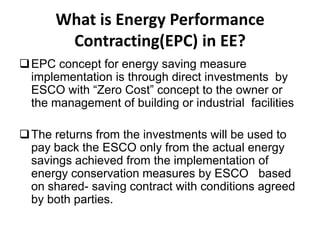
What is Energy Performance
Contracting(EPC) in EE?
 EPC concept for energy saving measure
implementation is through direct investments by
ESCO with “Zero Cost” concept to the owner or
the management of building or industrial facilities
 The returns from the investments will be used to
pay back the ESCO only from the actual energy
savings achieved from the implementation of
energy conservation measures by ESCO based
on shared- saving contract with conditions agreed
by both parties.
Benefits of EPC : Banks/Financial Institutions
 EPC provides needed comfort to investors
• Assures adequate cash flow
• Provides necessary third party engineering
calculations to justify the viability of technology being
applied
• Provides cost estimates that will be guaranteed by
design & build contract provided by ESCO
• Provides certainty that the money goes for the stated
purpose and not, say, diverted to cover operating
costs
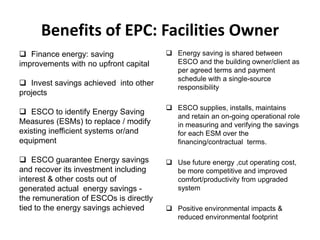
Benefits of EPC: Facilities Owner
 Finance energy: saving
improvements with no upfront capital
 Invest savings achieved into other
projects

 Energy saving is shared between
ESCO and the building owner/client as
per agreed terms and payment
schedule with a single-source
responsibility

 ESCO to identify Energy Saving
Measures (ESMs) to replace / modify
existing inefficient systems or/and
equipment

 ESCO supplies, installs, maintains
and retain an on-going operational role
in measuring and verifying the savings
for each ESM over the
financing/contractual terms.

 ESCO guarantee Energy savings
and recover its investment including
interest & other costs out of
generated actual energy savings the remuneration of ESCOs is directly
tied to the energy savings achieved

 Use future energy ,cut operating cost,
be more competitive and improved
comfort/productivity from upgraded
system
 Positive environmental impacts &
reduced environmental footprint
OPTIONS FOR EE FUNDING
Options To Implement Energy
Saving Measures
MEASURES
With LOW/
NO COST
Minimal Cost
Savings

MEASURES
WITH HIGH
COST
Significant Cost
Savings

• Management
Directives
• Implementation of
EMS - to ensure
sustainability of
energy cost reduction
initiatives

• Priorities of budget
core business/operations
• Investment risks
• Limited human resources
& expertise

In-house
initiatives

Expert
assistance &
investment from
ESCO
Financing Options for EPC
1. GUARANTEED
SAVINGS Model

2. SHARED
SAVINGS Model

• The loan goes on the client’s
balance sheet

• The loan goes on ESCO’s
balance sheet

3. Through a Special Purpose
Vehicle(SPV) created specially
for the purpose

 In all above, ESCO provides a guarantee of the project’s technical
performance and satisfaction of contracted specifications with the
client
Guaranteed Savings Model
Project Fees

Loan

FACILITIES
OWNER

BANK

Repayment

ESCO

Project Design&
Implementation
How Guaranteed Savings Model Works?
 Facilities owner takes out “normal” loan
(will appear on balance sheet)

 ESCO guarantees loan can be repaid with savings

 ESCO pays difference if minimum savings not met

Main advantage: ESCO can undertake more projects
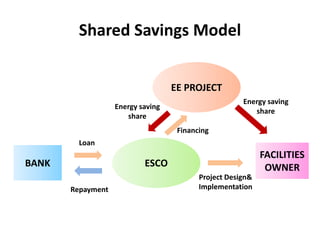
Shared Savings Model
EE PROJECT
Energy saving
share

Energy saving
share
Financing
Loan

BANK

FACILITIES
OWNER

ESCO
Repayment

Project Design&
Implementation
Shared Saving Mechanism
Energy Bills
Baseline
Savings for the
owner
Energy bill before
energy saving
measures
implementation

Before Contract Period

Payment to
ESCO

Lower Energy Bill

During contract period

Savings for the
owner

Energy bill
saved

Lower Energy Bill

After Contract
period

time
(year)
How Shared Savings Model Works?
 Facilities owner does not take loan (will not appear on balance sheet)
 ESCO finances project: takes performance & credit risk
 Customer pays higher %

Main advantage: Independent of Facilities owner ’s
borrowing capacity
Through a SPV
Common Elements of EPC Project Development
Potential Areas for EPC Projects
Energy Conservation
 Heating , Ventilation, Cooling
& Air Conditioning
 Operational, & equipment controls
 Heating equipment
 Chillers, AHUs, fans, pumps

Renewable & Alternative
Energy Sources
 Utilization of Feed-in Tariff(FiT)
offered by SEDA Malaysia
 (www.seda.gov.my)

 Compressed Air System
 Lighting Systems





Buildings(interior & exterior)
Public(Street lights)
Operational controls
Types of lamp technologies

 Maximum Demand Controls

 Solar Photo Voltaic(PV)
 Building Integrated PV System
 PV Power Plant

 Biomass & Biogas Power Plant
 Waste-to-energy systems
EVALUATION OF
ENERGY SAVING PROJECTS
Proposed Project

Basic Key Criteria

Technical Viability
Financial Viability
Sustainability Plan
Technical Viability
Type Of Project And
General Information
Modification/improvement or
Introduction/replacement for higher efficiency
technologies
Location and types of energy supplied and
tariff/rates applied (fuel, electricity)
Plant/equipment energy consumption per year
Existing plant/equipment energy efficiency
performance
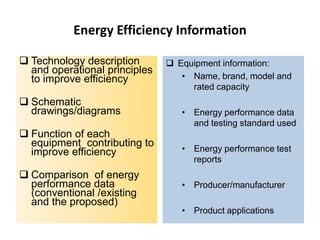
Energy Efficiency Information
 Technology description
and operational principles
to improve efficiency
 Schematic
drawings/diagrams
 Function of each
equipment contributing to
improve efficiency

 Comparison of energy
performance data
(conventional /existing
and the proposed)

 Equipment information:
• Name, brand, model and
rated capacity
• Energy performance data
and testing standard used
• Energy performance test
reports
• Producer/manufacturer
• Product applications
Energy Saving Potentials
 Types of energy to be saved (fuel, electricity)
 Method and data used in potential energy saving
calculations
 Estimated energy savings in energy units and
currency
Measurement And Verification
Of Results
 Energy saving measurement for verification
• baseline data/performance indicator
• measuring type and point

 Require energy metering
“The long term success of energy management projects is often
hampered by the inability of the project partners to agree on an
accurate, successful M&V plan.….. M&V protocol discusses
procedures that, when implemented, help buyers, sellers and
financiers of energy projects to agree on an M&V plan and
quantify savings from energy conservation measure (ECM)
projects.” - (IPMVP, Volume I, March 2002)
Energy Saving Measurement
& Verification
Baselines for saving
calculations & measurements
at agreed operating conditions
before implementation
 Energy bills
 Periodical Data logging
• Permanent- with submetering or
• Portable meter scheduled visits

 Savings Verification
• Joint scheduled data
logging & measurements

Baselines for saving
calculations & measurements mutually agreed for any
significant energy using
operational change
Factors should be considered while drafting a new
ESCO M&V to reduce dispute in EPC Contract
 Commitment From Client
 Factors Affecting Savings Performance
 Valuating Savings Uncertainty
 Minimum Operating Conditions
 Energy Prices
 Verification By A Third Party
 Baseline Adjustments (Non-routine)
 Balancing Uncertainty And Cost
Economic Viability
Financial Analysis
 Results often becomes the key parameter for the
management acceptance

 Smaller projects will normally be funded from
internal sources.
 Larger projects with external funding may require
consideration of :
•
•
•
•
•

Amount of investment.
Amount and period of loan.
Current and expected future inflation rates.
Asset of borrower.
Lender’s judgment of the risk involved, etc.
Criteria Used
Use company financial evaluation criteria
• Simple payback period for low cost projects
• Rate of return considers the benefits after the project
has paid back.
• Net present value gives the real cost benefits of a
project.
• Internal rate of return offers the most comprehensive
comparator
Life Cycle Cost Analysis
Consider the total life span of the equipment
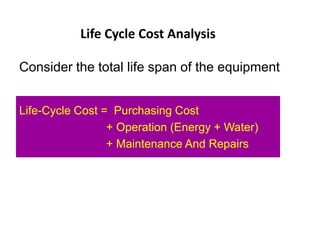
Life-Cycle Cost = Purchasing Cost
+ Operation (Energy + Water)
+ Maintenance And Repairs
Life Cycle Cost Indication:
Electric Motors
Sustainability Plan
Implementation Plan
 Resources
• Trained people involved in the implementation of the project
(internal personnel/external)
• Efficient operation & maintenance budget

 Work Plan
• Steps to be taken to implement the project and the targeted
duration for completion

 Energy Management Plan
• Equipment/System
• Plant
• Organizational (Adoption of Sustainable Energy Management
System /ISO 50001:2011)
Options & Risks for Implementation
Energy Saving Projects
Shared Saving/
Energy Performance
Contracting(EPC)
Component

Energy
Conservation

Renewable
Energy

Conventional

Technical Expertise

ESCO

ESCO

ESCO

Implementation/
Installation

ESCO

ESCO

ESCO

Funding Source

ESCO

ESCO

Owner

Sharing of returns
ratio

At agreed ratio &
conditions

At agreed ratio &
conditions

100% to
Owner

Technical &
Investment Risks

ESCO

ESCO

Owner

Performance
Maintenance &
monitoring

ESCO

ESCO

Owner
EXAMPLES OF EE SOLUTIONS
& TECHNOLOGIES
Computer -Aided Energy Resource Management
System(CERMS)

• Data acquisition
• Data Monitoring
• Data Analysis
• CONTROLS FOR ENERGY EFFICIENT
OPERATIONS: AC systems, Lighting
Energy Efficient Solutions
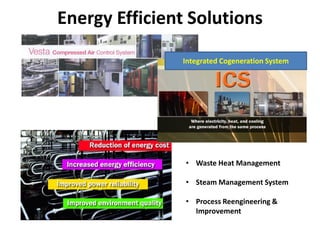
Integrated Cogeneration System

• Waste Heat Management
• Steam Management System
• Process Reengineering &
Improvement
Lighting Solutions

High Performance Fluorescent Lamp HPT8Vesta Energy Saving Micro Ballast
28W
Case Study 1: Public Library
1. Vesta T8-28W Micro Ballast – 542 sets
2.

Vesta HP T8-28 W FL – 1,354 tubes

Qty Installed:
Location
Ground FLR
Level 1
Level 2
Level 3
Level 4
Level 5
TOTAL

Total
(Sets)
171
124
64
61
61
61
542

1 Lamp
(Sets)
0
0
0
0
0
0
0

2 Lamps
(Sets)
145
120
8
8
8
5
294

3 Lamps
(Sets)
4
4
56
53
53
56
226

4 Lamps
(Sets)
22
0
0
0
0
0
22
Power Consumption Analysis

(7.8(8.0 – 4.6)/8.0
– 4.7)/7.8

Saving =
Saving = 40%42.5%
Comparison Before & After Implementation
(Before) Conventional FL 36W

(After) HP T8-28W
Case Study 2: Electronic Industry

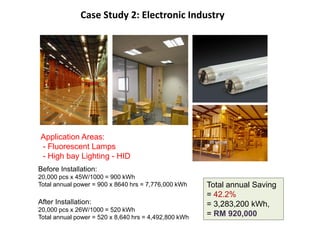
Application Areas:
- Fluorescent Lamps
- High bay Lighting - HID
Before Installation:
20,000 pcs x 45W/1000 = 900 kWh
Total annual power = 900 x 8640 hrs = 7,776,000 kWh

After Installation:
20,000 pcs x 26W/1000 = 520 kWh
Total annual power = 520 x 8,640 hrs = 4,492,800 kWh

Total annual Saving
= 42.2%
= 3,283,200 kWh,
= RM 920,000
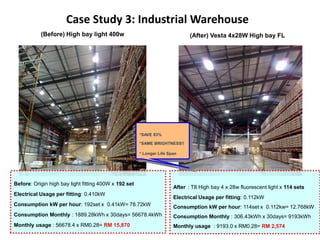
Case Study 3: Industrial Warehouse
(Before) High bay light 400w

(After) Vesta 4x28W High bay FL

*SAVE 83%
*SAME BRIGHTNESS!!
* Longer Life Span

Before: Origin high bay light fitting 400W x 192 set
Electrical Usage per fitting: 0.410kW

After : T8 High bay 4 x 28w fluorescent light x 114 sets
Electrical Usage per fitting: 0.112kW

Consumption kW per hour: 192set x 0.41kW= 78.72kW

Consumption kW per hour: 114set x 0.112kw= 12.768kW

Consumption Monthly : 1889.28kWh x 30days= 56678.4kWh

Consumption Monthly : 306.43kWh x 30days= 9193kWh

Monthly usage : 56678.4 x RM0.28= RM 15,870

Monthly usage : 9193.0 x RM0.28= RM 2,574
Conclusions
 Financing for EE is more complex than rebate or
grant programs
 Benefits of financing, including the potential for
leverage and for low or no subsidization
• provide new opportunities for overcoming barriers to
the adoption of EE measures.

 Financing should be viewed as a complement to
other strategies such as building energy codes,
appliance EE standards, or utility rebate programs
Conclusions..ctnd
 A successful financing program should support, and
not be a barrier to, customer participation - financing
should remain streamlined, easy-to-access, and quick.
 Customers need to know that they will have access to
financing, but they are not participating in a program
simply because it offers good financial terms
….As they are striving for lower utility bills, an upgraded
business property, and more comfortable working
spaces.
What’s Next?
Proposed Capacity Building Program by the
government through a competent/an
authorized body for EE
 Development of in-house capacity in technical & financial evaluation of
EE&EC Projects in financial institutions

 Development and acceptance of standard technical evaluation,
monitoring and performance verification criteria for EE&EC Projects
 With by technical experts from recognized professional/industrial bodies or association

 Development of and acceptance of standard evaluation for funding and
risk assessment criteria for EE&EC Projects
 Sharing of experiences in successful investments in EE projects
through seminars/dialogues
•
•
•

(results, payback period) from people in business communities who have experienced it
Criteria of viable EE projects
Competency of ESCOs

 Promotion of incentives/tax exemptions for EE&EC investment for
companies
Possible Actions Required for
Financial Institutions
 To specialize in green technologies such as EE
• EE has wide range of technologies & applications with different
levels of difficulties in technology(implementation, reliability,
ease of operation and durability

Due to…
 Insufficient proven domestic case studies by banks
• EE project require time and specific expertise to be assessed

 EE funds started in other countries such as Thailand & USA
has developed in-house expertise for banks in evaluating EE
projects
Source: Green Prospects Asia, June 2012
Proposed Basic Criteria To Evaluate ESCO for EE
Project Implementation
 Senior Management team members
 Technical Team Members
•

Registered Professional/Certified by recognized bodies

 Technical support personnel
 Basic energy audit equipment
 Experiences in EE projects
•

Scope of works

 Track records in EE related projects/works
 Registration/membership with authorized/industry bodies such as MoF, SEDA
Malaysia & MAESCO
•

For accountability and verification of qualified with the minimum requirements
Last Words
I hope today’s sessions will help you to
understand both the challenges to and
opportunities for using EE financing in a
productive manner
Thank you for your time & attention.

Energy Efficiency financing & evaluation criteria

  • 1.
    Fortnightly Technical TalkFor Project Management ENERGY EFFICIENCY PROJECTS : FINANCING & EVALUATION CRITERIA By Zaini Abdul Wahab Director of Operation CNS GROUP 14th June 2012 Menara SME Bank
  • 2.
    Outline 1. Existing EERelated Funds & Incentives In Malaysia 2. Financing Options To Implement EE Projects 3. EE Project Evaluation 4. Examples Of EE Solutions & Technologies 5. Conclusions 6. What’s Next?
  • 3.
    EXISTING EE RELATEDFUNDS & INCENTIVES IN MALAYSIA
  • 4.
    Green Technology FundScheme(GTFS)  Initial RM1.5 billion fund shared by government and banks to improve the supply and utilization of green technologies in Malaysia  2% subsidized interest rate of the total interest/profit rate  Any technology that suitable for the identified project criteria provided it is a proven technology FEATURES PRODUCER OF GREEN TECHNOLOGY USER OF GREEN TECHNOLOGY Financing size Maximum: RM50 million per company Maximum: RM10 million per company Financing tenure Up to 15 years Up to 10 years Eligibility criteria Legally registered Malaysian owned companies (at least 51%) in all economic sectors Legally registered Malaysian -owned companies (at least 70%) in all economic sector www.gtfs.my
  • 5.
    EPP9: Chiller ReplacementProgram • Eligible for private business entities registered in Malaysia • Comfort cooling for offices and commercial buildings only • Must purchase a new eligible EE chiller or replace an existing chiller due to lifespan (more than 10years) and inefficient existing chiller within the specified period No. State/Region 1 2 3 Peninsular Sabah Sarawak Total Total Targeted Quantity in 2011* (Refrigerant Ton,RT) 50,400 10,800 10,800 72,000 www.saveenergy.gov.my Percentage (%) 70 15 15 100
  • 6.
    Fiscal Incentives ForEE & RE Projects  Introduced by the government to promote EE & RE  Companies implementing EE measures in their premises (…2015) • Investment Tax Allowance • Accelerated capital allowance • import duty exemption • sales tax exemption  GBI Certified Buildings(…2014)  Implementing Agencies: • • MIDA – Business & Other Services Division(Application) Energy Commission(Technical assessment) www.kettha.gov.my www.st.gov.my
  • 7.
    Green Buildings Owners OfBuildings Awarded With The GBI Certificate Tax exemption equivalent to 100% of the additional capital expenditure incurred to obtain the GBI Certificate Buyers Of Buildings And Residential Properties Awarded With The GBI Certificates Bought From Real Property Developers  Stamp duty exemption on instrument of transfer of ownership of such building.  Amount of stamp duty exemption is on the additional cost incurred and is given only once to the first owner of the building 7
  • 8.
    How is theprogress of the funds and incentives?
  • 9.
  • 10.
    Considering EE Financing? It is worth asking why the public or private sector would consider financing EE investments over other options  Financing programs are almost always more complex to operate than the most common alternative—rebate programs  Financing programs require a long-term commitment of financial and human resources to collect principal and interest  In most cases they also require a credit evaluation process that is not necessary for a straight forward
  • 11.
    Why Use Financingfor Energy Efficiency? 1. Financing expands the amount of capital available to invest by attracting new sources of capital for EE &RE projects.  Financing energy efficiency investments gives a return on capital to investors that is unavailable in rebate or grant programs 2. Financing expands the number of players that can support EE or RE  Utilities and some government entities operate rebate programs because they have access to capital that does not require a return;  Financing programs allow lending institutions, ranging from banks to consumer credit companies and others, to administer loan programs and bring their own capital to those loan programs. 3. Financing means “skin in the game” for customer/borrowers.  Financing implies that customer/borrowers must pay back the money that they have borrowed to install EE measures.  This ―skin in the game may encourage them to operate and maintain equipment better than if simply given it to them. 4. Financing programs extend the life of limited government funds  A rebate or grant program-funding with no return.  A financing program that generates a return of both the capital invested as well as a return on that capital through a revolving fund can finance new investments in EE&RE many times over. 5. Financing programs can complement rebate or grant programs  For further long term saving for existing and future equipment/facilities
  • 12.
    Key Challenges inEE Financing  Still “ high risk”- banks still using the same guidelines for all industries and sectors  Risk management and credit enhancement is critical. Default rates for efficiency programs have been low in many countries(Thailand, USA) • results of careful underwriting in a small number of programs and the fact that EE measures actually reduce borrowers’ day to day expenses, thus making loan repayments affordable  However, it is unlikely that EE lending has a long or strong enough credit history to attract a large amount of outside capital and investors without additional credit enhancements (loan loss reserves and guarantees, for instance) to secure payment
  • 13.
    Classification of EEFinancing Barriers Source: www.iea.org
  • 14.
    Key Risk AssessmentFactors For EE in Asean  Risk aversion to finance new technologies-EE projects have yet to show sustainable commercial potentials  Applicant(mainly SMEs) have low capital compare to amount of loans requested  Risk assessment-base on performance & track records rather than potential of the technology  Applicants have yet to secure long-term contracts from reputable clients  In Malaysian GTFS: 60% guarantee by the government considered low compare to risks involved-Suggested 80% Source: Green Prospects Asia, June 2012
  • 15.
    Options for EEPrivate Funding Internal Sources: Companies’ Internal Budget External Sources  Local and international commercial banks  International banks  International organizations • GEF, UNDP Fund for EE projects  -With guarantee from the government Distribution Mechanism  With low interest loan for approved applicants  Approved/endorsed by the competent body appointed by the government
  • 16.
    Option 1: Dedicated CreditLine Structure Source: www.iea.org
  • 17.
    Examples of DedicatedCredit Line Programs Source: www.iea.org
  • 18.
    Option 2: RiskSharing Facilities Objectives providing access to finance from commercial Local Financial Institutions(LFIs) reducing the cost of capital by reducing the risk faced by the lender; expanding the loan tenor or grace period to match project cash flows; and helping create a long-term sustainable market for financing of EE projects.
  • 19.
    Risk Sharing FacilitiesStructure Source: www.iea.org
  • 20.
    Examples Risk SharingPrograms Source: www.iea.org
  • 21.
  • 22.
  • 23.
  • 24.
    What is EnergyServices?
  • 25.
    What is ESCO? An Energy Service Company  Capable of providing a turnkey service for the implementation of building EE or energy management projects  Providing comprehensive energy services including financing, and its delivery by one supplier that makes energy performance contracts (EPCs) covering : • • • • • • • • energy analysis and audits, energy management, project design and implementation, maintenance and operation, monitoring and evaluation of savings, property/facility management, energy and/or equipment supply, provision of service (space heating/cooling, lighting, etc.).  Once the expenses have been fully recovered or the contract expires (whichever occurs first), the building owner/client retains future savings from lower energy bills.
  • 26.
    Barriers to ESCOsin Developing Countries  Most independent ESCOs have a small capital base • • have difficulties accessing project funding from commercial financial institutions (FIs) recycling capital is needed through bond issuances.  New Concept among FIs • • project financing for ESCO projects is not commonly accepted by FIs in developing countries ESCO model is new in developing countries  Smaller compare to other investment • EE projects are generally small relative to other investment projects being considered by the FIs have a relatively large proportion of “soft costs” that cannot be easily collaterised.  Immaturity of the EE market in developing countries • • • • costs of project development are relatively high most small ESCOs find it difficult to finance project development costs limited experience with successful ESCO projects ESCO s have not yet developed good credibility with energy users  Lack of expertise among FIs • • • FI’s staff typically has limited knowledge and understanding of EE projects and the EPC concept FIs perceive EE projects (incorrectly) as inherently more risky than other investments. The combination of high project developments costs, limited access to long-term and low-cost project financing, high equity requirements for project financing
  • 27.
    Proposed Basic CriteriaTo Evaluate ESCO for EE Project Implementation  Senior Management team members  Technical Team Members • Registered Professional/Certified by recognized bodies  Technical support personnel • Qualifications, employment term  Basic energy audit equipment  Experiences in EE projects • Scope of works  Track records in EE related projects/works  Registration/membership with authorized/industry bodies such as MoF, SEDA Malaysia & MAESCO • For accountability and verification of qualified with the minimum requirements
  • 28.
    What is EnergyPerformance Contracting(EPC) in EE?  EPC concept for energy saving measure implementation is through direct investments by ESCO with “Zero Cost” concept to the owner or the management of building or industrial facilities  The returns from the investments will be used to pay back the ESCO only from the actual energy savings achieved from the implementation of energy conservation measures by ESCO based on shared- saving contract with conditions agreed by both parties.
  • 29.
    Benefits of EPC: Banks/Financial Institutions  EPC provides needed comfort to investors • Assures adequate cash flow • Provides necessary third party engineering calculations to justify the viability of technology being applied • Provides cost estimates that will be guaranteed by design & build contract provided by ESCO • Provides certainty that the money goes for the stated purpose and not, say, diverted to cover operating costs
  • 30.
    Benefits of EPC:Facilities Owner  Finance energy: saving improvements with no upfront capital  Invest savings achieved into other projects  Energy saving is shared between ESCO and the building owner/client as per agreed terms and payment schedule with a single-source responsibility  ESCO to identify Energy Saving Measures (ESMs) to replace / modify existing inefficient systems or/and equipment  ESCO supplies, installs, maintains and retain an on-going operational role in measuring and verifying the savings for each ESM over the financing/contractual terms.  ESCO guarantee Energy savings and recover its investment including interest & other costs out of generated actual energy savings the remuneration of ESCOs is directly tied to the energy savings achieved  Use future energy ,cut operating cost, be more competitive and improved comfort/productivity from upgraded system  Positive environmental impacts & reduced environmental footprint
  • 31.
  • 32.
    Options To ImplementEnergy Saving Measures MEASURES With LOW/ NO COST Minimal Cost Savings MEASURES WITH HIGH COST Significant Cost Savings • Management Directives • Implementation of EMS - to ensure sustainability of energy cost reduction initiatives • Priorities of budget core business/operations • Investment risks • Limited human resources & expertise In-house initiatives Expert assistance & investment from ESCO
  • 33.
    Financing Options forEPC 1. GUARANTEED SAVINGS Model 2. SHARED SAVINGS Model • The loan goes on the client’s balance sheet • The loan goes on ESCO’s balance sheet 3. Through a Special Purpose Vehicle(SPV) created specially for the purpose  In all above, ESCO provides a guarantee of the project’s technical performance and satisfaction of contracted specifications with the client
  • 34.
    Guaranteed Savings Model ProjectFees Loan FACILITIES OWNER BANK Repayment ESCO Project Design& Implementation
  • 35.
    How Guaranteed SavingsModel Works?  Facilities owner takes out “normal” loan (will appear on balance sheet)  ESCO guarantees loan can be repaid with savings  ESCO pays difference if minimum savings not met Main advantage: ESCO can undertake more projects
  • 36.
    Shared Savings Model EEPROJECT Energy saving share Energy saving share Financing Loan BANK FACILITIES OWNER ESCO Repayment Project Design& Implementation
  • 37.
    Shared Saving Mechanism EnergyBills Baseline Savings for the owner Energy bill before energy saving measures implementation Before Contract Period Payment to ESCO Lower Energy Bill During contract period Savings for the owner Energy bill saved Lower Energy Bill After Contract period time (year)
  • 38.
    How Shared SavingsModel Works?  Facilities owner does not take loan (will not appear on balance sheet)  ESCO finances project: takes performance & credit risk  Customer pays higher % Main advantage: Independent of Facilities owner ’s borrowing capacity
  • 39.
  • 40.
    Common Elements ofEPC Project Development
  • 41.
    Potential Areas forEPC Projects Energy Conservation  Heating , Ventilation, Cooling & Air Conditioning  Operational, & equipment controls  Heating equipment  Chillers, AHUs, fans, pumps Renewable & Alternative Energy Sources  Utilization of Feed-in Tariff(FiT) offered by SEDA Malaysia  (www.seda.gov.my)  Compressed Air System  Lighting Systems     Buildings(interior & exterior) Public(Street lights) Operational controls Types of lamp technologies  Maximum Demand Controls  Solar Photo Voltaic(PV)  Building Integrated PV System  PV Power Plant  Biomass & Biogas Power Plant  Waste-to-energy systems
  • 42.
  • 43.
    Proposed Project Basic KeyCriteria Technical Viability Financial Viability Sustainability Plan
  • 44.
  • 45.
    Type Of ProjectAnd General Information Modification/improvement or Introduction/replacement for higher efficiency technologies Location and types of energy supplied and tariff/rates applied (fuel, electricity) Plant/equipment energy consumption per year Existing plant/equipment energy efficiency performance
  • 46.
    Energy Efficiency Information Technology description and operational principles to improve efficiency  Schematic drawings/diagrams  Function of each equipment contributing to improve efficiency  Comparison of energy performance data (conventional /existing and the proposed)  Equipment information: • Name, brand, model and rated capacity • Energy performance data and testing standard used • Energy performance test reports • Producer/manufacturer • Product applications
  • 47.
    Energy Saving Potentials Types of energy to be saved (fuel, electricity)  Method and data used in potential energy saving calculations  Estimated energy savings in energy units and currency
  • 48.
    Measurement And Verification OfResults  Energy saving measurement for verification • baseline data/performance indicator • measuring type and point  Require energy metering “The long term success of energy management projects is often hampered by the inability of the project partners to agree on an accurate, successful M&V plan.….. M&V protocol discusses procedures that, when implemented, help buyers, sellers and financiers of energy projects to agree on an M&V plan and quantify savings from energy conservation measure (ECM) projects.” - (IPMVP, Volume I, March 2002)
  • 49.
    Energy Saving Measurement &Verification Baselines for saving calculations & measurements at agreed operating conditions before implementation  Energy bills  Periodical Data logging • Permanent- with submetering or • Portable meter scheduled visits  Savings Verification • Joint scheduled data logging & measurements Baselines for saving calculations & measurements mutually agreed for any significant energy using operational change
  • 50.
    Factors should beconsidered while drafting a new ESCO M&V to reduce dispute in EPC Contract  Commitment From Client  Factors Affecting Savings Performance  Valuating Savings Uncertainty  Minimum Operating Conditions  Energy Prices  Verification By A Third Party  Baseline Adjustments (Non-routine)  Balancing Uncertainty And Cost
  • 51.
  • 52.
    Financial Analysis  Resultsoften becomes the key parameter for the management acceptance  Smaller projects will normally be funded from internal sources.  Larger projects with external funding may require consideration of : • • • • • Amount of investment. Amount and period of loan. Current and expected future inflation rates. Asset of borrower. Lender’s judgment of the risk involved, etc.
  • 53.
    Criteria Used Use companyfinancial evaluation criteria • Simple payback period for low cost projects • Rate of return considers the benefits after the project has paid back. • Net present value gives the real cost benefits of a project. • Internal rate of return offers the most comprehensive comparator
  • 54.
    Life Cycle CostAnalysis Consider the total life span of the equipment Life-Cycle Cost = Purchasing Cost + Operation (Energy + Water) + Maintenance And Repairs
  • 55.
    Life Cycle CostIndication: Electric Motors
  • 56.
  • 57.
    Implementation Plan  Resources •Trained people involved in the implementation of the project (internal personnel/external) • Efficient operation & maintenance budget  Work Plan • Steps to be taken to implement the project and the targeted duration for completion  Energy Management Plan • Equipment/System • Plant • Organizational (Adoption of Sustainable Energy Management System /ISO 50001:2011)
  • 58.
    Options & Risksfor Implementation Energy Saving Projects Shared Saving/ Energy Performance Contracting(EPC) Component Energy Conservation Renewable Energy Conventional Technical Expertise ESCO ESCO ESCO Implementation/ Installation ESCO ESCO ESCO Funding Source ESCO ESCO Owner Sharing of returns ratio At agreed ratio & conditions At agreed ratio & conditions 100% to Owner Technical & Investment Risks ESCO ESCO Owner Performance Maintenance & monitoring ESCO ESCO Owner
  • 59.
    EXAMPLES OF EESOLUTIONS & TECHNOLOGIES
  • 60.
    Computer -Aided EnergyResource Management System(CERMS) • Data acquisition • Data Monitoring • Data Analysis • CONTROLS FOR ENERGY EFFICIENT OPERATIONS: AC systems, Lighting
  • 61.
    Energy Efficient Solutions IntegratedCogeneration System • Waste Heat Management • Steam Management System • Process Reengineering & Improvement
  • 62.
    Lighting Solutions High PerformanceFluorescent Lamp HPT8Vesta Energy Saving Micro Ballast 28W
  • 63.
    Case Study 1:Public Library 1. Vesta T8-28W Micro Ballast – 542 sets 2. Vesta HP T8-28 W FL – 1,354 tubes Qty Installed: Location Ground FLR Level 1 Level 2 Level 3 Level 4 Level 5 TOTAL Total (Sets) 171 124 64 61 61 61 542 1 Lamp (Sets) 0 0 0 0 0 0 0 2 Lamps (Sets) 145 120 8 8 8 5 294 3 Lamps (Sets) 4 4 56 53 53 56 226 4 Lamps (Sets) 22 0 0 0 0 0 22
  • 64.
    Power Consumption Analysis (7.8(8.0– 4.6)/8.0 – 4.7)/7.8 Saving = Saving = 40%42.5%
  • 65.
    Comparison Before &After Implementation (Before) Conventional FL 36W (After) HP T8-28W
  • 66.
    Case Study 2:Electronic Industry Application Areas: - Fluorescent Lamps - High bay Lighting - HID Before Installation: 20,000 pcs x 45W/1000 = 900 kWh Total annual power = 900 x 8640 hrs = 7,776,000 kWh After Installation: 20,000 pcs x 26W/1000 = 520 kWh Total annual power = 520 x 8,640 hrs = 4,492,800 kWh Total annual Saving = 42.2% = 3,283,200 kWh, = RM 920,000
  • 67.
    Case Study 3:Industrial Warehouse (Before) High bay light 400w (After) Vesta 4x28W High bay FL *SAVE 83% *SAME BRIGHTNESS!! * Longer Life Span Before: Origin high bay light fitting 400W x 192 set Electrical Usage per fitting: 0.410kW After : T8 High bay 4 x 28w fluorescent light x 114 sets Electrical Usage per fitting: 0.112kW Consumption kW per hour: 192set x 0.41kW= 78.72kW Consumption kW per hour: 114set x 0.112kw= 12.768kW Consumption Monthly : 1889.28kWh x 30days= 56678.4kWh Consumption Monthly : 306.43kWh x 30days= 9193kWh Monthly usage : 56678.4 x RM0.28= RM 15,870 Monthly usage : 9193.0 x RM0.28= RM 2,574
  • 68.
    Conclusions  Financing forEE is more complex than rebate or grant programs  Benefits of financing, including the potential for leverage and for low or no subsidization • provide new opportunities for overcoming barriers to the adoption of EE measures.  Financing should be viewed as a complement to other strategies such as building energy codes, appliance EE standards, or utility rebate programs
  • 69.
    Conclusions..ctnd  A successfulfinancing program should support, and not be a barrier to, customer participation - financing should remain streamlined, easy-to-access, and quick.  Customers need to know that they will have access to financing, but they are not participating in a program simply because it offers good financial terms ….As they are striving for lower utility bills, an upgraded business property, and more comfortable working spaces.
  • 70.
  • 71.
    Proposed Capacity BuildingProgram by the government through a competent/an authorized body for EE  Development of in-house capacity in technical & financial evaluation of EE&EC Projects in financial institutions  Development and acceptance of standard technical evaluation, monitoring and performance verification criteria for EE&EC Projects  With by technical experts from recognized professional/industrial bodies or association  Development of and acceptance of standard evaluation for funding and risk assessment criteria for EE&EC Projects  Sharing of experiences in successful investments in EE projects through seminars/dialogues • • • (results, payback period) from people in business communities who have experienced it Criteria of viable EE projects Competency of ESCOs  Promotion of incentives/tax exemptions for EE&EC investment for companies
  • 72.
    Possible Actions Requiredfor Financial Institutions  To specialize in green technologies such as EE • EE has wide range of technologies & applications with different levels of difficulties in technology(implementation, reliability, ease of operation and durability Due to…  Insufficient proven domestic case studies by banks • EE project require time and specific expertise to be assessed  EE funds started in other countries such as Thailand & USA has developed in-house expertise for banks in evaluating EE projects Source: Green Prospects Asia, June 2012
  • 73.
    Proposed Basic CriteriaTo Evaluate ESCO for EE Project Implementation  Senior Management team members  Technical Team Members • Registered Professional/Certified by recognized bodies  Technical support personnel  Basic energy audit equipment  Experiences in EE projects • Scope of works  Track records in EE related projects/works  Registration/membership with authorized/industry bodies such as MoF, SEDA Malaysia & MAESCO • For accountability and verification of qualified with the minimum requirements
  • 74.
    Last Words I hopetoday’s sessions will help you to understand both the challenges to and opportunities for using EE financing in a productive manner
  • 75.
    Thank you foryour time & attention.