NEUROGENIC BLADDER
Contents
1. ANATOMICAL INTRODUCTION
2. NERVE SUPPLY
3. PHYSIOLOGICAL REFLEX
4. NEUROGENIC BLADDER
5. INCONTINENCE
6. MANAGEMENT
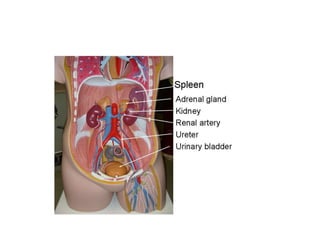
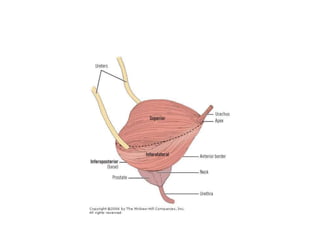
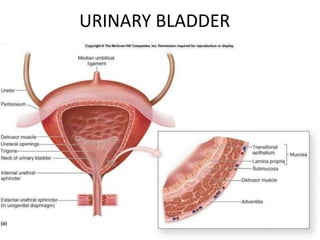
URINARY BLADDER
URINARY BLADDER ANATOMICAL
INTRODUCTION
Urinary bladder is the temporary store
house of urine which gets emptied
through the urethra.
The male urethra subserving the
functions of urination and ejaculation.
Female urethra is for urination only.
CAPACITY OF THE BLADDER
Capacity in an adult male 120 to 320 ml.
Filling beyond 220 ml causes micturition,
emptied when filled to about 250 to 300
ml.
Filling up to 500 ml may be tolerated, but
beyond this it becomes painful.
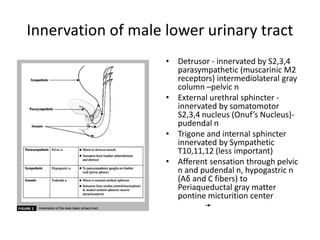
• Detrusor - innervated by S2,3,4
parasympathetic (muscarinic M2
receptors) intermediolateral gray
column –pelvic n
• External urethral sphincter -
innervated by somatomotor
S2,3,4 nucleus (Onuf’s Nucleus)-
pudendal n
• Trigone and internal sphincter
innervated by Sympathetic
T10,11,12 (less important)
• Afferent sensation through pelvic
n and pudendal n, hypogastric n
(Aδ and C fibers) to
Periaqueductal gray matter
pontine micturition center
S 2,3,4
S 2,3,4
Innervation of male lower urinary tract
NERVE SUPPLY
Its contains both sympathetic and
parasympathetic components.
Parasympathetic efferent fibers S2,S3,
S4 are motor to the detrusor muscle and
inhibitory to the sphincter vesicae.
 If these are destroyed, normal
micturition is not possible.
NERVE SUPPLY CONTI….
 Sympathetic efferent fibers (T11 to L2):
- inhibitory to the detrusor
-motor to the sphincter vesicae
 The pudendal nerve (S2, S3, S4)
-supplies the sphincter urethrae which
is voluntary
 Sensory nerves:
• pain sensations,
causes:
- spasm of bladder wall
- carried by parasympathetic nerves and
partly by sympathetic nerves
NERVE SUPPLY CONTI….
HIGHER CENTER
 Higher centers for micturition
1) Inhibitory centers : midbrain
-cerebral cortex
2) Facilitatory centers : Pons
- cerebral cortex
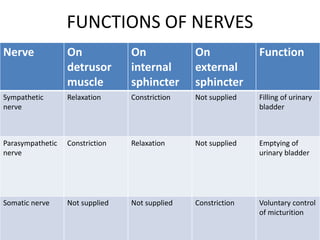
FUNCTIONS OF NERVES
Nerve On
detrusor
muscle
On
internal
sphincter
On
external
sphincter
Function
Sympathetic
nerve
Relaxation Constriction Not supplied Filling of urinary
bladder
Parasympathetic
nerve
Constriction Relaxation Not supplied Emptying of
urinary bladder
Somatic nerve Not supplied Not supplied Constriction Voluntary control
of micturition
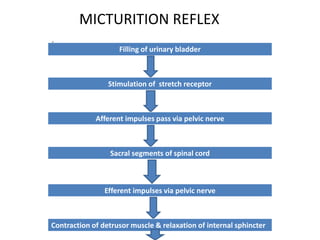
MICTURITION REFLEX
.
Filling of urinary bladder
Stimulation of stretch receptor
Afferent impulses pass via pelvic nerve
Efferent impulses via pelvic nerve
Contraction of detrusor muscle & relaxation of internal sphincter
Sacral segments of spinal cord
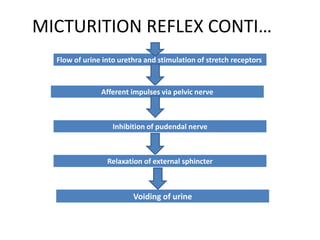
MICTURITION REFLEX CONTI…
Flow of urine into urethra and stimulation of stretch receptors
Afferent impulses via pelvic nerve
Inhibition of pudendal nerve
Relaxation of external sphincter
Voiding of urine
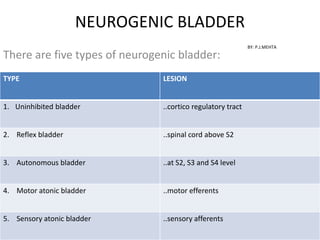
NEUROGENIC BLADDER
BY: P.J.MEHTA
There are five types of neurogenic bladder:
TYPE LESION
1. Uninhibited bladder ..cortico regulatory tract
2. Reflex bladder ..spinal cord above S2
3. Autonomous bladder ..at S2, S3 and S4 level
4. Motor atonic bladder ..motor efferents
5. Sensory atonic bladder ..sensory afferents
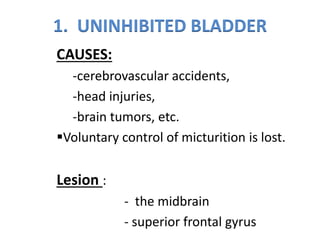
1. UNINHIBITED BLADDER
CAUSES:
-cerebrovascular accidents,
-head injuries,
-brain tumors, etc.
Voluntary control of micturition is lost.
Lesion :
- the midbrain
- superior frontal gyrus
2.REFLEX BLADDER
ETIOLOGY:
Transverses myelitis
Trauma
Neoplasms
Meningitis
Disseminated sclerosis
Lesion :
complete transection of spinal cord
above sacral segments
REFLEX BLADDER CONTI…
PATHOGENESIS:
Acute transaction of the cord causes
retention of urine during the stage of spinal
shock.
Leads to retention of residual urine.
During recovery stage, reflex activity begins
and automatic evacuation of bladder results.
3. AUTONOMOUS BLADDER
ETOLOGY:
Congenital : spina bifida,
meningomyelocele
Trauma: gunshot, auto accidents
Infective: arachnoiditis, radiculitis
Neoplasms of the cord
Surgery: combined perineal and abdominal
resection.
LESION:
sacral segment of spinal nerve.
AUTONOMOUS BLADDER CONTI…
CLINICAL FEATURES:
Loss of bladder sensation
Inability to initiate micturition
normally
paralysis of pariurethral striated
muscles
associated with anesthesia and
absent bulbocavernous reflex.
4. SENSORY PARALYTIC BLADDER
ETIOLOGY:
Tabes dorsalis
Pernicious anemia
Diabetes
Disseminated sclerosis
Syringomyelia
Lesion :
afferent fibers from the bladder
SENSORY PARALYTIC BLADDER
CONTI..
PATHOGENESIS:
Loss of bladder sensation, which leads
to overdistension of bladder.
Initially there is normal capacity
increases and residual urine appears.
CLINICAL FEATURES:
Initially these patients are
asymptomatic.
Gradually there is terminal dribbling
and later overflow incontinence.
5. MOTOR PARALYTIC BLADDER
ETIOLOGY:
Poliomyelitis
Polyradiculopathy
Congenital anomalies
Tumor
Trauma
Lesion :
Efferent fibers of the bladder
MOTOR PARALYTIC BLADDER CONTI..
PATHOGENESIS:
Since the sensory nerves are intact,
bladder if left alone, distends and
decompensates.
CLINICAL FEATURES:
Painful distention of the bladder and
inability to initiate micturition.
Decrease in size and force of steam
and interrupted stream.
Recurrent episodes of urinary
infections.
INCONTINENCE OF URINE
The term ‘continence’ is used to
describe the normal ability of a person
to store urine and faeces temporarily,
with conscious control over the time
and place of micturition and
defaecation.
‘Incontinence’ has been defined as
the involuntary or inappropriate passing
of urine or faeces, or both, that has an
impact on social functioning or
hygiene(DoH 2000).
INCONTINENCE OF URINE
Types:
1. Extra urethral incontinence
2.Detrusor over activity incontinence
3.Urodynamic stress incontinence
4.Nocturnal enuresis
5.Giggle incontinence
6.Functional incontinence
1.Extraurethral incontinence
Loss of urine through channels
other than the urethra
CAUSES
congenital abnormality.
trauma at pelvic surgery such as
hysterectomy
endometriosis,
infection or carcinoma.
Child birth(Wall 1999)
2. Detrusor overactivity
incontinence
-present as a symptom, a sign and as
a condition
The symptoms:
complains of urge incontinence,
immediately preceded by urgency,
that is a strong desire to void.
Detrusor overactivity
incontinence
The sign:
conformed as a sign observed
at urodynamic assessment
The condition:
May be further qualified as
neurogenic, in neurological condition
3.URODYNAMIC STRESS INCONTINENCE
Symptom:
during increased intra-abdominal
pressure, such as during coughing,
laughing, sneezing and lifting
Sign:
An involuntary spurt dribble or
droplet of urine is observed to leave
urethra immediately on an increase
in intra-abdominal pressure
4.NOCTURNAL ENURISIS
During sleep, or “bed wetting”
15-20% of 5 year old children and
up to 2% of young adults(Glazener
&Evans 2003)
5.GIGGLE INCONTINENCE
In girls around puberty
Caused by detrusor overactivity
induced by laughter(chandra et al
2002)
6.FUNCTIONAL INCONTINENCE
involuntary loss of urine
in ability to perform toileting
functions secondary to physical or
mental limitation
Urinary Retention
• If residual volume >
100ml
• Clean intermittent self
catheterisation (CISC)
• Permanent indwelling
catheter
Detrusor overactivity and
Retention
• Anticholinergic drugs
• CISC
Treatment
Treatment
• External device – condom catheter
• Sacral nerve stimulators – for DI
• Nerve root stimulators – S 2,3,4 for voiding
assisting defecation
• Surgery – Augmentation cystoplasty, artificial
sphincter, urinary diversion with stoma
collection bag

Bladder Innervation and Neurogenic Bladder.pptx

  • 1.
  • 2.
    Contents 1. ANATOMICAL INTRODUCTION 2.NERVE SUPPLY 3. PHYSIOLOGICAL REFLEX 4. NEUROGENIC BLADDER 5. INCONTINENCE 6. MANAGEMENT
  • 5.
  • 6.
    URINARY BLADDER ANATOMICAL INTRODUCTION Urinarybladder is the temporary store house of urine which gets emptied through the urethra. The male urethra subserving the functions of urination and ejaculation. Female urethra is for urination only.
  • 7.
    CAPACITY OF THEBLADDER Capacity in an adult male 120 to 320 ml. Filling beyond 220 ml causes micturition, emptied when filled to about 250 to 300 ml. Filling up to 500 ml may be tolerated, but beyond this it becomes painful.
  • 8.
    • Detrusor -innervated by S2,3,4 parasympathetic (muscarinic M2 receptors) intermediolateral gray column –pelvic n • External urethral sphincter - innervated by somatomotor S2,3,4 nucleus (Onuf’s Nucleus)- pudendal n • Trigone and internal sphincter innervated by Sympathetic T10,11,12 (less important) • Afferent sensation through pelvic n and pudendal n, hypogastric n (Aδ and C fibers) to Periaqueductal gray matter pontine micturition center S 2,3,4 S 2,3,4 Innervation of male lower urinary tract
  • 9.
    NERVE SUPPLY Its containsboth sympathetic and parasympathetic components. Parasympathetic efferent fibers S2,S3, S4 are motor to the detrusor muscle and inhibitory to the sphincter vesicae.  If these are destroyed, normal micturition is not possible.
  • 10.
    NERVE SUPPLY CONTI…. Sympathetic efferent fibers (T11 to L2): - inhibitory to the detrusor -motor to the sphincter vesicae  The pudendal nerve (S2, S3, S4) -supplies the sphincter urethrae which is voluntary  Sensory nerves: • pain sensations, causes: - spasm of bladder wall - carried by parasympathetic nerves and partly by sympathetic nerves NERVE SUPPLY CONTI….
  • 11.
    HIGHER CENTER  Highercenters for micturition 1) Inhibitory centers : midbrain -cerebral cortex 2) Facilitatory centers : Pons - cerebral cortex
  • 12.
    FUNCTIONS OF NERVES NerveOn detrusor muscle On internal sphincter On external sphincter Function Sympathetic nerve Relaxation Constriction Not supplied Filling of urinary bladder Parasympathetic nerve Constriction Relaxation Not supplied Emptying of urinary bladder Somatic nerve Not supplied Not supplied Constriction Voluntary control of micturition
  • 13.
    MICTURITION REFLEX . Filling ofurinary bladder Stimulation of stretch receptor Afferent impulses pass via pelvic nerve Efferent impulses via pelvic nerve Contraction of detrusor muscle & relaxation of internal sphincter Sacral segments of spinal cord
  • 14.
    MICTURITION REFLEX CONTI… Flowof urine into urethra and stimulation of stretch receptors Afferent impulses via pelvic nerve Inhibition of pudendal nerve Relaxation of external sphincter Voiding of urine
  • 15.
    NEUROGENIC BLADDER BY: P.J.MEHTA Thereare five types of neurogenic bladder: TYPE LESION 1. Uninhibited bladder ..cortico regulatory tract 2. Reflex bladder ..spinal cord above S2 3. Autonomous bladder ..at S2, S3 and S4 level 4. Motor atonic bladder ..motor efferents 5. Sensory atonic bladder ..sensory afferents
  • 16.
    1. UNINHIBITED BLADDER CAUSES: -cerebrovascularaccidents, -head injuries, -brain tumors, etc. Voluntary control of micturition is lost. Lesion : - the midbrain - superior frontal gyrus
  • 17.
    2.REFLEX BLADDER ETIOLOGY: Transverses myelitis Trauma Neoplasms Meningitis Disseminatedsclerosis Lesion : complete transection of spinal cord above sacral segments
  • 18.
    REFLEX BLADDER CONTI… PATHOGENESIS: Acutetransaction of the cord causes retention of urine during the stage of spinal shock. Leads to retention of residual urine. During recovery stage, reflex activity begins and automatic evacuation of bladder results.
  • 19.
    3. AUTONOMOUS BLADDER ETOLOGY: Congenital: spina bifida, meningomyelocele Trauma: gunshot, auto accidents Infective: arachnoiditis, radiculitis Neoplasms of the cord Surgery: combined perineal and abdominal resection. LESION: sacral segment of spinal nerve.
  • 20.
    AUTONOMOUS BLADDER CONTI… CLINICALFEATURES: Loss of bladder sensation Inability to initiate micturition normally paralysis of pariurethral striated muscles associated with anesthesia and absent bulbocavernous reflex.
  • 21.
    4. SENSORY PARALYTICBLADDER ETIOLOGY: Tabes dorsalis Pernicious anemia Diabetes Disseminated sclerosis Syringomyelia Lesion : afferent fibers from the bladder
  • 22.
    SENSORY PARALYTIC BLADDER CONTI.. PATHOGENESIS: Lossof bladder sensation, which leads to overdistension of bladder. Initially there is normal capacity increases and residual urine appears. CLINICAL FEATURES: Initially these patients are asymptomatic. Gradually there is terminal dribbling and later overflow incontinence.
  • 23.
    5. MOTOR PARALYTICBLADDER ETIOLOGY: Poliomyelitis Polyradiculopathy Congenital anomalies Tumor Trauma Lesion : Efferent fibers of the bladder
  • 24.
    MOTOR PARALYTIC BLADDERCONTI.. PATHOGENESIS: Since the sensory nerves are intact, bladder if left alone, distends and decompensates. CLINICAL FEATURES: Painful distention of the bladder and inability to initiate micturition. Decrease in size and force of steam and interrupted stream. Recurrent episodes of urinary infections.
  • 25.
    INCONTINENCE OF URINE Theterm ‘continence’ is used to describe the normal ability of a person to store urine and faeces temporarily, with conscious control over the time and place of micturition and defaecation. ‘Incontinence’ has been defined as the involuntary or inappropriate passing of urine or faeces, or both, that has an impact on social functioning or hygiene(DoH 2000).
  • 26.
    INCONTINENCE OF URINE Types: 1.Extra urethral incontinence 2.Detrusor over activity incontinence 3.Urodynamic stress incontinence 4.Nocturnal enuresis 5.Giggle incontinence 6.Functional incontinence
  • 27.
    1.Extraurethral incontinence Loss ofurine through channels other than the urethra CAUSES congenital abnormality. trauma at pelvic surgery such as hysterectomy endometriosis, infection or carcinoma. Child birth(Wall 1999)
  • 28.
    2. Detrusor overactivity incontinence -presentas a symptom, a sign and as a condition The symptoms: complains of urge incontinence, immediately preceded by urgency, that is a strong desire to void.
  • 29.
    Detrusor overactivity incontinence The sign: conformedas a sign observed at urodynamic assessment The condition: May be further qualified as neurogenic, in neurological condition
  • 30.
    3.URODYNAMIC STRESS INCONTINENCE Symptom: duringincreased intra-abdominal pressure, such as during coughing, laughing, sneezing and lifting Sign: An involuntary spurt dribble or droplet of urine is observed to leave urethra immediately on an increase in intra-abdominal pressure
  • 31.
    4.NOCTURNAL ENURISIS During sleep,or “bed wetting” 15-20% of 5 year old children and up to 2% of young adults(Glazener &Evans 2003)
  • 32.
    5.GIGGLE INCONTINENCE In girlsaround puberty Caused by detrusor overactivity induced by laughter(chandra et al 2002)
  • 33.
    6.FUNCTIONAL INCONTINENCE involuntary lossof urine in ability to perform toileting functions secondary to physical or mental limitation
  • 34.
    Urinary Retention • Ifresidual volume > 100ml • Clean intermittent self catheterisation (CISC) • Permanent indwelling catheter Detrusor overactivity and Retention • Anticholinergic drugs • CISC Treatment
  • 35.
    Treatment • External device– condom catheter • Sacral nerve stimulators – for DI • Nerve root stimulators – S 2,3,4 for voiding assisting defecation • Surgery – Augmentation cystoplasty, artificial sphincter, urinary diversion with stoma collection bag