MICROSPHERES
Molecular Pharmaceutics
Presented by : Mr. Chitrang Ramesh Patil
F.Y.M.PHARMACY.(Pharmaceutics) M23027
Konkan Gyanpeeth College of Pharmacy and Research Institute, Karjat Raigad.
Guided by:- Mr. Swapnil Phalak Sir
CONTENT
1.Introduction
2.Polymers used in microsphere
3.Criteria for preparation of microsphere
4.Method of preparation
5.Evaluation
6.Reference
7.Website links
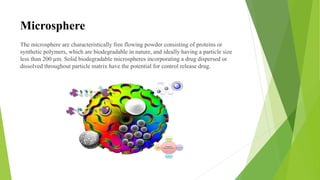
Microsphere
The microsphere are characteristically free flowing powder consisting of proteins or
synthetic polymers, which are biodegradable in nature, and ideally having a particle size
less than 200 µm. Solid biodegradable microspheres incorporating a drug dispersed or
dissolved throughout particle matrix have the potential for control release drug.
Polymers Used In Microsphere
A)Natural Polymer
1. Protien: Albumins, Gelatin, Collagen
2. Carbohydrates: Starch, Agarose, Carrageenan, Chitosan
3. Chemically modified carbohydrates: Poly(acryl)dextran, Poly(acryl)starch
B)Synthetic Polymers
1.Blodegradable Polymer
Lactides & glycolides & their copolymer, Polyalkyl cyano acrylates, Polyanhydride.
2.Non-Biodegradable polymers
Acroline, Glycidyl methacrylate, Polyanhydride
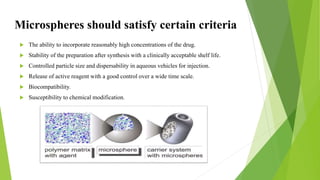
Microspheres should satisfy certain criteria
 The ability to incorporate reasonably high concentrations of the drug.
 Stability of the preparation after synthesis with a clinically acceptable shelf life.
 Controlled particle size and dispersability in aqueous vehicles for injection.
 Release of active reagent with a good control over a wide time scale.
 Biocompatibility.
 Susceptibility to chemical modification.
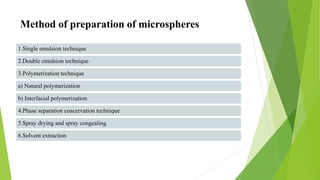
Method of preparation of microspheres
1.Single emulsion technique
2.Double emulsion technique
3.Polymerization technique
a) Natural polymerization
b) Interfacial polymerization
4.Phase separation coacervation technique
5.Spray drying and spray congealing
6.Solvent extraction
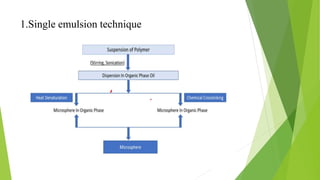
1.Single emulsion technique
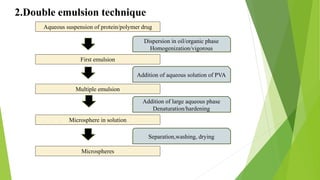
2.Double emulsion technique
Aqueous suspension of protein/polymer drug
First emulsion
Microspheres
Multiple emulsion
Microsphere in solution
Dispersion in oil/organic phase
Homogenization/vigorous
Addition of aqueous solution of PVA
Addition of large aqueous phase
Denaturation/hardening
Separation,washing, drying
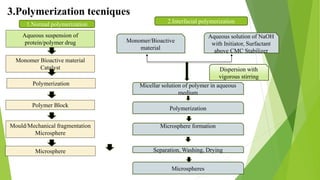
3.Polymerization tecniques
Aqueous suspension of
protein/polymer drug
Monomer Bioactive material
Catalyst
Mould/Mechanical fragmentation
Microsphere
Polymerization
Polymer Block
Monomer/Bioactive
material
Dispersion with
vigorous stirring
Polymerization
Separation, Washing, Drying
Microsphere
Aqueous solution of NaOH
with Initiator, Surfactant
above CMC Stabilizer
Micellar solution of polymer in aqueous
medium
Microsphere formation
Microspheres
1.Normal polymerization 2.Interfacial polymerization
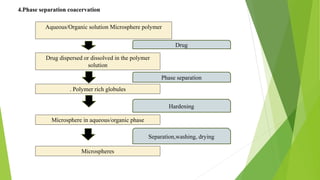
4.Phase separation coacervation
Aqueous/Organic solution Microsphere polymer
Drug dispersed or dissolved in the polymer
solution
Microspheres
. Polymer rich globules
Microsphere in aqueous/organic phase
Drug
Phase separation
Hardening
Separation,washing, drying
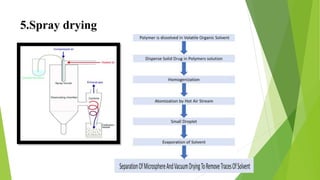
5.Spray drying
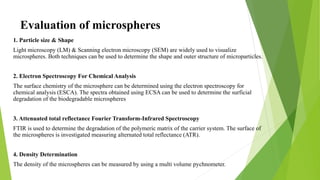
Evaluation of microspheres
1. Particle size & Shape
Light microscopy (LM) & Scanning electron microscopy (SEM) are widely used to visualize
microspheres. Both techniques can be used to determine the shape and outer structure of microparticles.
2. Electron Spectroscopy For Chemical Analysis
The surface chemistry of the microsphere can be determined using the electron spectroscopy for
chemical analysis (ESCA). The spectra obtained using ECSA can be used to determine the surficial
degradation of the biodegradable microspheres
3. Attenuated total reflectance Fourier Transform-Infrared Spectroscopy
FTIR is used to determine the degradation of the polymeric matrix of the carrier system. The surface of
the microspheres is investigated measuring alternated total reflectance (ATR).
4. Density Determination
The density of the microspheres can be measured by using a multi volume pychnometer.
Evaluation of microspheres
5. Isoelectric Point
The micro electrophoresis is an a apparatus used to measure electrophoretic mobility of
microsphere from which isoelectric point can be determined. The mean velocity at different Ph
values ranging from 3 10 is calculated by measuring the time of particle movement over a
distance of 1 mm.
6. Surface Carboxylic Acid Residue
The surface carboxylic acid residue is measured by using radioactive glycine. The radioactive
glycine conjugates is prepared by the reaction of 14C glycine ethyl ester hydro chloride with
the microspheres. The free carboxylic acid residue can be measured for hydrophobic or
hydrophilic or any other derivatized type of the microspheres.
7. Surface Amino acid Residue
Surface associated amino acid residue is determined by the radioactive c14-acetic acid
conjugate. The carboxylic acid residue is measured through the liquid scintillation counter and
hence the amino acid cosidue can be determined.
Evaluation of microspheres
8. Capture Efficiency
The capture efficiency of the microspheres or the percent entrapment can be determined by
allowing washed microspheres to lyse. Percent Entrapment = (Actual content/Theoretical
Content) X 100
9. Angle of Contact
The angle of contact is measured to determine the wetting property of a micro particulate
carrier. It determines the nature of microspheres in terms of hydrophilicity or
hydrophobicity.
Reference
 Targeted and Controlled Drug Delivery: Novel Carrier Systems: S.P. Vyas, R.K, Khar,
CBS Publishers, New Delhi, 2002, ISBN 81-239-0799-0 Page no- 417-457
 Microspheres as drug delivery system-a review. Prasad, B.S., Gupta, V.R., Devanna, N.
and Jayasurya, K., 2014. J Glob Trends Pharm Sci, 5(3), pp.1961-72.
 Microspheres for controlled release drug delivery. Expert opinion on biological therapy,
Varde, N.K. and Pack, D.W., 2004 4(1), pp.35-51.
 Microspheres as drug carriers for controlled drug delivery: a review. International
Journal of pharmaceutical sciences and research, 6(11), p.4579. Sharma, N., Purwar,
N. and Gupta, P.C., 2015.
 Microsphere as a novel drug delivery. International Journal of Pharmacy & Life
Sciences, 2(8). Patel, N.R., Patel, D.A., Bharadia, P.D., Pandya, V. and Modi, D., 2011.
Website links
 https://jgtps.com/admin/uploads/YqxI0h.pdf
 https://www.tandfonline.com/doi/abs/10.1517/14712598.4.1.35
 https://www.researchgate.net/profile/Nisha-Sharma-
14/publication/283503341_MICROSPHERES_AS_DRUG_CARRIERS_FOR_CONT
ROLLED_DRUG_DELIVERY_A_REVIEW/links/563b89c908ae34e98c47c6a9/MICR
OSPHERES-AS-DRUG-CARRIERS-FOR-CONTROLLED-DRUG-DELIVERY-A-
REVIEW.pdf
 https://www.academia.edu/download/83836505/Microsphere_as_a_novel_drug_deliver
y20220411-6770-1xwsrvs.pdf
Question Ask in University exam
 1.Discuss about preparation and evaluation of microsphere.
 2.write note on pharmaceutical application of microspheres.
Thank You…..

Microspheres in molecular pharmaceutics

  • 1.
    MICROSPHERES Molecular Pharmaceutics Presented by: Mr. Chitrang Ramesh Patil F.Y.M.PHARMACY.(Pharmaceutics) M23027 Konkan Gyanpeeth College of Pharmacy and Research Institute, Karjat Raigad. Guided by:- Mr. Swapnil Phalak Sir
  • 2.
    CONTENT 1.Introduction 2.Polymers used inmicrosphere 3.Criteria for preparation of microsphere 4.Method of preparation 5.Evaluation 6.Reference 7.Website links
  • 3.
    Microsphere The microsphere arecharacteristically free flowing powder consisting of proteins or synthetic polymers, which are biodegradable in nature, and ideally having a particle size less than 200 µm. Solid biodegradable microspheres incorporating a drug dispersed or dissolved throughout particle matrix have the potential for control release drug.
  • 4.
    Polymers Used InMicrosphere A)Natural Polymer 1. Protien: Albumins, Gelatin, Collagen 2. Carbohydrates: Starch, Agarose, Carrageenan, Chitosan 3. Chemically modified carbohydrates: Poly(acryl)dextran, Poly(acryl)starch B)Synthetic Polymers 1.Blodegradable Polymer Lactides & glycolides & their copolymer, Polyalkyl cyano acrylates, Polyanhydride. 2.Non-Biodegradable polymers Acroline, Glycidyl methacrylate, Polyanhydride
  • 5.
    Microspheres should satisfycertain criteria  The ability to incorporate reasonably high concentrations of the drug.  Stability of the preparation after synthesis with a clinically acceptable shelf life.  Controlled particle size and dispersability in aqueous vehicles for injection.  Release of active reagent with a good control over a wide time scale.  Biocompatibility.  Susceptibility to chemical modification.
  • 6.
    Method of preparationof microspheres 1.Single emulsion technique 2.Double emulsion technique 3.Polymerization technique a) Natural polymerization b) Interfacial polymerization 4.Phase separation coacervation technique 5.Spray drying and spray congealing 6.Solvent extraction
  • 7.
  • 8.
    2.Double emulsion technique Aqueoussuspension of protein/polymer drug First emulsion Microspheres Multiple emulsion Microsphere in solution Dispersion in oil/organic phase Homogenization/vigorous Addition of aqueous solution of PVA Addition of large aqueous phase Denaturation/hardening Separation,washing, drying
  • 9.
    3.Polymerization tecniques Aqueous suspensionof protein/polymer drug Monomer Bioactive material Catalyst Mould/Mechanical fragmentation Microsphere Polymerization Polymer Block Monomer/Bioactive material Dispersion with vigorous stirring Polymerization Separation, Washing, Drying Microsphere Aqueous solution of NaOH with Initiator, Surfactant above CMC Stabilizer Micellar solution of polymer in aqueous medium Microsphere formation Microspheres 1.Normal polymerization 2.Interfacial polymerization
  • 10.
    4.Phase separation coacervation Aqueous/Organicsolution Microsphere polymer Drug dispersed or dissolved in the polymer solution Microspheres . Polymer rich globules Microsphere in aqueous/organic phase Drug Phase separation Hardening Separation,washing, drying
  • 11.
  • 12.
    Evaluation of microspheres 1.Particle size & Shape Light microscopy (LM) & Scanning electron microscopy (SEM) are widely used to visualize microspheres. Both techniques can be used to determine the shape and outer structure of microparticles. 2. Electron Spectroscopy For Chemical Analysis The surface chemistry of the microsphere can be determined using the electron spectroscopy for chemical analysis (ESCA). The spectra obtained using ECSA can be used to determine the surficial degradation of the biodegradable microspheres 3. Attenuated total reflectance Fourier Transform-Infrared Spectroscopy FTIR is used to determine the degradation of the polymeric matrix of the carrier system. The surface of the microspheres is investigated measuring alternated total reflectance (ATR). 4. Density Determination The density of the microspheres can be measured by using a multi volume pychnometer.
  • 13.
    Evaluation of microspheres 5.Isoelectric Point The micro electrophoresis is an a apparatus used to measure electrophoretic mobility of microsphere from which isoelectric point can be determined. The mean velocity at different Ph values ranging from 3 10 is calculated by measuring the time of particle movement over a distance of 1 mm. 6. Surface Carboxylic Acid Residue The surface carboxylic acid residue is measured by using radioactive glycine. The radioactive glycine conjugates is prepared by the reaction of 14C glycine ethyl ester hydro chloride with the microspheres. The free carboxylic acid residue can be measured for hydrophobic or hydrophilic or any other derivatized type of the microspheres. 7. Surface Amino acid Residue Surface associated amino acid residue is determined by the radioactive c14-acetic acid conjugate. The carboxylic acid residue is measured through the liquid scintillation counter and hence the amino acid cosidue can be determined.
  • 14.
    Evaluation of microspheres 8.Capture Efficiency The capture efficiency of the microspheres or the percent entrapment can be determined by allowing washed microspheres to lyse. Percent Entrapment = (Actual content/Theoretical Content) X 100 9. Angle of Contact The angle of contact is measured to determine the wetting property of a micro particulate carrier. It determines the nature of microspheres in terms of hydrophilicity or hydrophobicity.
  • 15.
    Reference  Targeted andControlled Drug Delivery: Novel Carrier Systems: S.P. Vyas, R.K, Khar, CBS Publishers, New Delhi, 2002, ISBN 81-239-0799-0 Page no- 417-457  Microspheres as drug delivery system-a review. Prasad, B.S., Gupta, V.R., Devanna, N. and Jayasurya, K., 2014. J Glob Trends Pharm Sci, 5(3), pp.1961-72.  Microspheres for controlled release drug delivery. Expert opinion on biological therapy, Varde, N.K. and Pack, D.W., 2004 4(1), pp.35-51.  Microspheres as drug carriers for controlled drug delivery: a review. International Journal of pharmaceutical sciences and research, 6(11), p.4579. Sharma, N., Purwar, N. and Gupta, P.C., 2015.  Microsphere as a novel drug delivery. International Journal of Pharmacy & Life Sciences, 2(8). Patel, N.R., Patel, D.A., Bharadia, P.D., Pandya, V. and Modi, D., 2011.
  • 16.
    Website links  https://jgtps.com/admin/uploads/YqxI0h.pdf https://www.tandfonline.com/doi/abs/10.1517/14712598.4.1.35  https://www.researchgate.net/profile/Nisha-Sharma- 14/publication/283503341_MICROSPHERES_AS_DRUG_CARRIERS_FOR_CONT ROLLED_DRUG_DELIVERY_A_REVIEW/links/563b89c908ae34e98c47c6a9/MICR OSPHERES-AS-DRUG-CARRIERS-FOR-CONTROLLED-DRUG-DELIVERY-A- REVIEW.pdf  https://www.academia.edu/download/83836505/Microsphere_as_a_novel_drug_deliver y20220411-6770-1xwsrvs.pdf
  • 17.
    Question Ask inUniversity exam  1.Discuss about preparation and evaluation of microsphere.  2.write note on pharmaceutical application of microspheres.
  • 18.