BARKATULLAH
UNIVERSITY,
BHOPAL
MICROSCOPY
Presented by:
Navjot Singh
M.Sc. 1st semester
Application no. – B208140024
Introduction
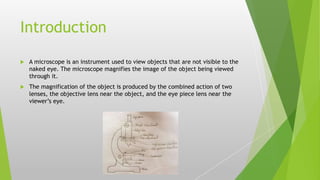
 A microscope is an instrument used to view objects that are not visible to the
naked eye. The microscope magnifies the image of the object being viewed
through it.
 The magnification of the object is produced by the combined action of two
lenses, the objective lens near the object, and the eye piece lens near the
viewer’s eye.
History
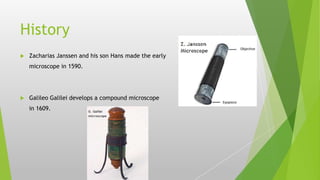
 Zacharias Janssen and his son Hans made the early
microscope in 1590.
 Galileo Galilei develops a compound microscope
in 1609.
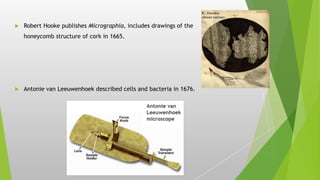
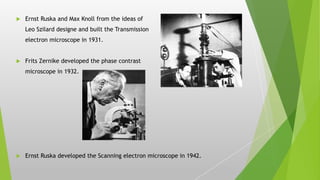
 Robert Hooke publishes Micrographia, includes drawings of the
honeycomb structure of cork in 1665.
 Antonie van Leeuwenhoek described cells and bacteria in 1676.
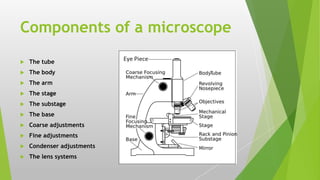
 Ernst Ruska and Max Knoll from the ideas of
Leo Szilard designe and built the Transmission
electron microscope in 1931.
 Frits Zernike developed the phase contrast
microscope in 1932.
 Ernst Ruska developed the Scanning electron microscope in 1942.
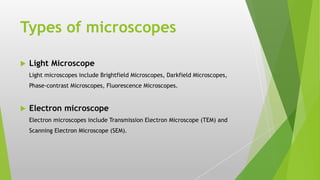
Components of a microscope
 The tube
 The body
 The arm
 The stage
 The substage
 The base
 Coarse adjustments
 Fine adjustments
 Condenser adjustments
 The lens systems
Uses and care of a bright field
microscope
 Always lift and carry the microscope with well supported hands.
 Protect the microscope from dust, moisture and direct sunlight.
 Place the microscope on a firm surface so that it does not vibrate.
 If the objective lens is dirty, it should be cleaned with a clean piece of soft
linen or lens tissue. Little xylene may be used if the dirt is difficult to
remove. Never use alcohol.
 The underside of a glass slide should be completely dry before it is placed
onto the stage.
 At the end of the working day, all the objective lenses must be wiped clean
and the microscope should be covered with its protective cover.
Types of microscopes
 Light Microscope
Light microscopes include Brightfield Microscopes, Darkfield Microscopes,
Phase-contrast Microscopes, Fluorescence Microscopes.
 Electron microscope
Electron microscopes include Transmission Electron Microscope (TEM) and
Scanning Electron Microscope (SEM).
Brightfield microscope
 The brightfield microscope is a compound microscope with two or more
lenses.
 It produce a dark image on a bright background.
 Eyepiece contains a lens called an ocular lens. The ocular lenses typically
magnify images 10 times (10x).
 The magnification of objective lenses typically ranges from 4x to 100x.
 The total magnification is
Ocular magnification x objective magnification
 For example, if a 40x objective lens is selected and the ocular lens is 10x, the
total magnification would be (40x)(10x) = 400x.
Darkfield microscope
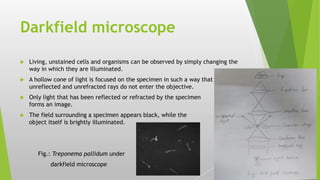
 Living, unstained cells and organisms can be observed by simply changing the
way in which they are illuminated.
 A hollow cone of light is focused on the specimen in such a way that
unreflected and unrefracted rays do not enter the objective.
 Only light that has been reflected or refracted by the specimen
forms an image.
 The field surrounding a specimen appears black, while the
object itself is brightly illuminated.
Fig.: Treponema pallidum under
darkfield microscope
Phase-contrast Microscope
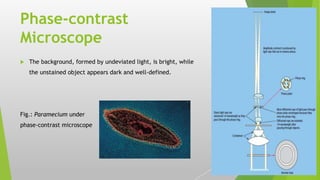
 The condenser of a phase-contrast microscope has an annular stop, an opaque
disk with a thin transparent ring, which produces a hollow cone of light.
 As this cone passes through a cell, some light rays are bent due to variations
in density and refractive index within the specimen and are retarded by about
1/4 wavelength.
 The deviated light is focused to form an image of the object.
 Undeviated light rays strike a phase ring in the phase plate, a special optical
disk located in the objective, while the deviated rays miss the ring and pass
through the rest of the plate.
 The phase ring is constructed in such a way that the undeviated light passing
through it is advanced by 1/4 wavelength, the deviated and undeviated waves
will be about 1/2 wavelength out of phase and will cancel each other when
they come together to form an image.
Phase-contrast
Microscope
 The background, formed by undeviated light, is bright, while
the unstained object appears dark and well-defined.
Fig.: Paramecium under
phase-contrast microscope
Fluorescence Microscope
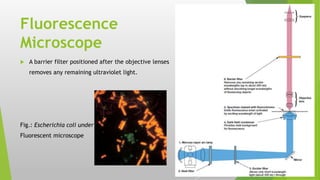
 The fluorescence microscope exposes a specimen to ultraviolet, violet, or
blue light and forms an image of the object with the resulting fluorescent
light.
 A mercury vapor arc lamp or other source produces an intense beam, and
heat transfer is limited by a special infrared filter.
 The light passes through an exciter filter that transmits only the desired
wavelength.
 A darkfield condenser provides a black background against which the
fluorescent objects glow.
 Usually the specimens have been stained with dye molecules, called
fluorochromes, which fluoresce brightly upon exposure to light of a specific
wavelength.
Fluorescence
Microscope
 A barrier filter positioned after the objective lenses
removes any remaining ultraviolet light.
Fig.: Escherichia coli under
Fluorescent microscope
Transmission Electron
Microscope (TEM)
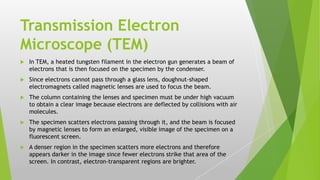
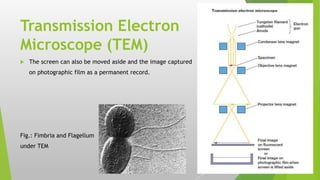
 In TEM, a heated tungsten filament in the electron gun generates a beam of
electrons that is then focused on the specimen by the condenser.
 Since electrons cannot pass through a glass lens, doughnut-shaped
electromagnets called magnetic lenses are used to focus the beam.
 The column containing the lenses and specimen must be under high vacuum
to obtain a clear image because electrons are deflected by collisions with air
molecules.
 The specimen scatters electrons passing through it, and the beam is focused
by magnetic lenses to form an enlarged, visible image of the specimen on a
fluorescent screen.
 A denser region in the specimen scatters more electrons and therefore
appears darker in the image since fewer electrons strike that area of the
screen. In contrast, electron-transparent regions are brighter.
Transmission Electron
Microscope (TEM)
 The screen can also be moved aside and the image captured
on photographic film as a permanent record.
Fig.: Fimbria and Flagellum
under TEM
Scanning Electron Microscope
(SEM)
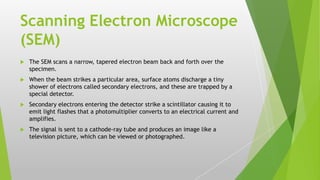
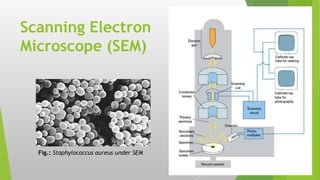
 The SEM scans a narrow, tapered electron beam back and forth over the
specimen.
 When the beam strikes a particular area, surface atoms discharge a tiny
shower of electrons called secondary electrons, and these are trapped by a
special detector.
 Secondary electrons entering the detector strike a scintillator causing it to
emit light flashes that a photomultiplier converts to an electrical current and
amplifies.
 The signal is sent to a cathode-ray tube and produces an image like a
television picture, which can be viewed or photographed.
Scanning Electron
Microscope (SEM)
Fig.: Staphylococcus aureus under SEM
References
 Ochei, J. and Kolhatkar A., (2015), Medical Laboratory Science, Theory and
Practices, Tata McGraw-Hill.
 Lansing M. Prescott, John P. Harley, Donald A. Klein, (2002), Microbiology, Tata
McGraw-Hill.
 https://www.microscopemaster.com/microscope-timeline.html
 https://www.sciencelearn.org.nz/resources/1692-history-of-microscopy-
timeline
Thank You

Microscopy

  • 1.
  • 2.
    Introduction  A microscopeis an instrument used to view objects that are not visible to the naked eye. The microscope magnifies the image of the object being viewed through it.  The magnification of the object is produced by the combined action of two lenses, the objective lens near the object, and the eye piece lens near the viewer’s eye.
  • 3.
    History  Zacharias Janssenand his son Hans made the early microscope in 1590.  Galileo Galilei develops a compound microscope in 1609.
  • 4.
     Robert Hookepublishes Micrographia, includes drawings of the honeycomb structure of cork in 1665.  Antonie van Leeuwenhoek described cells and bacteria in 1676.
  • 5.
     Ernst Ruskaand Max Knoll from the ideas of Leo Szilard designe and built the Transmission electron microscope in 1931.  Frits Zernike developed the phase contrast microscope in 1932.  Ernst Ruska developed the Scanning electron microscope in 1942.
  • 6.
    Components of amicroscope  The tube  The body  The arm  The stage  The substage  The base  Coarse adjustments  Fine adjustments  Condenser adjustments  The lens systems
  • 7.
    Uses and careof a bright field microscope  Always lift and carry the microscope with well supported hands.  Protect the microscope from dust, moisture and direct sunlight.  Place the microscope on a firm surface so that it does not vibrate.  If the objective lens is dirty, it should be cleaned with a clean piece of soft linen or lens tissue. Little xylene may be used if the dirt is difficult to remove. Never use alcohol.  The underside of a glass slide should be completely dry before it is placed onto the stage.  At the end of the working day, all the objective lenses must be wiped clean and the microscope should be covered with its protective cover.
  • 8.
    Types of microscopes Light Microscope Light microscopes include Brightfield Microscopes, Darkfield Microscopes, Phase-contrast Microscopes, Fluorescence Microscopes.  Electron microscope Electron microscopes include Transmission Electron Microscope (TEM) and Scanning Electron Microscope (SEM).
  • 9.
    Brightfield microscope  Thebrightfield microscope is a compound microscope with two or more lenses.  It produce a dark image on a bright background.  Eyepiece contains a lens called an ocular lens. The ocular lenses typically magnify images 10 times (10x).  The magnification of objective lenses typically ranges from 4x to 100x.  The total magnification is Ocular magnification x objective magnification  For example, if a 40x objective lens is selected and the ocular lens is 10x, the total magnification would be (40x)(10x) = 400x.
  • 10.
    Darkfield microscope  Living,unstained cells and organisms can be observed by simply changing the way in which they are illuminated.  A hollow cone of light is focused on the specimen in such a way that unreflected and unrefracted rays do not enter the objective.  Only light that has been reflected or refracted by the specimen forms an image.  The field surrounding a specimen appears black, while the object itself is brightly illuminated. Fig.: Treponema pallidum under darkfield microscope
  • 11.
    Phase-contrast Microscope  Thecondenser of a phase-contrast microscope has an annular stop, an opaque disk with a thin transparent ring, which produces a hollow cone of light.  As this cone passes through a cell, some light rays are bent due to variations in density and refractive index within the specimen and are retarded by about 1/4 wavelength.  The deviated light is focused to form an image of the object.  Undeviated light rays strike a phase ring in the phase plate, a special optical disk located in the objective, while the deviated rays miss the ring and pass through the rest of the plate.  The phase ring is constructed in such a way that the undeviated light passing through it is advanced by 1/4 wavelength, the deviated and undeviated waves will be about 1/2 wavelength out of phase and will cancel each other when they come together to form an image.
  • 12.
    Phase-contrast Microscope  The background,formed by undeviated light, is bright, while the unstained object appears dark and well-defined. Fig.: Paramecium under phase-contrast microscope
  • 13.
    Fluorescence Microscope  Thefluorescence microscope exposes a specimen to ultraviolet, violet, or blue light and forms an image of the object with the resulting fluorescent light.  A mercury vapor arc lamp or other source produces an intense beam, and heat transfer is limited by a special infrared filter.  The light passes through an exciter filter that transmits only the desired wavelength.  A darkfield condenser provides a black background against which the fluorescent objects glow.  Usually the specimens have been stained with dye molecules, called fluorochromes, which fluoresce brightly upon exposure to light of a specific wavelength.
  • 14.
    Fluorescence Microscope  A barrierfilter positioned after the objective lenses removes any remaining ultraviolet light. Fig.: Escherichia coli under Fluorescent microscope
  • 15.
    Transmission Electron Microscope (TEM) In TEM, a heated tungsten filament in the electron gun generates a beam of electrons that is then focused on the specimen by the condenser.  Since electrons cannot pass through a glass lens, doughnut-shaped electromagnets called magnetic lenses are used to focus the beam.  The column containing the lenses and specimen must be under high vacuum to obtain a clear image because electrons are deflected by collisions with air molecules.  The specimen scatters electrons passing through it, and the beam is focused by magnetic lenses to form an enlarged, visible image of the specimen on a fluorescent screen.  A denser region in the specimen scatters more electrons and therefore appears darker in the image since fewer electrons strike that area of the screen. In contrast, electron-transparent regions are brighter.
  • 16.
    Transmission Electron Microscope (TEM) The screen can also be moved aside and the image captured on photographic film as a permanent record. Fig.: Fimbria and Flagellum under TEM
  • 17.
    Scanning Electron Microscope (SEM) The SEM scans a narrow, tapered electron beam back and forth over the specimen.  When the beam strikes a particular area, surface atoms discharge a tiny shower of electrons called secondary electrons, and these are trapped by a special detector.  Secondary electrons entering the detector strike a scintillator causing it to emit light flashes that a photomultiplier converts to an electrical current and amplifies.  The signal is sent to a cathode-ray tube and produces an image like a television picture, which can be viewed or photographed.
  • 18.
    Scanning Electron Microscope (SEM) Fig.:Staphylococcus aureus under SEM
  • 19.
    References  Ochei, J.and Kolhatkar A., (2015), Medical Laboratory Science, Theory and Practices, Tata McGraw-Hill.  Lansing M. Prescott, John P. Harley, Donald A. Klein, (2002), Microbiology, Tata McGraw-Hill.  https://www.microscopemaster.com/microscope-timeline.html  https://www.sciencelearn.org.nz/resources/1692-history-of-microscopy- timeline
  • 20.