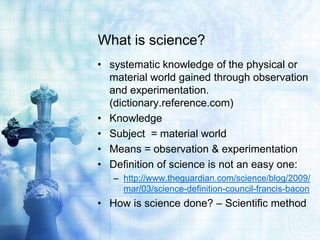
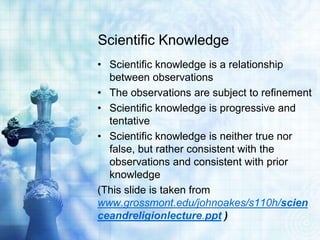
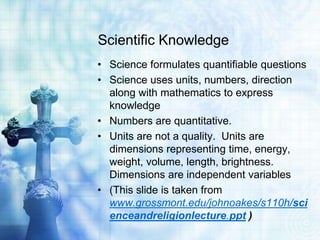
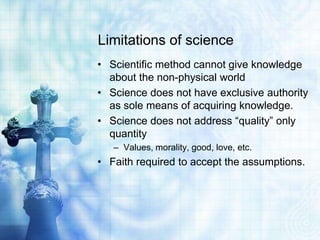
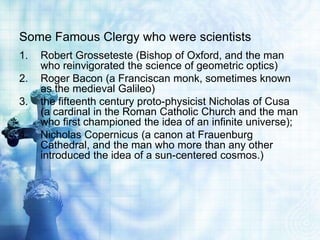
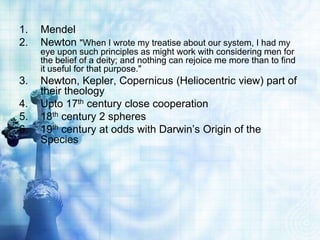
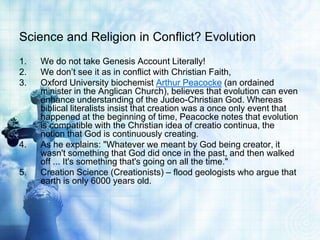
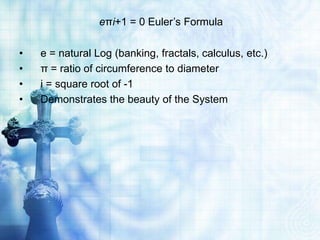
This document discusses the relationship between science and theology. It argues that the two fields can co-exist and even complement each other. While science uses observation and experimentation to study the physical world, theology addresses non-physical topics like morality, values, and spirituality. Both fields are attempting to understand and explain the world from different perspectives. Examples are given of how scientific discoveries like evolution, cosmology, and physics can enhance theological understanding of concepts like creation and design. Famous scientists from history like Newton and Mendel integrated their scientific work with their religious faith.
![Assumptions of Science
• The world is real. (time and matter)
• The real world is knowable and
comprehensible.
• There are laws that govern the real world.
• Those laws are knowable and
comprehensible.
• Those laws don't [radically] change
according to place or time, since the early
stages of the big bang.
• (This slide is taken from
www.grossmont.edu/johnoakes/s110h/sci
enceandreligionlecture.ppt )](https://image.slidesharecdn.com/book4-unit1-lesson5-130925200325-phpapp02/85/Book4-unit1-lesson5-7-320.jpg)
![Example of Science Complementing Theology
Anthropic Principle
1. Basic physical laws, physical constants finely balanced
that intelligent force or planed creation makes sense.
2. Gravitational, Electric, Magnetic force obey inverse
proportional [1/d^2.]
3. If gravitational force was stronger stable solar systems
could not form because planets would quickly spiral
into the sun.
4. Electric force was any stronger, stable atoms could not
form because electrons would spiral into the nucleus.
5. Gravitational force was any weaker, planets would
tend to drift off into space and not remain in orbit.](https://image.slidesharecdn.com/book4-unit1-lesson5-130925200325-phpapp02/85/Book4-unit1-lesson5-16-320.jpg)


![谷歌霸屏推广[ 𝙩𝙤𝙥 𝟮𝟯𝟯. 𝙘 𝙤𝙢 ]](https://cdn.slidesharecdn.com/ss_thumbnails/top233-260130171247-43791db0-thumbnail.jpg?width=640&height=640&fit=bounds)


