Name: Sampad Kar
Student Code: BWU/BTA/22/225
Course Name: Operating Systems
Course Code: PCC-CSM401
Group: D
Session: 2023-24
Microkernel
in
Operating
Systems
● Introduction to Kernel
● What is a Microkernel?
● Microkernel Architecture
● Advantages of Microkernel
● Disadvantages of Microkernel
● Microkernel vs Monolithic Kernel
● Use Cases
● References
Agenda
● A kernel is the core component of an
operating system. It plays a crucial role in
managing computer operations and
hardware.
● The kernel acts as a bridge between user
applications and the low-level data
processing performed by hardware.
● When an operating system is loaded, the
kernel is the first component to load into
memory and remains there until the system
shuts down. It handles tasks such as disk
management, task management, and memory
management.
Introduction to Kernel
01
02
What is a Microkernel?
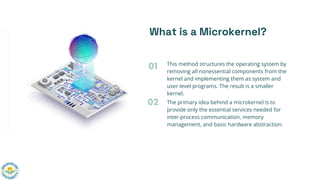
This method structures the operating system by
removing all nonessential components from the
kernel and implementing them as system and
user-level programs. The result is a smaller
kernel.
.
The primary idea behind a microkernel is to
provide only the essential services needed for
inter-process communication, memory
management, and basic hardware abstraction.
01
02
Microkernel Architecture
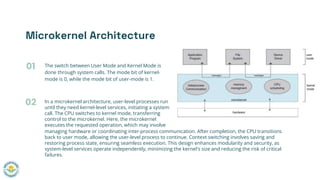
The switch between User Mode and Kernel Mode is
done through system calls. The mode bit of kernel-
mode is 0, while the mode bit of user-mode is 1.
In a microkernel architecture, user-level processes run
until they need kernel-level services, initiating a system
call. The CPU switches to kernel mode, transferring
control to the microkernel. Here, the microkernel
executes the requested operation, which may involve
managing hardware or coordinating inter-process communication. After completion, the CPU transitions
back to user mode, allowing the user-level process to continue. Context switching involves saving and
restoring process state, ensuring seamless execution. This design enhances modularity and security, as
system-level services operate independently, minimizing the kernel's size and reducing the risk of critical
failures.
01
02
03
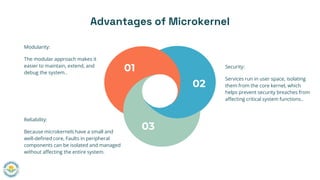
Modularity:
The modular approach makes it
easier to maintain, extend, and
debug the system..
Advantages of Microkernel
Security:
Services run in user space, isolating
them from the core kernel, which
helps prevent security breaches from
affecting critical system functions..
Reliability:
Because microkernels have a small and
well-defined core, Faults in peripheral
components can be isolated and managed
without affecting the entire system.
01
02
03
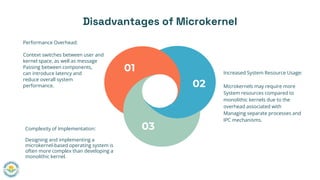
Increased System Resource Usage:
Microkernels may require more
System resources compared to
monolithic kernels due to the
overhead associated with
Managing separate processes and
IPC mechanisms.
Disadvantages of Microkernel
Performance Overhead:
Context switches between user and
kernel space, as well as message
Passing between components,
can introduce latency and
reduce overall system
performance.
Complexity of Implementation:
Designing and implementing a
microkernel-based operating system is
often more complex than developing a
monolithic kernel.
Monolithic Vs Microkernel
01
02
Use Cases
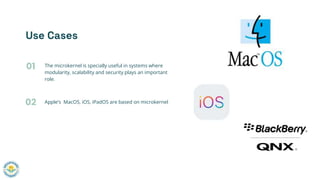
The microkernel is specially useful in systems where
modularity, scalability and security plays an important
role.
Apple’s MacOS, iOS, iPadOS are based on microkernel
References
• https://www.javatpoint.com/microkernel-in-operating-
system#:~:text=Microkernels%20are%20secure%20since%20only,so%20it%20may%
20perform%20better.
• https://en.wikipedia.org/wiki/Microkernel
• https://www.geeksforgeeks.org/microkernel-in-operating-systems/
Thank You

Microkernel in Operating System | Operating System

  • 1.
    Name: Sampad Kar StudentCode: BWU/BTA/22/225 Course Name: Operating Systems Course Code: PCC-CSM401 Group: D Session: 2023-24
  • 2.
  • 3.
    ● Introduction toKernel ● What is a Microkernel? ● Microkernel Architecture ● Advantages of Microkernel ● Disadvantages of Microkernel ● Microkernel vs Monolithic Kernel ● Use Cases ● References Agenda
  • 4.
    ● A kernelis the core component of an operating system. It plays a crucial role in managing computer operations and hardware. ● The kernel acts as a bridge between user applications and the low-level data processing performed by hardware. ● When an operating system is loaded, the kernel is the first component to load into memory and remains there until the system shuts down. It handles tasks such as disk management, task management, and memory management. Introduction to Kernel
  • 5.
    01 02 What is aMicrokernel? This method structures the operating system by removing all nonessential components from the kernel and implementing them as system and user-level programs. The result is a smaller kernel. . The primary idea behind a microkernel is to provide only the essential services needed for inter-process communication, memory management, and basic hardware abstraction.
  • 6.
    01 02 Microkernel Architecture The switchbetween User Mode and Kernel Mode is done through system calls. The mode bit of kernel- mode is 0, while the mode bit of user-mode is 1. In a microkernel architecture, user-level processes run until they need kernel-level services, initiating a system call. The CPU switches to kernel mode, transferring control to the microkernel. Here, the microkernel executes the requested operation, which may involve managing hardware or coordinating inter-process communication. After completion, the CPU transitions back to user mode, allowing the user-level process to continue. Context switching involves saving and restoring process state, ensuring seamless execution. This design enhances modularity and security, as system-level services operate independently, minimizing the kernel's size and reducing the risk of critical failures.
  • 7.
    01 02 03 Modularity: The modular approachmakes it easier to maintain, extend, and debug the system.. Advantages of Microkernel Security: Services run in user space, isolating them from the core kernel, which helps prevent security breaches from affecting critical system functions.. Reliability: Because microkernels have a small and well-defined core, Faults in peripheral components can be isolated and managed without affecting the entire system.
  • 8.
    01 02 03 Increased System ResourceUsage: Microkernels may require more System resources compared to monolithic kernels due to the overhead associated with Managing separate processes and IPC mechanisms. Disadvantages of Microkernel Performance Overhead: Context switches between user and kernel space, as well as message Passing between components, can introduce latency and reduce overall system performance. Complexity of Implementation: Designing and implementing a microkernel-based operating system is often more complex than developing a monolithic kernel.
  • 9.
  • 10.
    01 02 Use Cases The microkernelis specially useful in systems where modularity, scalability and security plays an important role. Apple’s MacOS, iOS, iPadOS are based on microkernel
  • 11.
  • 12.

Editor's Notes

  • #2 Entered text “Microkernel in Operating Systems” Agenda Slide: Introduction to Kernel What is a Microkernel? Microkernel Architecture Advantages of Microkernel Disadvantages of Microkernel Microkernel vs Monolithic Kernel Use Cases Conclusion Introduction to Kernel Slide: Define what a kernel is. Explain its role as a bridge between applications and hardware. Mention that it’s one of the first programs loaded on startup. What is a Microkernel? Slide: Describe the microkernel as a minimalistic kernel. Highlight that it provides essential services like memory management and process scheduling1. Microkernel Architecture Slide: Illustrate the architecture with a diagram. Detail the separation of user services and kernel services. Advantages of Microkernel Slide: Discuss security benefits due to reduced attack surface. Explain stability advantages as user-level process crashes don’t affect the system. Mention modularity and flexibility for customization1. Disadvantages of Microkernel Slide: Address potential performance issues due to message passing. Talk about the complexity that can arise from a modular design1. Microkernel vs Monolithic Kernel Slide: Compare and contrast with monolithic kernels. Use a table or bullet points for clear comparison. Use Cases Slide: Provide examples of operating systems using microkernels. Discuss scenarios where microkernels are preferred. Conclusion Slide: Summarize the key points. Reiterate the importance of microkernels in modern OS design.