SHRI RAMSWAROOP
MEMORIAL UNIVERSITY
Deva Road Lucknow
Name : Aayush Tiwari
Course: MCA Sem: 2nd Sem
Roll No: 202310101050052
Subject: Operating System
Sumitted To: Jullius Sir
TOPIC
KERNEL
WHAT IS KERNEL?
• In computing, the kernel is the central component of most
computer operating systems; it is a bridge between applications
and the actual data processing done at the hardware level.
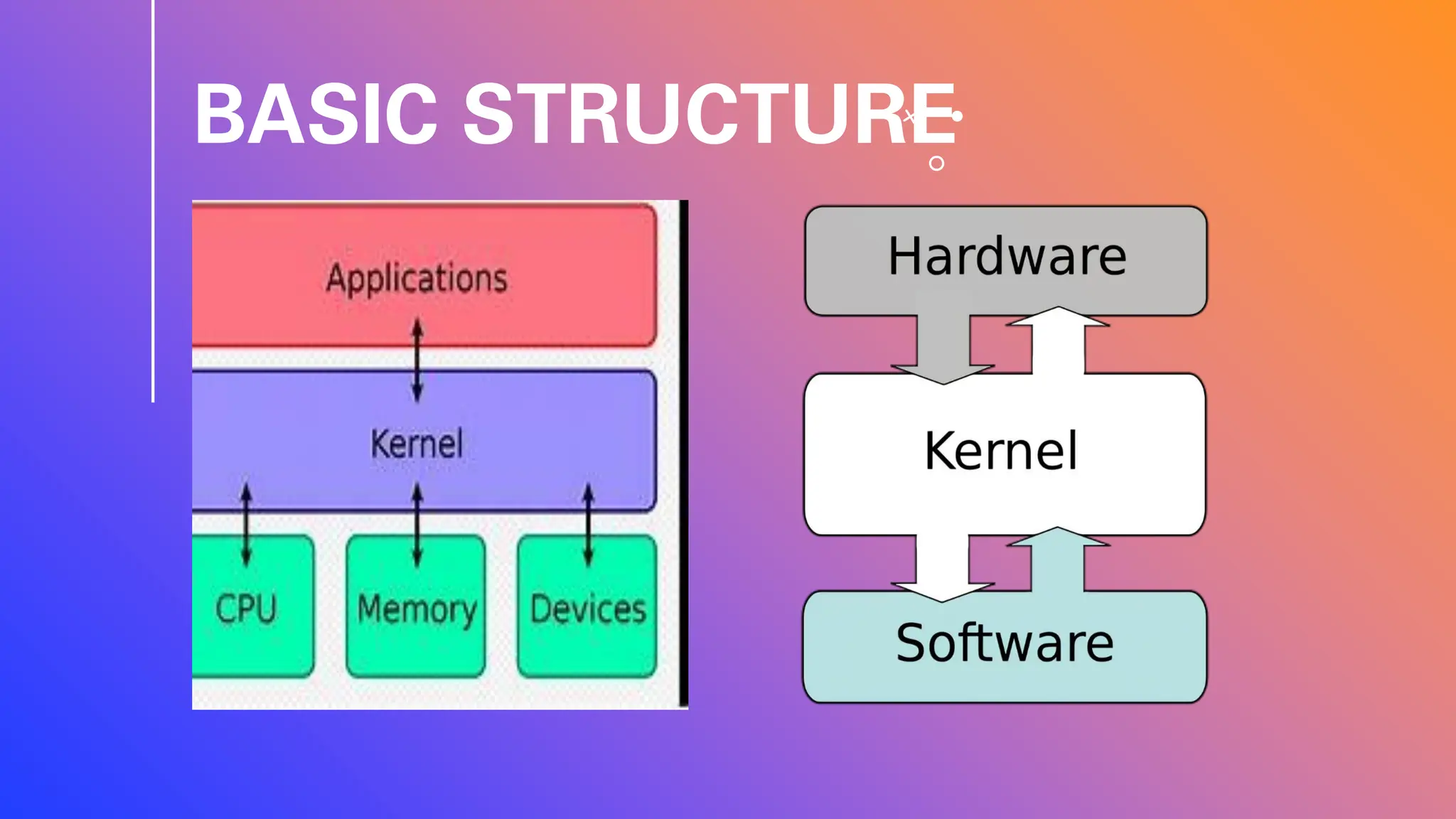
• It acts as an interface between the user applications and the
hardware.
• The sole aim of kernel is to manage the communication between
the software (user level applications) and the hardware (CPU,
disk memory etc)
• When a process makes requests of the kernel, the request is
called a system call. Various kernel designs differ in how they
manage system calls and resources.
BASIC STRUCTURE
TYPES OF KERNEL
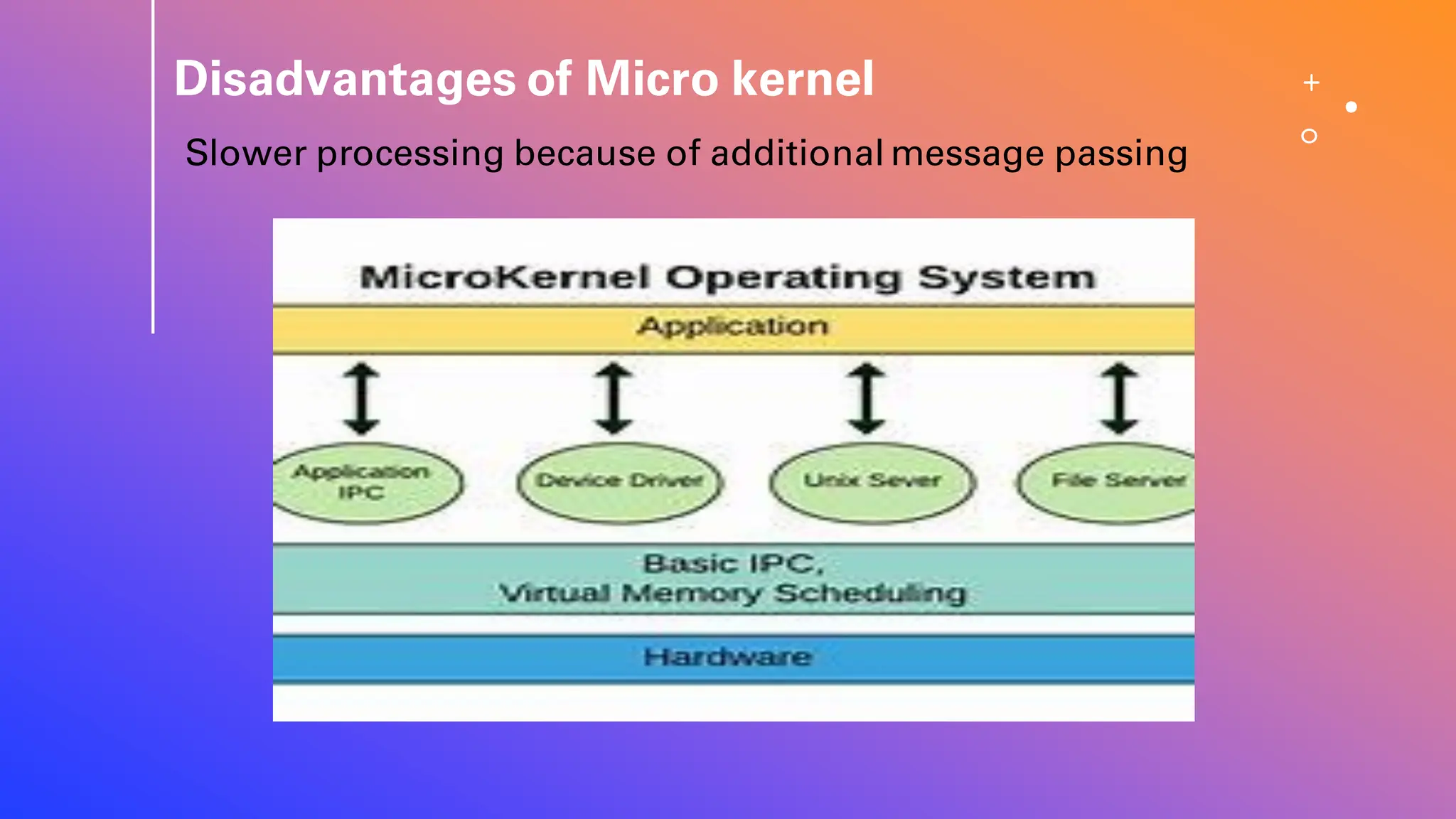
1. Micro kernel
A microkernel is a type of operating system kernel that is
designed to provide only the most basic services required for an
operating system to function, such as memory management
and process scheduling. Other services, such as device drivers
and file systems, are implemented as user-level processes that
communicate with the microkernel via message passing. This
design allows the operating system to be more modular and
flexible than traditional monolithic kernels, which implement all
operating system services in kernel space.
Advantages of Micro kernel
• More secure operating system due to reduced attack surface
• Better system stability, as crashes in user-level processes do not
affect the entire system
• More modular and flexible, making it easier to customize the
operating system
• Simplified development process, as services are developed and
tested as independent user-level processes
• Simplicity of the kernel (small)
• Portable
Disadvantages of Micro kernel
Slower processing because of additional message passing
Monolithic kernel
• A monolithic kernel is an operating system architecture where the
entire operating system operates within the kernel space.
• A monolithic architecture diagram is a graphical representation of a
software system that is built as a single, unified unit that is self-
contained and independent from other applications
Advantage of Monolithic kernel
Performance
Difficult to debug and maintain
Disadvantage of Monolithic kernel
Hybrid kernel
A hybrid kernel is an operating system kernel architecture that
combines aspects of both microkernel and monolithic kernel designs.
• A monolithic architecture diagram is a graphical representation of a
software system that is built as a single, unified unit that is self-
contained and independent from other applications
Advantage of Hybrid kernel
Benefits of monolithic and microkernels.
Difficult to debug and maintain
Disadvantage of Hybrid kernel
THANK YOU
Aayu Tiwari operating system presentation_240406_095037.pdf

Aayu Tiwari operating system presentation_240406_095037.pdf

  • 1.
    SHRI RAMSWAROOP MEMORIAL UNIVERSITY DevaRoad Lucknow Name : Aayush Tiwari Course: MCA Sem: 2nd Sem Roll No: 202310101050052 Subject: Operating System Sumitted To: Jullius Sir
  • 2.
  • 3.
    WHAT IS KERNEL? •In computing, the kernel is the central component of most computer operating systems; it is a bridge between applications and the actual data processing done at the hardware level. • It acts as an interface between the user applications and the hardware. • The sole aim of kernel is to manage the communication between the software (user level applications) and the hardware (CPU, disk memory etc) • When a process makes requests of the kernel, the request is called a system call. Various kernel designs differ in how they manage system calls and resources.
  • 4.
  • 5.
  • 6.
    1. Micro kernel Amicrokernel is a type of operating system kernel that is designed to provide only the most basic services required for an operating system to function, such as memory management and process scheduling. Other services, such as device drivers and file systems, are implemented as user-level processes that communicate with the microkernel via message passing. This design allows the operating system to be more modular and flexible than traditional monolithic kernels, which implement all operating system services in kernel space.
  • 7.
    Advantages of Microkernel • More secure operating system due to reduced attack surface • Better system stability, as crashes in user-level processes do not affect the entire system • More modular and flexible, making it easier to customize the operating system • Simplified development process, as services are developed and tested as independent user-level processes • Simplicity of the kernel (small) • Portable
  • 8.
    Disadvantages of Microkernel Slower processing because of additional message passing
  • 9.
    Monolithic kernel • Amonolithic kernel is an operating system architecture where the entire operating system operates within the kernel space. • A monolithic architecture diagram is a graphical representation of a software system that is built as a single, unified unit that is self- contained and independent from other applications Advantage of Monolithic kernel Performance Difficult to debug and maintain Disadvantage of Monolithic kernel
  • 10.
    Hybrid kernel A hybridkernel is an operating system kernel architecture that combines aspects of both microkernel and monolithic kernel designs. • A monolithic architecture diagram is a graphical representation of a software system that is built as a single, unified unit that is self- contained and independent from other applications Advantage of Hybrid kernel Benefits of monolithic and microkernels. Difficult to debug and maintain Disadvantage of Hybrid kernel
  • 11.