Name: Sampad Kar
Student Code: BWU/BTA/22/225
Course Name: Data Structure And
Algorithms
Course Code: BSCM302
Group: D
Session: 2023-24
Understanding
the Stack Data
Structure
Contents
• What is Stack
• Key Operations On a
Stack
• Visualization
• Common Use Cases
• Implementations and
Variations
• Advantages and
Disadvantages
• Examples in
Programming
What is Stack?
Definition:
A stack is a fundamental linear data
structure that follows the Last In, First
Out (LIFO) principle or First In, Last Out
(FILO) Principle.
It means that the last element added to
the stack is the first one to be removed.
Visual Representation:
Imagine a stack of books on a table. We
add books to the top of the stack and
remove them from the same top
position.
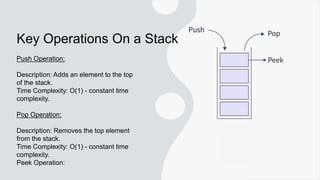
Push Operation:
Description: Adds an element to the top
of the stack.
Time Complexity: O(1) - constant time
complexity.
Pop Operation:
Description: Removes the top element
from the stack.
Time Complexity: O(1) - constant time
complexity.
Peek Operation:
Key Operations On a Stack
Display Operation:
Description: Prints or displays the contents
of the stack.
Time Complexity: O(n) - linear time
complexity, where n is the number of
elements in the stack.
IsEmpty Operation:
Checks if the stack is empty.
IsFull Operation:
Checks if the stack is full.
Key Operations On a Stack
Visualization
Implementations and Variations
Array-Based Implementation:
Description: Stacks can be implemented using arrays.
Elements are added or removed from the end of the array,
representing the top of the stack.
Linked List-Based Implementation:
Description: Stacks can also be implemented using linked
lists. Each node in the linked list represents an element in
the stack.
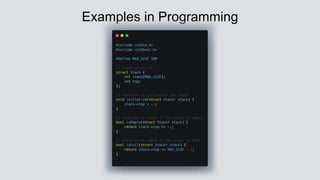
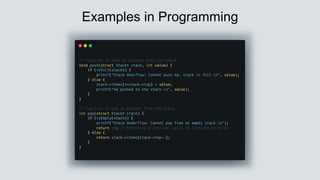
Examples in Programming
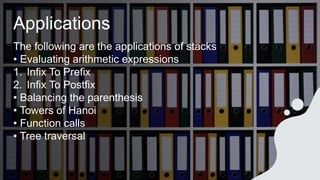
Applications
The following are the applications of stacks
• Evaluating arithmetic expressions
1. Infix To Prefix
2. Infix To Postfix
• Balancing the parenthesis
• Towers of Hanoi
• Function calls
• Tree traversal
Advantages and Disadvantages
Advantages:
• Stacks are simple and intuitive data structures, making them easy to
understand and implement.
• Key operations such as push, pop, and peek have constant time
complexity (O(1)).
Disadvantages:
• Stacks do not support direct access to elements in the middle.
Access is limited to the top element.
• Some stack implementations have fixed-size constraints, limiting the
number of elements that can be stored.
Data Structure - Stacks

Data Structure - Stacks

  • 1.
    Name: Sampad Kar StudentCode: BWU/BTA/22/225 Course Name: Data Structure And Algorithms Course Code: BSCM302 Group: D Session: 2023-24
  • 2.
  • 3.
    Contents • What isStack • Key Operations On a Stack • Visualization • Common Use Cases • Implementations and Variations • Advantages and Disadvantages • Examples in Programming
  • 4.
    What is Stack? Definition: Astack is a fundamental linear data structure that follows the Last In, First Out (LIFO) principle or First In, Last Out (FILO) Principle. It means that the last element added to the stack is the first one to be removed. Visual Representation: Imagine a stack of books on a table. We add books to the top of the stack and remove them from the same top position.
  • 5.
    Push Operation: Description: Addsan element to the top of the stack. Time Complexity: O(1) - constant time complexity. Pop Operation: Description: Removes the top element from the stack. Time Complexity: O(1) - constant time complexity. Peek Operation: Key Operations On a Stack
  • 6.
    Display Operation: Description: Printsor displays the contents of the stack. Time Complexity: O(n) - linear time complexity, where n is the number of elements in the stack. IsEmpty Operation: Checks if the stack is empty. IsFull Operation: Checks if the stack is full. Key Operations On a Stack
  • 7.
  • 8.
    Implementations and Variations Array-BasedImplementation: Description: Stacks can be implemented using arrays. Elements are added or removed from the end of the array, representing the top of the stack. Linked List-Based Implementation: Description: Stacks can also be implemented using linked lists. Each node in the linked list represents an element in the stack.
  • 9.
  • 10.
  • 11.
  • 12.
    Applications The following arethe applications of stacks • Evaluating arithmetic expressions 1. Infix To Prefix 2. Infix To Postfix • Balancing the parenthesis • Towers of Hanoi • Function calls • Tree traversal
  • 13.
    Advantages and Disadvantages Advantages: •Stacks are simple and intuitive data structures, making them easy to understand and implement. • Key operations such as push, pop, and peek have constant time complexity (O(1)). Disadvantages: • Stacks do not support direct access to elements in the middle. Access is limited to the top element. • Some stack implementations have fixed-size constraints, limiting the number of elements that can be stored.