W. A. Upananda
Former Assistant Professor
11th August, 2019
 Objectives: Define types of market structures,
understanding basic characteristics of each types
of structures, and understanding why each type
is needed.
 What is a market? ‘A group of sellers and buyers
whose activities affect the price at which a
commodity is sold’ (William J Bernard and Alan
S. Blinder, 1985).
 Suppliers may be single firm, several firms or
large number of firms. When a supplier is
considered in isolation, the suppler is termed
firm. Collection of similar firms makes an
industry.
 To understand the behavior of firms
economically, firms are classified into four
structures :
 Perfect competition, monopolistic
competition, oligopoly, and monopoly. These
structures are differentiate according to the
following:
 1. No. of firms, 2. nature of products, and
3. how easy/difficult to get into the market
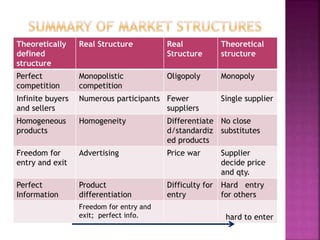
Theoretically
defined
structure
Real Structure Real
Structure
Theoretical
structure
Perfect
competition
Monopolistic
competition
Oligopoly Monopoly
Infinite buyers
and sellers
Numerous participants Fewer
suppliers
Single supplier
Homogeneous
products
Homogeneity Differentiate
d/standardiz
ed products
No close
substitutes
Freedom for
entry and exit
Advertising Price war Supplier
decide price
and qty.
Perfect
Information
Product
differentiation
Difficulty for
entry
Hard entry
for others
Freedom for entry and
exit; perfect info. hard to enter
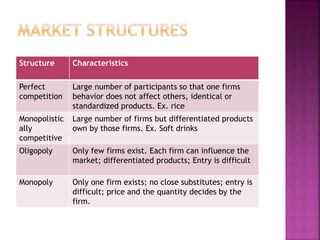
Structure Characteristics
Perfect
competition
Large number of participants so that one firms
behavior does not affect others, identical or
standardized products. Ex. rice
Monopolistic
ally
competitive
Large number of firms but differentiated products
own by those firms. Ex. Soft drinks
Oligopoly Only few firms exist. Each firm can influence the
market; differentiated products; Entry is difficult
Monopoly Only one firm exists; no close substitutes; entry is
difficult; price and the quantity decides by the
firm.
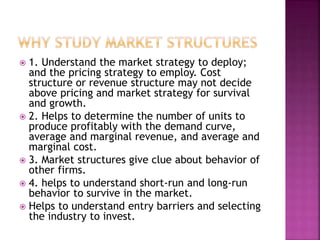
 1. Understand the market strategy to deploy;
and the pricing strategy to employ. Cost
structure or revenue structure may not decide
above pricing and market strategy for survival
and growth.
 2. Helps to determine the number of units to
produce profitably with the demand curve,
average and marginal revenue, and average and
marginal cost.
 3. Market structures give clue about behavior of
other firms.
 4. helps to understand short-run and long-run
behavior to survive in the market.
 Helps to understand entry barriers and selecting
the industry to invest.
 Objectives: Basic characteristics, demand and
supply curves under perfect competition,
Identifying equilibrium point, making decision on
long-run survival and closing the firm.
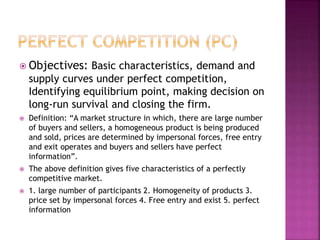
 Definition: “A market structure in which, there are large number
of buyers and sellers, a homogeneous product is being produced
and sold, prices are determined by impersonal forces, free entry
and exit operates and buyers and sellers have perfect
information”.
 The above definition gives five characteristics of a perfectly
competitive market.
 1. large number of participants 2. Homogeneity of products 3.
price set by impersonal forces 4. Free entry and exist 5. perfect
information
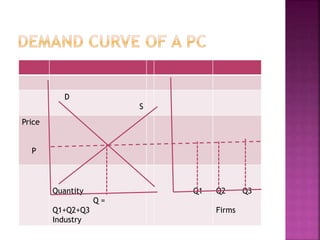
D
S
Price
P
Quantity
Q =
Q1+Q2+Q3
Industry
Q1 Q2 Q3
Firms
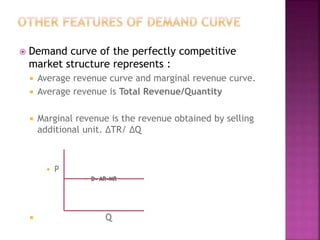
 Demand curve of the perfectly competitive
market structure represents :
 Average revenue curve and marginal revenue curve.
 Average revenue is Total Revenue/Quantity
 Marginal revenue is the revenue obtained by selling
additional unit. ∆TR/ ∆Q
 P
 D= AR=MR
 Q
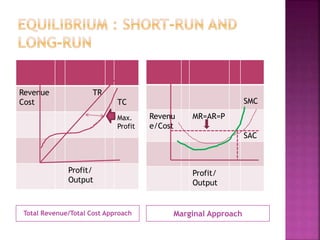
Total Revenue/Total Cost Approach Marginal Approach
Revenue
Cost
TR
TC
Max.
Profit
Profit/
Output
SMC
Revenu
e/Cost
MR=AR=P
SAC
Profit/
Output
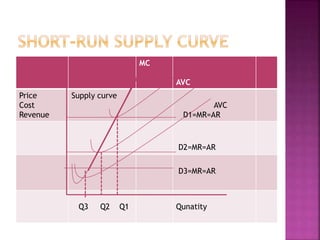
MC
AVC
Price
Cost
Revenue
Supply curve
AVC
D1=MR=AR
D2=MR=AR
D3=MR=AR
Q3 Q2 Q1 Qunatity
 Basically firm can operate until
 Variable cost => TR. This implies firm can
survive until variable cost is covered by the
total revenue IF VC > Total revenue firm
cannot survive.
 As previous slide shows Marginal cost should
lie below the marginal revenue which is
equal to AR and Demand curve.
 Then the supply curve should be the portion
of MC above the Average variable cost.
 By joining portions above AVC we can derive
supply curve of the firm.
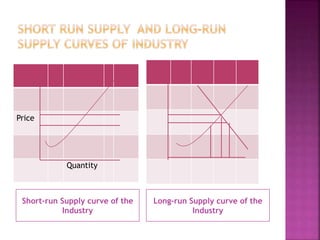
Short-run Supply curve of the
Industry
Long-run Supply curve of the
Industry
Price
Quantity
 Objectives: Define monopoly, causes for
monopoly to exist, demand and supply
behavior, determination of profit maximizing
output, and comparison of monopoly with
perfect competition.
 Definition: ‘a market structure in which
there is only one single firm, the product
which has no close substitute, and in which
it’s hard for other firm to enter.’
 Characteristics of a Monopoly: Single
producer exist in the industry; No close
substitutes, Difficult entry into the industry.
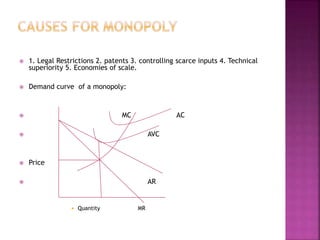
 1. Legal Restrictions 2. patents 3. controlling scarce inputs 4. Technical
superiority 5. Economies of scale.
 Demand curve of a monopoly:
 MC AC
 AVC
 Price
 AR
 Quantity MR
 Unlike perfect competition, Monopolists’
dictates price and not by the market forces.
 For monopolists no competition from other firms
and no close substitutes for products. Hence
monopolist is a price maker and not price taker.
 Characteristics: 1.Demand curve of monopolist is
Average revenue of which slope is twice of the
Marginal revenue. 2. MR is positive as demand
curve is elastic 3. MR become Zero when
elasticity is unitary 4. MR become negative when
elasticity is less than one.
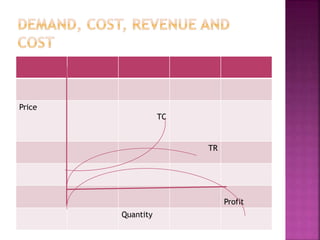
Price
TC
TR
Profit
Quantity
 Objectives: Basic characteristics of monopolistic
structure, how monopolistic competition are
different from perfect competition, how price and
output decisions are made; definition of product
differentiation.
 Definition: ‘A market structure in which there are a
large number of firms and each firm is producing a
distinctive or differentiated product and where
there is freedom of entry into and exit from the
industry’.
 Since it has characteristics of both perfect
competition and monopoly, monopolist need
branding, packaging, advertising, and sales promotion
to position the product in minds of customers.
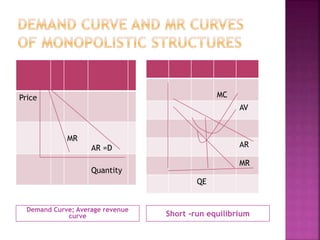
Demand Curve; Average revenue
curve Short -run equilibrium
Price
MR
AR =D
Quantity
MC
AV
AR
MR
QE
 Learning objectives: How oligopoly differ
from other market structures, understand
models which explain oligopoly.
 Definition: A market structure characterized
by few firms which produce identical or
differentiated goods and interdependent on
each other.
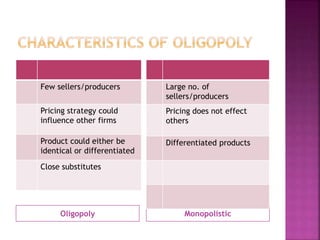
Oligopoly Monopolistic
Few sellers/producers
Pricing strategy could
influence other firms
Product could either be
identical or differentiated
Close substitutes
Large no. of
sellers/producers
Pricing does not effect
others
Differentiated products
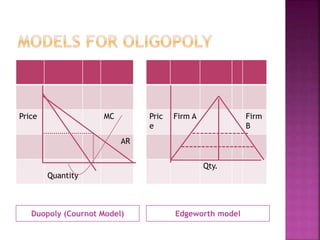
Duopoly (Cournot Model) Edgeworth model
Price MC
AR
Quantity
Pric
e
Firm A Firm
B
Qty.
Thanks for watching this
presentation
 Please do not forget to add comment

Microeconomics iii : Market Structuctures

  • 1.
    W. A. Upananda FormerAssistant Professor 11th August, 2019
  • 2.
     Objectives: Definetypes of market structures, understanding basic characteristics of each types of structures, and understanding why each type is needed.  What is a market? ‘A group of sellers and buyers whose activities affect the price at which a commodity is sold’ (William J Bernard and Alan S. Blinder, 1985).  Suppliers may be single firm, several firms or large number of firms. When a supplier is considered in isolation, the suppler is termed firm. Collection of similar firms makes an industry.
  • 3.
     To understandthe behavior of firms economically, firms are classified into four structures :  Perfect competition, monopolistic competition, oligopoly, and monopoly. These structures are differentiate according to the following:  1. No. of firms, 2. nature of products, and 3. how easy/difficult to get into the market
  • 4.
    Theoretically defined structure Real Structure Real Structure Theoretical structure Perfect competition Monopolistic competition OligopolyMonopoly Infinite buyers and sellers Numerous participants Fewer suppliers Single supplier Homogeneous products Homogeneity Differentiate d/standardiz ed products No close substitutes Freedom for entry and exit Advertising Price war Supplier decide price and qty. Perfect Information Product differentiation Difficulty for entry Hard entry for others Freedom for entry and exit; perfect info. hard to enter
  • 5.
    Structure Characteristics Perfect competition Large numberof participants so that one firms behavior does not affect others, identical or standardized products. Ex. rice Monopolistic ally competitive Large number of firms but differentiated products own by those firms. Ex. Soft drinks Oligopoly Only few firms exist. Each firm can influence the market; differentiated products; Entry is difficult Monopoly Only one firm exists; no close substitutes; entry is difficult; price and the quantity decides by the firm.
  • 6.
     1. Understandthe market strategy to deploy; and the pricing strategy to employ. Cost structure or revenue structure may not decide above pricing and market strategy for survival and growth.  2. Helps to determine the number of units to produce profitably with the demand curve, average and marginal revenue, and average and marginal cost.  3. Market structures give clue about behavior of other firms.  4. helps to understand short-run and long-run behavior to survive in the market.  Helps to understand entry barriers and selecting the industry to invest.
  • 7.
     Objectives: Basiccharacteristics, demand and supply curves under perfect competition, Identifying equilibrium point, making decision on long-run survival and closing the firm.  Definition: “A market structure in which, there are large number of buyers and sellers, a homogeneous product is being produced and sold, prices are determined by impersonal forces, free entry and exit operates and buyers and sellers have perfect information”.  The above definition gives five characteristics of a perfectly competitive market.  1. large number of participants 2. Homogeneity of products 3. price set by impersonal forces 4. Free entry and exist 5. perfect information
  • 8.
  • 9.
     Demand curveof the perfectly competitive market structure represents :  Average revenue curve and marginal revenue curve.  Average revenue is Total Revenue/Quantity  Marginal revenue is the revenue obtained by selling additional unit. ∆TR/ ∆Q  P  D= AR=MR  Q
  • 10.
    Total Revenue/Total CostApproach Marginal Approach Revenue Cost TR TC Max. Profit Profit/ Output SMC Revenu e/Cost MR=AR=P SAC Profit/ Output
  • 11.
  • 12.
     Basically firmcan operate until  Variable cost => TR. This implies firm can survive until variable cost is covered by the total revenue IF VC > Total revenue firm cannot survive.  As previous slide shows Marginal cost should lie below the marginal revenue which is equal to AR and Demand curve.  Then the supply curve should be the portion of MC above the Average variable cost.  By joining portions above AVC we can derive supply curve of the firm.
  • 13.
    Short-run Supply curveof the Industry Long-run Supply curve of the Industry Price Quantity
  • 14.
     Objectives: Definemonopoly, causes for monopoly to exist, demand and supply behavior, determination of profit maximizing output, and comparison of monopoly with perfect competition.  Definition: ‘a market structure in which there is only one single firm, the product which has no close substitute, and in which it’s hard for other firm to enter.’  Characteristics of a Monopoly: Single producer exist in the industry; No close substitutes, Difficult entry into the industry.
  • 15.
     1. LegalRestrictions 2. patents 3. controlling scarce inputs 4. Technical superiority 5. Economies of scale.  Demand curve of a monopoly:  MC AC  AVC  Price  AR  Quantity MR
  • 16.
     Unlike perfectcompetition, Monopolists’ dictates price and not by the market forces.  For monopolists no competition from other firms and no close substitutes for products. Hence monopolist is a price maker and not price taker.  Characteristics: 1.Demand curve of monopolist is Average revenue of which slope is twice of the Marginal revenue. 2. MR is positive as demand curve is elastic 3. MR become Zero when elasticity is unitary 4. MR become negative when elasticity is less than one.
  • 17.
  • 18.
     Objectives: Basiccharacteristics of monopolistic structure, how monopolistic competition are different from perfect competition, how price and output decisions are made; definition of product differentiation.  Definition: ‘A market structure in which there are a large number of firms and each firm is producing a distinctive or differentiated product and where there is freedom of entry into and exit from the industry’.  Since it has characteristics of both perfect competition and monopoly, monopolist need branding, packaging, advertising, and sales promotion to position the product in minds of customers.
  • 19.
    Demand Curve; Averagerevenue curve Short -run equilibrium Price MR AR =D Quantity MC AV AR MR QE
  • 20.
     Learning objectives:How oligopoly differ from other market structures, understand models which explain oligopoly.  Definition: A market structure characterized by few firms which produce identical or differentiated goods and interdependent on each other.
  • 21.
    Oligopoly Monopolistic Few sellers/producers Pricingstrategy could influence other firms Product could either be identical or differentiated Close substitutes Large no. of sellers/producers Pricing does not effect others Differentiated products
  • 22.
    Duopoly (Cournot Model)Edgeworth model Price MC AR Quantity Pric e Firm A Firm B Qty.
  • 23.
    Thanks for watchingthis presentation  Please do not forget to add comment