W. A. Upananda
Former Assistant Professor
11th August, 2019
 This session is consisted of:
 Marginal utility analysis
 Consumer equilibrium with Marginal utility
 Indifference curve analysis
 Consumer equilibrium with Indifference curve
analysis
 Assumptions in utility analysis
 Consumers attempt to maximize their well-being
which is termed utility (satisfaction)
 Constraints or limitation is the income which
limits consumption
 Any product has substitutes
 Utility is measurable
 Marginal utility of money is constant and marginal
utility is consistent.
 Satisfaction you get from several units of the
same commodity could be added up which
makes the total utility.The satisfaction or
utility gained from the last unit is termed
marginal utility.When marginal utility
become zero, the next unit gives negative
satisfaction.
 Mathematically marginal Utility is given as
follows:
 MU= change inTU/Change in Quantity
The law of diminishing
marginal utility
Total Utility ‘The law of diminishing
marginal states that as a
person consumes more
and more of a given
commodity of the
commodity eventually
tend to decline’.
Quantity
Marginal
Utility
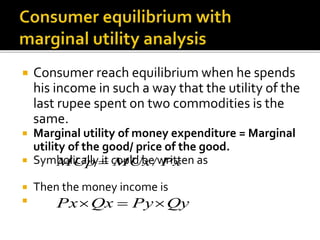
 Consumer reach equilibrium when he spends
his income in such a way that the utility of the
last rupee spent on two commodities is the
same.
 Marginal utility of money expenditure = Marginal
utility of the good/ price of the good.
 Symbolically it could be written as
 Then the money income is

PxMUxMUp /
QyPyQxPx 
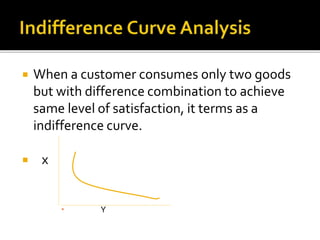
 When a customer consumes only two goods
but with difference combination to achieve
same level of satisfaction, it terms as a
indifference curve.
 x
 Y
 1. Negatively sloped
 2. Convex to the origin
 3. Indifference curves
cannot be intersected.
 4. Downward sloped or left
to right
 5. Amount of one
commodity could be
substitute for another
amount of other
commodity.This is termed
marginal rate of
substitution (MRS).
 Marginal rate of
substitution could be
traced. MRS curve is
downwardly sloped.
 MRS = ∆X/ ∆Y
 X
 Y
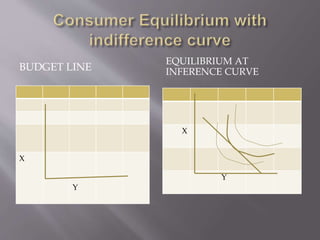
BUDGET LINE
EQUILIBRIUM AT
INFERENCE CURVE
X
Y
X
Y
DEFINING PRODUCTION
 The process of
transformation of inputs
into output.
 For production, one need
fixed inputs such as
buildings and machinery
and variable inputs such as
raw material.
 Fixed inputs do not vary
with the quantity produced
SHORT-RUNANALYSIS
 Q =f (L, K)
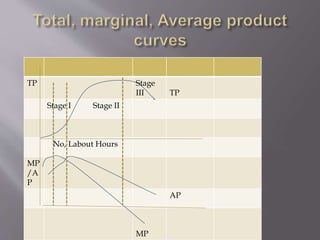
 Total production is the total
of goods produced within the
given period of time.
 Average production is the
average production for one
unit of input.
 Marginal product;
 Defined as the change of in
output by the last variable
unit of input added.
TP Stage
III TP
Stage I Stage II
No, Labout Hours
MP
/A
P
AP
MP
 This section covers 1. cost of production 2. Short-run
cost analysis and Long-run cost analysis.
 Two types of cost Explicit cost (direct cost) and
indirect or Implicit cost.The money spent to buy
machinery is a direct cost while your time is a implicit
cost.
 Fixed cost and variable cost:The cost which does not
change with the output is termed Fixed cost while
cost vary with the output is termed variable cost. Cost
of machinery is fixed cost while cost of input used for
production is a variable cost.
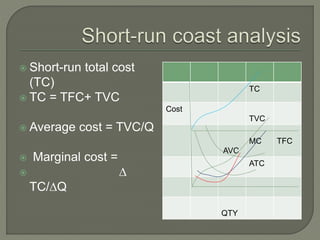
 Short-run total cost
(TC)
 TC = TFC+ TVC
 Average cost = TVC/Q
 Marginal cost =
 ∆
TC/∆Q
TC
Cost
TVC
AVC
MC TFC
ATC
QTY
Thank you for watching
▪Please do not forget to
comment

Microeconomics ii

  • 1.
    W. A. Upananda FormerAssistant Professor 11th August, 2019
  • 2.
     This sessionis consisted of:  Marginal utility analysis  Consumer equilibrium with Marginal utility  Indifference curve analysis  Consumer equilibrium with Indifference curve analysis
  • 3.
     Assumptions inutility analysis  Consumers attempt to maximize their well-being which is termed utility (satisfaction)  Constraints or limitation is the income which limits consumption  Any product has substitutes  Utility is measurable  Marginal utility of money is constant and marginal utility is consistent.
  • 4.
     Satisfaction youget from several units of the same commodity could be added up which makes the total utility.The satisfaction or utility gained from the last unit is termed marginal utility.When marginal utility become zero, the next unit gives negative satisfaction.  Mathematically marginal Utility is given as follows:  MU= change inTU/Change in Quantity
  • 5.
    The law ofdiminishing marginal utility Total Utility ‘The law of diminishing marginal states that as a person consumes more and more of a given commodity of the commodity eventually tend to decline’. Quantity Marginal Utility
  • 6.
     Consumer reachequilibrium when he spends his income in such a way that the utility of the last rupee spent on two commodities is the same.  Marginal utility of money expenditure = Marginal utility of the good/ price of the good.  Symbolically it could be written as  Then the money income is  PxMUxMUp / QyPyQxPx 
  • 7.
     When acustomer consumes only two goods but with difference combination to achieve same level of satisfaction, it terms as a indifference curve.  x  Y
  • 8.
     1. Negativelysloped  2. Convex to the origin  3. Indifference curves cannot be intersected.  4. Downward sloped or left to right  5. Amount of one commodity could be substitute for another amount of other commodity.This is termed marginal rate of substitution (MRS).  Marginal rate of substitution could be traced. MRS curve is downwardly sloped.  MRS = ∆X/ ∆Y  X  Y
  • 9.
  • 10.
    DEFINING PRODUCTION  Theprocess of transformation of inputs into output.  For production, one need fixed inputs such as buildings and machinery and variable inputs such as raw material.  Fixed inputs do not vary with the quantity produced SHORT-RUNANALYSIS  Q =f (L, K)  Total production is the total of goods produced within the given period of time.  Average production is the average production for one unit of input.  Marginal product;  Defined as the change of in output by the last variable unit of input added.
  • 11.
    TP Stage III TP StageI Stage II No, Labout Hours MP /A P AP MP
  • 12.
     This sectioncovers 1. cost of production 2. Short-run cost analysis and Long-run cost analysis.  Two types of cost Explicit cost (direct cost) and indirect or Implicit cost.The money spent to buy machinery is a direct cost while your time is a implicit cost.  Fixed cost and variable cost:The cost which does not change with the output is termed Fixed cost while cost vary with the output is termed variable cost. Cost of machinery is fixed cost while cost of input used for production is a variable cost.
  • 13.
     Short-run totalcost (TC)  TC = TFC+ TVC  Average cost = TVC/Q  Marginal cost =  ∆ TC/∆Q TC Cost TVC AVC MC TFC ATC QTY
  • 14.
    Thank you forwatching ▪Please do not forget to comment