

Cirip.euMICROBLOGGING for NETWORK LEARNINGGabriela Grosseck & Carmen Holotescu Network of Trainers in Europe Online ConferenceNovember, 9-10, 2009
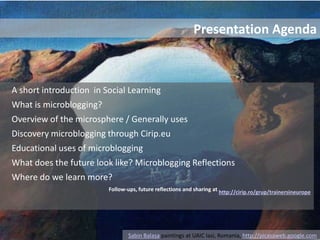
Presentation AgendaA short introduction  in Social Learning What is microblogging?Overview of the microsphere / Generally uses Discovery microblogging through Cirip.eu Educational uses of microbloggingWhat does the future look like? Microblogging ReflectionsWhere do we learn more? Follow-ups, future reflections and sharing at http://cirip.ro/grup/trainersineuropeSabin Balasa paintings at UAIC Iasi, Romania, http://picasaweb.google.com
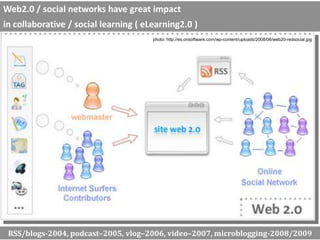
Web2.0 / social networks have great impact in collaborative / social learning ( eLearning2.0 )photo: http://es.onsoftware.com/wp-content/uploads/2008/06/web20-redsocial.jpgRSS/blogs-2004, podcast–2005, vlog–2006, video–2007, microblogging-2008/2009
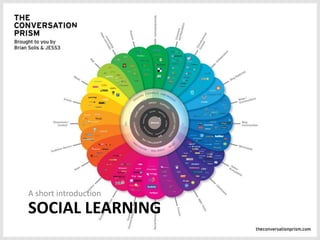
A short introductionSOCIAL LEARNING
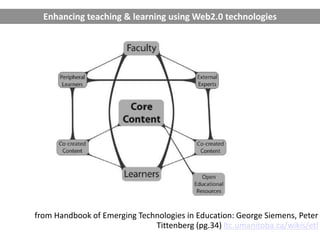
Enhancing teaching & learning using Web2.0 technologiesfrom Handbook of Emerging Technologies in Education: George Siemens, Peter Tittenberg (pg.34) ltc.umanitoba.ca/wikis/etl
Welcome to … your space Which 5 web 2.0 applications do you appreciate and use most?
 Compare your a-list with top at    Top 100 Tools for Learning 2009(http://c4lpt.co.uk/recommended/)yes, You CANstill contributeto this top this week.Photo Flickr by yanivg, http://farm1.static.flickr.com/28/64298062_4b83b8b87d.jpg
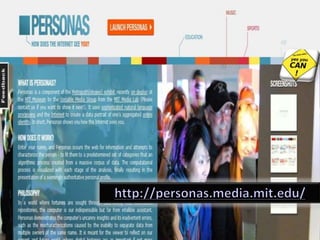
http://personas.media.mit.edu/
What is it? And why should  I care? INTRODUCTION TO MICROBLOGGING
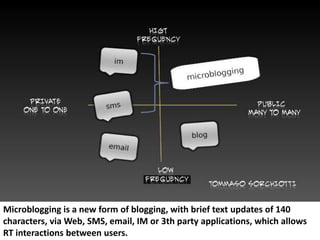
Microblogging is a new form of blogging, with brief text updates of 140 characters, via Web, SMS, email, IM or 3th party applications, which allows RT interactions between users.
photo: http://media2.lelombrik.net/13501-14000/13845.jpgMicroblogging is a collaborative technology
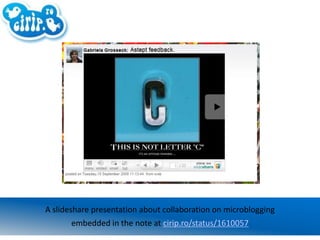
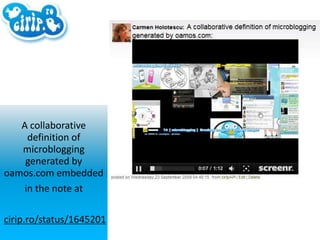
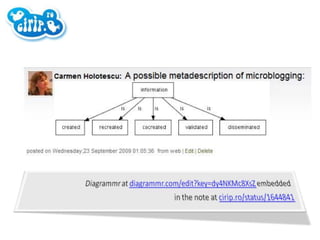
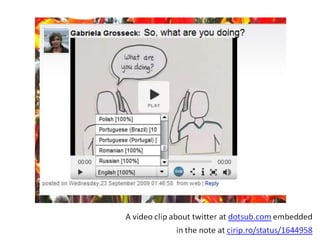
A collaborative definition of microblogging generated by oamos.com embedded in the note at cirip.ro/status/1645201
MICROBLOGGING PLATFORMS
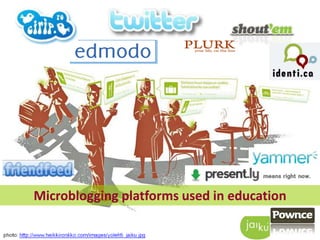
Microblogging platforms used in education
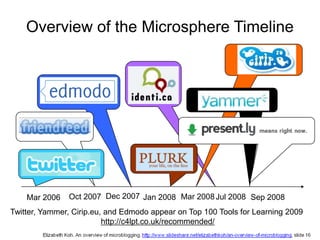
Overview of the Microsphere TimelineDec 2007Oct 2007Mar 2008 Jul 2008Jan 2008Sep 2008 Mar 2006Twitter, Yammer, Cirip.eu, and Edmodo appear on Top 100 Tools for Learning 2009 http://c4lpt.co.uk/recommended/
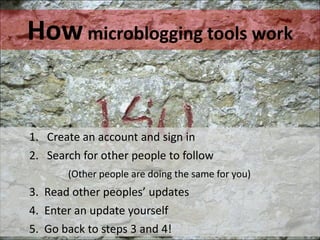
How microblogging tools workCreate an account and sign inSearch for other people to follow(Other people are doing the same for you)3.  Read other peoples’ updates 4.  Enter an update yourself5.  Go back to steps 3 and 4!16
Social networking in 140 characterstwitter The most popular microblogging system
 Launched in July, 2006
 Robust, elegant and simple
 More than 160 million users
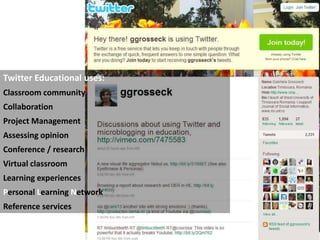
 Numerous mash-upsTwitter Educational uses:Classroom communityCollaboration Project ManagementAssessing opinionConference / research Virtual classroomLearning experiences Personal Learning Network  Reference services
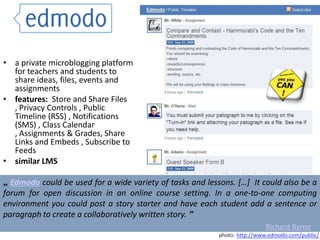
a private microblogging platform for teachers and students to share ideas, files, events and assignments
features:  Store and Share Files , Privacy Controls , Public Timeline (RSS) , Notifications (SMS) , Class Calendar , Assignments & Grades, Share Links and Embeds , Subscribe to Feeds
similar LMS„ Edmodo could be used for a wide variety of tasks and lessons. […]  It could also be a forum for open discussion in an online course setting. In a one-to-one computing environment you could post a story starter and have each student add a sentence or paragraph to create a collaboratively written story. ”Richard Byrne
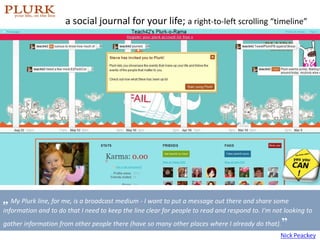
                          a social journal for your life; a right-to-left scrolling“timeline”photo: http://friendfeed.com/robingood„ My Plurk line, for me, is a broadcast medium - I want to put a message out there and share some information and to do that I need to keep the line clear for people to read and respond to. I'm not looking to gather information from other people there (have so many other places where I already do that).”
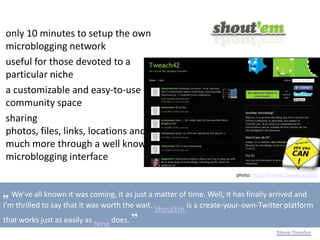
only 10 minutes to setup the own microblogging networkuseful for those devoted to a particular nichea customizable and easy-to-use community spacesharing photos, files, links, locations and much more through a well known microblogging interfacephoto: http://teach42.shoutem.com/„We’ve all known it was coming, it as just a matter of time. Well, it has finally arrived and I’m thrilled to say that it was worth the wait. ShoutEmis a create-your-own-Twitter platform that works just as easily as Ningdoes. ”Steve Dembo
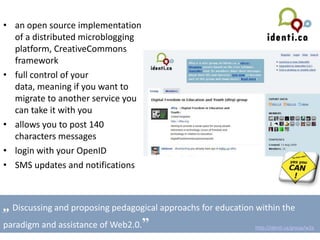
an open source implementation of a distributed microblogging platform, CreativeCommons framework
full control of your data, meaning if you want to migrate to another service you can take it with you
allows you to post 140 characters messages
login with your OpenID
SMS updates and notifications„Discussing and proposing pedagogical approachs for education within the paradigm and assistance of Web2.0.”http://identi.ca/group/w2e
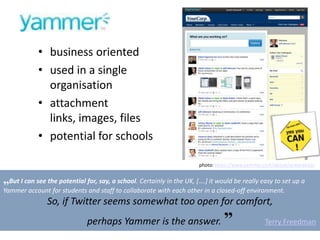
business oriented
used in a single organisation
attachment links, images, files
potential for schoolsphoto: https://www.yammer.com/about/screenshots„But I can see the potential for, say, a school. Certainly in the UK, [….] it would be really easy to set up a Yammer account for students and staff to collaborate with each other in a closed-off environment.So, if Twitter seems somewhat too open for comfort,perhaps Yammer is the answer.”Terry Freedman
more than 140 characters
commenting and "like" system
room/ group creation
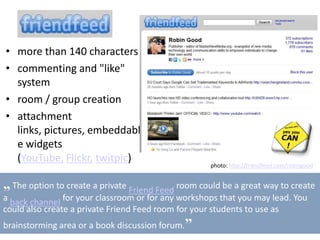
attachment links, pictures, embeddable widgets (YouTube,Flickr,twitpic)photo: http://friendfeed.com/robingood„ The option to create a private Friend Feed room could be a great way to create a back channel for your classroom or for any workshops that you may lead. You could also create a private Friend Feed room for your students to use as brainstorming area or a book discussion forum.”
a micro-update communications for companies that gives employees the ability to:
instantly communicate their current status (collaboration in Real-Time)
ask questions
post media (share documents & media)
groups for keeping conversations organized
device support (computer, mobile phone, any device connected to the Internet)photo: http://presentlyapp.com/„Present.ly provides a free place to get the same type of feedback as you'd gather on Twitter, but in a closed setting..”Richard Byrne
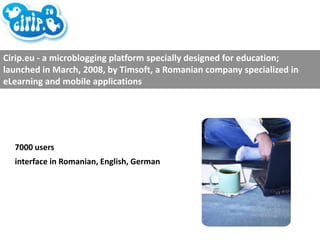
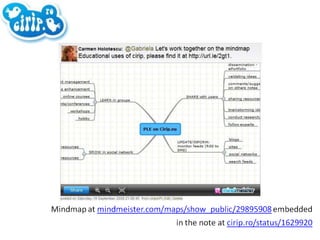
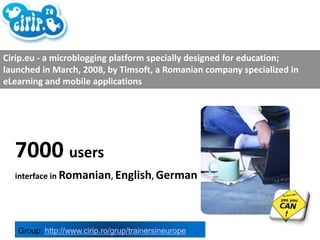
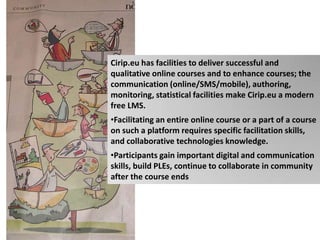
Cirip.eu - a microblogging platform specially designed for education; launched in March, 2008, by Timsoft, a Romanian company specialized in eLearning and mobile applications7000 usersinterface in Romanian, English, German
      HOW MICROBLOGGING CAN IMPROVE        TEACHING AND LEARNINGbrainstorming ideas – please add your thoughtsScribd paper: Can we use Twitter for educational activities?
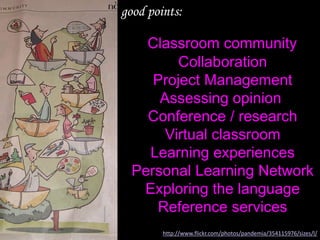
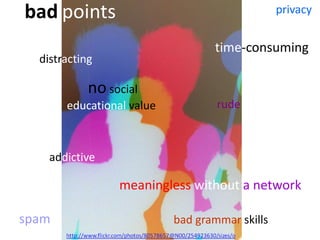
good points:Classroom community Collaboration  Project ManagementAssessing opinion Conference / research  Virtual classroom Learning experiences  Personal Learning Network  Exploring the language  Reference serviceshttp://www.flickr.com/photos/pandemia/354115976/sizes/l/

Microblogging for Networked Learning

  • 1.
    Cirip.euMICROBLOGGING for NETWORKLEARNINGGabriela Grosseck & Carmen Holotescu Network of Trainers in Europe Online ConferenceNovember, 9-10, 2009
  • 2.
    Presentation AgendaA shortintroduction in Social Learning What is microblogging?Overview of the microsphere / Generally uses Discovery microblogging through Cirip.eu Educational uses of microbloggingWhat does the future look like? Microblogging ReflectionsWhere do we learn more? Follow-ups, future reflections and sharing at http://cirip.ro/grup/trainersineuropeSabin Balasa paintings at UAIC Iasi, Romania, http://picasaweb.google.com
  • 3.
    Web2.0 / socialnetworks have great impact in collaborative / social learning ( eLearning2.0 )photo: http://es.onsoftware.com/wp-content/uploads/2008/06/web20-redsocial.jpgRSS/blogs-2004, podcast–2005, vlog–2006, video–2007, microblogging-2008/2009
  • 4.
  • 5.
    Enhancing teaching &learning using Web2.0 technologiesfrom Handbook of Emerging Technologies in Education: George Siemens, Peter Tittenberg (pg.34) ltc.umanitoba.ca/wikis/etl
  • 6.
    Welcome to …your space Which 5 web 2.0 applications do you appreciate and use most?
  • 7.
    Compare youra-list with top at Top 100 Tools for Learning 2009(http://c4lpt.co.uk/recommended/)yes, You CANstill contributeto this top this week.Photo Flickr by yanivg, http://farm1.static.flickr.com/28/64298062_4b83b8b87d.jpg
  • 8.
  • 9.
    What is it?And why should I care? INTRODUCTION TO MICROBLOGGING
  • 10.
    Microblogging is anew form of blogging, with brief text updates of 140 characters, via Web, SMS, email, IM or 3th party applications, which allows RT interactions between users.
  • 11.
  • 12.
    A collaborative definitionof microblogging generated by oamos.com embedded in the note at cirip.ro/status/1645201
  • 14.
  • 15.
  • 16.
    Overview of theMicrosphere TimelineDec 2007Oct 2007Mar 2008 Jul 2008Jan 2008Sep 2008 Mar 2006Twitter, Yammer, Cirip.eu, and Edmodo appear on Top 100 Tools for Learning 2009 http://c4lpt.co.uk/recommended/
  • 17.
    How microblogging toolsworkCreate an account and sign inSearch for other people to follow(Other people are doing the same for you)3. Read other peoples’ updates 4. Enter an update yourself5. Go back to steps 3 and 4!16
  • 18.
    Social networking in140 characterstwitter The most popular microblogging system
  • 19.
    Launched inJuly, 2006
  • 20.
  • 21.
    More than160 million users
  • 22.
    Numerous mash-upsTwitterEducational uses:Classroom communityCollaboration Project ManagementAssessing opinionConference / research Virtual classroomLearning experiences Personal Learning Network Reference services
  • 24.
    a private microbloggingplatform for teachers and students to share ideas, files, events and assignments
  • 25.
    features: Storeand Share Files , Privacy Controls , Public Timeline (RSS) , Notifications (SMS) , Class Calendar , Assignments & Grades, Share Links and Embeds , Subscribe to Feeds
  • 26.
    similar LMS„ Edmodocould be used for a wide variety of tasks and lessons. […] It could also be a forum for open discussion in an online course setting. In a one-to-one computing environment you could post a story starter and have each student add a sentence or paragraph to create a collaboratively written story. ”Richard Byrne
  • 27.
    a social journal for your life; a right-to-left scrolling“timeline”photo: http://friendfeed.com/robingood„ My Plurk line, for me, is a broadcast medium - I want to put a message out there and share some information and to do that I need to keep the line clear for people to read and respond to. I'm not looking to gather information from other people there (have so many other places where I already do that).”
  • 28.
    only 10 minutesto setup the own microblogging networkuseful for those devoted to a particular nichea customizable and easy-to-use community spacesharing photos, files, links, locations and much more through a well known microblogging interfacephoto: http://teach42.shoutem.com/„We’ve all known it was coming, it as just a matter of time. Well, it has finally arrived and I’m thrilled to say that it was worth the wait. ShoutEmis a create-your-own-Twitter platform that works just as easily as Ningdoes. ”Steve Dembo
  • 29.
    an open sourceimplementation of a distributed microblogging platform, CreativeCommons framework
  • 30.
    full control ofyour data, meaning if you want to migrate to another service you can take it with you
  • 31.
    allows you topost 140 characters messages
  • 32.
  • 33.
    SMS updates andnotifications„Discussing and proposing pedagogical approachs for education within the paradigm and assistance of Web2.0.”http://identi.ca/group/w2e
  • 34.
  • 35.
    used in asingle organisation
  • 36.
  • 37.
    potential for schoolsphoto:https://www.yammer.com/about/screenshots„But I can see the potential for, say, a school. Certainly in the UK, [….] it would be really easy to set up a Yammer account for students and staff to collaborate with each other in a closed-off environment.So, if Twitter seems somewhat too open for comfort,perhaps Yammer is the answer.”Terry Freedman
  • 38.
    more than 140characters
  • 39.
  • 40.
  • 41.
    attachment links, pictures,embeddable widgets (YouTube,Flickr,twitpic)photo: http://friendfeed.com/robingood„ The option to create a private Friend Feed room could be a great way to create a back channel for your classroom or for any workshops that you may lead. You could also create a private Friend Feed room for your students to use as brainstorming area or a book discussion forum.”
  • 42.
    a micro-update communicationsfor companies that gives employees the ability to:
  • 43.
    instantly communicate theircurrent status (collaboration in Real-Time)
  • 44.
  • 45.
    post media (sharedocuments & media)
  • 46.
    groups for keepingconversations organized
  • 47.
    device support (computer,mobile phone, any device connected to the Internet)photo: http://presentlyapp.com/„Present.ly provides a free place to get the same type of feedback as you'd gather on Twitter, but in a closed setting..”Richard Byrne
  • 48.
    Cirip.eu - amicroblogging platform specially designed for education; launched in March, 2008, by Timsoft, a Romanian company specialized in eLearning and mobile applications7000 usersinterface in Romanian, English, German
  • 50.
    HOW MICROBLOGGING CAN IMPROVE TEACHING AND LEARNINGbrainstorming ideas – please add your thoughtsScribd paper: Can we use Twitter for educational activities?
  • 51.
    good points:Classroom communityCollaboration Project ManagementAssessing opinion Conference / research Virtual classroom Learning experiences Personal Learning Network Exploring the language Reference serviceshttp://www.flickr.com/photos/pandemia/354115976/sizes/l/