DECODING
Fake
News
at WUT
photo credit: @marinahenina
Laura MALITA
laura.malita@e-uvt.ro
@lmalita
Gabriela GROSSECK
gabriela.grosseck@e-uvt.ro
@ggrosseck
- Twitter, Instagram, Slideshare etc. -
Why this
subject now?
Adam and Eve by Titian, c. 1550
'Fake news' led to
Adam and Eve’s
original sin
Pope Francis
Definition?
Oxford Dictionary
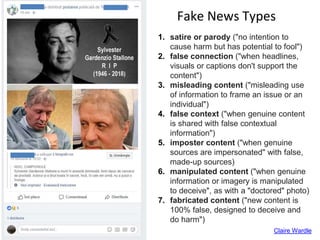
Fake News Types
1. satire or parody ("no intention to
cause harm but has potential to fool")
2. false connection ("when headlines,
visuals or captions don't support the
content")
3. misleading content ("misleading use
of information to frame an issue or an
individual")
4. false context ("when genuine content
is shared with false contextual
information")
5. imposter content ("when genuine
sources are impersonated" with false,
made-up sources)
6. manipulated content ("when genuine
information or imagery is manipulated
to deceive", as with a "doctored" photo)
7. fabricated content ("new content is
100% false, designed to deceive and
do harm")
Claire Wardle
https://www.youtube.com/watch?v=vckz6EAn30Y
FactCheck.Org
PolitiFact.com
Snopes.com
Bellingcat's
Online
Investigatio
n Toolkit
https://verificasursa.ro/
https://rubrika.ro/
https://www.factual.ro/
https://cyberm.ro/
https://www.ghideducatiemedia.ro/
http://www.cdep.ro/pls/proiecte/upl_pck2015.proiect?cam=2&idp=17607
Fake Information on Academia??
Foto: : Coralia Sulea
Spotting fake / bad scholars
1. PREDATORY PUBLISHING (journals or
conferences): “predatory” for-profit open
access publishers
• In some cases criminal actors go so far as to
create fake incarnations of real journals to
steal submission fees.
• Even the peer review process itself is
increasingly under attack with fake reviewers
and even “peer review rings.”
Spotting bad scholars
2. ACADEMIC FRAUD: Even in publications that
are not predatory, some academic publications
still contain false or misleading information.
* sometimes even fake papers slip through the
supposedly rigorous peer-review process
3. MISLEADING STATISTICS. Data Leaks (real
data mixed with untrue or biased data). When
statistics are manipulated or misused, they can
make fake news even more powerful
(See the MOOC from Future Learn, Making Sense of
Data in the Media)
Spotting bad scholars
4. FAKE POLL. If there isn’t something on the
website that tells why the pollster is conducting
the poll, something is probably up.
5. ACADEMIC INACURANCIES. Review process is
been hijacked by fake reviewers ->Diluting
academic literature.
6. USE specific tools to choose journals to
publish/conference to attend:
See also Beall’s list of predatory journals
and Caltech Library’s list of predatory
approach in tackling …
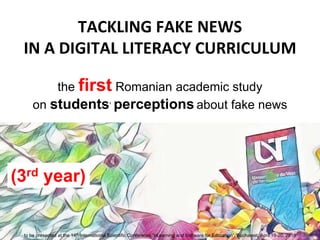
TACKLING FAKE NEWS
IN A DIGITAL LITERACY CURRICULUM
the first Romanian academic study
on students’ perceptions about fake news
to be presented at the 14th International Scientific Conference “eLearning and Software for Education”, Bucharest, April 19-20, 2018
(3rd year)
The purpose of the study was to gather information on
ways in which students perceive what fake news are
and to identify their habits and practices when they
have encountered doubtful content.
• October-December
2017/2018/2019
• WUT LMS (online
questionnaire)
• 452 respondents
• 4 specializations:
Communication Studies /
Journalism / Psychology and
Educational Sciences
short bio-data
Is there a need for
training
students on this topic?
How students perceive and understand the
concept of doubtful content?
(clickbaits headlines, false or biased information online, deceptive advertising, satirical websites etc.)?
How well the students
can research?
Do they know how to evaluate such information?
Do they distinguish between real and fake
news? What are they research skills and
abilities?
Research questions:
Increased information / digital literacy
education (training)
New specialization
starting 2019-2020 academic
year WUT offers the programme
“Digital Media” at bachelor level
for 100 students
Transversal disciplines
“Evaluating information
credibility and fighting against
fake news and content”
Awareness of fake news topic through the WUT
promotional materials (newsletter, Facebook page)
Bogdan Nadolu, The Sociology of politics (Sociologia politicului)
Integrating fake news topic
in the syllabus of different disciplines (piloting the transversals)
Political life in the digital era – from google to fake news
Laura Malita, The evaluation of information credibility and online content
(Evaluarea credibilității informațiilor și a conținutului online)
The universe of fake online content: who and why is producing it, which contexts
Encouraging academic writing on fake news
in master / doctoral thesis
Master thesis
Integrating MOOCs
about fake news in
academic courses
See Holotescu et al. (2014) Integrating MOOC in Blended Courses
https://www.coursera.org/learn/news-literacy
https://classroom.google.com
Organization of different events on fake news
topic (workshops, lectures, conferences etc.)
Denisa RIFAI
16 May 2017
Moise GURAN
30 January 2017
International student event approaching the topics of DIGITAL CITIZENSHIP and
FAKE NEWS in European context.12 December 2017
Next steps
• Academic Fake News Observatory (research,
reports, studies, guides etc.)
• OER library
• Short courses f2f for teachers
• Opening the MOOC on fake news this spring
• Partnership with industry
• Students’ high school specific activities:
(online)courses, workshops, camps etc.
https://west-university-timisoara.teachable.com/p/fake-news
Thank you for your attention!
With the support of the ERASMUS+, 575370-EPP-1-2016-1-RO-EPPJMO-MODULE
This project has been funded with support from the European Commission. This communication reflects the views only
of the author, and the Commission cannot be held responsible for any use which may be made of the information
contained therein.

Decoding fake news at WUT

  • 1.
  • 2.
  • 3.
    Why this subject now? Adamand Eve by Titian, c. 1550 'Fake news' led to Adam and Eve’s original sin Pope Francis
  • 4.
  • 5.
    Fake News Types 1.satire or parody ("no intention to cause harm but has potential to fool") 2. false connection ("when headlines, visuals or captions don't support the content") 3. misleading content ("misleading use of information to frame an issue or an individual") 4. false context ("when genuine content is shared with false contextual information") 5. imposter content ("when genuine sources are impersonated" with false, made-up sources) 6. manipulated content ("when genuine information or imagery is manipulated to deceive", as with a "doctored" photo) 7. fabricated content ("new content is 100% false, designed to deceive and do harm") Claire Wardle
  • 6.
  • 7.
  • 8.
  • 9.
  • 10.
    Fake Information onAcademia?? Foto: : Coralia Sulea
  • 11.
    Spotting fake /bad scholars 1. PREDATORY PUBLISHING (journals or conferences): “predatory” for-profit open access publishers • In some cases criminal actors go so far as to create fake incarnations of real journals to steal submission fees. • Even the peer review process itself is increasingly under attack with fake reviewers and even “peer review rings.”
  • 12.
    Spotting bad scholars 2.ACADEMIC FRAUD: Even in publications that are not predatory, some academic publications still contain false or misleading information. * sometimes even fake papers slip through the supposedly rigorous peer-review process 3. MISLEADING STATISTICS. Data Leaks (real data mixed with untrue or biased data). When statistics are manipulated or misused, they can make fake news even more powerful (See the MOOC from Future Learn, Making Sense of Data in the Media)
  • 13.
    Spotting bad scholars 4.FAKE POLL. If there isn’t something on the website that tells why the pollster is conducting the poll, something is probably up. 5. ACADEMIC INACURANCIES. Review process is been hijacked by fake reviewers ->Diluting academic literature. 6. USE specific tools to choose journals to publish/conference to attend: See also Beall’s list of predatory journals and Caltech Library’s list of predatory
  • 14.
  • 15.
    TACKLING FAKE NEWS INA DIGITAL LITERACY CURRICULUM the first Romanian academic study on students’ perceptions about fake news to be presented at the 14th International Scientific Conference “eLearning and Software for Education”, Bucharest, April 19-20, 2018 (3rd year)
  • 16.
    The purpose ofthe study was to gather information on ways in which students perceive what fake news are and to identify their habits and practices when they have encountered doubtful content. • October-December 2017/2018/2019 • WUT LMS (online questionnaire) • 452 respondents • 4 specializations: Communication Studies / Journalism / Psychology and Educational Sciences short bio-data
  • 17.
    Is there aneed for training students on this topic? How students perceive and understand the concept of doubtful content? (clickbaits headlines, false or biased information online, deceptive advertising, satirical websites etc.)? How well the students can research? Do they know how to evaluate such information? Do they distinguish between real and fake news? What are they research skills and abilities? Research questions:
  • 18.
    Increased information /digital literacy education (training) New specialization starting 2019-2020 academic year WUT offers the programme “Digital Media” at bachelor level for 100 students Transversal disciplines “Evaluating information credibility and fighting against fake news and content”
  • 19.
    Awareness of fakenews topic through the WUT promotional materials (newsletter, Facebook page)
  • 20.
    Bogdan Nadolu, TheSociology of politics (Sociologia politicului) Integrating fake news topic in the syllabus of different disciplines (piloting the transversals) Political life in the digital era – from google to fake news Laura Malita, The evaluation of information credibility and online content (Evaluarea credibilității informațiilor și a conținutului online) The universe of fake online content: who and why is producing it, which contexts
  • 21.
    Encouraging academic writingon fake news in master / doctoral thesis Master thesis
  • 22.
    Integrating MOOCs about fakenews in academic courses See Holotescu et al. (2014) Integrating MOOC in Blended Courses https://www.coursera.org/learn/news-literacy https://classroom.google.com
  • 23.
    Organization of differentevents on fake news topic (workshops, lectures, conferences etc.) Denisa RIFAI 16 May 2017 Moise GURAN 30 January 2017 International student event approaching the topics of DIGITAL CITIZENSHIP and FAKE NEWS in European context.12 December 2017
  • 25.
    Next steps • AcademicFake News Observatory (research, reports, studies, guides etc.) • OER library • Short courses f2f for teachers • Opening the MOOC on fake news this spring • Partnership with industry • Students’ high school specific activities: (online)courses, workshops, camps etc. https://west-university-timisoara.teachable.com/p/fake-news
  • 26.
    Thank you foryour attention! With the support of the ERASMUS+, 575370-EPP-1-2016-1-RO-EPPJMO-MODULE This project has been funded with support from the European Commission. This communication reflects the views only of the author, and the Commission cannot be held responsible for any use which may be made of the information contained therein.