Assessment in microblogging enhanced courses
            Carmen Holotescu               Mirella Mioc         Gabriela Grosseck
       University Politehnica/ Timsoft University Politehnica          West University
                                                                   Timisoara, Romania


                            11th WSEAS International Conference on
DNCOCO12              Data Networks, Communications, Computers
                                                                Malta - Sept, 7-9, 2012
Social Media and
                                                       Microblogging as new trends in
                                                       education
                                                        Overview of the projects for
                                                       Social Media assessment
                                                        Cirip.eu – an educational
                                                       microblogging platform
                                                        Set of microblogging metrics
                                                        Conclusions


image from http://www.flickr.com/photos/robinhoypaco
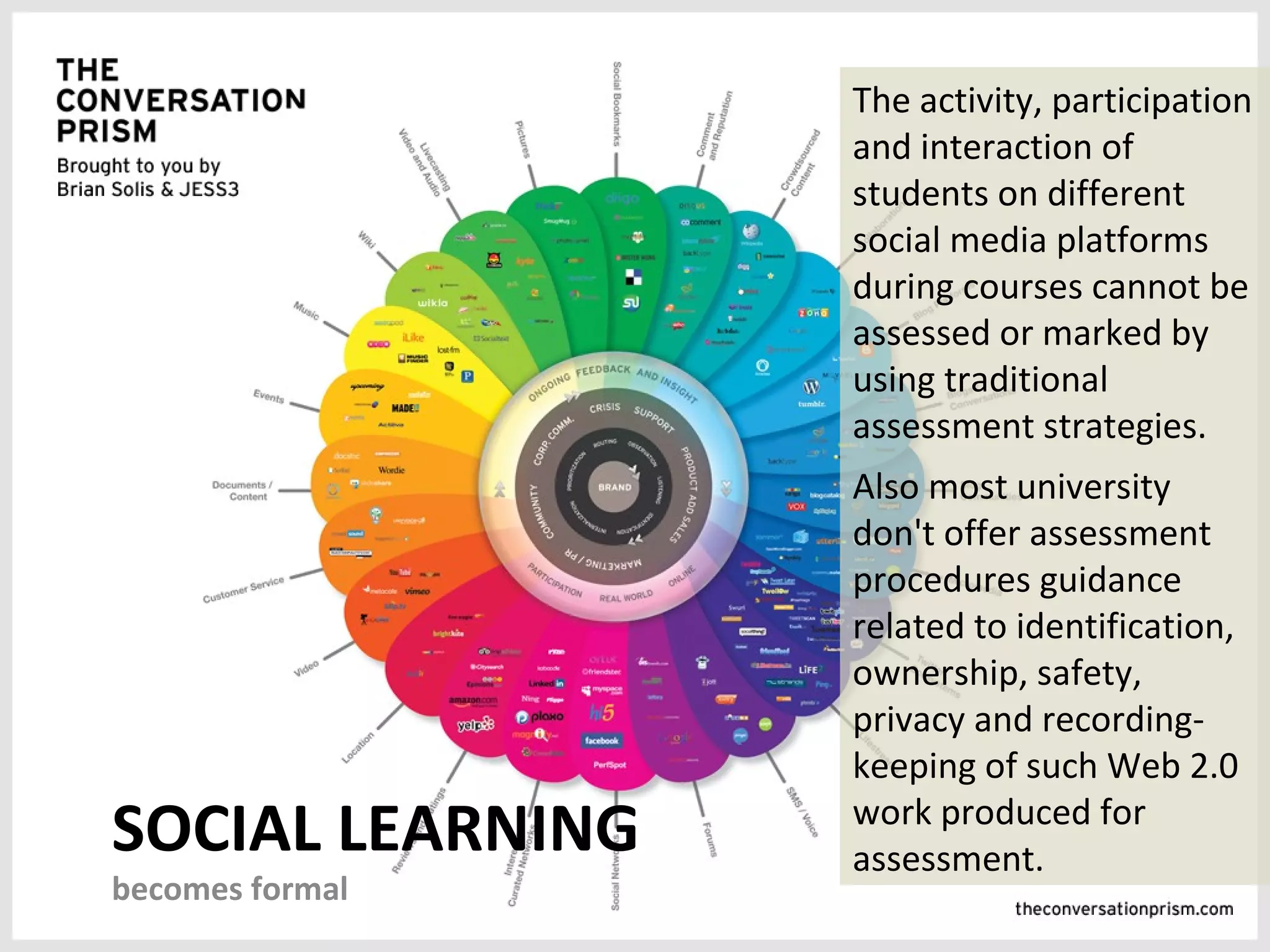
The activity, participation
                  and interaction of
                  students on different
                  social media platforms
                  during courses cannot be
                  assessed or marked by
                  using traditional
                  assessment strategies.
                  Also most university
                  don't offer assessment
                  procedures guidance
                  related to identification,
                  ownership, safety,
                  privacy and recording-
                  keeping of such Web 2.0
SOCIAL LEARNING   work produced for
                  assessment.
becomes formal
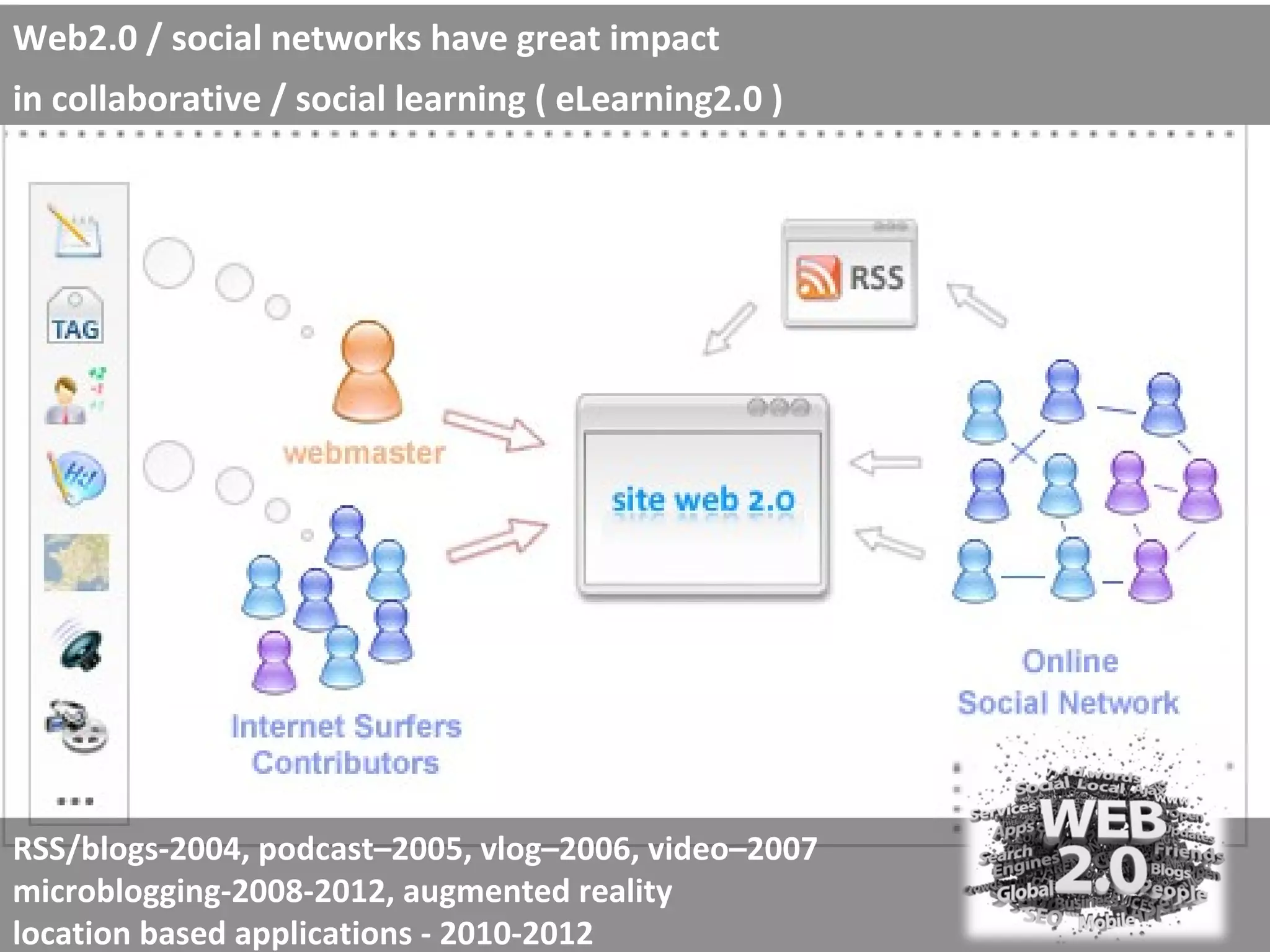
Web2.0 / social networks have great impact
in collaborative / social learning ( eLearning2.0 )


RSS/blogs-2004, podcast–2005, vlog–2006, video–2007
microblogging-2008-2012, augmented reality
location based applications - 2010-2012
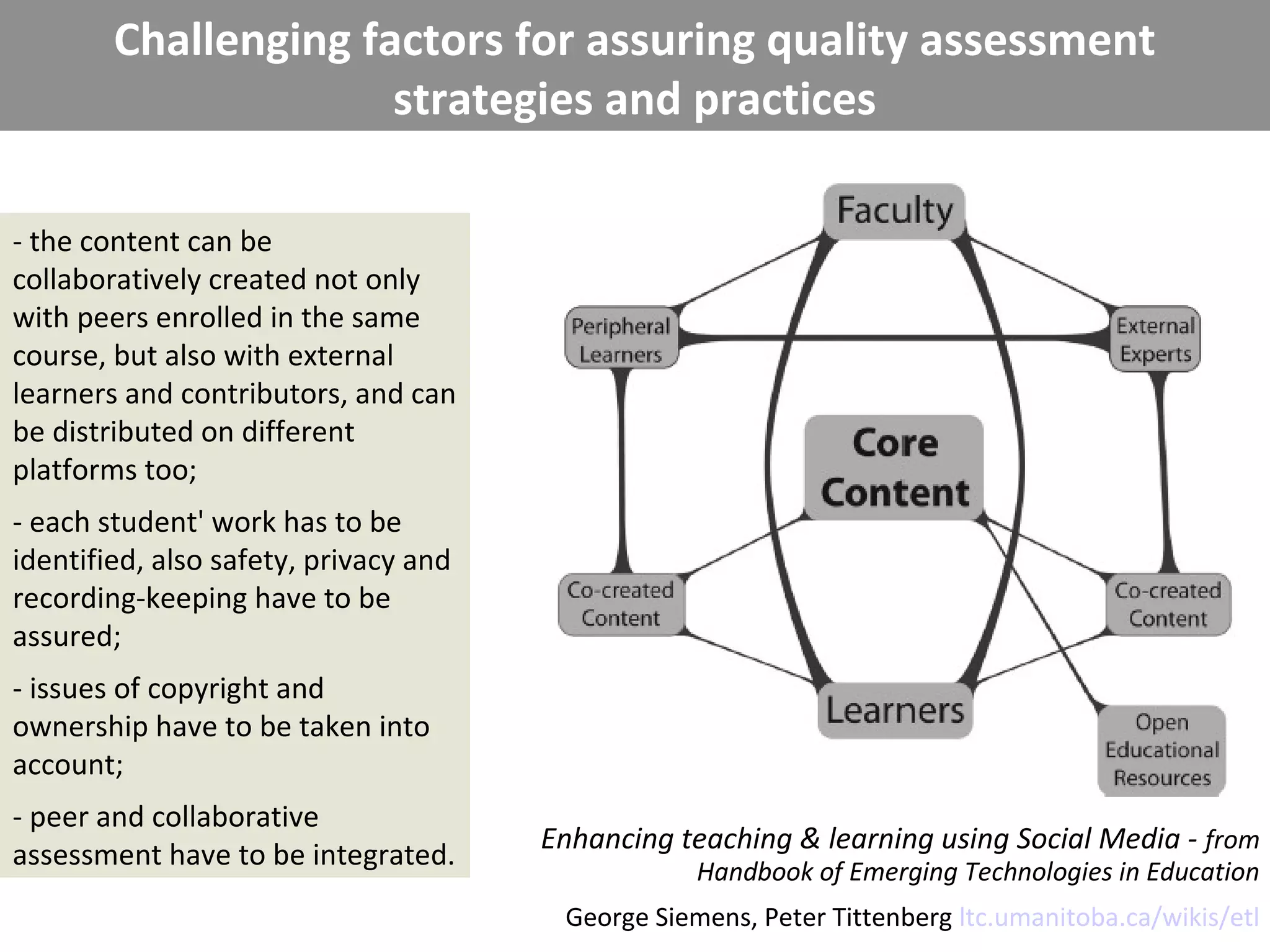
Challenging factors for assuring quality assessment
                      strategies and practices

- the content can be
collaboratively created not only
with peers enrolled in the same
course, but also with external
learners and contributors, and can
be distributed on different
platforms too;
- each student' work has to be
identified, also safety, privacy and
recording-keeping have to be
assured;
- issues of copyright and
ownership have to be taken into
account;
- peer and collaborative
                                       Enhancing teaching & learning using Social Media - from
assessment have to be integrated.                  Handbook of Emerging Technologies in Education
                                        George Siemens, Peter Tittenberg ltc.umanitoba.ca/wikis/etl
Overview of the projects for Social Media assessment

                                                                 1. Gray, K., Thompson, C., Sheard,
                                                                 J., Clerehan, R., Hamilton, M..,
                                                                 Students as Web 2.0 authors:
                                                                 Implications for assessment
                                                                 design and conduct. Australasian
                                                                 Journal of Educational
                                                                 Technology. 26, 2010.
                                                                 2. Gray, K., Waycott, J., Clerehan,
                                                                 R., Hamilton, M., Richardson, M.,
                                                                 Sheard, J., Thompson, C., Web 2.0
                                                                 authoring tools in HE learning and
                                                                 teaching: New directions for
                                                                 assessment and academic
                                                                 integrity, 2010.
                                                             3. Tinoca L., Assessment 2.0,
                                                             2011. Presentation at
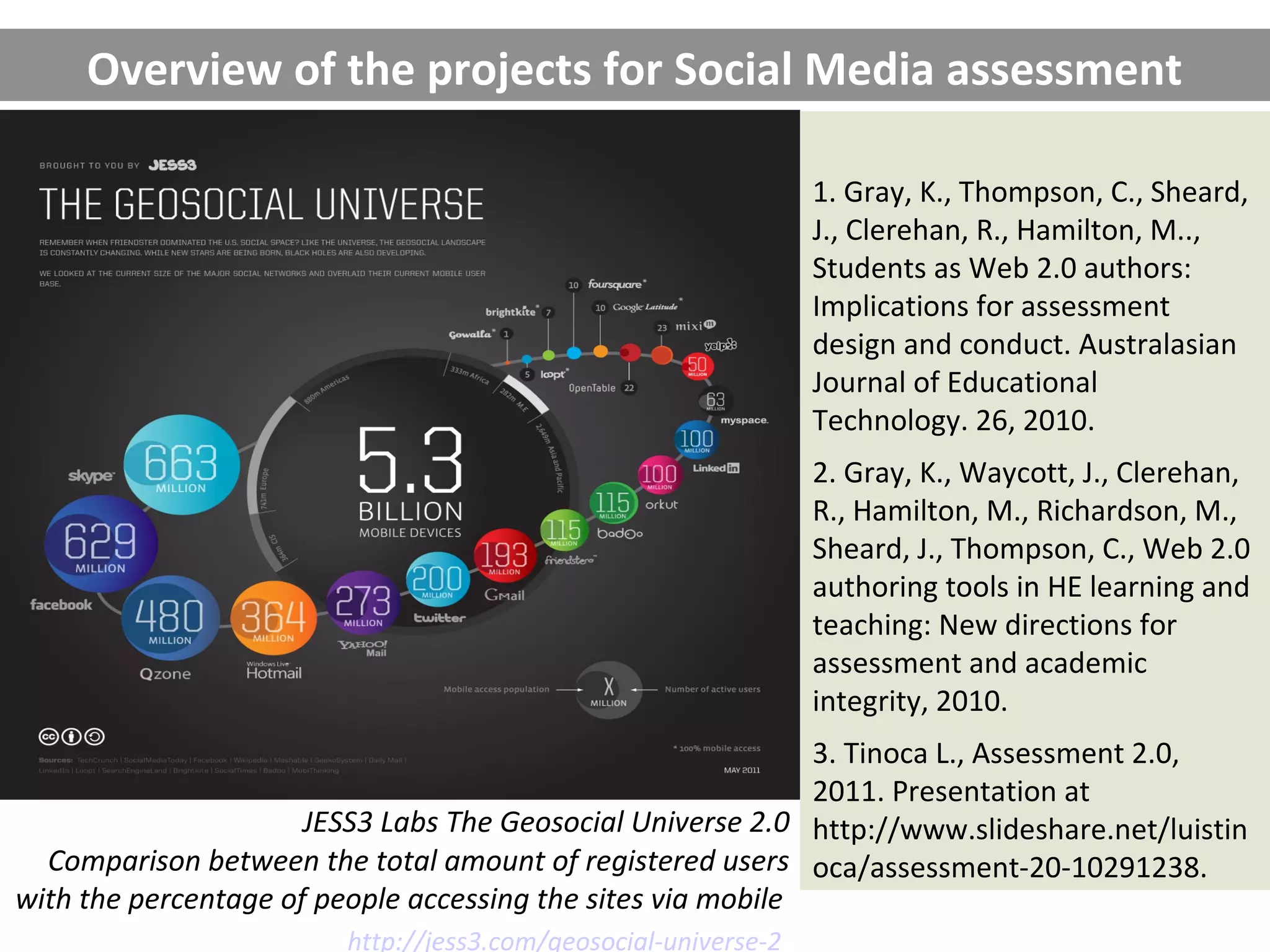
                      JESS3 Labs The Geosocial Universe 2.0 http://www.slideshare.net/luistin
  Comparison between the total amount of registered users oca/assessment-20-10291238.
with the percentage of people accessing the sites via mobile
                         http://jess3.com/geosocial-universe-2
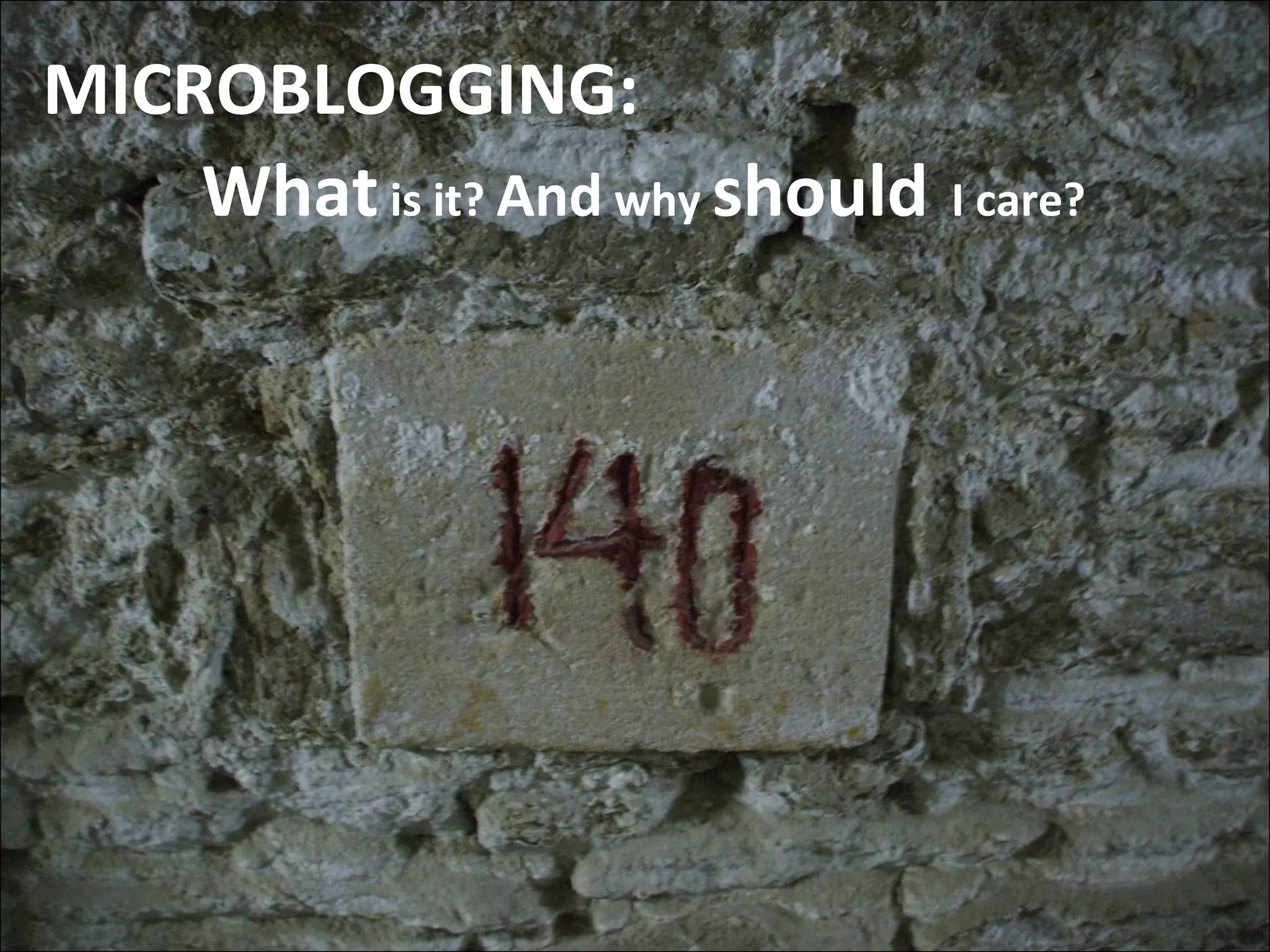
MICROBLOGGING:
    What is it? And why should I care?
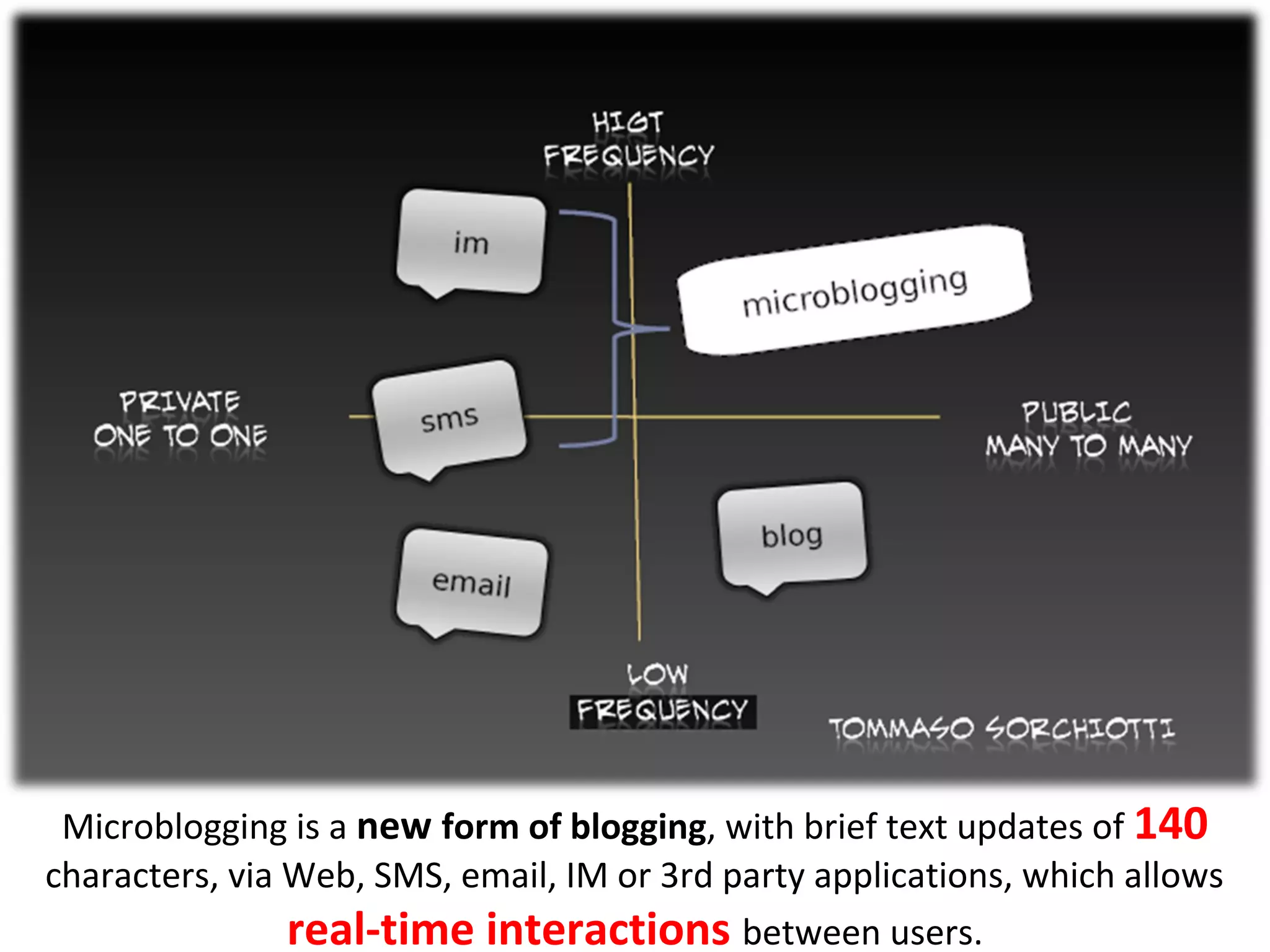
Microblogging is a new form of blogging, with brief text updates of 140
characters, via Web, SMS, email, IM or 3rd party applications, which allows
                real-time interactions between users.
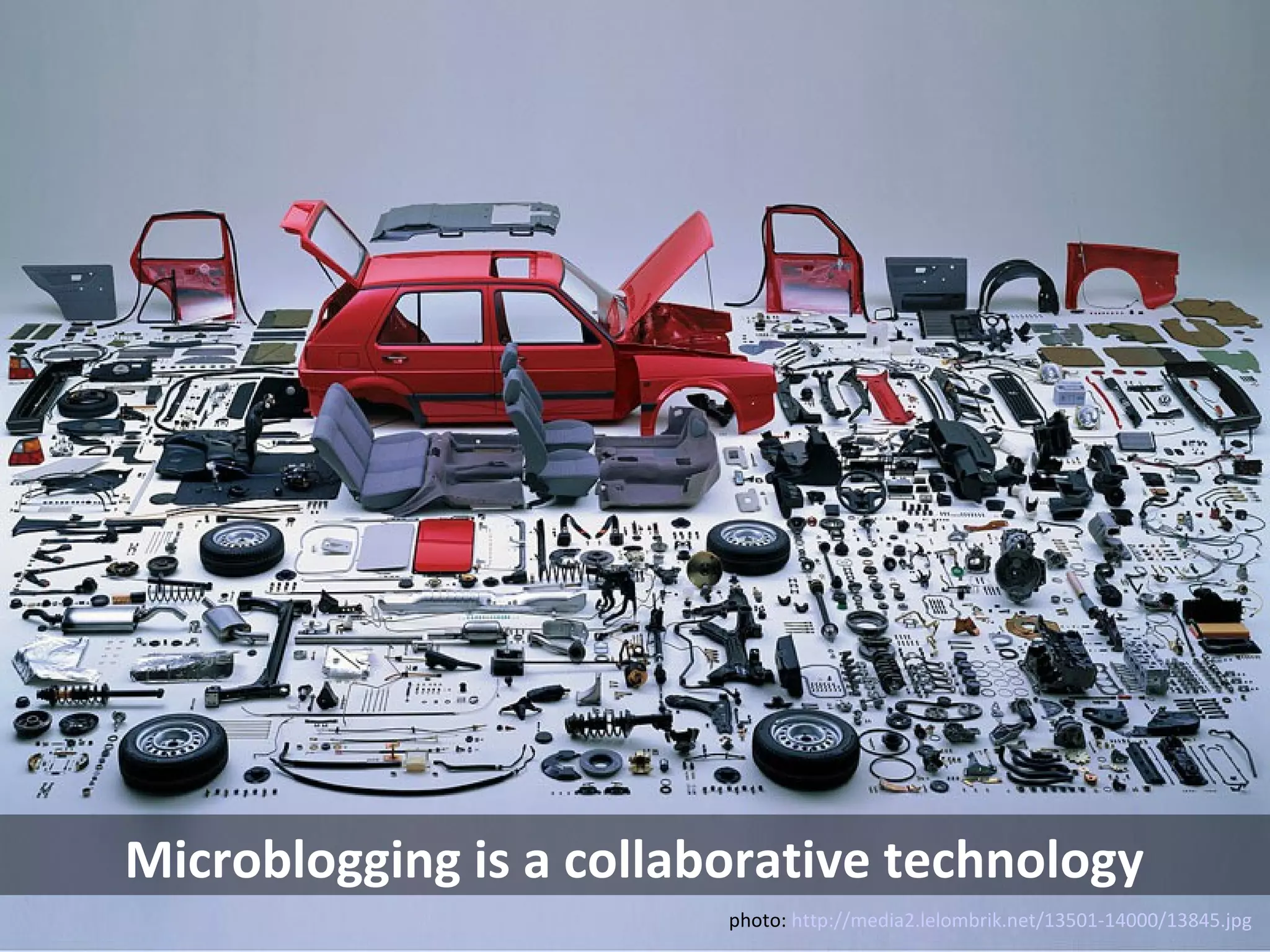
Microblogging is a collaborative technology
                         photo: http://media2.lelombrik.net/13501-14000/13845.jpg
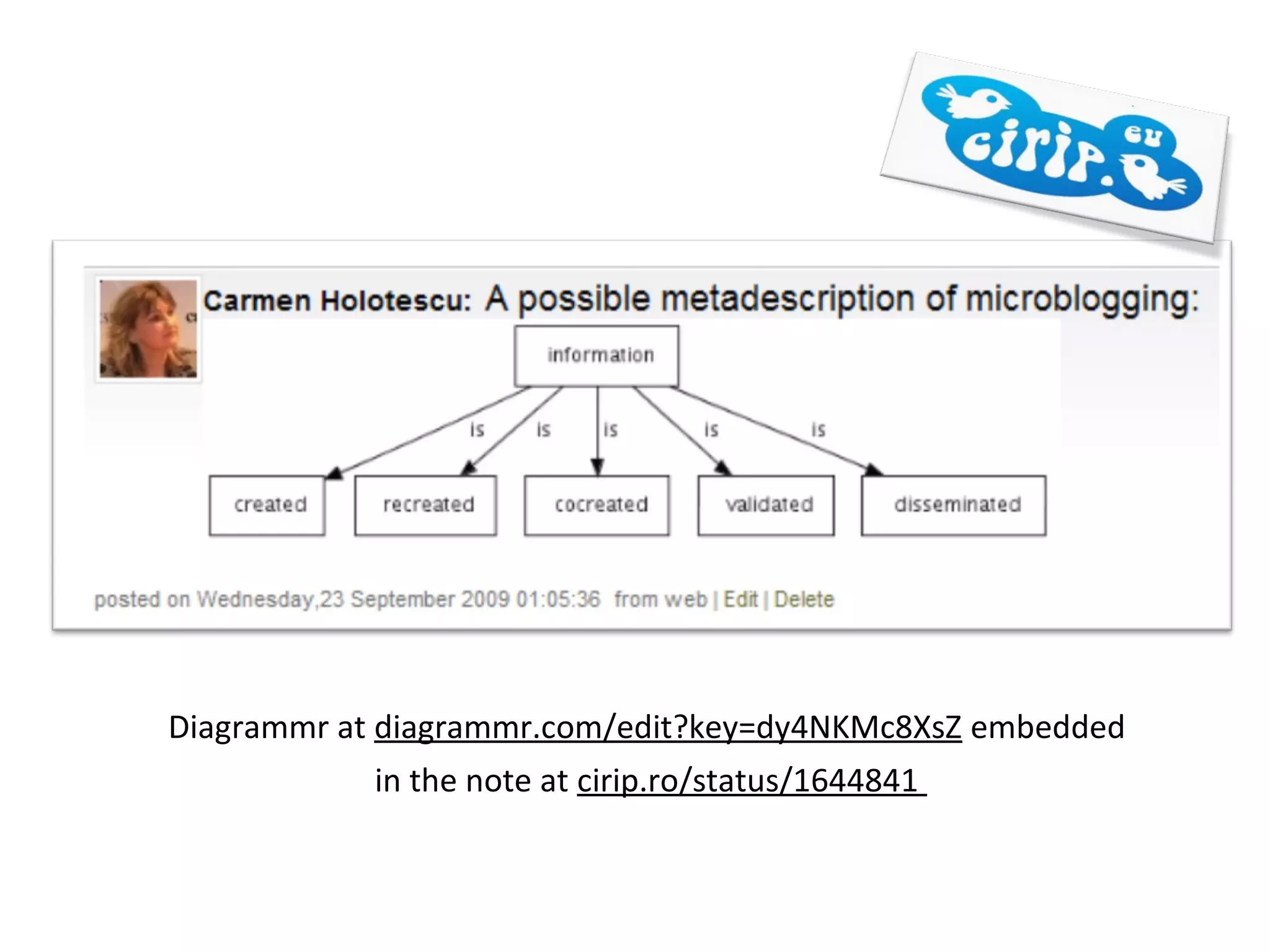
Diagrammr at diagrammr.com/edit?key=dy4NKMc8XsZ embedded
            in the note at cirip.ro/status/1644841
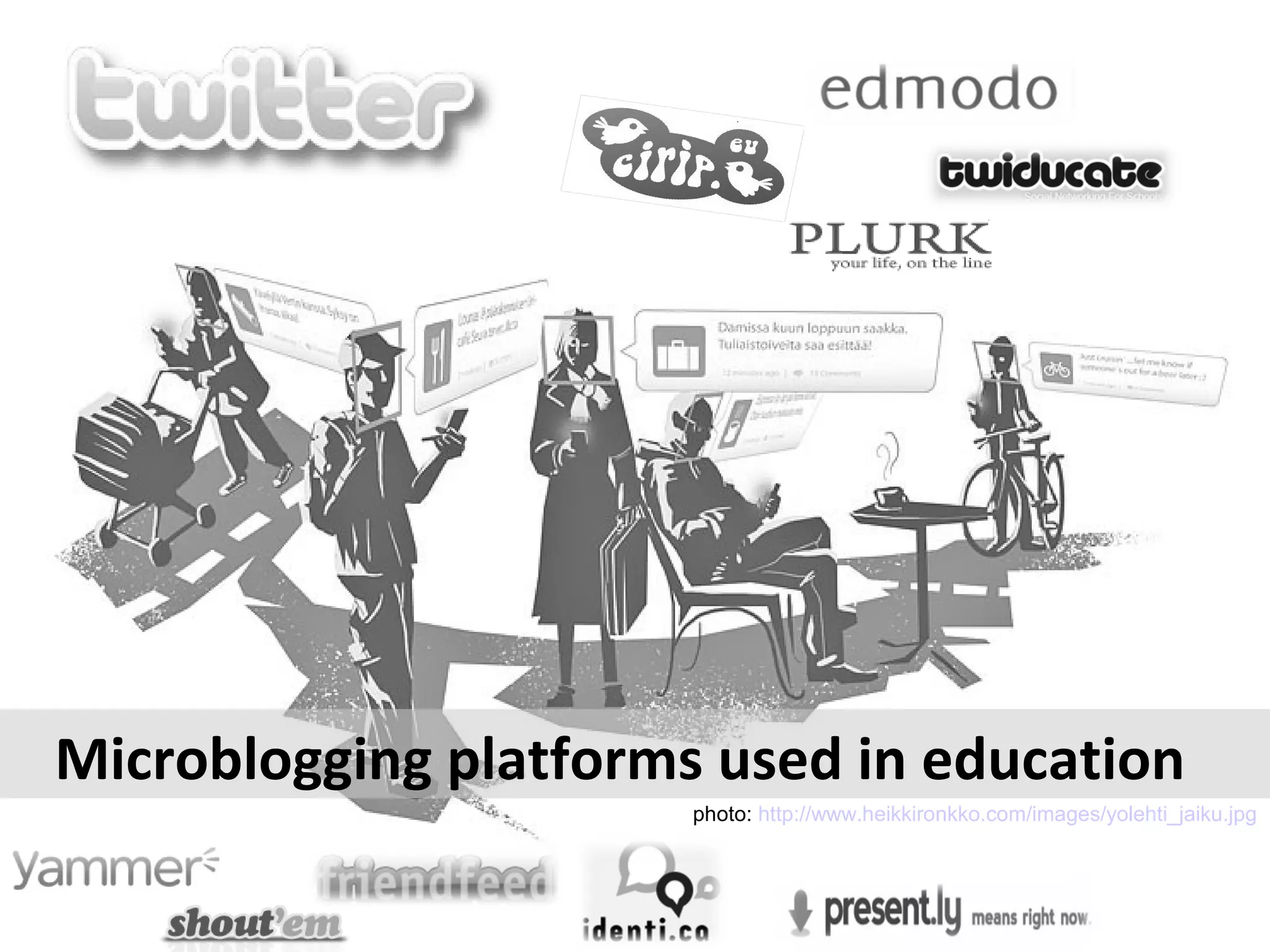
Microblogging platforms used in education
                       photo: http://www.heikkironkko.com/images/yolehti_jaiku.jpg
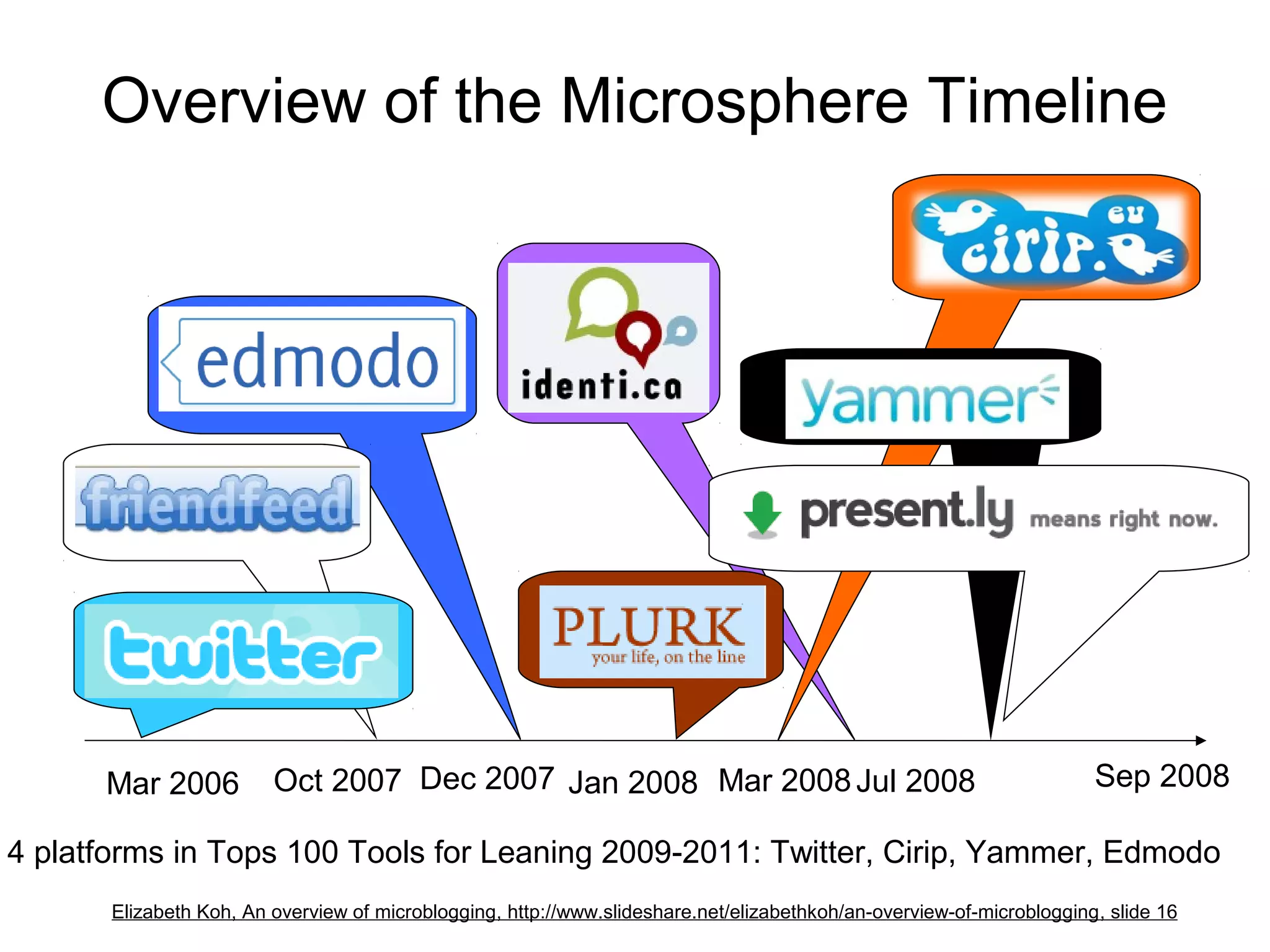
Overview of the Microsphere Timeline


      Mar 2006           Oct 2007 Dec 2007 Jan 2008 Mar 2008 Jul 2008                                                  Sep 2008

4 platforms in Tops 100 Tools for Leaning 2009-2011: Twitter, Cirip, Yammer, Edmodo
       Elizabeth Koh, An overview of microblogging, http://www.slideshare.net/elizabethkoh/an-overview-of-microblogging, slide 16
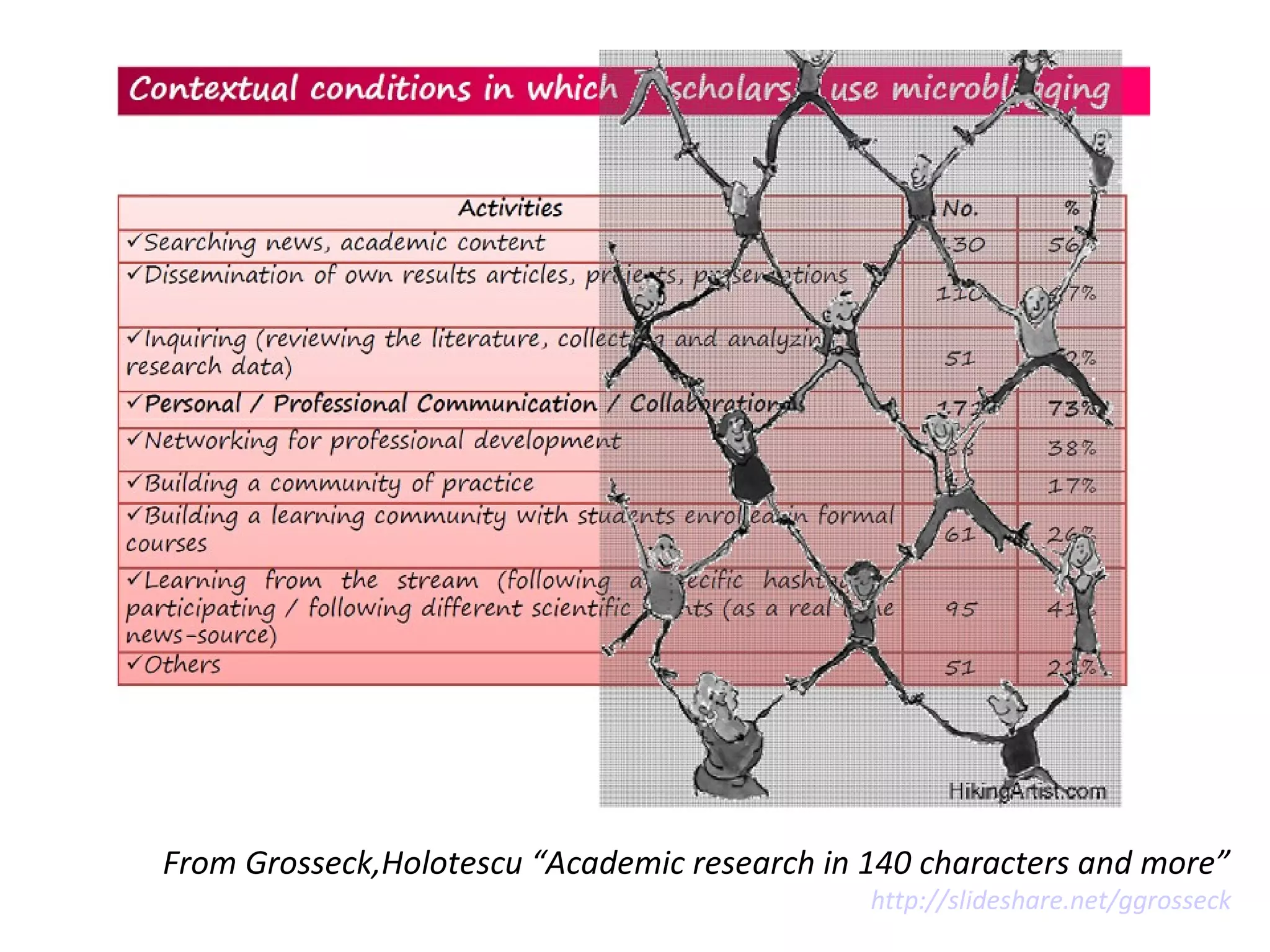
From Grosseck,Holotescu “Academic research in 140 characters and more”
                                              http://slideshare.net/ggrosseck
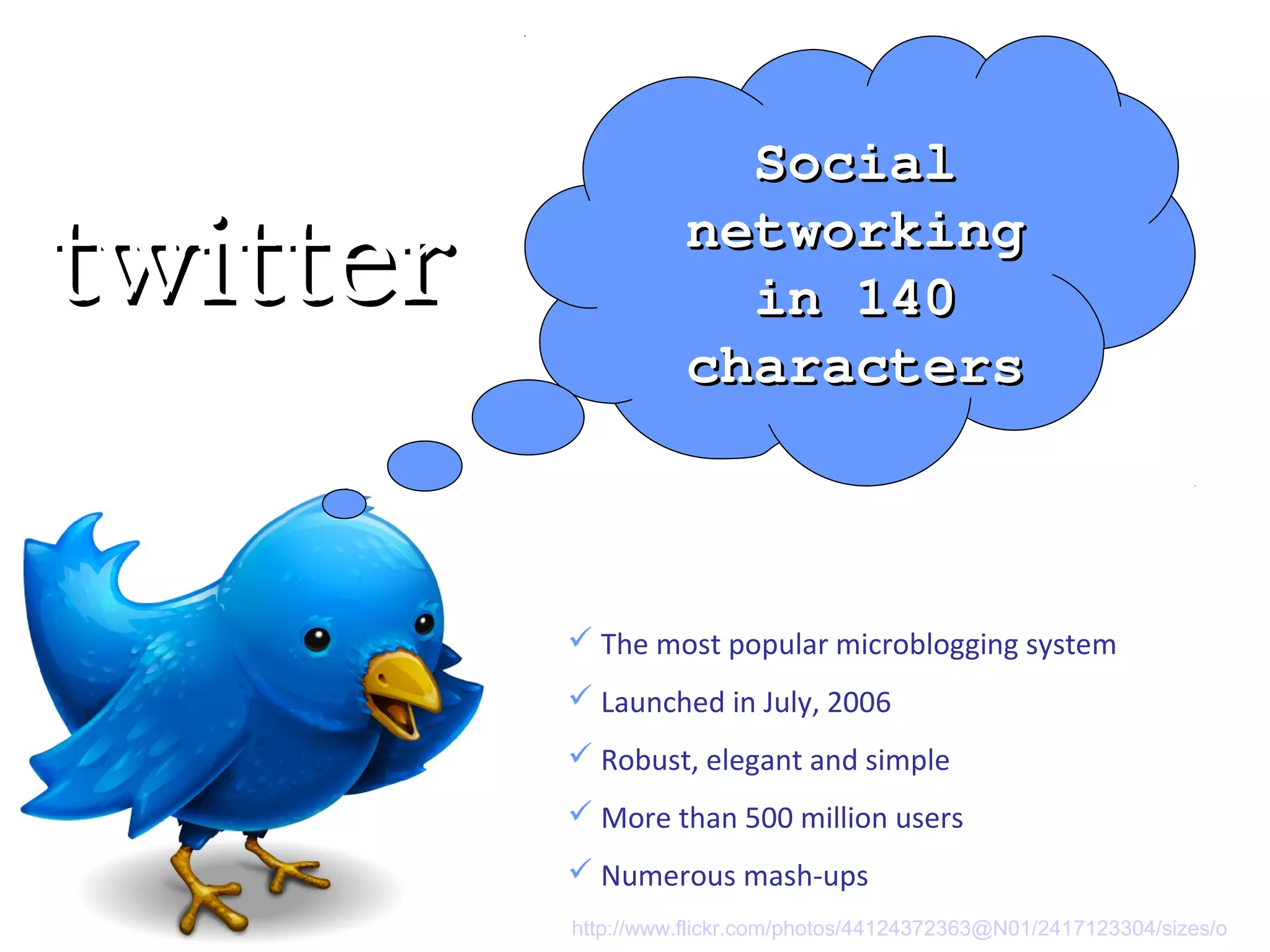
Social

twitter             networking
                      in 140
                    characters


           The most popular microblogging system
           Launched in July, 2006
           Robust, elegant and simple
           More than 500 million users
           Numerous mash-ups
          http://www.flickr.com/photos/44124372363@N01/2417123304/sizes/o
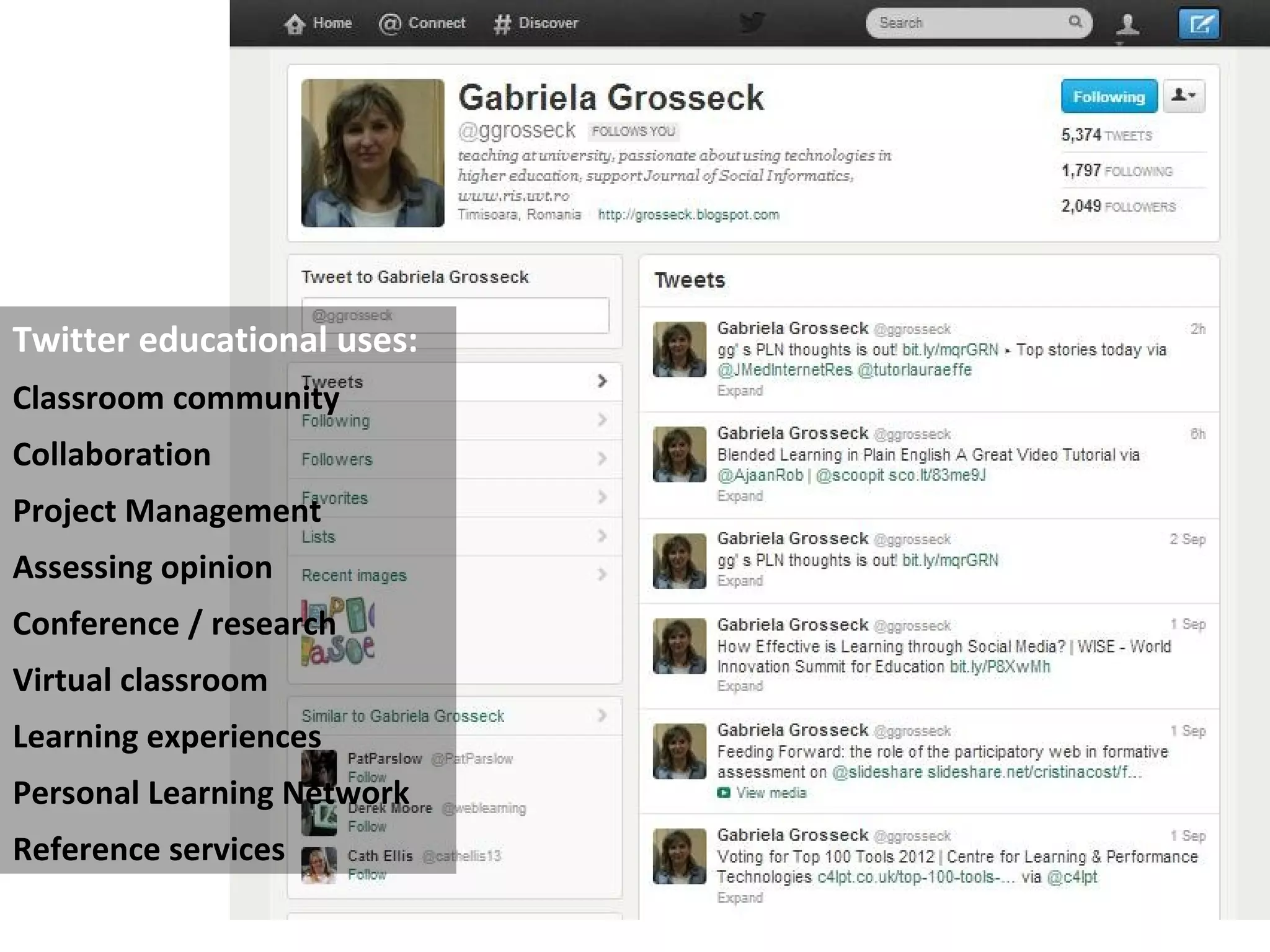
Twitter educational uses:
Classroom community
Collaboration
Project Management
Assessing opinion
Conference / research
Virtual classroom
Learning experiences
Personal Learning Network
Reference services
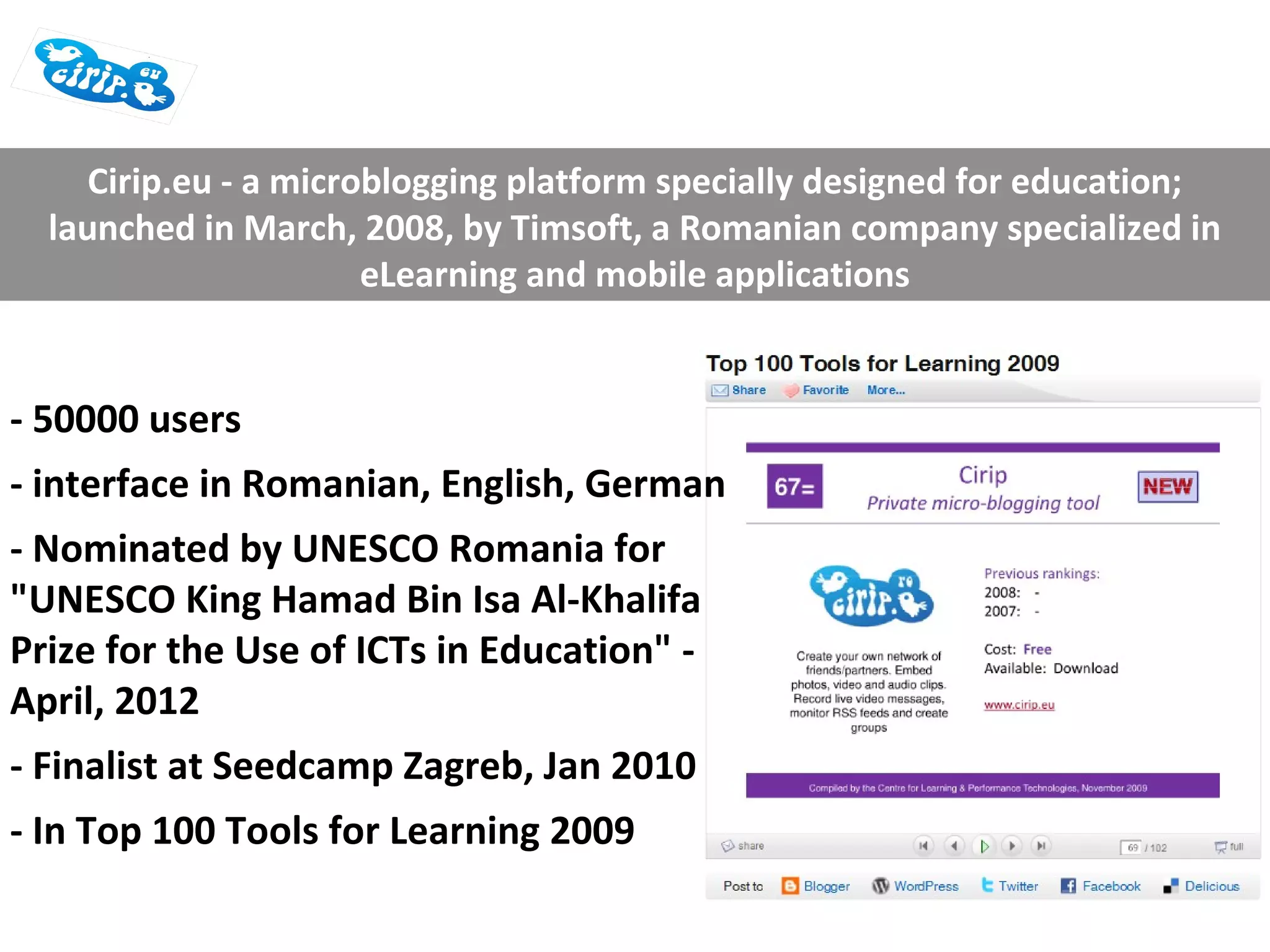
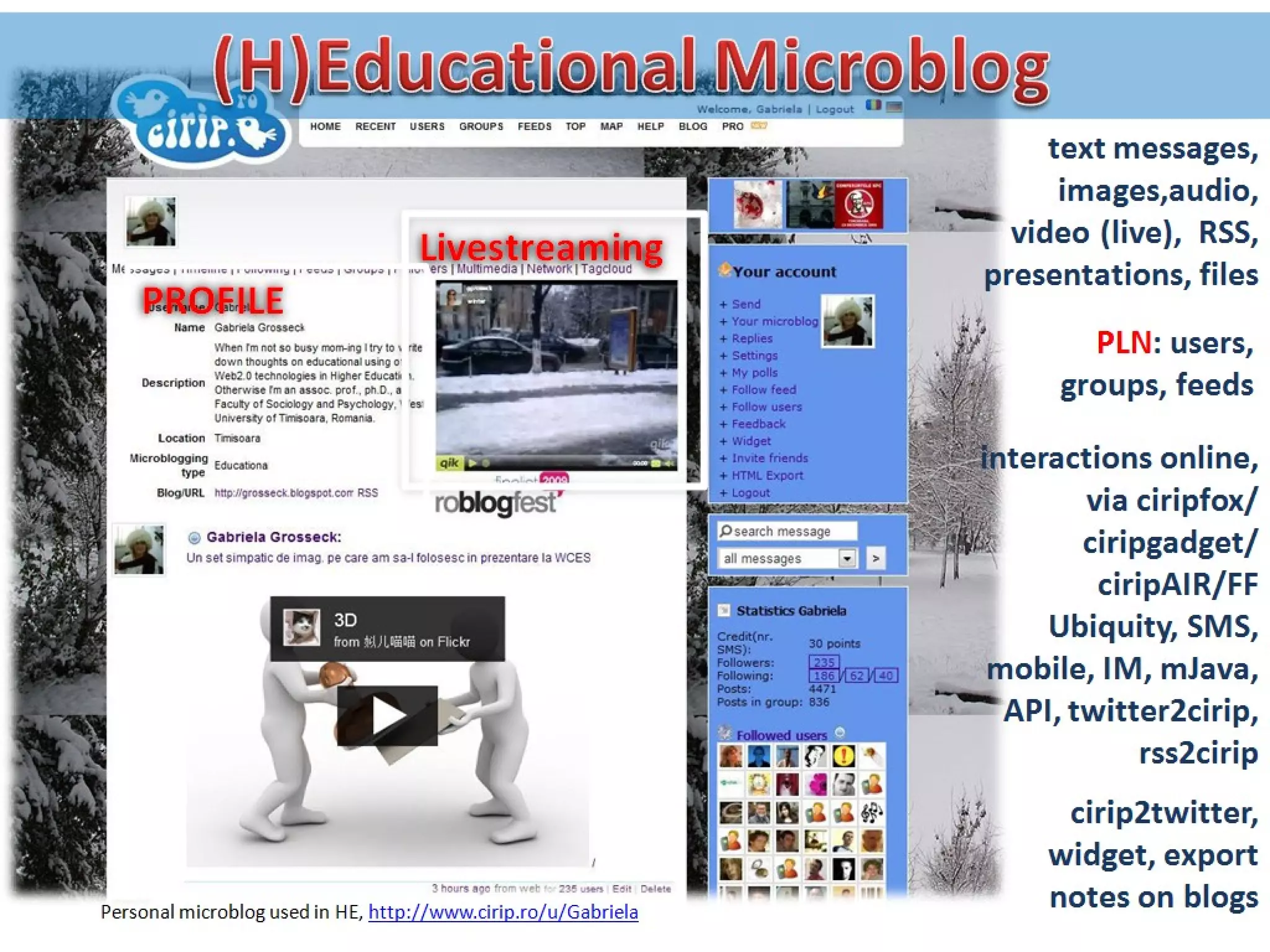
Cirip.eu - a microblogging platform specially designed for education;
  launched in March, 2008, by Timsoft, a Romanian company specialized in
                       eLearning and mobile applications


- 50000 users
- interface in Romanian, English, German
- Nominated by UNESCO Romania for
"UNESCO King Hamad Bin Isa Al-Khalifa
Prize for the Use of ICTs in Education" -
April, 2012
- Finalist at Seedcamp Zagreb, Jan 2010
- In Top 100 Tools for Learning 2009
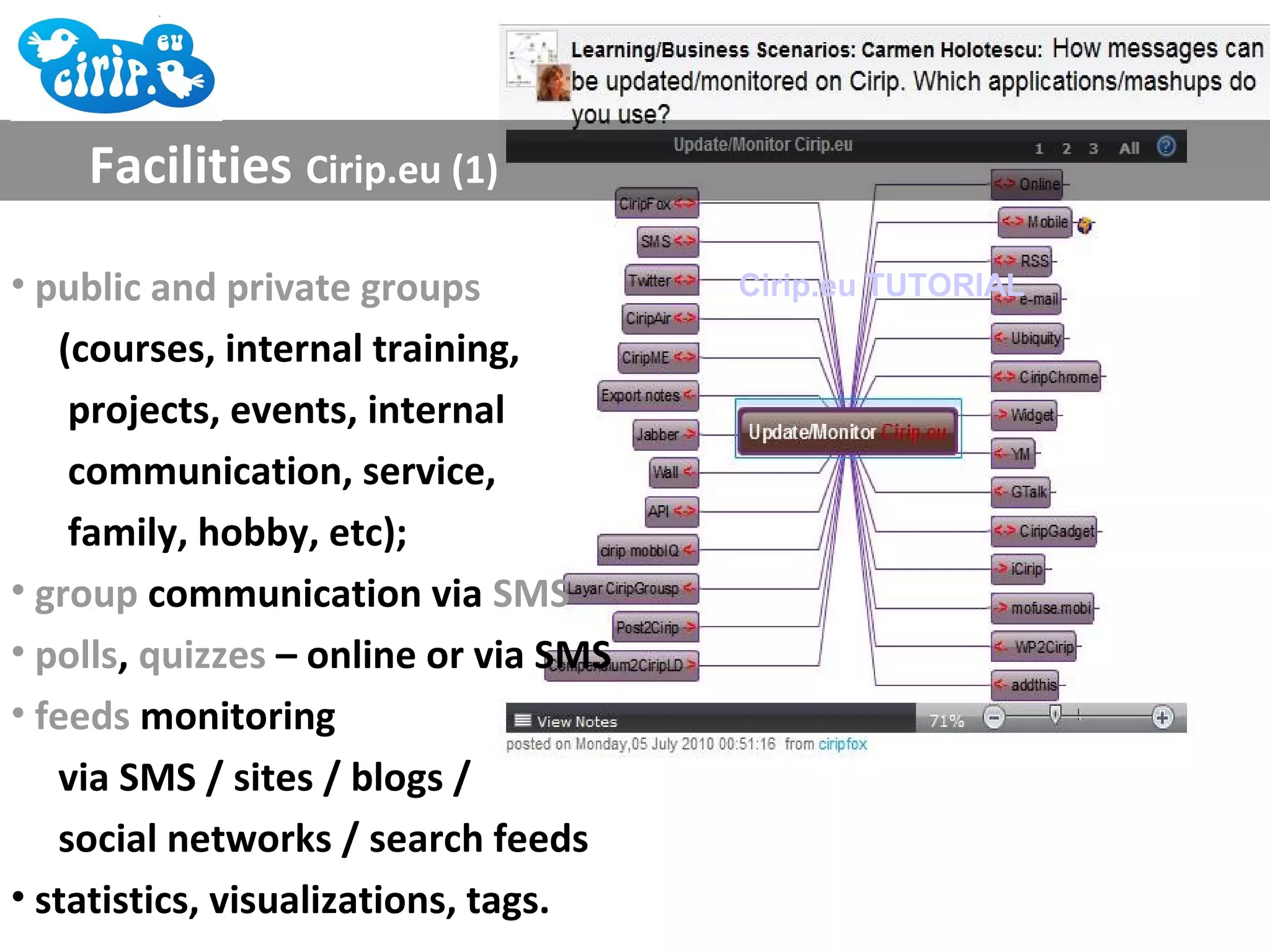
Facilities Cirip.eu (1)

• public and private groups            Cirip.eu TUTORIAL

   (courses, internal training,
    projects, events, internal
    communication, service,
    family, hobby, etc);
• group communication via SMS
• polls, quizzes – online or via SMS
• feeds monitoring
   via SMS / sites / blogs /
   social networks / search feeds
• statistics, visualizations, tags.
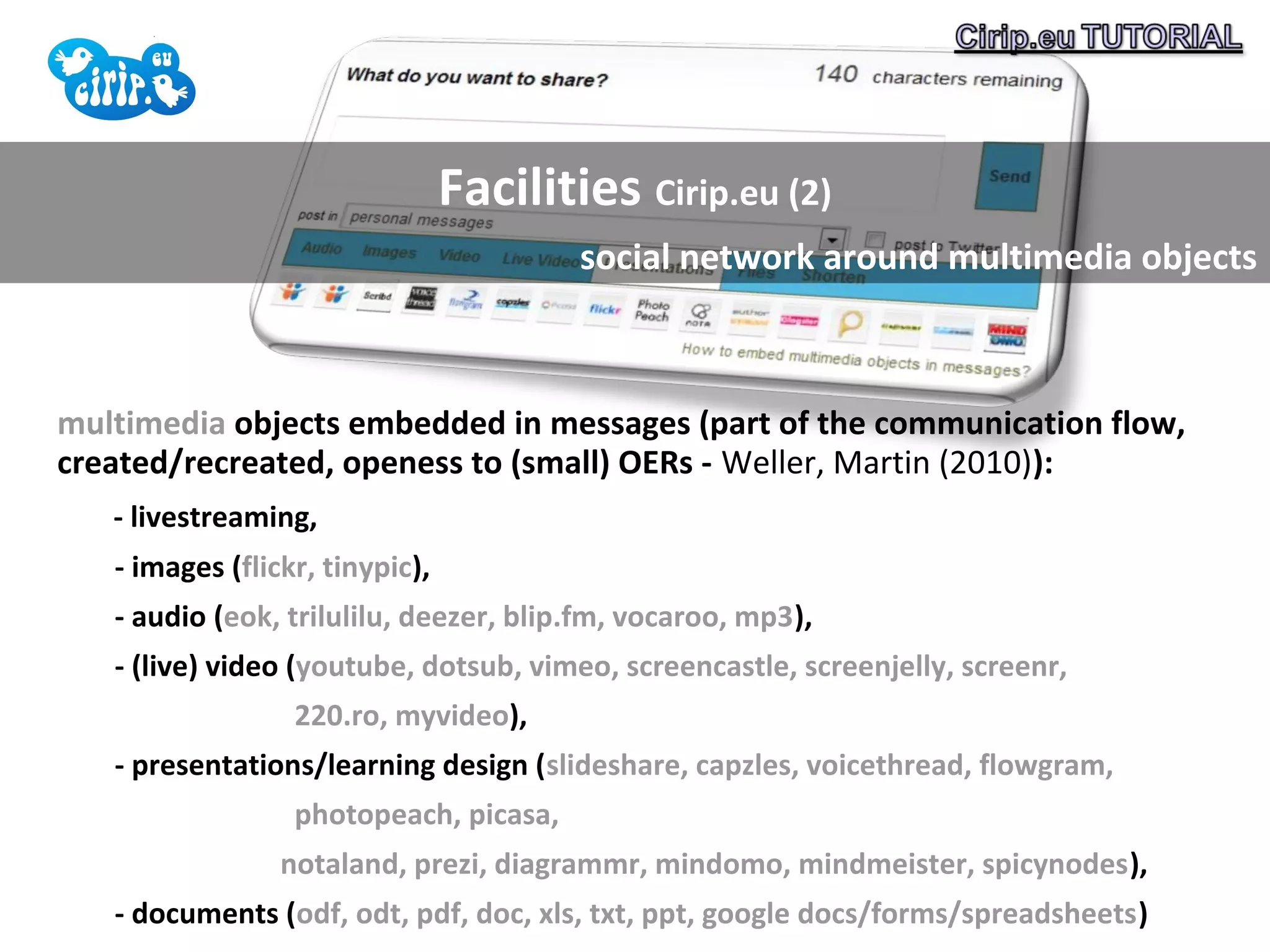
Facilities Cirip.eu (2)
                                         social network around multimedia objects


multimedia objects embedded in messages (part of the communication flow,
created/recreated, openess to (small) OERs - Weller, Martin (2010)):
   - livestreaming,
   - images (flickr, tinypic),
   - audio (eok, trilulilu, deezer, blip.fm, vocaroo, mp3),
   - (live) video (youtube, dotsub, vimeo, screencastle, screenjelly, screenr,
                  220.ro, myvideo),
   - presentations/learning design (slideshare, capzles, voicethread, flowgram,
                  photopeach, picasa,
                 notaland, prezi, diagrammr, mindomo, mindmeister, spicynodes),
   - documents (odf, odt, pdf, doc, xls, txt, ppt, google docs/forms/spreadsheets)
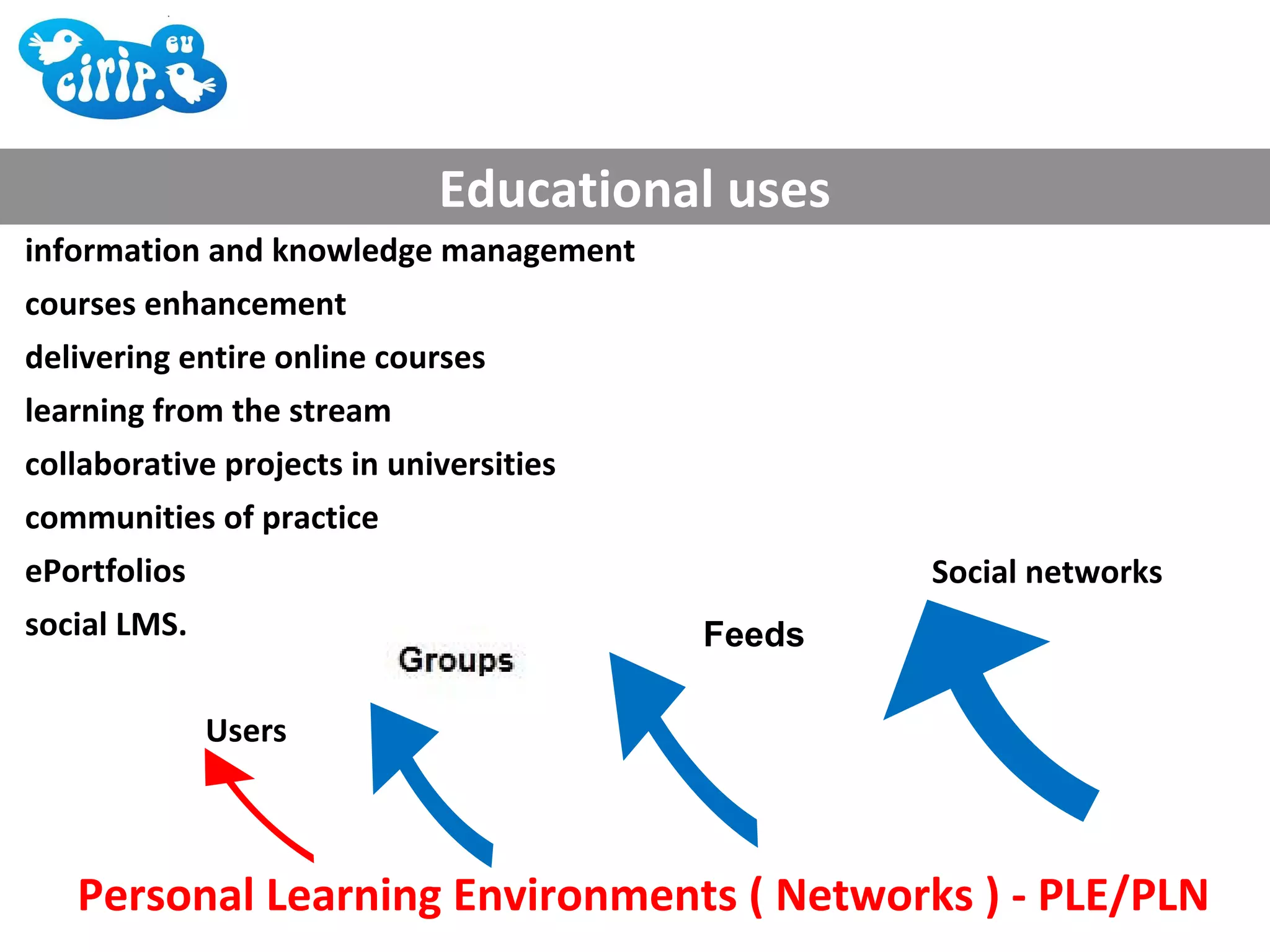
Educational uses
information and knowledge management
courses enhancement
delivering entire online courses
learning from the stream
collaborative projects in universities
communities of practice
ePortfolios                                      Social networks
social LMS.                              Feeds

              Users


   Personal Learning Environments ( Networks ) - PLE/PLN
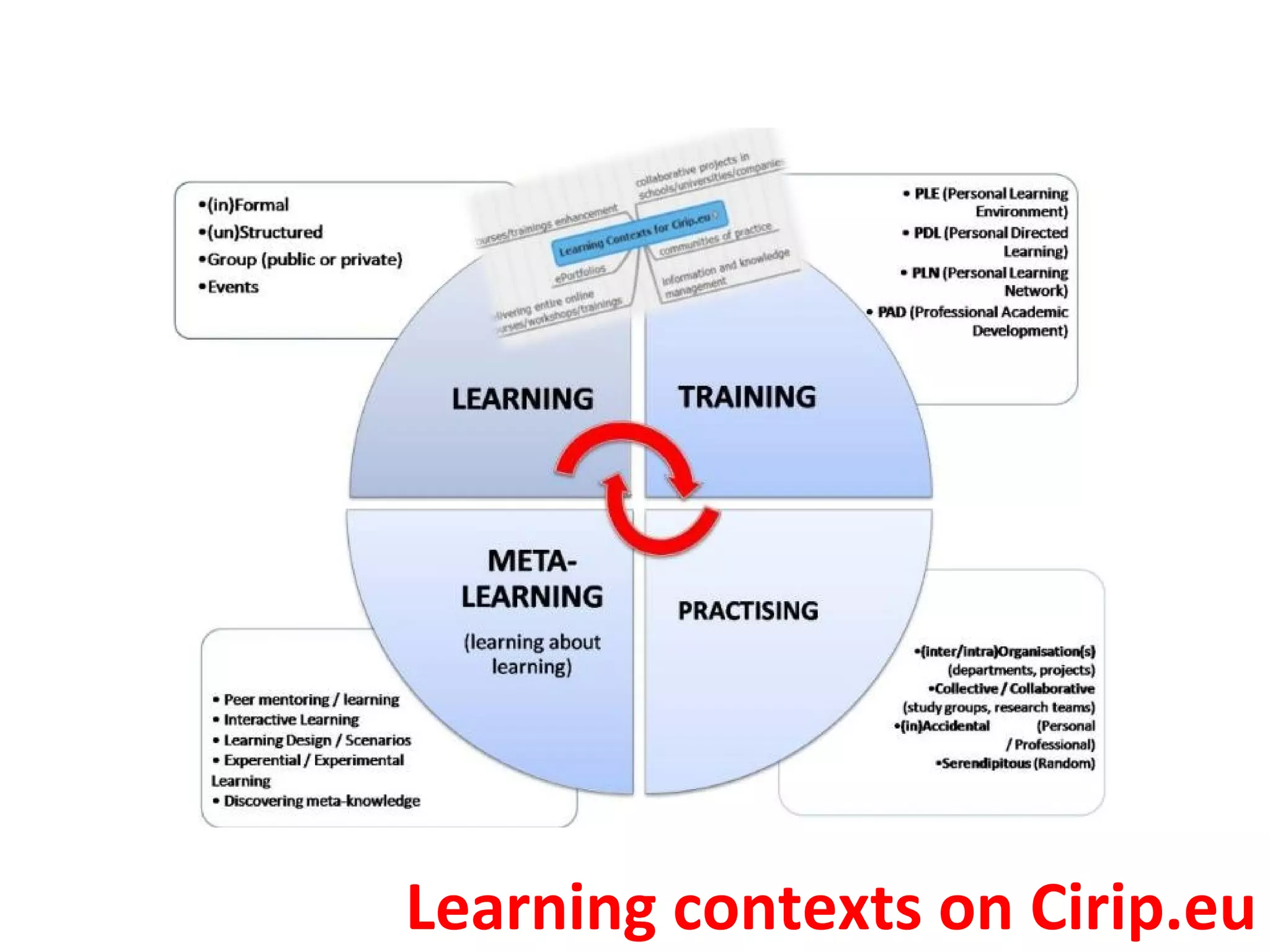
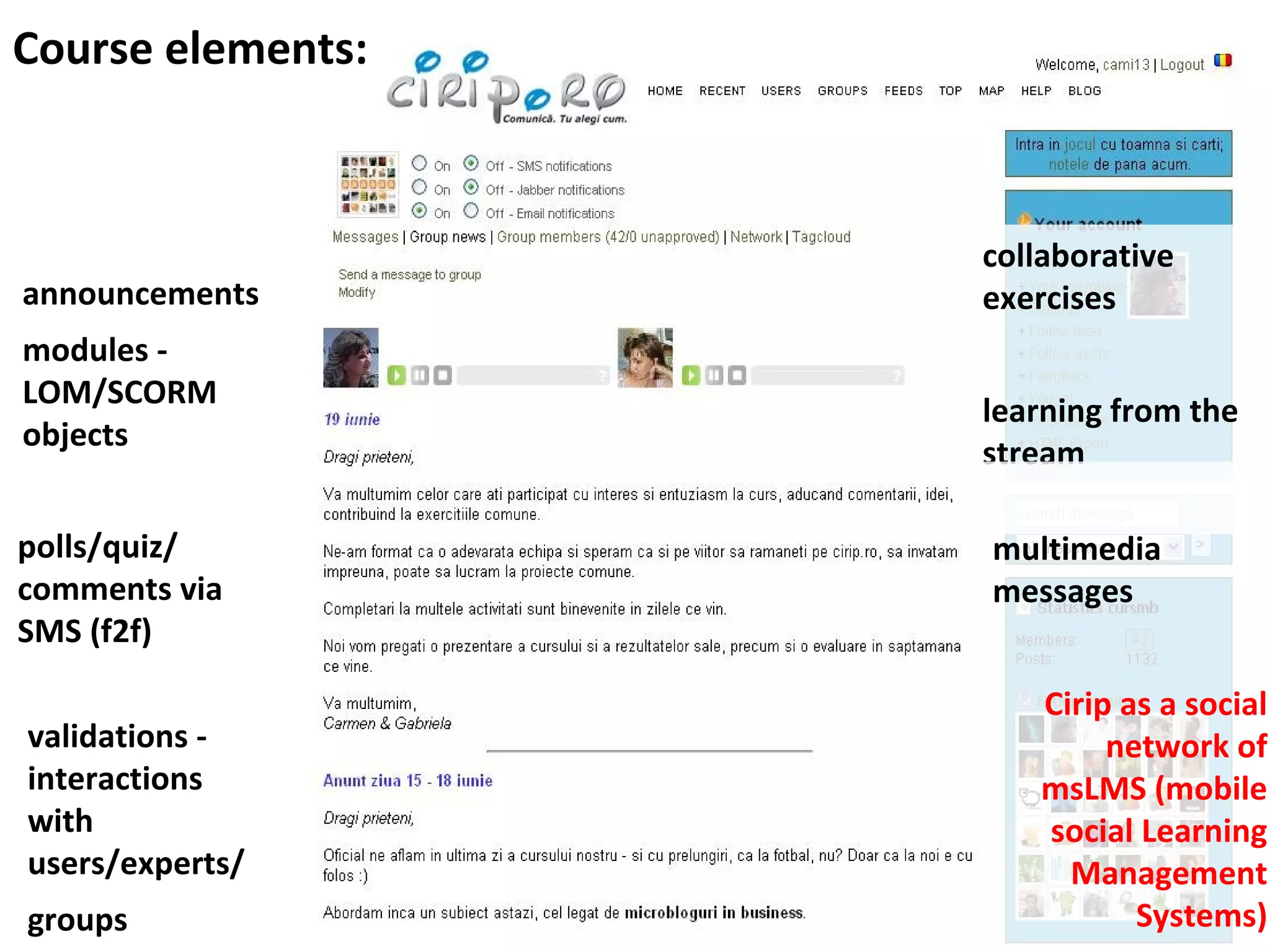
Learning contexts on Cirip.eu
Course elements:


                   collaborative
announcements      exercises
modules -
LOM/SCORM
                   learning from the
objects
                   stream

polls/quiz/        multimedia
comments via       messages
SMS (f2f)

                      Cirip as a social
validations -              network of
interactions          msLMS (mobile
with                  social Learning
users/experts/          Management
groups                       Systems)
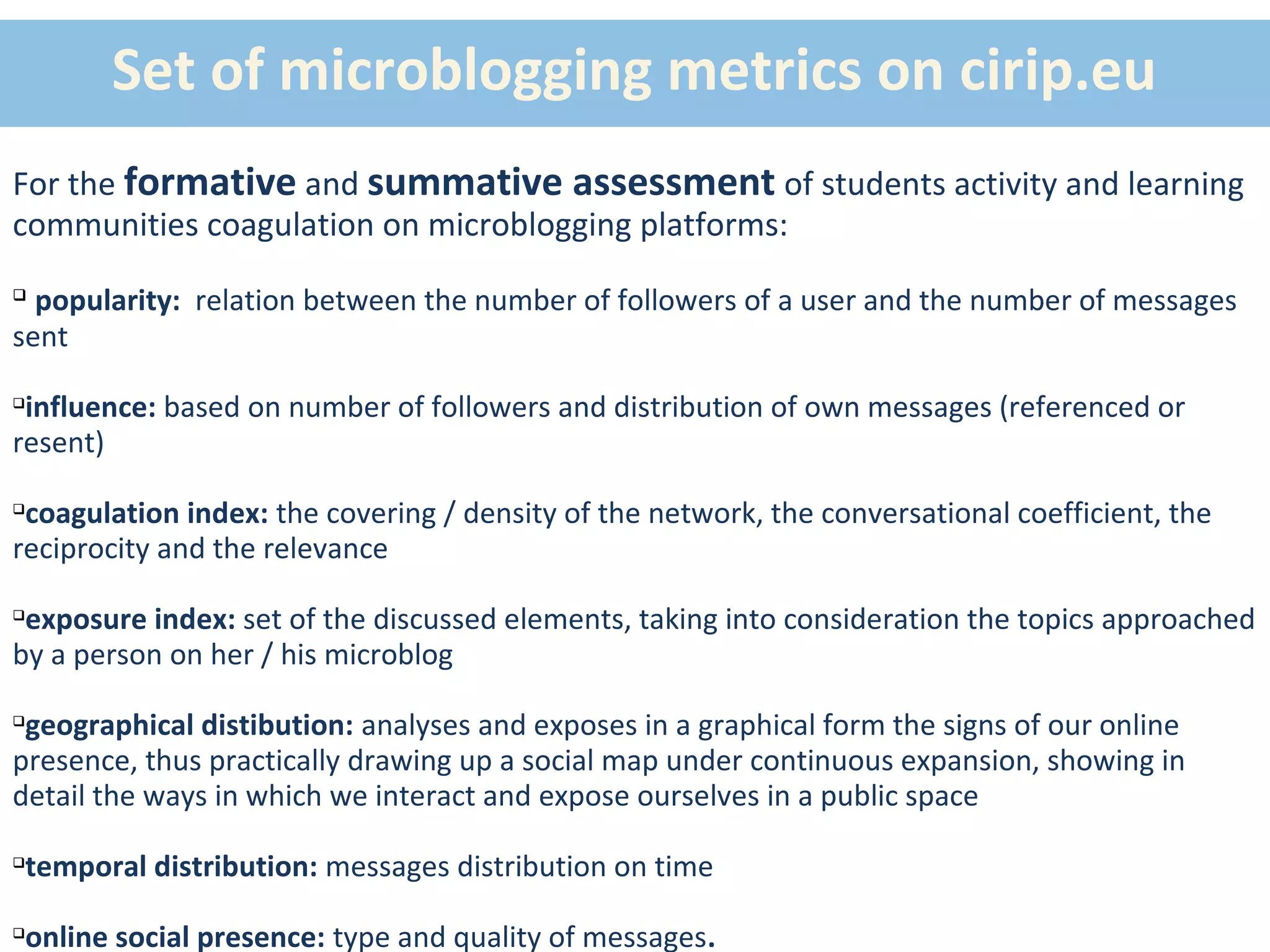
Set of microblogging metrics on cirip.eu
For the formative and summative assessment of students activity and learning
communities coagulation on microblogging platforms:

  popularity: relation between the number of followers of a user and the number of messages
sent

 influence: based on number of followers and distribution of own messages (referenced or
resent)

 coagulation index: the covering / density of the network, the conversational coefficient, the
reciprocity and the relevance

 exposure index: set of the discussed elements, taking into consideration the topics approached
by a person on her / his microblog

 geographical distibution: analyses and exposes in a graphical form the signs of our online
presence, thus practically drawing up a social map under continuous expansion, showing in
detail the ways in which we interact and expose ourselves in a public space

temporal distribution: messages distribution on time



online social presence: type and quality of messages.

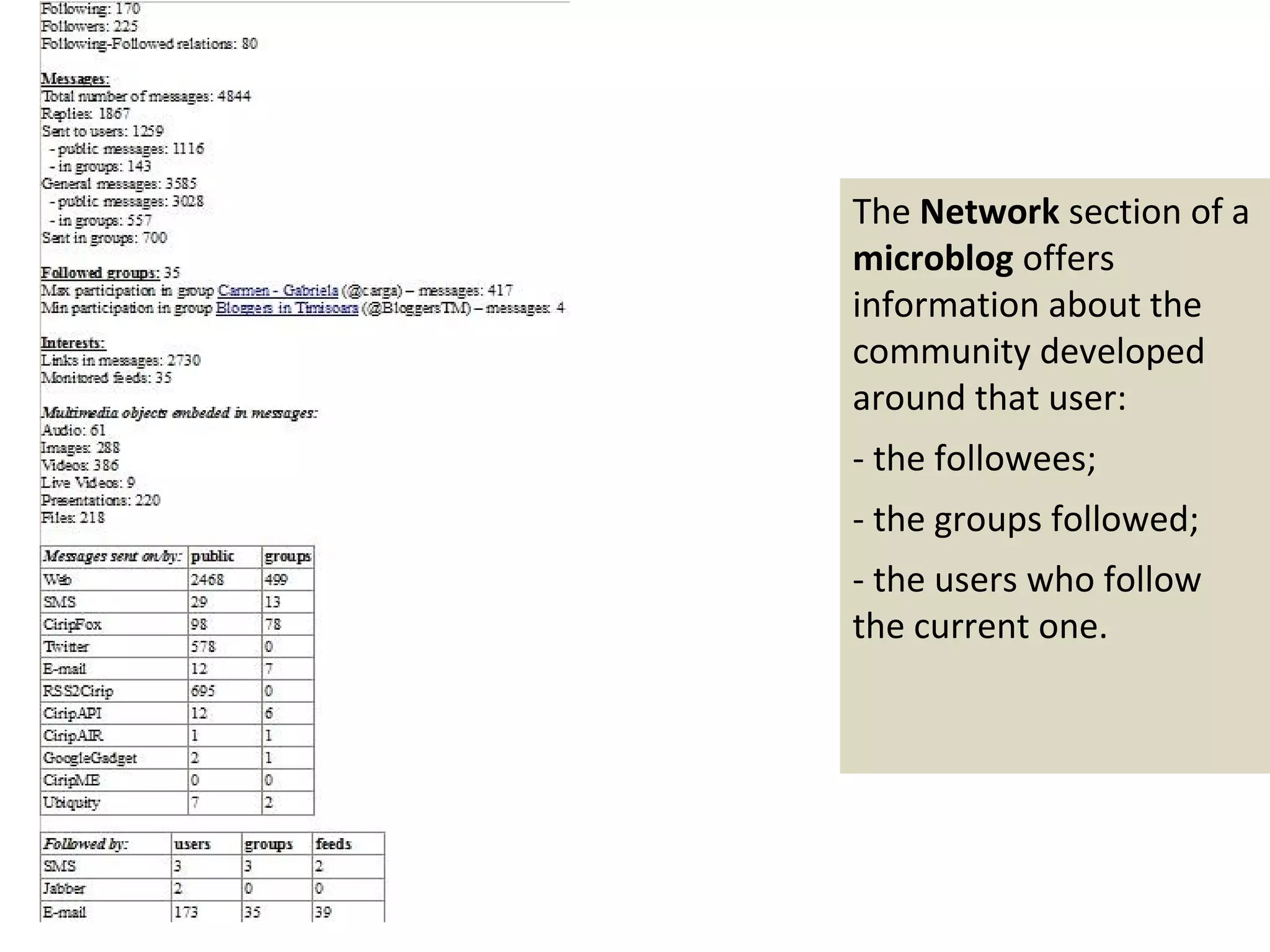
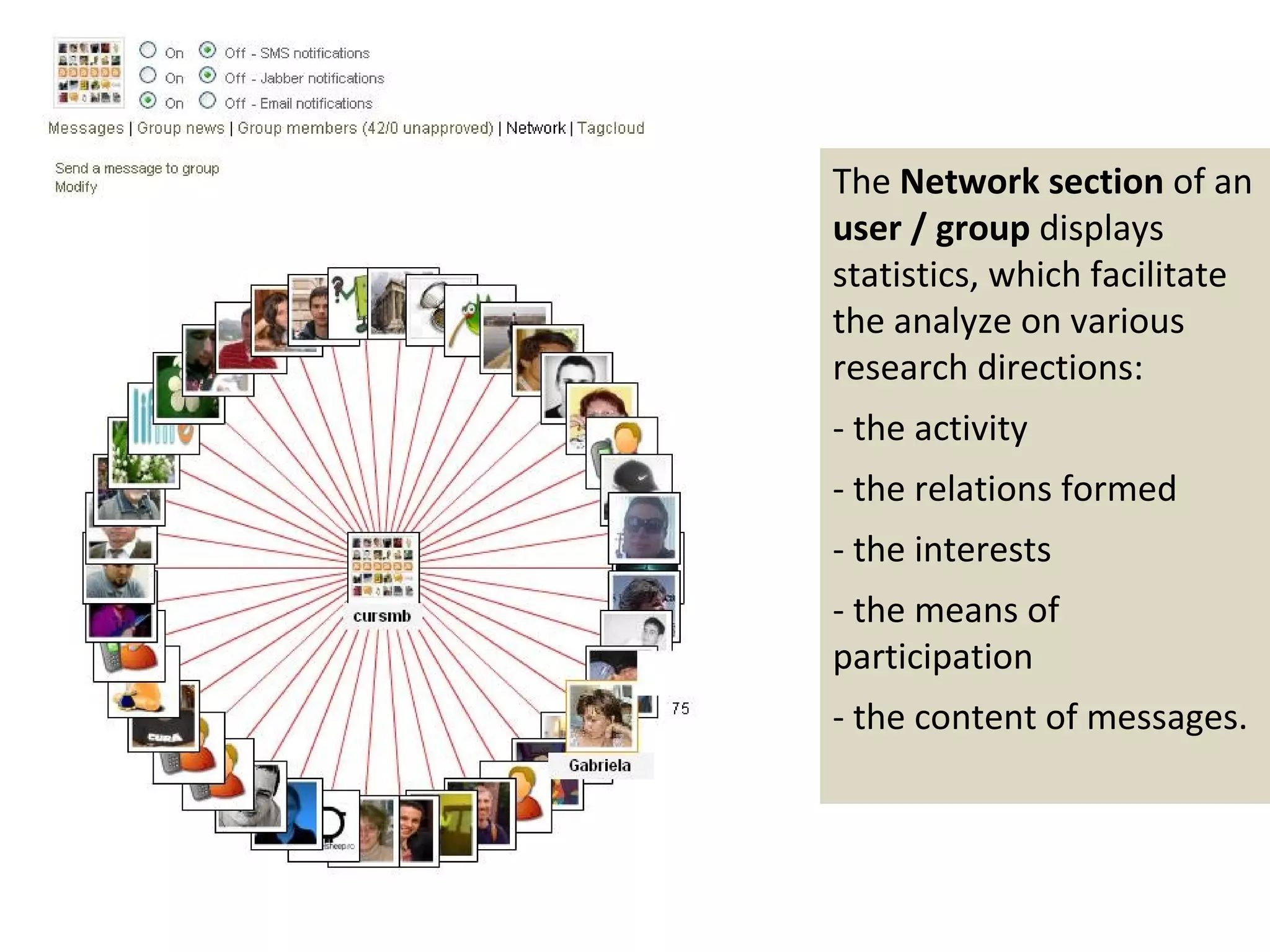
The Network section of a
microblog offers
information about the
community developed
around that user:
- the followees;
- the groups followed;
- the users who follow
the current one.
The Network section of an
user / group displays
statistics, which facilitate
the analyze on various
research directions:
- the activity
- the relations formed
- the interests
- the means of
participation
- the content of messages.
Conclusions
The integration of social media, in particular
microblogging, in academic courses demands a
new pedagogy of the teaching and learning
process and a rethinking of student
assessment.
 “It is not only about bringing into education a set
of new tools and technologies; it is about a change
 in the learning ethos. And the way in which such
  learning is assessed needs to be consistent with
 this change in learning philosophy” [Summary report
 on the Workshop Assessing Learning in a Digital World. Online
               Educa Conference Berlin, 2010]

The microblogging metrics defined for the
Cirip.eu educational microblogging platform
can be applied both for summative and
formative assessment, and can be adapted for
other microblogging applications used in
education.                                                       image from
                                                                 http://www.flickr.com/photos/neilsingapore
Thank you!

   Carmen Holotescu
    cirip.ro/u/cami13
  twitter.com/cami13

          Mirella Mioc
     Cirip.ro/u/mirella

     Gabriela Grosseck
    cirip.ro/u/gabriela
twitter.com/ggrosseck

Assessment in microblogging enhanced courses

  • 1.
    Assessment in microbloggingenhanced courses Carmen Holotescu Mirella Mioc Gabriela Grosseck University Politehnica/ Timsoft University Politehnica West University Timisoara, Romania 11th WSEAS International Conference on DNCOCO12 Data Networks, Communications, Computers Malta - Sept, 7-9, 2012
  • 2.
    Social Media and Microblogging as new trends in education Overview of the projects for Social Media assessment Cirip.eu – an educational microblogging platform Set of microblogging metrics Conclusions image from http://www.flickr.com/photos/robinhoypaco
  • 3.
    The activity, participation and interaction of students on different social media platforms during courses cannot be assessed or marked by using traditional assessment strategies. Also most university don't offer assessment procedures guidance related to identification, ownership, safety, privacy and recording- keeping of such Web 2.0 SOCIAL LEARNING work produced for assessment. becomes formal
  • 4.
    Web2.0 / socialnetworks have great impact in collaborative / social learning ( eLearning2.0 ) RSS/blogs-2004, podcast–2005, vlog–2006, video–2007 microblogging-2008-2012, augmented reality location based applications - 2010-2012
  • 5.
    Challenging factors forassuring quality assessment strategies and practices - the content can be collaboratively created not only with peers enrolled in the same course, but also with external learners and contributors, and can be distributed on different platforms too; - each student' work has to be identified, also safety, privacy and recording-keeping have to be assured; - issues of copyright and ownership have to be taken into account; - peer and collaborative Enhancing teaching & learning using Social Media - from assessment have to be integrated. Handbook of Emerging Technologies in Education George Siemens, Peter Tittenberg ltc.umanitoba.ca/wikis/etl
  • 6.
    Overview of theprojects for Social Media assessment 1. Gray, K., Thompson, C., Sheard, J., Clerehan, R., Hamilton, M.., Students as Web 2.0 authors: Implications for assessment design and conduct. Australasian Journal of Educational Technology. 26, 2010. 2. Gray, K., Waycott, J., Clerehan, R., Hamilton, M., Richardson, M., Sheard, J., Thompson, C., Web 2.0 authoring tools in HE learning and teaching: New directions for assessment and academic integrity, 2010. 3. Tinoca L., Assessment 2.0, 2011. Presentation at JESS3 Labs The Geosocial Universe 2.0 http://www.slideshare.net/luistin Comparison between the total amount of registered users oca/assessment-20-10291238. with the percentage of people accessing the sites via mobile http://jess3.com/geosocial-universe-2
  • 7.
    MICROBLOGGING: What is it? And why should I care?
  • 8.
    Microblogging is anew form of blogging, with brief text updates of 140 characters, via Web, SMS, email, IM or 3rd party applications, which allows real-time interactions between users.
  • 9.
    Microblogging is acollaborative technology photo: http://media2.lelombrik.net/13501-14000/13845.jpg
  • 10.
    Diagrammr at diagrammr.com/edit?key=dy4NKMc8XsZembedded in the note at cirip.ro/status/1644841
  • 11.
    Microblogging platforms usedin education photo: http://www.heikkironkko.com/images/yolehti_jaiku.jpg
  • 12.
    Overview of theMicrosphere Timeline Mar 2006 Oct 2007 Dec 2007 Jan 2008 Mar 2008 Jul 2008 Sep 2008 4 platforms in Tops 100 Tools for Leaning 2009-2011: Twitter, Cirip, Yammer, Edmodo Elizabeth Koh, An overview of microblogging, http://www.slideshare.net/elizabethkoh/an-overview-of-microblogging, slide 16
  • 13.
    From Grosseck,Holotescu “Academicresearch in 140 characters and more” http://slideshare.net/ggrosseck
  • 14.
    Social twitter networking in 140 characters  The most popular microblogging system  Launched in July, 2006  Robust, elegant and simple  More than 500 million users  Numerous mash-ups http://www.flickr.com/photos/44124372363@N01/2417123304/sizes/o
  • 15.
    Twitter educational uses: Classroomcommunity Collaboration Project Management Assessing opinion Conference / research Virtual classroom Learning experiences Personal Learning Network Reference services
  • 16.
    Cirip.eu - amicroblogging platform specially designed for education; launched in March, 2008, by Timsoft, a Romanian company specialized in eLearning and mobile applications - 50000 users - interface in Romanian, English, German - Nominated by UNESCO Romania for "UNESCO King Hamad Bin Isa Al-Khalifa Prize for the Use of ICTs in Education" - April, 2012 - Finalist at Seedcamp Zagreb, Jan 2010 - In Top 100 Tools for Learning 2009
  • 17.
    Facilities Cirip.eu (1) •public and private groups Cirip.eu TUTORIAL (courses, internal training, projects, events, internal communication, service, family, hobby, etc); • group communication via SMS • polls, quizzes – online or via SMS • feeds monitoring via SMS / sites / blogs / social networks / search feeds • statistics, visualizations, tags.
  • 18.
    Facilities Cirip.eu (2) social network around multimedia objects multimedia objects embedded in messages (part of the communication flow, created/recreated, openess to (small) OERs - Weller, Martin (2010)): - livestreaming, - images (flickr, tinypic), - audio (eok, trilulilu, deezer, blip.fm, vocaroo, mp3), - (live) video (youtube, dotsub, vimeo, screencastle, screenjelly, screenr, 220.ro, myvideo), - presentations/learning design (slideshare, capzles, voicethread, flowgram, photopeach, picasa, notaland, prezi, diagrammr, mindomo, mindmeister, spicynodes), - documents (odf, odt, pdf, doc, xls, txt, ppt, google docs/forms/spreadsheets)
  • 19.
    Educational uses information andknowledge management courses enhancement delivering entire online courses learning from the stream collaborative projects in universities communities of practice ePortfolios Social networks social LMS. Feeds Users Personal Learning Environments ( Networks ) - PLE/PLN
  • 20.
  • 22.
    Course elements: collaborative announcements exercises modules - LOM/SCORM learning from the objects stream polls/quiz/ multimedia comments via messages SMS (f2f) Cirip as a social validations - network of interactions msLMS (mobile with social Learning users/experts/ Management groups Systems)
  • 23.
    Set of microbloggingmetrics on cirip.eu For the formative and summative assessment of students activity and learning communities coagulation on microblogging platforms:  popularity: relation between the number of followers of a user and the number of messages sent  influence: based on number of followers and distribution of own messages (referenced or resent)  coagulation index: the covering / density of the network, the conversational coefficient, the reciprocity and the relevance  exposure index: set of the discussed elements, taking into consideration the topics approached by a person on her / his microblog  geographical distibution: analyses and exposes in a graphical form the signs of our online presence, thus practically drawing up a social map under continuous expansion, showing in detail the ways in which we interact and expose ourselves in a public space temporal distribution: messages distribution on time  online social presence: type and quality of messages. 
  • 24.
    The Network sectionof a microblog offers information about the community developed around that user: - the followees; - the groups followed; - the users who follow the current one.
  • 25.
    The Network sectionof an user / group displays statistics, which facilitate the analyze on various research directions: - the activity - the relations formed - the interests - the means of participation - the content of messages.
  • 26.
    Conclusions The integration ofsocial media, in particular microblogging, in academic courses demands a new pedagogy of the teaching and learning process and a rethinking of student assessment. “It is not only about bringing into education a set of new tools and technologies; it is about a change in the learning ethos. And the way in which such learning is assessed needs to be consistent with this change in learning philosophy” [Summary report on the Workshop Assessing Learning in a Digital World. Online Educa Conference Berlin, 2010] The microblogging metrics defined for the Cirip.eu educational microblogging platform can be applied both for summative and formative assessment, and can be adapted for other microblogging applications used in education. image from http://www.flickr.com/photos/neilsingapore
  • 27.
    Thank you! Carmen Holotescu cirip.ro/u/cami13 twitter.com/cami13 Mirella Mioc Cirip.ro/u/mirella Gabriela Grosseck cirip.ro/u/gabriela twitter.com/ggrosseck