


L’ecosistema
cutaneo
nell ’eczema
12 - 14 Settembre 2013
Dr. G. Baviera
TEATRO OPERATIVO
• CUTE: 2.5 m2
• APPARATO RESPIRATORIO: 150 m2
• APPARATO DIGERENTE: 400 m2
Lungo queste superfici ciascuno di
noi ospita circa 100 trilioni di
batteri che corrispondono all’ 1–3%
del peso corporeo
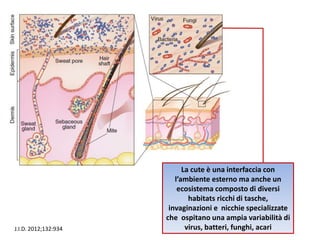
J.I.D. 2012;132:934
La cute è una interfaccia con
l’ambiente esterno ma anche un
ecosistema composto di diversi
habitats ricchi di tasche,
invaginazioni e nicchie specializzate
che ospitano una ampia variabilità di
virus, batteri, funghi, acari
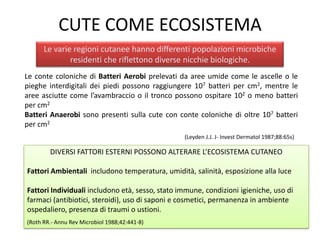
CUTE COME ECOSISTEMA
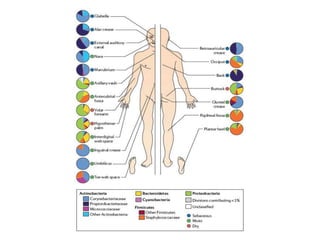
Le varie regioni cutanee hanno differenti popolazioni microbiche
residenti che riflettono diverse nicchie biologiche.
Le conte coloniche di Batteri Aerobi prelevati da aree umide come le ascelle o le
pieghe interdigitali dei piedi possono raggiungere 107 batteri per cm2, mentre le
aree asciutte come l’avambraccio o il tronco possono ospitare 102 o meno batteri
per cm2
Batteri Anaerobi sono presenti sulla cute con conte coloniche di oltre 107 batteri
per cm2
(Leyden J.J. J- Invest Dermatol 1987;88:65s)
DIVERSI FATTORI ESTERNI POSSONO ALTERARE L’ECOSISTEMA CUTANEO
Fattori Ambientali includono temperatura, umidità, salinità, esposizione alla luce
Fattori Individuali includono età, sesso, stato immune, condizioni igieniche, uso di
farmaci (antibiotici, steroidi), uso di saponi e cosmetici, permanenza in ambiente
ospedaliero, presenza di traumi o ustioni.
(Roth RR.- Annu Rev Microbiol 1988;42:441-8)
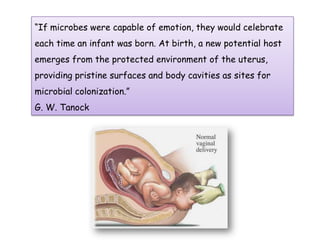
“If microbes were capable of emotion, they would celebrate
each time an infant was born. At birth, a new potential host
emerges from the protected environment of the uterus,
providing pristine surfaces and body cavities as sites for
microbial colonization.”
G. W. Tanock
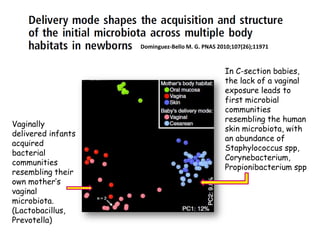
Vaginally
delivered infants
acquired
bacterial
communities
resembling their
own mother’s
vaginal
microbiota.
(Lactobacillus,
Prevotella)
In C-section babies,
the lack of a vaginal
exposure leads to
first microbial
communities
resembling the human
skin microbiota, with
an abundance of
Staphylococcus spp,
Corynebacterium,
Propionibacterium spp
Dominguez-Bello M. G. PNAS 2010;107(26);11971
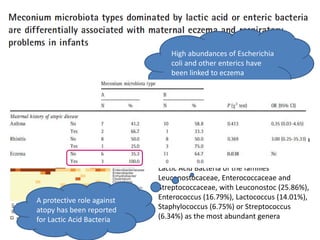
Gosalbes M.J. CEA 2013;43:198
Two distinct types of microbiota composition
can be detected in meconium samples.
Type A - The family Enterobacteriaceae as the
most abundant bacterial taxon (58.69%),
mainly represented by the Escherichia/Shigella
genus (24.68%).
Type B – presents Firmicutes, and particularly
Lactic Acid Bacteria of the families
Leuconostocaceae, Enterococcaceae and
Streptococcaceae, with Leuconostoc (25.86%),
Enterococcus (16.79%), Lactococcus (14.01%),
Staphylococcus (6.75%) or Streptococcus
(6.34%) as the most abundant genera
High abundances of Escherichia
coli and other enterics have
been linked to eczema
A protective role against
atopy has been reported
for Lactic Acid Bacteria
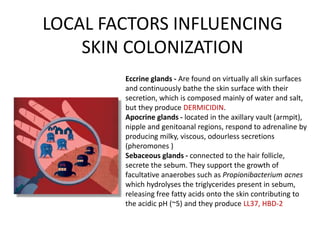
LOCAL FACTORS INFLUENCING
SKIN COLONIZATION
Eccrine glands - Are found on virtually all skin surfaces
and continuously bathe the skin surface with their
secretion, which is composed mainly of water and salt,
but they produce DERMICIDIN.
Apocrine glands - located in the axillary vault (armpit),
nipple and genitoanal regions, respond to adrenaline by
producing milky, viscous, odourless secretions
(pheromones )
Sebaceous glands - connected to the hair follicle,
secrete the sebum. They support the growth of
facultative anaerobes such as Propionibacterium acnes
which hydrolyses the triglycerides present in sebum,
releasing free fatty acids onto the skin contributing to
the acidic pH (~5) and they produce LL37, HBD-2
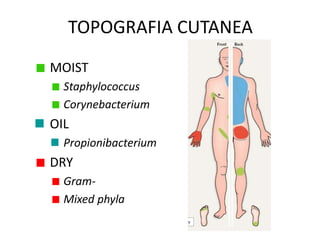
TOPOGRAFIA CUTANEA
MOIST
Staphylococcus
Corynebacterium
OIL
Propionibacterium
DRY
Gram-
Mixed phyla
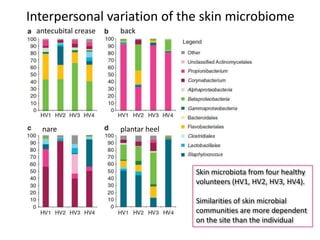
Interpersonal variation of the skin microbiome
Skin microbiota from four healthy
volunteers (HV1, HV2, HV3, HV4).
Similarities of skin microbial
communities are more dependent
on the site than the individual
antecubital crease back
nare plantar heel
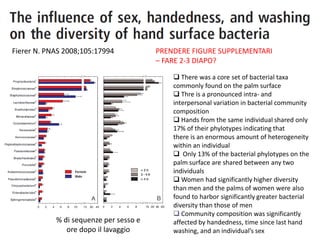
Fierer N. PNAS 2008;105:17994
% di sequenze per sesso e
ore dopo il lavaggio
PRENDERE FIGURE SUPPLEMENTARI
– FARE 2-3 DIAPO?
 There was a core set of bacterial taxa
commonly found on the palm surface
 Thre is a pronounced intra- and
interpersonal variation in bacterial community
composition
 Hands from the same individual shared only
17% of their phylotypes indicating that
there is an enormous amount of heterogeneity
within an individual
 Only 13% of the bacterial phylotypes on the
palm surface are shared between any two
individuals
 Women had significantly higher diversity
than men and the palms of women were also
found to harbor significantly greater bacterial
diversity than those of men
 Community composition was significantly
affected by handedness, time since last hand
washing, and an individual’s sex
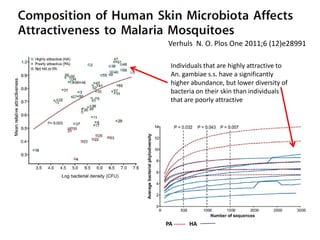
Verhuls N. O. Plos One 2011;6 (12)e28991
Individuals that are highly attractive to
An. gambiae s.s. have a significantly
higher abundance, but lower diversity of
bacteria on their skin than individuals
that are poorly attractive
PA ------ HA
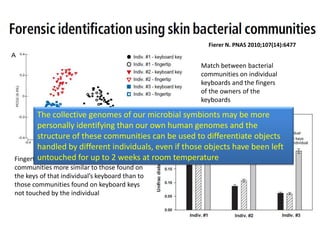
Fierer N. PNAS 2010;107(14):6477
Fingertips of an individual harbor bacterial
communities more similar to those found on
the keys of that individual’s keyboard than to
those communities found on keyboard keys
not touched by the individual
Match between bacterial
communities on individual
keyboards and the fingers
of the owners of the
keyboards
The collective genomes of our microbial symbionts may be more
personally identifying than our own human genomes and the
structure of these communities can be used to differentiate objects
handled by different individuals, even if those objects have been left
untouched for up to 2 weeks at room temperature
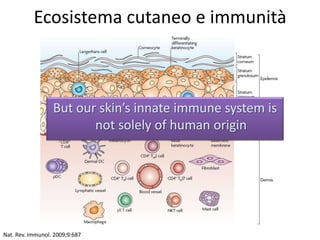
Nat. Rev. Immunol. 2009;9:687
Ecosistema cutaneo e immunità
But our skin’s innate immune system is
not solely of human origin
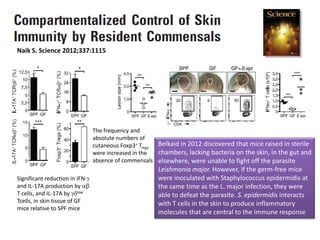
Naik S. Science 2012;337:1115
Significant reduction in IFN-
and IL-17A production by
T cells, and IL-17A by low
Tcells, in skin tissue of GF
mice relative to SPF mice
The frequency and
absolute numbers of
cutaneous Foxp3+ Tregs
were increased in the
absence of commensals
Belkaid in 2012 discovered that mice raised in sterile
chambers, lacking bacteria on the skin, in the gut and
elsewhere, were unable to fight off the parasite
Leishmania major. However, if the germ-free mice
were inoculated with Staphylococcus epidermidis at
the same time as the L. major infection, they were
able to defeat the parasite. S. epidermidis interacts
with T cells in the skin to produce inflammatory
molecules that are central to the immune response
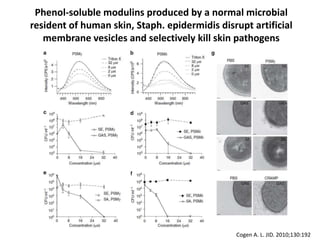
Phenol-soluble modulins produced by a normal microbial
resident of human skin, Staph. epidermidis disrupt artificial
membrane vesicles and selectively kill skin pathogens
Cogen A. L. JID. 2010;130:192
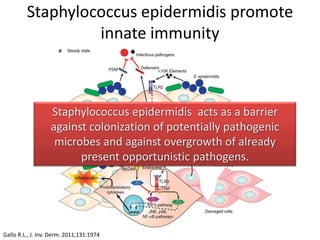
Staphylococcus epidermidis promote
innate immunity
Gallo R.L., J. Inv. Derm. 2011;131:1974
Staphylococcus epidermidis acts as a barrier
against colonization of potentially pathogenic
microbes and against overgrowth of already
present opportunistic pathogens.
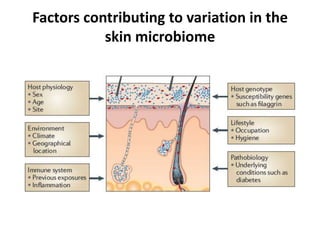
Factors contributing to variation in the
skin microbiome
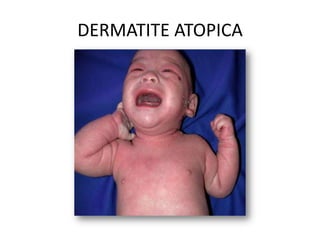
DERMATITE ATOPICA
DERMATITE ATOPICA
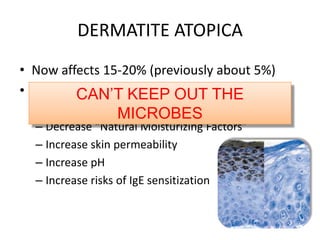
• Now affects 15-20% (previously about 5%)
• 20-40% have an innate genetic filaggrin
mutation
– Decrease “Natural Moisturizing Factors”
– Increase skin permeability
– Increase pH
– Increase risks of IgE sensitization
CAN’T KEEP OUT THE
MICROBES
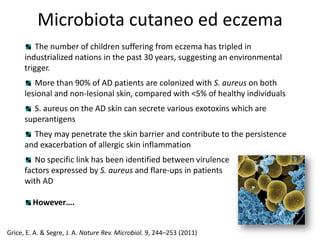
The number of children suffering from eczema has tripled in
industrialized nations in the past 30 years, suggesting an environmental
trigger.
More than 90% of AD patients are colonized with S. aureus on both
lesional and non-lesional skin, compared with <5% of healthy individuals
S. aureus on the AD skin can secrete various exotoxins which are
superantigens
They may penetrate the skin barrier and contribute to the persistence
and exacerbation of allergic skin inflammation
No specific link has been identified between virulence
factors expressed by S. aureus and flare-ups in patients
with AD
However….
Microbiota cutaneo ed eczema
Grice, E. A. & Segre, J. A. Nature Rev. Microbiol. 9, 244–253 (2011)
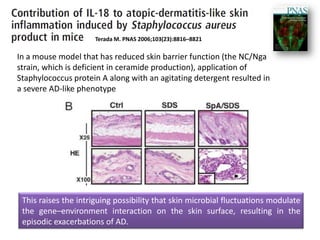
Terada M. PNAS 2006;103(23):8816–8821
This raises the intriguing possibility that skin microbial fluctuations modulate
the gene–environment interaction on the skin surface, resulting in the
episodic exacerbations of AD.
In a mouse model that has reduced skin barrier function (the NC/Nga
strain, which is deficient in ceramide production), application of
Staphylococcus protein A along with an agitating detergent resulted in
a severe AD-like phenotype
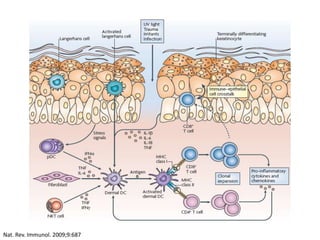
Nat. Rev. Immunol. 2009;9:687
Mechanisms that promote the
increase of S. aureus colonization
• Skin barrier dysfunction
• Increased synthesis of the extracellular matrix
adhesins for S. aureus
• Reduced skin lipid content
• Changes in the skin surface pH values toward
alkalinity
• Decreased production of endogenous
antimicrobial peptides.
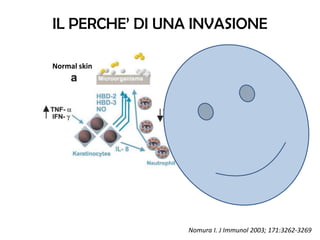
AD skin
Nomura I. J Immunol 2003; 171:3262-3269
S. Aureus
IL PERCHE’ DI UNA INVASIONE
Normal skin
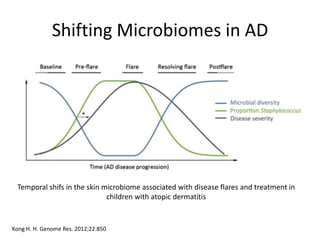
Kong H. H. Genome Res. 2012;22:850
Shifting Microbiomes in AD
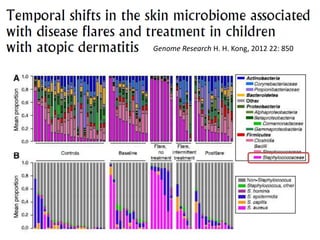
Temporal shifs in the skin microbiome associated with disease flares and treatment in
children with atopic dermatitis
Genome Research H. H. Kong, 2012 22: 850
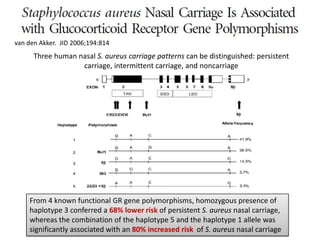
van den Akker. JID 2006;194:814
From 4 known functional GR gene polymorphisms, homozygous presence of
haplotype 3 conferred a 68% lower risk of persistent S. aureus nasal carriage,
whereas the combination of the haplotype 5 and the haplotype 1 allele was
significantly associated with an 80% increased risk of S. aureus nasal carriage
Three human nasal S. aureus carriage patterns can be distinguished: persistent
carriage, intermittent carriage, and noncarriage
.
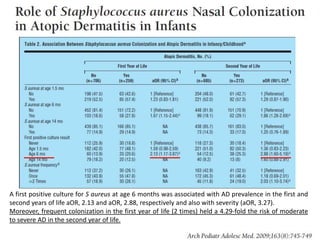
A first positive culture for S aureus at age 6 months was associated with AD prevalence in the first and
second years of life aOR, 2.13 and aOR, 2.88, respectively and also with severity (aOR, 3.27).
Moreover, frequent colonization in the first year of life (2 times) held a 4.29-fold the risk of moderate
to severe AD in the second year of life.
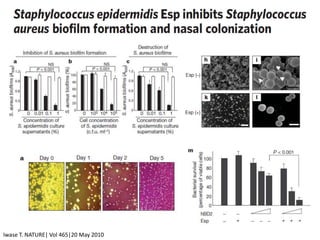
Iwase T. NATURE| Vol 465|20 May 2010
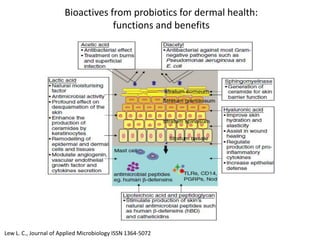
Lew L. C., Journal of Applied Microbiology ISSN 1364-5072
Bioactives from probiotics for dermal health:
functions and benefits
Microbiota cutaneo

Microbiota cutaneo

  • 1.
    L’ecosistema cutaneo nell ’eczema 12 -14 Settembre 2013 Dr. G. Baviera
  • 2.
    TEATRO OPERATIVO • CUTE:2.5 m2 • APPARATO RESPIRATORIO: 150 m2 • APPARATO DIGERENTE: 400 m2 Lungo queste superfici ciascuno di noi ospita circa 100 trilioni di batteri che corrispondono all’ 1–3% del peso corporeo
  • 3.
    J.I.D. 2012;132:934 La cuteè una interfaccia con l’ambiente esterno ma anche un ecosistema composto di diversi habitats ricchi di tasche, invaginazioni e nicchie specializzate che ospitano una ampia variabilità di virus, batteri, funghi, acari
  • 4.
    CUTE COME ECOSISTEMA Levarie regioni cutanee hanno differenti popolazioni microbiche residenti che riflettono diverse nicchie biologiche. Le conte coloniche di Batteri Aerobi prelevati da aree umide come le ascelle o le pieghe interdigitali dei piedi possono raggiungere 107 batteri per cm2, mentre le aree asciutte come l’avambraccio o il tronco possono ospitare 102 o meno batteri per cm2 Batteri Anaerobi sono presenti sulla cute con conte coloniche di oltre 107 batteri per cm2 (Leyden J.J. J- Invest Dermatol 1987;88:65s) DIVERSI FATTORI ESTERNI POSSONO ALTERARE L’ECOSISTEMA CUTANEO Fattori Ambientali includono temperatura, umidità, salinità, esposizione alla luce Fattori Individuali includono età, sesso, stato immune, condizioni igieniche, uso di farmaci (antibiotici, steroidi), uso di saponi e cosmetici, permanenza in ambiente ospedaliero, presenza di traumi o ustioni. (Roth RR.- Annu Rev Microbiol 1988;42:441-8)
  • 5.
    “If microbes werecapable of emotion, they would celebrate each time an infant was born. At birth, a new potential host emerges from the protected environment of the uterus, providing pristine surfaces and body cavities as sites for microbial colonization.” G. W. Tanock
  • 6.
    Vaginally delivered infants acquired bacterial communities resembling their ownmother’s vaginal microbiota. (Lactobacillus, Prevotella) In C-section babies, the lack of a vaginal exposure leads to first microbial communities resembling the human skin microbiota, with an abundance of Staphylococcus spp, Corynebacterium, Propionibacterium spp Dominguez-Bello M. G. PNAS 2010;107(26);11971
  • 7.
    Gosalbes M.J. CEA2013;43:198 Two distinct types of microbiota composition can be detected in meconium samples. Type A - The family Enterobacteriaceae as the most abundant bacterial taxon (58.69%), mainly represented by the Escherichia/Shigella genus (24.68%). Type B – presents Firmicutes, and particularly Lactic Acid Bacteria of the families Leuconostocaceae, Enterococcaceae and Streptococcaceae, with Leuconostoc (25.86%), Enterococcus (16.79%), Lactococcus (14.01%), Staphylococcus (6.75%) or Streptococcus (6.34%) as the most abundant genera High abundances of Escherichia coli and other enterics have been linked to eczema A protective role against atopy has been reported for Lactic Acid Bacteria
  • 8.
    LOCAL FACTORS INFLUENCING SKINCOLONIZATION Eccrine glands - Are found on virtually all skin surfaces and continuously bathe the skin surface with their secretion, which is composed mainly of water and salt, but they produce DERMICIDIN. Apocrine glands - located in the axillary vault (armpit), nipple and genitoanal regions, respond to adrenaline by producing milky, viscous, odourless secretions (pheromones ) Sebaceous glands - connected to the hair follicle, secrete the sebum. They support the growth of facultative anaerobes such as Propionibacterium acnes which hydrolyses the triglycerides present in sebum, releasing free fatty acids onto the skin contributing to the acidic pH (~5) and they produce LL37, HBD-2
  • 9.
  • 11.
    Interpersonal variation ofthe skin microbiome Skin microbiota from four healthy volunteers (HV1, HV2, HV3, HV4). Similarities of skin microbial communities are more dependent on the site than the individual antecubital crease back nare plantar heel
  • 12.
    Fierer N. PNAS2008;105:17994 % di sequenze per sesso e ore dopo il lavaggio PRENDERE FIGURE SUPPLEMENTARI – FARE 2-3 DIAPO?  There was a core set of bacterial taxa commonly found on the palm surface  Thre is a pronounced intra- and interpersonal variation in bacterial community composition  Hands from the same individual shared only 17% of their phylotypes indicating that there is an enormous amount of heterogeneity within an individual  Only 13% of the bacterial phylotypes on the palm surface are shared between any two individuals  Women had significantly higher diversity than men and the palms of women were also found to harbor significantly greater bacterial diversity than those of men  Community composition was significantly affected by handedness, time since last hand washing, and an individual’s sex
  • 13.
    Verhuls N. O.Plos One 2011;6 (12)e28991 Individuals that are highly attractive to An. gambiae s.s. have a significantly higher abundance, but lower diversity of bacteria on their skin than individuals that are poorly attractive PA ------ HA
  • 14.
    Fierer N. PNAS2010;107(14):6477 Fingertips of an individual harbor bacterial communities more similar to those found on the keys of that individual’s keyboard than to those communities found on keyboard keys not touched by the individual Match between bacterial communities on individual keyboards and the fingers of the owners of the keyboards The collective genomes of our microbial symbionts may be more personally identifying than our own human genomes and the structure of these communities can be used to differentiate objects handled by different individuals, even if those objects have been left untouched for up to 2 weeks at room temperature
  • 15.
    Nat. Rev. Immunol.2009;9:687 Ecosistema cutaneo e immunità But our skin’s innate immune system is not solely of human origin
  • 16.
    Naik S. Science2012;337:1115 Significant reduction in IFN- and IL-17A production by T cells, and IL-17A by low Tcells, in skin tissue of GF mice relative to SPF mice The frequency and absolute numbers of cutaneous Foxp3+ Tregs were increased in the absence of commensals Belkaid in 2012 discovered that mice raised in sterile chambers, lacking bacteria on the skin, in the gut and elsewhere, were unable to fight off the parasite Leishmania major. However, if the germ-free mice were inoculated with Staphylococcus epidermidis at the same time as the L. major infection, they were able to defeat the parasite. S. epidermidis interacts with T cells in the skin to produce inflammatory molecules that are central to the immune response
  • 17.
    Phenol-soluble modulins producedby a normal microbial resident of human skin, Staph. epidermidis disrupt artificial membrane vesicles and selectively kill skin pathogens Cogen A. L. JID. 2010;130:192
  • 18.
    Staphylococcus epidermidis promote innateimmunity Gallo R.L., J. Inv. Derm. 2011;131:1974 Staphylococcus epidermidis acts as a barrier against colonization of potentially pathogenic microbes and against overgrowth of already present opportunistic pathogens.
  • 19.
    Factors contributing tovariation in the skin microbiome
  • 20.
  • 21.
    DERMATITE ATOPICA • Nowaffects 15-20% (previously about 5%) • 20-40% have an innate genetic filaggrin mutation – Decrease “Natural Moisturizing Factors” – Increase skin permeability – Increase pH – Increase risks of IgE sensitization CAN’T KEEP OUT THE MICROBES
  • 22.
    The number ofchildren suffering from eczema has tripled in industrialized nations in the past 30 years, suggesting an environmental trigger. More than 90% of AD patients are colonized with S. aureus on both lesional and non-lesional skin, compared with <5% of healthy individuals S. aureus on the AD skin can secrete various exotoxins which are superantigens They may penetrate the skin barrier and contribute to the persistence and exacerbation of allergic skin inflammation No specific link has been identified between virulence factors expressed by S. aureus and flare-ups in patients with AD However…. Microbiota cutaneo ed eczema Grice, E. A. & Segre, J. A. Nature Rev. Microbiol. 9, 244–253 (2011)
  • 23.
    Terada M. PNAS2006;103(23):8816–8821 This raises the intriguing possibility that skin microbial fluctuations modulate the gene–environment interaction on the skin surface, resulting in the episodic exacerbations of AD. In a mouse model that has reduced skin barrier function (the NC/Nga strain, which is deficient in ceramide production), application of Staphylococcus protein A along with an agitating detergent resulted in a severe AD-like phenotype
  • 24.
  • 25.
    Mechanisms that promotethe increase of S. aureus colonization • Skin barrier dysfunction • Increased synthesis of the extracellular matrix adhesins for S. aureus • Reduced skin lipid content • Changes in the skin surface pH values toward alkalinity • Decreased production of endogenous antimicrobial peptides.
  • 26.
    AD skin Nomura I.J Immunol 2003; 171:3262-3269 S. Aureus IL PERCHE’ DI UNA INVASIONE Normal skin
  • 27.
    Kong H. H.Genome Res. 2012;22:850 Shifting Microbiomes in AD Temporal shifs in the skin microbiome associated with disease flares and treatment in children with atopic dermatitis
  • 28.
    Genome Research H.H. Kong, 2012 22: 850
  • 29.
    van den Akker.JID 2006;194:814 From 4 known functional GR gene polymorphisms, homozygous presence of haplotype 3 conferred a 68% lower risk of persistent S. aureus nasal carriage, whereas the combination of the haplotype 5 and the haplotype 1 allele was significantly associated with an 80% increased risk of S. aureus nasal carriage Three human nasal S. aureus carriage patterns can be distinguished: persistent carriage, intermittent carriage, and noncarriage .
  • 30.
    A first positiveculture for S aureus at age 6 months was associated with AD prevalence in the first and second years of life aOR, 2.13 and aOR, 2.88, respectively and also with severity (aOR, 3.27). Moreover, frequent colonization in the first year of life (2 times) held a 4.29-fold the risk of moderate to severe AD in the second year of life.
  • 31.
    Iwase T. NATURE|Vol 465|20 May 2010
  • 32.
    Lew L. C.,Journal of Applied Microbiology ISSN 1364-5072 Bioactives from probiotics for dermal health: functions and benefits