An Introduction to Robert Koch
Dr. Athul Sandheep.R
Assistant Professor
Department of Microbiology
St. Mary’s College, Thrissur
Robert Koch ,Dr.AthulSandheep.R ,St.Mary’s College
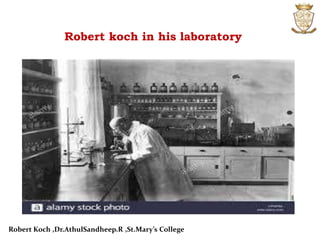
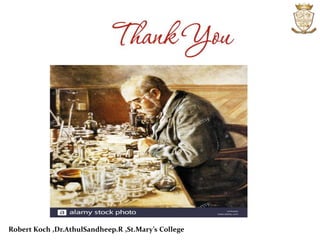
Robert koch in his laboratory
Robert Koch ,Dr.AthulSandheep.R ,St.Mary’s College
Robert Koch-Biographical
 Robert Koch was born on December 11, 1843, at Clausthal in
the Upper Harz Mountains.
 In 1862 Koch went to the University of Gottingen to study
medicine.
 After taking his M.D. degree in 1866, Koch went to Berlin for
six months of chemical study.
Robert Koch ,Dr.AthulSandheep.R ,St.Mary’s College
 In 1867 he settled, after a period as Assistant in the General Hospital
at Hamburg, in general practice, first at Langenhagen and soon after,
in 1869, at Rackwitz, in the Province of Posen.
 Here he passed his District Medical Officer’s Examination.
 In 1870 he volunteered for service in the Franco-Prussian war and
from 1872 to 1880 he was District Medical Officer for Wollstein.
 It was here that he carried out the epoch-making researches which
placed him at one step in the front rank of scientific workers.
Robert Koch ,Dr.AthulSandheep.R ,St.Mary’s College
 His laboratory was the 4-roomed flat that was his home, and
his equipment, apart from the microscope given to him by
his wife, he provided for himself.
 Anthrax was, at that time, prevalent among the farm animals
in the Wollstein district .
 Earlier the anthrax bacillus had been discovered by
Pollender, Rayer and Davaine.
 Koch set himself to prove scientifically that this bacillus is,
in fact, the cause of the disease.
Robert Koch ,Dr.AthulSandheep.R ,St.Mary’s College
 Koch grew the bacilli for several generations in pure cultures.
 In 1880, when he was appointed a member of the Imperial
Health Bureau in Berlin.
 Here he was provided with a better laboratory, in which he
could work with Loeffler, Gaffky and others, as his assistants.
Robert Koch ,Dr.AthulSandheep.R ,St.Mary’s College
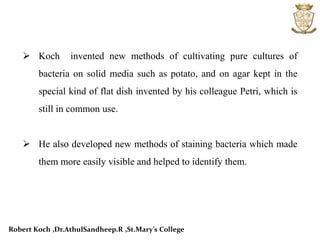
 Koch invented new methods of cultivating pure cultures of
bacteria on solid media such as potato, and on agar kept in the
special kind of flat dish invented by his colleague Petri, which is
still in common use.
 He also developed new methods of staining bacteria which made
them more easily visible and helped to identify them.
Robert Koch ,Dr.AthulSandheep.R ,St.Mary’s College
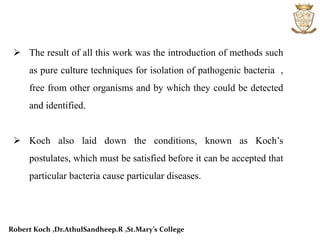
 The result of all this work was the introduction of methods such
as pure culture techniques for isolation of pathogenic bacteria ,
free from other organisms and by which they could be detected
and identified.
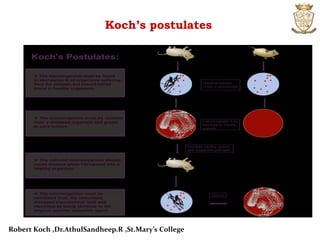
 Koch also laid down the conditions, known as Koch’s
postulates, which must be satisfied before it can be accepted that
particular bacteria cause particular diseases.
Robert Koch ,Dr.AthulSandheep.R ,St.Mary’s College
Koch’s postulates
Robert Koch ,Dr.AthulSandheep.R ,St.Mary’s College
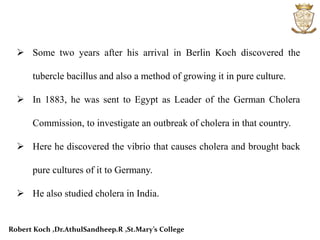
 Some two years after his arrival in Berlin Koch discovered the
tubercle bacillus and also a method of growing it in pure culture.
 In 1883, he was sent to Egypt as Leader of the German Cholera
Commission, to investigate an outbreak of cholera in that country.
 Here he discovered the vibrio that causes cholera and brought back
pure cultures of it to Germany.
 He also studied cholera in India.
Robert Koch ,Dr.AthulSandheep.R ,St.Mary’s College
 Koch formulated rules for the control of epidemics of cholera which
were approved by the Great Powers in Dresden in 1893 and formed
the basis of the methods of control which are still used today.
 His work on cholera, for which a Prize of 100,000 German Marks
was awarded to him.
Robert Koch ,Dr.AthulSandheep.R ,St.Mary’s College
 In 1885 Koch was appointed Professor of Hygiene in the
University of Berlin and Director of the newly established
Institute of Hygiene in the University there.
 In 1890 he was appointed Surgeon General (Generalarzt)
Class I and Freeman of the City of Berlin.
Robert Koch ,Dr.AthulSandheep.R ,St.Mary’s College
 In 1891 he became an Honorary Professor of the Medical
Faculty of Berlin and Director of the new Institute for
Infectious Diseases.
 Here he was fortunate to have among his colleagues, such
men as Ehrlich, von Behring and Kitasato, who themselves
made great discoveries.
Robert Koch ,Dr.AthulSandheep.R ,St.Mary’s College
 In 1896 Koch went to South Africa to study the origin of
rinderpest .
 He did not identify the cause of this disease.
 But he succeeded in limiting the outbreak of it by injection into
healthy farm-stock of bile taken from the gall bladders of
infected animals.
Robert Koch ,Dr.AthulSandheep.R ,St.Mary’s College
 In 1898. Soon after his return to Germany he was sent to
Italy and the tropics where he confirmed the work of Sir
Ronald Ross in malaria .
 He did useful work on the aetiology of the different forms
of malaria and their control with quinine.
Robert Koch ,Dr.AthulSandheep.R ,St.Mary’s College
 In December, 1904, Koch was sent to German East Africa to
study East Coast fever of cattle.
 He made important observations on this disease.
 He also observed pathogenic species of Babesia and
Trypanosoma and on tickborne spirochaetosis, continuing his
work on these organisms when he returned home.
Robert Koch ,Dr.AthulSandheep.R ,St.Mary’s College
Koch was the recipient of many prizes
and medals
 Honorary doctorates of the Universities of Heidelberg and
Bologna.
 Honorary citizenships of Berlin, Wollstein and his native
Clausthal.
 Honorary memberships of learned societies and academies in
Berlin, Vienna, Posen, Perugia, Naples and New York.
Robert Koch ,Dr.AthulSandheep.R ,St.Mary’s College
 He was awarded the German Order of the Crown, the Grand
Cross of the German Order of the Red Eagle
 Orders from Russia and Turkey
 Long after his death, he was posthumously honoured by
memorials and in other ways in several countries.
Robert Koch ,Dr.AthulSandheep.R ,St.Mary’s College
 In 1905 he was awarded the Nobel Prize for Physiology or
Medicine.
 In 1906, he returned to Central Africa to work on the control
of human trypanosomiasis, and there he reported quinine is
against malaria.
Robert Koch ,Dr.AthulSandheep.R ,St.Mary’s College
 Thereafter Koch continued his experimental work on
bacteriology and serology.
 In 1866 Koch married Emmy Fraats. She bore him his only
child, Gertrud (b. 1865), who became the wife of Dr. E. Pfuhl.
In 1893 Koch married Hedwig Freiberg.
 Dr. Koch died on May 27, 1910, in Baden-Baden.
Robert Koch ,Dr.AthulSandheep.R ,St.Mary’s College

MicrobiologyAn Introduction to Robert Koch

  • 1.
    An Introduction toRobert Koch Dr. Athul Sandheep.R Assistant Professor Department of Microbiology St. Mary’s College, Thrissur
  • 2.
    Robert Koch ,Dr.AthulSandheep.R,St.Mary’s College
  • 3.
    Robert Koch ,Dr.AthulSandheep.R,St.Mary’s College
  • 4.
    Robert koch inhis laboratory Robert Koch ,Dr.AthulSandheep.R ,St.Mary’s College
  • 5.
    Robert Koch-Biographical  RobertKoch was born on December 11, 1843, at Clausthal in the Upper Harz Mountains.  In 1862 Koch went to the University of Gottingen to study medicine.  After taking his M.D. degree in 1866, Koch went to Berlin for six months of chemical study. Robert Koch ,Dr.AthulSandheep.R ,St.Mary’s College
  • 6.
     In 1867he settled, after a period as Assistant in the General Hospital at Hamburg, in general practice, first at Langenhagen and soon after, in 1869, at Rackwitz, in the Province of Posen.  Here he passed his District Medical Officer’s Examination.  In 1870 he volunteered for service in the Franco-Prussian war and from 1872 to 1880 he was District Medical Officer for Wollstein.  It was here that he carried out the epoch-making researches which placed him at one step in the front rank of scientific workers. Robert Koch ,Dr.AthulSandheep.R ,St.Mary’s College
  • 7.
     His laboratorywas the 4-roomed flat that was his home, and his equipment, apart from the microscope given to him by his wife, he provided for himself.  Anthrax was, at that time, prevalent among the farm animals in the Wollstein district .  Earlier the anthrax bacillus had been discovered by Pollender, Rayer and Davaine.  Koch set himself to prove scientifically that this bacillus is, in fact, the cause of the disease. Robert Koch ,Dr.AthulSandheep.R ,St.Mary’s College
  • 8.
     Koch grewthe bacilli for several generations in pure cultures.  In 1880, when he was appointed a member of the Imperial Health Bureau in Berlin.  Here he was provided with a better laboratory, in which he could work with Loeffler, Gaffky and others, as his assistants. Robert Koch ,Dr.AthulSandheep.R ,St.Mary’s College
  • 9.
     Koch inventednew methods of cultivating pure cultures of bacteria on solid media such as potato, and on agar kept in the special kind of flat dish invented by his colleague Petri, which is still in common use.  He also developed new methods of staining bacteria which made them more easily visible and helped to identify them. Robert Koch ,Dr.AthulSandheep.R ,St.Mary’s College
  • 10.
     The resultof all this work was the introduction of methods such as pure culture techniques for isolation of pathogenic bacteria , free from other organisms and by which they could be detected and identified.  Koch also laid down the conditions, known as Koch’s postulates, which must be satisfied before it can be accepted that particular bacteria cause particular diseases. Robert Koch ,Dr.AthulSandheep.R ,St.Mary’s College
  • 11.
    Koch’s postulates Robert Koch,Dr.AthulSandheep.R ,St.Mary’s College
  • 12.
     Some twoyears after his arrival in Berlin Koch discovered the tubercle bacillus and also a method of growing it in pure culture.  In 1883, he was sent to Egypt as Leader of the German Cholera Commission, to investigate an outbreak of cholera in that country.  Here he discovered the vibrio that causes cholera and brought back pure cultures of it to Germany.  He also studied cholera in India. Robert Koch ,Dr.AthulSandheep.R ,St.Mary’s College
  • 13.
     Koch formulatedrules for the control of epidemics of cholera which were approved by the Great Powers in Dresden in 1893 and formed the basis of the methods of control which are still used today.  His work on cholera, for which a Prize of 100,000 German Marks was awarded to him. Robert Koch ,Dr.AthulSandheep.R ,St.Mary’s College
  • 14.
     In 1885Koch was appointed Professor of Hygiene in the University of Berlin and Director of the newly established Institute of Hygiene in the University there.  In 1890 he was appointed Surgeon General (Generalarzt) Class I and Freeman of the City of Berlin. Robert Koch ,Dr.AthulSandheep.R ,St.Mary’s College
  • 15.
     In 1891he became an Honorary Professor of the Medical Faculty of Berlin and Director of the new Institute for Infectious Diseases.  Here he was fortunate to have among his colleagues, such men as Ehrlich, von Behring and Kitasato, who themselves made great discoveries. Robert Koch ,Dr.AthulSandheep.R ,St.Mary’s College
  • 16.
     In 1896Koch went to South Africa to study the origin of rinderpest .  He did not identify the cause of this disease.  But he succeeded in limiting the outbreak of it by injection into healthy farm-stock of bile taken from the gall bladders of infected animals. Robert Koch ,Dr.AthulSandheep.R ,St.Mary’s College
  • 17.
     In 1898.Soon after his return to Germany he was sent to Italy and the tropics where he confirmed the work of Sir Ronald Ross in malaria .  He did useful work on the aetiology of the different forms of malaria and their control with quinine. Robert Koch ,Dr.AthulSandheep.R ,St.Mary’s College
  • 18.
     In December,1904, Koch was sent to German East Africa to study East Coast fever of cattle.  He made important observations on this disease.  He also observed pathogenic species of Babesia and Trypanosoma and on tickborne spirochaetosis, continuing his work on these organisms when he returned home. Robert Koch ,Dr.AthulSandheep.R ,St.Mary’s College
  • 19.
    Koch was therecipient of many prizes and medals  Honorary doctorates of the Universities of Heidelberg and Bologna.  Honorary citizenships of Berlin, Wollstein and his native Clausthal.  Honorary memberships of learned societies and academies in Berlin, Vienna, Posen, Perugia, Naples and New York. Robert Koch ,Dr.AthulSandheep.R ,St.Mary’s College
  • 20.
     He wasawarded the German Order of the Crown, the Grand Cross of the German Order of the Red Eagle  Orders from Russia and Turkey  Long after his death, he was posthumously honoured by memorials and in other ways in several countries. Robert Koch ,Dr.AthulSandheep.R ,St.Mary’s College
  • 21.
     In 1905he was awarded the Nobel Prize for Physiology or Medicine.  In 1906, he returned to Central Africa to work on the control of human trypanosomiasis, and there he reported quinine is against malaria. Robert Koch ,Dr.AthulSandheep.R ,St.Mary’s College
  • 22.
     Thereafter Kochcontinued his experimental work on bacteriology and serology.  In 1866 Koch married Emmy Fraats. She bore him his only child, Gertrud (b. 1865), who became the wife of Dr. E. Pfuhl. In 1893 Koch married Hedwig Freiberg.  Dr. Koch died on May 27, 1910, in Baden-Baden. Robert Koch ,Dr.AthulSandheep.R ,St.Mary’s College
  • 23.
    Robert Koch ,Dr.AthulSandheep.R,St.Mary’s College