Microbiology and Parasitology
UNIT 1: INTRODUCTION
Some rules
• Listen when others are talking
• Show respect for other opinions
• If you don’t understand, don’t hesitate to ask (raise hand)
• No cellphones in the class room
• Full participation is asked
Microbiology
Virus: Ebola
Fungi: Mushroom
Bacteria: Salmonella
ENEMY OR… …FRIEND
Algae: Algal bloom
MICROBES
Course content
• Theory
– Burton’s Microbiology for the Health Sciences – P.G. Engelkirk & J. Duben
– Microbiology and Infection – T.J.J. Inglis
• Practice: demonstrations in laboratory science
– Growth of bacteria
– Growth of fungi
• Tests
• Assignments
• Final examination
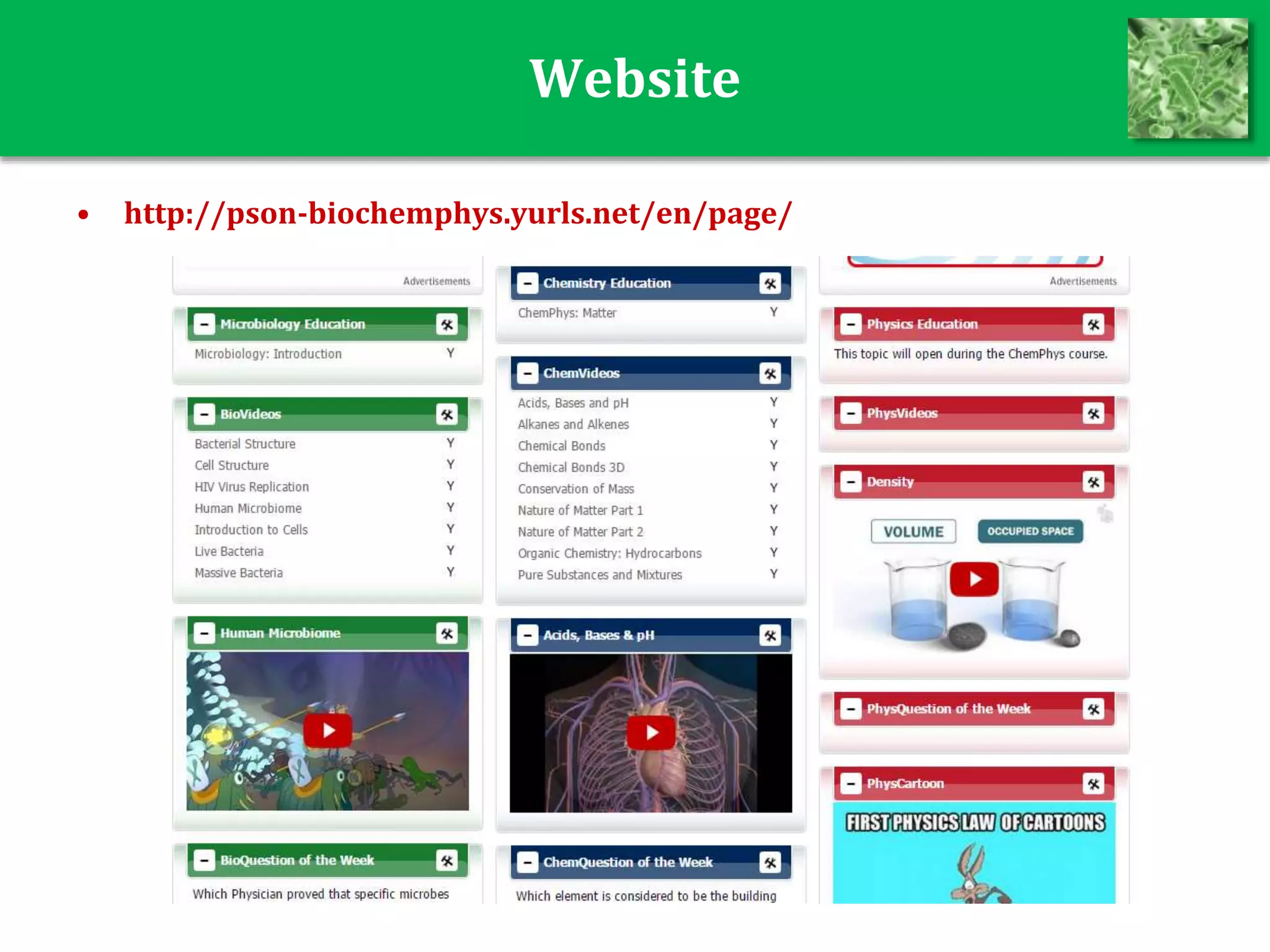
Website
• http://pson-biochemphys.yurls.net/en/page/
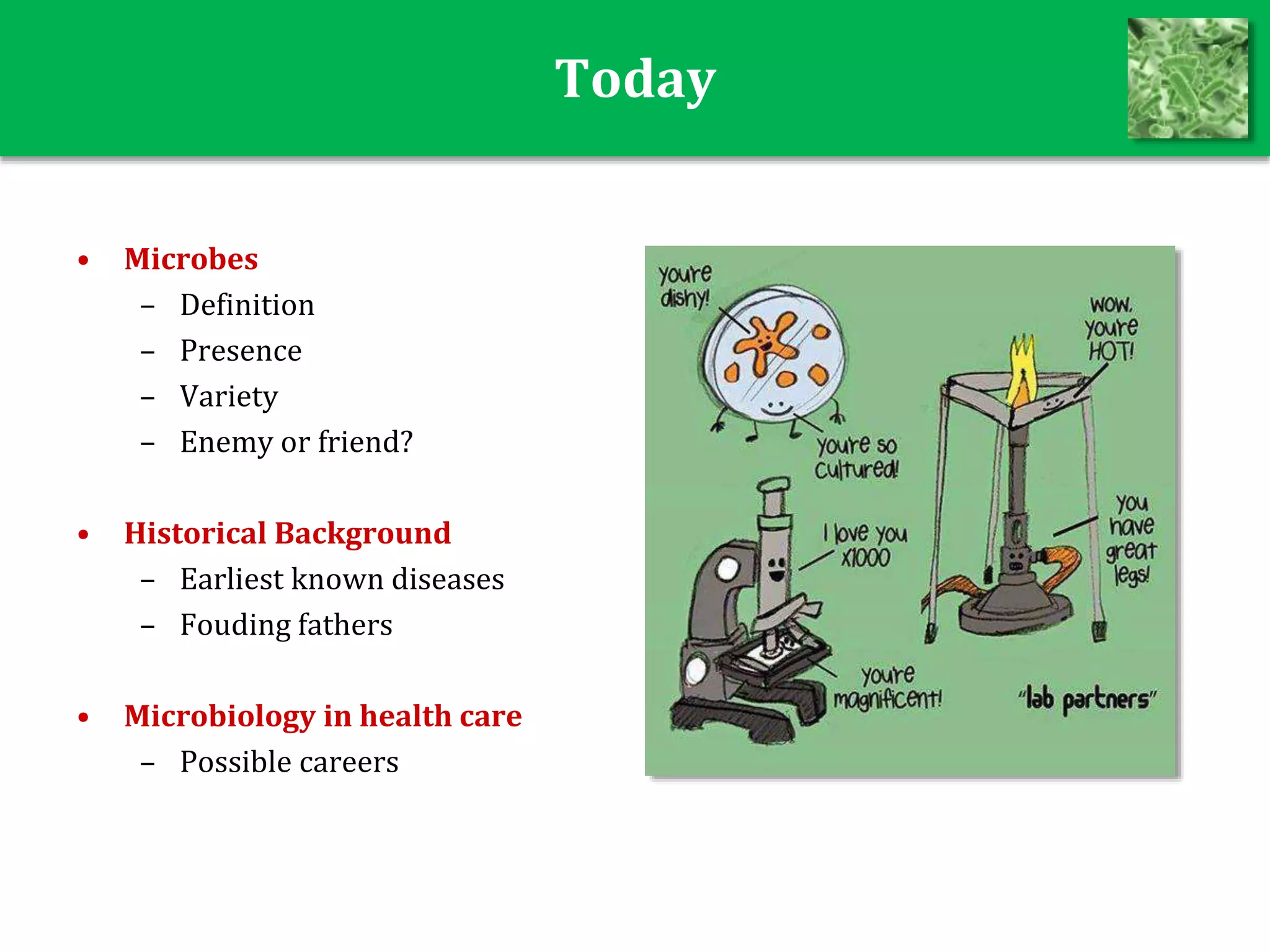
Today
• Microbes
– Definition
– Presence
– Variety
– Enemy or friend?
• Historical Background
– Earliest known diseases
– Fouding fathers
• Microbiology in health care
– Possible careers
Definition?
• MICRO – BIO – LOGY
– μικρος = micros = “small”
– βιος = bios = “life”
– λογος = logos = “science”
– “The study of very small living organisms”
• or: MICROBIOLOGY
– “The study of microorganisms (microbes) usually less then 1 mm in
diameter which requires some sort of magnification to be seen clearly”
Burton’s Microbiology: Chapter 1
Presence of Microbes
• Microbes are ubiquitous: virtually everywhere
– Water (photosynthetic algae, plankton)
– Dead or decaying materials (decomposers/saprophytes)
– Soil (bacteria used in microbial ecology)
– Animals/plants (bacteria and protozoa in intestinal tract)
– Food/drinks (yeast in bread and beer)
– Laboratory (study or to produce antibiotics, insulin, hormones)
Burton’s Microbiology: Chapter 1
MANY
MICROBES
ARE
USEFUL
(FRIENDLY)
Variety of Microbes
• Categories
– Acellar: Viroids, Virus, Prion
– Prokaryotes (cellular without nucleus): Bacteria, Archaea, Cyanobacteria
– Eukaryotes (cellular with nucleus): Algae, Fungi, Protozoa
Burton’s Microbiology: Chapter 1
Microbes
Acellular
Viroids
Prions
Virusus
Cellular
Prokaryotes
Archaea
Bacteria
Cyanobacteria
Eukaryotes
Algae
Fungi
Protozoa
Microflora
Indigenous
microflora
(100 trillion)
Nonpathogens
(97%)
Opportunistic
pathogens
Pathogens /
infectious agents
(3%)
FRIENDS
MICROBIAL ALLIES
ENEMIES
MICROBIAL ENEMIES
“GERMS”
USED-TO-BE-FRIENDS
POTENTIAL ENEMIES
Burton’s Microbiology: Chapter 1
• All microbes living on our bodies: Indigenous Microflora
Disease
• Microbial enemies…
– …cause disease
– “Pathogens”
– Two categories
• Infectious diseases
– 50.000 deaths/day
– Majority in
developing countries
• Be aware of…
– Infectious diseases
– Pathogens
– Source
– Transmission
– Protection/prevention
Burton’s Microbiology: Chapter 1
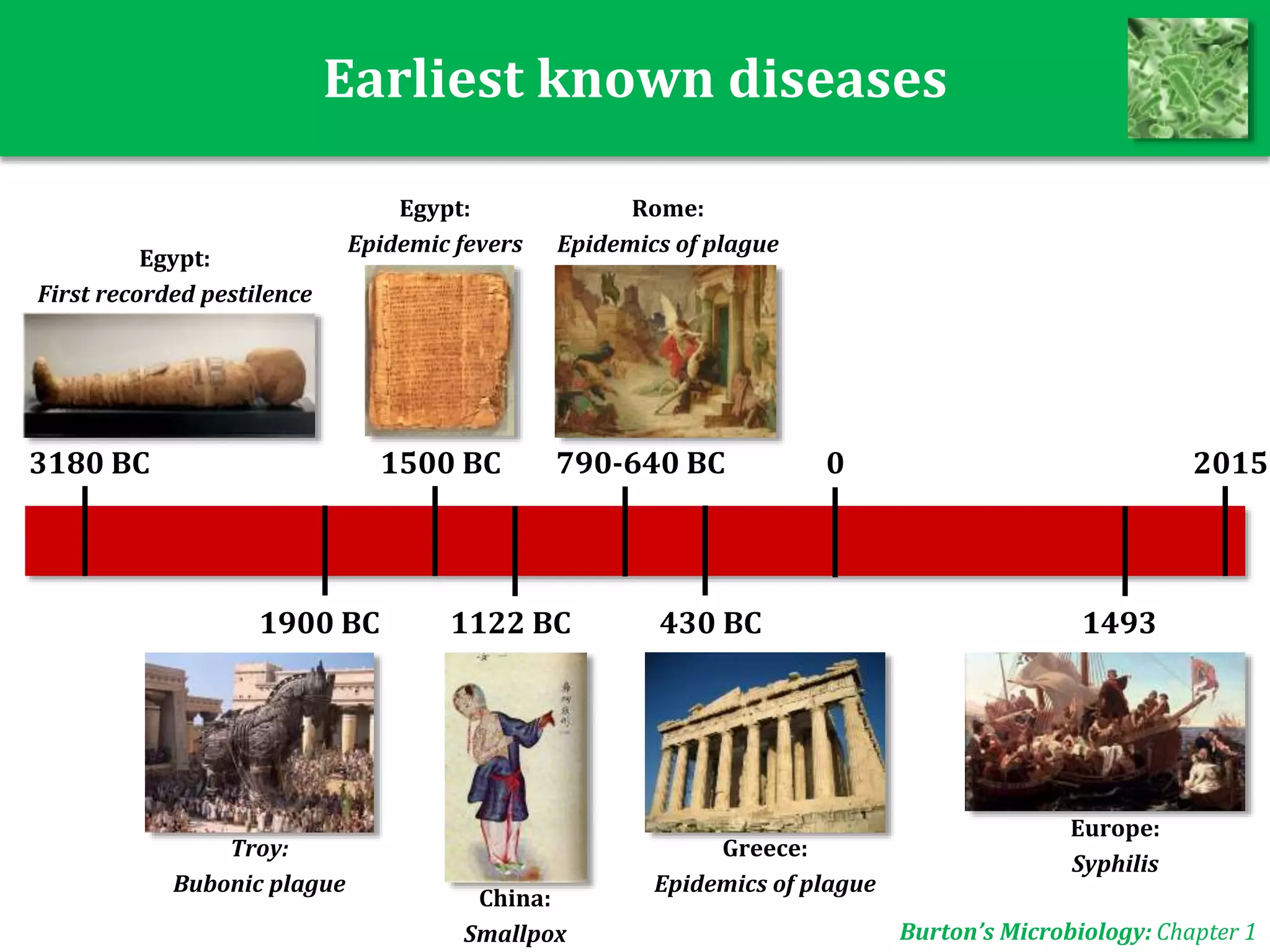
Earliest known diseases
3180 BC
1900 BC
1500 BC
1122 BC
790-640 BC
430 BC 1493
0 2015
Egypt:
First recorded pestilence
Troy:
Bubonic plague
Egypt:
Epidemic fevers
China:
Smallpox
Rome:
Epidemics of plague
Greece:
Epidemics of plague
Europe:
Syphilis
Burton’s Microbiology: Chapter 1
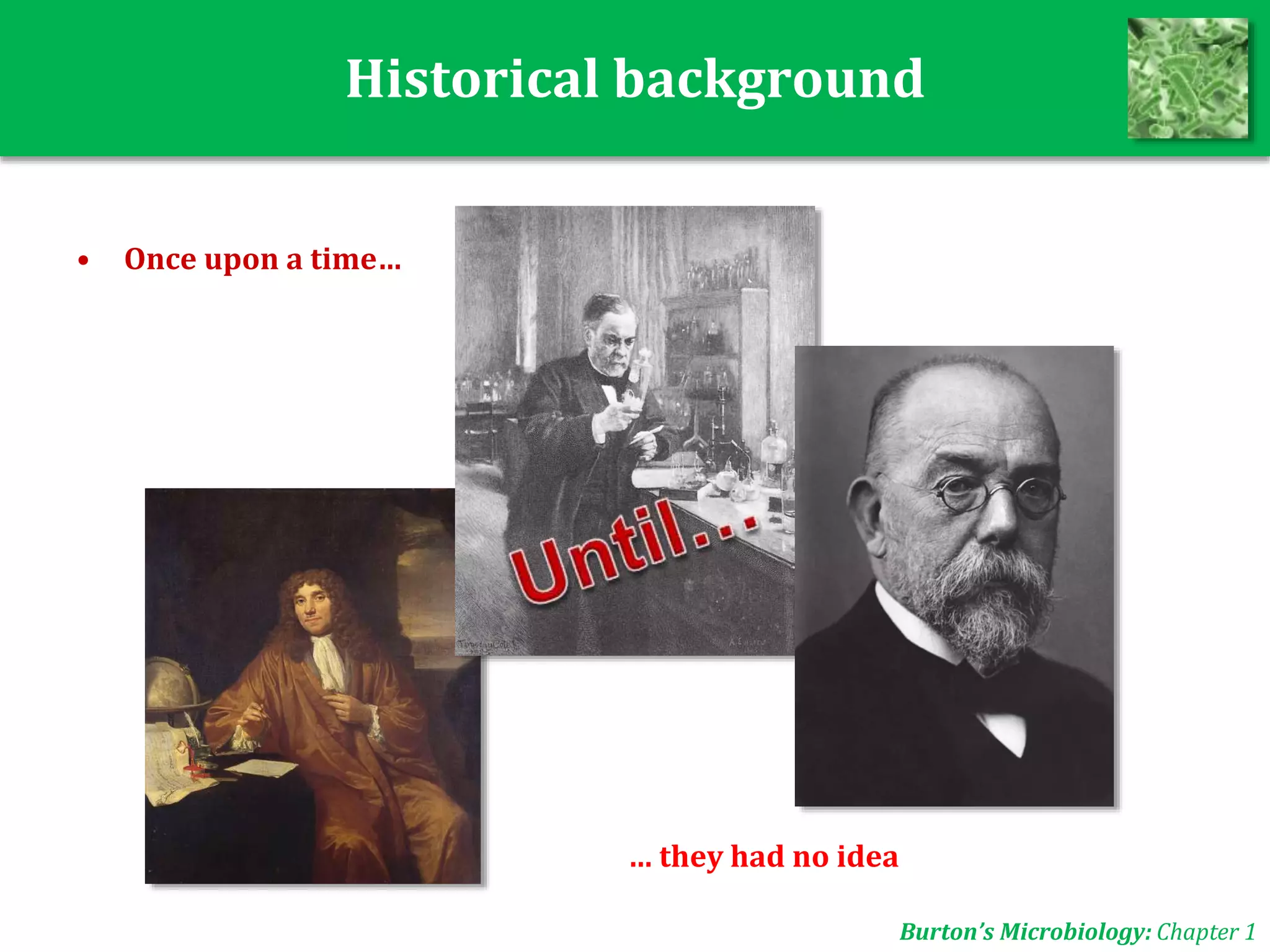
Historical background
• Once upon a time…
Burton’s Microbiology: Chapter 1
… they had no idea
Antoni van Leeuwenhoek
• Dutch merchant
• Godfather of Microbiology
– First to see live bacteria
– Quote from Microbe Hunters
• Inventor microscope (hobby)
– Examined water, blood, sperm,
teeth, stool, etc.
– Observed tiny living creatures:
“ANIMALCULES”
• No scientist
– No speculation on origin
– No association with disease
Burton’s Microbiology: Chapter 1
Leeuwenhoek’s microscopes
• Simple or single-lens microscope
– One magnifying lens
– Magnifying power of x 300
– Tiny glass lens mounted in a plate
– Specimen placed on small pin
– Screws used to adjust position
Burton’s Microbiology: Chapter 2
Drawings of van Leeuwenhoek
Robert Koch
• German Physician
– Germ theory of disease: “specific
microbes cause specific disease”
– Developed fixing, staining,
photographing bacteria
– Contributed to TB skin test
– Cultivate bacteria on solid agar
• obtain pure culture (one type)
• Developed Koch’s postulates
– Experimental procedure
– Proof germ theory of disease: “specific
microbes cause specific disease”
– e.g. Antrax bacillus  Antrax
Burton’s Microbiology: Chapter 1
Koch’s Postulates
After fulfilling Koch’s Postulates: prove that microbe is cause of particular disease
Burton’s Microbiology: Chapter 1
Edward Jenner
• British physician and scientist
• 1976: Developed smallpox vaccine
– Hypothesis:
“Having cowpox protects from
smallpox”
– Vaccin: sample from milder cowpox
– First to publish results of vaccination
– Origin of immunology?
Burton’s Microbiology: Chapter 16
Louis Pasteur
• French Chemist
– Fermentation process
– Disproved abiogenesis
(sponteneous generation)
– Aerobes/Anaerobes
– Developed Pasteurization
– Germ theory of disease: “specific
microbes cause specific disease”
– Championed changes in hosptial
practices: minimize spread disease
– Vaccins for chicken cholora, antrax
and rabies.
• Research center for
infectious disease
Burton’s Microbiology: Chapter 1
Joseph Lister
• British surgeon
– Asepsis (without infection)
– Antisepsis (against infection)
• “Phenol as antiseptic”
– Apply to wounds, hands, instruments,
wound dressings
– Perform surgery in phenol mist (irritating)
• Use of sterile equipment
• ↓ wound infections/mortality
• First pure culture (in liquid medium)
Burton’s Microbiology: Chapter 8,12
Alexander Fleming
• Scottish bacteriologist
• First antibiotic
– Accident: mould (fungi) on bacteria
culture plate
– Antibiotic (Penicillin) produced by
mould inhibited growth of bacteria!
• WWII: Penicillin saved thousands of lifes
Burton’s Microbiology: Chapter 9
Ronald Ross
• British medical doctor (born in India)
– Discovered malarial parasite in
mosquito
– Realization: “Malaria transmitted by
mosquitos”
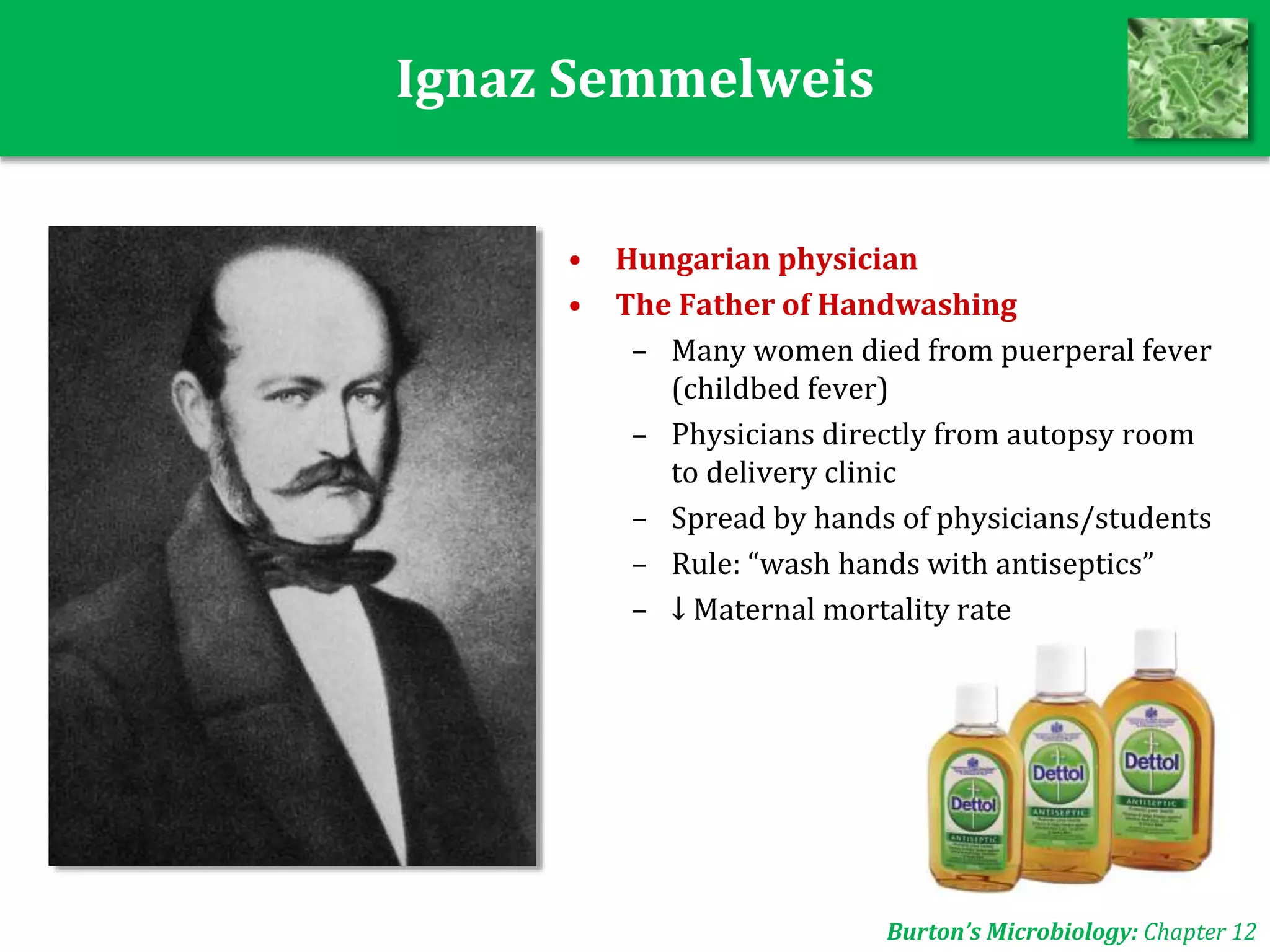
Ignaz Semmelweis
• Hungarian physician
• The Father of Handwashing
– Many women died from puerperal fever
(childbed fever)
– Physicians directly from autopsy room
to delivery clinic
– Spread by hands of physicians/students
– Rule: “wash hands with antiseptics”
– ↓ Maternal mortality rate
Burton’s Microbiology: Chapter 12
Career in Health Care
• Bacteriologist (Bacteria)
• Phycologist (Algae)
• Protozoologist (Protozoa)
• Mycologyst (Fungi)
• Virologist (Viruses)
• Pursue career in
medical microbiology?
– Study pathogens, infectious diseases
and body’s defense mechanisms
– Development of vaccines
– Epidemiology (public health)
– Immunology (immune system)
– Clinical/diagnostic microbiology
(laboratory diagnosis)
Burton’s Microbiology: Chapter 1
The End
Microbiology Unit 1: Introduction

Microbiology Unit 1: Introduction

  • 1.
  • 2.
    Some rules • Listenwhen others are talking • Show respect for other opinions • If you don’t understand, don’t hesitate to ask (raise hand) • No cellphones in the class room • Full participation is asked
  • 3.
    Microbiology Virus: Ebola Fungi: Mushroom Bacteria:Salmonella ENEMY OR… …FRIEND Algae: Algal bloom MICROBES
  • 4.
    Course content • Theory –Burton’s Microbiology for the Health Sciences – P.G. Engelkirk & J. Duben – Microbiology and Infection – T.J.J. Inglis • Practice: demonstrations in laboratory science – Growth of bacteria – Growth of fungi • Tests • Assignments • Final examination
  • 5.
  • 6.
    Today • Microbes – Definition –Presence – Variety – Enemy or friend? • Historical Background – Earliest known diseases – Fouding fathers • Microbiology in health care – Possible careers
  • 7.
    Definition? • MICRO –BIO – LOGY – μικρος = micros = “small” – βιος = bios = “life” – λογος = logos = “science” – “The study of very small living organisms” • or: MICROBIOLOGY – “The study of microorganisms (microbes) usually less then 1 mm in diameter which requires some sort of magnification to be seen clearly” Burton’s Microbiology: Chapter 1
  • 8.
    Presence of Microbes •Microbes are ubiquitous: virtually everywhere – Water (photosynthetic algae, plankton) – Dead or decaying materials (decomposers/saprophytes) – Soil (bacteria used in microbial ecology) – Animals/plants (bacteria and protozoa in intestinal tract) – Food/drinks (yeast in bread and beer) – Laboratory (study or to produce antibiotics, insulin, hormones) Burton’s Microbiology: Chapter 1 MANY MICROBES ARE USEFUL (FRIENDLY)
  • 9.
    Variety of Microbes •Categories – Acellar: Viroids, Virus, Prion – Prokaryotes (cellular without nucleus): Bacteria, Archaea, Cyanobacteria – Eukaryotes (cellular with nucleus): Algae, Fungi, Protozoa Burton’s Microbiology: Chapter 1 Microbes Acellular Viroids Prions Virusus Cellular Prokaryotes Archaea Bacteria Cyanobacteria Eukaryotes Algae Fungi Protozoa
  • 10.
    Microflora Indigenous microflora (100 trillion) Nonpathogens (97%) Opportunistic pathogens Pathogens / infectiousagents (3%) FRIENDS MICROBIAL ALLIES ENEMIES MICROBIAL ENEMIES “GERMS” USED-TO-BE-FRIENDS POTENTIAL ENEMIES Burton’s Microbiology: Chapter 1 • All microbes living on our bodies: Indigenous Microflora
  • 11.
    Disease • Microbial enemies… –…cause disease – “Pathogens” – Two categories • Infectious diseases – 50.000 deaths/day – Majority in developing countries • Be aware of… – Infectious diseases – Pathogens – Source – Transmission – Protection/prevention Burton’s Microbiology: Chapter 1
  • 12.
    Earliest known diseases 3180BC 1900 BC 1500 BC 1122 BC 790-640 BC 430 BC 1493 0 2015 Egypt: First recorded pestilence Troy: Bubonic plague Egypt: Epidemic fevers China: Smallpox Rome: Epidemics of plague Greece: Epidemics of plague Europe: Syphilis Burton’s Microbiology: Chapter 1
  • 13.
    Historical background • Onceupon a time… Burton’s Microbiology: Chapter 1 … they had no idea
  • 14.
    Antoni van Leeuwenhoek •Dutch merchant • Godfather of Microbiology – First to see live bacteria – Quote from Microbe Hunters • Inventor microscope (hobby) – Examined water, blood, sperm, teeth, stool, etc. – Observed tiny living creatures: “ANIMALCULES” • No scientist – No speculation on origin – No association with disease Burton’s Microbiology: Chapter 1
  • 15.
    Leeuwenhoek’s microscopes • Simpleor single-lens microscope – One magnifying lens – Magnifying power of x 300 – Tiny glass lens mounted in a plate – Specimen placed on small pin – Screws used to adjust position Burton’s Microbiology: Chapter 2 Drawings of van Leeuwenhoek
  • 16.
    Robert Koch • GermanPhysician – Germ theory of disease: “specific microbes cause specific disease” – Developed fixing, staining, photographing bacteria – Contributed to TB skin test – Cultivate bacteria on solid agar • obtain pure culture (one type) • Developed Koch’s postulates – Experimental procedure – Proof germ theory of disease: “specific microbes cause specific disease” – e.g. Antrax bacillus  Antrax Burton’s Microbiology: Chapter 1
  • 17.
    Koch’s Postulates After fulfillingKoch’s Postulates: prove that microbe is cause of particular disease Burton’s Microbiology: Chapter 1
  • 18.
    Edward Jenner • Britishphysician and scientist • 1976: Developed smallpox vaccine – Hypothesis: “Having cowpox protects from smallpox” – Vaccin: sample from milder cowpox – First to publish results of vaccination – Origin of immunology? Burton’s Microbiology: Chapter 16
  • 19.
    Louis Pasteur • FrenchChemist – Fermentation process – Disproved abiogenesis (sponteneous generation) – Aerobes/Anaerobes – Developed Pasteurization – Germ theory of disease: “specific microbes cause specific disease” – Championed changes in hosptial practices: minimize spread disease – Vaccins for chicken cholora, antrax and rabies. • Research center for infectious disease Burton’s Microbiology: Chapter 1
  • 20.
    Joseph Lister • Britishsurgeon – Asepsis (without infection) – Antisepsis (against infection) • “Phenol as antiseptic” – Apply to wounds, hands, instruments, wound dressings – Perform surgery in phenol mist (irritating) • Use of sterile equipment • ↓ wound infections/mortality • First pure culture (in liquid medium) Burton’s Microbiology: Chapter 8,12
  • 21.
    Alexander Fleming • Scottishbacteriologist • First antibiotic – Accident: mould (fungi) on bacteria culture plate – Antibiotic (Penicillin) produced by mould inhibited growth of bacteria! • WWII: Penicillin saved thousands of lifes Burton’s Microbiology: Chapter 9
  • 22.
    Ronald Ross • Britishmedical doctor (born in India) – Discovered malarial parasite in mosquito – Realization: “Malaria transmitted by mosquitos”
  • 23.
    Ignaz Semmelweis • Hungarianphysician • The Father of Handwashing – Many women died from puerperal fever (childbed fever) – Physicians directly from autopsy room to delivery clinic – Spread by hands of physicians/students – Rule: “wash hands with antiseptics” – ↓ Maternal mortality rate Burton’s Microbiology: Chapter 12
  • 24.
    Career in HealthCare • Bacteriologist (Bacteria) • Phycologist (Algae) • Protozoologist (Protozoa) • Mycologyst (Fungi) • Virologist (Viruses) • Pursue career in medical microbiology? – Study pathogens, infectious diseases and body’s defense mechanisms – Development of vaccines – Epidemiology (public health) – Immunology (immune system) – Clinical/diagnostic microbiology (laboratory diagnosis) Burton’s Microbiology: Chapter 1
  • 25.

Editor's Notes