VIVEKANANDHA ARTS AND SCIENCE COLLEGE FOR WOMEN,
VEERACHIPALAYAM, SANKAGIRI.
DEPARTMENT OF MICROBIOLOGY
SUBJECT: MARINE MICROBIOLOGY
TITLE: MICROBIAL INTERACTION - ECTOSYMBIONT AND ENDOSYMBIONTS
Submitted to:
Dr.R. DINESHKUMAR,
ASSISTANT PROFESSOR,
DEPARTMENT OF MICROBIOLOGY,
VIAAS,
VEERACHIPALAYAM, SANKAGIRI.
Submitted by:
M. KEJAPRIYA,
II-M.Sc., MICROBIOLOGY,
VIAAS,
VEERACHIPALAYAM, SANKAGIRI.
• Microbial interaction
• Types of Microbial
interactions in marine
environment
• Types of interactions
• Method of symbiosis
Index
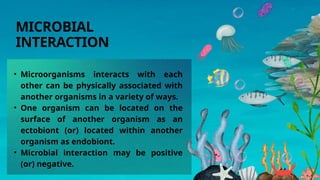
• Microorganisms interacts with each
other can be physically associated with
another organisms in a variety of ways.
• One organism can be located on the
surface of another organism as an
ectobiont (or) located within another
organism as endobiont.
• Microbial interaction may be positive
(or) negative.
MICROBIAL
INTERACTION
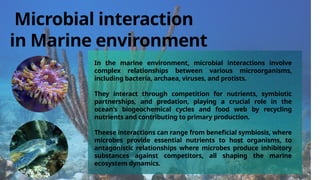
In the marine environment, microbial interactions involve
complex relationships between various microorganisms,
including bacteria, archaea, viruses, and protists.
They interact through competition for nutrients, symbiotic
partnerships, and predation, playing a crucial role in the
ocean's biogeochemical cycles and food web by recycling
nutrients and contributing to primary production.
Theese interactions can range from beneficial symbiosis, where
microbes provide essential nutrients to host organisms, to
antagonistic relationships where microbes produce inhibitory
substances against competitors, all shaping the marine
ecosystem dynamics.
Microbial interaction
in Marine environment
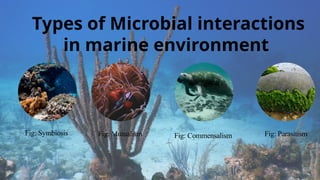
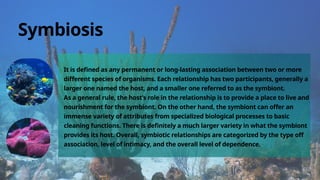
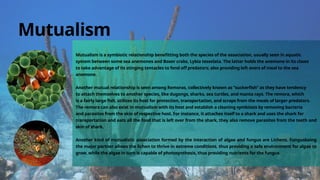
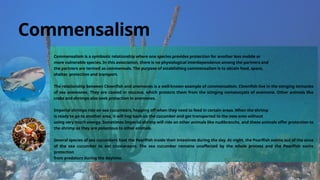
Types of Microbial interactions
in marine environment
Fig: Symbiosis Fig: Parasitism
Fig: Commensalism
Fig: Mutualism
It is defined as any permanent or long-lasting association between two or more
different species of organisms. Each relationship has two participants, generally a
larger one named the host, and a smaller one referred to as the symbiont.
As a general rule, the host’s role in the relationship is to provide a place to live and
nourishment for the symbiont. On the other hand, the symbiont can offer an
immense variety of attributes from specialized biological processes to basic
cleaning functions. There is definitely a much larger variety in what the symbiont
provides its host. Overall, symbiotic relationships are categorized by the type off
association, level of intimacy, and the overall level of dependence.
Symbiosis
Mutualism is a symbiotic relationship benefitting both the species of the association, usually seen in aquatic
system between some sea anemones and Boxer crabs, Lybia tesselata. The latter holds the anemone in its claws
to take advantage of its stinging tentacles to fend off predators; also providing left overs of meal to the sea
anemone.
Another mutual relationship is seen among Remoras, collectively known as “suckerfish” as they have tendency
to attach themselves to another species, like dugongs, sharks, sea turtles, and manta rays. The remora, which
is a fairly large fish, utilizes its host for protection, transportation, and scraps from the meals of larger predators.
The remora can also exist in mutualism with its host and establish a cleaning symbiosis by removing bacteria
and parasites from the skin of respective host. For instance, it attaches itself to a shark and uses the shark for
transportation and eats all the food that is left over from the shark, they also remove parasites from the teeth and
skin of shark.
Another kind of mutualistic association formed by the interaction of algae and fungus are Lichens. Fungusbeing
the major partner allows the lichen to thrive in extreme conditions, thus providing a safe environment for algae to
grow, while the algae in turn is capable of photosynthesis, thus providing nutrients for the fungus
Mutualism
Commensalism is a symbiotic relationship where one species provides protection for another less mobile or
more vulnerable species. In this association, there is no physiological interdependence among the partners and
the partners are termed as commensals. The purpose of establishing commensalism is to obtain food, space,
shelter, protection and transport.
The relationship between Clownfish and anemones is a well-known example of commensalism. Clownfish live in the stinging tentacles
of sea anemones. They are coated in mucous, which protects them from the stinging nematocysts of anemone. Other animals like
crabs and shrimps also seek protection in anemones.
Imperial shrimps ride on sea cucumbers, hopping off when they need to feed in certain areas. When the shrimp
is ready to go to another area, it will hop back on the cucumber and get transported to the new area without
using very much energy. Sometimes Imperial shrimp will ride on other animals like nudibranchs, and these animals offer protection to
the shrimp as they are poisonous to other animals.
Several species of sea cucumbers host the Pearlfish inside their intestines during the day. At night, the Pearlfish swims out of the anus
of the sea cucumber to eat crustaceans. The sea cucumber remains unaffected by the whole process and the Pearlfish earns
protection
from predators during the daytime.
Commensalism
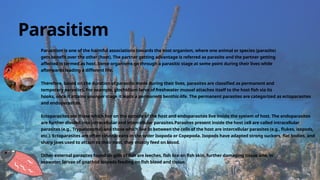
Parasitism is one of the harmful associations towards the host organism, where one animal or species (parasite)
gets benefit over the other (host). The partner getting advantage is referred as parasite and the partner getting
affected is termed as host. Some organisms go through a parasitic stage at some point during their lives while
afterwards leading a different life.
Therefore, based on the duration of parasitic mode during their lives, parasites are classified as permanent and
temporary parasites. For example, glochidium larva of freshwater mussel attaches itself to the host fish via its
hooks, once it attains younger stage it leads a permanent benthic-life. The permanent parasites are categorized as ectoparasites
and endoparasites.
Ectoparasites are those which live on the outside of the host and endoparasites live inside the system of host. The endoparasites
are further divided into intracellular and intercellular parasites.Parasites present inside the host cell are called intracellular
parasites (e.g., Trypanosoma) and those which live In between the cells of the host are intercellular parasites (e.g., flukes, isopods,
etc.). Ectoparasites are often cirustaceans in the order Isopoda or Copepoda. Isopods have adapted strong suckers, flat bodies, and
sharp jaws used to attach to their host, they mostly feed on blood.
Other external parasites found on gills of fish are leeches, fish lice on fish skin, further damaging tissue and, in
seawater, larvae of gnathiid isopods feeding on fish blood and tissue.
Parasitism
Endosymbionts
Method of symbiosis
Ectosymbionts
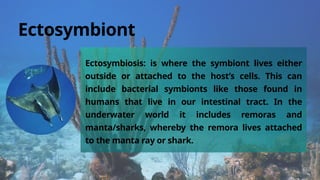
Ectosymbiosis: is where the symbiont lives either
outside or attached to the host’s cells. This can
include bacterial symbionts like those found in
humans that live in our intestinal tract. In the
underwater world it includes remoras and
manta/sharks, whereby the remora lives attached
to the manta ray or shark.
Ectosymbiont
Epibiotic
bacteria
on coral
reefs
Epibiotic
algae on
seagrasses
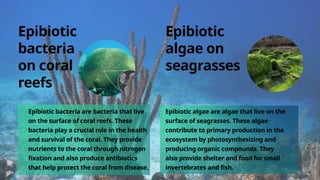
Epibiotic bacteria are bacteria that live
on the surface of coral reefs. These
bacteria play a crucial role in the health
and survival of the coral. They provide
nutrients to the coral through nitrogen
fixation and also produce antibiotics
that help protect the coral from disease.
Epibiotic algae are algae that live on the
surface of seagrasses. These algae
contribute to primary production in the
ecosystem by photosynthesizing and
producing organic compounds. They
also provide shelter and food for small
invertebrates and fish.
Hydrother
mal vent
bacteria
Seaweed-
fungal
symbiosis
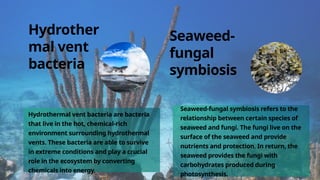
Hydrothermal vent bacteria are bacteria
that live in the hot, chemical-rich
environment surrounding hydrothermal
vents. These bacteria are able to survive
in extreme conditions and play a crucial
role in the ecosystem by converting
chemicals into energy.
Seaweed-fungal symbiosis refers to the
relationship between certain species of
seaweed and fungi. The fungi live on the
surface of the seaweed and provide
nutrients and protection. In return, the
seaweed provides the fungi with
carbohydrates produced during
photosynthesis.
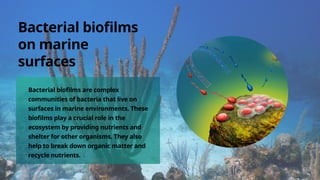
Bacterial biofilms
on marine
surfaces
Bacterial biofilms are complex
communities of bacteria that live on
surfaces in marine environments. These
biofilms play a crucial role in the
ecosystem by providing nutrients and
shelter for other organisms. They also
help to break down organic matter and
recycle nutrients.
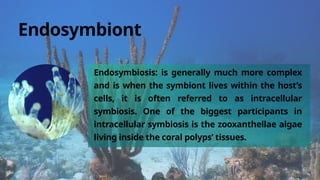
Endosymbiosis: is generally much more complex
and is when the symbiont lives within the host’s
cells, it is often referred to as intracellular
symbiosis. One of the biggest participants in
intracellular symbiosis is the zooxanthellae algae
living inside the coral polyps’ tissues.
Endosymbiont
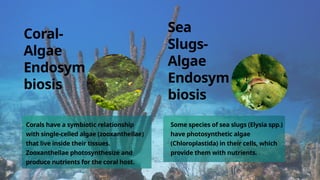
Coral-
Algae
Endosym
biosis
Sea
Slugs-
Algae
Endosym
biosis
Corals have a symbiotic relationship
with single-celled algae (zooxanthellae)
that live inside their tissues.
Zooxanthellae photosynthesize and
produce nutrients for the coral host.
Some species of sea slugs (Elysia spp.)
have photosynthetic algae
(Chloroplastida) in their cells, which
provide them with nutrients.
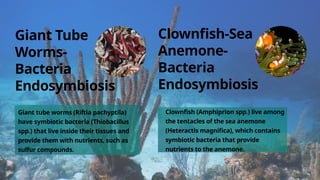
Giant Tube
Worms-
Bacteria
Endosymbiosis
Clownfish-Sea
Anemone-
Bacteria
Endosymbiosis
Giant tube worms (Riftia pachyptila)
have symbiotic bacteria (Thiobacillus
spp.) that live inside their tissues and
provide them with nutrients, such as
sulfur compounds.
Clownfish (Amphiprion spp.) live among
the tentacles of the sea anemone
(Heteractis magnifica), which contains
symbiotic bacteria that provide
nutrients to the anemone.
Marine Sponges-
Bacteria
Endosymbiosis
Many species of marine sponges
(Porifera) have symbiotic bacteria that
live inside their tissues and provide
them with nutrients, such as nitrogen
and phosphorus.
Thank you!

MICROBIAL INTERACTION_20241209_092401_0000.pptx

  • 1.
    VIVEKANANDHA ARTS ANDSCIENCE COLLEGE FOR WOMEN, VEERACHIPALAYAM, SANKAGIRI. DEPARTMENT OF MICROBIOLOGY SUBJECT: MARINE MICROBIOLOGY TITLE: MICROBIAL INTERACTION - ECTOSYMBIONT AND ENDOSYMBIONTS Submitted to: Dr.R. DINESHKUMAR, ASSISTANT PROFESSOR, DEPARTMENT OF MICROBIOLOGY, VIAAS, VEERACHIPALAYAM, SANKAGIRI. Submitted by: M. KEJAPRIYA, II-M.Sc., MICROBIOLOGY, VIAAS, VEERACHIPALAYAM, SANKAGIRI.
  • 2.
    • Microbial interaction •Types of Microbial interactions in marine environment • Types of interactions • Method of symbiosis Index
  • 3.
    • Microorganisms interactswith each other can be physically associated with another organisms in a variety of ways. • One organism can be located on the surface of another organism as an ectobiont (or) located within another organism as endobiont. • Microbial interaction may be positive (or) negative. MICROBIAL INTERACTION
  • 4.
    In the marineenvironment, microbial interactions involve complex relationships between various microorganisms, including bacteria, archaea, viruses, and protists. They interact through competition for nutrients, symbiotic partnerships, and predation, playing a crucial role in the ocean's biogeochemical cycles and food web by recycling nutrients and contributing to primary production. Theese interactions can range from beneficial symbiosis, where microbes provide essential nutrients to host organisms, to antagonistic relationships where microbes produce inhibitory substances against competitors, all shaping the marine ecosystem dynamics. Microbial interaction in Marine environment
  • 5.
    Types of Microbialinteractions in marine environment Fig: Symbiosis Fig: Parasitism Fig: Commensalism Fig: Mutualism
  • 6.
    It is definedas any permanent or long-lasting association between two or more different species of organisms. Each relationship has two participants, generally a larger one named the host, and a smaller one referred to as the symbiont. As a general rule, the host’s role in the relationship is to provide a place to live and nourishment for the symbiont. On the other hand, the symbiont can offer an immense variety of attributes from specialized biological processes to basic cleaning functions. There is definitely a much larger variety in what the symbiont provides its host. Overall, symbiotic relationships are categorized by the type off association, level of intimacy, and the overall level of dependence. Symbiosis
  • 7.
    Mutualism is asymbiotic relationship benefitting both the species of the association, usually seen in aquatic system between some sea anemones and Boxer crabs, Lybia tesselata. The latter holds the anemone in its claws to take advantage of its stinging tentacles to fend off predators; also providing left overs of meal to the sea anemone. Another mutual relationship is seen among Remoras, collectively known as “suckerfish” as they have tendency to attach themselves to another species, like dugongs, sharks, sea turtles, and manta rays. The remora, which is a fairly large fish, utilizes its host for protection, transportation, and scraps from the meals of larger predators. The remora can also exist in mutualism with its host and establish a cleaning symbiosis by removing bacteria and parasites from the skin of respective host. For instance, it attaches itself to a shark and uses the shark for transportation and eats all the food that is left over from the shark, they also remove parasites from the teeth and skin of shark. Another kind of mutualistic association formed by the interaction of algae and fungus are Lichens. Fungusbeing the major partner allows the lichen to thrive in extreme conditions, thus providing a safe environment for algae to grow, while the algae in turn is capable of photosynthesis, thus providing nutrients for the fungus Mutualism
  • 8.
    Commensalism is asymbiotic relationship where one species provides protection for another less mobile or more vulnerable species. In this association, there is no physiological interdependence among the partners and the partners are termed as commensals. The purpose of establishing commensalism is to obtain food, space, shelter, protection and transport. The relationship between Clownfish and anemones is a well-known example of commensalism. Clownfish live in the stinging tentacles of sea anemones. They are coated in mucous, which protects them from the stinging nematocysts of anemone. Other animals like crabs and shrimps also seek protection in anemones. Imperial shrimps ride on sea cucumbers, hopping off when they need to feed in certain areas. When the shrimp is ready to go to another area, it will hop back on the cucumber and get transported to the new area without using very much energy. Sometimes Imperial shrimp will ride on other animals like nudibranchs, and these animals offer protection to the shrimp as they are poisonous to other animals. Several species of sea cucumbers host the Pearlfish inside their intestines during the day. At night, the Pearlfish swims out of the anus of the sea cucumber to eat crustaceans. The sea cucumber remains unaffected by the whole process and the Pearlfish earns protection from predators during the daytime. Commensalism
  • 9.
    Parasitism is oneof the harmful associations towards the host organism, where one animal or species (parasite) gets benefit over the other (host). The partner getting advantage is referred as parasite and the partner getting affected is termed as host. Some organisms go through a parasitic stage at some point during their lives while afterwards leading a different life. Therefore, based on the duration of parasitic mode during their lives, parasites are classified as permanent and temporary parasites. For example, glochidium larva of freshwater mussel attaches itself to the host fish via its hooks, once it attains younger stage it leads a permanent benthic-life. The permanent parasites are categorized as ectoparasites and endoparasites. Ectoparasites are those which live on the outside of the host and endoparasites live inside the system of host. The endoparasites are further divided into intracellular and intercellular parasites.Parasites present inside the host cell are called intracellular parasites (e.g., Trypanosoma) and those which live In between the cells of the host are intercellular parasites (e.g., flukes, isopods, etc.). Ectoparasites are often cirustaceans in the order Isopoda or Copepoda. Isopods have adapted strong suckers, flat bodies, and sharp jaws used to attach to their host, they mostly feed on blood. Other external parasites found on gills of fish are leeches, fish lice on fish skin, further damaging tissue and, in seawater, larvae of gnathiid isopods feeding on fish blood and tissue. Parasitism
  • 10.
  • 11.
    Ectosymbiosis: is wherethe symbiont lives either outside or attached to the host’s cells. This can include bacterial symbionts like those found in humans that live in our intestinal tract. In the underwater world it includes remoras and manta/sharks, whereby the remora lives attached to the manta ray or shark. Ectosymbiont
  • 12.
    Epibiotic bacteria on coral reefs Epibiotic algae on seagrasses Epibioticbacteria are bacteria that live on the surface of coral reefs. These bacteria play a crucial role in the health and survival of the coral. They provide nutrients to the coral through nitrogen fixation and also produce antibiotics that help protect the coral from disease. Epibiotic algae are algae that live on the surface of seagrasses. These algae contribute to primary production in the ecosystem by photosynthesizing and producing organic compounds. They also provide shelter and food for small invertebrates and fish.
  • 13.
    Hydrother mal vent bacteria Seaweed- fungal symbiosis Hydrothermal ventbacteria are bacteria that live in the hot, chemical-rich environment surrounding hydrothermal vents. These bacteria are able to survive in extreme conditions and play a crucial role in the ecosystem by converting chemicals into energy. Seaweed-fungal symbiosis refers to the relationship between certain species of seaweed and fungi. The fungi live on the surface of the seaweed and provide nutrients and protection. In return, the seaweed provides the fungi with carbohydrates produced during photosynthesis.
  • 14.
    Bacterial biofilms on marine surfaces Bacterialbiofilms are complex communities of bacteria that live on surfaces in marine environments. These biofilms play a crucial role in the ecosystem by providing nutrients and shelter for other organisms. They also help to break down organic matter and recycle nutrients.
  • 15.
    Endosymbiosis: is generallymuch more complex and is when the symbiont lives within the host’s cells, it is often referred to as intracellular symbiosis. One of the biggest participants in intracellular symbiosis is the zooxanthellae algae living inside the coral polyps’ tissues. Endosymbiont
  • 16.
    Coral- Algae Endosym biosis Sea Slugs- Algae Endosym biosis Corals have asymbiotic relationship with single-celled algae (zooxanthellae) that live inside their tissues. Zooxanthellae photosynthesize and produce nutrients for the coral host. Some species of sea slugs (Elysia spp.) have photosynthetic algae (Chloroplastida) in their cells, which provide them with nutrients.
  • 17.
    Giant Tube Worms- Bacteria Endosymbiosis Clownfish-Sea Anemone- Bacteria Endosymbiosis Giant tubeworms (Riftia pachyptila) have symbiotic bacteria (Thiobacillus spp.) that live inside their tissues and provide them with nutrients, such as sulfur compounds. Clownfish (Amphiprion spp.) live among the tentacles of the sea anemone (Heteractis magnifica), which contains symbiotic bacteria that provide nutrients to the anemone.
  • 18.
    Marine Sponges- Bacteria Endosymbiosis Many speciesof marine sponges (Porifera) have symbiotic bacteria that live inside their tissues and provide them with nutrients, such as nitrogen and phosphorus.
  • 19.