VIVEKANANDHAARTS AND SCIENCE COLLEGE FOR WOMEN,
VEERACHIPALAYAM, SAKAGIRI, SALEM .
DEPARTMENT OF MICROBIOLOGY
Topic: Marine Microbial environment- Microbial loop
Dr.R.Dineshkumar,
Department of Microbiology,
Assistant Professor,
Vivekanandha Arts and Science College for Women,
Veerachipalayam, Sankagiri, Salem.
Subject incharge: Submitted by:
P.Divya
II- M.Sc, Microbiology
Department of Microbiology
Vivekanandha Arts And Science College For women,
Veerachipalayam, Sankagiri, Salem.
CONTENTS
• Microbial loop
• Factors controlling the microbial loop
• Microbial loop in marine ecosystem
• Impact on the marine ecosystem
• Conclusion
MICROBIAL LOOP
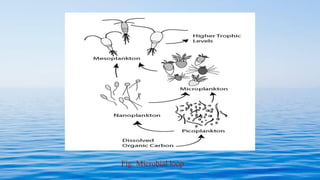
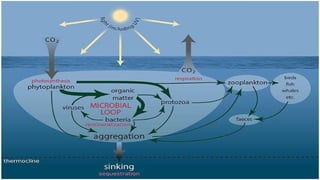
• The microbial loop describes a trophic pathway where, in aquatic systems,
dissolved organic carbon (DOC) is returned to higher trophic levels via its incorporation into
bacterial biomass, and then coupled with the classic food chain formed by phytoplankton-
zooplankton-nekton.
• In soil systems, the microbial loop refers to soil carbon
• The term microbial loop was coined by Farooq Azam, Tom Fenchel et al. in 1983
to include the role played by bacteria in the carbon and nutrient cycles of the
marine environment.
• In general, dissolved organic carbon (DOC) is introduced into the ocean environment from bacterial lysis,
the leakage or exudation of fixed carbon from phytoplankton (e.g., mucilaginous exopolymer from
diatoms), sudden cell senescence, sloppy feeding by zooplankton, the excretion of waste products by
aquatic animals, or the breakdown or dissolution of organic particles from terrestrial plants and soils.
Fig: Microbial loop
• Bacteria in the microbial loop decompose this particulate detritus to utilize this
energy-rich matter for growth. Since more than 95% of organic matter in marine
ecosystems consists of polymeric, high molecular weight (HMW) compounds (e.g.,
protein, polysaccharides, lipids), only a small portion of total
dissolved organic matter (DOM) is readily utilizable to most marine organisms at
higher trophic levels.
• This means that dissolved organic carbon is not available directly to most marine
organisms; marine bacteria introduce this organic carbon into the food web, resulting in
additional energy becoming available to higher trophic levels
• Recently the term "microbial food web" has been substituted for the term
"microbial loop".
Continue...
Factors Controlling the Microbial Loop
• The efficiency of the microbial loop is determined by the density of
marine bacteria within it
• It has become clear that bacterial density is mainly controlled by the grazing
activity of small protozoans and various taxonomic groups of flagellates
• Also, viral infection causes bacterial lysis, which release cell contents back into the
dissolved organic matter (DOM) pool, lowering the overall efficiency of the microbial
loop.
• Mortality from viral infection has almost the same magnitude as that from protozoan
grazing. However, compared to protozoan grazing, the effect of viral lysis can be very
different because lysis is highly host-specific to each marine bacteria.
• Both protozoan grazing and viral infection balance the major fraction of
bacterial growth.
• In addition, the microbial loop dominates in oligotrophic waters, rather than in
eutrophic areas - there the classical plankton food chain predominates, due to the
frequent fresh supply of mineral nutrients (e.g. spring bloom in temperate waters,
upwelling areas).
• The magnitude of the efficiency of the microbial loop can be determined by
measuring bacterial incorporation of radiolabeled substrates (such as tritiated
thymidine or leucine).
Continue...
Microbial loop in marine ecosystem
• The microbial loop is of particular importance in increasing the efficiency of the marine
food web via the utilization of dissolved organic matter (DOM), which is typically
unavailable to most marine organisms.
• In this sense, the process aids in recycling of organic matter and nutrients and
mediates the transfer of energy above the thermocline. More than 30% of
dissolved organic carbon (DOC) incorporated into bacteria is respired and released
as carbon dioxide.
• The other main effect of the microbial loop in the water column is that it accelerates
mineralization through regenerating production in nutrient-limited environments (e.g.
oligotrophic waters).
• In general, the entire microbial loop is to some extent typically five to ten times
the mass of all multicellular marine organisms in the marine ecosystem.
• Marine bacteria are the base of the food web in most oceanic environments, and
they improve the trophic efficiency of both marine food webs and important
aquatic processes (such as the productivity of fisheries and the amount of carbon
exported to the ocean floor).
• Therefore, the microbial loop, together with primary production,
controls the productivity of marine systems in the ocean.
• Many planktonic bacteria are motile, using a flagellum to propagate, and
chemotax to locate, move toward, and attach to a point source of
dissolved organic matter (DOM) where fast growing cells digest all or part of the
particle.
• Accumulation within just a few minutes at such patches is directly
observable.
Continue...
• Therefore, the water column can be considered to some extent as a spatially
organized place on a small scale rather than a completely mixed system.
• This patch formation affects the biologically-mediated transfer of matter and
energy in the microbial loop.
• More currently, the microbial loop is considered to be more extended.[9]
Chemical
compounds in typical bacteria (such as DNA, lipids, sugars, etc.) and similar
values of C:N ratios per particle are found in the microparticles formed
abiotically.
• Microparticles are a potentially attractive food source to
bacterivorous plankton.
Continue...
• If this is the case, the microbial loop can be extended by the pathway of direct
transfer of dissolved organic matter (DOM) via abiotic microparticle
formation to higher trophic levels.
• This has ecological importance in two ways. First, it occurs without carbon
loss, and makes organic matter more efficiently available to phagotrophic
organisms, rather than only heterotrophic bacteria
• Furthermore, abiotic transformation in the extended microbial loop depends only
on temperature and the capacity of DOM to aggregate, while biotic transformation
is dependent on its biological availability
Impact on the marine ecosystem
• Carbon cycle: The marine microbial loop plays a key role in the ocean’s carbon
cycle, influencing the sequestration and release of co2.
• Nutrient availability: The microbial loop influence the availability of nutrients for
Phytoplankton growth, impacting the ocean’s primary production.
• Water quality: The microbial loop affects the ocean’s water quality, influencing the
concentration of dissolved organic matter and nutrients.
• Climate regulation: The marine microbial loop plays a role in regulating the earth’s
climate, influencing the ocean carbon sequestration and release of greenhouse
gases.
Conclusion
The marine microbial loop is
a fundamental process that
supports life in the ocean,
contributing the functioning
of marine ecosystems and the
global biogeochemical cycle.
Marine microbial environment - Microbial loop

Marine microbial environment - Microbial loop

  • 1.
    VIVEKANANDHAARTS AND SCIENCECOLLEGE FOR WOMEN, VEERACHIPALAYAM, SAKAGIRI, SALEM . DEPARTMENT OF MICROBIOLOGY Topic: Marine Microbial environment- Microbial loop Dr.R.Dineshkumar, Department of Microbiology, Assistant Professor, Vivekanandha Arts and Science College for Women, Veerachipalayam, Sankagiri, Salem. Subject incharge: Submitted by: P.Divya II- M.Sc, Microbiology Department of Microbiology Vivekanandha Arts And Science College For women, Veerachipalayam, Sankagiri, Salem.
  • 2.
    CONTENTS • Microbial loop •Factors controlling the microbial loop • Microbial loop in marine ecosystem • Impact on the marine ecosystem • Conclusion
  • 3.
    MICROBIAL LOOP • Themicrobial loop describes a trophic pathway where, in aquatic systems, dissolved organic carbon (DOC) is returned to higher trophic levels via its incorporation into bacterial biomass, and then coupled with the classic food chain formed by phytoplankton- zooplankton-nekton. • In soil systems, the microbial loop refers to soil carbon • The term microbial loop was coined by Farooq Azam, Tom Fenchel et al. in 1983 to include the role played by bacteria in the carbon and nutrient cycles of the marine environment. • In general, dissolved organic carbon (DOC) is introduced into the ocean environment from bacterial lysis, the leakage or exudation of fixed carbon from phytoplankton (e.g., mucilaginous exopolymer from diatoms), sudden cell senescence, sloppy feeding by zooplankton, the excretion of waste products by aquatic animals, or the breakdown or dissolution of organic particles from terrestrial plants and soils.
  • 4.
  • 5.
    • Bacteria inthe microbial loop decompose this particulate detritus to utilize this energy-rich matter for growth. Since more than 95% of organic matter in marine ecosystems consists of polymeric, high molecular weight (HMW) compounds (e.g., protein, polysaccharides, lipids), only a small portion of total dissolved organic matter (DOM) is readily utilizable to most marine organisms at higher trophic levels. • This means that dissolved organic carbon is not available directly to most marine organisms; marine bacteria introduce this organic carbon into the food web, resulting in additional energy becoming available to higher trophic levels • Recently the term "microbial food web" has been substituted for the term "microbial loop". Continue...
  • 6.
    Factors Controlling theMicrobial Loop • The efficiency of the microbial loop is determined by the density of marine bacteria within it • It has become clear that bacterial density is mainly controlled by the grazing activity of small protozoans and various taxonomic groups of flagellates • Also, viral infection causes bacterial lysis, which release cell contents back into the dissolved organic matter (DOM) pool, lowering the overall efficiency of the microbial loop. • Mortality from viral infection has almost the same magnitude as that from protozoan grazing. However, compared to protozoan grazing, the effect of viral lysis can be very different because lysis is highly host-specific to each marine bacteria.
  • 7.
    • Both protozoangrazing and viral infection balance the major fraction of bacterial growth. • In addition, the microbial loop dominates in oligotrophic waters, rather than in eutrophic areas - there the classical plankton food chain predominates, due to the frequent fresh supply of mineral nutrients (e.g. spring bloom in temperate waters, upwelling areas). • The magnitude of the efficiency of the microbial loop can be determined by measuring bacterial incorporation of radiolabeled substrates (such as tritiated thymidine or leucine). Continue...
  • 8.
    Microbial loop inmarine ecosystem • The microbial loop is of particular importance in increasing the efficiency of the marine food web via the utilization of dissolved organic matter (DOM), which is typically unavailable to most marine organisms. • In this sense, the process aids in recycling of organic matter and nutrients and mediates the transfer of energy above the thermocline. More than 30% of dissolved organic carbon (DOC) incorporated into bacteria is respired and released as carbon dioxide. • The other main effect of the microbial loop in the water column is that it accelerates mineralization through regenerating production in nutrient-limited environments (e.g. oligotrophic waters). • In general, the entire microbial loop is to some extent typically five to ten times the mass of all multicellular marine organisms in the marine ecosystem.
  • 9.
    • Marine bacteriaare the base of the food web in most oceanic environments, and they improve the trophic efficiency of both marine food webs and important aquatic processes (such as the productivity of fisheries and the amount of carbon exported to the ocean floor). • Therefore, the microbial loop, together with primary production, controls the productivity of marine systems in the ocean. • Many planktonic bacteria are motile, using a flagellum to propagate, and chemotax to locate, move toward, and attach to a point source of dissolved organic matter (DOM) where fast growing cells digest all or part of the particle. • Accumulation within just a few minutes at such patches is directly observable. Continue...
  • 11.
    • Therefore, thewater column can be considered to some extent as a spatially organized place on a small scale rather than a completely mixed system. • This patch formation affects the biologically-mediated transfer of matter and energy in the microbial loop. • More currently, the microbial loop is considered to be more extended.[9] Chemical compounds in typical bacteria (such as DNA, lipids, sugars, etc.) and similar values of C:N ratios per particle are found in the microparticles formed abiotically. • Microparticles are a potentially attractive food source to bacterivorous plankton. Continue...
  • 12.
    • If thisis the case, the microbial loop can be extended by the pathway of direct transfer of dissolved organic matter (DOM) via abiotic microparticle formation to higher trophic levels. • This has ecological importance in two ways. First, it occurs without carbon loss, and makes organic matter more efficiently available to phagotrophic organisms, rather than only heterotrophic bacteria • Furthermore, abiotic transformation in the extended microbial loop depends only on temperature and the capacity of DOM to aggregate, while biotic transformation is dependent on its biological availability
  • 13.
    Impact on themarine ecosystem • Carbon cycle: The marine microbial loop plays a key role in the ocean’s carbon cycle, influencing the sequestration and release of co2. • Nutrient availability: The microbial loop influence the availability of nutrients for Phytoplankton growth, impacting the ocean’s primary production. • Water quality: The microbial loop affects the ocean’s water quality, influencing the concentration of dissolved organic matter and nutrients. • Climate regulation: The marine microbial loop plays a role in regulating the earth’s climate, influencing the ocean carbon sequestration and release of greenhouse gases.
  • 14.
    Conclusion The marine microbialloop is a fundamental process that supports life in the ocean, contributing the functioning of marine ecosystems and the global biogeochemical cycle.