{DIVERSITY OF MICRO-ORGANISMS IN
MARINE HABITAT.
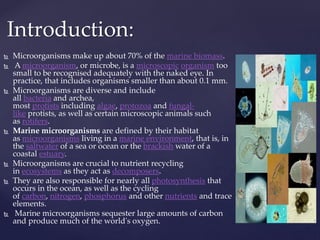
 Microorganisms make up about 70% of the marine biomass.
 A microorganism, or microbe, is a microscopic organism too
small to be recognised adequately with the naked eye. In
practice, that includes organisms smaller than about 0.1 mm.
 Microorganisms are diverse and include
all bacteria and archea,
most protists including algae, protozoa and fungal-
like protists, as well as certain microscopic animals such
as rotifers.
 Marine microorganisms are defined by their habitat
as microorganisms living in a marine environment, that is, in
the saltwater of a sea or ocean or the brackish water of a
coastal estuary.
 Microorganisms are crucial to nutrient recycling
in ecosystems as they act as decomposers.
 They are also responsible for nearly all photosynthesis that
occurs in the ocean, as well as the cycling
of carbon, nitrogen, phosphorus and other nutrients and trace
elements.
 Marine microorganisms sequester large amounts of carbon
and produce much of the world's oxygen.
Introduction:
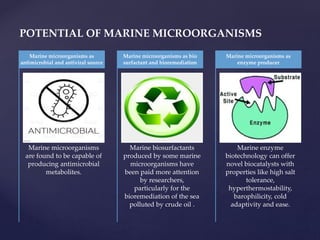
Marine microorganisms
are found to be capable of
producing antimicrobial
metabolites.
Marine microorganisms as
antimicrobial and antiviral source
Marine biosurfactants
produced by some marine
microorganisms have
been paid more attention
by researchers,
particularly for the
bioremediation of the sea
polluted by crude oil .
Marine microorganisms as bio
surfactant and bioremediation
Marine enzyme
biotechnology can offer
novel biocatalysts with
properties like high salt
tolerance,
hyperthermostability,
barophilicity, cold
adaptivity and ease.
Marine microorganisms as
enzyme producer
POTENTIAL OF MARINE MICROORGANISMS
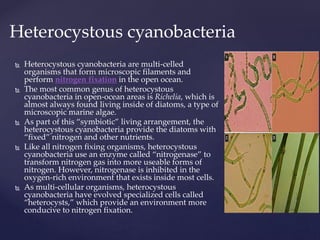
 Heterocystous cyanobacteria are multi-celled
organisms that form microscopic filaments and
perform nitrogen fixation in the open ocean.
 The most common genus of heterocystous
cyanobacteria in open-ocean areas is Richelia, which is
almost always found living inside of diatoms, a type of
microscopic marine algae.
 As part of this “symbiotic” living arrangement, the
heterocystous cyanobacteria provide the diatoms with
“fixed” nitrogen and other nutrients.
 Like all nitrogen fixing organisms, heterocystous
cyanobacteria use an enzyme called “nitrogenase” to
transform nitrogen gas into more useable forms of
nitrogen. However, nitrogenase is inhibited in the
oxygen-rich environment that exists inside most cells.
 As multi-cellular organisms, heterocystous
cyanobacteria have evolved specialized cells called
“heterocysts,” which provide an environment more
conducive to nitrogen fixation.
Heterocystous cyanobacteria
 Pelagibacter ubique, is significantly known to be
one of smallest and simplest, self-replicating,
and free living cell.
 P. ubique has a coastal, ocean surface ecotype,
living in a low nutrient habitat.
 P. ubique was first isolated in 2002 from the
Sargasso Sea.
 P. ubique is an efficient microbe, it consumes the
dead organic matter which is dissolved in the
ocean water.
 The microbe releases nutrients needed by the
ocean algae to convert carbon dioxide into
oxygen, which is a photosynthetic process.
Pelagibacter ubique
 Aliivibrio fischeri (also called Vibrio fischeri) is
a Gram-negative, rod-shaped bacterium found
globally in marine environments.
 One of its most distinguishing characteristics,
bioluminescence, is controlled by a small set of
genes known as the lux operon.
 Luminescent bacteria are found in free-living,
symbiotic, saprophytic or parasitic
relationships.
 The bacterium is a key research organism for
examination of
microbial bioluminescence, quorum sensing,
and bacterial-animal symbiosis.
Vibrio fischeri
 https://en.m.wikipedia.org/wiki/Marine_micro
organisms
 https://hahana.soest.hawaii.edu/cmoreserver/cr
uises/biolincs/microbes.htm
 https://www.sciencedirect.com/topics/earth-
and-planetary-sciences/marine-microorganism
 https://scialert.net/fulltext/?doi=jbs.2010.555.564
 https://www.aims.gov.au/docs/research/marine
-
microbes/microbes/microbes.html#:~:text=Mari
ne%20microbes%20are%20tiny%20organisms,t
hat%20freeload%20along%20with%20them.
References:-

marine microorganisms.pptx

  • 1.
  • 2.
     Microorganisms makeup about 70% of the marine biomass.  A microorganism, or microbe, is a microscopic organism too small to be recognised adequately with the naked eye. In practice, that includes organisms smaller than about 0.1 mm.  Microorganisms are diverse and include all bacteria and archea, most protists including algae, protozoa and fungal- like protists, as well as certain microscopic animals such as rotifers.  Marine microorganisms are defined by their habitat as microorganisms living in a marine environment, that is, in the saltwater of a sea or ocean or the brackish water of a coastal estuary.  Microorganisms are crucial to nutrient recycling in ecosystems as they act as decomposers.  They are also responsible for nearly all photosynthesis that occurs in the ocean, as well as the cycling of carbon, nitrogen, phosphorus and other nutrients and trace elements.  Marine microorganisms sequester large amounts of carbon and produce much of the world's oxygen. Introduction:
  • 3.
    Marine microorganisms are foundto be capable of producing antimicrobial metabolites. Marine microorganisms as antimicrobial and antiviral source Marine biosurfactants produced by some marine microorganisms have been paid more attention by researchers, particularly for the bioremediation of the sea polluted by crude oil . Marine microorganisms as bio surfactant and bioremediation Marine enzyme biotechnology can offer novel biocatalysts with properties like high salt tolerance, hyperthermostability, barophilicity, cold adaptivity and ease. Marine microorganisms as enzyme producer POTENTIAL OF MARINE MICROORGANISMS
  • 4.
     Heterocystous cyanobacteriaare multi-celled organisms that form microscopic filaments and perform nitrogen fixation in the open ocean.  The most common genus of heterocystous cyanobacteria in open-ocean areas is Richelia, which is almost always found living inside of diatoms, a type of microscopic marine algae.  As part of this “symbiotic” living arrangement, the heterocystous cyanobacteria provide the diatoms with “fixed” nitrogen and other nutrients.  Like all nitrogen fixing organisms, heterocystous cyanobacteria use an enzyme called “nitrogenase” to transform nitrogen gas into more useable forms of nitrogen. However, nitrogenase is inhibited in the oxygen-rich environment that exists inside most cells.  As multi-cellular organisms, heterocystous cyanobacteria have evolved specialized cells called “heterocysts,” which provide an environment more conducive to nitrogen fixation. Heterocystous cyanobacteria
  • 5.
     Pelagibacter ubique,is significantly known to be one of smallest and simplest, self-replicating, and free living cell.  P. ubique has a coastal, ocean surface ecotype, living in a low nutrient habitat.  P. ubique was first isolated in 2002 from the Sargasso Sea.  P. ubique is an efficient microbe, it consumes the dead organic matter which is dissolved in the ocean water.  The microbe releases nutrients needed by the ocean algae to convert carbon dioxide into oxygen, which is a photosynthetic process. Pelagibacter ubique
  • 6.
     Aliivibrio fischeri(also called Vibrio fischeri) is a Gram-negative, rod-shaped bacterium found globally in marine environments.  One of its most distinguishing characteristics, bioluminescence, is controlled by a small set of genes known as the lux operon.  Luminescent bacteria are found in free-living, symbiotic, saprophytic or parasitic relationships.  The bacterium is a key research organism for examination of microbial bioluminescence, quorum sensing, and bacterial-animal symbiosis. Vibrio fischeri
  • 7.
     https://en.m.wikipedia.org/wiki/Marine_micro organisms  https://hahana.soest.hawaii.edu/cmoreserver/cr uises/biolincs/microbes.htm https://www.sciencedirect.com/topics/earth- and-planetary-sciences/marine-microorganism  https://scialert.net/fulltext/?doi=jbs.2010.555.564  https://www.aims.gov.au/docs/research/marine - microbes/microbes/microbes.html#:~:text=Mari ne%20microbes%20are%20tiny%20organisms,t hat%20freeload%20along%20with%20them. References:-