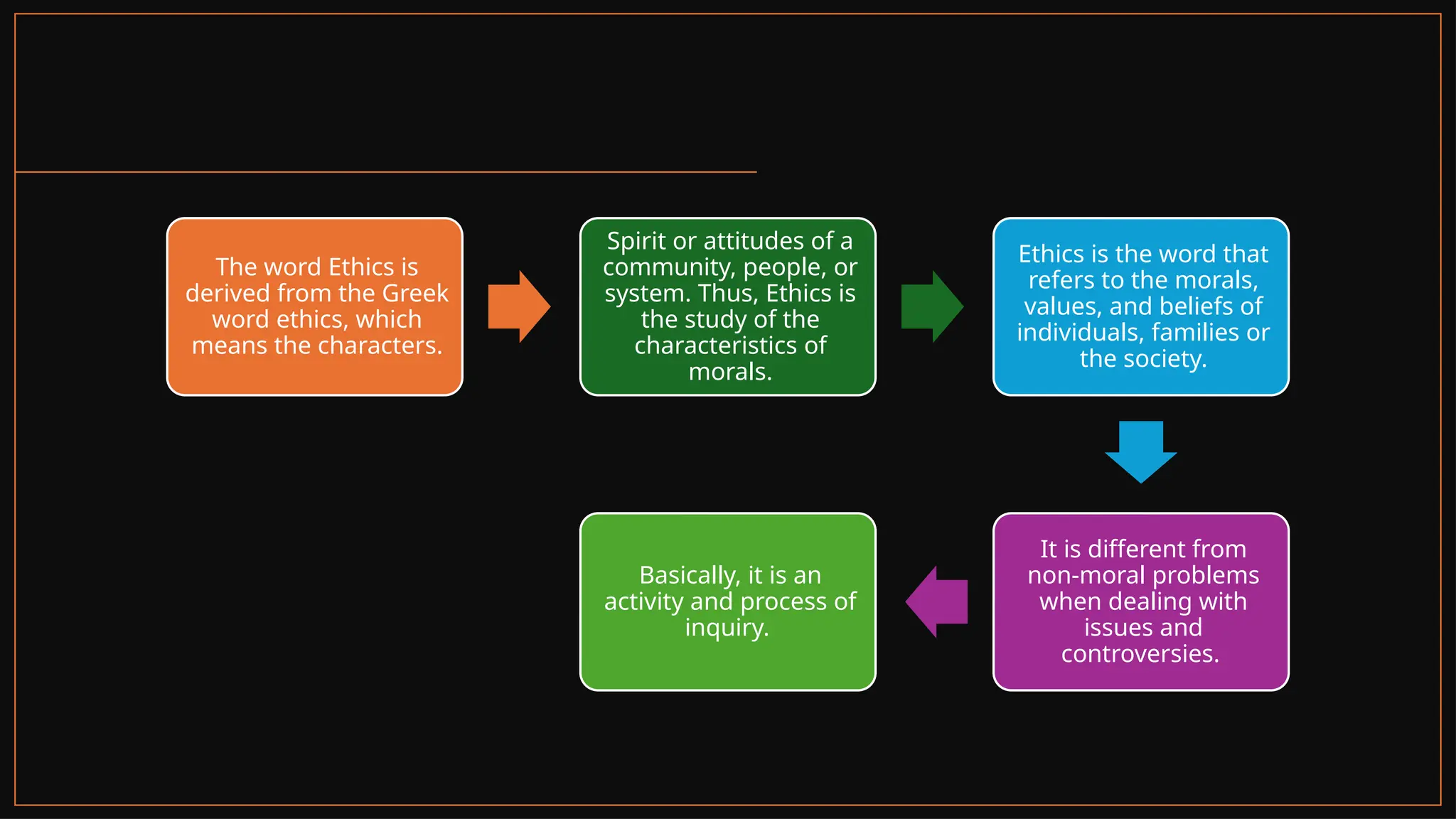
The word Ethicsis
derived from the Greek
word ethics, which
means the characters.
Spirit or attitudes of a
community, people, or
system. Thus, Ethics is
the study of the
characteristics of
morals.
Ethics is the word that
refers to the morals,
values, and beliefs of
individuals, families or
the society.
It is different from
non-moral problems
when dealing with
issues and
controversies.
Basically, it is an
activity and process of
inquiry.
3.
It refers toa particular set of beliefs, attitudes,
and habits of individuals, families, or groups
concerned with morals.
It is used to mean ‘morally correct’.
The study on ethics helps to know people’s
beliefs, values, and morals, learn the good and
bad of them, and practice them to maximize
their well-being and happiness.
It involves the inquiry on the existing situations,
forming judgments, and resolving the issues.
In addition, ethics tells us how to live, to respond
to issues, through the duties, rights,
responsibilities, and obligations.
4.
Work Ethics
•A setof attitudes concerned with the value of work, which forms the
motivational orientation. Work ethic plays an essential role in the
industry and society.
•Industry and Society are the two systems that interact with each
other and are interdependent.
•Society requires an industry/business system that provides
manufacturing, distribution, and consumption activities.
•It needs investment (capital input), labor (input), supply (raw
materials), production (industries, business organizations), marketing
and distribution (transport), and consumption (public, customer).
•A lot of transactions (and interactions) between these sub-systems
involving people are needed for the welfare of the society.
•Work ethic is defined as a set of attitudes concerned with the value of
work, which forms the motivational orientation.
5.
•Many complex socialproblems exist in the industrial/business
scenario because:
1. The people desire to be recognized as individuals and treated
with dignity, as living human beings.
•Work is intrinsically valuable so far as it is enjoyable or
meaningful in allowing personal expression and self-fulfillment.
2. Meaningful work is worth doing for the sense of personal
identity and the self-esteem it holds.
Economic independence: Work is the major instrumental good in
life.
•It is the main source of providing the income needed to avoid
economic dependence on others, for obtaining desired materials
and services, and for achieving status and recognition from
others.
6.
•3. Pay aswell as the pace of work should be commensurate
with the expertise required, acquired, and utilized by the
person. Exploitation and bargained pay should be
discouraged.
•4. The privacy (personal freedom) of the employee,
including women, is to be protected. At the same time, the
confidentiality of the employer is also to be protected.
Mutual trust and loyalty both ways play major roles in this
aspect.
•5. Security during job and upon retirement: This concept is
being accepted only in government jobs, public limited
companies, and corporate organizations.
•The Western thought has influenced the Indian private
industries and multinationals in a paradigm shift from
‘lifelong employment’ to policies such as ‘merit only’, ‘hire
and fire’, ‘pay and use’, etc. This situation has no doubt
created tension in the Indian scene.
7.
•6. Recognition tonon-work activities, such as leisure, paid
holiday on the day of visit of a dignitary, social service, and
other developmental activities. The workers in prosperous
countries are less willing to consider ‘work’ as their prime
interest in life. They claim that such service activities give them
peace of mind and happiness. However, such a trend is likely
to undermine the work ethic.
•7. Hard work and productivity are essential for the success of
an industry. The quality of work life deserves to be improved.
Hard labor, undignified jobs (human-drawn rickshaw, people
carrying night soil), and hazardous jobs are to be made less
straining, dignified, and safer. Automation and CNC systems,
to a large extent, have been successful in lessening the
human burden. Still, much hard work cannot be replaced by
‘virtual work’, in the near future.
8.
•8. Employee alienation:Absence of or inadequate ‘recognition
and reward system’ and
•‘grievance redressed system’, lack of transparency in policy
implementation, factions in trade unions etc. lead to ethical
problems, affecting the work ethics. Participative
management, quality circles, job rotation, and flexible working
hours are some of the measures to counter this situation.
•9. A different view of work ethics: Work is considered as a
necessary evil. It is a thing one must do in order to avoid
worse evils, such as dependency and poverty. That is a major
source of anxiety and unhappiness.
•10. As per the Protestant Work Ethics, financial success is a
sign that is favored by
•God. It means making maximal profit is a duty mandated by
God. It is to be obtained rationally, diligently, and without
compromising with other values such as spending time with
one’s family and not exploiting or harming others.
9.
Integrity
Unity of thought,word, and deed (honesty) and
open-mindedness.
It includes the capacity to communicate factual
information so that others can make well-informed
decisions.
It yields the person’s ‘peace of mind’, and hence
adds strength and consistency in character,
decisions, and actions.
This paves the way to one’s success.
It is one of the self-direction virtues.
It enthuses people not only to execute a job well
but to achieve excellence in performance.
It helps them to own the responsibility and earn
self-respect and recognition by doing the job.
10.
•Moral integrity isdefined as a virtue that
reflects a consistency of one’s attitudes,
emotions, and conduct in relation to justified
moral values.
•Integrity involves two fundamental intuitions:
•1. It is primarily a formal relation one has to
oneself
•2. It is connected in an important way to
acting morally.
11.
•Integrity is abridge between
responsibility in private and
professional life.
•Integrity makes possible the virtues of
self-respect and pride in one’s work.
•It precludes the attitude that one is not
personally accountable for one’s work.
•It implies a concern for achieving
excellence in the technical aspects of
one’s work, a strong desire to see the
work done well.
•In turn, this desire constituted a potent
stimulus for professional conduct.
12.
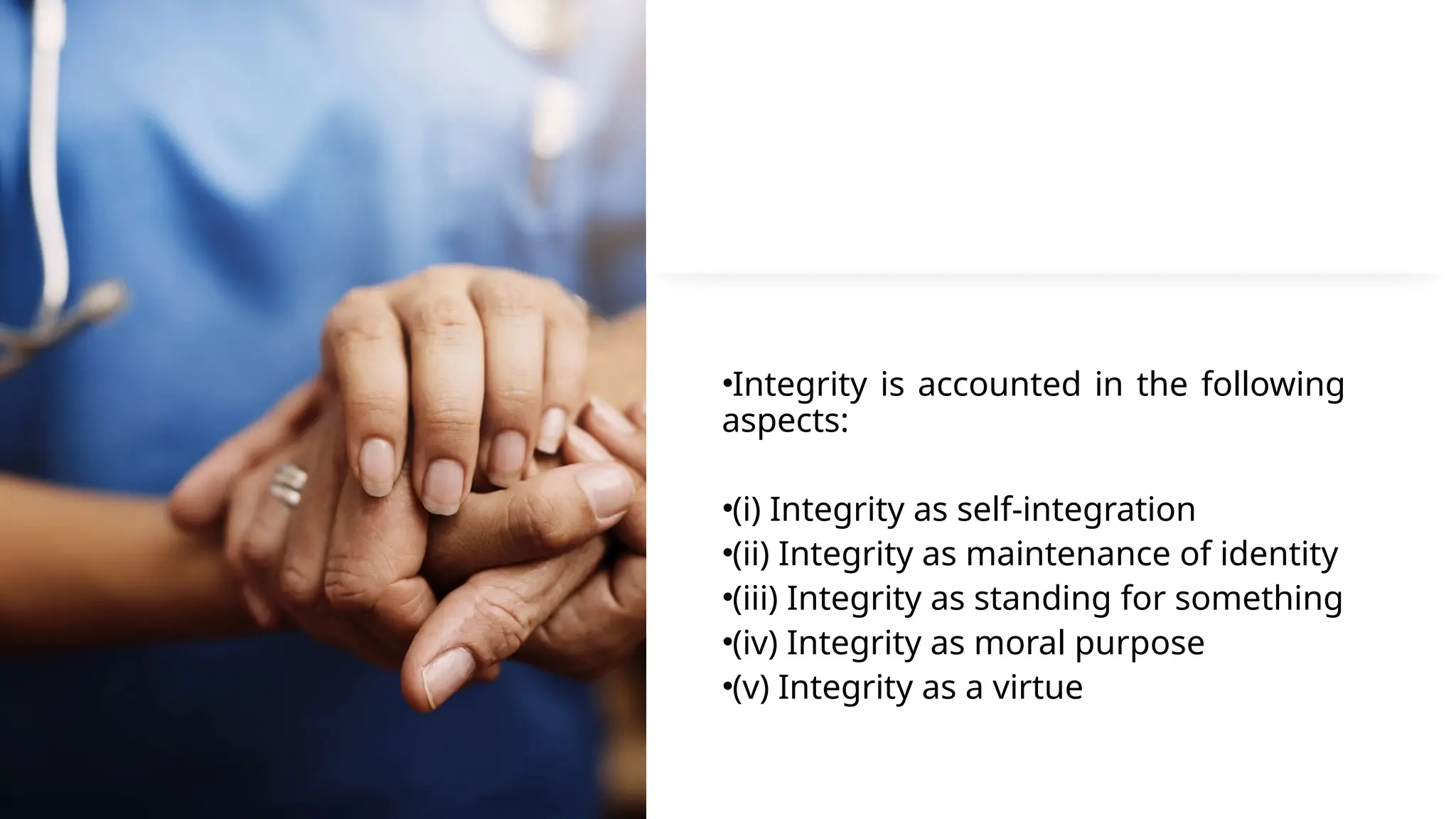
•Integrity is accountedin the following
aspects:
•(i) Integrity as self-integration
•(ii) Integrity as maintenance of identity
•(iii) Integrity as standing for something
•(iv) Integrity as moral purpose
•(v) Integrity as a virtue
13.
Viewing integrity asself-integration is a practice of integrating various parts of their personality into a
harmonious use.
It is a matter of keeping self intact and without corruption.
A specific identity has to be maintained in practicing integrity.
This action should be according to their commitments, not based on a certain acceptance of desires.
Integrity should not be just an act of consistency, but should stand for something.
As such the social character of integrity is a matter of a person’s proper regard for their best judgment.
Integrity in terms of moral purpose is uses dedication to the pursuit of a rural life.
Integrity is a complex and thick virtue.
Integrity stands as a means to various excesses.


![2018 Jun 29 [v] - Work Ethics for Professional Excellence - EEI [Please dow...](https://cdn.slidesharecdn.com/ss_thumbnails/2018jun29-v-workethicsforprofessionalexcellence-eei-180629135725-thumbnail.jpg?width=640&height=640&fit=bounds)


