IMAGING IN ELECTRO MAGNETIC (EM)
ENERGY SPECTRUM
MICROWAVE BAND
Report
Date of Submission: 13/12/2017
Group Members
 M.T. Dedigama - 3543
 W.M.B.T. Wanninayaka - 3604
 U.M.D.S. Jayawardhane - 3554
 Jayani Nawarathne - 3574
 M.A.A.D. Madurapperuma - 3564
 R.W.G.U.C.E. Premachandra- 3587
 A.R.V. Prabhathiya - 3586
 R.S. Pussepitiya - 3588
 K.G.S. Sumanasekara - 3597
Introduction
The electromagnetic (EM) spectrum is the range of all types of EM radiation. Radiation is energy that travels
and spreads out as it goes – the visible light that comes from a lamp in your house and the radio waves that
come from a radio station are two types of electromagnetic radiation. The other types of EM radiation that make
up the electromagnetic spectrum are microwaves , infrared light, ultraviolet light, X-rays and gamma rays. Here
we talk about how to imaging using electromagnetic (EM) spectrum.
Here we talk further about how to use Microwave band as an Image source.
Introduction-Microwave band
Microwaves are a form of electromagnetic radiation with wavelengths ranging from one meter to one
millimeter; with frequencies between 300 MHz (100 cm) and 300 GHz (0.1 cm). Microwave radiation will not
only cook your popcorn in just a few minutes, but also it also used by astronomers to learn about the structure of
nearby galaxies. Will discuss further about microwave band under four topics.
 Limits and Constraints
 How to form images
 Applications
 New researches on microwave
Limits and Constraints-Microwave band
 Microwaves are a form of electromagnetic radiation with wavelengths ranging from one meter to one
millimeter; with frequencies between 300 MHz (100 cm) and 300 GHz (0.1 cm).
 In radio engineering the range of a microwave is between 1 and 100 GHz (300 and 3 mm).
 In all cases, microwaves include the entire SHF band (3 to 30 GHz, or 10 to 1 cm) at minimum.
 Since microwave is an electro-magnetic wave (EM wave) it consists of all the characteristics of a EM
wave.
 Microwaves occupy a place in the electromagnetic spectrum between ordinary radio waves and infrared
light:
 Wavelength is about 1mm-1m
 Frequency of about 300GHz-300MHz
 It carries out photon energy of 1.24meV-1.24microeV
 Microwave too has a frequency band containing different areas with different frequencies and
wavelengths.
 Frequencies in the microwave range are often referred to by their IEEE radar band designations: S, C, X,
Ku, K, or Ka band, or by similar NATO or EU designations.
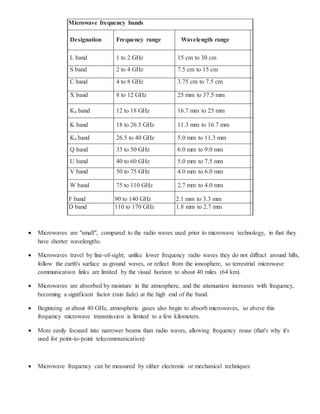
Microwave frequency bands
Designation Frequency range Wavelength range
L band 1 to 2 GHz 15 cm to 30 cm
S band 2 to 4 GHz 7.5 cm to 15 cm
C band 4 to 8 GHz 3.75 cm to 7.5 cm
X band 8 to 12 GHz 25 mm to 37.5 mm
Ku band 12 to 18 GHz 16.7 mm to 25 mm
K band 18 to 26.5 GHz 11.3 mm to 16.7 mm
Ka band 26.5 to 40 GHz 5.0 mm to 11.3 mm
Q band 33 to 50 GHz 6.0 mm to 9.0 mm
U band 40 to 60 GHz 5.0 mm to 7.5 mm
V band 50 to 75 GHz 4.0 mm to 6.0 mm
W band 75 to 110 GHz 2.7 mm to 4.0 mm
F band 90 to 140 GHz 2.1 mm to 3.3 mm
D band 110 to 170 GHz 1.8 mm to 2.7 mm
 Microwaves are "small", compared to the radio waves used prior to microwave technology, in that they
have shorter wavelengths.
 Microwaves travel by line-of-sight; unlike lower frequency radio waves they do not diffract around hills,
follow the earth's surface as ground waves, or reflect from the ionosphere, so terrestrial microwave
communication links are limited by the visual horizon to about 40 miles (64 km).
 Microwaves are absorbed by moisture in the atmosphere, and the attenuation increases with frequency,
becoming a significant factor (rain fade) at the high end of the band.
 Beginning at about 40 GHz, atmospheric gases also begin to absorb microwaves, so above this
frequency microwave transmission is limited to a few kilometers.
 More easily focused into narrower beams than radio waves, allowing frequency reuse (that's why it's
used for point-to-point telecommunication)
 Microwave frequency can be measured by either electronic or mechanical techniques
 Frequency counters or high frequency heterodyne systems can be used. Here the unknown frequency is
compared with harmonics of a known lower frequency by use of a low frequency generator, a harmonic
generator and a mixer. (Accuracy of the measurement is limited by the accuracy and stability of the
reference source.)
 Microwaves do not contain sufficient energy to chemically change substances by ionization, and so are
an example of non-ionizing radiation. But long-term exposure may have a carcinogenic effect.
 Exposure to microwave radiation can produce cataracts too, because the microwave heating denatures
proteins in the crystalline lens of the eye.
How to form images-Microwave band
Microwave imaging is a science which has been evolved from older detecting/locating techniques (e.g. radar)
in order to evaluate hidden or embedded objects in a structure (or media) using electromagnetic (EM) waves
in microwave regime (i.e., ~300 MHz-300 GHz). Engineering and application oriented microwave imaging
for non-destructive testing is called microwave testing
A general view of a microwave imaging system.
Applications-Microwave band
Microwave imaging has been used in a variety of applications such as:
 Nondestructive testing and evaluation (NDT&E)
 Medical imaging
 Concealed weapon detection at security check points
 Structural health monitoring
 Through-the-wall imaging.
Nondestructive testing and evaluation (NDT&E)
Microwave thermography (MWT) has many advantages including strong penetrability, selective heating,
volumetric heating, significant energy savings, uniform heating, and good thermal efficiency. MWT has
received growing interest due to its potential to overcome some of the limitations of microwave
nondestructive testing (NDT) and thermal NDT. Moreover, during the last few decades MWT has attracted
growing interest in materials assessment
Medicalimaging
Applications of Medical Imaging:-
 Breast cancer detection
 Stroke detection
 Bladder volume control
 Lung edema
 Bone analysis
Advantages: -
 non-invasive
 non-ionizing (MW)
 low-power
 potentially low-cost
 comfortable : no compression, quick
 differences in dielectric properties between the constituent tissues of the healthy and cancer
masses at MW frequencies in shallow parts of the body
How does Medical Microwave Imaging Radar work?
Concealedweapondetectionat security check points
 Recently, increasing terrors have been motivating the development of various concealed weapon
detection techniques for better security monitoring at airports, courthouses, and other buildings
[1–15].
 The ability to detect dangerous hidden items is seen as a significant tool in defeating terrorism in
today’s environment.
 However, it is monumentally difficult to timely detect concealed weapons carried on an
individual with conventional metal detectors.
 Since microwave possesses a unique property of passing transparently through materials such as
heavy clothing, it is possible to identify the presence of hidden threatening objects under
clothing with microwave imaging technique.
 In addition, microwave imaging systems eliminate the use of ionizing radiation such as those
present in X-ray systems and, therefore, pose no known health hazard at a low power.
 In the past few years, an increased interest has been addressed to three-dimensional (3D)
microwave imaging [16–22].
 The system has the capability of mapping the microwave reflectivity of an individual in 3D
space and providing the basis for detection, identification, and further automatic recognition
New researches on microwave

Micro Wave Band

  • 1.
    IMAGING IN ELECTROMAGNETIC (EM) ENERGY SPECTRUM MICROWAVE BAND Report Date of Submission: 13/12/2017 Group Members  M.T. Dedigama - 3543  W.M.B.T. Wanninayaka - 3604  U.M.D.S. Jayawardhane - 3554  Jayani Nawarathne - 3574  M.A.A.D. Madurapperuma - 3564  R.W.G.U.C.E. Premachandra- 3587  A.R.V. Prabhathiya - 3586  R.S. Pussepitiya - 3588  K.G.S. Sumanasekara - 3597
  • 2.
    Introduction The electromagnetic (EM)spectrum is the range of all types of EM radiation. Radiation is energy that travels and spreads out as it goes – the visible light that comes from a lamp in your house and the radio waves that come from a radio station are two types of electromagnetic radiation. The other types of EM radiation that make up the electromagnetic spectrum are microwaves , infrared light, ultraviolet light, X-rays and gamma rays. Here we talk about how to imaging using electromagnetic (EM) spectrum. Here we talk further about how to use Microwave band as an Image source.
  • 3.
    Introduction-Microwave band Microwaves area form of electromagnetic radiation with wavelengths ranging from one meter to one millimeter; with frequencies between 300 MHz (100 cm) and 300 GHz (0.1 cm). Microwave radiation will not only cook your popcorn in just a few minutes, but also it also used by astronomers to learn about the structure of nearby galaxies. Will discuss further about microwave band under four topics.  Limits and Constraints  How to form images  Applications  New researches on microwave Limits and Constraints-Microwave band  Microwaves are a form of electromagnetic radiation with wavelengths ranging from one meter to one millimeter; with frequencies between 300 MHz (100 cm) and 300 GHz (0.1 cm).  In radio engineering the range of a microwave is between 1 and 100 GHz (300 and 3 mm).  In all cases, microwaves include the entire SHF band (3 to 30 GHz, or 10 to 1 cm) at minimum.  Since microwave is an electro-magnetic wave (EM wave) it consists of all the characteristics of a EM wave.  Microwaves occupy a place in the electromagnetic spectrum between ordinary radio waves and infrared light:  Wavelength is about 1mm-1m  Frequency of about 300GHz-300MHz  It carries out photon energy of 1.24meV-1.24microeV  Microwave too has a frequency band containing different areas with different frequencies and wavelengths.  Frequencies in the microwave range are often referred to by their IEEE radar band designations: S, C, X, Ku, K, or Ka band, or by similar NATO or EU designations.
  • 4.
    Microwave frequency bands DesignationFrequency range Wavelength range L band 1 to 2 GHz 15 cm to 30 cm S band 2 to 4 GHz 7.5 cm to 15 cm C band 4 to 8 GHz 3.75 cm to 7.5 cm X band 8 to 12 GHz 25 mm to 37.5 mm Ku band 12 to 18 GHz 16.7 mm to 25 mm K band 18 to 26.5 GHz 11.3 mm to 16.7 mm Ka band 26.5 to 40 GHz 5.0 mm to 11.3 mm Q band 33 to 50 GHz 6.0 mm to 9.0 mm U band 40 to 60 GHz 5.0 mm to 7.5 mm V band 50 to 75 GHz 4.0 mm to 6.0 mm W band 75 to 110 GHz 2.7 mm to 4.0 mm F band 90 to 140 GHz 2.1 mm to 3.3 mm D band 110 to 170 GHz 1.8 mm to 2.7 mm  Microwaves are "small", compared to the radio waves used prior to microwave technology, in that they have shorter wavelengths.  Microwaves travel by line-of-sight; unlike lower frequency radio waves they do not diffract around hills, follow the earth's surface as ground waves, or reflect from the ionosphere, so terrestrial microwave communication links are limited by the visual horizon to about 40 miles (64 km).  Microwaves are absorbed by moisture in the atmosphere, and the attenuation increases with frequency, becoming a significant factor (rain fade) at the high end of the band.  Beginning at about 40 GHz, atmospheric gases also begin to absorb microwaves, so above this frequency microwave transmission is limited to a few kilometers.  More easily focused into narrower beams than radio waves, allowing frequency reuse (that's why it's used for point-to-point telecommunication)  Microwave frequency can be measured by either electronic or mechanical techniques
  • 5.
     Frequency countersor high frequency heterodyne systems can be used. Here the unknown frequency is compared with harmonics of a known lower frequency by use of a low frequency generator, a harmonic generator and a mixer. (Accuracy of the measurement is limited by the accuracy and stability of the reference source.)  Microwaves do not contain sufficient energy to chemically change substances by ionization, and so are an example of non-ionizing radiation. But long-term exposure may have a carcinogenic effect.  Exposure to microwave radiation can produce cataracts too, because the microwave heating denatures proteins in the crystalline lens of the eye.
  • 6.
    How to formimages-Microwave band Microwave imaging is a science which has been evolved from older detecting/locating techniques (e.g. radar) in order to evaluate hidden or embedded objects in a structure (or media) using electromagnetic (EM) waves in microwave regime (i.e., ~300 MHz-300 GHz). Engineering and application oriented microwave imaging for non-destructive testing is called microwave testing A general view of a microwave imaging system.
  • 7.
    Applications-Microwave band Microwave imaginghas been used in a variety of applications such as:  Nondestructive testing and evaluation (NDT&E)  Medical imaging  Concealed weapon detection at security check points  Structural health monitoring  Through-the-wall imaging. Nondestructive testing and evaluation (NDT&E) Microwave thermography (MWT) has many advantages including strong penetrability, selective heating, volumetric heating, significant energy savings, uniform heating, and good thermal efficiency. MWT has received growing interest due to its potential to overcome some of the limitations of microwave nondestructive testing (NDT) and thermal NDT. Moreover, during the last few decades MWT has attracted growing interest in materials assessment
  • 8.
    Medicalimaging Applications of MedicalImaging:-  Breast cancer detection  Stroke detection  Bladder volume control  Lung edema  Bone analysis Advantages: -  non-invasive  non-ionizing (MW)  low-power  potentially low-cost  comfortable : no compression, quick  differences in dielectric properties between the constituent tissues of the healthy and cancer masses at MW frequencies in shallow parts of the body How does Medical Microwave Imaging Radar work?
  • 9.
    How does MedicalMicrowave Imaging Radar work? Concealedweapondetectionat security check points  Recently, increasing terrors have been motivating the development of various concealed weapon detection techniques for better security monitoring at airports, courthouses, and other buildings [1–15].  The ability to detect dangerous hidden items is seen as a significant tool in defeating terrorism in today’s environment.  However, it is monumentally difficult to timely detect concealed weapons carried on an individual with conventional metal detectors.  Since microwave possesses a unique property of passing transparently through materials such as heavy clothing, it is possible to identify the presence of hidden threatening objects under clothing with microwave imaging technique.  In addition, microwave imaging systems eliminate the use of ionizing radiation such as those present in X-ray systems and, therefore, pose no known health hazard at a low power.  In the past few years, an increased interest has been addressed to three-dimensional (3D) microwave imaging [16–22].  The system has the capability of mapping the microwave reflectivity of an individual in 3D space and providing the basis for detection, identification, and further automatic recognition
  • 11.