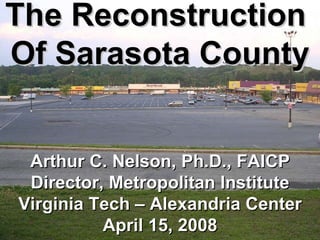
The Opportunity The Reconstruction  Of Sarasota County Arthur C. Nelson, Ph.D., FAICP Director, Metropolitan Institute Virginia Tech – Alexandria Center April 15, 2008
Overview Projections  Population projections based on national analysis adapted from Census by Arthur C. Nelson at the Metropolitan Institute and Virginia Tech.  Employment  projections based on Arthur C. Nelson adapted from Bureau of Economic Analysis for full- and part-time jobs (Florida BBER uses only full-time jobs). All projections intended only for “order of magnitude” change and not precision. Refined View of the Future In the past the future was told in terms of units and jobs. This presentation refines that analysis to include replacement of structures and to match demand with supply.
Themes Change is coming Demographics are changing needs  profoundly Most growth will be redevelopment Sarasota County could accommodate all  growth on existing parking lots.
America Grows 200 million in 1968 300 million in 2006 400 million in 2032 500 million in 2050 America adds 100 million people faster  than any other nation except India and Pakistan – But  faster  than China. Source : Arthur C. Nelson, Metropolitan Institute at Virginia Tech.
 
Getting Ahead of the Curve Sarasota County   2000   2040 Population   327,000   664,000 Housing Units   183,000   372,000 Jobs   192,000   450,000 Jobs/Housing Ratio (target is 1.40) 1.05 1.20 Surplus (Deficit)   70,000   82,000 Source : Arthur C. Nelson, Metropolitan Institute at Virginia Tech
Residential Development US 2000 to 2040 Growth-Related Units   190,000 Replaced Units   85,000 Total Units   275,000 Source : Arthur C. Nelson, Metropolitan Institute at Virginia Tech
Nonresidential Development US   2000 to 2040 Growth-Related Square Feet   95 million Replaced Square Feet   150 million Total Square Feet   245 million Source : Arthur C. Nelson, Metropolitan Institute at Virginia Tech
Life-Span of Building Function Source : Arthur C. Nelson, Metropolitan Institute at Virginia Tech based on DoE Commercial Buildings Energy Consumption Survey.
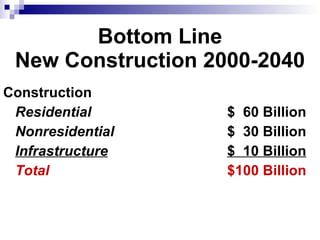
Bottom Line New Construction 2000-2040 Construction Residential $  60 Billion Nonresidential $  30 Billion Infrastructure $  10 Billion Total $100 Billion
How Does It Change?
What is the Resale Market  Telling Us? Resale prices of condominiums are  approaching resale prices of single- family homes for first time ever. Appreciation of condominiums is higher  than single-family homes nationally and  every region. However, Sarasota County hit with higher  than average condo speculation.
Emerging Resale Price Evidence   Trends During 2007 Region   SF%   CC% US   -1.2%   1.9% NE   2.4%  2.9% MW   -3.2%  4.2% S   -2.1%  0.8% W   -1.5%  0.0% SF includes detached and townhouse units. CC includes condominium and cooperative units. Source : Adapted from National Association of Realtors, March 2008, by Arthur C. Nelson, Metropolitan Institute at Virginia Tech.
Sale Price Trends Sarasota Co. Source:  http://www.sarasotarealtors.com/  accessed April 10, 2008.
“ Traditional” Households on the Wane – National Household Type   1960   2000   2040 HH with Children   48%   33%   28% HH without Children  52%  67%  72% Single-Person HH   13%   27%   29% Source : Arthur C. Nelson, Metropolitan Institute at Virginia Tech.
People Turning 65  Each  Year [Figures in 000s] Source:  US Census Bureau  – 65+ in the United States: 2005;  Wan He, Manisha Sengupta, Victoria A. Velkoff, & Kimberly A DeBarros.  December 2005 .
Share of Growth 2000-2040 HH Type Growth Share With children         9M   15% Without children   52M   85% Total new households   61M Single-person   21M  34% Figures in millions of households. Source : Adapted and extrapolated from Martha Farnsworth Riche,  How Changes in the Nation's Age and Household Structure Will Reshape Housing Demand in the 21st Century , HUD (2003).
What Futurists Tell Us Bio-medical advances extend lifetimes. Insurance actuarial tables extend to 120. Another 20 years added – minimum   Census says 76 to 96 Adulthood nearing 75% without child- rearing Gen-X & -Y making “family” location  decisions differently from their  parents
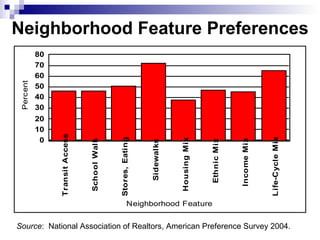
Neighborhood Feature Preferences Source :  National Association of Realtors, American Preference Survey 2004.
Unmet  Walkable  Demand Residential Form Boston Atlanta % want drivable suburbs     30%   41% % of those who have   85%   95% % want walkable suburbs   40%   29% % of those who have   70%   35% Source : Jonathan Levine,  Zoned Out , Resources for the Future, 2006.
Retired Location Preference In a city 14% In a suburb close to a city 37% Total “urban” 51% In a suburb away from a city 19% In a rural community 30% Suburbs away from cities are the losers Source : National Association of Realtors & Smart Growth America,  American Preference Survey 2004.
Housing Type Choices of Seniors Housing Type   All Seniors  Senior Movers Detached   69%   35% Attached   24%   54% Owner   80%   41% Source: American Housing Survey 2003.  New movers means moved in past year. Annual senior movers are about 5% of all senior households; 75%+ of all senior will change housing type between ages 65 and 80.
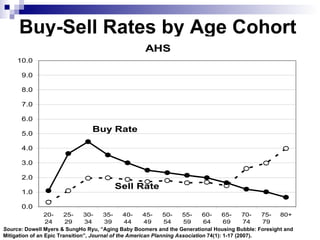
Buy-Sell Rates by Age Cohort Source:  Dowell Myers & SungHo Ryu, “Aging Baby Boomers and the Generational Housing Bubble: Foresight and Mitigation of an Epic Transition”,  Journal of the American Planning Association  74(1): 1-17 (2007).
Source:  Dowell Myers & SungHo Ryu, “Aging Baby Boomers and the Generational Housing Bubble: Foresight and Mitigation of an Epic Transition”,  Journal of the American Planning Association  74(1): 1-17 (2007). Figures for net buying or selling rate at age 65 – point of life cycle transition to selling. Net Buying or Selling Rates at Age 65 Sell Buy WEST MIDWEST SOUTH NORTHEAST
Housing Preference Surveys by Type, 1995-2004 Unit Type   Share Attached 38% Apartments 14% Condos, Coops   9%* Townhouses 15% Detached 62% Small Lot (<7,000 sf) 37% Large Lot (>7,000 sf) 25% Source :   Low range   of surveys reviewed by Arthur C. Nelson, “Planning for a New Era,”  Journal of the American Planning Association , Fall 2006. *Toll Brothers shifting product mix to 15% condominium;  WSJ  12/06.
Trend Demand 2005 - 2040 50% Attached (apartment, TH, condo, etc.) 30% Detached small/cluster/zero-lot 20% Conventional large-lot subdivision 80% = Traditional Urban Density
Large-Lot Oversupply 2030    Supply  Preference  Mid-Point Unit Type  2005 Change    Change Attached     39M   15M    13M Small Lot     12M   40M   22M Large Lot     58M   - 23M   - 3M Large lots subdivided, redeveloped = 7M. Figures in millions of units. Preference change based on low-range of preference survey averages. Mid-point is mid-percentage distribution between 2005 and low-range estimate of preference surveys and supply of occupied units in 2005.
Unmet Smart Growth Demand One-third of households want smart growth a 165M households in 2040 @ 33% = 55M  New housing demand 2000-2040 = 50M units If all new dwelling units were “smart growth” new  supply would not meet demand. Next 100 million = 33% smart growth demand a Gregg Logan, EPA Large-Production Builders Conference, January 31, 2007.
The Opportunity The New Promise Land?
Tear Up a Parking Lot, Rebuild Paradise Ability to Retrofit Low Impact Drainage Major infrastructure in place 4+ lane highway frontage    “transit-ready” “ Kelo”  problems avoided Committed to commercial/mixed use Can turn NIMBYs into YIMBYs Slide title phrase adapted from Joni Mitchell,  Big Yellow Taxi , refrain: “Pave over paradise, put up a parking lot.”
 
Actions Needed Systematically evaluate low-FAR areas for their  conversion ripeness over planning horizon Estimate share of growth conversion can  accommodate feasibly Evaluate feasibility of creating transit corridors Engage stakeholders now to create “sector” and  “form-based code” plans to grease the future Explore win-win financial tools to bridge near- term rate-of-return gap for long term gain
 
 
Sarasota County Parking Lot Building Capacity Calculation     Result Commercial Acres  Ripe  for  Redevelopment Acres by 2040   6,600 Average 25 dwellings @ 1,500sq.ft.  Average 40 jobs @ 500sq.ft.   1.3FAR [With “smart parking” policies & design] Percent Residential Absorption   100% Percent Employment Absorption   100%
FAR @ about 1.50    2-3 level
Invest Where People Want to Be Half the population (NAR) and 70+% of seniors  want transit options (AARP) ULI, PriceWaterhouseCoopers, others advise: Do not invest in suburban fringe Highest rates of return in redevelopment, infill Understand changing preferences   Affluent elderly who want urbane opportunities Growing number want to raise children in urbane settings Longer life spans increase adult-oriented preferences 33% and growing share want “green” living in  more dense urban/suburban areas
THANK YOU!

Nelson sarasota 4-15-08

  • 1.
    The Opportunity TheReconstruction Of Sarasota County Arthur C. Nelson, Ph.D., FAICP Director, Metropolitan Institute Virginia Tech – Alexandria Center April 15, 2008
  • 2.
    Overview Projections Population projections based on national analysis adapted from Census by Arthur C. Nelson at the Metropolitan Institute and Virginia Tech. Employment projections based on Arthur C. Nelson adapted from Bureau of Economic Analysis for full- and part-time jobs (Florida BBER uses only full-time jobs). All projections intended only for “order of magnitude” change and not precision. Refined View of the Future In the past the future was told in terms of units and jobs. This presentation refines that analysis to include replacement of structures and to match demand with supply.
  • 3.
    Themes Change iscoming Demographics are changing needs profoundly Most growth will be redevelopment Sarasota County could accommodate all growth on existing parking lots.
  • 4.
    America Grows 200million in 1968 300 million in 2006 400 million in 2032 500 million in 2050 America adds 100 million people faster than any other nation except India and Pakistan – But faster than China. Source : Arthur C. Nelson, Metropolitan Institute at Virginia Tech.
  • 5.
  • 6.
    Getting Ahead ofthe Curve Sarasota County 2000 2040 Population 327,000 664,000 Housing Units 183,000 372,000 Jobs 192,000 450,000 Jobs/Housing Ratio (target is 1.40) 1.05 1.20 Surplus (Deficit) 70,000 82,000 Source : Arthur C. Nelson, Metropolitan Institute at Virginia Tech
  • 7.
    Residential Development US2000 to 2040 Growth-Related Units 190,000 Replaced Units 85,000 Total Units 275,000 Source : Arthur C. Nelson, Metropolitan Institute at Virginia Tech
  • 8.
    Nonresidential Development US 2000 to 2040 Growth-Related Square Feet 95 million Replaced Square Feet 150 million Total Square Feet 245 million Source : Arthur C. Nelson, Metropolitan Institute at Virginia Tech
  • 9.
    Life-Span of BuildingFunction Source : Arthur C. Nelson, Metropolitan Institute at Virginia Tech based on DoE Commercial Buildings Energy Consumption Survey.
  • 10.
    Bottom Line NewConstruction 2000-2040 Construction Residential $ 60 Billion Nonresidential $ 30 Billion Infrastructure $ 10 Billion Total $100 Billion
  • 11.
    How Does ItChange?
  • 12.
    What is theResale Market Telling Us? Resale prices of condominiums are approaching resale prices of single- family homes for first time ever. Appreciation of condominiums is higher than single-family homes nationally and every region. However, Sarasota County hit with higher than average condo speculation.
  • 13.
    Emerging Resale PriceEvidence Trends During 2007 Region SF% CC% US -1.2% 1.9% NE 2.4% 2.9% MW -3.2% 4.2% S -2.1% 0.8% W -1.5% 0.0% SF includes detached and townhouse units. CC includes condominium and cooperative units. Source : Adapted from National Association of Realtors, March 2008, by Arthur C. Nelson, Metropolitan Institute at Virginia Tech.
  • 14.
    Sale Price TrendsSarasota Co. Source: http://www.sarasotarealtors.com/ accessed April 10, 2008.
  • 15.
    “ Traditional” Householdson the Wane – National Household Type 1960 2000 2040 HH with Children 48% 33% 28% HH without Children 52% 67% 72% Single-Person HH 13% 27% 29% Source : Arthur C. Nelson, Metropolitan Institute at Virginia Tech.
  • 16.
    People Turning 65 Each Year [Figures in 000s] Source: US Census Bureau – 65+ in the United States: 2005; Wan He, Manisha Sengupta, Victoria A. Velkoff, & Kimberly A DeBarros. December 2005 .
  • 17.
    Share of Growth2000-2040 HH Type Growth Share With children 9M 15% Without children 52M 85% Total new households 61M Single-person 21M 34% Figures in millions of households. Source : Adapted and extrapolated from Martha Farnsworth Riche, How Changes in the Nation's Age and Household Structure Will Reshape Housing Demand in the 21st Century , HUD (2003).
  • 18.
    What Futurists TellUs Bio-medical advances extend lifetimes. Insurance actuarial tables extend to 120. Another 20 years added – minimum  Census says 76 to 96 Adulthood nearing 75% without child- rearing Gen-X & -Y making “family” location decisions differently from their parents
  • 19.
    Neighborhood Feature PreferencesSource : National Association of Realtors, American Preference Survey 2004.
  • 20.
    Unmet Walkable Demand Residential Form Boston Atlanta % want drivable suburbs 30% 41% % of those who have 85% 95% % want walkable suburbs 40% 29% % of those who have 70% 35% Source : Jonathan Levine, Zoned Out , Resources for the Future, 2006.
  • 21.
    Retired Location PreferenceIn a city 14% In a suburb close to a city 37% Total “urban” 51% In a suburb away from a city 19% In a rural community 30% Suburbs away from cities are the losers Source : National Association of Realtors & Smart Growth America, American Preference Survey 2004.
  • 22.
    Housing Type Choicesof Seniors Housing Type All Seniors Senior Movers Detached 69% 35% Attached 24% 54% Owner 80% 41% Source: American Housing Survey 2003. New movers means moved in past year. Annual senior movers are about 5% of all senior households; 75%+ of all senior will change housing type between ages 65 and 80.
  • 23.
    Buy-Sell Rates byAge Cohort Source: Dowell Myers & SungHo Ryu, “Aging Baby Boomers and the Generational Housing Bubble: Foresight and Mitigation of an Epic Transition”, Journal of the American Planning Association 74(1): 1-17 (2007).
  • 24.
    Source: DowellMyers & SungHo Ryu, “Aging Baby Boomers and the Generational Housing Bubble: Foresight and Mitigation of an Epic Transition”, Journal of the American Planning Association 74(1): 1-17 (2007). Figures for net buying or selling rate at age 65 – point of life cycle transition to selling. Net Buying or Selling Rates at Age 65 Sell Buy WEST MIDWEST SOUTH NORTHEAST
  • 25.
    Housing Preference Surveysby Type, 1995-2004 Unit Type Share Attached 38% Apartments 14% Condos, Coops 9%* Townhouses 15% Detached 62% Small Lot (<7,000 sf) 37% Large Lot (>7,000 sf) 25% Source : Low range of surveys reviewed by Arthur C. Nelson, “Planning for a New Era,” Journal of the American Planning Association , Fall 2006. *Toll Brothers shifting product mix to 15% condominium; WSJ 12/06.
  • 26.
    Trend Demand 2005- 2040 50% Attached (apartment, TH, condo, etc.) 30% Detached small/cluster/zero-lot 20% Conventional large-lot subdivision 80% = Traditional Urban Density
  • 27.
    Large-Lot Oversupply 2030 Supply Preference Mid-Point Unit Type 2005 Change Change Attached 39M 15M 13M Small Lot 12M 40M 22M Large Lot 58M - 23M - 3M Large lots subdivided, redeveloped = 7M. Figures in millions of units. Preference change based on low-range of preference survey averages. Mid-point is mid-percentage distribution between 2005 and low-range estimate of preference surveys and supply of occupied units in 2005.
  • 28.
    Unmet Smart GrowthDemand One-third of households want smart growth a 165M households in 2040 @ 33% = 55M New housing demand 2000-2040 = 50M units If all new dwelling units were “smart growth” new supply would not meet demand. Next 100 million = 33% smart growth demand a Gregg Logan, EPA Large-Production Builders Conference, January 31, 2007.
  • 29.
    The Opportunity TheNew Promise Land?
  • 30.
    Tear Up aParking Lot, Rebuild Paradise Ability to Retrofit Low Impact Drainage Major infrastructure in place 4+ lane highway frontage  “transit-ready” “ Kelo” problems avoided Committed to commercial/mixed use Can turn NIMBYs into YIMBYs Slide title phrase adapted from Joni Mitchell, Big Yellow Taxi , refrain: “Pave over paradise, put up a parking lot.”
  • 31.
  • 32.
    Actions Needed Systematicallyevaluate low-FAR areas for their conversion ripeness over planning horizon Estimate share of growth conversion can accommodate feasibly Evaluate feasibility of creating transit corridors Engage stakeholders now to create “sector” and “form-based code” plans to grease the future Explore win-win financial tools to bridge near- term rate-of-return gap for long term gain
  • 33.
  • 34.
  • 35.
    Sarasota County ParkingLot Building Capacity Calculation Result Commercial Acres Ripe for Redevelopment Acres by 2040 6,600 Average 25 dwellings @ 1,500sq.ft. Average 40 jobs @ 500sq.ft. 1.3FAR [With “smart parking” policies & design] Percent Residential Absorption 100% Percent Employment Absorption 100%
  • 36.
    FAR @ about1.50  2-3 level
  • 37.
    Invest Where PeopleWant to Be Half the population (NAR) and 70+% of seniors want transit options (AARP) ULI, PriceWaterhouseCoopers, others advise: Do not invest in suburban fringe Highest rates of return in redevelopment, infill Understand changing preferences  Affluent elderly who want urbane opportunities Growing number want to raise children in urbane settings Longer life spans increase adult-oriented preferences 33% and growing share want “green” living in more dense urban/suburban areas
  • 38.

Editor's Notes

  • #32 This slide has many elements of new urbanist design in it: transit-oriented development, mixed use, and dense infills So that there is room for parks and other greenspaces. Notice the single-family homes beyond the main street, so the housing is meant to invoke the possibilities of different types of families. http://www.cnu.org/resources/index.cfm?formAction=image_bank_detail&amp;imagebank_id=690&amp;CFID=7218897&amp;CFTOKEN=70542539
  • #39 This slide has many elements of new urbanist design in it: transit-oriented development, mixed use, and dense infills So that there is room for parks and other greenspaces. Notice the single-family homes beyond the main street, so the housing is meant to invoke the possibilities of different types of families. http://www.cnu.org/resources/index.cfm?formAction=image_bank_detail&amp;imagebank_id=690&amp;CFID=7218897&amp;CFTOKEN=70542539