Antimatter Driven Sail for Deep Space ExplorationDeep ExplorationDr. Steven D. HoweDr. HoweDr. Gerald P. JacksonDr. JacksonHbar Technologies, LLCHbar LLC
““Any technology being presented to 
you at this workshop will need at 
least one miracle in development in 
order to enable an interstellar 
mission” - 
Dr. Steven D. Howe 
Interstellar Robotics Missions for the 21 21st st Century 
Workshop, JPL/Cal Tech, 1998
Velocities Required for Deep 
Space Missions 
4.5e14 
30,000 
A Centauri –– 
270,000 au –– 40 yrs 
7.2e11 
1200 
Oort Cloud Cloud- 
10,000 au au- 40 yrs 
6.8e09 
117 
Kuiper Belt Belt- 
250 au - 10 yrs 
Energy Density 
(j/kg) 
Velocity 
(km/s) 
MISSION
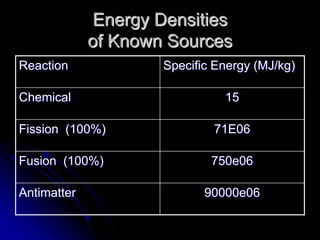
Energy Densities 
of Known Sources 
90000e06 
Antimatter 
750e06 
Fusion (100%) 
71E06 
Fission (100%) 
15 
Chemical 
Specific Energy (MJ/kg) 
Reaction
Antimatter Sail Concept 
zz Any conversion cycle to produce thrust that 
uses Local Thermodynamic Equilibrium 
(LET) will be heavy 
zz Antiprotons will induce fission in uranium 
with 100% efficiency 
zz Antiproton fission produces two products, 
(roughly Pd Pd-111) each with near 1 MeV/amu 
zz A particle with 1MeV/amu has a velocity of 
around 1.38X10 1.38X10⁷ m/s 
zz Thus, an Isp of over 1 million seconds is 
possible
Specific Impulse 
zz For a given mission and ΔΔV, an optimum 
V, specific impulse exists for minimum 
energy consumption 
zz Vex ex= 0.6 = ΔΔVmission mission 
zz Mass Massfinal final/Mass /Massinitial initial = .2 
zz For ΔΔV of 117 km/s, V V Vex ex=67 km/s 
=(Isp Isp=6800s) 
=
Variable Isp 
zz Sail concept may have the ability to adjust 
the Vex by varying the incident pbar energy 
or sail material 
zz Depositing the antiproton deep into the 
uranium may lead to multiple atom ejection 
resulting in increased thrust and reduced Isp 
zz Momentum is transferred by ingoing particle 
zz What is momentum from multi multi-atom burst? 
zz Mechanism causing burst is not known
Potential Advantages 
zz Extremely lightweight 
zz Does not require ultra thin sail material 
zz Ability to tack –– course correct 
zz Ability to stop 
zz Variable acceleration 
zz Variable Isp
Phase I
Missions 
zz An interstellar mission is the eventual goal but is 
very tough 
zz Kuiper Belt in 10 years demonstrates the 
architecture 
zz Did not consider periapsis pumping, gravity 
boosts or more complex transfers transfers- believe these 
are a 10 10-20% effect, i.e. 10km/s out of 100 km/s 
zz Assumed departure from 1AU orbit but beyond 
Earth orbit
Micro Payload 
zz Assume a total instrument payload of 10 
kg including communications 
zz JPL report report- Deutsch, Salvo, & Woerner –– 
10 10-50 kg by 2003 
zz JPL report –– Hemmati & Lesh –– ACLAIM: 
laser communications 
zz Interstellar Robotics Missions for the 21 21st st 
Century Workshop, 1998 1998- 10 kg
Sail Subsystem 
zz Uranium coated carbon 
zz Carbon is thick enough to stop FF 
zz Examined the use of carbon only only- Isp 
higher but not variable 
zz Key parameter is Nat Nat- #atoms/fission 
zz Diameter dictated by pellet expansion 
zz Temperature dictates max pbar rate 
zz Acceleration dictated by solar gravity
Sail Issues 
zz Ejection and expansion of antihydrogen 
pellet 
zz Uniformity of deposition is not critical due 
to carbon recoil contribution 
zz Single most critical factor is Nat –– if Nat is 
low then Isp is too high and mass goes up 
and thrust is insufficient.
Antimatter Storage
Antimatter Storage
Antimatter Storage 
zz Solid antihydrogen has energy density 
zz Pbar + positron ÆÆ Hbar (Athena Athena-2002) 
zz Hbar + Hbar ÆÆ H2bar bar 
zz H2bar bar ÆÆ condensation ÆÆ solid pellet 
zz Pellet + electrons ÆÆ pellet pelletn- 
zz 10 1014 14 H2bar bar has diameter of 160 μμ 
zz Pellets Pelletsn- are held in an electrostatic trap 
array
Storage issues 
zz Creation of solid H H2 pellet 
zz Confinement of pellet in macro macro-scale 
electrostatic trap 
zz Containment of H H2bar in trap? 
bar zz Condensation rate and confinement 
zz Formation and control of pellet 
zz Evaporation of pellet
Power 
zz RTGs have 88 kg/kW 
zz Voyager has 400 W and 35 kg 
zz This would require 238 GJ of energy (13 
mg pbars pbars) ) 
zz Had to develop new power source 
zz Have on on-board the highest energy source 
known 
zz Antimatter Fission Conversion (AFC)
AFC 
zz Utilize antiprotons extracted from storage 
just as in the propulsion system 
zz Impact conical receptor consisting of 
uranium coated scintillator 
zz Scintillator tailored to emit photons 
“matched” to photo photo-voltaic (PV) cell
AFC 
zz Wavelength of scintillator determines 
conversion efficiency –– 25 eV per photon 
required 
zz Must operate at high temperatures 
zz PV cell efficiencies and spectral response 
zz Conclude CdWO4 –– high light output at 
450 nm 
zz Total efficiency = .044 
zz Specific mass = 6.6 kg/ kw
Power Issues 
zz AFC needs Proof Proof-of of-Concept (POC) 
zz Temperature dependence is crucial 
zz Coupling to radiator in pulsed mode 
zz Z2 dependence could strongly impact 
design 
zz N2 emits at 350 nm (5 ev ev): can we find a 
): PV cell that works in that range? Potential 
efficiency = 8 8-10 %
System Studies
Technology roadmap 
zz Power 
zz Demonstrate AFC on planar disks 
zz Optimize for scintillator scintillator/PV Cell coupling 
/zz Evaluate temperature sensitivity 
zz Evaluate hetero vs homogeneous 
zz Demonstrate stand stand-alone prototype 
in space environment conditions
Technology Roadmap 
zz Antimatter Storage 
zz Demonstrate storage in electrostatic trap 
zz Demo storage of macro macro-particle 
zz Demo accumulation of hydrogen molecules 
into pellets 
zz Store pellets of SH SH2 in solid state units 
zz Improve formation rate of Hbar atoms 
zz Demo formation of H H2bar molecules 
bar
Technology Roadmap 
zz Antimatter Production 
zz Demonstrate deceleration of FNAL beam 
zz Construct cooling ring at FNAL –– 5e14/yr 
zz Improve current and production at FNAL FNAL- 
X100 to 1000 
zz Build new production machine optimized for 
pbar accumulation accumulation- 1-10 mg/yr
Phase II 
zz Detailed mission profiles with g assist, 
solar fly bys, 
zz Full technology path development 
zz Torsion experiment –– measure ΔΔp; ; ejecta 
zz AFC Power cell demonstration 
zz Storage –– electrostatic trap demo of pellet; 
pellet formation and vaporization
““Nat” is the Key 
zz Two experiments in the past indicate a 
range of 10,000 –– 100,000 atoms/fission 
zz NOT surface fission but volumetric 
zz NOT fast fission but SF 
zz Ejection mechanism may depend on light 
fragment/heavy fragment of normal fission 
zz Real question is what is the momentum 
transferred by the ejecta cloud
Summary 
zz Kuiper Belt mission in 10 years is possible with 
mg quantities of antihydrogen antihydrogen- not gm to kg 
zz Sail concept appears feasible IF Nat is above 
1000 
zz New power concept may be applicable to 
intrasolar system missions within next decade 
zz Pbar sail is the lowest mass/lowest energy 
consuming concept yet developed 
zz POCs can be performed in Phase II 
zz Concept may allow interstellar mission to be 
launched within next 2 decades
740 howe

740 howe

  • 1.
    Antimatter Driven Sailfor Deep Space ExplorationDeep ExplorationDr. Steven D. HoweDr. HoweDr. Gerald P. JacksonDr. JacksonHbar Technologies, LLCHbar LLC
  • 2.
    ““Any technology beingpresented to you at this workshop will need at least one miracle in development in order to enable an interstellar mission” - Dr. Steven D. Howe Interstellar Robotics Missions for the 21 21st st Century Workshop, JPL/Cal Tech, 1998
  • 6.
    Velocities Required forDeep Space Missions 4.5e14 30,000 A Centauri –– 270,000 au –– 40 yrs 7.2e11 1200 Oort Cloud Cloud- 10,000 au au- 40 yrs 6.8e09 117 Kuiper Belt Belt- 250 au - 10 yrs Energy Density (j/kg) Velocity (km/s) MISSION
  • 7.
    Energy Densities ofKnown Sources 90000e06 Antimatter 750e06 Fusion (100%) 71E06 Fission (100%) 15 Chemical Specific Energy (MJ/kg) Reaction
  • 11.
    Antimatter Sail Concept zz Any conversion cycle to produce thrust that uses Local Thermodynamic Equilibrium (LET) will be heavy zz Antiprotons will induce fission in uranium with 100% efficiency zz Antiproton fission produces two products, (roughly Pd Pd-111) each with near 1 MeV/amu zz A particle with 1MeV/amu has a velocity of around 1.38X10 1.38X10⁷ m/s zz Thus, an Isp of over 1 million seconds is possible
  • 12.
    Specific Impulse zzFor a given mission and ΔΔV, an optimum V, specific impulse exists for minimum energy consumption zz Vex ex= 0.6 = ΔΔVmission mission zz Mass Massfinal final/Mass /Massinitial initial = .2 zz For ΔΔV of 117 km/s, V V Vex ex=67 km/s =(Isp Isp=6800s) =
  • 14.
    Variable Isp zzSail concept may have the ability to adjust the Vex by varying the incident pbar energy or sail material zz Depositing the antiproton deep into the uranium may lead to multiple atom ejection resulting in increased thrust and reduced Isp zz Momentum is transferred by ingoing particle zz What is momentum from multi multi-atom burst? zz Mechanism causing burst is not known
  • 15.
    Potential Advantages zzExtremely lightweight zz Does not require ultra thin sail material zz Ability to tack –– course correct zz Ability to stop zz Variable acceleration zz Variable Isp
  • 16.
  • 17.
    Missions zz Aninterstellar mission is the eventual goal but is very tough zz Kuiper Belt in 10 years demonstrates the architecture zz Did not consider periapsis pumping, gravity boosts or more complex transfers transfers- believe these are a 10 10-20% effect, i.e. 10km/s out of 100 km/s zz Assumed departure from 1AU orbit but beyond Earth orbit
  • 19.
    Micro Payload zzAssume a total instrument payload of 10 kg including communications zz JPL report report- Deutsch, Salvo, & Woerner –– 10 10-50 kg by 2003 zz JPL report –– Hemmati & Lesh –– ACLAIM: laser communications zz Interstellar Robotics Missions for the 21 21st st Century Workshop, 1998 1998- 10 kg
  • 20.
    Sail Subsystem zzUranium coated carbon zz Carbon is thick enough to stop FF zz Examined the use of carbon only only- Isp higher but not variable zz Key parameter is Nat Nat- #atoms/fission zz Diameter dictated by pellet expansion zz Temperature dictates max pbar rate zz Acceleration dictated by solar gravity
  • 21.
    Sail Issues zzEjection and expansion of antihydrogen pellet zz Uniformity of deposition is not critical due to carbon recoil contribution zz Single most critical factor is Nat –– if Nat is low then Isp is too high and mass goes up and thrust is insufficient.
  • 22.
  • 23.
  • 26.
    Antimatter Storage zzSolid antihydrogen has energy density zz Pbar + positron ÆÆ Hbar (Athena Athena-2002) zz Hbar + Hbar ÆÆ H2bar bar zz H2bar bar ÆÆ condensation ÆÆ solid pellet zz Pellet + electrons ÆÆ pellet pelletn- zz 10 1014 14 H2bar bar has diameter of 160 μμ zz Pellets Pelletsn- are held in an electrostatic trap array
  • 29.
    Storage issues zzCreation of solid H H2 pellet zz Confinement of pellet in macro macro-scale electrostatic trap zz Containment of H H2bar in trap? bar zz Condensation rate and confinement zz Formation and control of pellet zz Evaporation of pellet
  • 30.
    Power zz RTGshave 88 kg/kW zz Voyager has 400 W and 35 kg zz This would require 238 GJ of energy (13 mg pbars pbars) ) zz Had to develop new power source zz Have on on-board the highest energy source known zz Antimatter Fission Conversion (AFC)
  • 31.
    AFC zz Utilizeantiprotons extracted from storage just as in the propulsion system zz Impact conical receptor consisting of uranium coated scintillator zz Scintillator tailored to emit photons “matched” to photo photo-voltaic (PV) cell
  • 32.
    AFC zz Wavelengthof scintillator determines conversion efficiency –– 25 eV per photon required zz Must operate at high temperatures zz PV cell efficiencies and spectral response zz Conclude CdWO4 –– high light output at 450 nm zz Total efficiency = .044 zz Specific mass = 6.6 kg/ kw
  • 34.
    Power Issues zzAFC needs Proof Proof-of of-Concept (POC) zz Temperature dependence is crucial zz Coupling to radiator in pulsed mode zz Z2 dependence could strongly impact design zz N2 emits at 350 nm (5 ev ev): can we find a ): PV cell that works in that range? Potential efficiency = 8 8-10 %
  • 35.
  • 41.
    Technology roadmap zzPower zz Demonstrate AFC on planar disks zz Optimize for scintillator scintillator/PV Cell coupling /zz Evaluate temperature sensitivity zz Evaluate hetero vs homogeneous zz Demonstrate stand stand-alone prototype in space environment conditions
  • 42.
    Technology Roadmap zzAntimatter Storage zz Demonstrate storage in electrostatic trap zz Demo storage of macro macro-particle zz Demo accumulation of hydrogen molecules into pellets zz Store pellets of SH SH2 in solid state units zz Improve formation rate of Hbar atoms zz Demo formation of H H2bar molecules bar
  • 43.
    Technology Roadmap zzAntimatter Production zz Demonstrate deceleration of FNAL beam zz Construct cooling ring at FNAL –– 5e14/yr zz Improve current and production at FNAL FNAL- X100 to 1000 zz Build new production machine optimized for pbar accumulation accumulation- 1-10 mg/yr
  • 45.
    Phase II zzDetailed mission profiles with g assist, solar fly bys, zz Full technology path development zz Torsion experiment –– measure ΔΔp; ; ejecta zz AFC Power cell demonstration zz Storage –– electrostatic trap demo of pellet; pellet formation and vaporization
  • 46.
    ““Nat” is theKey zz Two experiments in the past indicate a range of 10,000 –– 100,000 atoms/fission zz NOT surface fission but volumetric zz NOT fast fission but SF zz Ejection mechanism may depend on light fragment/heavy fragment of normal fission zz Real question is what is the momentum transferred by the ejecta cloud
  • 48.
    Summary zz KuiperBelt mission in 10 years is possible with mg quantities of antihydrogen antihydrogen- not gm to kg zz Sail concept appears feasible IF Nat is above 1000 zz New power concept may be applicable to intrasolar system missions within next decade zz Pbar sail is the lowest mass/lowest energy consuming concept yet developed zz POCs can be performed in Phase II zz Concept may allow interstellar mission to be launched within next 2 decades