Session introduction 
Reproducibility of computational research: 
methods to avoid madness 
Chair: Michael Hucka, Ph.D. 
Department of Computing and Mathematical Sciences 
California Institute of Technology 
Pasadena, CA, USA 
ICSB 2014, Melbourne, Australia, September 2014
So, what’s this about reproducibility?
“In biomedical science, at least one 
thing is apparently reproducible: a 
steady stream of studies that show 
the irreproducibility of many 
important experiments …” 
— Wadman. (2013). Nature, 500(7460).
“We find it utterly unexpected that, overall, 
it is only a minority of articles that properly 
describe (in a reproducible way) the 
computational research performed …” 
— Hübner, Sahle & Kummer. (2011). FEBS Journal 278(16).
What is the focus of this session?
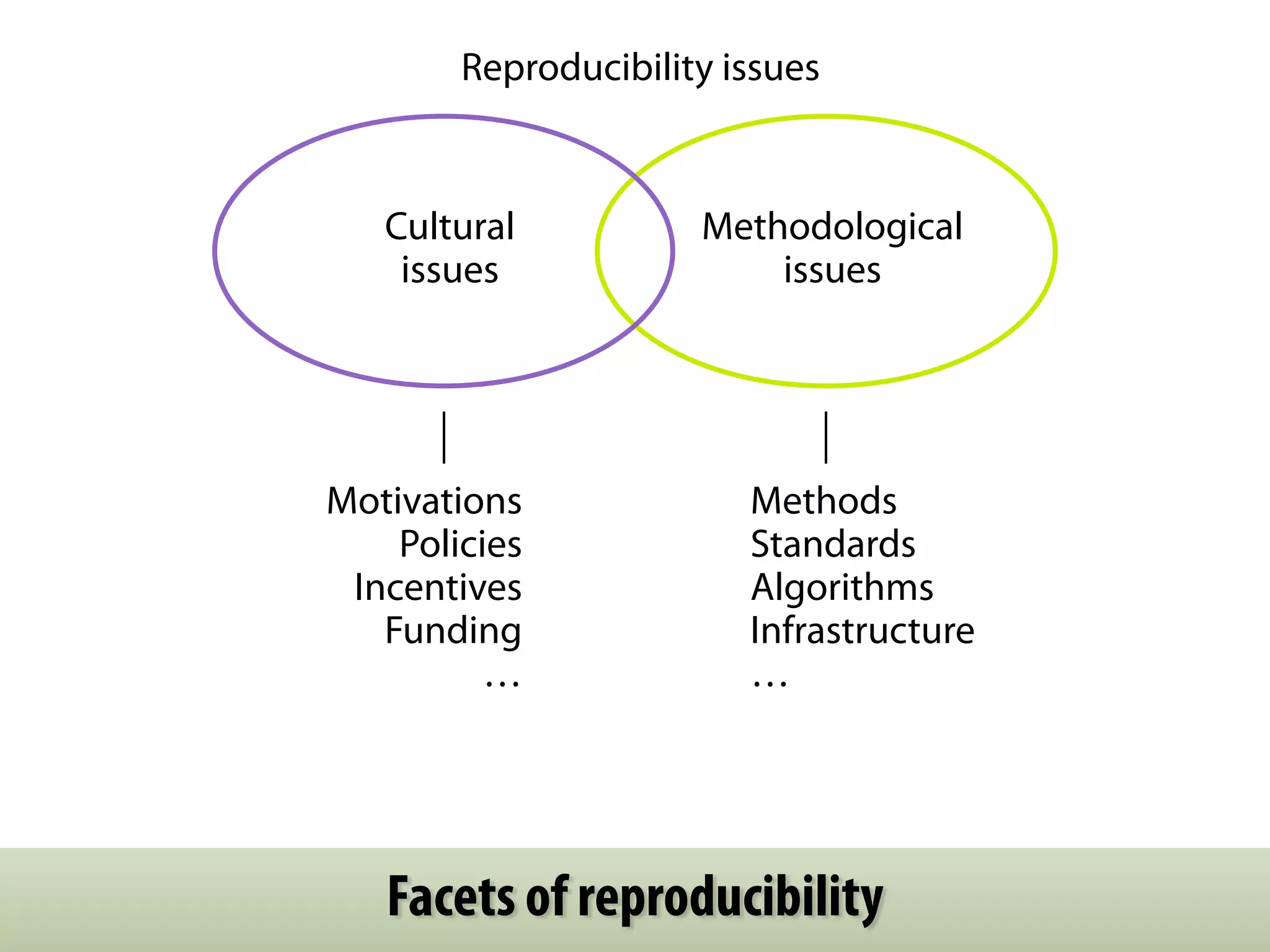
Reproducibility issues 
Methodological 
issues 
Cultural 
issues 
Motivations 
Policies 
Incentives 
Funding 
… 
Methods 
Standards 
Algorithms 
Infrastructure 
… 
Facets of reproducibility
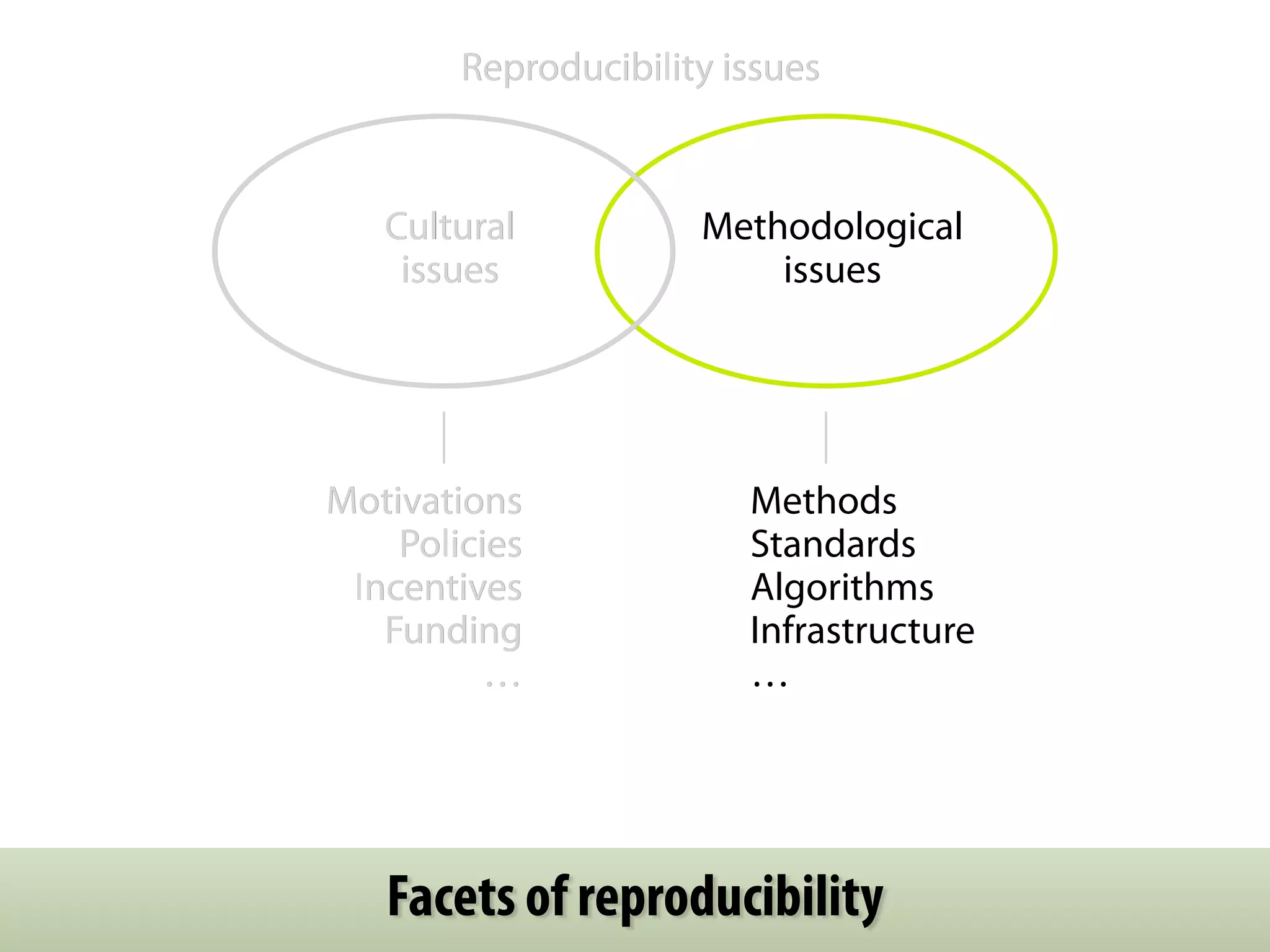
Reproducibility issues 
Methodological 
issues 
Cultural 
issues 
Motivations 
Policies 
Incentives 
Funding 
… 
Methods 
Standards 
Algorithms 
Infrastructure 
… 
Facets of reproducibility
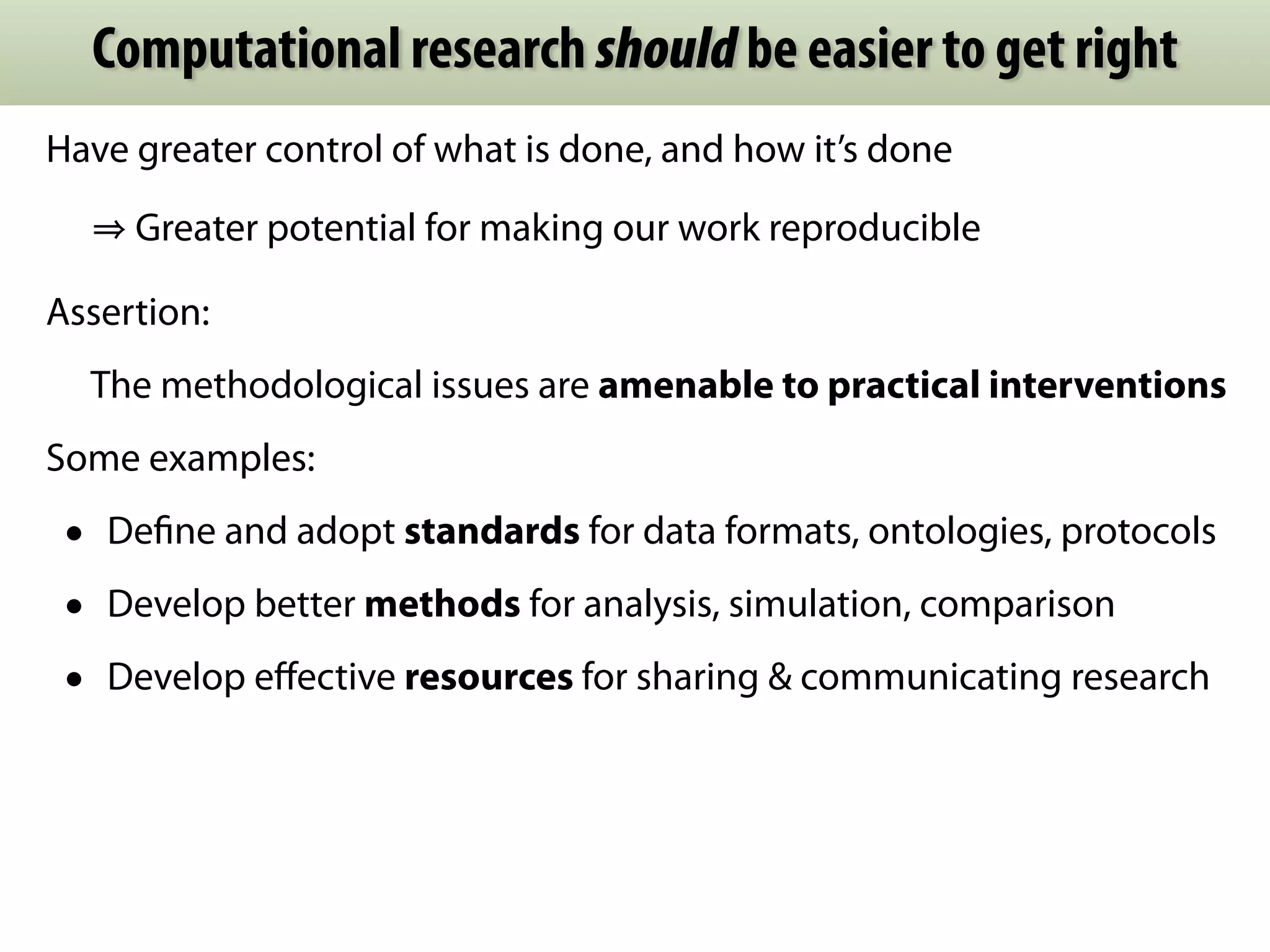
Computational research should be easier to get right 
Have greater control of what is done, and how it’s done 
⇒ Greater potential for making our work reproducible 
Assertion: 
The methodological issues are amenable to practical interventions 
Some examples: 
• Define and adopt standards for data formats, ontologies, protocols 
• Develop better methods for analysis, simulation, comparison 
• Develop effective resources for sharing & communicating research
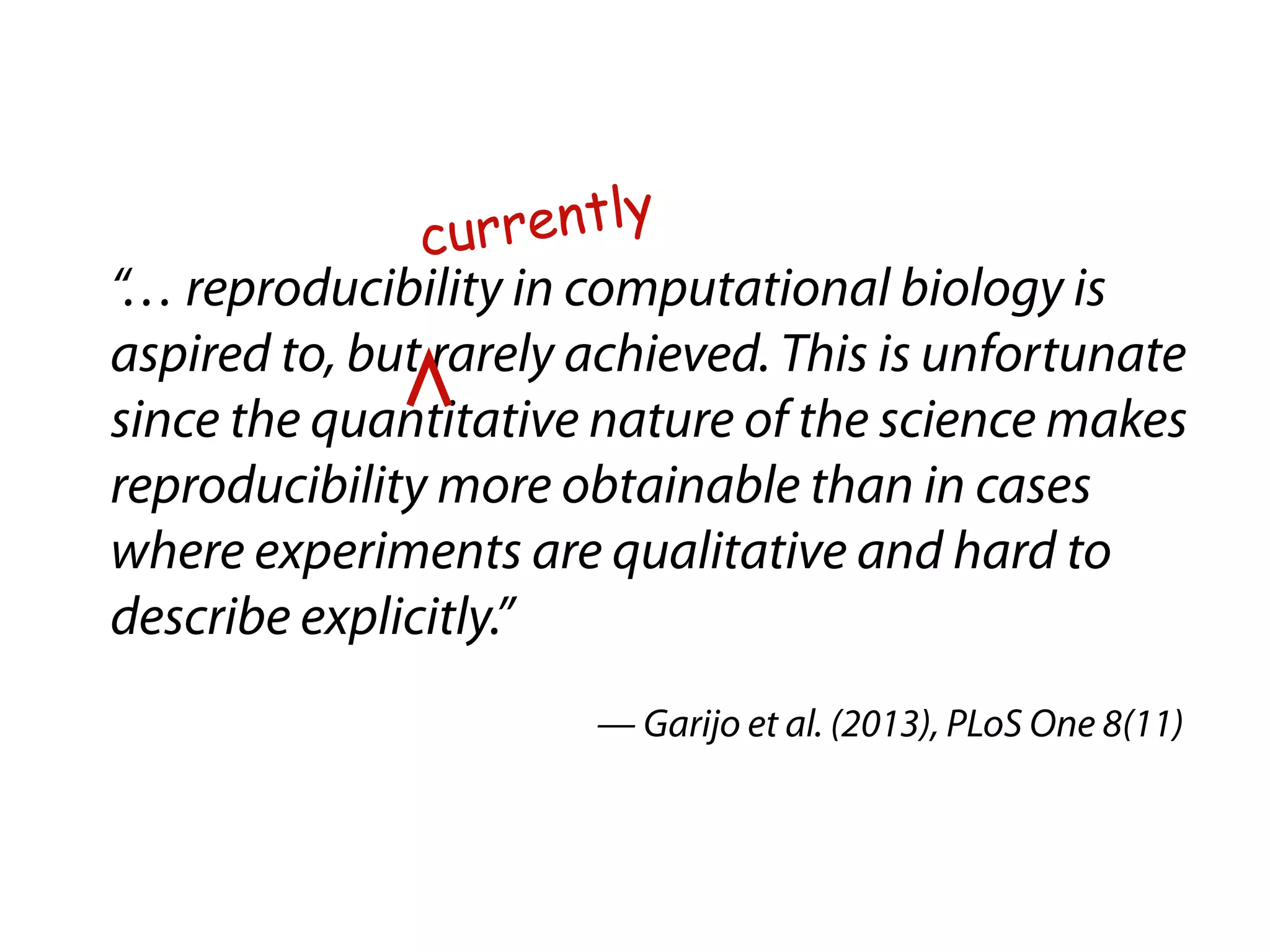
“… reproducibility in computational biology is 
aspired to, but rarely achieved. This is unfortunate 
since the quantitative nature of the science makes 
reproducibility more obtainable than in cases 
where experiments are qualitative and hard to 
describe explicitly.” 
— Garijo et al. (2013), PLoS One 8(11)
currently 
“… reproducibility in computational biology is 
aspired to, but rarely achieved. This is unfortunate 
since the quantitative nature of the science makes 
reproducibility more obtainable than in cases 
where experiments are qualitative and hard to 
describe explicitly.” 
— Garijo et al. (2013), PLoS One 8(11)
What will be covered in this session?
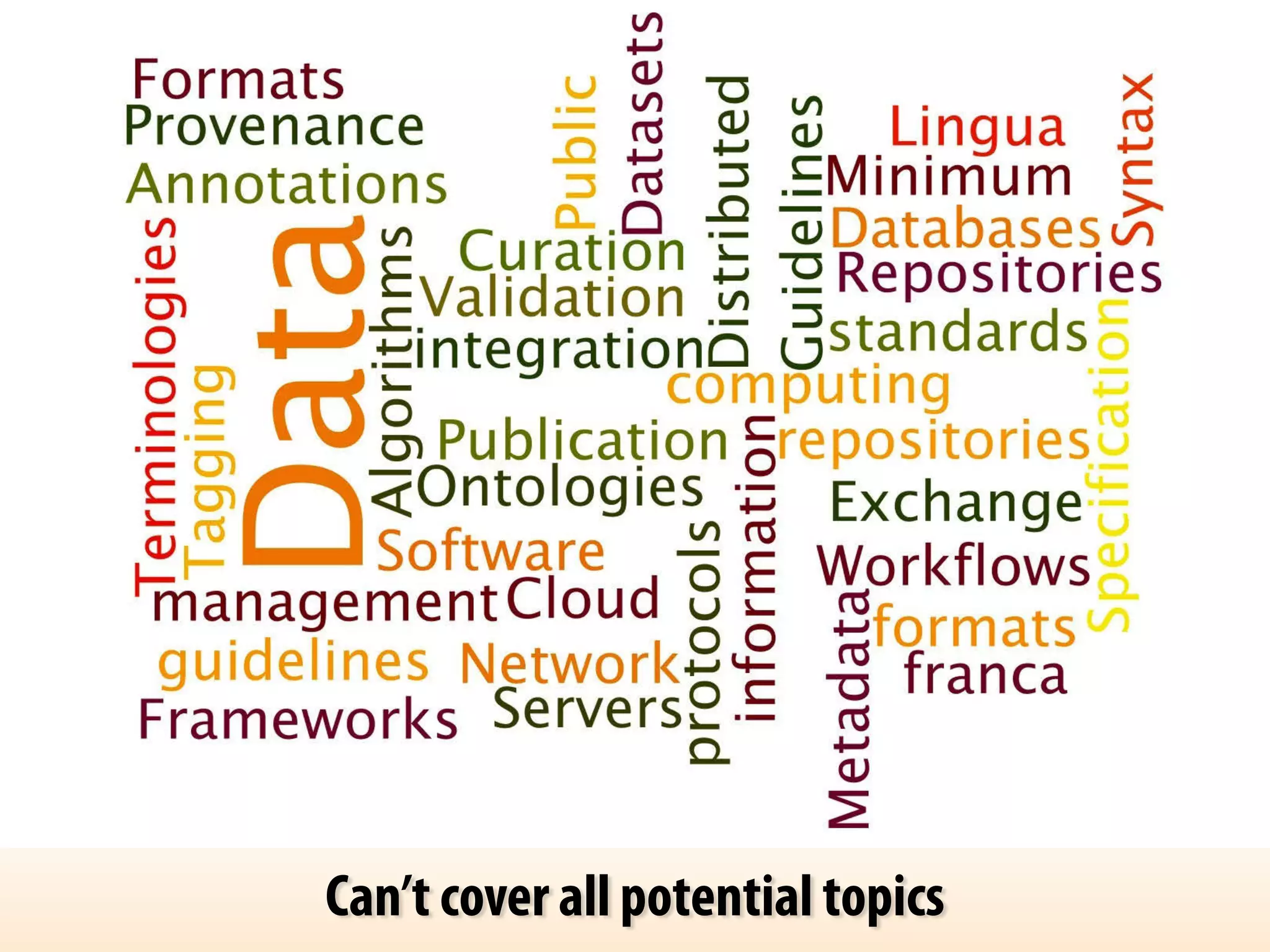
Can’t cover all potential topics
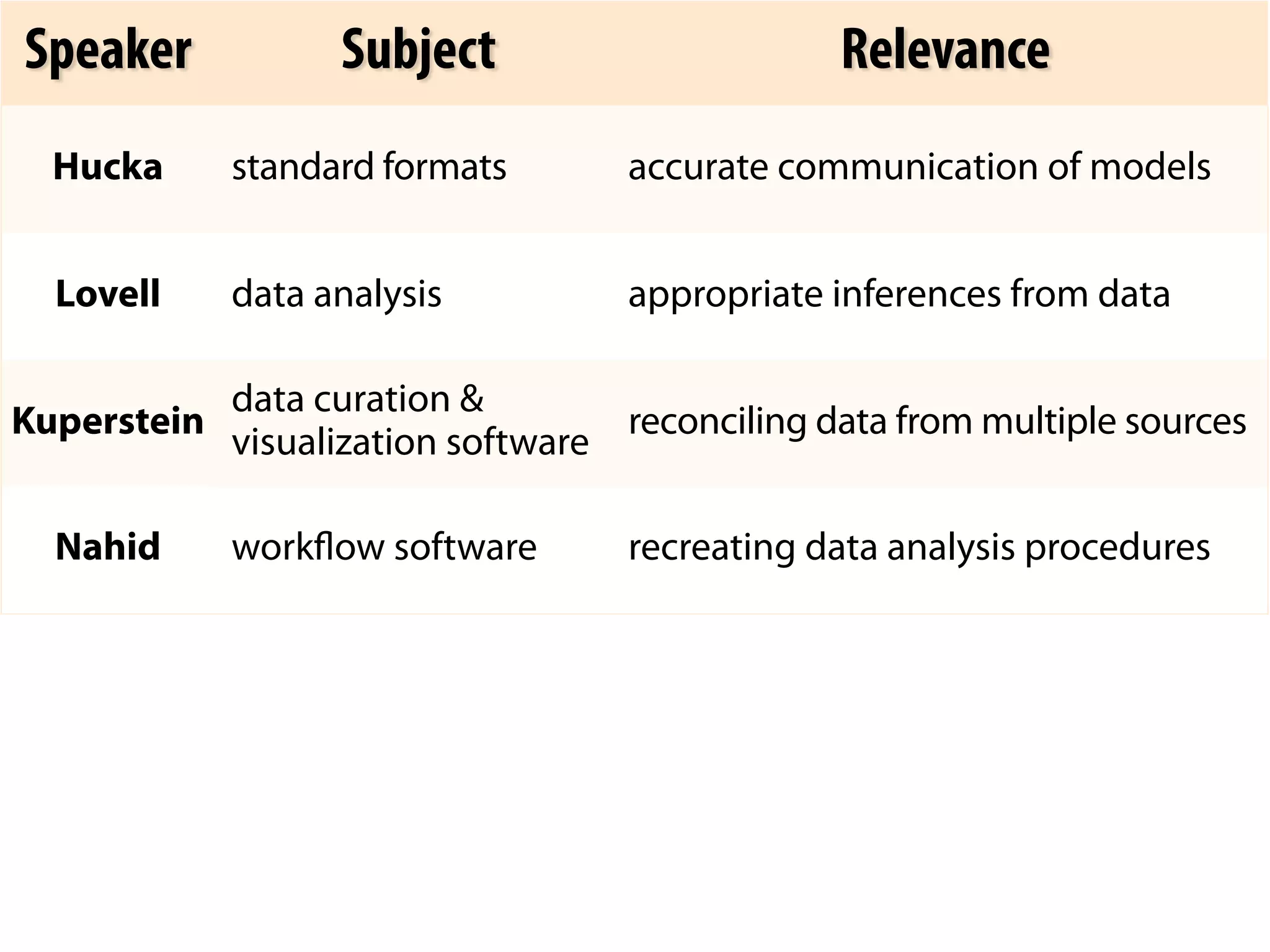
Speaker Subject Relevance 
Hucka standard formats accurate communication of models 
Lovell data analysis appropriate inferences from data 
Kuperstein data curation & 
visualization software reconciling data from multiple sources 
Nahid workflow software recreating data analysis procedures

Reproducibility of computational research: methods to avoid madness (Session introduction)

  • 1.
    Session introduction Reproducibilityof computational research: methods to avoid madness Chair: Michael Hucka, Ph.D. Department of Computing and Mathematical Sciences California Institute of Technology Pasadena, CA, USA ICSB 2014, Melbourne, Australia, September 2014
  • 2.
    So, what’s thisabout reproducibility?
  • 4.
    “In biomedical science,at least one thing is apparently reproducible: a steady stream of studies that show the irreproducibility of many important experiments …” — Wadman. (2013). Nature, 500(7460).
  • 6.
    “We find itutterly unexpected that, overall, it is only a minority of articles that properly describe (in a reproducible way) the computational research performed …” — Hübner, Sahle & Kummer. (2011). FEBS Journal 278(16).
  • 7.
    What is thefocus of this session?
  • 8.
    Reproducibility issues Methodological issues Cultural issues Motivations Policies Incentives Funding … Methods Standards Algorithms Infrastructure … Facets of reproducibility
  • 9.
    Reproducibility issues Methodological issues Cultural issues Motivations Policies Incentives Funding … Methods Standards Algorithms Infrastructure … Facets of reproducibility
  • 10.
    Computational research shouldbe easier to get right Have greater control of what is done, and how it’s done ⇒ Greater potential for making our work reproducible Assertion: The methodological issues are amenable to practical interventions Some examples: • Define and adopt standards for data formats, ontologies, protocols • Develop better methods for analysis, simulation, comparison • Develop effective resources for sharing & communicating research
  • 11.
    “… reproducibility incomputational biology is aspired to, but rarely achieved. This is unfortunate since the quantitative nature of the science makes reproducibility more obtainable than in cases where experiments are qualitative and hard to describe explicitly.” — Garijo et al. (2013), PLoS One 8(11)
  • 12.
    currently “… reproducibilityin computational biology is aspired to, but rarely achieved. This is unfortunate since the quantitative nature of the science makes reproducibility more obtainable than in cases where experiments are qualitative and hard to describe explicitly.” — Garijo et al. (2013), PLoS One 8(11)
  • 13.
    What will becovered in this session?
  • 14.
    Can’t cover allpotential topics
  • 15.
    Speaker Subject Relevance Hucka standard formats accurate communication of models Lovell data analysis appropriate inferences from data Kuperstein data curation & visualization software reconciling data from multiple sources Nahid workflow software recreating data analysis procedures