Standards and software: practical aids for 
reproducibility of computational research 
in systems biology 
Michael Hucka, Ph.D. (on behalf of many) 
Department of Computing and Mathematical Sciences 
California Institute of Technology 
Pasadena, CA, USA 
Email: mhucka@caltech.edu Twitter: @mhucka 
ICSB 2014, Melbourne, Australia, September 2014
SBML as enabler 
The COMBINE family of standardization efforts 
Examples of growing software capabilities 
Outline
SBML as enabler
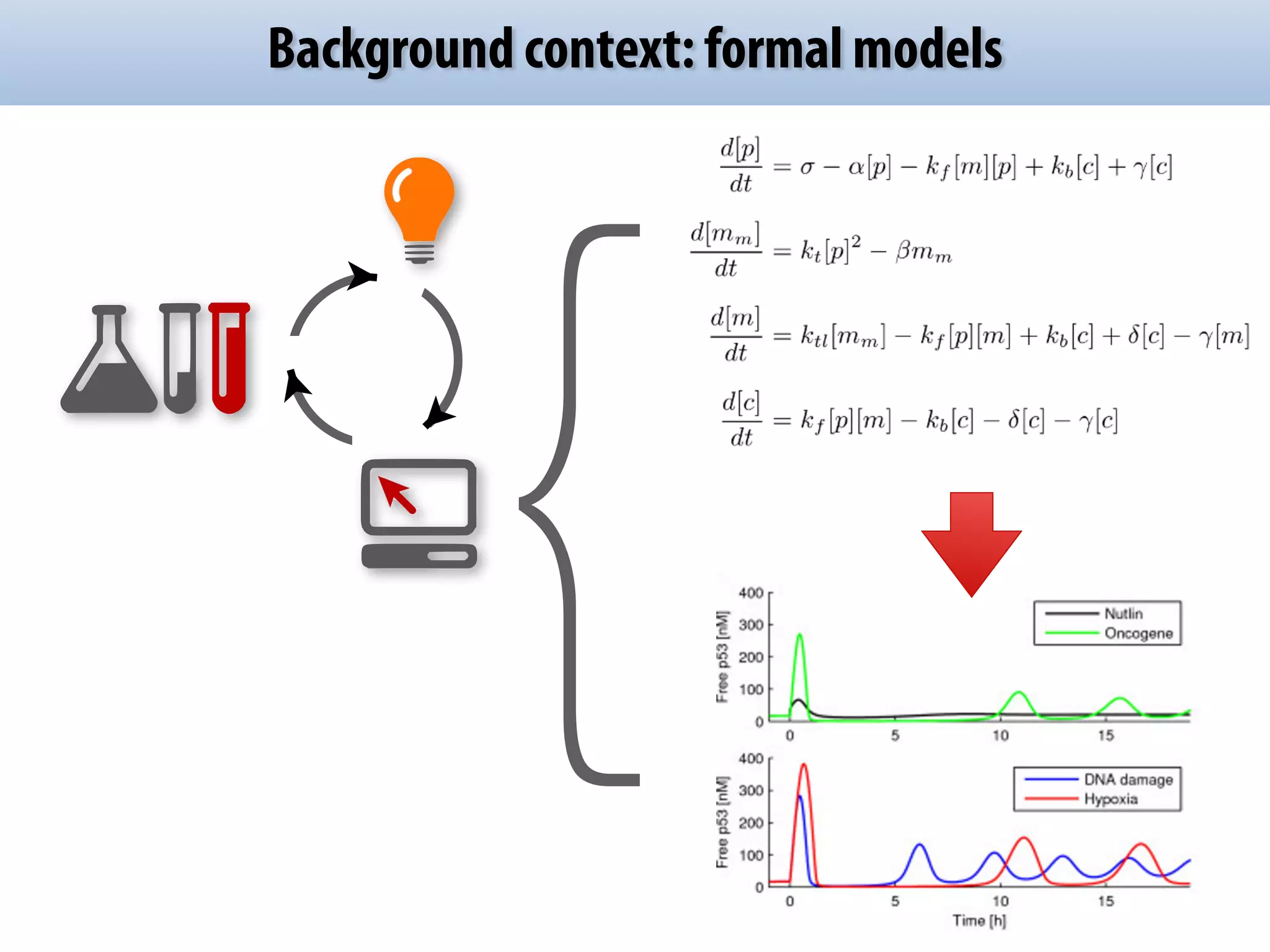
Background context: formal models {
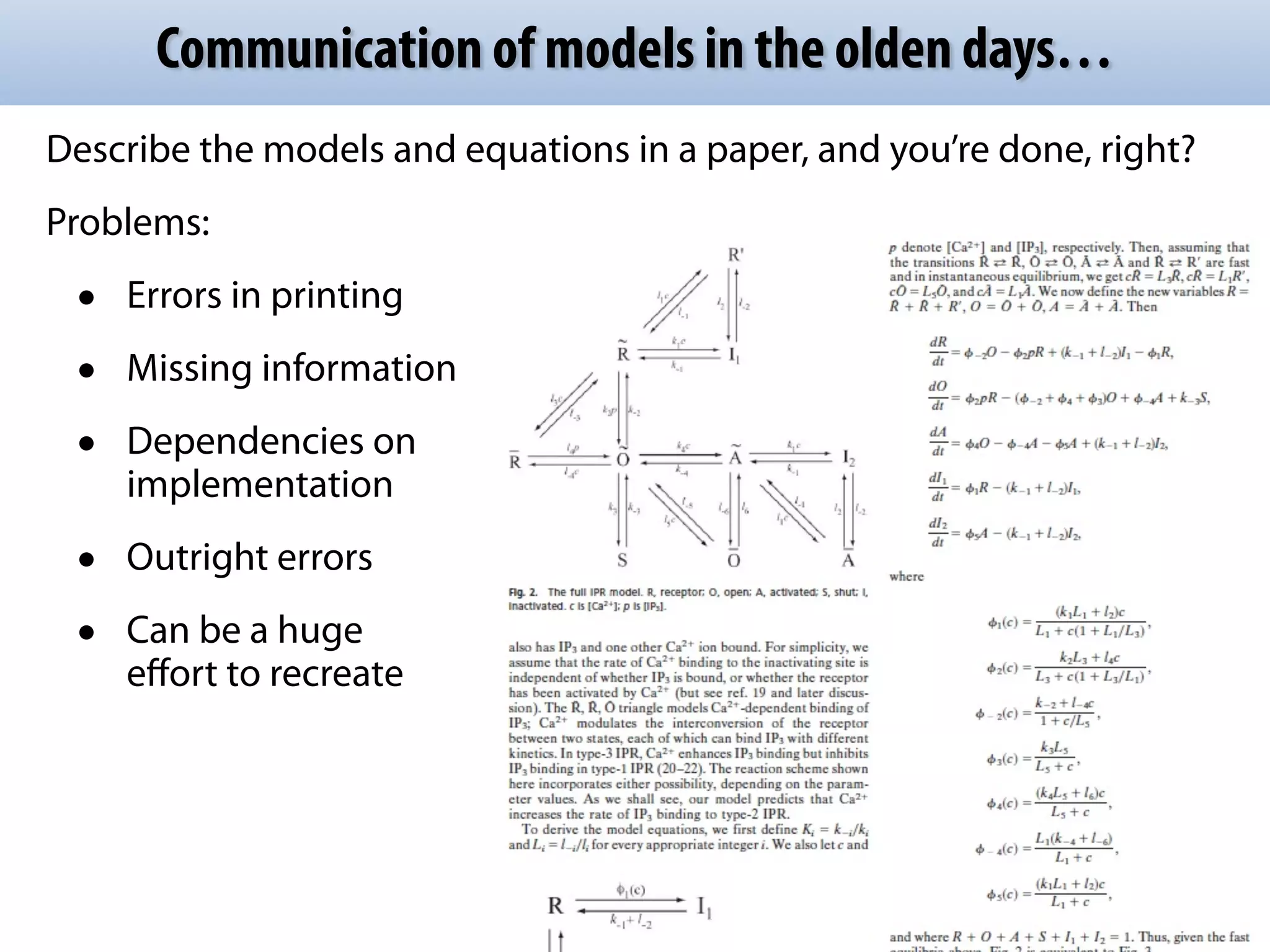
Communication of models in the olden days… 
Describe the models and equations in a paper, and you’re done, right? 
Problems: 
• Errors in printing 
• Missing information 
• Dependencies on 
implementation 
• Outright errors 
• Can be a huge 
effort to recreate
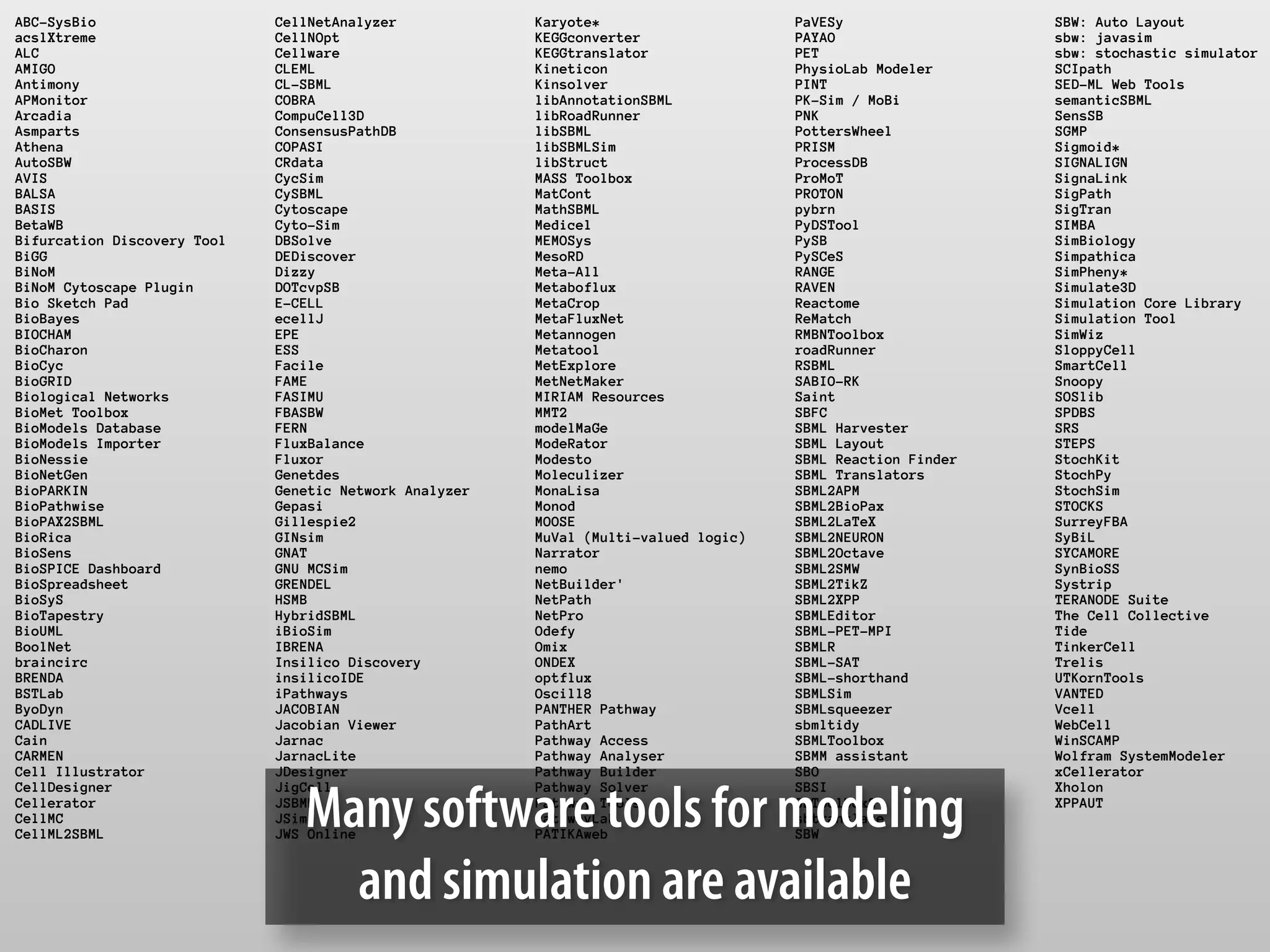
ABC-SysBio CellNetAnalyzer Karyote* PaVESy SBW: Auto Layout 
acslXtreme CellNOpt KEGGconverter PAYAO sbw: javasim 
ALC Cellware KEGGtranslator PET sbw: stochastic simulator 
AMIGO CLEML Kineticon PhysioLab Modeler SCIpath 
Antimony CL-SBML Kinsolver PINT SED-ML Web Tools 
APMonitor COBRA libAnnotationSBML PK-Sim / MoBi semanticSBML 
Arcadia CompuCell3D libRoadRunner PNK SensSB 
Asmparts ConsensusPathDB libSBML PottersWheel SGMP 
Athena COPASI libSBMLSim PRISM Sigmoid* 
AutoSBW CRdata libStruct ProcessDB SIGNALIGN 
AVIS CycSim MASS Toolbox ProMoT SignaLink 
BALSA CySBML MatCont PROTON SigPath 
BASIS Cytoscape MathSBML pybrn SigTran 
BetaWB Cyto-Sim Medicel PyDSTool SIMBA 
Bifurcation Discovery Tool DBSolve MEMOSys PySB SimBiology 
BiGG DEDiscover MesoRD PySCeS Simpathica 
BiNoM Dizzy Meta-All RANGE SimPheny* 
BiNoM Cytoscape Plugin DOTcvpSB Metaboflux RAVEN Simulate3D 
Bio Sketch Pad E-CELL MetaCrop Reactome Simulation Core Library 
BioBayes ecellJ MetaFluxNet ReMatch Simulation Tool 
BIOCHAM EPE Metannogen RMBNToolbox SimWiz 
BioCharon ESS Metatool roadRunner SloppyCell 
BioCyc Facile MetExplore RSBML SmartCell 
BioGRID FAME MetNetMaker SABIO-RK Snoopy 
Biological Networks FASIMU MIRIAM Resources Saint SOSlib 
BioMet Toolbox FBASBW MMT2 SBFC SPDBS 
BioModels Database FERN modelMaGe SBML Harvester SRS 
BioModels Importer FluxBalance ModeRator SBML Layout STEPS 
BioNessie Fluxor Modesto SBML Reaction Finder StochKit 
BioNetGen Genetdes Moleculizer SBML Translators StochPy 
BioPARKIN Genetic Network Analyzer MonaLisa SBML2APM StochSim 
BioPathwise Gepasi Monod SBML2BioPax STOCKS 
BioPAX2SBML Gillespie2 MOOSE SBML2LaTeX SurreyFBA 
BioRica GINsim MuVal (Multi-valued logic) SBML2NEURON SyBiL 
BioSens GNAT Narrator SBML2Octave SYCAMORE 
BioSPICE Dashboard GNU MCSim nemo SBML2SMW SynBioSS 
BioSpreadsheet GRENDEL NetBuilder' SBML2TikZ Systrip 
BioSyS HSMB NetPath SBML2XPP TERANODE Suite 
BioTapestry HybridSBML NetPro SBMLEditor The Cell Collective 
BioUML iBioSim Odefy SBML-PET-MPI Tide 
BoolNet IBRENA Omix SBMLR TinkerCell 
braincirc Insilico Discovery ONDEX SBML-SAT Trelis 
BRENDA insilicoIDE optflux SBML-shorthand UTKornTools 
BSTLab iPathways Oscill8 SBMLSim VANTED 
ByoDyn JACOBIAN PANTHER Pathway SBMLsqueezer Vcell 
CADLIVE Jacobian Viewer PathArt sbmltidy WebCell 
Cain Jarnac Pathway Access SBMLToolbox WinSCAMP 
CARMEN JarnacLite Pathway Analyser SBMM assistant Wolfram SystemModeler 
Cell Illustrator JDesigner Pathway Builder SBO xCellerator 
CellDesigner JigCell Pathway Solver SBSI Xholon 
Cellerator JSBML Pathway Tools SBToolbox2 XPPAUT 
CellMC JSim PathwayLab sbtranslate 
CellML2SBML JWS Online PATIKAweb SBW Many software tools for modeling 
and simulation are available
https://www.behance.net/gallery/d/7465033 
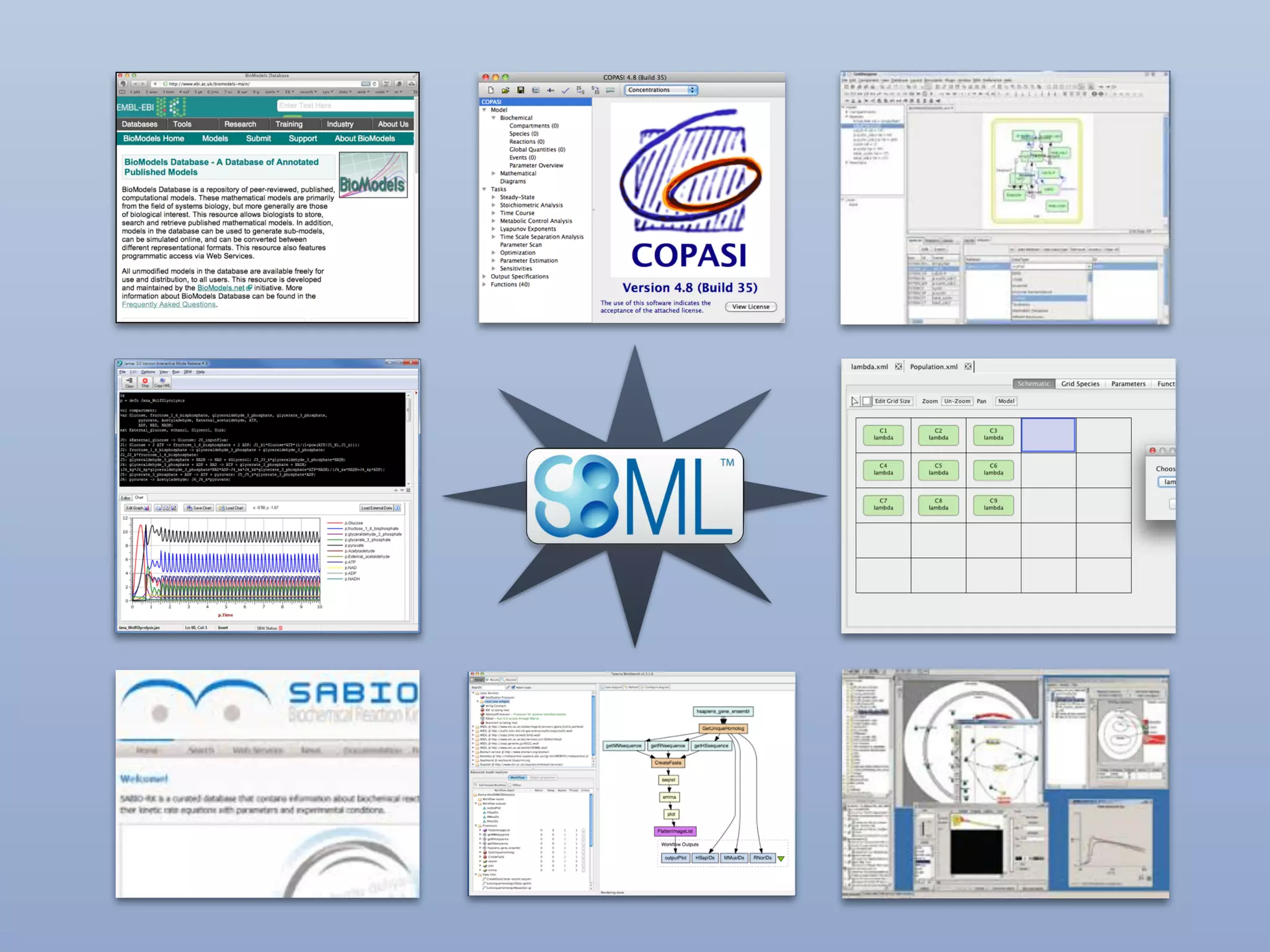
Projects often involve the 
use of more than one tool
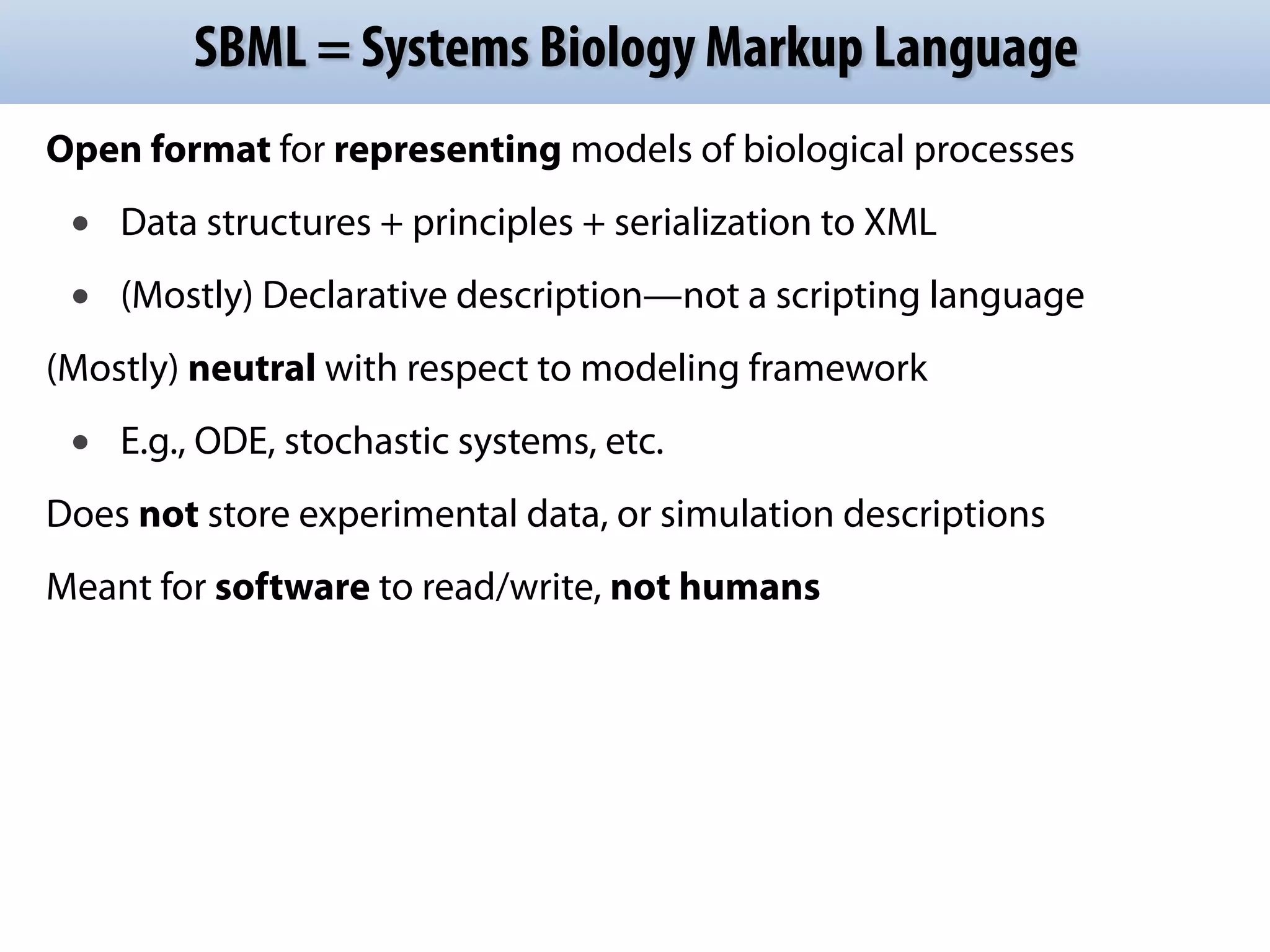
SBML = Systems Biology Markup Language 
Open format for representing models of biological processes 
• Data structures + principles + serialization to XML 
• (Mostly) Declarative description—not a scripting language 
(Mostly) neutral with respect to modeling framework 
• E.g., ODE, stochastic systems, etc. 
Does not store experimental data, or simulation descriptions 
Meant for software to read/write, not humans
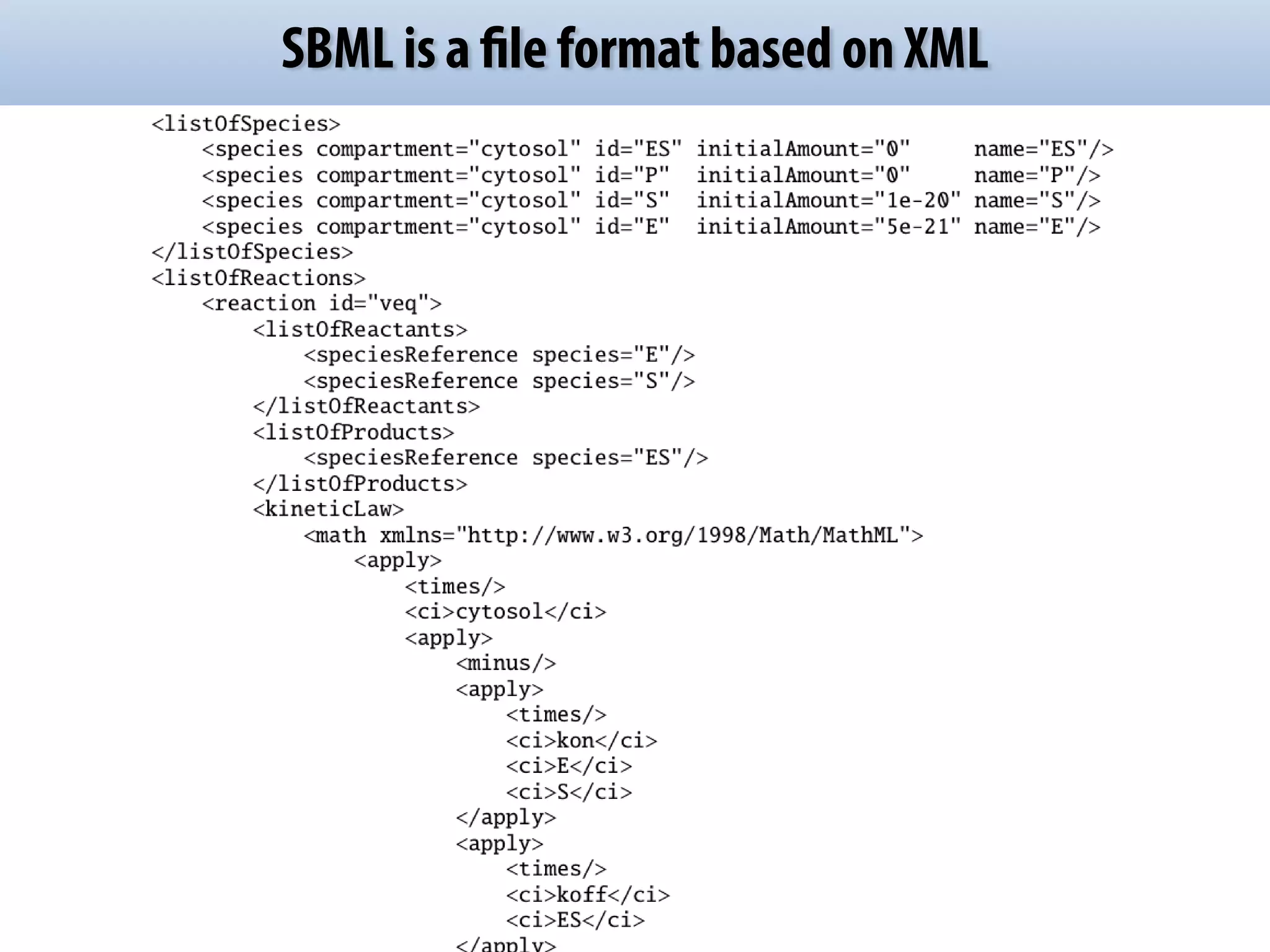
SBML is a file format based on XML
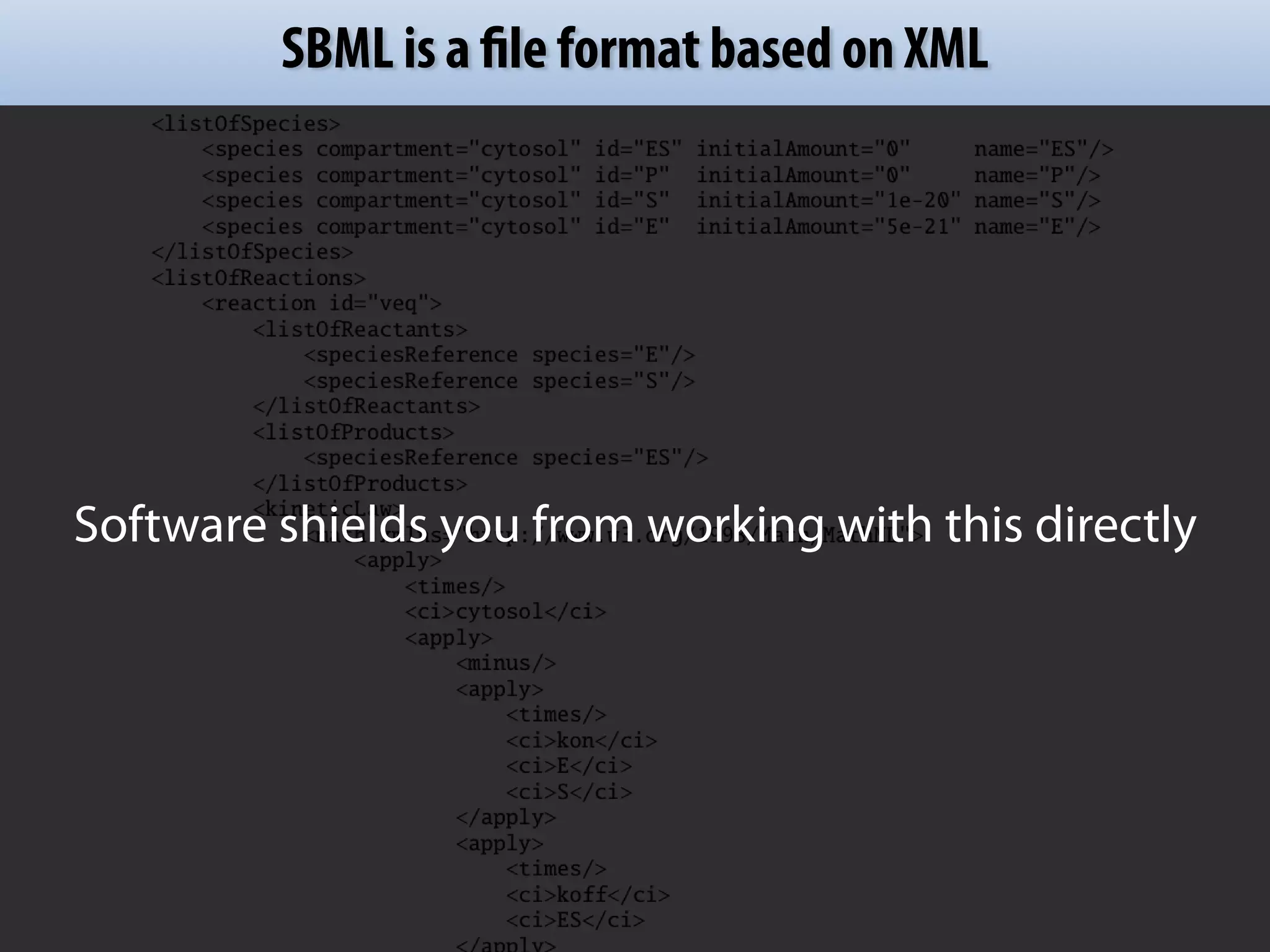
SBML is a file format based on XML 
Software shields you from working with this directly
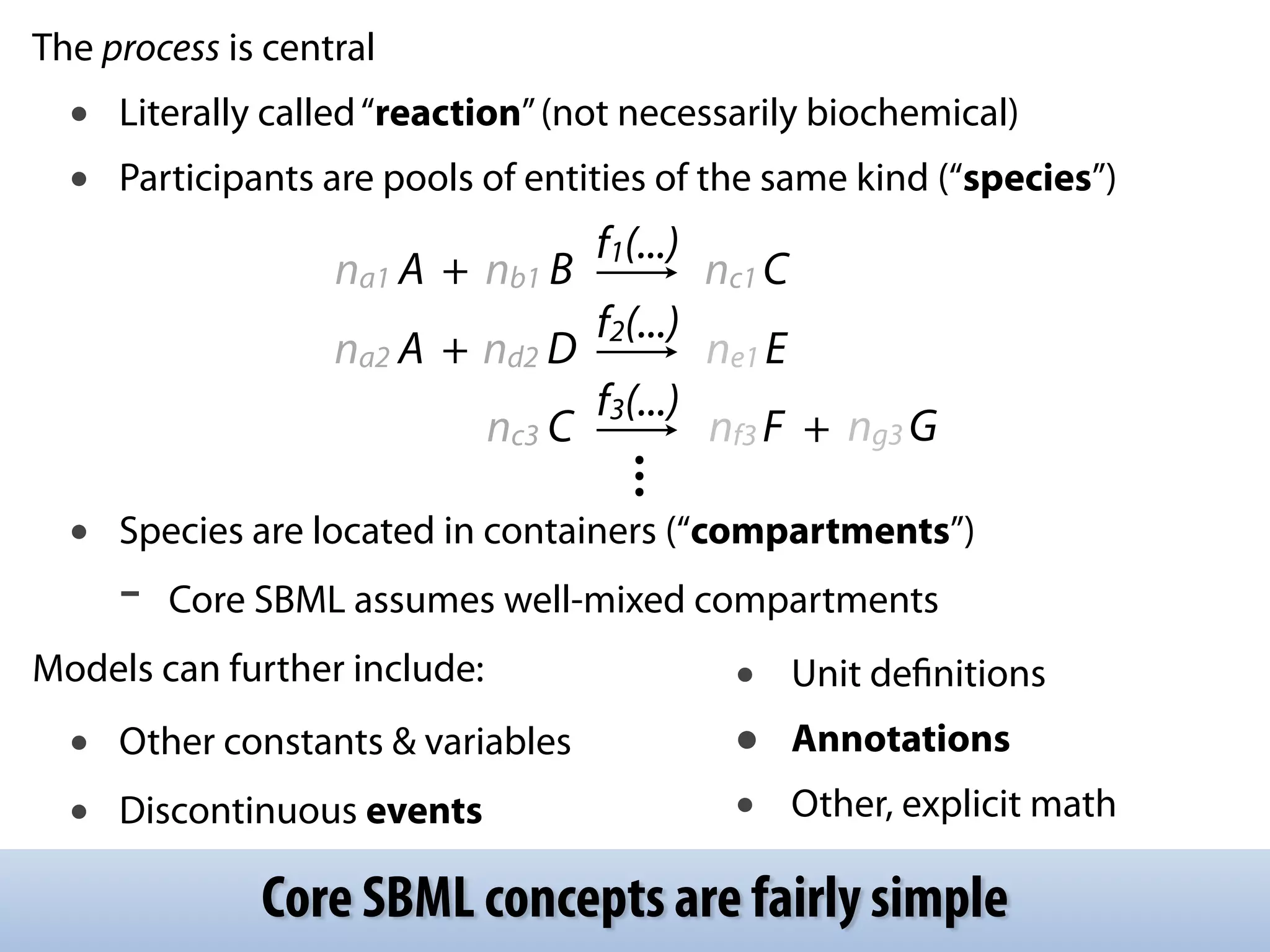
The process is central 
• Literally called “reaction” (not necessarily biochemical) 
• Participants are pools of entities of the same kind (“species”) 
! 
! 
! 
na1 A + nb1 B f1(...) nc1 C 
na2 A + nd2 D f2(...) ne1 E 
nc3 C f3(...) nf3 F + ng3 G 
... 
! 
• Species are located in containers (“compartments”) 
- Core SBML assumes well-mixed compartments 
Models can further include: 
• Other constants & variables 
• Discontinuous events 
• Unit definitions 
• Annotations 
• Other, explicit math 
Core SBML concepts are fairly simple
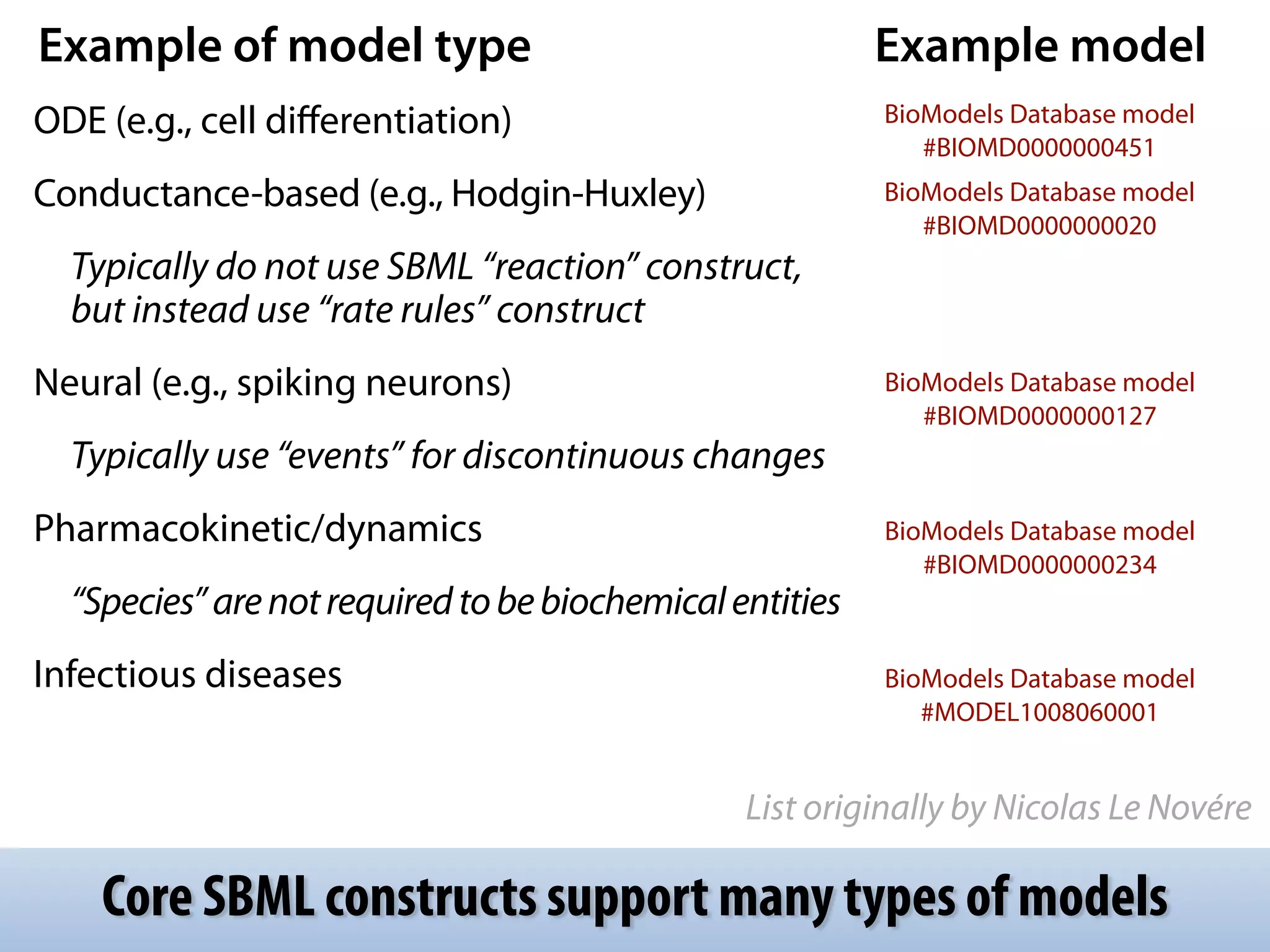
Example of model type Example model 
! 
ODE (e.g., cell differentiation) 
BioModels Database model 
#BIOMD0000000451 
Conductance-based (e.g., Hodgin-Huxley) 
BioModels Database model 
#BIOMD0000000020 
Typically do not use SBML “reaction” construct, 
but instead use “rate rules” construct 
Neural (e.g., spiking neurons) 
BioModels Database model 
#BIOMD0000000127 
Typically use “events” for discontinuous changes 
Pharmacokinetic/dynamics 
BioModels Database model 
#BIOMD0000000234 
“Species” are not required to be biochemical entities 
Infectious diseases BioModels Database model 
#MODEL1008060001 
List originally by Nicolas Le Novére 
Core SBML constructs support many types of models
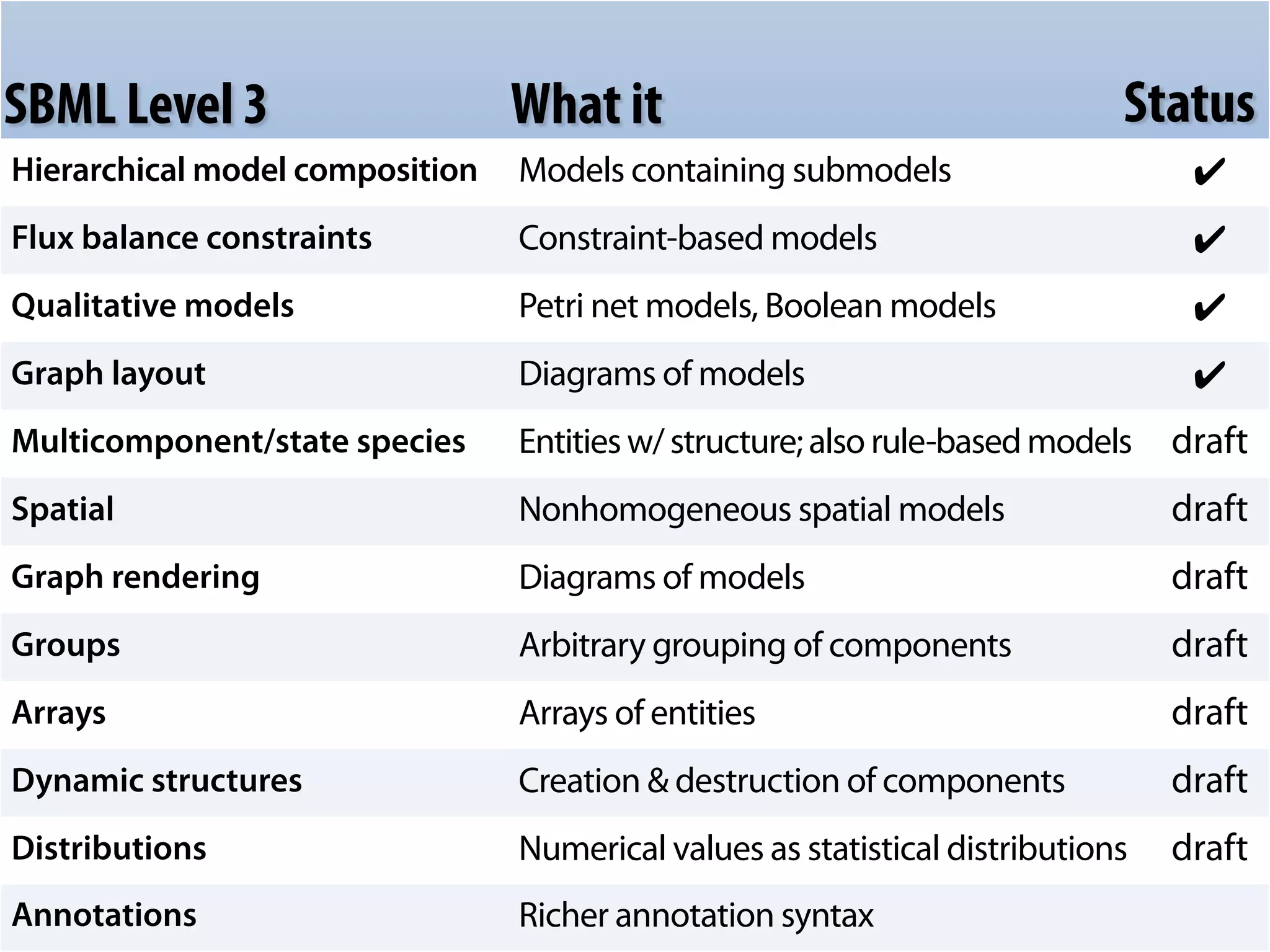
Status 
SBML Level 3 What it 
Hierarchical model composition Models containing submodels ✔ 
Flux balance constraints Constraint-based models ✔ 
Qualitative models Petri net models, Boolean models ✔ 
Graph layout Diagrams of models ✔ 
Multicomponent/state species Entities w/ structure; also rule-based models draft 
Spatial Nonhomogeneous spatial models draft 
Graph rendering Diagrams of models draft 
Groups Arbitrary grouping of components draft 
Arrays Arrays of entities draft 
Dynamic structures Creation & destruction of components draft 
Distributions Numerical values as statistical distributions draft 
Annotations Richer annotation syntax
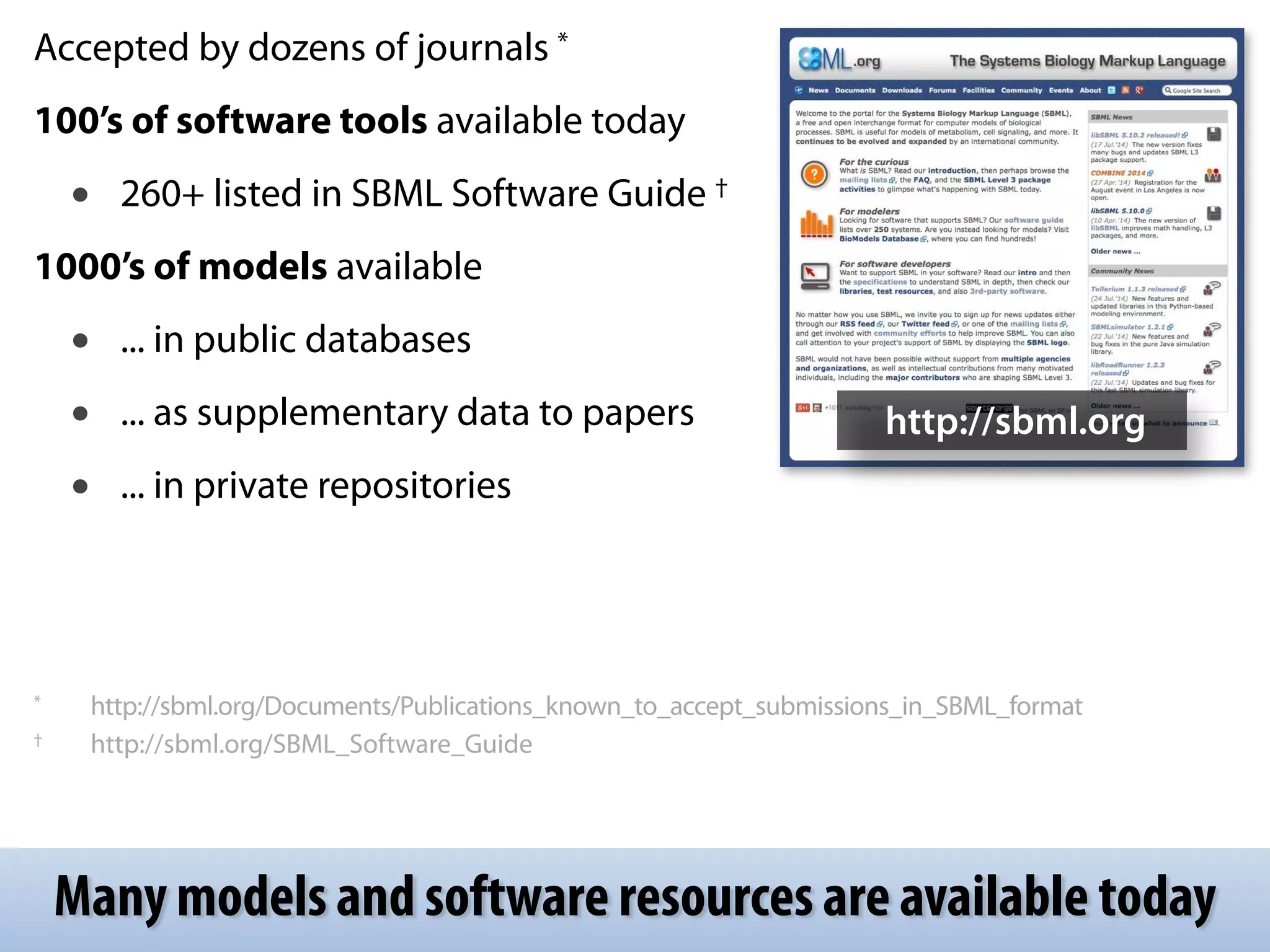
Accepted by dozens of journals * 
100’s of software tools available today 
• 260+ listed in SBML Software Guide † 
1000’s of models available 
• ... in public databases 
• ... as supplementary data to papers 
• ... in private repositories 
! 
! 
! 
! 
* http://sbml.org/Documents/Publications_known_to_accept_submissions_in_SBML_format 
† http://sbml.org/SBML_Software_Guide 
http://sbml.org 
Many models and software resources are available today
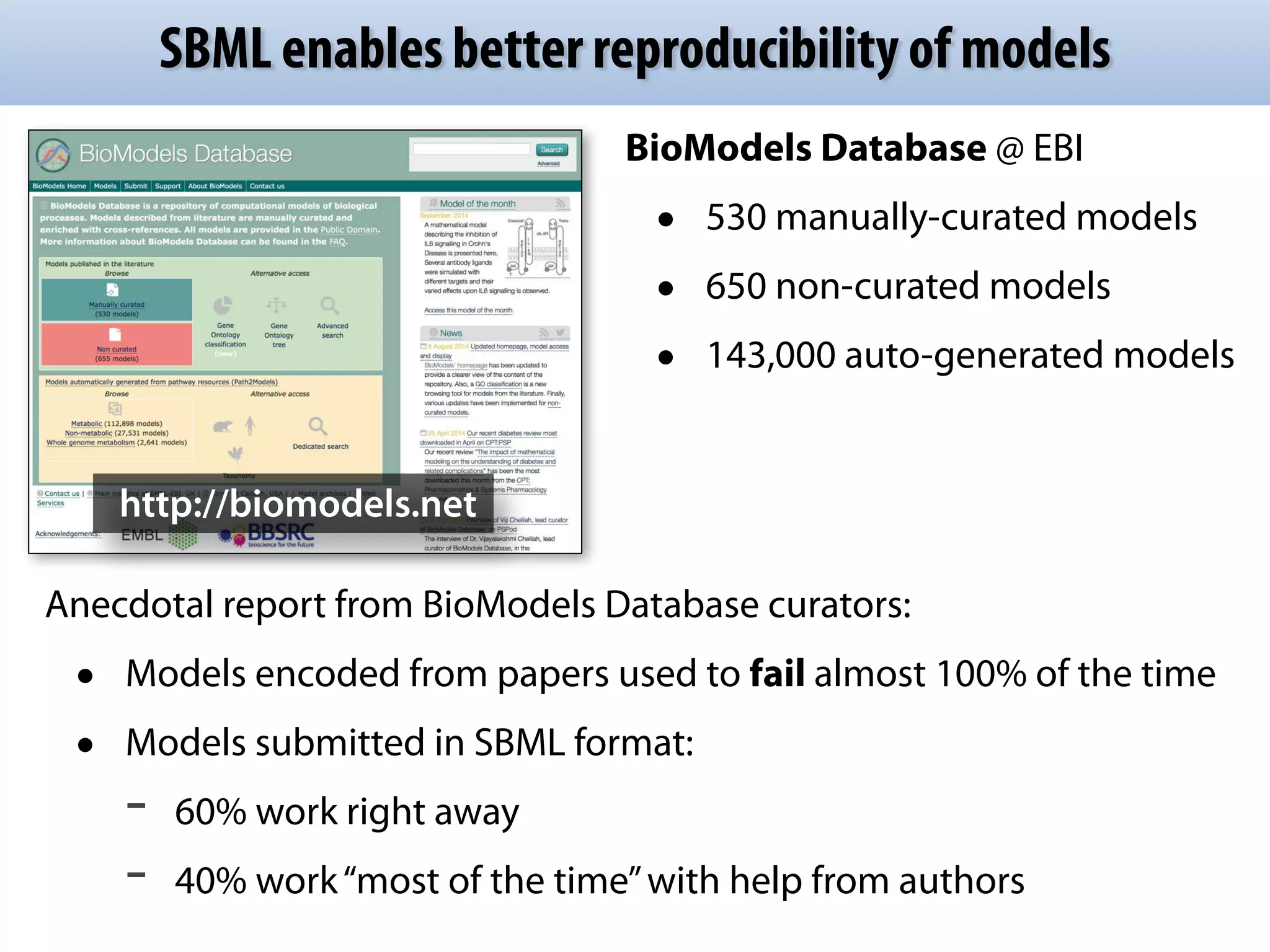
SBML enables better reproducibility of models 
BioModels Database @ EBI 
• 530 manually-curated models 
• 650 non-curated models 
• 143,000 auto-generated models 
http://biomodels.net 
Anecdotal report from BioModels Database curators: 
• Models encoded from papers used to fail almost 100% of the time 
• Models submitted in SBML format: 
- 60% work right away 
- 40% work “most of the time” with help from authors
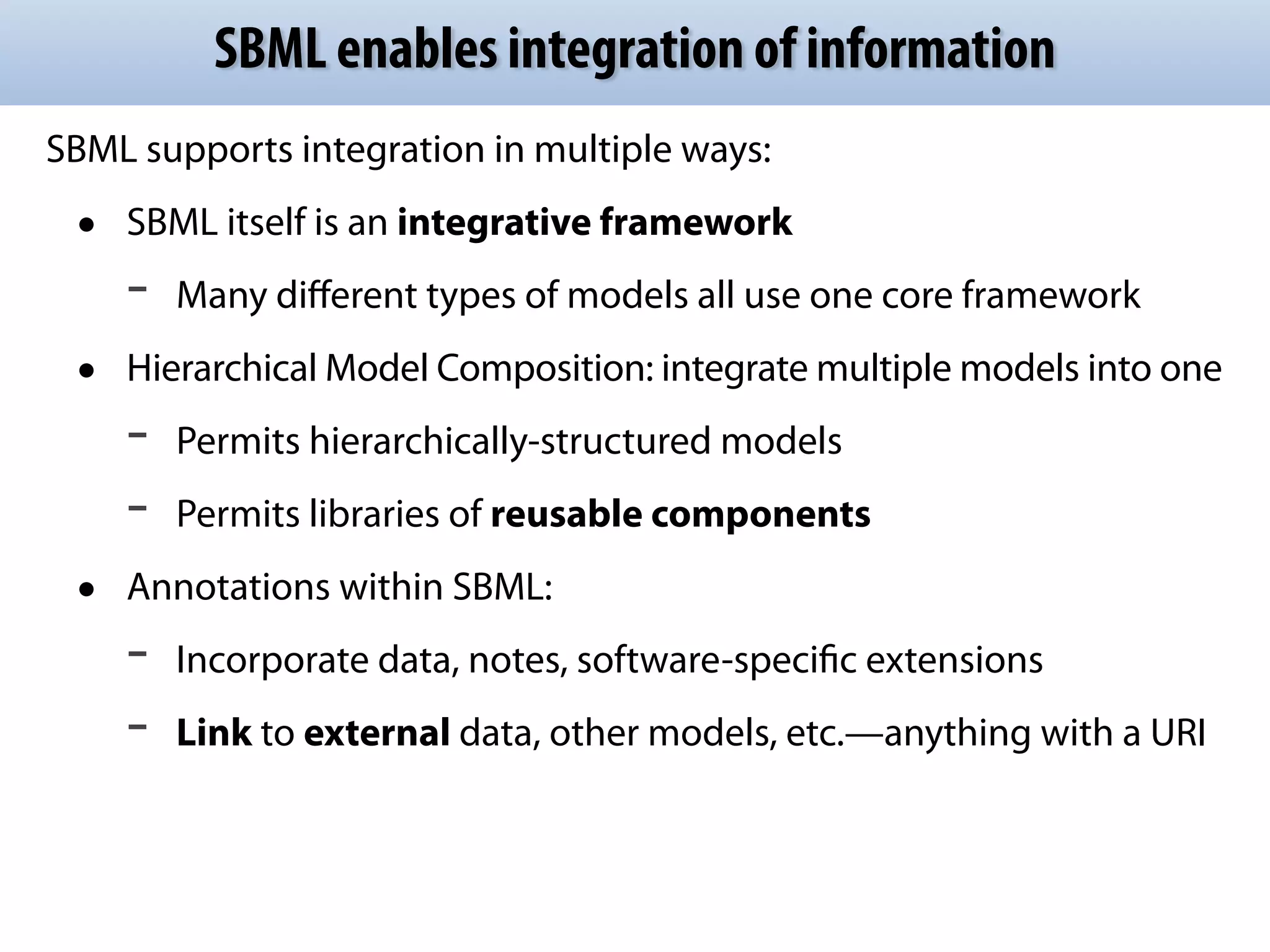
SBML enables integration of information 
SBML supports integration in multiple ways: 
• SBML itself is an integrative framework 
- Many different types of models all use one core framework 
• Hierarchical Model Composition: integrate multiple models into one 
- Permits hierarchically-structured models 
- Permits libraries of reusable components 
• Annotations within SBML: 
- Incorporate data, notes, software-specific extensions 
- Link to external data, other models, etc.—anything with a URI
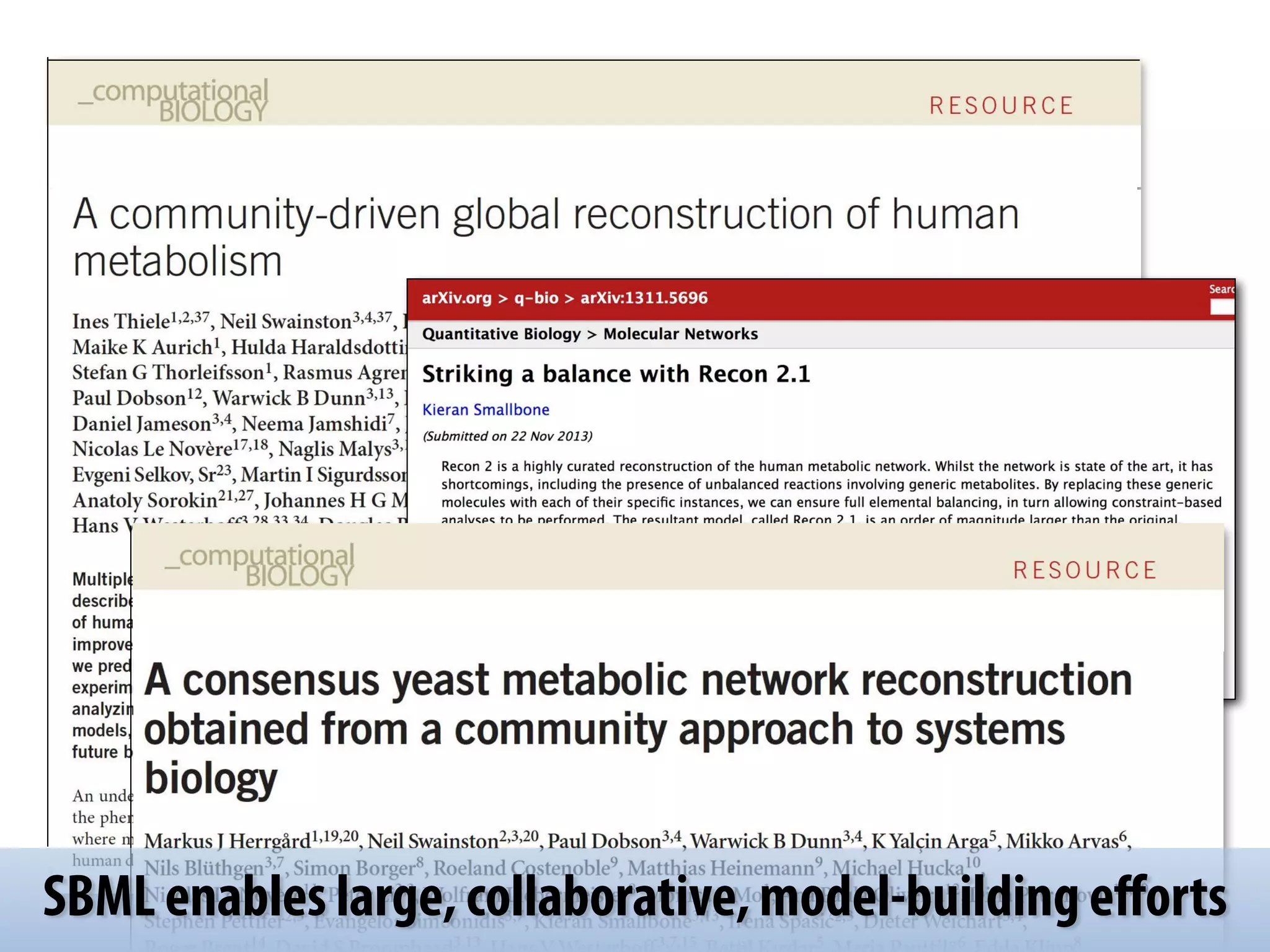
SBML enables large, collaborative, model-building efforts
The COMBINE family of standardization efforts
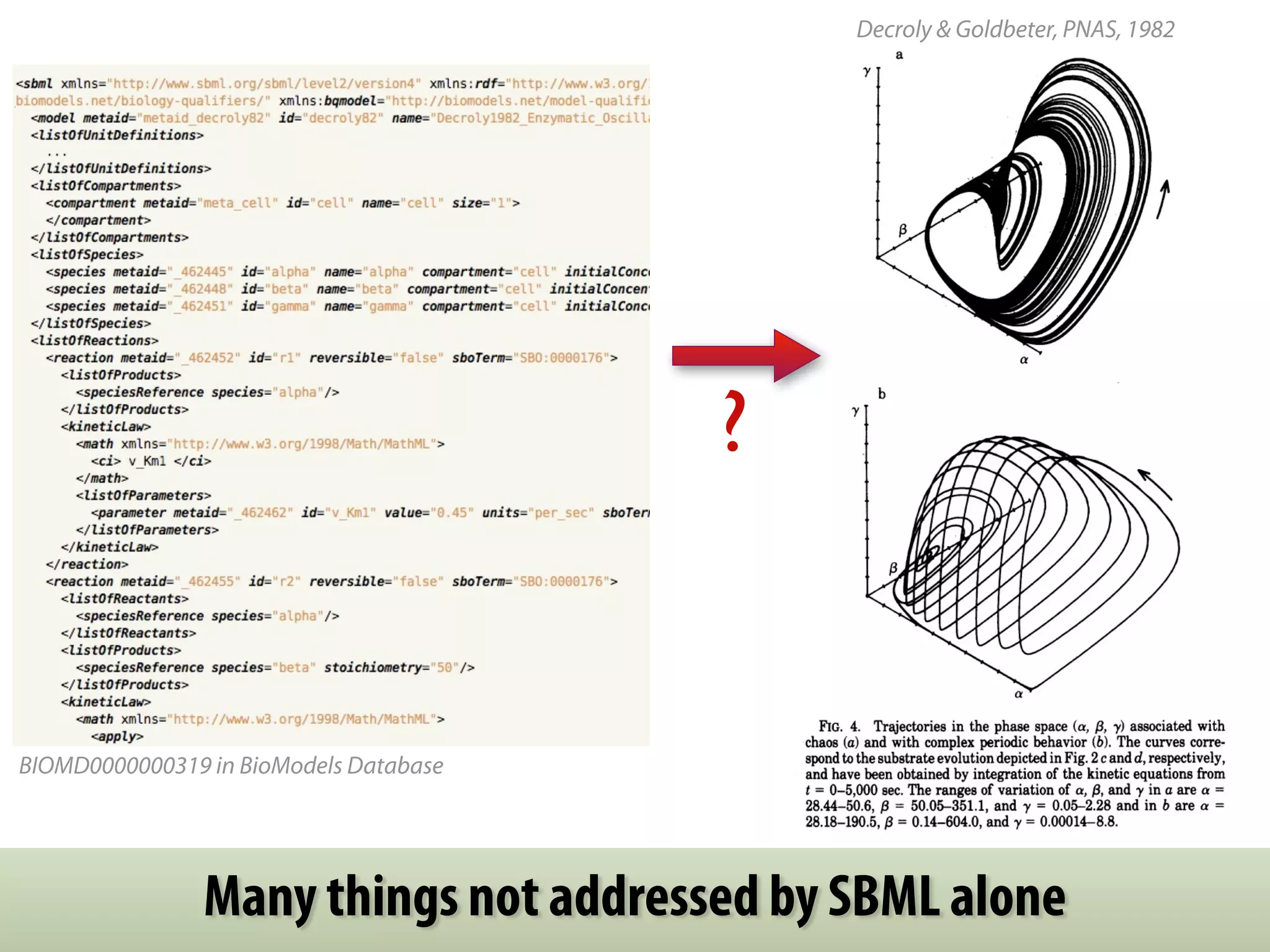
? 
BIOMD0000000319 in BioModels Database 
Decroly & Goldbeter, PNAS, 1982 
Many things not addressed by SBML alone
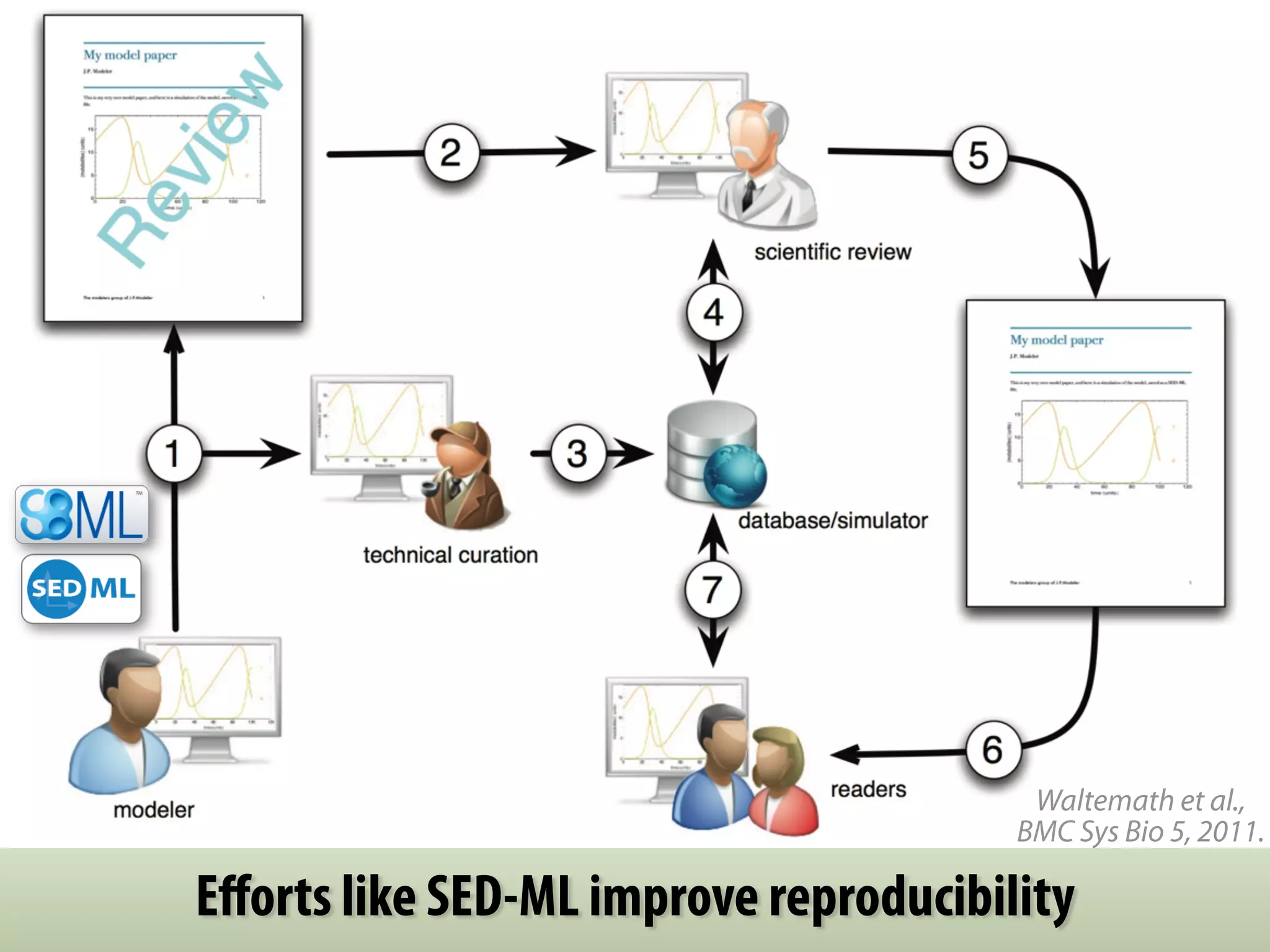
Waltemath et al., 
BMC Sys Bio 5, 2011. 
Efforts like SED-ML improve reproducibility
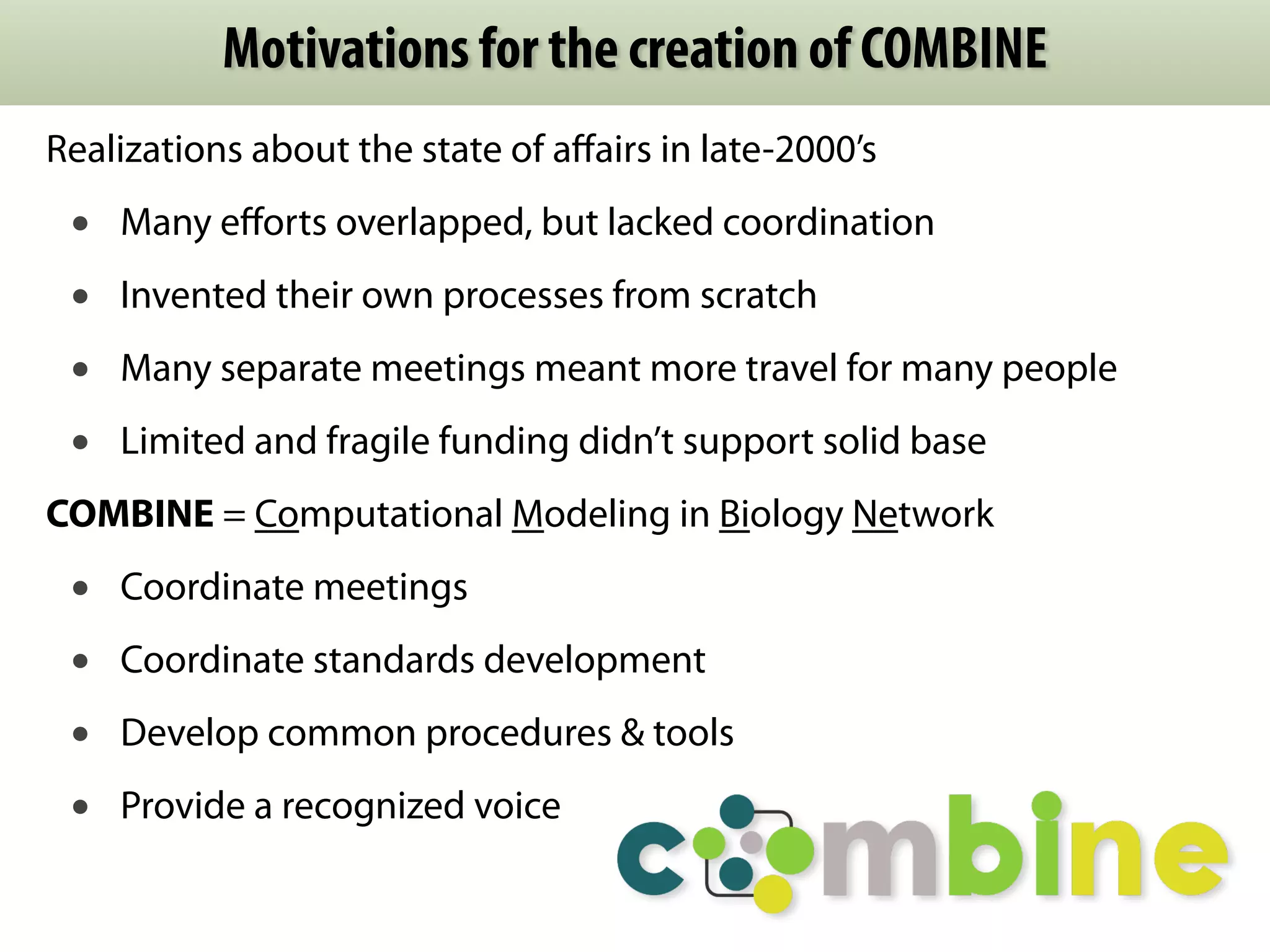
Motivations for the creation of COMBINE 
Realizations about the state of affairs in late-2000’s 
• Many efforts overlapped, but lacked coordination 
• Invented their own processes from scratch 
• Many separate meetings meant more travel for many people 
• Limited and fragile funding didn’t support solid base 
COMBINE = Computational Modeling in Biology Network 
• Coordinate meetings 
• Coordinate standards development 
• Develop common procedures & tools 
• Provide a recognized voice
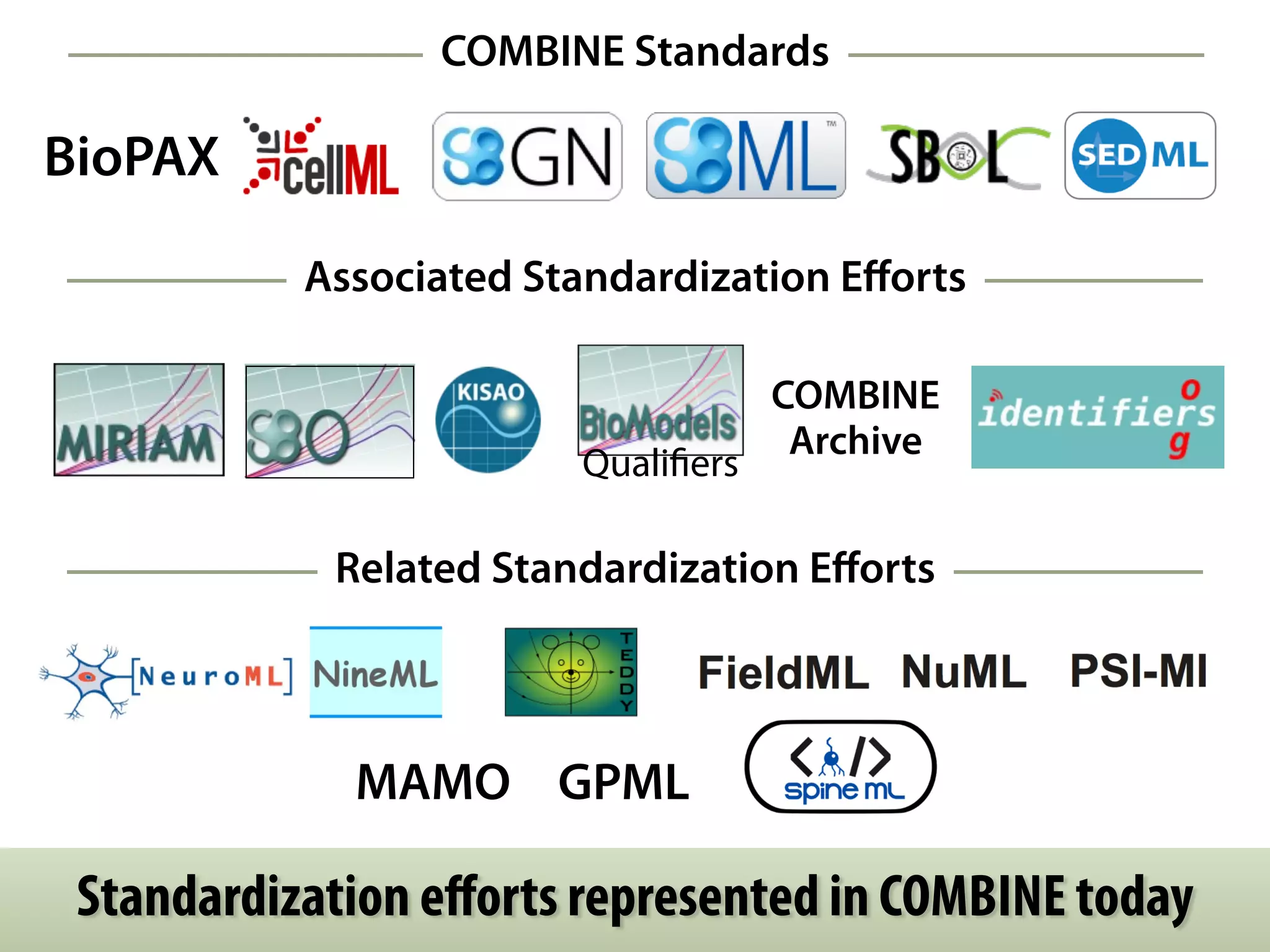
BioPAX 
COMBINE Standards 
Associated Standardization Efforts 
Qualifiers 
COMBINE 
Archive 
Related Standardization Efforts 
GPML 
MAMO 
Standardization efforts represented in COMBINE today
Examples of growing software capabilities
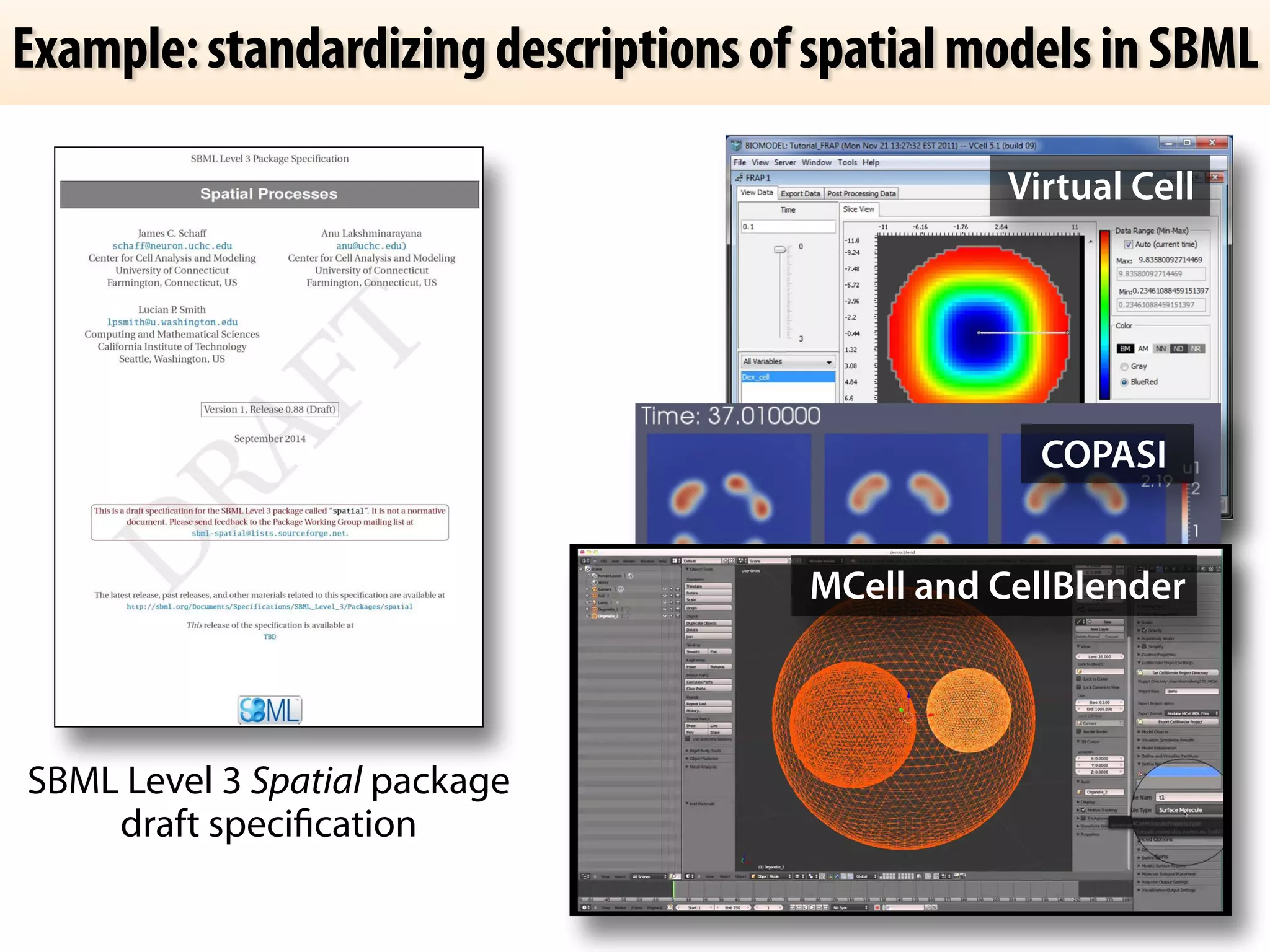
Example: standardizing descriptions of spatial models in SBML 
Virtual Cell 
SBML Level 3 Spatial package 
draft specification 
COPASI 
MCell and CellBlender
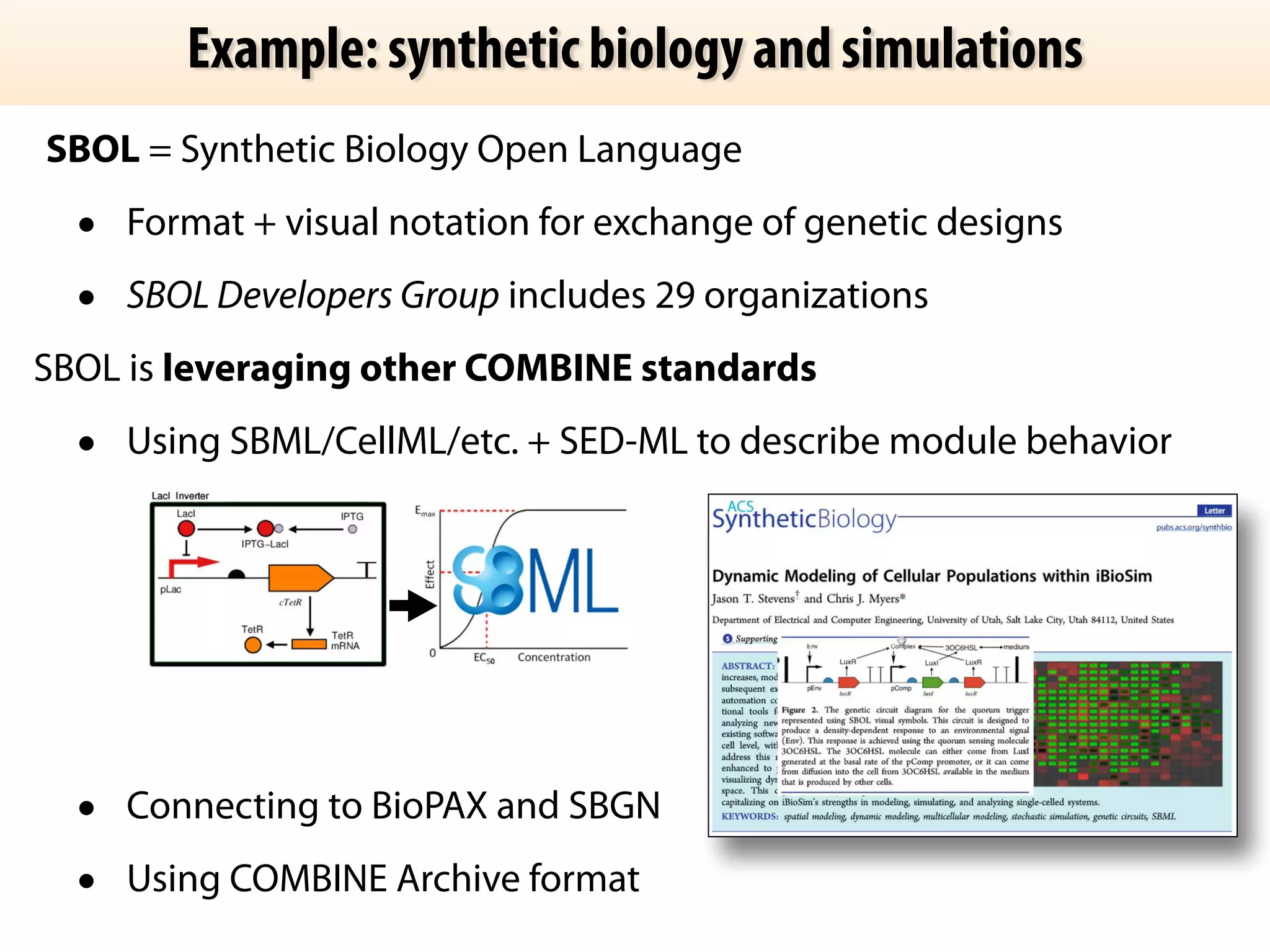
Example: synthetic biology and simulations 
SBOL = Synthetic Biology Open Language 
• Format + visual notation for exchange of genetic designs 
• SBOL Developers Group includes 29 organizations 
SBOL is leveraging other COMBINE standards 
• Using SBML/CellML/etc. + SED-ML to describe module behavior 
! 
! 
! 
! 
• Connecting to BioPAX and SBGN 
• Using COMBINE Archive format
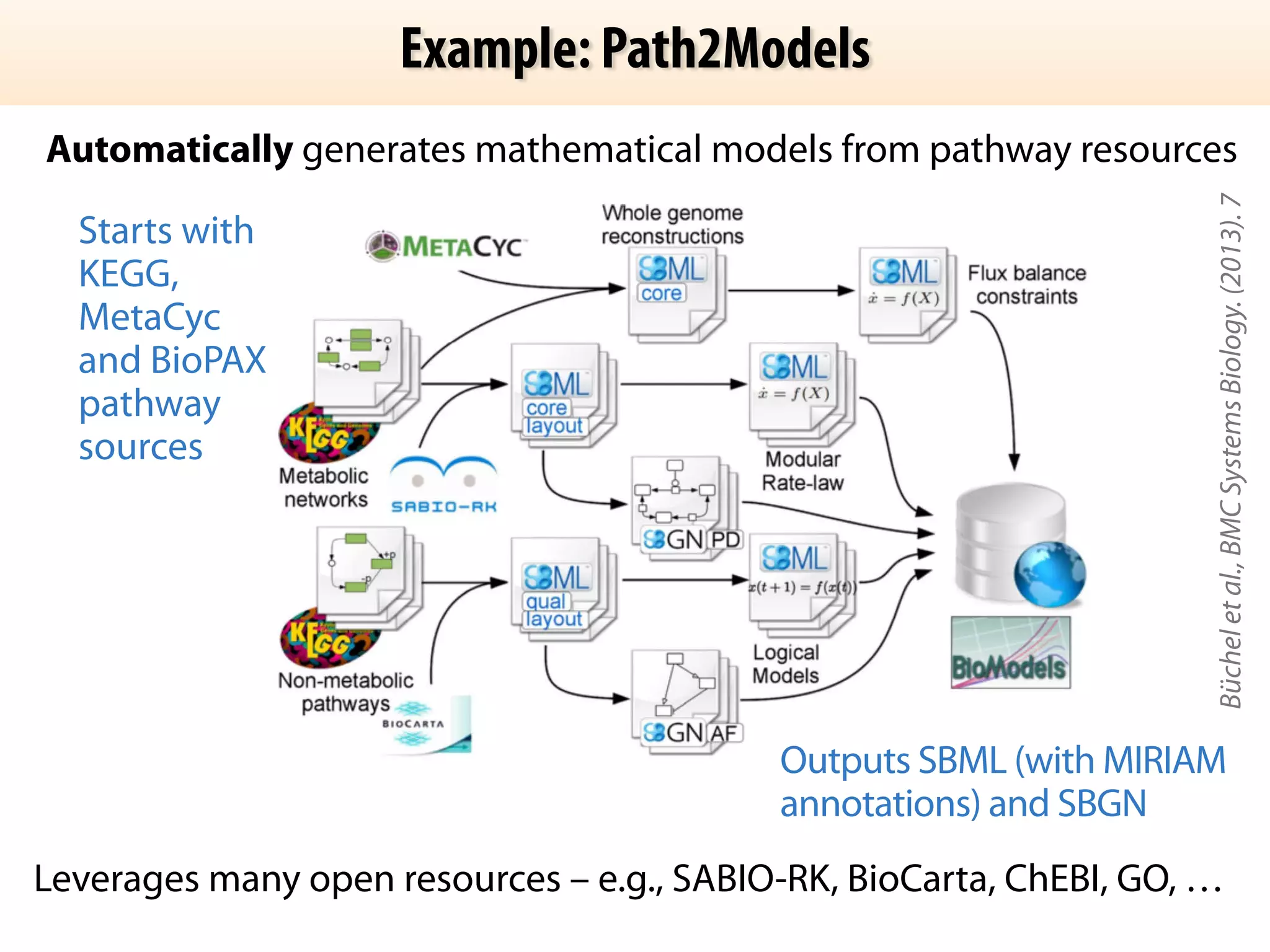
Example: Path2Models 
Automatically generates mathematical models from pathway resources 
Starts ! 
with 
KEGG, 
MetaCyc 
! 
and ! 
BioPAX 
pathway 
sources 
! 
! 
! 
! 
! 
Büchel et al., BMC Systems Biology. (2013). 7 
Outputs SBML (with MIRIAM 
annotations) and SBGN 
! 
Leverages many open resources – e.g., SABIO-RK, BioCarta, ChEBI, GO, …
Acknowledgments
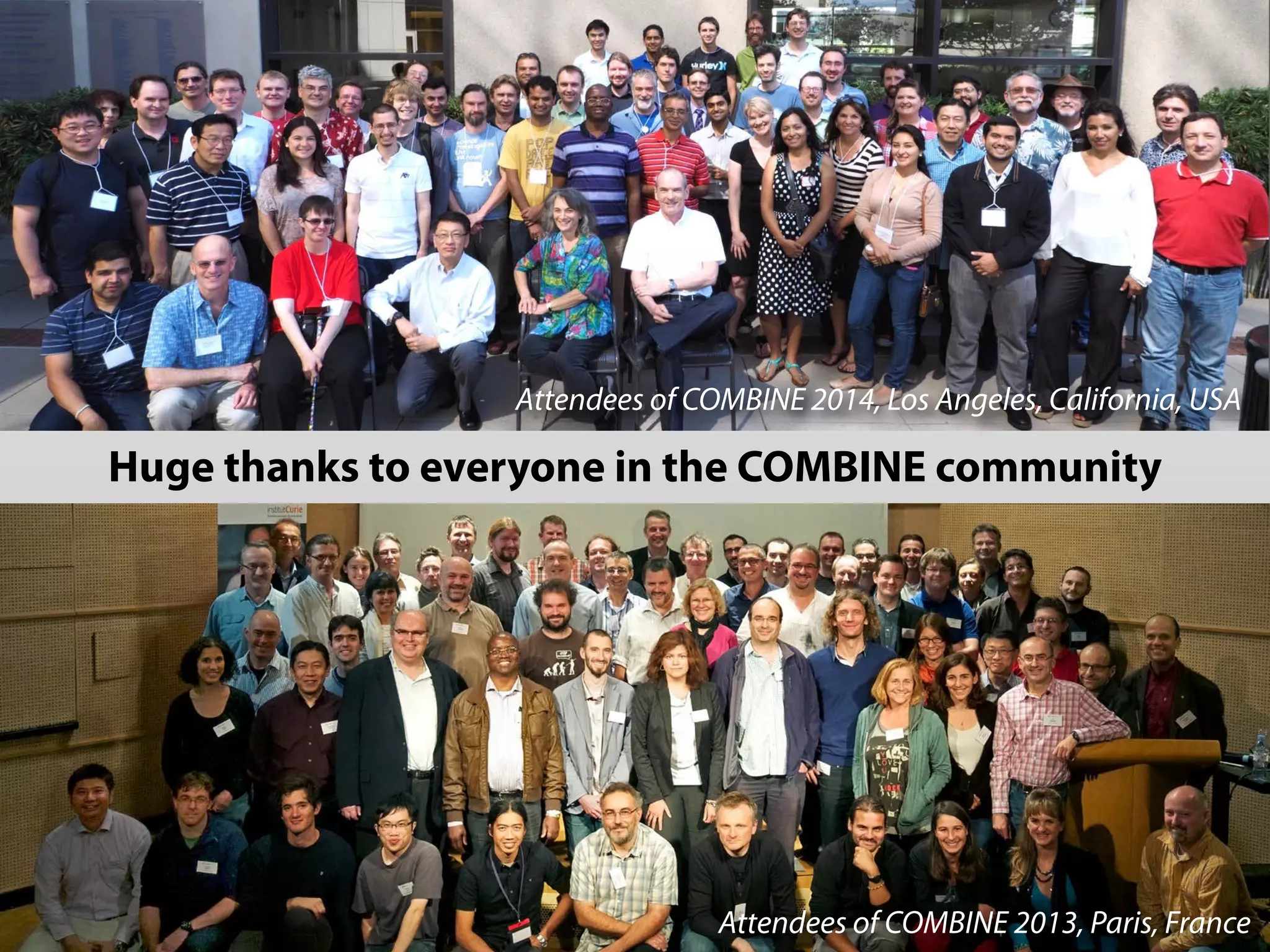
Attendees of COMBINE 2014, Los Angeles, California, USA 
Huge thanks to everyone in the COMBINE community 
Attendees of COMBINE 2013, Paris, France
National Institute of General Medical Sciences (USA) 
Air Force Office of Scientific Research (USA) 
BBSRC (UK) 
Beckman Institute, Caltech (USA) 
DARPA IPTO Bio-SPICE Bio-Computation Program (USA) 
Drug Disease Model Resources (EU-EFPIA Innovative Medicine Initiate) 
ELIXIR (UK) 
European Molecular Biology Laboratory (EMBL) 
Google Summer of Code 
International Joint Research Program of NEDO (Japan) 
Japanese Ministry of Agriculture 
Japanese Ministry of Education, Culture, Sports, Science and Technology 
JST ERATO Kitano Symbiotic Systems Project (Japan) (to 2003) 
JST ERATO-SORST Program (Japan) 
Keio University (Japan) 
Molecular Sciences Institute (USA) 
National Science Foundation (USA) 
STRI, University of Hertfordshire (UK) 
SBML funding sources over the past 14 years
SBML http://sbml.org 
COMBINE http://co.mbine.org 
SED-ML http://sed-ml.org 
SBOL http://sbolstandard.org 
SBGN http://sbgn.org 
BioPAX http://biopax.org 
BioModels Database http://biomodels.net 
Path2Models https://code.google.com/p/path2models/ 
URLs

Standards and software: practical aids for reproducibility of computational research 
in systems biology

  • 1.
    Standards and software:practical aids for reproducibility of computational research in systems biology Michael Hucka, Ph.D. (on behalf of many) Department of Computing and Mathematical Sciences California Institute of Technology Pasadena, CA, USA Email: mhucka@caltech.edu Twitter: @mhucka ICSB 2014, Melbourne, Australia, September 2014
  • 2.
    SBML as enabler The COMBINE family of standardization efforts Examples of growing software capabilities Outline
  • 3.
  • 4.
  • 5.
    Communication of modelsin the olden days… Describe the models and equations in a paper, and you’re done, right? Problems: • Errors in printing • Missing information • Dependencies on implementation • Outright errors • Can be a huge effort to recreate
  • 6.
    ABC-SysBio CellNetAnalyzer Karyote*PaVESy SBW: Auto Layout acslXtreme CellNOpt KEGGconverter PAYAO sbw: javasim ALC Cellware KEGGtranslator PET sbw: stochastic simulator AMIGO CLEML Kineticon PhysioLab Modeler SCIpath Antimony CL-SBML Kinsolver PINT SED-ML Web Tools APMonitor COBRA libAnnotationSBML PK-Sim / MoBi semanticSBML Arcadia CompuCell3D libRoadRunner PNK SensSB Asmparts ConsensusPathDB libSBML PottersWheel SGMP Athena COPASI libSBMLSim PRISM Sigmoid* AutoSBW CRdata libStruct ProcessDB SIGNALIGN AVIS CycSim MASS Toolbox ProMoT SignaLink BALSA CySBML MatCont PROTON SigPath BASIS Cytoscape MathSBML pybrn SigTran BetaWB Cyto-Sim Medicel PyDSTool SIMBA Bifurcation Discovery Tool DBSolve MEMOSys PySB SimBiology BiGG DEDiscover MesoRD PySCeS Simpathica BiNoM Dizzy Meta-All RANGE SimPheny* BiNoM Cytoscape Plugin DOTcvpSB Metaboflux RAVEN Simulate3D Bio Sketch Pad E-CELL MetaCrop Reactome Simulation Core Library BioBayes ecellJ MetaFluxNet ReMatch Simulation Tool BIOCHAM EPE Metannogen RMBNToolbox SimWiz BioCharon ESS Metatool roadRunner SloppyCell BioCyc Facile MetExplore RSBML SmartCell BioGRID FAME MetNetMaker SABIO-RK Snoopy Biological Networks FASIMU MIRIAM Resources Saint SOSlib BioMet Toolbox FBASBW MMT2 SBFC SPDBS BioModels Database FERN modelMaGe SBML Harvester SRS BioModels Importer FluxBalance ModeRator SBML Layout STEPS BioNessie Fluxor Modesto SBML Reaction Finder StochKit BioNetGen Genetdes Moleculizer SBML Translators StochPy BioPARKIN Genetic Network Analyzer MonaLisa SBML2APM StochSim BioPathwise Gepasi Monod SBML2BioPax STOCKS BioPAX2SBML Gillespie2 MOOSE SBML2LaTeX SurreyFBA BioRica GINsim MuVal (Multi-valued logic) SBML2NEURON SyBiL BioSens GNAT Narrator SBML2Octave SYCAMORE BioSPICE Dashboard GNU MCSim nemo SBML2SMW SynBioSS BioSpreadsheet GRENDEL NetBuilder' SBML2TikZ Systrip BioSyS HSMB NetPath SBML2XPP TERANODE Suite BioTapestry HybridSBML NetPro SBMLEditor The Cell Collective BioUML iBioSim Odefy SBML-PET-MPI Tide BoolNet IBRENA Omix SBMLR TinkerCell braincirc Insilico Discovery ONDEX SBML-SAT Trelis BRENDA insilicoIDE optflux SBML-shorthand UTKornTools BSTLab iPathways Oscill8 SBMLSim VANTED ByoDyn JACOBIAN PANTHER Pathway SBMLsqueezer Vcell CADLIVE Jacobian Viewer PathArt sbmltidy WebCell Cain Jarnac Pathway Access SBMLToolbox WinSCAMP CARMEN JarnacLite Pathway Analyser SBMM assistant Wolfram SystemModeler Cell Illustrator JDesigner Pathway Builder SBO xCellerator CellDesigner JigCell Pathway Solver SBSI Xholon Cellerator JSBML Pathway Tools SBToolbox2 XPPAUT CellMC JSim PathwayLab sbtranslate CellML2SBML JWS Online PATIKAweb SBW Many software tools for modeling and simulation are available
  • 7.
    https://www.behance.net/gallery/d/7465033 Projects ofteninvolve the use of more than one tool
  • 9.
    SBML = SystemsBiology Markup Language Open format for representing models of biological processes • Data structures + principles + serialization to XML • (Mostly) Declarative description—not a scripting language (Mostly) neutral with respect to modeling framework • E.g., ODE, stochastic systems, etc. Does not store experimental data, or simulation descriptions Meant for software to read/write, not humans
  • 10.
    SBML is afile format based on XML
  • 11.
    SBML is afile format based on XML Software shields you from working with this directly
  • 12.
    The process iscentral • Literally called “reaction” (not necessarily biochemical) • Participants are pools of entities of the same kind (“species”) ! ! ! na1 A + nb1 B f1(...) nc1 C na2 A + nd2 D f2(...) ne1 E nc3 C f3(...) nf3 F + ng3 G ... ! • Species are located in containers (“compartments”) - Core SBML assumes well-mixed compartments Models can further include: • Other constants & variables • Discontinuous events • Unit definitions • Annotations • Other, explicit math Core SBML concepts are fairly simple
  • 13.
    Example of modeltype Example model ! ODE (e.g., cell differentiation) BioModels Database model #BIOMD0000000451 Conductance-based (e.g., Hodgin-Huxley) BioModels Database model #BIOMD0000000020 Typically do not use SBML “reaction” construct, but instead use “rate rules” construct Neural (e.g., spiking neurons) BioModels Database model #BIOMD0000000127 Typically use “events” for discontinuous changes Pharmacokinetic/dynamics BioModels Database model #BIOMD0000000234 “Species” are not required to be biochemical entities Infectious diseases BioModels Database model #MODEL1008060001 List originally by Nicolas Le Novére Core SBML constructs support many types of models
  • 14.
    Status SBML Level3 What it Hierarchical model composition Models containing submodels ✔ Flux balance constraints Constraint-based models ✔ Qualitative models Petri net models, Boolean models ✔ Graph layout Diagrams of models ✔ Multicomponent/state species Entities w/ structure; also rule-based models draft Spatial Nonhomogeneous spatial models draft Graph rendering Diagrams of models draft Groups Arbitrary grouping of components draft Arrays Arrays of entities draft Dynamic structures Creation & destruction of components draft Distributions Numerical values as statistical distributions draft Annotations Richer annotation syntax
  • 15.
    Accepted by dozensof journals * 100’s of software tools available today • 260+ listed in SBML Software Guide † 1000’s of models available • ... in public databases • ... as supplementary data to papers • ... in private repositories ! ! ! ! * http://sbml.org/Documents/Publications_known_to_accept_submissions_in_SBML_format † http://sbml.org/SBML_Software_Guide http://sbml.org Many models and software resources are available today
  • 16.
    SBML enables betterreproducibility of models BioModels Database @ EBI • 530 manually-curated models • 650 non-curated models • 143,000 auto-generated models http://biomodels.net Anecdotal report from BioModels Database curators: • Models encoded from papers used to fail almost 100% of the time • Models submitted in SBML format: - 60% work right away - 40% work “most of the time” with help from authors
  • 17.
    SBML enables integrationof information SBML supports integration in multiple ways: • SBML itself is an integrative framework - Many different types of models all use one core framework • Hierarchical Model Composition: integrate multiple models into one - Permits hierarchically-structured models - Permits libraries of reusable components • Annotations within SBML: - Incorporate data, notes, software-specific extensions - Link to external data, other models, etc.—anything with a URI
  • 18.
    SBML enables large,collaborative, model-building efforts
  • 19.
    The COMBINE familyof standardization efforts
  • 20.
    ? BIOMD0000000319 inBioModels Database Decroly & Goldbeter, PNAS, 1982 Many things not addressed by SBML alone
  • 21.
    Waltemath et al., BMC Sys Bio 5, 2011. Efforts like SED-ML improve reproducibility
  • 22.
    Motivations for thecreation of COMBINE Realizations about the state of affairs in late-2000’s • Many efforts overlapped, but lacked coordination • Invented their own processes from scratch • Many separate meetings meant more travel for many people • Limited and fragile funding didn’t support solid base COMBINE = Computational Modeling in Biology Network • Coordinate meetings • Coordinate standards development • Develop common procedures & tools • Provide a recognized voice
  • 23.
    BioPAX COMBINE Standards Associated Standardization Efforts Qualifiers COMBINE Archive Related Standardization Efforts GPML MAMO Standardization efforts represented in COMBINE today
  • 24.
    Examples of growingsoftware capabilities
  • 25.
    Example: standardizing descriptionsof spatial models in SBML Virtual Cell SBML Level 3 Spatial package draft specification COPASI MCell and CellBlender
  • 26.
    Example: synthetic biologyand simulations SBOL = Synthetic Biology Open Language • Format + visual notation for exchange of genetic designs • SBOL Developers Group includes 29 organizations SBOL is leveraging other COMBINE standards • Using SBML/CellML/etc. + SED-ML to describe module behavior ! ! ! ! • Connecting to BioPAX and SBGN • Using COMBINE Archive format
  • 27.
    Example: Path2Models Automaticallygenerates mathematical models from pathway resources Starts ! with KEGG, MetaCyc ! and ! BioPAX pathway sources ! ! ! ! ! Büchel et al., BMC Systems Biology. (2013). 7 Outputs SBML (with MIRIAM annotations) and SBGN ! Leverages many open resources – e.g., SABIO-RK, BioCarta, ChEBI, GO, …
  • 28.
  • 29.
    Attendees of COMBINE2014, Los Angeles, California, USA Huge thanks to everyone in the COMBINE community Attendees of COMBINE 2013, Paris, France
  • 30.
    National Institute ofGeneral Medical Sciences (USA) Air Force Office of Scientific Research (USA) BBSRC (UK) Beckman Institute, Caltech (USA) DARPA IPTO Bio-SPICE Bio-Computation Program (USA) Drug Disease Model Resources (EU-EFPIA Innovative Medicine Initiate) ELIXIR (UK) European Molecular Biology Laboratory (EMBL) Google Summer of Code International Joint Research Program of NEDO (Japan) Japanese Ministry of Agriculture Japanese Ministry of Education, Culture, Sports, Science and Technology JST ERATO Kitano Symbiotic Systems Project (Japan) (to 2003) JST ERATO-SORST Program (Japan) Keio University (Japan) Molecular Sciences Institute (USA) National Science Foundation (USA) STRI, University of Hertfordshire (UK) SBML funding sources over the past 14 years
  • 31.
    SBML http://sbml.org COMBINEhttp://co.mbine.org SED-ML http://sed-ml.org SBOL http://sbolstandard.org SBGN http://sbgn.org BioPAX http://biopax.org BioModels Database http://biomodels.net Path2Models https://code.google.com/p/path2models/ URLs