Finding common ground between modelers
and simulation software in systems biology

              Michael Hucka
         (On behalf of many people)
              Senior Research Fellow
        California Institute of Technology
             Pasadena, California, USA


                                             2
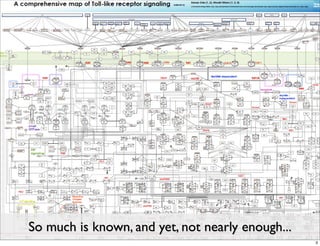
So much is known, and yet, not nearly enough...
                                                  3
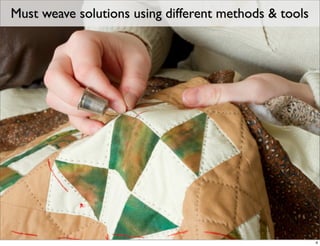
Must weave solutions using different methods & tools


                                                       4
Common side-effect: compatibility problems
                                             5
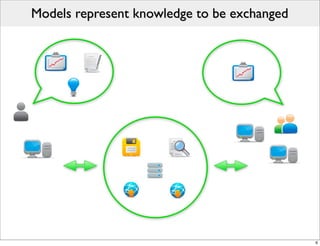
Models represent knowledge to be exchanged


                                             6
SBML


       7
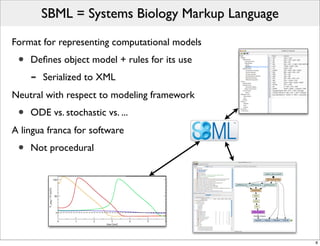
SBML = Systems Biology Markup Language

Format for representing computational models
 •   Defines object model + rules for its use
     -   Serialized to XML
Neutral with respect to modeling framework
 •   ODE vs. stochastic vs. ...
A lingua franca for software
 •   Not procedural


                                                  8
Basic SBML concepts are simple

The reaction is central: a process occurring at a given rate

 •   Participants are pools of entities (species)
                                       f ([A],[B],[P ],...)
                     na A + nb B       − − − − − − → np P
                                        −−−−−−

                            f (...)
                     nc C   −−
                             −→       nd D + ne E + nf F
                                         .
                                         .
                                         .
Models can further include:
 •   Other constants & variables               •   Unit definitions
 •   Compartments                              •   Annotations
 •   Explicit math
 •   Discontinuous events

                                                                     9
Basic SBML concepts are simple

The reaction is central: a process occurring at a given rate

 •   Participants are pools of entities (species)             Can be anything
                                                               conceptually
                                       f ([A],[B],[P ],...)
                     na A + nb B       − − − − − − → np P
                                        −−−−−−                  compatible

                            f (...)
                     nc C   −−
                             −→       nd D + ne E + nf F
                                         .
                                         .
                                         .
Models can further include:
 •   Other constants & variables               •   Unit definitions
 •   Compartments                              •   Annotations
 •   Explicit math
 •   Discontinuous events

                                                                                9
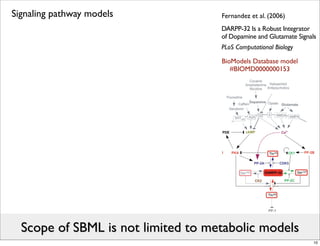
Signaling pathway models            Fernandez et al. (2006)
                                    DARPP-32 Is a Robust Integrator
                                    of Dopamine and Glutamate Signals
                                    PLoS Computational Biology

                                    BioModels Database model
                                       #BIOMD0000000153


  Scope of SBML is not limited to metabolic models
                                                                    10
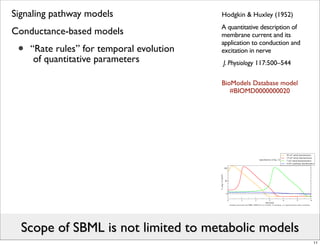
Signaling pathway models                   Hodgkin & Huxley (1952)
                                           A quantitative description of
Conductance-based models                   membrane current and its

 •
                                           application to conduction and
     “Rate rules” for temporal evolution   excitation in nerve
      of quantitative parameters           J. Physiology 117:500–544

                                           BioModels Database model
                                              #BIOMD0000000020


  Scope of SBML is not limited to metabolic models
                                                                           11
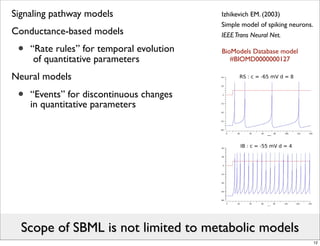
Signaling pathway models                   Izhikevich EM. (2003)
                                           Simple model of spiking neurons.
Conductance-based models                   IEEE Trans Neural Net.

 •   “Rate rules” for temporal evolution
      of quantitative parameters
                                           BioModels Database model
                                              #BIOMD0000000127

Neural models

 •   “Events” for discontinuous changes
     in quantitative parameters


  Scope of SBML is not limited to metabolic models
                                                                              12
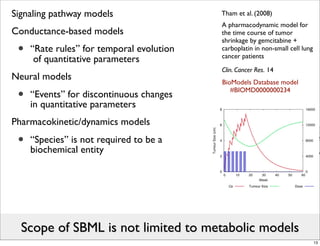
Signaling pathway models                   Tham et al. (2008)
                                           A pharmacodynamic model for
Conductance-based models                   the time course of tumor
                                           shrinkage by gemcitabine +
 •   “Rate rules” for temporal evolution
      of quantitative parameters
                                           carboplatin in non-small cell lung
                                           cancer patients

                                           Clin. Cancer Res. 14
Neural models                              BioModels Database model

 •   “Events” for discontinuous changes
     in quantitative parameters
                                              #BIOMD0000000234


Pharmacokinetic/dynamics models

 •   “Species” is not required to be a
     biochemical entity


  Scope of SBML is not limited to metabolic models
                                                                                13
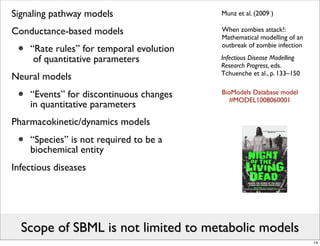
Signaling pathway models                   Munz et al. (2009 )

Conductance-based models                   When zombies attack!:
                                           Mathematical modelling of an

 •   “Rate rules” for temporal evolution
      of quantitative parameters
                                           outbreak of zombie infection
                                           Infectious Disease Modelling
                                           Research Progress, eds.
                                           Tchuenche et al., p. 133–150
Neural models

 •   “Events” for discontinuous changes
     in quantitative parameters
                                           BioModels Database model
                                              #MODEL1008060001


Pharmacokinetic/dynamics models

 •   “Species” is not required to be a
     biochemical entity
Infectious diseases


  Scope of SBML is not limited to metabolic models
                                                                          14
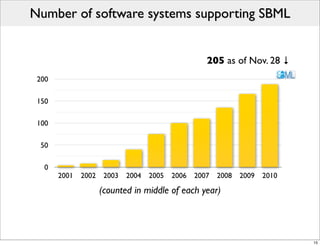
Number of software systems supporting SBML


                                                     205 as of Nov. 28 ↓
 200

 150

 100

  50

   0
       2001   2002    2003   2004   2005   2006   2007   2008   2009   2010

                     (counted in middle of each year)


                                                                              15
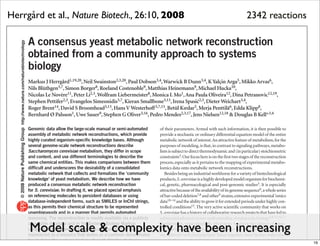
HerrgĂĽrd et al., Nature Biotech., 26:10, 2008                                                                                                                                                           2342 reactions

                                                                              A consensus yeast metabolic network reconstruction
   Š 2008 Nature Publishing Group http://www.nature.com/naturebiotechnology


                                                                              obtained from a community approach to systems
                                                                              biology
                                                                              Markus J Herrgürd1,19,20, Neil Swainston2,3,20, Paul Dobson3,4, Warwick B Dunn3,4, K Yalçin Arga5, Mikko Arvas6,
                                                                              Nils BlĂźthgen3,7, Simon Borger8, Roeland Costenoble9, Matthias Heinemann9, Michael Hucka10,
                                                                              Nicolas Le Novère11, Peter Li2,3, Wolfram Liebermeister8, Monica L Mo1, Ana Paula Oliveira12, Dina Petranovic12,19,
                                                                              Stephen Pettifer2,3, Evangelos Simeonidis3,7, Kieran Smallbone3,13, Irena Spasić2,3, Dieter Weichart3,4,
                                                                              Roger Brent14, David S Broomhead3,13, Hans V Westerhoff 3,7,15, Betßl KĹrdar5, Merja Penttilä6, Edda Klipp8,
                                                                              Bernhard Ø Palsson1, Uwe Sauer9, Stephen G Oliver3,16, Pedro Mendes2,3,17, Jens Nielsen12,18 & Douglas B Kell*3,4

                                                                              Genomic data allow the large-scale manual or semi-automated         of their parameters. Armed with such information, it is then possible to
                                                                              assembly of metabolic network reconstructions, which provide        provide a stochastic or ordinary differential equation model of the entire
                                                                              highly curated organism-specific knowledge bases. Although          metabolic network of interest. An attractive feature of metabolism, for the
                                                                              several genome-scale network reconstructions describe               purposes of modeling, is that, in contrast to signaling pathways, metabo-
                                                                              Saccharomyces cerevisiae metabolism, they differ in scope           lism is subject to direct thermodynamic and (in particular) stoichiometric
                                                                              and content, and use different terminologies to describe the        constraints3. Our focus here is on the first two stages of the reconstruction
                                                                              same chemical entities. This makes comparisons between them         process, especially as it pertains to the mapping of experimental metabo-
                                                                              difficult and underscores the desirability of a consolidated        lomics data onto metabolic network reconstructions.
                                                                              metabolic network that collects and formalizes the ‘community          Besides being an industrial workhorse for a variety of biotechnological
                                                                              knowledge’ of yeast metabolism. We describe how we have             products, S. cerevisiae is a highly developed model organism for biochemi-
                                                                              produced a consensus metabolic network reconstruction               cal, genetic, pharmacological and post-genomic studies5. It is especially
                                                                              for S. cerevisiae. In drafting it, we placed special emphasis       attractive because of the availability of its genome sequence6, a whole series
                                                                              on referencing molecules to persistent databases or using           of bar-coded deletion7,8 and other9 strains, extensive experimental ’omics
                                                                              database-independent forms, such as SMILES or InChI strings,        data10–14 and the ability to grow it for extended periods under highly con-
                                                                              as this permits their chemical structure to be represented          trolled conditions15. The very active scientific community that works on
                                                                              unambiguously and in a manner that permits automated                S. cerevisiae has a history of collaborative research projects that have led to
                                                                              reasoning. The reconstruction is readily available via a publicly   substantial advances in our understanding of eukaryotic biology6,8,13,16,17.

                                                                              Model scale & complexity have been increasing
                                                                              accessible database and in the Systems Biology Markup
                                                                              Language (http://www.comp-sys-bio.org/yeastnet). It can be
                                                                              maintained as a resource that serves as a common denominator
                                                                                                                                                  Furthermore, yeast metabolic physiology has been the subject of inten-
                                                                                                                                                  sive study and most of the components of the yeast metabolic network
                                                                                                                                                  are relatively well characterized. Taken together, these factors make yeast
                                                                              for studying the systems biology of yeast. Similar strategies       metabolism an attractive topic to test a community approach to build              16
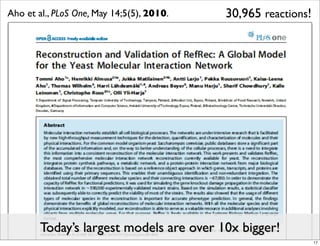
Aho et al., PLoS One, May 14;5(5), 2010.   30,965 reactions!


        Today’s largest models are over 10x bigger!
                                                               17
SBML continues to evolve


                           18
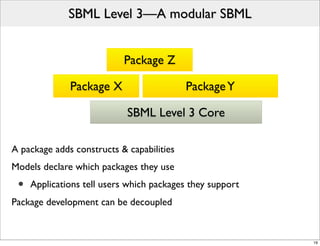
SBML Level 3—A modular SBML


                           Package Z

              Package X                    Package Y

                            SBML Level 3 Core

A package adds constructs & capabilities
Models declare which packages they use
 •   Applications tell users which packages they support
Package development can be decoupled


                                                           19
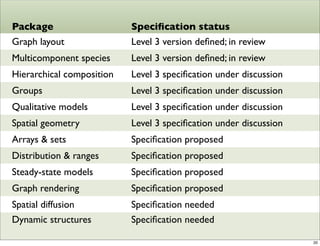
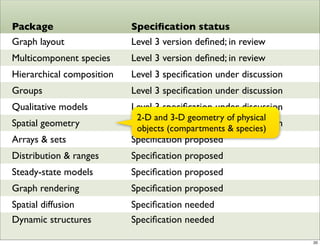
Package                    Specication status
Graph layout               Level 3 version dened; in review
Multicomponent species     Level 3 version dened; in review
Hierarchical composition   Level 3 specication under discussion
Groups                     Level 3 specication under discussion
Qualitative models         Level 3 specication under discussion
Spatial geometry           Level 3 specication under discussion
Arrays & sets              Specication proposed
Distribution & ranges      Specication proposed
Steady-state models        Specication proposed
Graph rendering            Specication proposed
Spatial diffusion          Specication needed
Dynamic structures         Specication needed

                                                                   20
Package                    Specication status
Graph layout               Level 3 version dened; in review
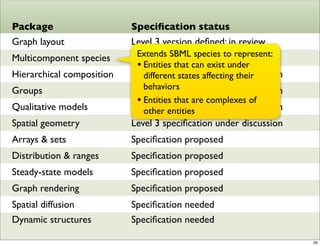
Multicomponent species     Level 3 version species to represent:
                            Extends SBML dened; in review
                            • Entities that can exist under
Hierarchical composition   Level 3 specication under discussion
                              different states affecting their
Groups                        behaviors
                           Level 3 specication under discussion
                            • Entities that are complexes of
Qualitative models         Level 3 specication under discussion
                              other entities
Spatial geometry           Level 3 specication under discussion
Arrays & sets              Specication proposed
Distribution & ranges      Specication proposed
Steady-state models        Specication proposed
Graph rendering            Specication proposed
Spatial diffusion          Specication needed
Dynamic structures         Specication needed

                                                                   20
Package                    Specication status
Graph layout               Level 3 version dened; in review
Multicomponent species     Level 3 version dened; in review
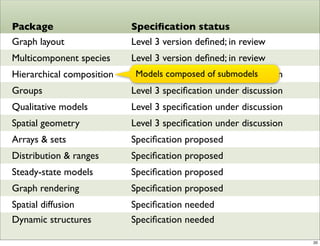
Hierarchical composition    Models composed of submodels
                           Level 3 specication under discussion
Groups                     Level 3 specication under discussion
Qualitative models         Level 3 specication under discussion
Spatial geometry           Level 3 specication under discussion
Arrays & sets              Specication proposed
Distribution & ranges      Specication proposed
Steady-state models        Specication proposed
Graph rendering            Specication proposed
Spatial diffusion          Specication needed
Dynamic structures         Specication needed

                                                                   20
Package                    Specication status
Graph layout               Level 3 version dened; in review
Multicomponent species     Level 3 version dened; in review
Hierarchical composition   Level 3 specication under discussion
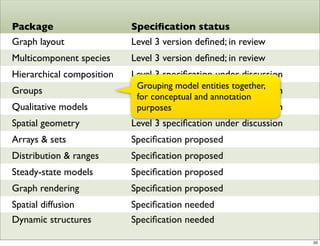
                            Grouping model entities together,
Groups                     Level 3 specication under discussion
                            for conceptual and annotation
Qualitative models         Level 3 specication under discussion
                            purposes
Spatial geometry           Level 3 specication under discussion
Arrays & sets              Specication proposed
Distribution & ranges      Specication proposed
Steady-state models        Specication proposed
Graph rendering            Specication proposed
Spatial diffusion          Specication needed
Dynamic structures         Specication needed

                                                                   20
Package                    Specication status
Graph layout               Level 3 version dened; in review
Multicomponent species     Level 3 version dened; in review
Hierarchical composition   Level 3 specication under discussion
Groups                     Level 3 specication under discussion
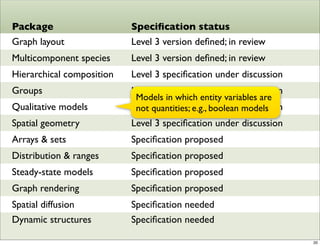
                            Models in which entity variables are
Qualitative models         Levelquantities; e.g., boolean models
                            not 3 specication under discussion
Spatial geometry           Level 3 specication under discussion
Arrays & sets              Specication proposed
Distribution & ranges      Specication proposed
Steady-state models        Specication proposed
Graph rendering            Specication proposed
Spatial diffusion          Specication needed
Dynamic structures         Specication needed

                                                                   20
Package                    Specication status
Graph layout               Level 3 version dened; in review
Multicomponent species     Level 3 version dened; in review
Hierarchical composition   Level 3 specication under discussion
Groups                     Level 3 specication under discussion
Qualitative models         Level 3 specication under discussion
                            2-D and 3-D geometry of physical
Spatial geometry           Level 3 specication under discussion
                            objects (compartments & species)
Arrays & sets              Specication proposed
Distribution & ranges      Specication proposed
Steady-state models        Specication proposed
Graph rendering            Specication proposed
Spatial diffusion          Specication needed
Dynamic structures         Specication needed

                                                                   20
21
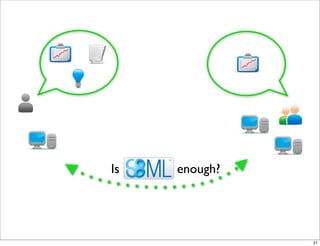
Is   enough?


               21
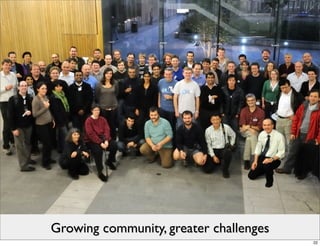
Growing community, greater challenges
                                        22
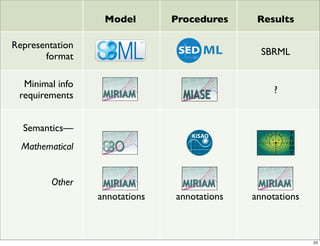
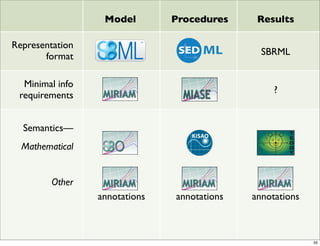
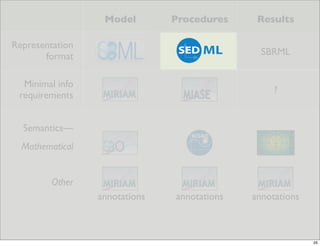
Model        Procedures     Results

Representation
       format                                  SBRML


  Minimal info
                                                  ?
 requirements


  Semantics—
  Mathematical


         Other
                 annotations   annotations   annotations


                                                           23
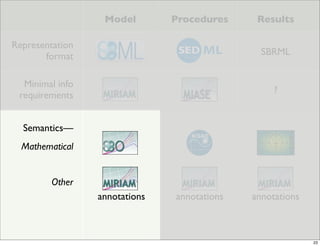
Model        Procedures     Results

Representation
       format                                  SBRML


  Minimal info
                                                  ?
 requirements


  Semantics—
  Mathematical


         Other
                 annotations   annotations   annotations


                                                           23
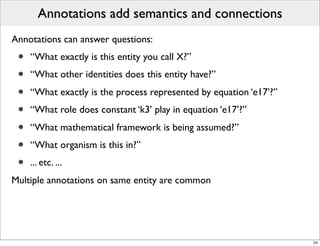
Annotations add semantics and connections
Annotations can answer questions:
 •   “What exactly is this entity you call X?”
 •   “What other identities does this entity have?”

 •   “What exactly is the process represented by equation ‘e17’?”
 •   “What role does constant ‘k3’ play in equation ‘e17’?”

 •   “What mathematical framework is being assumed?”
 •   “What organism is this in?”
 •   ... etc. ...
Multiple annotations on same entity are common


                                                                    24
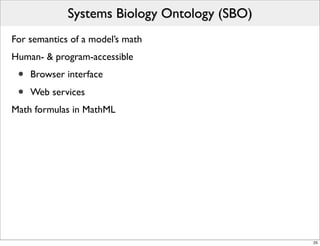
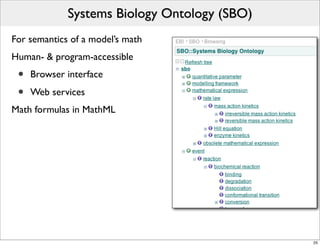
Systems Biology Ontology (SBO)
For semantics of a model’s math
Human- & program-accessible
 •   Browser interface

 •   Web services
Math formulas in MathML


                                              25
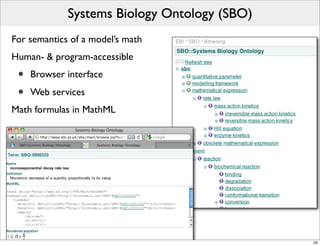
Systems Biology Ontology (SBO)
For semantics of a model’s math
Human- & program-accessible
 •   Browser interface

 •   Web services
Math formulas in MathML


                                              25
Systems Biology Ontology (SBO)
For semantics of a model’s math
Human- & program-accessible
 •   Browser interface

 •   Web services
Math formulas in MathML


                                              25
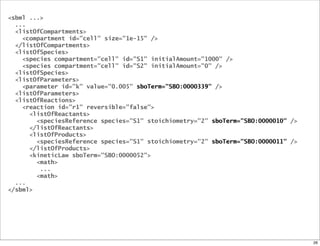
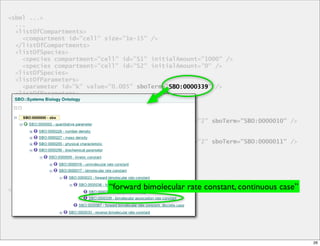
<sbml ...>
  ...
  <listOfCompartments>
    <compartment id="cell" size="1e-15" />
  </listOfCompartments>
  <listOfSpecies>
    <species compartment="cell" id="S1" initialAmount="1000" />
    <species compartment="cell" id="S2" initialAmount="0" />
  <listOfSpecies>
  <listOfParameters>
    <parameter id="k" value="0.005" sboTerm="SBO:0000339" />
  <listOfParameters>
  <listOfReactions>
    <reaction id="r1" reversible="false">
      <listOfReactants>
        <speciesReference species="S1" stoichiometry="2" sboTerm="SBO:0000010" />
      </listOfReactants>
      <listOfProducts>
        <speciesReference species="S1" stoichiometry="2" sboTerm="SBO:0000011" />
      </listOfProducts>
      <kineticLaw sboTerm="SBO:0000052">
        <math>
         ...
        <math>
  ...
</sbml>


                                                                                    26
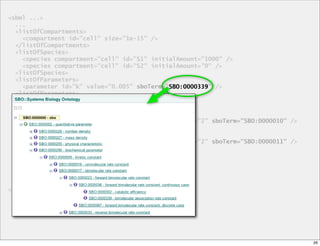
<sbml ...>
  ...
  <listOfCompartments>
    <compartment id="cell" size="1e-15" />
  </listOfCompartments>
  <listOfSpecies>
    <species compartment="cell" id="S1" initialAmount="1000" />
    <species compartment="cell" id="S2" initialAmount="0" />
  <listOfSpecies>
  <listOfParameters>
    <parameter id="k" value="0.005" sboTerm="SBO:0000339" />
                                             SBO:0000339
  <listOfParameters>
  <listOfReactions>
    <reaction id="r1" reversible="false">
      <listOfReactants>
        <speciesReference species="S1" stoichiometry="2" sboTerm="SBO:0000010" />
      </listOfReactants>
      <listOfProducts>
        <speciesReference species="S1" stoichiometry="2" sboTerm="SBO:0000011" />
      </listOfProducts>
      <kineticLaw sboTerm="SBO:0000052">
        <math>
         ...
        <math>
  ...
</sbml>


                                                                                    26
<sbml ...>
  ...
  <listOfCompartments>
    <compartment id="cell" size="1e-15" />
  </listOfCompartments>
  <listOfSpecies>
    <species compartment="cell" id="S1" initialAmount="1000" />
    <species compartment="cell" id="S2" initialAmount="0" />
  <listOfSpecies>
  <listOfParameters>
    <parameter id="k" value="0.005" sboTerm="SBO:0000339" />
                                             SBO:0000339
  <listOfParameters>
  <listOfReactions>
    <reaction id="r1" reversible="false">
      <listOfReactants>
        <speciesReference species="S1" stoichiometry="2" sboTerm="SBO:0000010" />
      </listOfReactants>
      <listOfProducts>
        <speciesReference species="S1" stoichiometry="2" sboTerm="SBO:0000011" />
      </listOfProducts>
      <kineticLaw sboTerm="SBO:0000052">
        <math>
         ...
        <math>
  ...
</sbml>                     “forward bimolecular rate constant, continuous case”


                                                                                    26
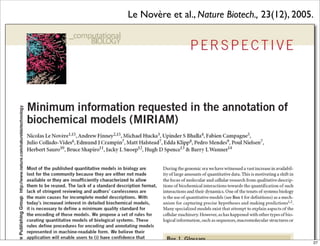
Le Novère et al., Nature Biotech., 23(12), 2005.


                                               27
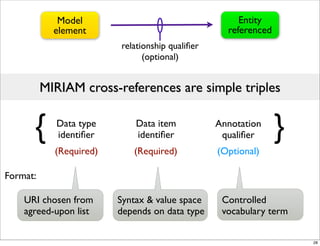
Model                                    Entity
            element                                referenced
                         relationship qualier
                               (optional)


          MIRIAM cross-references are simple triples


      {     Data type
            identier
                             Data item
                             identier
                                                 Annotation
                                                  qualier      }
            (Required)      (Required)           (Optional)

Format:

    URI chosen from      Syntax & value space     Controlled
    agreed-upon list     depends on data type     vocabulary term

                                                                    28
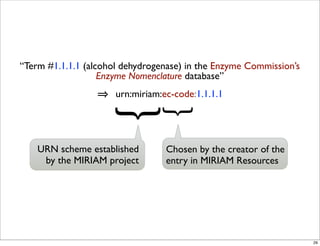
“Term #1.1.1.1 (alcohol dehydrogenase) in the Enzyme Commission’s
                   Enzyme Nomenclature database”
                      urn:miriam:ec-code:1.1.1.1


                   {
                               {
    URN scheme established        Chosen by the creator of the
     by the MIRIAM project        entry in MIRIAM Resources


                                                                    29
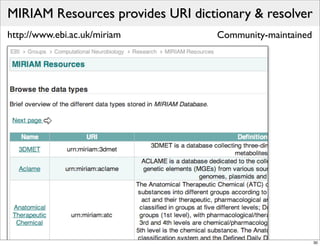
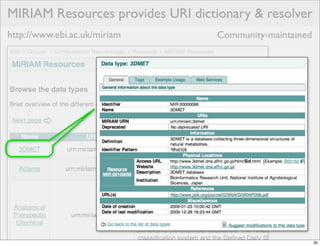
MIRIAM Resources provides URI dictionary & resolver
http://www.ebi.ac.uk/miriam        Community-maintained


                                                          30
MIRIAM Resources provides URI dictionary & resolver
http://www.ebi.ac.uk/miriam        Community-maintained


                                                          30
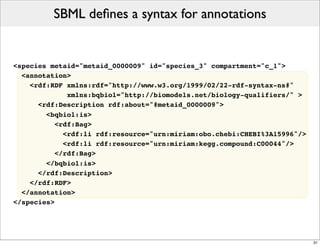
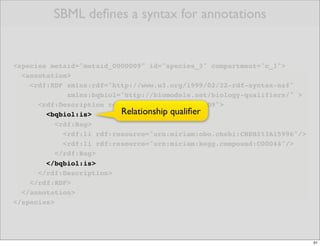
SBML denes a syntax for annotations


<species metaid="metaid_0000009" id="species_3" compartment="c_1">
  <annotation>
    <rdf:RDF xmlns:rdf="http://www.w3.org/1999/02/22-rdf-syntax-ns#"
              xmlns:bqbiol="http://biomodels.net/biology-qualifiers/" >
      <rdf:Description rdf:about="#metaid_0000009">
        <bqbiol:is>
           <rdf:Bag>
             <rdf:li rdf:resource="urn:miriam:obo.chebi:CHEBI%3A15996"/>
             <rdf:li rdf:resource="urn:miriam:kegg.compound:C00044"/>
           </rdf:Bag>
        </bqbiol:is>
      </rdf:Description>
    </rdf:RDF>
  </annotation>
</species>


                                                                           31
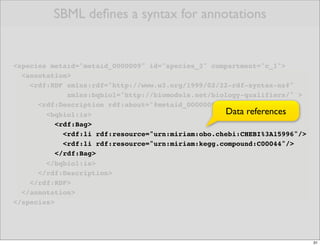
SBML denes a syntax for annotations


<species metaid="metaid_0000009" id="species_3" compartment="c_1">
  <annotation>
    <rdf:RDF xmlns:rdf="http://www.w3.org/1999/02/22-rdf-syntax-ns#"
              xmlns:bqbiol="http://biomodels.net/biology-qualifiers/" >
      <rdf:Description rdf:about="#metaid_0000009">
        <bqbiol:is>                                 Data references
           <rdf:Bag>
             <rdf:li rdf:resource="urn:miriam:obo.chebi:CHEBI%3A15996"/>
             <rdf:li rdf:resource="urn:miriam:kegg.compound:C00044"/>
           </rdf:Bag>
        </bqbiol:is>
      </rdf:Description>
    </rdf:RDF>
  </annotation>
</species>


                                                                           31
SBML denes a syntax for annotations


<species metaid="metaid_0000009" id="species_3" compartment="c_1">
  <annotation>
    <rdf:RDF xmlns:rdf="http://www.w3.org/1999/02/22-rdf-syntax-ns#"
              xmlns:bqbiol="http://biomodels.net/biology-qualifiers/" >
      <rdf:Description rdf:about="#metaid_0000009">
        <bqbiol:is>        Relationship qualier
           <rdf:Bag>
             <rdf:li rdf:resource="urn:miriam:obo.chebi:CHEBI%3A15996"/>
             <rdf:li rdf:resource="urn:miriam:kegg.compound:C00044"/>
           </rdf:Bag>
        </bqbiol:is>
      </rdf:Description>
    </rdf:RDF>
  </annotation>
</species>


                                                                           31
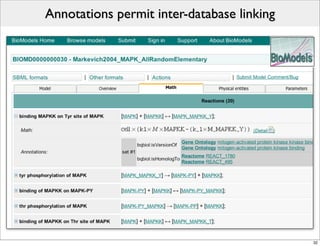
Annotations permit inter-database linking


                                            32
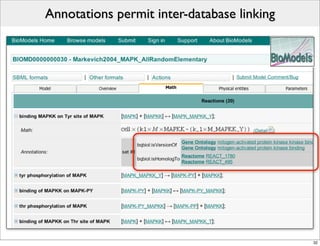
Annotations permit inter-database linking


                                            32
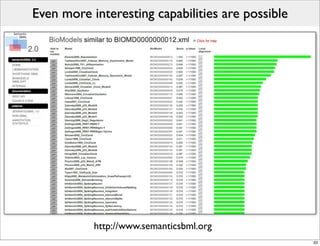
Even more interesting capabilities are possible


           http://www.semanticsbml.org
                                                  33
MIRIAM identiers now in use by many other projects

Data resources                           Application software
• BioModels Database (kinetic models)    • ARCADIA
• PSI Consortium (protein interaction)   • BioUML
• Reactome (pathways)                    • COPASI
• Pathway Commons (pathways)             • libAnnotationSBML
                                         • libSBML
• SABIO-RK (reaction kinetics)
                                         • Saint
• Yeast consensus model database
                                         • SBML2BioPAX
• E-MeP (structural genomics)            • SBML2LaTeX
                                         • SBMLeditor
                                         • semanticSBML
                                         • Snazer
                                         • SBW
                                         • The Virtual Cell


                                                                34
Model        Procedures     Results

Representation
       format                                  SBRML


  Minimal info
                                                  ?
 requirements


  Semantics—
  Mathematical


         Other
                 annotations   annotations   annotations


                                                           35
Model        Procedures     Results

Representation
       format                                  SBRML


  Minimal info
                                                  ?
 requirements


  Semantics—
  Mathematical


         Other
                 annotations   annotations   annotations


                                                           35
<sbml ...>
  ...
  <listOfCompartments>
    <compartment id="cell" size="1e-15" />
  </listOfCompartments>
  <listOfSpecies>
                                                                  ?
    <species compartment="cell" id="S1" initialAmount="1000" />
    <species compartment="cell" id="S2" initialAmount="0" />
  <listOfSpecies>
  <listOfParameters>
    <parameter id="k" value="0.005" sboTerm="SBO:0000339" />
  <listOfParameters>
  <listOfReactions>
    <reaction id="r1" reversible="false">
      <listOfReactants>
        <speciesReference species="S1" stoichiometry="2"
sboTerm="SBO:0000010" />
...


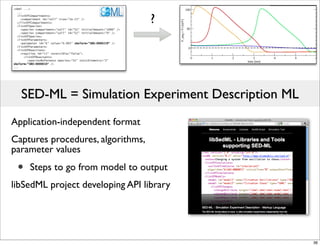
    SED-ML = Simulation Experiment Description ML
Application-independent format
Captures procedures, algorithms,
parameter values

  •      Steps to go from model to output
libSedML project developing API library


                                                                      36
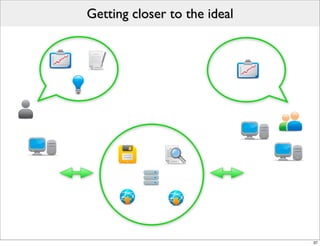
Getting closer to the ideal


                              37
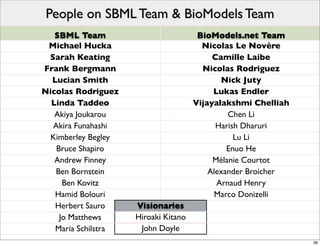
People on SBML Team & BioModels Team
   SBML Team                           BioModels.net Team
 Michael Hucka                          Nicolas Le Novère
 Sarah Keating                             Camille Laibe
Frank Bergmann                          Nicolas Rodriguez
  Lucian Smith                               Nick Juty
Nicolas Rodriguez                          Lukas Endler
  Linda Taddeo                        Vijayalakshmi Chelliah
   Akiya Joukarou                              Chen Li
  Akira Funahashi                           Harish Dharuri
  Kimberley Begley                               Lu Li
   Bruce Shapiro                               Enuo He
   Andrew Finney                           MĂŠlanie Courtot
   Ben Bornstein                          Alexander Broicher
     Ben Kovitz                             Arnaud Henry
   Hamid Bolouri                           Marco Donizelli
   Herbert Sauro     Visionaries
    Jo Matthews      Hiroaki Kitano
   Maria Schilstra    John Doyle
                                                               38
National Institute of General Medical Sciences (USA)
European Molecular Biology Laboratory (EMBL)
ELIXIR (UK)
Beckman Institute, Caltech (USA)
Keio University (Japan)
JST ERATO Kitano Symbiotic Systems Project (Japan) (to 2003)
National Science Foundation (USA)
International Joint Research Program of NEDO (Japan)
JST ERATO-SORST Program (Japan)
Japanese Ministry of Agriculture
Japanese Ministry of Educ., Culture, Sports, Science and Tech.
BBSRC (UK)
DARPA IPTO Bio-SPICE Bio-Computation Program (USA)
Air Force Office of Scientific Research (USA)
STRI, University of Hertfordshire (UK)
Molecular Sciences Institute (USA)

Agencies to thank for supporting SBML & BioModels.net
                                                                 39
Where to nd out more
               SBML http://sbml.org
BioModels Database http://biomodels.net/biomodels
            MIRIAM http://biomodels.net/miriam
              MIASE http://biomodels.net/miase
            SED-ML http://biomodels.net/sed-ml
                SBO http://biomodels.net/sbo
              KiSAO http://www.ebi.ac.uk/compneur-srv/kisao/
             TEDDY http://www.ebi.ac.uk/compneur-srv/teddy/
             SBRML http://tinyurl.com/sbrml

             Thank you for listening!
                                                               40

Finding common ground between modelers and simulation software in systems biology

  • 1.
    Finding common groundbetween modelers and simulation software in systems biology Michael Hucka (On behalf of many people) Senior Research Fellow California Institute of Technology Pasadena, California, USA 2
  • 2.
    So much isknown, and yet, not nearly enough... 3
  • 3.
    Must weave solutionsusing different methods & tools 4
  • 4.
  • 5.
    Models represent knowledgeto be exchanged 6
  • 6.
  • 7.
    SBML = SystemsBiology Markup Language Format for representing computational models • Defines object model + rules for its use - Serialized to XML Neutral with respect to modeling framework • ODE vs. stochastic vs. ... A lingua franca for software • Not procedural 8
  • 8.
    Basic SBML conceptsare simple The reaction is central: a process occurring at a given rate • Participants are pools of entities (species) f ([A],[B],[P ],...) na A + nb B − − − − − − → np P −−−−−− f (...) nc C −− −→ nd D + ne E + nf F . . . Models can further include: • Other constants & variables • Unit definitions • Compartments • Annotations • Explicit math • Discontinuous events 9
  • 9.
    Basic SBML conceptsare simple The reaction is central: a process occurring at a given rate • Participants are pools of entities (species) Can be anything conceptually f ([A],[B],[P ],...) na A + nb B − − − − − − → np P −−−−−− compatible f (...) nc C −− −→ nd D + ne E + nf F . . . Models can further include: • Other constants & variables • Unit definitions • Compartments • Annotations • Explicit math • Discontinuous events 9
  • 10.
    Signaling pathway models Fernandez et al. (2006) DARPP-32 Is a Robust Integrator of Dopamine and Glutamate Signals PLoS Computational Biology BioModels Database model #BIOMD0000000153 Scope of SBML is not limited to metabolic models 10
  • 11.
    Signaling pathway models Hodgkin & Huxley (1952) A quantitative description of Conductance-based models membrane current and its • application to conduction and “Rate rules” for temporal evolution excitation in nerve of quantitative parameters J. Physiology 117:500–544 BioModels Database model #BIOMD0000000020 Scope of SBML is not limited to metabolic models 11
  • 12.
    Signaling pathway models Izhikevich EM. (2003) Simple model of spiking neurons. Conductance-based models IEEE Trans Neural Net. • “Rate rules” for temporal evolution of quantitative parameters BioModels Database model #BIOMD0000000127 Neural models • “Events” for discontinuous changes in quantitative parameters Scope of SBML is not limited to metabolic models 12
  • 13.
    Signaling pathway models Tham et al. (2008) A pharmacodynamic model for Conductance-based models the time course of tumor shrinkage by gemcitabine + • “Rate rules” for temporal evolution of quantitative parameters carboplatin in non-small cell lung cancer patients Clin. Cancer Res. 14 Neural models BioModels Database model • “Events” for discontinuous changes in quantitative parameters #BIOMD0000000234 Pharmacokinetic/dynamics models • “Species” is not required to be a biochemical entity Scope of SBML is not limited to metabolic models 13
  • 14.
    Signaling pathway models Munz et al. (2009 ) Conductance-based models When zombies attack!: Mathematical modelling of an • “Rate rules” for temporal evolution of quantitative parameters outbreak of zombie infection Infectious Disease Modelling Research Progress, eds. Tchuenche et al., p. 133–150 Neural models • “Events” for discontinuous changes in quantitative parameters BioModels Database model #MODEL1008060001 Pharmacokinetic/dynamics models • “Species” is not required to be a biochemical entity Infectious diseases Scope of SBML is not limited to metabolic models 14
  • 15.
    Number of softwaresystems supporting SBML 205 as of Nov. 28 ↓ 200 150 100 50 0 2001 2002 2003 2004 2005 2006 2007 2008 2009 2010 (counted in middle of each year) 15
  • 16.
    Herrgård et al.,Nature Biotech., 26:10, 2008 2342 reactions A consensus yeast metabolic network reconstruction © 2008 Nature Publishing Group http://www.nature.com/naturebiotechnology obtained from a community approach to systems biology Markus J Herrgård1,19,20, Neil Swainston2,3,20, Paul Dobson3,4, Warwick B Dunn3,4, K Yalçin Arga5, Mikko Arvas6, Nils Blüthgen3,7, Simon Borger8, Roeland Costenoble9, Matthias Heinemann9, Michael Hucka10, Nicolas Le Novère11, Peter Li2,3, Wolfram Liebermeister8, Monica L Mo1, Ana Paula Oliveira12, Dina Petranovic12,19, Stephen Pettifer2,3, Evangelos Simeonidis3,7, Kieran Smallbone3,13, Irena Spasić2,3, Dieter Weichart3,4, Roger Brent14, David S Broomhead3,13, Hans V Westerhoff 3,7,15, Betül Kırdar5, Merja Penttilä6, Edda Klipp8, Bernhard Ø Palsson1, Uwe Sauer9, Stephen G Oliver3,16, Pedro Mendes2,3,17, Jens Nielsen12,18 & Douglas B Kell*3,4 Genomic data allow the large-scale manual or semi-automated of their parameters. Armed with such information, it is then possible to assembly of metabolic network reconstructions, which provide provide a stochastic or ordinary differential equation model of the entire highly curated organism-specific knowledge bases. Although metabolic network of interest. An attractive feature of metabolism, for the several genome-scale network reconstructions describe purposes of modeling, is that, in contrast to signaling pathways, metabo- Saccharomyces cerevisiae metabolism, they differ in scope lism is subject to direct thermodynamic and (in particular) stoichiometric and content, and use different terminologies to describe the constraints3. Our focus here is on the first two stages of the reconstruction same chemical entities. This makes comparisons between them process, especially as it pertains to the mapping of experimental metabo- difficult and underscores the desirability of a consolidated lomics data onto metabolic network reconstructions. metabolic network that collects and formalizes the ‘community Besides being an industrial workhorse for a variety of biotechnological knowledge’ of yeast metabolism. We describe how we have products, S. cerevisiae is a highly developed model organism for biochemi- produced a consensus metabolic network reconstruction cal, genetic, pharmacological and post-genomic studies5. It is especially for S. cerevisiae. In drafting it, we placed special emphasis attractive because of the availability of its genome sequence6, a whole series on referencing molecules to persistent databases or using of bar-coded deletion7,8 and other9 strains, extensive experimental ’omics database-independent forms, such as SMILES or InChI strings, data10–14 and the ability to grow it for extended periods under highly con- as this permits their chemical structure to be represented trolled conditions15. The very active scientific community that works on unambiguously and in a manner that permits automated S. cerevisiae has a history of collaborative research projects that have led to reasoning. The reconstruction is readily available via a publicly substantial advances in our understanding of eukaryotic biology6,8,13,16,17. Model scale & complexity have been increasing accessible database and in the Systems Biology Markup Language (http://www.comp-sys-bio.org/yeastnet). It can be maintained as a resource that serves as a common denominator Furthermore, yeast metabolic physiology has been the subject of inten- sive study and most of the components of the yeast metabolic network are relatively well characterized. Taken together, these factors make yeast for studying the systems biology of yeast. Similar strategies metabolism an attractive topic to test a community approach to build 16
  • 17.
    Aho et al.,PLoS One, May 14;5(5), 2010. 30,965 reactions! Today’s largest models are over 10x bigger! 17
  • 18.
  • 19.
    SBML Level 3—Amodular SBML Package Z Package X Package Y SBML Level 3 Core A package adds constructs & capabilities Models declare which packages they use • Applications tell users which packages they support Package development can be decoupled 19
  • 20.
    Package Specication status Graph layout Level 3 version dened; in review Multicomponent species Level 3 version dened; in review Hierarchical composition Level 3 specication under discussion Groups Level 3 specication under discussion Qualitative models Level 3 specication under discussion Spatial geometry Level 3 specication under discussion Arrays & sets Specication proposed Distribution & ranges Specication proposed Steady-state models Specication proposed Graph rendering Specication proposed Spatial diffusion Specication needed Dynamic structures Specication needed 20
  • 21.
    Package Specification status Graph layout Level 3 version defined; in review Multicomponent species Level 3 version species to represent: Extends SBML defined; in review • Entities that can exist under Hierarchical composition Level 3 specification under discussion different states affecting their Groups behaviors Level 3 specification under discussion • Entities that are complexes of Qualitative models Level 3 specification under discussion other entities Spatial geometry Level 3 specification under discussion Arrays & sets Specification proposed Distribution & ranges Specification proposed Steady-state models Specification proposed Graph rendering Specification proposed Spatial diffusion Specification needed Dynamic structures Specification needed 20
  • 22.
    Package Specication status Graph layout Level 3 version dened; in review Multicomponent species Level 3 version dened; in review Hierarchical composition Models composed of submodels Level 3 specication under discussion Groups Level 3 specication under discussion Qualitative models Level 3 specication under discussion Spatial geometry Level 3 specication under discussion Arrays & sets Specication proposed Distribution & ranges Specication proposed Steady-state models Specication proposed Graph rendering Specication proposed Spatial diffusion Specication needed Dynamic structures Specication needed 20
  • 23.
    Package Specication status Graph layout Level 3 version dened; in review Multicomponent species Level 3 version dened; in review Hierarchical composition Level 3 specication under discussion Grouping model entities together, Groups Level 3 specication under discussion for conceptual and annotation Qualitative models Level 3 specication under discussion purposes Spatial geometry Level 3 specication under discussion Arrays & sets Specication proposed Distribution & ranges Specication proposed Steady-state models Specication proposed Graph rendering Specication proposed Spatial diffusion Specication needed Dynamic structures Specication needed 20
  • 24.
    Package Specication status Graph layout Level 3 version dened; in review Multicomponent species Level 3 version dened; in review Hierarchical composition Level 3 specication under discussion Groups Level 3 specication under discussion Models in which entity variables are Qualitative models Levelquantities; e.g., boolean models not 3 specication under discussion Spatial geometry Level 3 specication under discussion Arrays & sets Specication proposed Distribution & ranges Specication proposed Steady-state models Specication proposed Graph rendering Specication proposed Spatial diffusion Specication needed Dynamic structures Specication needed 20
  • 25.
    Package Specication status Graph layout Level 3 version dened; in review Multicomponent species Level 3 version dened; in review Hierarchical composition Level 3 specication under discussion Groups Level 3 specication under discussion Qualitative models Level 3 specication under discussion 2-D and 3-D geometry of physical Spatial geometry Level 3 specication under discussion objects (compartments & species) Arrays & sets Specication proposed Distribution & ranges Specication proposed Steady-state models Specication proposed Graph rendering Specication proposed Spatial diffusion Specication needed Dynamic structures Specication needed 20
  • 26.
  • 27.
    Is enough? 21
  • 28.
  • 29.
    Model Procedures Results Representation format SBRML Minimal info ? requirements Semantics— Mathematical Other annotations annotations annotations 23
  • 30.
    Model Procedures Results Representation format SBRML Minimal info ? requirements Semantics— Mathematical Other annotations annotations annotations 23
  • 31.
    Annotations add semanticsand connections Annotations can answer questions: • “What exactly is this entity you call X?” • “What other identities does this entity have?” • “What exactly is the process represented by equation ‘e17’?” • “What role does constant ‘k3’ play in equation ‘e17’?” • “What mathematical framework is being assumed?” • “What organism is this in?” • ... etc. ... Multiple annotations on same entity are common 24
  • 32.
    Systems Biology Ontology(SBO) For semantics of a model’s math Human- & program-accessible • Browser interface • Web services Math formulas in MathML 25
  • 33.
    Systems Biology Ontology(SBO) For semantics of a model’s math Human- & program-accessible • Browser interface • Web services Math formulas in MathML 25
  • 34.
    Systems Biology Ontology(SBO) For semantics of a model’s math Human- & program-accessible • Browser interface • Web services Math formulas in MathML 25
  • 35.
    <sbml ...> ... <listOfCompartments> <compartment id="cell" size="1e-15" /> </listOfCompartments> <listOfSpecies> <species compartment="cell" id="S1" initialAmount="1000" /> <species compartment="cell" id="S2" initialAmount="0" /> <listOfSpecies> <listOfParameters> <parameter id="k" value="0.005" sboTerm="SBO:0000339" /> <listOfParameters> <listOfReactions> <reaction id="r1" reversible="false"> <listOfReactants> <speciesReference species="S1" stoichiometry="2" sboTerm="SBO:0000010" /> </listOfReactants> <listOfProducts> <speciesReference species="S1" stoichiometry="2" sboTerm="SBO:0000011" /> </listOfProducts> <kineticLaw sboTerm="SBO:0000052"> <math> ... <math> ... </sbml> 26
  • 36.
    <sbml ...> ... <listOfCompartments> <compartment id="cell" size="1e-15" /> </listOfCompartments> <listOfSpecies> <species compartment="cell" id="S1" initialAmount="1000" /> <species compartment="cell" id="S2" initialAmount="0" /> <listOfSpecies> <listOfParameters> <parameter id="k" value="0.005" sboTerm="SBO:0000339" /> SBO:0000339 <listOfParameters> <listOfReactions> <reaction id="r1" reversible="false"> <listOfReactants> <speciesReference species="S1" stoichiometry="2" sboTerm="SBO:0000010" /> </listOfReactants> <listOfProducts> <speciesReference species="S1" stoichiometry="2" sboTerm="SBO:0000011" /> </listOfProducts> <kineticLaw sboTerm="SBO:0000052"> <math> ... <math> ... </sbml> 26
  • 37.
    <sbml ...> ... <listOfCompartments> <compartment id="cell" size="1e-15" /> </listOfCompartments> <listOfSpecies> <species compartment="cell" id="S1" initialAmount="1000" /> <species compartment="cell" id="S2" initialAmount="0" /> <listOfSpecies> <listOfParameters> <parameter id="k" value="0.005" sboTerm="SBO:0000339" /> SBO:0000339 <listOfParameters> <listOfReactions> <reaction id="r1" reversible="false"> <listOfReactants> <speciesReference species="S1" stoichiometry="2" sboTerm="SBO:0000010" /> </listOfReactants> <listOfProducts> <speciesReference species="S1" stoichiometry="2" sboTerm="SBO:0000011" /> </listOfProducts> <kineticLaw sboTerm="SBO:0000052"> <math> ... <math> ... </sbml> “forward bimolecular rate constant, continuous case” 26
  • 38.
    Le Novère etal., Nature Biotech., 23(12), 2005. 27
  • 39.
    Model Entity element referenced relationship qualier (optional) MIRIAM cross-references are simple triples { Data type identier Data item identier Annotation qualier } (Required) (Required) (Optional) Format: URI chosen from Syntax & value space Controlled agreed-upon list depends on data type vocabulary term 28
  • 40.
    “Term #1.1.1.1 (alcoholdehydrogenase) in the Enzyme Commission’s Enzyme Nomenclature database” urn:miriam:ec-code:1.1.1.1 { { URN scheme established Chosen by the creator of the by the MIRIAM project entry in MIRIAM Resources 29
  • 41.
    MIRIAM Resources providesURI dictionary & resolver http://www.ebi.ac.uk/miriam Community-maintained 30
  • 42.
    MIRIAM Resources providesURI dictionary & resolver http://www.ebi.ac.uk/miriam Community-maintained 30
  • 43.
    SBML denes asyntax for annotations <species metaid="metaid_0000009" id="species_3" compartment="c_1"> <annotation> <rdf:RDF xmlns:rdf="http://www.w3.org/1999/02/22-rdf-syntax-ns#" xmlns:bqbiol="http://biomodels.net/biology-qualifiers/" > <rdf:Description rdf:about="#metaid_0000009"> <bqbiol:is> <rdf:Bag> <rdf:li rdf:resource="urn:miriam:obo.chebi:CHEBI%3A15996"/> <rdf:li rdf:resource="urn:miriam:kegg.compound:C00044"/> </rdf:Bag> </bqbiol:is> </rdf:Description> </rdf:RDF> </annotation> </species> 31
  • 44.
    SBML denes asyntax for annotations <species metaid="metaid_0000009" id="species_3" compartment="c_1"> <annotation> <rdf:RDF xmlns:rdf="http://www.w3.org/1999/02/22-rdf-syntax-ns#" xmlns:bqbiol="http://biomodels.net/biology-qualifiers/" > <rdf:Description rdf:about="#metaid_0000009"> <bqbiol:is> Data references <rdf:Bag> <rdf:li rdf:resource="urn:miriam:obo.chebi:CHEBI%3A15996"/> <rdf:li rdf:resource="urn:miriam:kegg.compound:C00044"/> </rdf:Bag> </bqbiol:is> </rdf:Description> </rdf:RDF> </annotation> </species> 31
  • 45.
    SBML denes asyntax for annotations <species metaid="metaid_0000009" id="species_3" compartment="c_1"> <annotation> <rdf:RDF xmlns:rdf="http://www.w3.org/1999/02/22-rdf-syntax-ns#" xmlns:bqbiol="http://biomodels.net/biology-qualifiers/" > <rdf:Description rdf:about="#metaid_0000009"> <bqbiol:is> Relationship qualier <rdf:Bag> <rdf:li rdf:resource="urn:miriam:obo.chebi:CHEBI%3A15996"/> <rdf:li rdf:resource="urn:miriam:kegg.compound:C00044"/> </rdf:Bag> </bqbiol:is> </rdf:Description> </rdf:RDF> </annotation> </species> 31
  • 46.
  • 47.
  • 48.
    Even more interestingcapabilities are possible http://www.semanticsbml.org 33
  • 49.
    MIRIAM identifiers nowin use by many other projects Data resources Application software • BioModels Database (kinetic models) • ARCADIA • PSI Consortium (protein interaction) • BioUML • Reactome (pathways) • COPASI • Pathway Commons (pathways) • libAnnotationSBML • libSBML • SABIO-RK (reaction kinetics) • Saint • Yeast consensus model database • SBML2BioPAX • E-MeP (structural genomics) • SBML2LaTeX • SBMLeditor • semanticSBML • Snazer • SBW • The Virtual Cell 34
  • 50.
    Model Procedures Results Representation format SBRML Minimal info ? requirements Semantics— Mathematical Other annotations annotations annotations 35
  • 51.
    Model Procedures Results Representation format SBRML Minimal info ? requirements Semantics— Mathematical Other annotations annotations annotations 35
  • 52.
    <sbml ...> ... <listOfCompartments> <compartment id="cell" size="1e-15" /> </listOfCompartments> <listOfSpecies> ? <species compartment="cell" id="S1" initialAmount="1000" /> <species compartment="cell" id="S2" initialAmount="0" /> <listOfSpecies> <listOfParameters> <parameter id="k" value="0.005" sboTerm="SBO:0000339" /> <listOfParameters> <listOfReactions> <reaction id="r1" reversible="false"> <listOfReactants> <speciesReference species="S1" stoichiometry="2" sboTerm="SBO:0000010" /> ... SED-ML = Simulation Experiment Description ML Application-independent format Captures procedures, algorithms, parameter values • Steps to go from model to output libSedML project developing API library 36
  • 53.
    Getting closer tothe ideal 37
  • 54.
    People on SBMLTeam & BioModels Team SBML Team BioModels.net Team Michael Hucka Nicolas Le Novère Sarah Keating Camille Laibe Frank Bergmann Nicolas Rodriguez Lucian Smith Nick Juty Nicolas Rodriguez Lukas Endler Linda Taddeo Vijayalakshmi Chelliah Akiya Joukarou Chen Li Akira Funahashi Harish Dharuri Kimberley Begley Lu Li Bruce Shapiro Enuo He Andrew Finney MÊlanie Courtot Ben Bornstein Alexander Broicher Ben Kovitz Arnaud Henry Hamid Bolouri Marco Donizelli Herbert Sauro Visionaries Jo Matthews Hiroaki Kitano Maria Schilstra John Doyle 38
  • 55.
    National Institute ofGeneral Medical Sciences (USA) European Molecular Biology Laboratory (EMBL) ELIXIR (UK) Beckman Institute, Caltech (USA) Keio University (Japan) JST ERATO Kitano Symbiotic Systems Project (Japan) (to 2003) National Science Foundation (USA) International Joint Research Program of NEDO (Japan) JST ERATO-SORST Program (Japan) Japanese Ministry of Agriculture Japanese Ministry of Educ., Culture, Sports, Science and Tech. BBSRC (UK) DARPA IPTO Bio-SPICE Bio-Computation Program (USA) Air Force Office of Scientific Research (USA) STRI, University of Hertfordshire (UK) Molecular Sciences Institute (USA) Agencies to thank for supporting SBML & BioModels.net 39
  • 56.
    Where to ndout more SBML http://sbml.org BioModels Database http://biomodels.net/biomodels MIRIAM http://biomodels.net/miriam MIASE http://biomodels.net/miase SED-ML http://biomodels.net/sed-ml SBO http://biomodels.net/sbo KiSAO http://www.ebi.ac.uk/compneur-srv/kisao/ TEDDY http://www.ebi.ac.uk/compneur-srv/teddy/ SBRML http://tinyurl.com/sbrml Thank you for listening! 40