Creating a new language to support
open innovation
Michael Hucka, Ph.D.
Department of Computing + Mathematical Sciences
California Institute of Technology
Pasadena, CA, USA
BioBriefing – BioMelbourne Network, Australia, August 2013
Email: mhucka@caltech.edu Twitter: @mhucka
Outline
Background and introduction
The Systems Biology Markup Language (SBML)
Complementary efforts: MIRIAM and SED-ML
COMBINE: the Computational Modeling in Biology Network
Conclusion
Outline
Background and introduction
The Systems Biology Markup Language (SBML)
Complementary efforts: MIRIAM and SED-ML
COMBINE: the Computational Modeling in Biology Network
Conclusion
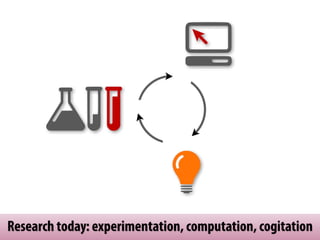
Research today: experimentation, computation, cogitation
“ The nature of systems biology”
Bruggeman & Westerhoff,
Trends Microbiol. 15 (2007).
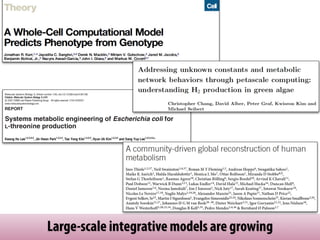
Large-scale integrative models are growing
Many models have traditionally been published this way
Problems:
• Errors in printing
• Missing information
• Dependencies on
implementation
• Outright errors
• Can be a huge
effort to recreate
Is it enough to communicate the model in a paper?
Experiences from BioModels Database
BioModels Database:
• Public database of published computational models in biology
• Many models are curated – i.e., made to work & annotated
- If not available in electronic form, they encode it from the paper
Their experiences?
• Vast majority of models encoded directly from the publication
did not work as published
- Often (not always) due to common errors – typos, omissions
• Success rate improved in recent years thanks to more people
providing their models in electronic formats
More is needed to make computational results reproducible
Experiences from BioModels Database
BioModels Database:
• Public database of published computational models in biology
• Many models are curated – i.e., made to work & annotated
- If not available in electronic form, they encode it from the paper
Their experiences?
• Vast majority of models encoded directly from the publication
did not work as published
- Often (not always) due to common errors – typos, omissions
• Success rate improved in recent years thanks to more people
providing their models in electronic formats
More is needed to make computational results reproducible
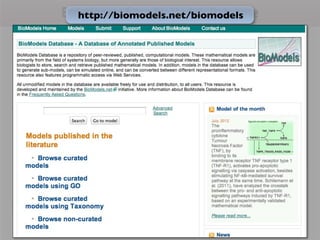
http://biomodels.net/biomodels
Experiences from BioModels Database
BioModels Database:
• Public database of published computational models in biology
• Many models are curated – i.e., made to work & annotated
- If not available in electronic form, they encode it from the paper
Their experiences?
• Vast majority of models encoded directly from the publication
did not work as published
- Often (not always) due to common errors – typos, omissions
• Success rate improved in recent years thanks to more people
providing their models in electronic formats
More is needed to make computational results reproducible
Is it enough to make your (software X) code available?
It’s vital for good science:
• Someone with access to the same software can try to run it,
understand it, verify the computational results, build on them, etc.
• Opinion: you should always do this in any case
Is it enough to make your (software X) code available?
It’s vital for good science—
• Someone with access to the same software can try to run it,
understand it, build on it, etc.
• Opinion: you should always do this in any case
But it’s still not ideal for communication of scientific results:
• What if they don’t have access to the same software?
• What if they don’t want to use that software?
• What if they want to use a different conceptual framework?
• And how will people be able to relate the model to other work?
Different tools different interfaces & languages
Outline
Background and introduction
The Systems Biology Markup Language (SBML)
Complementary efforts: MIRIAM and SED-ML
COMBINE: the Computational Modeling in Biology Network
Conclusion
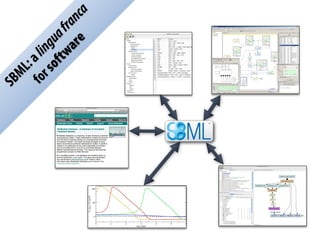
SBML:alinguafranca
forsoftware
Format for representing computational models of biological processes
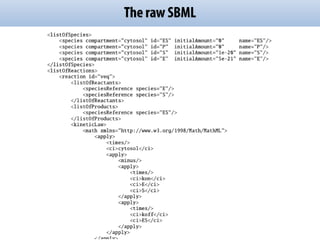
• Data structures + usage principles + serialization to XML
• (Mostly) Declarative, not procedural—not a scripting language
Neutral with respect to modeling framework
• E.g., ODE, stochastic systems, etc.
Important: software reads/writes SBML, not humans
SBML = Systems Biology Markup Language
The raw SBML
The process is central
• Literally called a“reaction”in SBML
• Participants are pools of entities (biochemical species)
Models can further include:
• Compartments
• Other constants & variables
• Discontinuous events
• Other, explicit math
Core SBML concepts are fairly simple
• Unit definitions
• Annotations
SBML is now widely used
Dozens of journals accept models in SBML format
100’s of software tools available today
1000’s of models available in SBML format today
0
100
200
300
2001 2002 2003 2004 2005 2006 2007 2008 2009 2010 2011 2012
254+ today
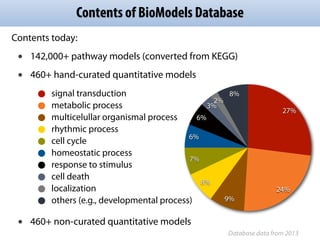
Contents of BioModels Database
Contents today:
• 142,000+ pathway models (converted from KEGG)
• 460+ hand-curated quantitative models
• 460+ non-curated quantitative models
8%
2%
3%
6%
6%
7%
8%
9%
24%
27%
signal transduction
metabolic process
multicelullar organismal process
rhythmic process
cell cycle
homeostatic process
response to stimulus
cell death
localization
others (e.g., developmental process)
Database data from 2013
Free software libraries – libSBML
Reads, writes, validates SBML
Can check & convert units
Written in portable C++
Runs on Linux, Mac, Windows
APIs for C, C++, C#, Java, Octave,
Perl, Python, R, Ruby, MATLAB
Well documented API
Open-source (LGPL)
http://sbml.org/Software/libSBML
Free software libraries – JSBML
Pure Java implementation
API is compatible with libSBML but
more Java-like
Functionality is subset of libSBML
Open source (LGPL)
http://sbml.org/Software/JSBML
Evolution of SBML continues
Today: SBML Level 3
• Level 3 Core provides framework for common models
• Level 3 packages add additional constructs to the Core
Level 3 package What it enables
Hierarchical model composition Models containing submodels ✔
Flux balance constraints Constraint-based models ✔
Qualitative models Petri net models, Boolean models ✔
Graph layout Diagrams of models ✔
Multicomponent/state species Entities w/ structure; also rule-based models draft
Spatial Nonhomogeneous spatial models draft
Graph rendering Diagrams of models draft
Groups Arbitrary grouping of components draft
Distributions Numerical values as statistical distributions in dev
Arrays & sets Arrays or sets of entities in dev
Dynamic structures Creation & destruction of components in dev
Annotations Richer annotation syntax
Status
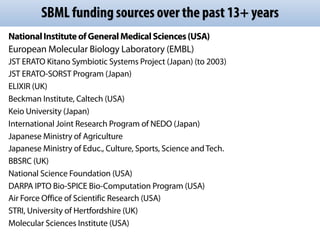
NationalInstituteofGeneralMedicalSciences(USA)
European Molecular Biology Laboratory (EMBL)
JST ERATO Kitano Symbiotic Systems Project (Japan) (to 2003)
JST ERATO-SORST Program (Japan)
ELIXIR (UK)
Beckman Institute, Caltech (USA)
Keio University (Japan)
International Joint Research Program of NEDO (Japan)
Japanese Ministry of Agriculture
Japanese Ministry of Educ., Culture, Sports, Science and Tech.
BBSRC (UK)
National Science Foundation (USA)
DARPA IPTO Bio-SPICE Bio-Computation Program (USA)
Air Force Office of Scientific Research (USA)
STRI, University of Hertfordshire (UK)
Molecular Sciences Institute (USA)
SBML funding sources over the past 13+ years
Outline
Background and introduction
The Systems Biology Markup Language (SBML)
Complementary efforts: MIRIAM and SED-ML
COMBINE: the Computational Modeling in Biology Network
Conclusion
Mathematical semantics
Biological semantics
Visual interpretation
Discrete stochastic entities
Continuous lumped parameter
State transition
Meanfieldapproximation
Model type
Model creation
Model annotation
Model analysis
Numericalresults
Model life-cycle
Model representation level
COMBINE efforts cover different facets of modeling
...
ConceptduetoNicolasLeNovère
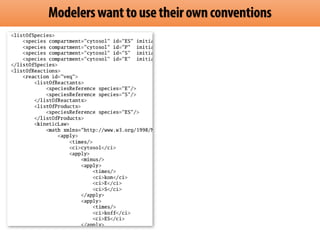
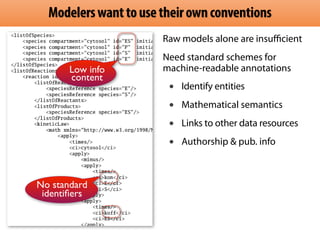
Modelerswanttousetheirownconventions
No standard
identifiers
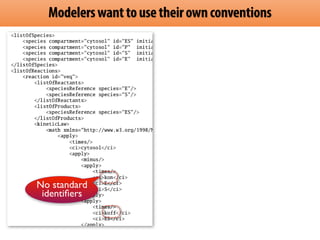
Modelerswanttousetheirownconventions
Low info
content
No standard
identifiers
Raw models alone are insufficient
Need standard schemes for
machine-readable annotations
• Identify entities
• Mathematical semantics
• Links to other data resources
• Authorship & pub. info
Modelerswanttousetheirownconventions
Low info
content
No standard
identifiers
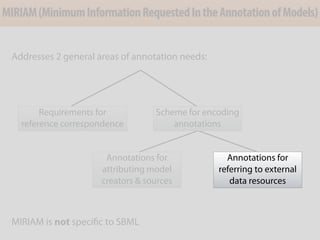
Addresses 2 general areas of annotation needs:
MIRIAM is not specific to SBML
MIRIAM(MinimumInformationRequestedIntheAnnotationofModels)
Requirements for
reference correspondence
Scheme for encoding
annotations
Annotations for
attributing model
creators & sources
Annotations for
referring to external
data resources
Addresses 2 general areas of annotation needs:
MIRIAM is not specific to SBML
MIRIAM(MinimumInformationRequestedIntheAnnotationofModels)
Requirements for
reference correspondence
Scheme for encoding
annotations
Annotations for
attributing model
creators & sources
Annotations for
referring to external
data resources
Annotations for
referring to external
data resources
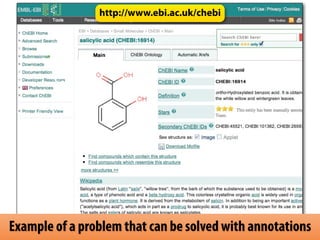
Example of a problem that can be solved with annotations
http://www.ebi.ac.uk/chebi
Low info
content
Example of a problem that can be solved with annotations
http://www.ebi.ac.uk/chebi
Low info
content
Known by different names – 
do you want to write all of
them into your model?
salicylic acid
MIRIAM annotations for external references
Goal: link model constituents to corresponding entities in
bioinformatics resources (e.g., databases, controlled vocabularies)
• Supports:
- Precise identification of model constituents
- Discovery of models that concern the same thing
- Comparison of model constituents between different models
MIRIAM approach avoids putting data content directly in the model
• Instead, it points at external resources that contain the data
How do we create globally unique identifiers consistently?
Long story short—developed by the Le Novère group at the EBI
• Resource identifiers (URIs) combine 2 parts:
• There’s a registry for namespaces: MIRIAM Registry
- Allows people & software to use same namespace identifiers
• There’s a URI resolution service: MIRIAM Resources & identifiers.org
- Allows people & software to take a given identifier and figure
out what it points to
namespace entity identifier
{
{
Identifies a dataset Identifies a datum
within the dataset
Another problem: software can’t read figure legends
?
BIOMD0000000319 in BioModels Database
Decroly & Goldbeter, PNAS, 1982
SED-ML = Simulation Experiment Description ML
Application-independent format
•Captures procedures, algorithms, parameter values
Can be used for
•Simulation experiments encoding parametrizations & perturbations
•Simulations using more than one model and/or method
•Data manipulations to produce plot(s)
http://sedml.org
Simulation
Model
Task Data generators
Reports
Efforts like SED-ML improve reproducibility of publications
Waltemath et al.,
BMC Sys Bio 5, 2011.
Outline
Background and introduction
The Systems Biology Markup Language (SBML)
Complementary efforts: MIRIAM and SED-ML
COMBINE: the Computational Modeling in Biology Network
Conclusion
Need interoperable formats, but developing them is not easy
Need people with diverse set of knowledge & skills
• Scientific needs
• Technical implementation skills
• Practical experience
Need manage multiple phases of a standardization effort
• Creation
• Evolution
• Support
Need interoperable formats, but developing them is not easy
Need people with diverse set of knowledge & skills
• Scientific needs
• Technical implementation skills
• Practical experience
Need manage multiple phases of a standardization effort
• Creation
• Evolution
• Support
} This is just for the specification of the
standards, to say nothing of the necessary
software and other infrastructure!
Realizations about the state of affairs in late-2000’s
• Many standardization efforts overlapped, but lacked coordination
• Efforts were inventing their own processes from scratch
• Many individual meetings meant more travel for many people
• Limited and fragile funding didn’t support solid, coherent base
COMBINE = Computational Modeling in Biology Network
• Coordinate standards development
• Develop common procedures & tools (but not impose them!)
• Coordinate meetings
• Provide a recognized voice
Motivations for the creation of COMBINE
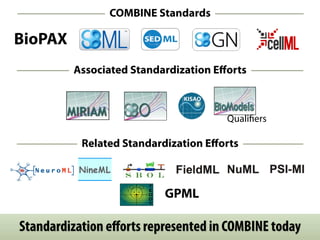
Standardization efforts represented in COMBINE today
BioPAX
Qualifiers
GPML
COMBINE Standards
Associated Standardization Efforts
Related Standardization Efforts
Those are the products of successful, open collaborations!
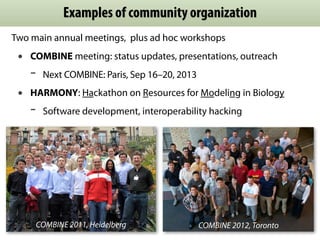
Examples of community organization
Two main annual meetings, plus ad hoc workshops
• COMBINE meeting: status updates, presentations, outreach
- Next COMBINE: Paris, Sep 16–20, 2013
• HARMONY: Hackathon on Resources for Modeling in Biology
- Software development, interoperability hacking
COMBINE 2012, TorontoCOMBINE 2011, Heidelberg
What motivates people to do this?
Solving a problem for yourself/your closed group is easier and quicker
• So what are these people getting out of it?
Some advantages of an open, community-oriented approach:
• Finding better solutions they wouldn’t find alone
- Arguments Discussions leads to realizations & better solutions
• Contributions to science – publications, peer recognition
• Support of a standard makes their software more desirable
• Sense of community involvement
Some admitted disadvantages:
• Agreement takes time – progress can be very slow
• Solutions may include features you didn’t plan on, or need
COMBINE is open to all—and COMBINE needs you!
http://co.mbine.org
Current coordinators:
• Nicolas Le Novère, Mike Hucka, Falk Schreiber, Gary Bader
Outline
Background and introduction
The Systems Biology Markup Language (SBML)
Complementary efforts: MIRIAM and SED-ML
COMBINE: the Computational Modeling in Biology Network
Conclusion
Time it well
• Too early and too late are bad
Start with actual stakeholders
• Address real needs, not perceived ones
Start with small team of dedicated developers
• Can work faster, more focused; also avoids“designed-by-committee”
Engage people constantly, in many ways
• Electronic forums, email, electronic voting, surveys, hackathons
Make the results free and open-source
• Makes people comfortable knowing it will always be available
Be creative about seeking funding
Some things we (maybe?) got right with SBML
Not waiting for implementations before freezing specifications
• Sometimes finalized specification before implementations tested it
- Especially bad when we failed to do a good job
‣ E.g.,“forward thinking”features, or“elegant”designs
Not formalizing the development process sufficiently
• Especially early in the history, did not have a very open process
Not resolving intellectual property issues from the beginning
• Industrial users ask“who has the right to give any rights to this?”
Some things we certainly got wrong
Nicolas Le Novère, Henning Hermjakob, Camille Laibe, Chen Li, Lukas Endler,
Nico Rodriguez, Marco Donizelli,Viji Chelliah, Mélanie Courtot, Harish Dharuri
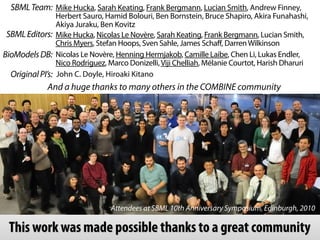
Attendees at SBML 10th Anniversary Symposium, Edinburgh, 2010
John C. Doyle, Hiroaki Kitano
Mike Hucka, Sarah Keating, Frank Bergmann, Lucian Smith, Andrew Finney,
Herbert Sauro, Hamid Bolouri, Ben Bornstein, Bruce Shapiro, Akira Funahashi,
Akiya Juraku, Ben Kovitz
OriginalPI’s:
SBMLTeam:
SBMLEditors:
BioModelsDB:
Mike Hucka, Nicolas Le Novère, Sarah Keating, Frank Bergmann, Lucian Smith,
Chris Myers, Stefan Hoops, Sven Sahle, James Schaff, DarrenWilkinson
And a huge thanks to many others in the COMBINE community
This work was made possible thanks to a great community
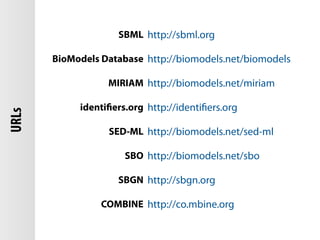
SBML http://sbml.org
BioModels Database http://biomodels.net/biomodels
MIRIAM http://biomodels.net/miriam
identifiers.org http://identifiers.org
SED-ML http://biomodels.net/sed-ml
SBO http://biomodels.net/sbo
SBGN http://sbgn.org
COMBINE http://co.mbine.org
URLs
I’d like your feedback!
You can use this anonymous form:
http://tinyurl.com/mhuckafeedback

Creating a new language to support open innovation

  • 1.
    Creating a newlanguage to support open innovation Michael Hucka, Ph.D. Department of Computing + Mathematical Sciences California Institute of Technology Pasadena, CA, USA BioBriefing – BioMelbourne Network, Australia, August 2013 Email: mhucka@caltech.edu Twitter: @mhucka
  • 2.
    Outline Background and introduction TheSystems Biology Markup Language (SBML) Complementary efforts: MIRIAM and SED-ML COMBINE: the Computational Modeling in Biology Network Conclusion
  • 3.
    Outline Background and introduction TheSystems Biology Markup Language (SBML) Complementary efforts: MIRIAM and SED-ML COMBINE: the Computational Modeling in Biology Network Conclusion
  • 4.
    Research today: experimentation,computation, cogitation
  • 5.
    “ The natureof systems biology” Bruggeman & Westerhoff, Trends Microbiol. 15 (2007).
  • 6.
  • 7.
    Many models havetraditionally been published this way Problems: • Errors in printing • Missing information • Dependencies on implementation • Outright errors • Can be a huge effort to recreate Is it enough to communicate the model in a paper?
  • 8.
    Experiences from BioModelsDatabase BioModels Database: • Public database of published computational models in biology • Many models are curated – i.e., made to work & annotated - If not available in electronic form, they encode it from the paper Their experiences? • Vast majority of models encoded directly from the publication did not work as published - Often (not always) due to common errors – typos, omissions • Success rate improved in recent years thanks to more people providing their models in electronic formats More is needed to make computational results reproducible
  • 9.
    Experiences from BioModelsDatabase BioModels Database: • Public database of published computational models in biology • Many models are curated – i.e., made to work & annotated - If not available in electronic form, they encode it from the paper Their experiences? • Vast majority of models encoded directly from the publication did not work as published - Often (not always) due to common errors – typos, omissions • Success rate improved in recent years thanks to more people providing their models in electronic formats More is needed to make computational results reproducible http://biomodels.net/biomodels
  • 10.
    Experiences from BioModelsDatabase BioModels Database: • Public database of published computational models in biology • Many models are curated – i.e., made to work & annotated - If not available in electronic form, they encode it from the paper Their experiences? • Vast majority of models encoded directly from the publication did not work as published - Often (not always) due to common errors – typos, omissions • Success rate improved in recent years thanks to more people providing their models in electronic formats More is needed to make computational results reproducible
  • 11.
    Is it enoughto make your (software X) code available? It’s vital for good science: • Someone with access to the same software can try to run it, understand it, verify the computational results, build on them, etc. • Opinion: you should always do this in any case
  • 12.
    Is it enoughto make your (software X) code available? It’s vital for good science— • Someone with access to the same software can try to run it, understand it, build on it, etc. • Opinion: you should always do this in any case But it’s still not ideal for communication of scientific results: • What if they don’t have access to the same software? • What if they don’t want to use that software? • What if they want to use a different conceptual framework? • And how will people be able to relate the model to other work?
  • 13.
    Different tools differentinterfaces & languages
  • 14.
    Outline Background and introduction TheSystems Biology Markup Language (SBML) Complementary efforts: MIRIAM and SED-ML COMBINE: the Computational Modeling in Biology Network Conclusion
  • 15.
  • 16.
    Format for representingcomputational models of biological processes • Data structures + usage principles + serialization to XML • (Mostly) Declarative, not procedural—not a scripting language Neutral with respect to modeling framework • E.g., ODE, stochastic systems, etc. Important: software reads/writes SBML, not humans SBML = Systems Biology Markup Language
  • 17.
  • 18.
    The process iscentral • Literally called a“reaction”in SBML • Participants are pools of entities (biochemical species) Models can further include: • Compartments • Other constants & variables • Discontinuous events • Other, explicit math Core SBML concepts are fairly simple • Unit definitions • Annotations
  • 19.
    SBML is nowwidely used Dozens of journals accept models in SBML format 100’s of software tools available today 1000’s of models available in SBML format today 0 100 200 300 2001 2002 2003 2004 2005 2006 2007 2008 2009 2010 2011 2012 254+ today
  • 20.
    Contents of BioModelsDatabase Contents today: • 142,000+ pathway models (converted from KEGG) • 460+ hand-curated quantitative models • 460+ non-curated quantitative models 8% 2% 3% 6% 6% 7% 8% 9% 24% 27% signal transduction metabolic process multicelullar organismal process rhythmic process cell cycle homeostatic process response to stimulus cell death localization others (e.g., developmental process) Database data from 2013
  • 21.
    Free software libraries– libSBML Reads, writes, validates SBML Can check & convert units Written in portable C++ Runs on Linux, Mac, Windows APIs for C, C++, C#, Java, Octave, Perl, Python, R, Ruby, MATLAB Well documented API Open-source (LGPL) http://sbml.org/Software/libSBML
  • 22.
    Free software libraries– JSBML Pure Java implementation API is compatible with libSBML but more Java-like Functionality is subset of libSBML Open source (LGPL) http://sbml.org/Software/JSBML
  • 23.
    Evolution of SBMLcontinues Today: SBML Level 3 • Level 3 Core provides framework for common models • Level 3 packages add additional constructs to the Core
  • 24.
    Level 3 packageWhat it enables Hierarchical model composition Models containing submodels ✔ Flux balance constraints Constraint-based models ✔ Qualitative models Petri net models, Boolean models ✔ Graph layout Diagrams of models ✔ Multicomponent/state species Entities w/ structure; also rule-based models draft Spatial Nonhomogeneous spatial models draft Graph rendering Diagrams of models draft Groups Arbitrary grouping of components draft Distributions Numerical values as statistical distributions in dev Arrays & sets Arrays or sets of entities in dev Dynamic structures Creation & destruction of components in dev Annotations Richer annotation syntax Status
  • 25.
    NationalInstituteofGeneralMedicalSciences(USA) European Molecular BiologyLaboratory (EMBL) JST ERATO Kitano Symbiotic Systems Project (Japan) (to 2003) JST ERATO-SORST Program (Japan) ELIXIR (UK) Beckman Institute, Caltech (USA) Keio University (Japan) International Joint Research Program of NEDO (Japan) Japanese Ministry of Agriculture Japanese Ministry of Educ., Culture, Sports, Science and Tech. BBSRC (UK) National Science Foundation (USA) DARPA IPTO Bio-SPICE Bio-Computation Program (USA) Air Force Office of Scientific Research (USA) STRI, University of Hertfordshire (UK) Molecular Sciences Institute (USA) SBML funding sources over the past 13+ years
  • 26.
    Outline Background and introduction TheSystems Biology Markup Language (SBML) Complementary efforts: MIRIAM and SED-ML COMBINE: the Computational Modeling in Biology Network Conclusion
  • 27.
    Mathematical semantics Biological semantics Visualinterpretation Discrete stochastic entities Continuous lumped parameter State transition Meanfieldapproximation Model type Model creation Model annotation Model analysis Numericalresults Model life-cycle Model representation level COMBINE efforts cover different facets of modeling ... ConceptduetoNicolasLeNovère
  • 28.
  • 29.
  • 30.
  • 31.
    Raw models aloneare insufficient Need standard schemes for machine-readable annotations • Identify entities • Mathematical semantics • Links to other data resources • Authorship & pub. info Modelerswanttousetheirownconventions Low info content No standard identifiers
  • 32.
    Addresses 2 generalareas of annotation needs: MIRIAM is not specific to SBML MIRIAM(MinimumInformationRequestedIntheAnnotationofModels) Requirements for reference correspondence Scheme for encoding annotations Annotations for attributing model creators & sources Annotations for referring to external data resources
  • 33.
    Addresses 2 generalareas of annotation needs: MIRIAM is not specific to SBML MIRIAM(MinimumInformationRequestedIntheAnnotationofModels) Requirements for reference correspondence Scheme for encoding annotations Annotations for attributing model creators & sources Annotations for referring to external data resources Annotations for referring to external data resources
  • 34.
    Example of aproblem that can be solved with annotations http://www.ebi.ac.uk/chebi Low info content
  • 35.
    Example of aproblem that can be solved with annotations http://www.ebi.ac.uk/chebi Low info content Known by different names –  do you want to write all of them into your model? salicylic acid
  • 36.
    MIRIAM annotations forexternal references Goal: link model constituents to corresponding entities in bioinformatics resources (e.g., databases, controlled vocabularies) • Supports: - Precise identification of model constituents - Discovery of models that concern the same thing - Comparison of model constituents between different models MIRIAM approach avoids putting data content directly in the model • Instead, it points at external resources that contain the data
  • 37.
    How do wecreate globally unique identifiers consistently? Long story short—developed by the Le Novère group at the EBI • Resource identifiers (URIs) combine 2 parts: • There’s a registry for namespaces: MIRIAM Registry - Allows people & software to use same namespace identifiers • There’s a URI resolution service: MIRIAM Resources & identifiers.org - Allows people & software to take a given identifier and figure out what it points to namespace entity identifier { { Identifies a dataset Identifies a datum within the dataset
  • 38.
    Another problem: softwarecan’t read figure legends ? BIOMD0000000319 in BioModels Database Decroly & Goldbeter, PNAS, 1982
  • 39.
    SED-ML = SimulationExperiment Description ML Application-independent format •Captures procedures, algorithms, parameter values Can be used for •Simulation experiments encoding parametrizations & perturbations •Simulations using more than one model and/or method •Data manipulations to produce plot(s) http://sedml.org Simulation Model Task Data generators Reports
  • 40.
    Efforts like SED-MLimprove reproducibility of publications Waltemath et al., BMC Sys Bio 5, 2011.
  • 41.
    Outline Background and introduction TheSystems Biology Markup Language (SBML) Complementary efforts: MIRIAM and SED-ML COMBINE: the Computational Modeling in Biology Network Conclusion
  • 42.
    Need interoperable formats,but developing them is not easy Need people with diverse set of knowledge & skills • Scientific needs • Technical implementation skills • Practical experience Need manage multiple phases of a standardization effort • Creation • Evolution • Support
  • 43.
    Need interoperable formats,but developing them is not easy Need people with diverse set of knowledge & skills • Scientific needs • Technical implementation skills • Practical experience Need manage multiple phases of a standardization effort • Creation • Evolution • Support } This is just for the specification of the standards, to say nothing of the necessary software and other infrastructure!
  • 44.
    Realizations about thestate of affairs in late-2000’s • Many standardization efforts overlapped, but lacked coordination • Efforts were inventing their own processes from scratch • Many individual meetings meant more travel for many people • Limited and fragile funding didn’t support solid, coherent base COMBINE = Computational Modeling in Biology Network • Coordinate standards development • Develop common procedures & tools (but not impose them!) • Coordinate meetings • Provide a recognized voice Motivations for the creation of COMBINE
  • 45.
    Standardization efforts representedin COMBINE today BioPAX Qualifiers GPML COMBINE Standards Associated Standardization Efforts Related Standardization Efforts
  • 46.
    Those are theproducts of successful, open collaborations!
  • 47.
    Examples of communityorganization Two main annual meetings, plus ad hoc workshops • COMBINE meeting: status updates, presentations, outreach - Next COMBINE: Paris, Sep 16–20, 2013 • HARMONY: Hackathon on Resources for Modeling in Biology - Software development, interoperability hacking COMBINE 2012, TorontoCOMBINE 2011, Heidelberg
  • 48.
    What motivates peopleto do this? Solving a problem for yourself/your closed group is easier and quicker • So what are these people getting out of it? Some advantages of an open, community-oriented approach: • Finding better solutions they wouldn’t find alone - Arguments Discussions leads to realizations & better solutions • Contributions to science – publications, peer recognition • Support of a standard makes their software more desirable • Sense of community involvement Some admitted disadvantages: • Agreement takes time – progress can be very slow • Solutions may include features you didn’t plan on, or need
  • 49.
    COMBINE is opento all—and COMBINE needs you! http://co.mbine.org Current coordinators: • Nicolas Le Novère, Mike Hucka, Falk Schreiber, Gary Bader
  • 50.
    Outline Background and introduction TheSystems Biology Markup Language (SBML) Complementary efforts: MIRIAM and SED-ML COMBINE: the Computational Modeling in Biology Network Conclusion
  • 51.
    Time it well •Too early and too late are bad Start with actual stakeholders • Address real needs, not perceived ones Start with small team of dedicated developers • Can work faster, more focused; also avoids“designed-by-committee” Engage people constantly, in many ways • Electronic forums, email, electronic voting, surveys, hackathons Make the results free and open-source • Makes people comfortable knowing it will always be available Be creative about seeking funding Some things we (maybe?) got right with SBML
  • 52.
    Not waiting forimplementations before freezing specifications • Sometimes finalized specification before implementations tested it - Especially bad when we failed to do a good job ‣ E.g.,“forward thinking”features, or“elegant”designs Not formalizing the development process sufficiently • Especially early in the history, did not have a very open process Not resolving intellectual property issues from the beginning • Industrial users ask“who has the right to give any rights to this?” Some things we certainly got wrong
  • 53.
    Nicolas Le Novère,Henning Hermjakob, Camille Laibe, Chen Li, Lukas Endler, Nico Rodriguez, Marco Donizelli,Viji Chelliah, Mélanie Courtot, Harish Dharuri Attendees at SBML 10th Anniversary Symposium, Edinburgh, 2010 John C. Doyle, Hiroaki Kitano Mike Hucka, Sarah Keating, Frank Bergmann, Lucian Smith, Andrew Finney, Herbert Sauro, Hamid Bolouri, Ben Bornstein, Bruce Shapiro, Akira Funahashi, Akiya Juraku, Ben Kovitz OriginalPI’s: SBMLTeam: SBMLEditors: BioModelsDB: Mike Hucka, Nicolas Le Novère, Sarah Keating, Frank Bergmann, Lucian Smith, Chris Myers, Stefan Hoops, Sven Sahle, James Schaff, DarrenWilkinson And a huge thanks to many others in the COMBINE community This work was made possible thanks to a great community
  • 54.
    SBML http://sbml.org BioModels Databasehttp://biomodels.net/biomodels MIRIAM http://biomodels.net/miriam identifiers.org http://identifiers.org SED-ML http://biomodels.net/sed-ml SBO http://biomodels.net/sbo SBGN http://sbgn.org COMBINE http://co.mbine.org URLs
  • 55.
    I’d like yourfeedback! You can use this anonymous form: http://tinyurl.com/mhuckafeedback