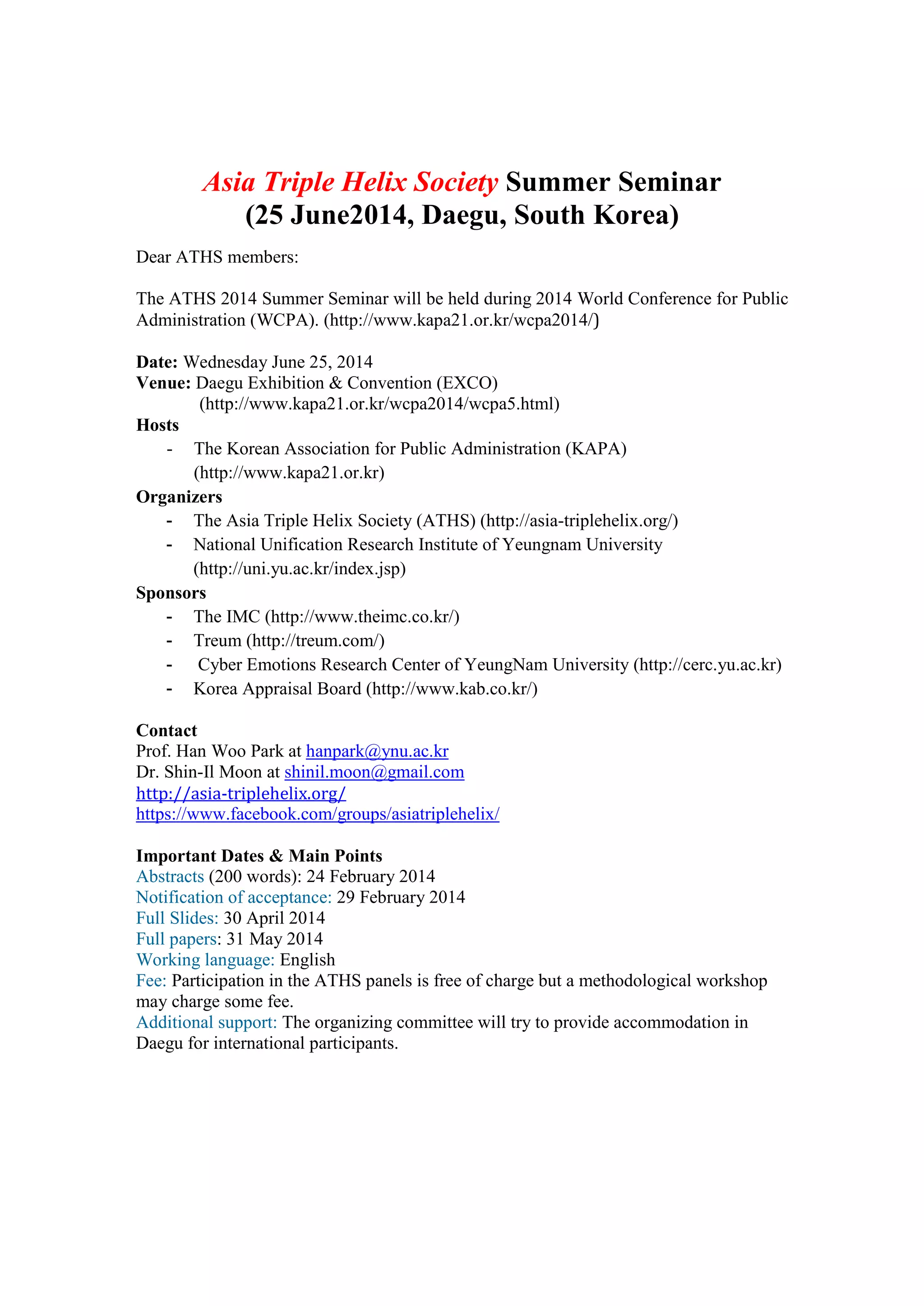
Asia Triple Helix Society Summer Seminar
(25 June2014, Daegu, South Korea)
Dear ATHS members:
The ATHS 2014 Summer Seminar will be held during 2014 World Conference for Public
Administration (WCPA). (http://www.kapa21.or.kr/wcpa2014/)	
	
Date: Wednesday June 25, 2014
Venue: Daegu Exhibition & Convention (EXCO)
(http://www.kapa21.or.kr/wcpa2014/wcpa5.html)
Hosts
- The Korean Association for Public Administration (KAPA)
(http://www.kapa21.or.kr)
Organizers
- The Asia Triple Helix Society (ATHS) (http://asia-triplehelix.org/)
- National Unification Research Institute of Yeungnam University
(http://uni.yu.ac.kr/index.jsp)
Sponsors
- The IMC (http://www.theimc.co.kr/)
- Treum (http://treum.com/)
- Cyber Emotions Research Center of YeungNam University (http://cerc.yu.ac.kr)
- Korea Appraisal Board (http://www.kab.co.kr/)
Contact
Prof. Han Woo Park at hanpark@ynu.ac.kr
Dr. Shin-Il Moon at shinil.moon@gmail.com	
http://asia-triplehelix.org/	
https://www.facebook.com/groups/asiatriplehelix/
Important Dates & Main Points
Abstracts (200 words): 24 February 2014
Notification of acceptance: 29 February 2014
Full Slides: 30 April 2014
Full papers: 31 May 2014
Working language: English
Fee: Participation in the ATHS panels is free of charge but a methodological workshop
may charge some fee.
Additional support: The organizing committee will try to provide accommodation in
Daegu for international participants.
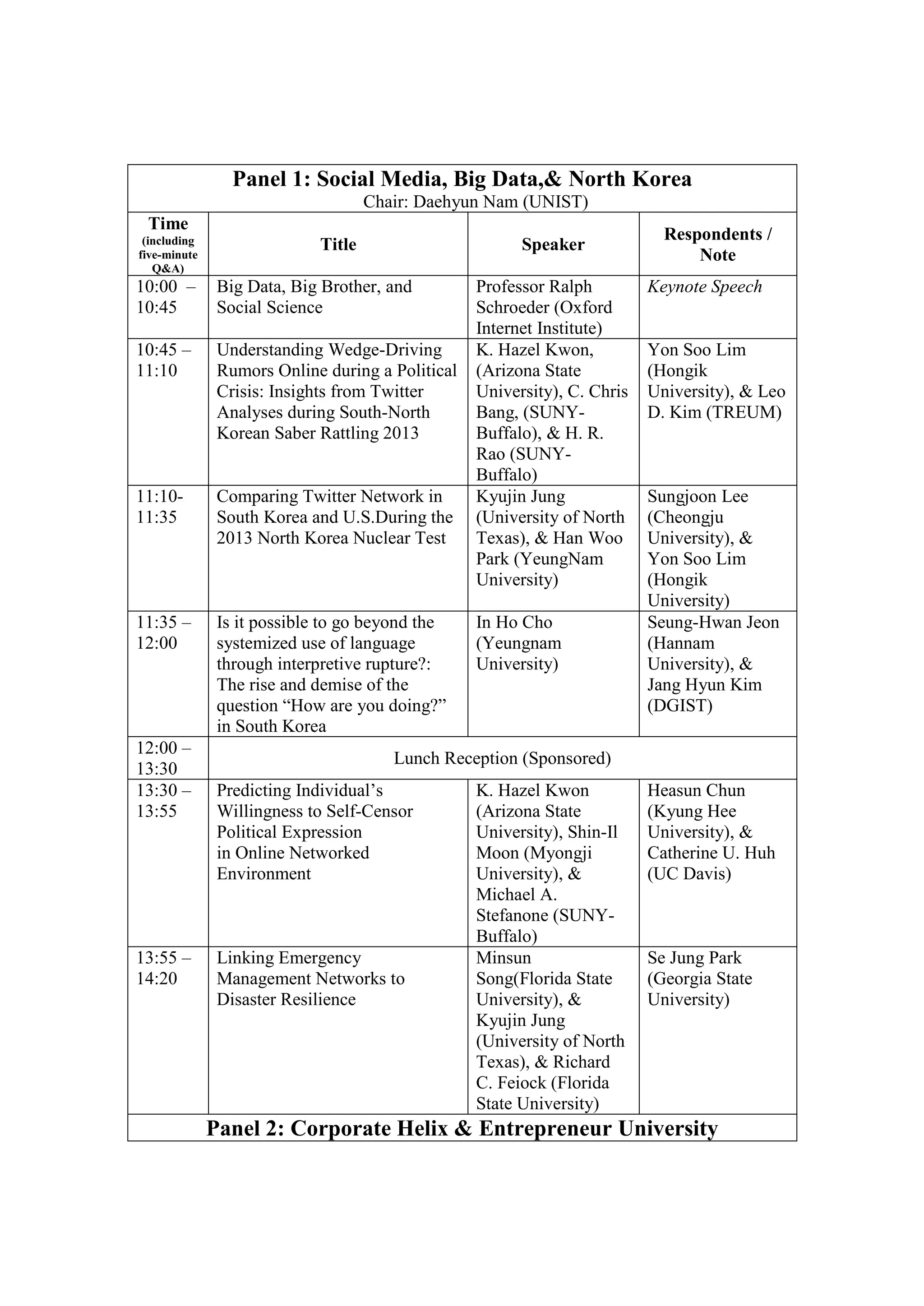
Panel 1: Social Media, Big Data,& North Korea
Chair: Daehyun Nam (UNIST)
Time
(including
five-minute
Q&A)
Title Speaker
Respondents /
Note
10:00 โ€“
10:45
Big Data, Big Brother, and
Social Science
Professor Ralph
Schroeder (Oxford
Internet Institute)
Keynote Speech
10:45 โ€“
11:10
Understanding Wedge-Driving
Rumors Online during a Political
Crisis: Insights from Twitter
Analyses during South-North
Korean Saber Rattling 2013
K. Hazel Kwon,
(Arizona State
University), C. Chris
Bang, (SUNY-
Buffalo), & H. R.
Rao (SUNY-
Buffalo)
Yon Soo Lim
(Hongik
University), & Leo
D. Kim (TREUM)
11:10-
11:35
Comparing Twitter Network in
South Korea and U.S.During the
2013 North Korea Nuclear Test
Kyujin Jung
(University of North
Texas), & Han Woo
Park (YeungNam
University)
Sungjoon Lee
(Cheongju
University), &
Yon Soo Lim
(Hongik
University)
11:35 โ€“
12:00
Is it possible to go beyond the
systemized use of language
through interpretive rupture?:
The rise and demise of the
question โ€œHow are you doing?โ€
in South Korea
In Ho Cho
(Yeungnam
University)
Seung-Hwan Jeon
(Hannam
University), &
Jang Hyun Kim
(DGIST)
12:00 โ€“
13:30
Lunch Reception (Sponsored)
13:30 โ€“
13:55
Predicting Individualโ€™s
Willingness to Self-Censor
Political Expression
in Online Networked
Environment
K. Hazel Kwon
(Arizona State
University), Shin-Il
Moon (Myongji
University), &
Michael A.
Stefanone (SUNY-
Buffalo)
Heasun Chun
(Kyung Hee
University), &
Catherine U. Huh
(UC Davis)
13:55 โ€“
14:20
Linking Emergency
Management Networks to
Disaster Resilience
Minsun
Song(Florida State
University), &
Kyujin Jung
(University of North
Texas), & Richard
C. Feiock (Florida
State University)
Se Jung Park
(Georgia State
University)
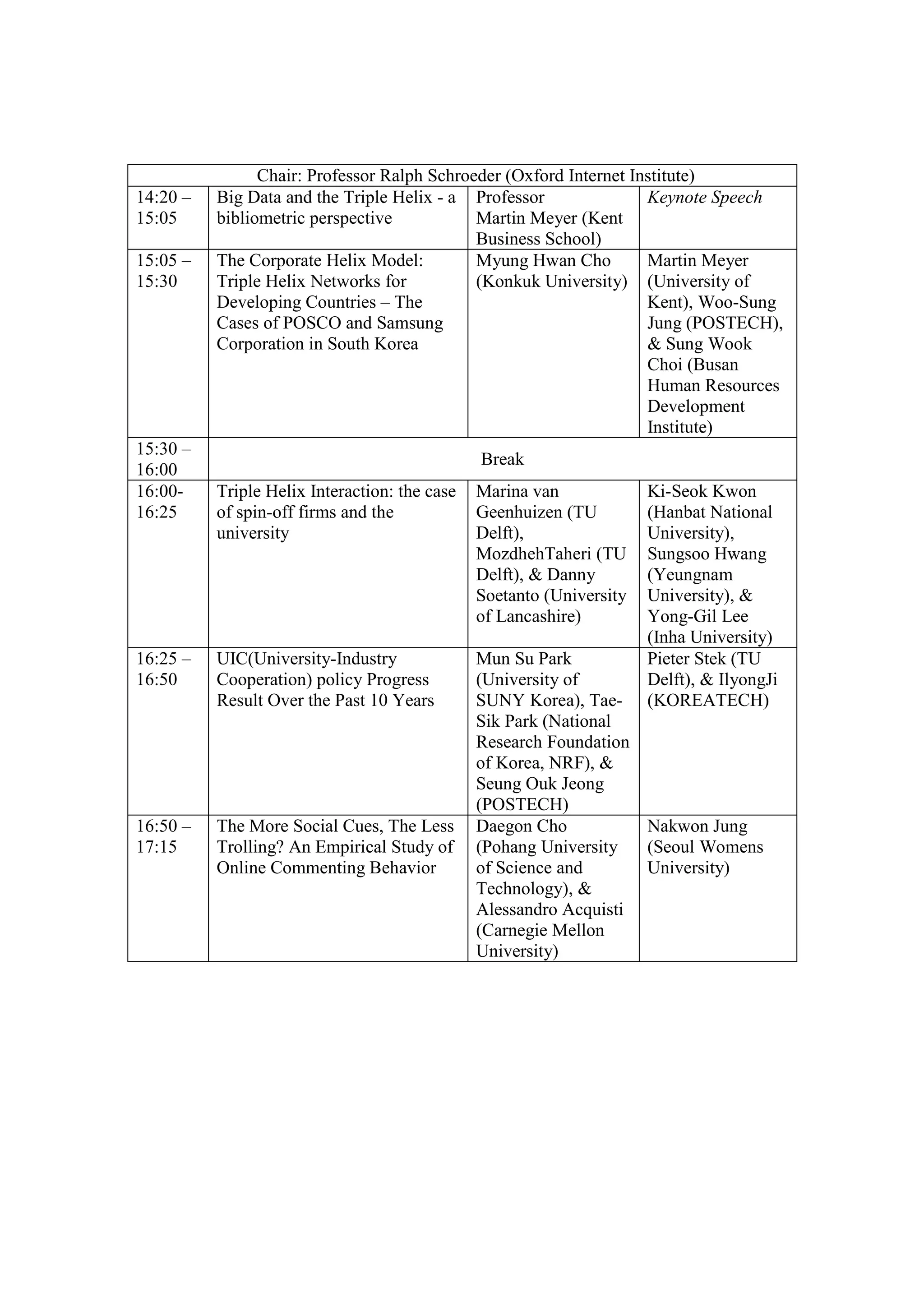
Panel 2: Corporate Helix & Entrepreneur University
Chair: Professor Ralph Schroeder (Oxford Internet Institute)
14:20 โ€“
15:05
Big Data and the Triple Helix - a
bibliometric perspective
Professor
Martin Meyer (Kent
Business School)
Keynote Speech
15:05 โ€“
15:30
The Corporate Helix Model:
Triple Helix Networks for
Developing Countries โ€“ The
Cases of POSCO and Samsung
Corporation in South Korea
Myung Hwan Cho
(Konkuk University)
Martin Meyer
(University of
Kent), Woo-Sung
Jung (POSTECH),
& Sung Wook
Choi (Busan
Human Resources
Development
Institute)
15:30 โ€“
16:00
Break
16:00-
16:25
Triple Helix Interaction: the case
of spin-off firms and the
university
Marina van
Geenhuizen (TU
Delft),
MozdhehTaheri (TU
Delft), & Danny
Soetanto (University
of Lancashire)
Ki-Seok Kwon
(Hanbat National
University),
Sungsoo Hwang
(Yeungnam
University), &
Yong-Gil Lee
(Inha University)
16:25 โ€“
16:50
UIC(University-Industry
Cooperation) policy Progress
Result Over the Past 10 Years
Mun Su Park
(University of
SUNY Korea), Tae-
Sik Park (National
Research Foundation
of Korea, NRF), &
Seung Ouk Jeong
(POSTECH)
Pieter Stek (TU
Delft), & IlyongJi
(KOREATECH)
16:50 โ€“
17:15
The More Social Cues, The Less
Trolling? An Empirical Study of
Online Commenting Behavior
Daegon Cho
(Pohang University
of Science and
Technology), &
Alessandro Acquisti
(Carnegie Mellon
University)
Nakwon Jung
(Seoul Womens
University)
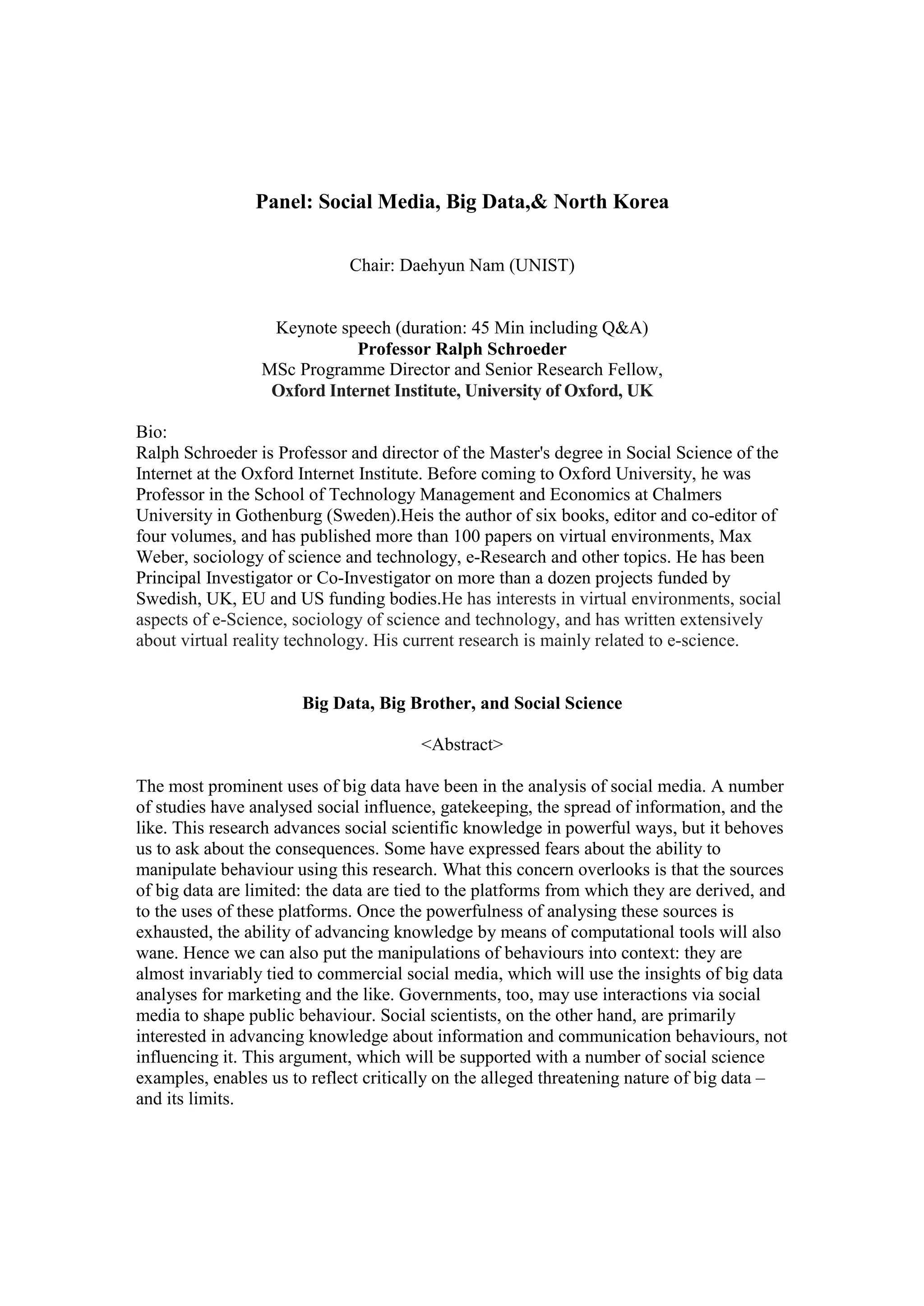
Panel: Social Media, Big Data,& North Korea
Chair: Daehyun Nam (UNIST)
Keynote speech (duration: 45 Min including Q&A)
Professor Ralph Schroeder
MSc Programme Director and Senior Research Fellow,
Oxford Internet Institute, University of Oxford, UK
Bio:
Ralph Schroeder is Professor and director of the Master's degree in Social Science of the
Internet at the Oxford Internet Institute. Before coming to Oxford University, he was
Professor in the School of Technology Management and Economics at Chalmers
University in Gothenburg (Sweden).Heis the author of six books, editor and co-editor of
four volumes, and has published more than 100 papers on virtual environments, Max
Weber, sociology of science and technology, e-Research and other topics. He has been
Principal Investigator or Co-Investigator on more than a dozen projects funded by
Swedish, UK, EU and US funding bodies.He has interests in virtual environments, social
aspects of e-Science, sociology of science and technology, and has written extensively
about virtual reality technology. His current research is mainly related to e-science.
Big Data, Big Brother, and Social Science
<Abstract>
The most prominent uses of big data have been in the analysis of social media. A number
of studies have analysed social influence, gatekeeping, the spread of information, and the
like. This research advances social scientific knowledge in powerful ways, but it behoves
us to ask about the consequences. Some have expressed fears about the ability to
manipulate behaviour using this research. What this concern overlooks is that the sources
of big data are limited: the data are tied to the platforms from which they are derived, and
to the uses of these platforms. Once the powerfulness of analysing these sources is
exhausted, the ability of advancing knowledge by means of computational tools will also
wane. Hence we can also put the manipulations of behaviours into context: they are
almost invariably tied to commercial social media, which will use the insights of big data
analyses for marketing and the like. Governments, too, may use interactions via social
media to shape public behaviour. Social scientists, on the other hand, are primarily
interested in advancing knowledge about information and communication behaviours, not
influencing it. This argument, which will be supported with a number of social science
examples, enables us to reflect critically on the alleged threatening nature of big data โ€“
and its limits.
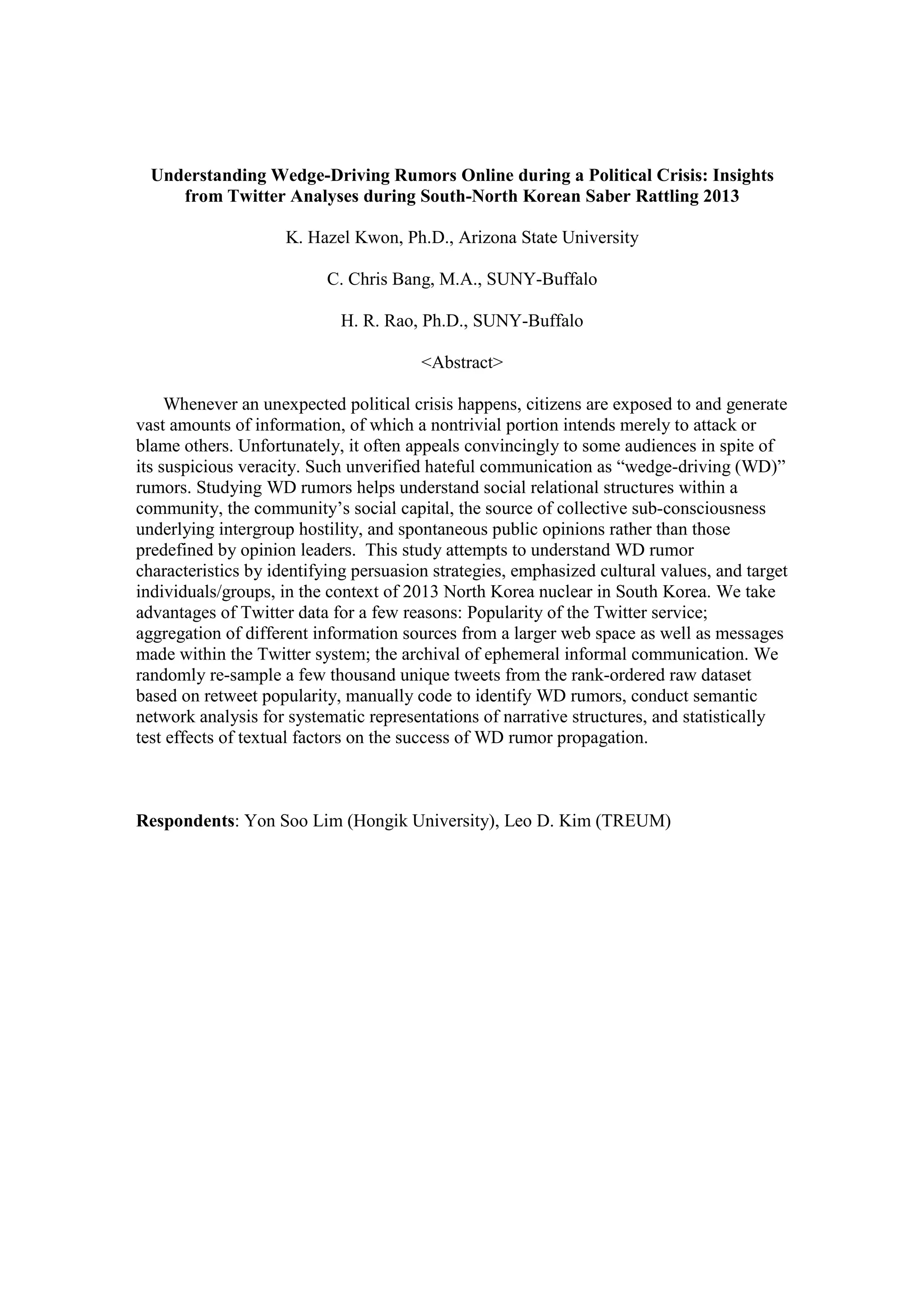
Understanding Wedge-Driving Rumors Online during a Political Crisis: Insights
from Twitter Analyses during South-North Korean Saber Rattling 2013
K. Hazel Kwon, Ph.D., Arizona State University
C. Chris Bang, M.A., SUNY-Buffalo
H. R. Rao, Ph.D., SUNY-Buffalo
<Abstract>
Whenever an unexpected political crisis happens, citizens are exposed to and generate
vast amounts of information, of which a nontrivial portion intends merely to attack or
blame others. Unfortunately, it often appeals convincingly to some audiences in spite of
its suspicious veracity. Such unverified hateful communication as โ€œwedge-driving (WD)โ€
rumors. Studying WD rumors helps understand social relational structures within a
community, the communityโ€™s social capital, the source of collective sub-consciousness
underlying intergroup hostility, and spontaneous public opinions rather than those
predefined by opinion leaders. This study attempts to understand WD rumor
characteristics by identifying persuasion strategies, emphasized cultural values, and target
individuals/groups, in the context of 2013 North Korea nuclear in South Korea. We take
advantages of Twitter data for a few reasons: Popularity of the Twitter service;
aggregation of different information sources from a larger web space as well as messages
made within the Twitter system; the archival of ephemeral informal communication. We
randomly re-sample a few thousand unique tweets from the rank-ordered raw dataset
based on retweet popularity, manually code to identify WD rumors, conduct semantic
network analysis for systematic representations of narrative structures, and statistically
test effects of textual factors on the success of WD rumor propagation.
Respondents: Yon Soo Lim (Hongik University), Leo D. Kim (TREUM)
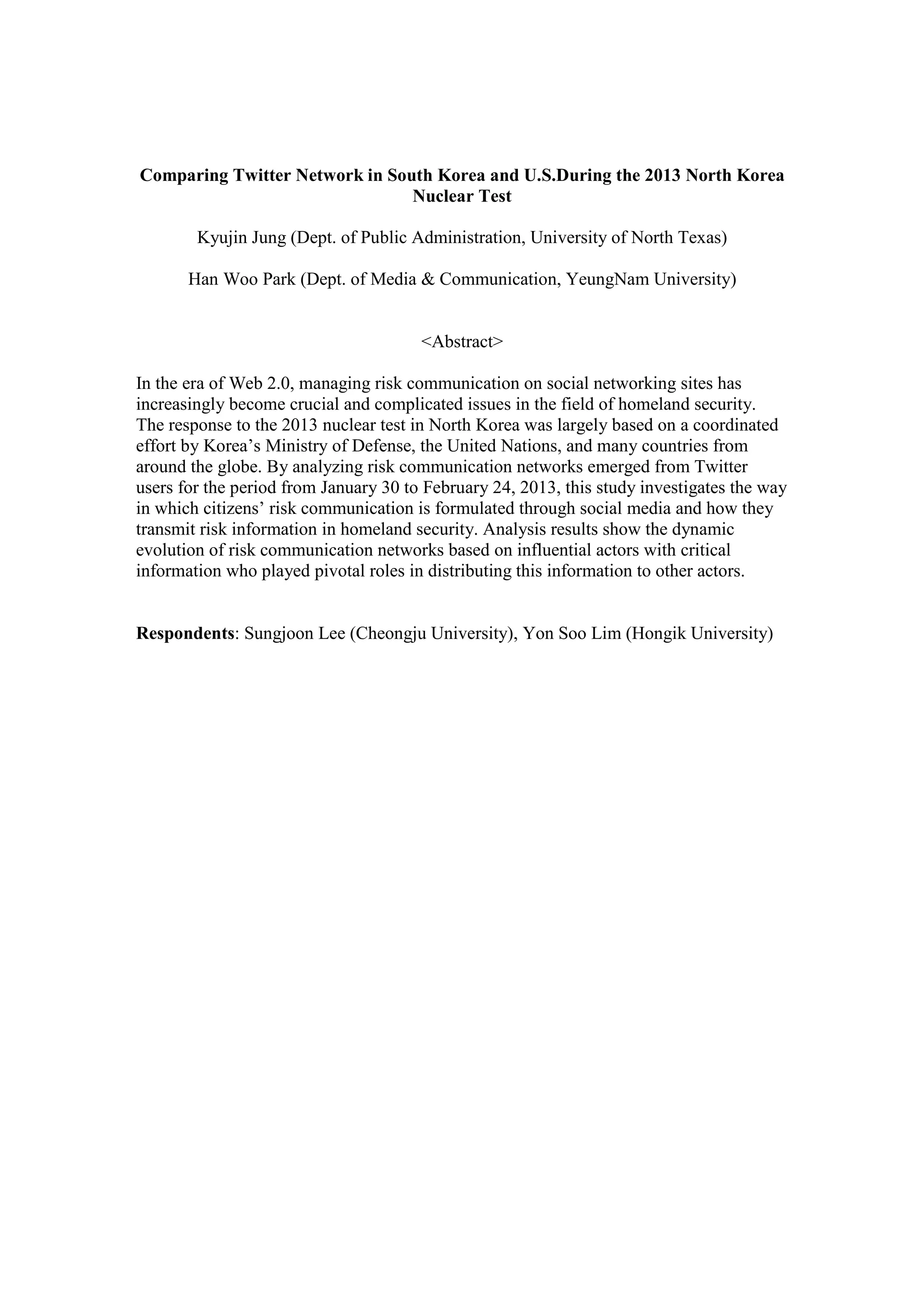
Comparing Twitter Network in South Korea and U.S.During the 2013 North Korea
Nuclear Test
Kyujin Jung (Dept. of Public Administration, University of North Texas)
Han Woo Park (Dept. of Media & Communication, YeungNam University)
<Abstract>
In the era of Web 2.0, managing risk communication on social networking sites has
increasingly become crucial and complicated issues in the field of homeland security.
The response to the 2013 nuclear test in North Korea was largely based on a coordinated
effort by Koreaโ€™s Ministry of Defense, the United Nations, and many countries from
around the globe. By analyzing risk communication networks emerged from Twitter
users for the period from January 30 to February 24, 2013, this study investigates the way
in which citizensโ€™ risk communication is formulated through social media and how they
transmit risk information in homeland security. Analysis results show the dynamic
evolution of risk communication networks based on influential actors with critical
information who played pivotal roles in distributing this information to other actors.
Respondents: Sungjoon Lee (Cheongju University), Yon Soo Lim (Hongik University)
Is it possible to go beyond the systemized use of language through interpretive
rupture?: The rise and demise of the question โ€œHow are you doing?โ€ in South
Korea.
In Ho Cho (Ph.D., Dept. of Media & Communication, Yeungnam University)
In 2013, one student who is attending Korea University asked his fellow students,
โ€œHow are you? Are you really doing fine when youโ€™re avoiding social issues and thinking
that they are not your business?โ€ by a single school board post, titled โ€œHow are you
doing?โ€ The post immediately garnered wide attentions from online and offline
communities. More than 60 response posts were put up right next to Korea Universityโ€™s
โ€œHow are you?โ€ post, discussing social issues under the title of โ€œIโ€™m not doing fine.โ€ The
content quickly spread out on Facebook, receiving more than 140,000 likes in five days.
The post was spread to other universities as well as high schools and became a
nationwidephenomenon. News programs heavily reported this phenomenon and pundits
busied analyzing its causes and possible trajectories. Politicians immediately attempted to
utilize it for their own benefits regardless of their positions. Quickly, this phenomenon
was politicized by media and politicians and โ€œhow are you doing?โ€ appeared as a political
slogan supporting railroad employeesโ€™ strike and opposing high-voltage power line
construction in Miryang, South Gyeongsang Province. Finally, the question, โ€œHow are
you doing?โ€ lost its visibility from online and offline in a short period of time.
This short outline of the rise and demise of โ€œHow are you doing?โ€ raises a very
serious question about whether it is possible to break the familiar rules of ordinary
language use and its systemized interpretation. We understand this is a unique case where
ordinary people opened up discursive and interpretive possibility of a familiar remark
rather than creating new words or concepts in order to express their intentions and
emotions that could not be adequately dealt with everyday language practices. In the
current study, we explores how the questions opened up discursive possibility and
extended interpretive flexibility within offline and online communication via semantic
analyses on school board posts and Facebook messages. In addition, the study
investigates how and in what process this opened possibility quickly closed. In order to
answer the latter, we explore the interplay between media coverage on โ€œhow are you
doing?โ€ and the messages generated by ordinary people. Through the analyses we
attempt to evaluate the possibility of rupturing ordinary language use through introducing
anxiety and tension into familiar remarks.
Respondents:Seung-Hwan Jeon (Hannam University),Jang Hyun Kim (DGIST)
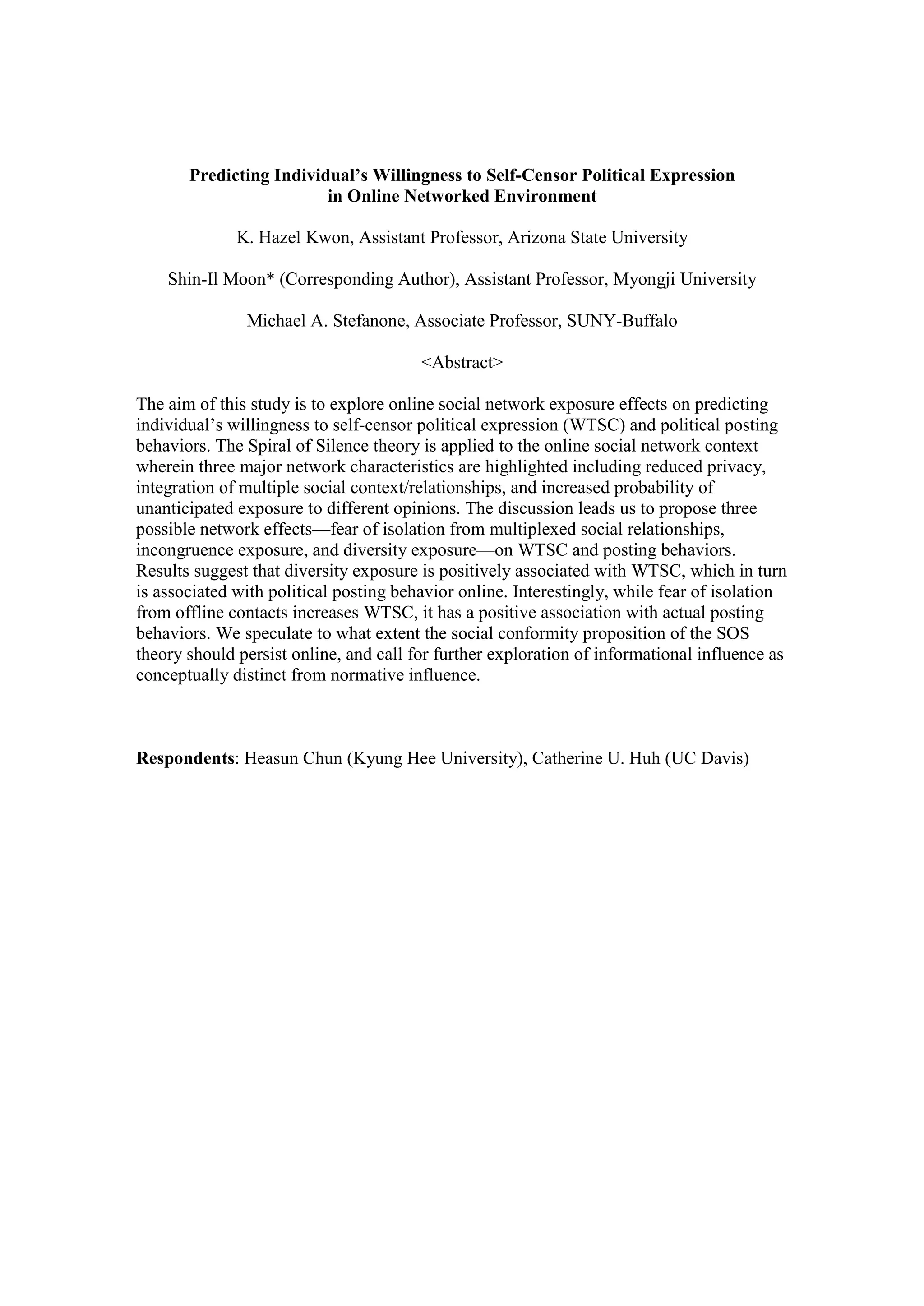
Predicting Individualโ€™s Willingness to Self-Censor Political Expression
in Online Networked Environment
K. Hazel Kwon, Assistant Professor, Arizona State University
Shin-Il Moon* (Corresponding Author), Assistant Professor, Myongji University
Michael A. Stefanone, Associate Professor, SUNY-Buffalo
<Abstract>
The aim of this study is to explore online social network exposure effects on predicting
individualโ€™s willingness to self-censor political expression (WTSC) and political posting
behaviors. The Spiral of Silence theory is applied to the online social network context
wherein three major network characteristics are highlighted including reduced privacy,
integration of multiple social context/relationships, and increased probability of
unanticipated exposure to different opinions. The discussion leads us to propose three
possible network effectsโ€”fear of isolation from multiplexed social relationships,
incongruence exposure, and diversity exposureโ€”on WTSC and posting behaviors.
Results suggest that diversity exposure is positively associated with WTSC, which in turn
is associated with political posting behavior online. Interestingly, while fear of isolation
from offline contacts increases WTSC, it has a positive association with actual posting
behaviors. We speculate to what extent the social conformity proposition of the SOS
theory should persist online, and call for further exploration of informational influence as
conceptually distinct from normative influence.
Respondents: Heasun Chun (Kyung Hee University), Catherine U. Huh (UC Davis)
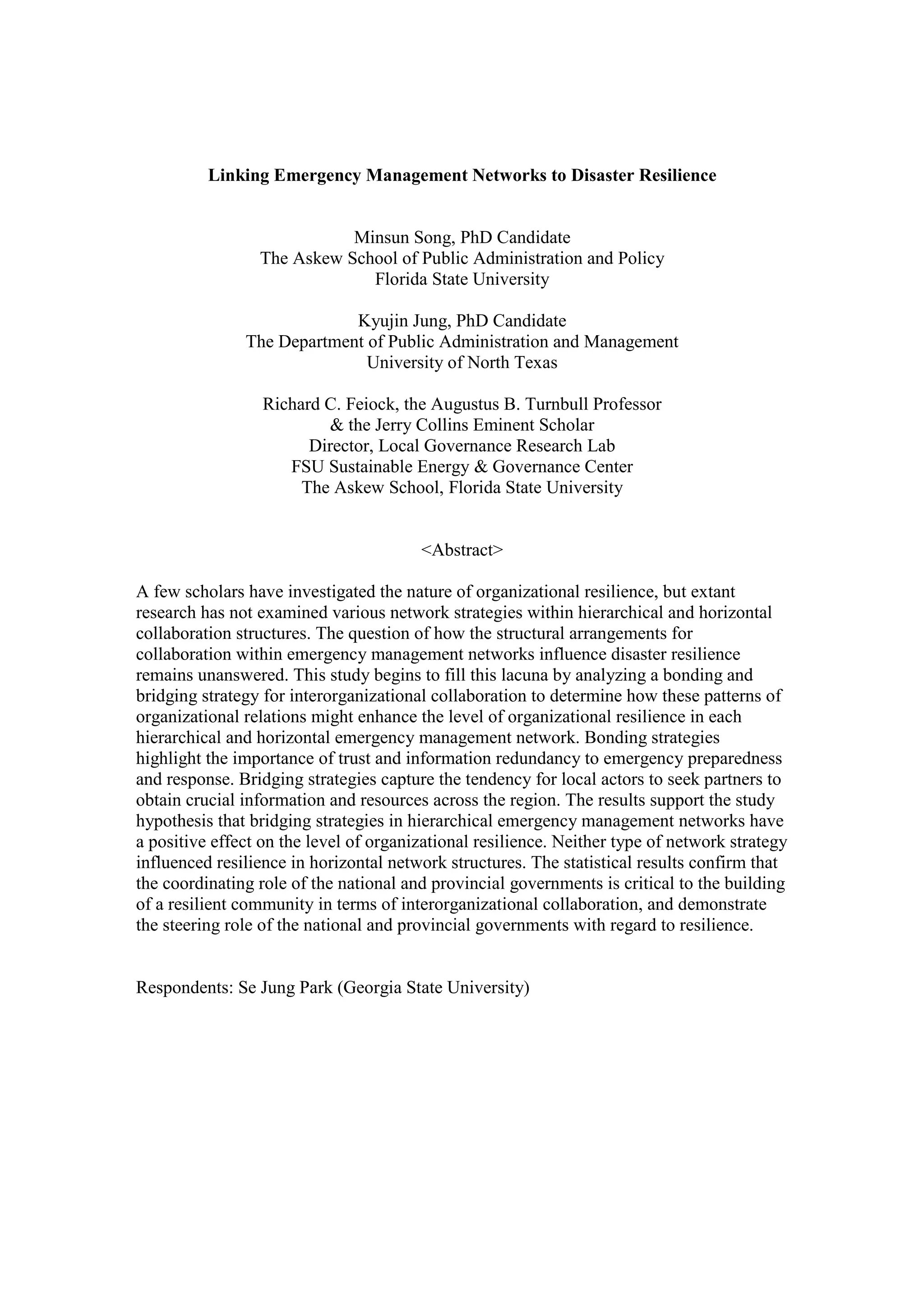
Linking Emergency Management Networks to Disaster Resilience
Minsun Song, PhD Candidate
The Askew School of Public Administration and Policy
Florida State University
Kyujin Jung, PhD Candidate
The Department of Public Administration and Management
University of North Texas
Richard C. Feiock, the Augustus B. Turnbull Professor
& the Jerry Collins Eminent Scholar
Director, Local Governance Research Lab
FSU Sustainable Energy & Governance Center
The Askew School, Florida State University
<Abstract>
A few scholars have investigated the nature of organizational resilience, but extant
research has not examined various network strategies within hierarchical and horizontal
collaboration structures. The question of how the structural arrangements for
collaboration within emergency management networks influence disaster resilience
remains unanswered. This study begins to fill this lacuna by analyzing a bonding and
bridging strategy for interorganizational collaboration to determine how these patterns of
organizational relations might enhance the level of organizational resilience in each
hierarchical and horizontal emergency management network. Bonding strategies
highlight the importance of trust and information redundancy to emergency preparedness
and response. Bridging strategies capture the tendency for local actors to seek partners to
obtain crucial information and resources across the region. The results support the study
hypothesis that bridging strategies in hierarchical emergency management networks have
a positive effect on the level of organizational resilience. Neither type of network strategy
influenced resilience in horizontal network structures. The statistical results confirm that
the coordinating role of the national and provincial governments is critical to the building
of a resilient community in terms of interorganizational collaboration, and demonstrate
the steering role of the national and provincial governments with regard to resilience.
Respondents: Se Jung Park (Georgia State University)
Panel: Corporate Helix & Entrepreneur University
Chair: Professor Ralph Schroeder
Keynote speech (duration: 45 Min including Q&A)
Professor Martin Meyer
Kent	Business	School,	University	of	Kent,	Canterbury	CT2	7PE,	United	Kingdom	
m.s.meyer@kent.ac.uk	
Bio:
Martin Meyer is Director of School, and Professor of Business & Innovation at Kent
Business School. He studied business, economics and sociology at the Universities of
Dortmund (Germany), Uppsala (Sweden) and holds a D.Phil. in Science and Technology
Studies which he obtained from SPRU at the University of Sussex. Martin also worked in
the private sector, for RAND Europe and Technopolis Group. Professor Meyer is well
known for his work on science, technology and innovation as well as the Triple Helix on
university-industry-government relations. He holds visiting appointments at the Birkbeck
Centre for Innovation Management Research, the Centre for Research & Development
Monitoring at KatholiekeUniversiteit Leuven, and SC-Research at the University of
Vaasa.He joined Kent Business School recently from the University of Sussex where he
was the Deputy Head of the School of Business, Management and Economics as well as
the founding Head of the Department of Business and Management. Prior to this, Martin
held positions at KatholiekeUniversiteit Leuven (Belgium), Helsinki University of
Technology - now Aalto University (Finland), the Finnish Institute for Enterprise
Management, and Linkรถping University (Sweden).
Big Data and the Triple Helix - a bibliometric perspective
	
<Abstract>
	
Big data has become the buzz word in recent years. This presentation will present a
bibliometric approach to the topic. We analyze the emergent literature in the field. Our
analysis will offer a general overview of developments and then zoom infocusing on
areas of particular interest. Big data is a topic that is of interest to a multitude of players,
be it government or industry, academics or the public at large. In our analysis we will
explore whether publication activity in certain domains are focused on particular themes.
The presentation concludes with an outlook as to what strongly emergent topics are and
explore the extent to which big data related themes have become visible in scholarly
debates.
The Corporate Helix Model: Triple Helix Networks for Developing Countries โ€“ The
Cases of POSCO and Samsung Corporation in South Korea
Myung Hwan Cho, Ph.D, MPA
Department of Biological Sciences
College of Bioscience and Biotechnology
Konkuk University
Seoul 143-701, Republic of Korea
<Abstract>
Linkages between industry and university have become crucial for knowledge discovery
and driving industrialization within fast-paced global competition and technological
evolution. Studies have often ignored the evolving of universities from an ivory tower to
an entrepreneurial university in the triple helix context of a nationโ€™s technological catch-
up to innovation-based growth, especially in developing countries. This paper illustrates
the transitioning of Pohang University of Science and Technology (POSTECH) and
Sungkyunkwan University (SKKU) to become entrepreneurial universities through the
Corporate Helix Model, where this transformation is made possible by the industry
before the university becomes independent in the triple network interactions between
university-industry-government. POSTECH and SKKU demonstrated divergent routes
but convergent outcomes in technological catch-up during the double helix formation
stage. POSTECH has been one of the top science-technology universities in Asia through
the relationship triad it shares with industry and government after being established by
POSCO. SKKU has become one of the top schools in South Korea while interacting
closely with industry and government to cultivate the efficacy of South Koreaโ€™s national
innovation system as a result of its acquisition and intensive investment from Samsung
for almost over two decades. The Corporate Helix model takes into account the university
which lacks the resources and capability to become entrepreneurial and to participate in a
nationโ€™s technological catch-up to innovation-based growth. The cases of POSTECH and
SKKU illustrate that a university can be established or acquired by the industry and
through this partnership undergo transformation to become entrepreneurial.
Keywords: Triple-Helix, Corporate-Helix, University, Industry, Government, POSCO,
Samsung, POSTECH, SKKU
Respondents: Martin Meyer (University of Kent), Woo-Sung Jung (POSTECH),
Sung Wook Choi (Busan Human Resources Development Institute)
Triple Helix Interaction: the case of spin-off firms and the university
	
Marina van Geenhuizen, Professor of Innovation and Innovation Policy,
TU Delft, The Netherlands
MozdhehTaheri PhD, researcher, TU Delft, The Netherlands
Danny Soetanto PhD, researcher at University of Lancashire, Lancaster, UK
<Abstract>
In the European Union, academic spin-off firms are seen as an important channel for
bringing academic knowledge to market and for improving the entrepreneurial ecosystem
in the region. Their contribution to regional employment creation, however, seems to lag
behind expectations, because most spin-offs do not grow or do not grow substantially.
From research on networks, it is well known that small firms attract resources and
develop capabilities in networking with partners that provide some of the resources
enabling growth.Against this background, we first explore how important networks are in
the growth of spin-off firms, and secondly we explore the importance of the relationships
with the major Triple Helix partner, namely the university. The study draws on a sample
of about 100 spin-off firms in Norway and in the Netherlands.
The paper is structured as follows. First, the specific character of the national innovation
system in the Netherlands and Norway is introduced using various indicators. This is
followed by some theory on networkingthat helps us to understand the role of the actual
networks in building entrepreneurial capabilities and attract resources by spin-off firms,
aside from the starting team. In the empirical part, we estimate the importance of
networks in spin-offsโ€™ growth and specifically the importance of the university in
disclosing opportunities for R&D in spin-off firms. The paper closes with some
conclusions and avenues for future research.
Key words: spin-off firms, networks, entrepreneurial teams, university relationships,
growth, the Netherland, Norway.
	
Respondents: Ki-Seok Kwon (Hanbat National University), Sungsoo Hwang
(Yeungnam University), Yong-Gil Lee (Inha University)
UIC(University-Industry Cooperation) policy Progress Result Over the Past 10
Years
Mun Su Park (Dept. of Technology & Society, University of SUNY Korea, The State
University of New York)
Tae-Sik Park (National Research Foundation of Korea, NRF)
SeungOukJeong, Senior Staff Researcher at POSTECH(POSCO Liaison Center)
<Abstract>
This research has a purpose of reviewing the success of UIC and proposing new direction
of future UIC policy. Especially, it focuses on suggesting future progress result and
evaluates governmentโ€™s UIC policy progress result. Society organizes open innovation
system, realizes the importance of UIC, and puts efforts into economic development. To
contribute to economic development and social innovation through scientific technology,
each department is in the process of promoting varied UIC policy. Universities contribute
to accord with demand in industrial world trend, and they perform various UIC activities
including research and education. Also, UIC is a major element in structure of technology,
innovation system, education region, and etc. Current trend tends to more focus on UIC
linkage. Even though the importance of UIC increases, itโ€™s still fact that UICโ€™s settlement
and proliferation is weak and hard. Promotion of UIC localized phenomenon in Korea.
To promote UIC, advanced countries try all sorts of inducement policy. In 1980,
UICpromotion systems appeared in US after โ€˜Bayh-Dole ACT.โ€™ Various legal systems
for cooperation study settled down, and it led promotion in UIC. These transition
influenced on new eco-system in the American Universities supervise their own venture
business, and it forms UIC System centrally in private and state Universities. Since Korea
established Industrial Education Promotion Act in 1963, Korea constructed UICโ€˜s
institutional framework under reformation of UIC law.Since last 10 years, this research
has focused on evaluating governmentโ€™s UICpolicy and proposing future direction of
improvement.
Respondents: Pieter Stek (TU Delft), IlyongJi (KOREATECH)
The More Social Cues, The Less Trolling? An Empirical Study of Online
Commenting Behavior
Daegon Cho (Pohang University of Science and Technology)
Alessandro Acquisti (Carnegie Mellon University)
<Abstract>
We investigate how online commenting behavior is affected by different degrees of
commenters' anonymity and identifiability. We focus on commenters' likelihood of using
offensive language as function of their endogenous choice to post comments on news
sites using accounts not associated with social networking sites, pseudonymous accounts
associated with social networking sites, or real name accounts associated with social
networking sites. We construct a model that accounts for commenters' choice of an
account type and their subsequent likelihood of including offensive language in
comments. Using bivariate probit estimation to account for endogeneity, we apply the
model to a unique set of data consisting of over 75,000 comments attached to news
stories collected from a variety of South Korean news sites. We find that usage of
accounts from social networking sites is associated with lower occurrence of offensive
language in commenting, relative to usage of accounts not linked to social networking
sites. Furthermore, we find that the usage of real name accounts is associated with lower
occurrence of offensive language relative to usage of pseudonym accounts.
Respondents: Nakwon Jung (Seoul Womens University)

2014 ATHS Summer

  • 1.
    Asia Triple HelixSociety Summer Seminar (25 June2014, Daegu, South Korea) Dear ATHS members: The ATHS 2014 Summer Seminar will be held during 2014 World Conference for Public Administration (WCPA). (http://www.kapa21.or.kr/wcpa2014/) Date: Wednesday June 25, 2014 Venue: Daegu Exhibition & Convention (EXCO) (http://www.kapa21.or.kr/wcpa2014/wcpa5.html) Hosts - The Korean Association for Public Administration (KAPA) (http://www.kapa21.or.kr) Organizers - The Asia Triple Helix Society (ATHS) (http://asia-triplehelix.org/) - National Unification Research Institute of Yeungnam University (http://uni.yu.ac.kr/index.jsp) Sponsors - The IMC (http://www.theimc.co.kr/) - Treum (http://treum.com/) - Cyber Emotions Research Center of YeungNam University (http://cerc.yu.ac.kr) - Korea Appraisal Board (http://www.kab.co.kr/) Contact Prof. Han Woo Park at hanpark@ynu.ac.kr Dr. Shin-Il Moon at shinil.moon@gmail.com http://asia-triplehelix.org/ https://www.facebook.com/groups/asiatriplehelix/ Important Dates & Main Points Abstracts (200 words): 24 February 2014 Notification of acceptance: 29 February 2014 Full Slides: 30 April 2014 Full papers: 31 May 2014 Working language: English Fee: Participation in the ATHS panels is free of charge but a methodological workshop may charge some fee. Additional support: The organizing committee will try to provide accommodation in Daegu for international participants.
  • 2.
    Panel 1: SocialMedia, Big Data,& North Korea Chair: Daehyun Nam (UNIST) Time (including five-minute Q&A) Title Speaker Respondents / Note 10:00 โ€“ 10:45 Big Data, Big Brother, and Social Science Professor Ralph Schroeder (Oxford Internet Institute) Keynote Speech 10:45 โ€“ 11:10 Understanding Wedge-Driving Rumors Online during a Political Crisis: Insights from Twitter Analyses during South-North Korean Saber Rattling 2013 K. Hazel Kwon, (Arizona State University), C. Chris Bang, (SUNY- Buffalo), & H. R. Rao (SUNY- Buffalo) Yon Soo Lim (Hongik University), & Leo D. Kim (TREUM) 11:10- 11:35 Comparing Twitter Network in South Korea and U.S.During the 2013 North Korea Nuclear Test Kyujin Jung (University of North Texas), & Han Woo Park (YeungNam University) Sungjoon Lee (Cheongju University), & Yon Soo Lim (Hongik University) 11:35 โ€“ 12:00 Is it possible to go beyond the systemized use of language through interpretive rupture?: The rise and demise of the question โ€œHow are you doing?โ€ in South Korea In Ho Cho (Yeungnam University) Seung-Hwan Jeon (Hannam University), & Jang Hyun Kim (DGIST) 12:00 โ€“ 13:30 Lunch Reception (Sponsored) 13:30 โ€“ 13:55 Predicting Individualโ€™s Willingness to Self-Censor Political Expression in Online Networked Environment K. Hazel Kwon (Arizona State University), Shin-Il Moon (Myongji University), & Michael A. Stefanone (SUNY- Buffalo) Heasun Chun (Kyung Hee University), & Catherine U. Huh (UC Davis) 13:55 โ€“ 14:20 Linking Emergency Management Networks to Disaster Resilience Minsun Song(Florida State University), & Kyujin Jung (University of North Texas), & Richard C. Feiock (Florida State University) Se Jung Park (Georgia State University) Panel 2: Corporate Helix & Entrepreneur University
  • 3.
    Chair: Professor RalphSchroeder (Oxford Internet Institute) 14:20 โ€“ 15:05 Big Data and the Triple Helix - a bibliometric perspective Professor Martin Meyer (Kent Business School) Keynote Speech 15:05 โ€“ 15:30 The Corporate Helix Model: Triple Helix Networks for Developing Countries โ€“ The Cases of POSCO and Samsung Corporation in South Korea Myung Hwan Cho (Konkuk University) Martin Meyer (University of Kent), Woo-Sung Jung (POSTECH), & Sung Wook Choi (Busan Human Resources Development Institute) 15:30 โ€“ 16:00 Break 16:00- 16:25 Triple Helix Interaction: the case of spin-off firms and the university Marina van Geenhuizen (TU Delft), MozdhehTaheri (TU Delft), & Danny Soetanto (University of Lancashire) Ki-Seok Kwon (Hanbat National University), Sungsoo Hwang (Yeungnam University), & Yong-Gil Lee (Inha University) 16:25 โ€“ 16:50 UIC(University-Industry Cooperation) policy Progress Result Over the Past 10 Years Mun Su Park (University of SUNY Korea), Tae- Sik Park (National Research Foundation of Korea, NRF), & Seung Ouk Jeong (POSTECH) Pieter Stek (TU Delft), & IlyongJi (KOREATECH) 16:50 โ€“ 17:15 The More Social Cues, The Less Trolling? An Empirical Study of Online Commenting Behavior Daegon Cho (Pohang University of Science and Technology), & Alessandro Acquisti (Carnegie Mellon University) Nakwon Jung (Seoul Womens University)
  • 4.
    Panel: Social Media,Big Data,& North Korea Chair: Daehyun Nam (UNIST) Keynote speech (duration: 45 Min including Q&A) Professor Ralph Schroeder MSc Programme Director and Senior Research Fellow, Oxford Internet Institute, University of Oxford, UK Bio: Ralph Schroeder is Professor and director of the Master's degree in Social Science of the Internet at the Oxford Internet Institute. Before coming to Oxford University, he was Professor in the School of Technology Management and Economics at Chalmers University in Gothenburg (Sweden).Heis the author of six books, editor and co-editor of four volumes, and has published more than 100 papers on virtual environments, Max Weber, sociology of science and technology, e-Research and other topics. He has been Principal Investigator or Co-Investigator on more than a dozen projects funded by Swedish, UK, EU and US funding bodies.He has interests in virtual environments, social aspects of e-Science, sociology of science and technology, and has written extensively about virtual reality technology. His current research is mainly related to e-science. Big Data, Big Brother, and Social Science <Abstract> The most prominent uses of big data have been in the analysis of social media. A number of studies have analysed social influence, gatekeeping, the spread of information, and the like. This research advances social scientific knowledge in powerful ways, but it behoves us to ask about the consequences. Some have expressed fears about the ability to manipulate behaviour using this research. What this concern overlooks is that the sources of big data are limited: the data are tied to the platforms from which they are derived, and to the uses of these platforms. Once the powerfulness of analysing these sources is exhausted, the ability of advancing knowledge by means of computational tools will also wane. Hence we can also put the manipulations of behaviours into context: they are almost invariably tied to commercial social media, which will use the insights of big data analyses for marketing and the like. Governments, too, may use interactions via social media to shape public behaviour. Social scientists, on the other hand, are primarily interested in advancing knowledge about information and communication behaviours, not influencing it. This argument, which will be supported with a number of social science examples, enables us to reflect critically on the alleged threatening nature of big data โ€“ and its limits.
  • 5.
    Understanding Wedge-Driving RumorsOnline during a Political Crisis: Insights from Twitter Analyses during South-North Korean Saber Rattling 2013 K. Hazel Kwon, Ph.D., Arizona State University C. Chris Bang, M.A., SUNY-Buffalo H. R. Rao, Ph.D., SUNY-Buffalo <Abstract> Whenever an unexpected political crisis happens, citizens are exposed to and generate vast amounts of information, of which a nontrivial portion intends merely to attack or blame others. Unfortunately, it often appeals convincingly to some audiences in spite of its suspicious veracity. Such unverified hateful communication as โ€œwedge-driving (WD)โ€ rumors. Studying WD rumors helps understand social relational structures within a community, the communityโ€™s social capital, the source of collective sub-consciousness underlying intergroup hostility, and spontaneous public opinions rather than those predefined by opinion leaders. This study attempts to understand WD rumor characteristics by identifying persuasion strategies, emphasized cultural values, and target individuals/groups, in the context of 2013 North Korea nuclear in South Korea. We take advantages of Twitter data for a few reasons: Popularity of the Twitter service; aggregation of different information sources from a larger web space as well as messages made within the Twitter system; the archival of ephemeral informal communication. We randomly re-sample a few thousand unique tweets from the rank-ordered raw dataset based on retweet popularity, manually code to identify WD rumors, conduct semantic network analysis for systematic representations of narrative structures, and statistically test effects of textual factors on the success of WD rumor propagation. Respondents: Yon Soo Lim (Hongik University), Leo D. Kim (TREUM)
  • 6.
    Comparing Twitter Networkin South Korea and U.S.During the 2013 North Korea Nuclear Test Kyujin Jung (Dept. of Public Administration, University of North Texas) Han Woo Park (Dept. of Media & Communication, YeungNam University) <Abstract> In the era of Web 2.0, managing risk communication on social networking sites has increasingly become crucial and complicated issues in the field of homeland security. The response to the 2013 nuclear test in North Korea was largely based on a coordinated effort by Koreaโ€™s Ministry of Defense, the United Nations, and many countries from around the globe. By analyzing risk communication networks emerged from Twitter users for the period from January 30 to February 24, 2013, this study investigates the way in which citizensโ€™ risk communication is formulated through social media and how they transmit risk information in homeland security. Analysis results show the dynamic evolution of risk communication networks based on influential actors with critical information who played pivotal roles in distributing this information to other actors. Respondents: Sungjoon Lee (Cheongju University), Yon Soo Lim (Hongik University)
  • 7.
    Is it possibleto go beyond the systemized use of language through interpretive rupture?: The rise and demise of the question โ€œHow are you doing?โ€ in South Korea. In Ho Cho (Ph.D., Dept. of Media & Communication, Yeungnam University) In 2013, one student who is attending Korea University asked his fellow students, โ€œHow are you? Are you really doing fine when youโ€™re avoiding social issues and thinking that they are not your business?โ€ by a single school board post, titled โ€œHow are you doing?โ€ The post immediately garnered wide attentions from online and offline communities. More than 60 response posts were put up right next to Korea Universityโ€™s โ€œHow are you?โ€ post, discussing social issues under the title of โ€œIโ€™m not doing fine.โ€ The content quickly spread out on Facebook, receiving more than 140,000 likes in five days. The post was spread to other universities as well as high schools and became a nationwidephenomenon. News programs heavily reported this phenomenon and pundits busied analyzing its causes and possible trajectories. Politicians immediately attempted to utilize it for their own benefits regardless of their positions. Quickly, this phenomenon was politicized by media and politicians and โ€œhow are you doing?โ€ appeared as a political slogan supporting railroad employeesโ€™ strike and opposing high-voltage power line construction in Miryang, South Gyeongsang Province. Finally, the question, โ€œHow are you doing?โ€ lost its visibility from online and offline in a short period of time. This short outline of the rise and demise of โ€œHow are you doing?โ€ raises a very serious question about whether it is possible to break the familiar rules of ordinary language use and its systemized interpretation. We understand this is a unique case where ordinary people opened up discursive and interpretive possibility of a familiar remark rather than creating new words or concepts in order to express their intentions and emotions that could not be adequately dealt with everyday language practices. In the current study, we explores how the questions opened up discursive possibility and extended interpretive flexibility within offline and online communication via semantic analyses on school board posts and Facebook messages. In addition, the study investigates how and in what process this opened possibility quickly closed. In order to answer the latter, we explore the interplay between media coverage on โ€œhow are you doing?โ€ and the messages generated by ordinary people. Through the analyses we attempt to evaluate the possibility of rupturing ordinary language use through introducing anxiety and tension into familiar remarks. Respondents:Seung-Hwan Jeon (Hannam University),Jang Hyun Kim (DGIST)
  • 8.
    Predicting Individualโ€™s Willingnessto Self-Censor Political Expression in Online Networked Environment K. Hazel Kwon, Assistant Professor, Arizona State University Shin-Il Moon* (Corresponding Author), Assistant Professor, Myongji University Michael A. Stefanone, Associate Professor, SUNY-Buffalo <Abstract> The aim of this study is to explore online social network exposure effects on predicting individualโ€™s willingness to self-censor political expression (WTSC) and political posting behaviors. The Spiral of Silence theory is applied to the online social network context wherein three major network characteristics are highlighted including reduced privacy, integration of multiple social context/relationships, and increased probability of unanticipated exposure to different opinions. The discussion leads us to propose three possible network effectsโ€”fear of isolation from multiplexed social relationships, incongruence exposure, and diversity exposureโ€”on WTSC and posting behaviors. Results suggest that diversity exposure is positively associated with WTSC, which in turn is associated with political posting behavior online. Interestingly, while fear of isolation from offline contacts increases WTSC, it has a positive association with actual posting behaviors. We speculate to what extent the social conformity proposition of the SOS theory should persist online, and call for further exploration of informational influence as conceptually distinct from normative influence. Respondents: Heasun Chun (Kyung Hee University), Catherine U. Huh (UC Davis)
  • 9.
    Linking Emergency ManagementNetworks to Disaster Resilience Minsun Song, PhD Candidate The Askew School of Public Administration and Policy Florida State University Kyujin Jung, PhD Candidate The Department of Public Administration and Management University of North Texas Richard C. Feiock, the Augustus B. Turnbull Professor & the Jerry Collins Eminent Scholar Director, Local Governance Research Lab FSU Sustainable Energy & Governance Center The Askew School, Florida State University <Abstract> A few scholars have investigated the nature of organizational resilience, but extant research has not examined various network strategies within hierarchical and horizontal collaboration structures. The question of how the structural arrangements for collaboration within emergency management networks influence disaster resilience remains unanswered. This study begins to fill this lacuna by analyzing a bonding and bridging strategy for interorganizational collaboration to determine how these patterns of organizational relations might enhance the level of organizational resilience in each hierarchical and horizontal emergency management network. Bonding strategies highlight the importance of trust and information redundancy to emergency preparedness and response. Bridging strategies capture the tendency for local actors to seek partners to obtain crucial information and resources across the region. The results support the study hypothesis that bridging strategies in hierarchical emergency management networks have a positive effect on the level of organizational resilience. Neither type of network strategy influenced resilience in horizontal network structures. The statistical results confirm that the coordinating role of the national and provincial governments is critical to the building of a resilient community in terms of interorganizational collaboration, and demonstrate the steering role of the national and provincial governments with regard to resilience. Respondents: Se Jung Park (Georgia State University)
  • 10.
    Panel: Corporate Helix& Entrepreneur University Chair: Professor Ralph Schroeder Keynote speech (duration: 45 Min including Q&A) Professor Martin Meyer Kent Business School, University of Kent, Canterbury CT2 7PE, United Kingdom m.s.meyer@kent.ac.uk Bio: Martin Meyer is Director of School, and Professor of Business & Innovation at Kent Business School. He studied business, economics and sociology at the Universities of Dortmund (Germany), Uppsala (Sweden) and holds a D.Phil. in Science and Technology Studies which he obtained from SPRU at the University of Sussex. Martin also worked in the private sector, for RAND Europe and Technopolis Group. Professor Meyer is well known for his work on science, technology and innovation as well as the Triple Helix on university-industry-government relations. He holds visiting appointments at the Birkbeck Centre for Innovation Management Research, the Centre for Research & Development Monitoring at KatholiekeUniversiteit Leuven, and SC-Research at the University of Vaasa.He joined Kent Business School recently from the University of Sussex where he was the Deputy Head of the School of Business, Management and Economics as well as the founding Head of the Department of Business and Management. Prior to this, Martin held positions at KatholiekeUniversiteit Leuven (Belgium), Helsinki University of Technology - now Aalto University (Finland), the Finnish Institute for Enterprise Management, and Linkรถping University (Sweden). Big Data and the Triple Helix - a bibliometric perspective <Abstract> Big data has become the buzz word in recent years. This presentation will present a bibliometric approach to the topic. We analyze the emergent literature in the field. Our analysis will offer a general overview of developments and then zoom infocusing on areas of particular interest. Big data is a topic that is of interest to a multitude of players, be it government or industry, academics or the public at large. In our analysis we will explore whether publication activity in certain domains are focused on particular themes. The presentation concludes with an outlook as to what strongly emergent topics are and explore the extent to which big data related themes have become visible in scholarly debates.
  • 11.
    The Corporate HelixModel: Triple Helix Networks for Developing Countries โ€“ The Cases of POSCO and Samsung Corporation in South Korea Myung Hwan Cho, Ph.D, MPA Department of Biological Sciences College of Bioscience and Biotechnology Konkuk University Seoul 143-701, Republic of Korea <Abstract> Linkages between industry and university have become crucial for knowledge discovery and driving industrialization within fast-paced global competition and technological evolution. Studies have often ignored the evolving of universities from an ivory tower to an entrepreneurial university in the triple helix context of a nationโ€™s technological catch- up to innovation-based growth, especially in developing countries. This paper illustrates the transitioning of Pohang University of Science and Technology (POSTECH) and Sungkyunkwan University (SKKU) to become entrepreneurial universities through the Corporate Helix Model, where this transformation is made possible by the industry before the university becomes independent in the triple network interactions between university-industry-government. POSTECH and SKKU demonstrated divergent routes but convergent outcomes in technological catch-up during the double helix formation stage. POSTECH has been one of the top science-technology universities in Asia through the relationship triad it shares with industry and government after being established by POSCO. SKKU has become one of the top schools in South Korea while interacting closely with industry and government to cultivate the efficacy of South Koreaโ€™s national innovation system as a result of its acquisition and intensive investment from Samsung for almost over two decades. The Corporate Helix model takes into account the university which lacks the resources and capability to become entrepreneurial and to participate in a nationโ€™s technological catch-up to innovation-based growth. The cases of POSTECH and SKKU illustrate that a university can be established or acquired by the industry and through this partnership undergo transformation to become entrepreneurial. Keywords: Triple-Helix, Corporate-Helix, University, Industry, Government, POSCO, Samsung, POSTECH, SKKU Respondents: Martin Meyer (University of Kent), Woo-Sung Jung (POSTECH), Sung Wook Choi (Busan Human Resources Development Institute)
  • 12.
    Triple Helix Interaction:the case of spin-off firms and the university Marina van Geenhuizen, Professor of Innovation and Innovation Policy, TU Delft, The Netherlands MozdhehTaheri PhD, researcher, TU Delft, The Netherlands Danny Soetanto PhD, researcher at University of Lancashire, Lancaster, UK <Abstract> In the European Union, academic spin-off firms are seen as an important channel for bringing academic knowledge to market and for improving the entrepreneurial ecosystem in the region. Their contribution to regional employment creation, however, seems to lag behind expectations, because most spin-offs do not grow or do not grow substantially. From research on networks, it is well known that small firms attract resources and develop capabilities in networking with partners that provide some of the resources enabling growth.Against this background, we first explore how important networks are in the growth of spin-off firms, and secondly we explore the importance of the relationships with the major Triple Helix partner, namely the university. The study draws on a sample of about 100 spin-off firms in Norway and in the Netherlands. The paper is structured as follows. First, the specific character of the national innovation system in the Netherlands and Norway is introduced using various indicators. This is followed by some theory on networkingthat helps us to understand the role of the actual networks in building entrepreneurial capabilities and attract resources by spin-off firms, aside from the starting team. In the empirical part, we estimate the importance of networks in spin-offsโ€™ growth and specifically the importance of the university in disclosing opportunities for R&D in spin-off firms. The paper closes with some conclusions and avenues for future research. Key words: spin-off firms, networks, entrepreneurial teams, university relationships, growth, the Netherland, Norway. Respondents: Ki-Seok Kwon (Hanbat National University), Sungsoo Hwang (Yeungnam University), Yong-Gil Lee (Inha University)
  • 13.
    UIC(University-Industry Cooperation) policyProgress Result Over the Past 10 Years Mun Su Park (Dept. of Technology & Society, University of SUNY Korea, The State University of New York) Tae-Sik Park (National Research Foundation of Korea, NRF) SeungOukJeong, Senior Staff Researcher at POSTECH(POSCO Liaison Center) <Abstract> This research has a purpose of reviewing the success of UIC and proposing new direction of future UIC policy. Especially, it focuses on suggesting future progress result and evaluates governmentโ€™s UIC policy progress result. Society organizes open innovation system, realizes the importance of UIC, and puts efforts into economic development. To contribute to economic development and social innovation through scientific technology, each department is in the process of promoting varied UIC policy. Universities contribute to accord with demand in industrial world trend, and they perform various UIC activities including research and education. Also, UIC is a major element in structure of technology, innovation system, education region, and etc. Current trend tends to more focus on UIC linkage. Even though the importance of UIC increases, itโ€™s still fact that UICโ€™s settlement and proliferation is weak and hard. Promotion of UIC localized phenomenon in Korea. To promote UIC, advanced countries try all sorts of inducement policy. In 1980, UICpromotion systems appeared in US after โ€˜Bayh-Dole ACT.โ€™ Various legal systems for cooperation study settled down, and it led promotion in UIC. These transition influenced on new eco-system in the American Universities supervise their own venture business, and it forms UIC System centrally in private and state Universities. Since Korea established Industrial Education Promotion Act in 1963, Korea constructed UICโ€˜s institutional framework under reformation of UIC law.Since last 10 years, this research has focused on evaluating governmentโ€™s UICpolicy and proposing future direction of improvement. Respondents: Pieter Stek (TU Delft), IlyongJi (KOREATECH)
  • 14.
    The More SocialCues, The Less Trolling? An Empirical Study of Online Commenting Behavior Daegon Cho (Pohang University of Science and Technology) Alessandro Acquisti (Carnegie Mellon University) <Abstract> We investigate how online commenting behavior is affected by different degrees of commenters' anonymity and identifiability. We focus on commenters' likelihood of using offensive language as function of their endogenous choice to post comments on news sites using accounts not associated with social networking sites, pseudonymous accounts associated with social networking sites, or real name accounts associated with social networking sites. We construct a model that accounts for commenters' choice of an account type and their subsequent likelihood of including offensive language in comments. Using bivariate probit estimation to account for endogeneity, we apply the model to a unique set of data consisting of over 75,000 comments attached to news stories collected from a variety of South Korean news sites. We find that usage of accounts from social networking sites is associated with lower occurrence of offensive language in commenting, relative to usage of accounts not linked to social networking sites. Furthermore, we find that the usage of real name accounts is associated with lower occurrence of offensive language relative to usage of pseudonym accounts. Respondents: Nakwon Jung (Seoul Womens University)