Digital Ethnography
Eric T. Meyer
Senior Research Fellow & Associate Professor
Director of Graduate Studies
eric.meyer@oii.ox.ac.uk
http://www.oii.ox.ac.uk/people/meyer
@etmeyer
Oxford Internet Institute 2014
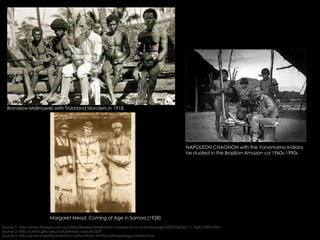
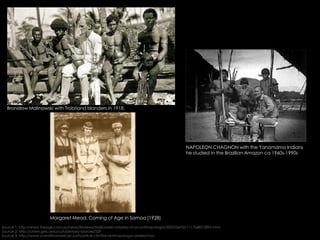
Bronislaw Malinowski with Trobriand Islanders in 1918.
Margaret Mead: Coming of Age in Samoa (1928)
NAPOLEON CHAGNON with the Yanomamo Indians
he studied in the Brazilian Amazon ca 1960s-1990s
Source 1: http://www.theage.com.au/news/Reviews/Malinowski-odyssey-of-an-anthropologist/2005/06/02/1117568312895.html
Source 2: http://chnm.gmu.edu/cyh/primary-sources/329
Source 3: http://www.scientificamerican.com/article.cfm?id=anthropologys-darkest-hou
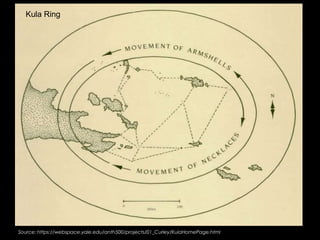
Kula Ring
Source: https://webspace.yale.edu/anth500/projects/01_Curley/KulaHomePage.html
Why do digital ethnography?
George Marcus (1995). “Ethnography in/of the world system:
the emergence of multi-sited ethnography.” Annual Review of
Anthropology 24: 95-117. Available at:
http://www.annualreviews.org/doi/pdf/10.1146/annurev.an.24.
100195.000523
Jenna Burrell (2009). The Field Site as a Network: A Strategy
for Locating Ethnographic Research. Field Methods 21(2):
181-199. Available online:
http://fmx.sagepub.com/content/21/2/181
Media Anthropology Network: http://www.media-
anthropology.net/
Ethnography and the Internet
vs.
Ethnography, and the Internet
Ethnography and the Internet
vs.
Ethnography, and the Internet
As part of my doctoral studies, I conducted ethnographic
research last year at a university campus in Kathmandu,
Nepal. In the course of my fieldwork it turned out that the
majority of my research participants were very actively
using Facebook (usually relying on their mobile phones to
access the internet). I hadn't anticipated that this source of
information would play such a big role for my project and
hence want to see whether and how I could use the
information for my analysis.
Doctoral Student, School of Geography and the Environment, Oxford
“
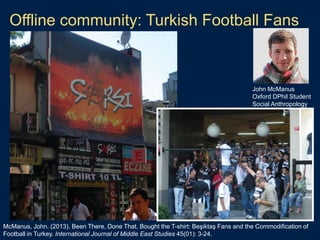
Offline community: Turkish Football Fans
McManus, John. (2013). Been There, Done That, Bought the T-shirt: Beşiktaş Fans and the Commodification of
Football in Turkey. International Journal of Middle East Studies 45(01): 3-24.
John McManus
Oxford DPhil Student
Social Anthropology
Offline community: Turkish Football Fans
The shift to searching for identity among the
forums and video websites of the internet,
rather than on the terraces of Beşiktaş, is
profoundly altering how fans construct their
allegiance to the fan group and the club. This
process, it will be shown, is not so much
liberating supporters from the requirements of
fandom as it is generating new conventions
and processes to which Çarşı members must
adhere.
McManus, John. (2013). Been There, Done That, Bought the T-shirt: Beşiktaş Fans and the Commodification of
Football in Turkey. International Journal of Middle East Studies 45(01): 3-24.
“
Gaining Entrée
Are the problems with overcoming cultural difference
(and understanding a foreign culture) different when
working with online rather than offline ethnography?
Doctoral Student, Department of Politics and International Relations, Oxford
“
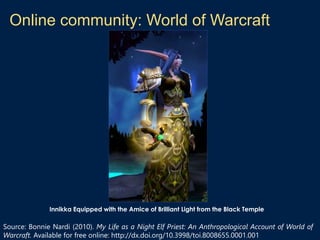
Online community: World of Warcraft
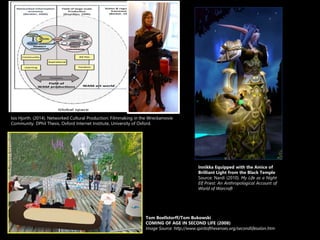
Innikka Equipped with the Amice of Brilliant Light from the Black Temple
Source: Bonnie Nardi (2010). My Life as a Night Elf Priest: An Anthropological Account of World of
Warcraft. Available for free online: http://dx.doi.org/10.3998/toi.8008655.0001.001
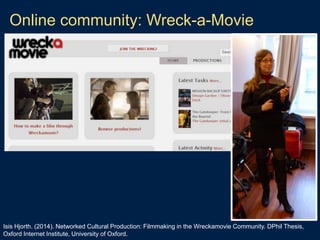
Online community: Wreck-a-Movie
Isis Hjorth. (2014). Networked Cultural Production: Filmmaking in the Wreckamovie Community. DPhil Thesis,
Oxford Internet Institute, University of Oxford.
Research theme 3
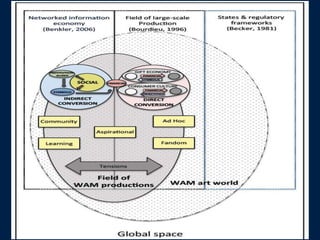
Conversion of capital
• Iron Sky crowdfunding campaigns
Differences in interpretation of practices
 direct influence on conversion mechanisms and
dynamics
Iron Sky […] has been
generating headlines and
online buzz for years[…] About
$1 million of the $10 million
budget came through fans'
online donations, or so-
called crowd funding.
[The Hollywood Reporter, 15
February 2012]
Slides courtesy Isis Hjorth
Research theme 3
Conversion of capital
The gift economy […] is based on […] a refusal
of the logic of the maximization of economic
profit, i.e. of the spirit of calculation […]. It is
organized with a view to the accumulation of
symbolic capital. (Bourdieu, 1997b, p. 237)
Slides courtesy Isis Hjorth
Research theme 3
Conversion of capital
us Wreckies are all one big happy family. If you
see anyone wearing the [Star Wreck/WAM]
logo anywhere, go up to them to chat about
our stuff. Heck, while you’re at it, give ‘em a
hug for good measure.
[Pasi, Iron Sky blog post, 7 September 2007]
Hm, guess those who bought
"war bonds" are not included in
the [end] credits? shame :(
[Iron Sky Facebook fan, 17
January 2013]
Slides courtesy Isis Hjorth
Research theme 3
Conversion of capital
300 euro piss right off are the disks gold
plated? No film is worth that no matter
how it was funded or where the cash goes.
[Iron Sky Facebook fan, 29 May 2012]
300?? Is the box made of Pandas =/ ??
[Iron Sky Facebook fan, 29 May 2012]
Come on people! If you are not so called
"collectors", then piss off and go whining
somewhere else! I bet you are not visiting art
galleries either, as collectors? Or are you
bitching there too, how can some painting be
so freaking expensive?
[Iron Sky Facebook fan, 29 May 2012]
Slides courtesy Isis Hjorth
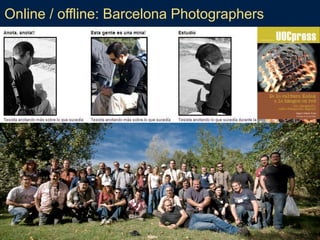
Online / offline: Barcelona Photographers
TOOLS & METHODS
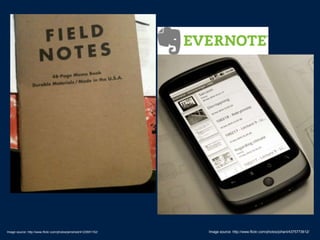
Old and New
Image source: http://www.flickr.com/photos/jemshed/4123591152/ Image source: http://www.flickr.com/photos/johanl/4375773612/
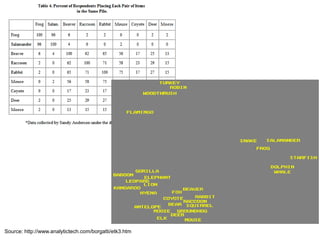
Source: http://www.analytictech.com/borgatti/etk3.htm
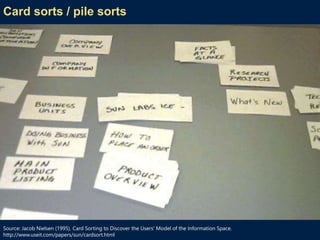
Source: Jacob Nielsen (1995). Card Sorting to Discover the Users' Model of the Information Space.
http://www.useit.com/papers/sun/cardsort.html
Card sorts / pile sorts
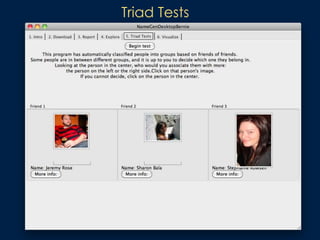
Triad Tests
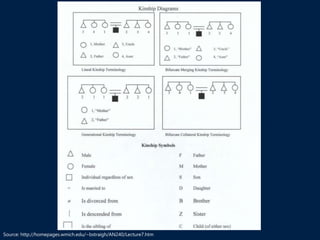
Source: http://homepages.wmich.edu/~bstraigh/AN240/Lecture7.htm
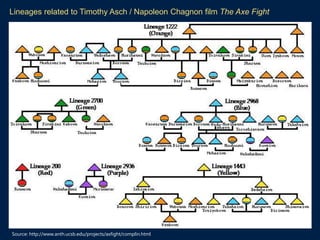
Source: http://www.anth.ucsb.edu/projects/axfight/complin.html
Lineages related to Timothy Asch / Napoleon Chagnon film The Axe Fight
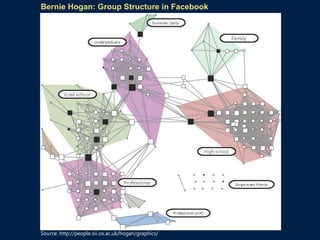
Source: http://people.oii.ox.ac.uk/hogan/graphics/
Bernie Hogan: Group Structure in Facebook
Other tools for ethnography on/of the Internet
• Lurking? (Hine)
• Hyperlink analysis (Webometric Analyst)
• Blog data: coding and deep reading
• Textual analysis
• Coding texts, notes, images, etc (NVivo, ATLAS.ti, MaxQDA, CAT, Dedoose, others)
• Social networks (NodeXL, NameGen)
• Web archives (HTTrack)
• Twitter (TAGS)
• Email archives
• Photo voice / Photo-elicitation interviews
• Quant data (traces of activity like log files?)
• Crowd-sourcing
• Reflexivity – blogging your research (Wordpress / Livejournal)
Other tools for ethnography on/of the Internet
• Dropbox to store and backup files
• Photobucket / Flickr
• MindMaps (Compendium, Vue)
• Fraps (capture game video)
• Greenshot or SnagIt or other programs to capture screen (including
scrolling windows)
• Evernote / OneNote / Zotero
• Freeforums
• Recording
– Livescribe pen
– Zoom and Olympus recorders
– iPhone/Android
– Cameras / iPhones / Androids with GPS tagging on
Ethical considerations for online ethnography
• Privacy in public, Nissenbaum (1998)
• Sensitivity to actors intentions of 'publicness' e.g. Bassett
and O'Riordan (2002)
• Changing nature of informed consent
• Profiling from multiple datasets
• Different cultural perspectives of values such as privacy
• Legal protections nationally bounded
• Research responsibility for rigour and usefulness
Questions of Ethics
How to use information found online & how to participate on the
online community: do you mention that you are a researcher?
Is it ethical to directly quote from the web from people who are
not aware that their words are being used for other purposes?
How do you study anonymous users, or piracy and illegal
activities?
How valid is the information? People can say anything on the
internet – how can researchers know that what they are reading is a
true representation of reality? Can you really ‘trust’ online
sources? What can you do to make sure it is as reliable as
possible?
“
Bronislaw Malinowski with Trobriand Islanders in 1918.
Margaret Mead: Coming of Age in Samoa (1928)
NAPOLEON CHAGNON with the Yanomamo Indians
he studied in the Brazilian Amazon ca 1960s-1990s
Source 1: http://www.theage.com.au/news/Reviews/Malinowski-odyssey-of-an-anthropologist/2005/06/02/1117568312895.html
Source 2: http://chnm.gmu.edu/cyh/primary-sources/329
Source 3: http://www.scientificamerican.com/article.cfm?id=anthropologys-darkest-hou
Innikka Equipped with the Amice of
Brilliant Light from the Black Temple
Source: Nardi (2010). My Life as a Night
Elf Priest: An Anthropological Account of
World of Warcraft
Isis Hjorth. (2014). Networked Cultural Production: Filmmaking in the Wreckamovie
Community. DPhil Thesis, Oxford Internet Institute, University of Oxford.
Tom Boellstorff/Tom Bukowski
COMING OF AGE IN SECOND LIFE (2008)
Image Source: http://www.spiritofthesenses.org/secondlifesalon.htm
Information Ethnographers of interest (list courtesy of David Hakken, Indiana University, available at :
http://www.informatics.indiana.edu/courses/descriptions/I651.doc)
John Anderson, anthropology, Catholic University (Arab informatics)
Steve Barley, management, Stanford (Researching engineers in Silicon Valley)
Genevieve Bell, anthropologist, Intel (Cross-cultural study of technology, especially Asia)
Tom Boellstorff, UC Irvine (Anthropology)
Pablo Boczkowski, MIT (Sloan School of Management)
Gabriella Coleman, anthropology, University of Chicago (Open Source and the Cultural Imaginary)
Andy Crabtree, Sociology, University of Nottingham, UK (organizations, systems development; rapid ethnographic
assessment)
Joe Dumit, anthropology, (Director of STS program, UC-Davis)
Jan English-Lueck, Anthropology, San Jose State (Silicon Valley Project)
Joan Fujimura (Sociology, University of Wisconsin)
Keith Hampton, MIT (Department of Urban Studies and Planning)
Penny Harvey, anthropologist, University of Manchester (UK) (Museum informatics)
Stephen Helmreich, History of Consciousness, MIT (Artificial Life, Bio-informatics)
Adrienne Jenik, UCSD, (Computer and Media Arts)
Lori Kendall, SUNY Purchase (Sociology)
Jean Lave, Education and anthropology, University of California at Berkeley
Gustavo Mesch, University of Haifa (Sociology and Anthropology)
Bonnie Nardi, (Informatics, UC-Irvine)
Carsten Oesterlund, Information Studies, Syracuse University (health informatics)
Wanda Orlikowski, management, MIT (organizational informatics)
Bryan Pfaffenberger, anthropology in the School of Engineering, University of Virginia (technology)
Sandeep Sahay, Informatics, University of Oslo (development informatics)
Susan Leigh Star, Sociology, University of Santa Clara (Classification; science informatics)
Lucy Suchman, anthropology/ethnomethodology, University of Lancaster (UK)
Sharon Traweek, UCLA (science informatics)
Sherry Turkle, MIT (Sociology)
Nina Wakeford University of Surrey (Sociology and INCITE)
Eric T. Meyer
Senior Research Fellow & Associate Professor
eric.meyer@oii.ox.ac.uk
http://www.oii.ox.ac.uk/people/meyer
• In groups of 2-4 plan how you would go about doing a
virtual ethnography of an online or blended on/offline
community.
• Think about:
– What community would be appropriate for an ethnographic
study?
– How would you construct the study?
– How would you gain access to the community?
– What sort of evidence might be available to you?
– What methods you would use to gather that evidence?
– How would you analyse the data?
– What ethical considerations would you have to negotiate?
Practical exercise: planning an
ethnography

2014 digital ethography_eric meyer

  • 1.
    Digital Ethnography Eric T.Meyer Senior Research Fellow & Associate Professor Director of Graduate Studies eric.meyer@oii.ox.ac.uk http://www.oii.ox.ac.uk/people/meyer @etmeyer Oxford Internet Institute 2014
  • 2.
    Bronislaw Malinowski withTrobriand Islanders in 1918. Margaret Mead: Coming of Age in Samoa (1928) NAPOLEON CHAGNON with the Yanomamo Indians he studied in the Brazilian Amazon ca 1960s-1990s Source 1: http://www.theage.com.au/news/Reviews/Malinowski-odyssey-of-an-anthropologist/2005/06/02/1117568312895.html Source 2: http://chnm.gmu.edu/cyh/primary-sources/329 Source 3: http://www.scientificamerican.com/article.cfm?id=anthropologys-darkest-hou
  • 4.
  • 5.
    Why do digitalethnography? George Marcus (1995). “Ethnography in/of the world system: the emergence of multi-sited ethnography.” Annual Review of Anthropology 24: 95-117. Available at: http://www.annualreviews.org/doi/pdf/10.1146/annurev.an.24. 100195.000523 Jenna Burrell (2009). The Field Site as a Network: A Strategy for Locating Ethnographic Research. Field Methods 21(2): 181-199. Available online: http://fmx.sagepub.com/content/21/2/181 Media Anthropology Network: http://www.media- anthropology.net/
  • 6.
    Ethnography and theInternet vs. Ethnography, and the Internet
  • 7.
    Ethnography and theInternet vs. Ethnography, and the Internet As part of my doctoral studies, I conducted ethnographic research last year at a university campus in Kathmandu, Nepal. In the course of my fieldwork it turned out that the majority of my research participants were very actively using Facebook (usually relying on their mobile phones to access the internet). I hadn't anticipated that this source of information would play such a big role for my project and hence want to see whether and how I could use the information for my analysis. Doctoral Student, School of Geography and the Environment, Oxford “
  • 8.
    Offline community: TurkishFootball Fans McManus, John. (2013). Been There, Done That, Bought the T-shirt: Beşiktaş Fans and the Commodification of Football in Turkey. International Journal of Middle East Studies 45(01): 3-24. John McManus Oxford DPhil Student Social Anthropology
  • 9.
    Offline community: TurkishFootball Fans The shift to searching for identity among the forums and video websites of the internet, rather than on the terraces of Beşiktaş, is profoundly altering how fans construct their allegiance to the fan group and the club. This process, it will be shown, is not so much liberating supporters from the requirements of fandom as it is generating new conventions and processes to which Çarşı members must adhere. McManus, John. (2013). Been There, Done That, Bought the T-shirt: Beşiktaş Fans and the Commodification of Football in Turkey. International Journal of Middle East Studies 45(01): 3-24. “
  • 10.
    Gaining Entrée Are theproblems with overcoming cultural difference (and understanding a foreign culture) different when working with online rather than offline ethnography? Doctoral Student, Department of Politics and International Relations, Oxford “
  • 11.
    Online community: Worldof Warcraft Innikka Equipped with the Amice of Brilliant Light from the Black Temple Source: Bonnie Nardi (2010). My Life as a Night Elf Priest: An Anthropological Account of World of Warcraft. Available for free online: http://dx.doi.org/10.3998/toi.8008655.0001.001
  • 12.
    Online community: Wreck-a-Movie IsisHjorth. (2014). Networked Cultural Production: Filmmaking in the Wreckamovie Community. DPhil Thesis, Oxford Internet Institute, University of Oxford.
  • 13.
    Research theme 3 Conversionof capital • Iron Sky crowdfunding campaigns Differences in interpretation of practices  direct influence on conversion mechanisms and dynamics Iron Sky […] has been generating headlines and online buzz for years[…] About $1 million of the $10 million budget came through fans' online donations, or so- called crowd funding. [The Hollywood Reporter, 15 February 2012] Slides courtesy Isis Hjorth
  • 14.
    Research theme 3 Conversionof capital The gift economy […] is based on […] a refusal of the logic of the maximization of economic profit, i.e. of the spirit of calculation […]. It is organized with a view to the accumulation of symbolic capital. (Bourdieu, 1997b, p. 237) Slides courtesy Isis Hjorth
  • 15.
    Research theme 3 Conversionof capital us Wreckies are all one big happy family. If you see anyone wearing the [Star Wreck/WAM] logo anywhere, go up to them to chat about our stuff. Heck, while you’re at it, give ‘em a hug for good measure. [Pasi, Iron Sky blog post, 7 September 2007] Hm, guess those who bought "war bonds" are not included in the [end] credits? shame :( [Iron Sky Facebook fan, 17 January 2013] Slides courtesy Isis Hjorth
  • 16.
    Research theme 3 Conversionof capital 300 euro piss right off are the disks gold plated? No film is worth that no matter how it was funded or where the cash goes. [Iron Sky Facebook fan, 29 May 2012] 300?? Is the box made of Pandas =/ ?? [Iron Sky Facebook fan, 29 May 2012] Come on people! If you are not so called "collectors", then piss off and go whining somewhere else! I bet you are not visiting art galleries either, as collectors? Or are you bitching there too, how can some painting be so freaking expensive? [Iron Sky Facebook fan, 29 May 2012] Slides courtesy Isis Hjorth
  • 18.
    Online / offline:Barcelona Photographers
  • 19.
  • 20.
    Image source: http://www.flickr.com/photos/jemshed/4123591152/Image source: http://www.flickr.com/photos/johanl/4375773612/
  • 21.
  • 22.
    Source: Jacob Nielsen(1995). Card Sorting to Discover the Users' Model of the Information Space. http://www.useit.com/papers/sun/cardsort.html Card sorts / pile sorts
  • 23.
  • 24.
  • 25.
    Source: http://www.anth.ucsb.edu/projects/axfight/complin.html Lineages relatedto Timothy Asch / Napoleon Chagnon film The Axe Fight
  • 26.
  • 27.
    Other tools forethnography on/of the Internet • Lurking? (Hine) • Hyperlink analysis (Webometric Analyst) • Blog data: coding and deep reading • Textual analysis • Coding texts, notes, images, etc (NVivo, ATLAS.ti, MaxQDA, CAT, Dedoose, others) • Social networks (NodeXL, NameGen) • Web archives (HTTrack) • Twitter (TAGS) • Email archives • Photo voice / Photo-elicitation interviews • Quant data (traces of activity like log files?) • Crowd-sourcing • Reflexivity – blogging your research (Wordpress / Livejournal)
  • 28.
    Other tools forethnography on/of the Internet • Dropbox to store and backup files • Photobucket / Flickr • MindMaps (Compendium, Vue) • Fraps (capture game video) • Greenshot or SnagIt or other programs to capture screen (including scrolling windows) • Evernote / OneNote / Zotero • Freeforums • Recording – Livescribe pen – Zoom and Olympus recorders – iPhone/Android – Cameras / iPhones / Androids with GPS tagging on
  • 29.
    Ethical considerations foronline ethnography • Privacy in public, Nissenbaum (1998) • Sensitivity to actors intentions of 'publicness' e.g. Bassett and O'Riordan (2002) • Changing nature of informed consent • Profiling from multiple datasets • Different cultural perspectives of values such as privacy • Legal protections nationally bounded • Research responsibility for rigour and usefulness
  • 30.
    Questions of Ethics Howto use information found online & how to participate on the online community: do you mention that you are a researcher? Is it ethical to directly quote from the web from people who are not aware that their words are being used for other purposes? How do you study anonymous users, or piracy and illegal activities? How valid is the information? People can say anything on the internet – how can researchers know that what they are reading is a true representation of reality? Can you really ‘trust’ online sources? What can you do to make sure it is as reliable as possible? “
  • 32.
    Bronislaw Malinowski withTrobriand Islanders in 1918. Margaret Mead: Coming of Age in Samoa (1928) NAPOLEON CHAGNON with the Yanomamo Indians he studied in the Brazilian Amazon ca 1960s-1990s Source 1: http://www.theage.com.au/news/Reviews/Malinowski-odyssey-of-an-anthropologist/2005/06/02/1117568312895.html Source 2: http://chnm.gmu.edu/cyh/primary-sources/329 Source 3: http://www.scientificamerican.com/article.cfm?id=anthropologys-darkest-hou
  • 33.
    Innikka Equipped withthe Amice of Brilliant Light from the Black Temple Source: Nardi (2010). My Life as a Night Elf Priest: An Anthropological Account of World of Warcraft Isis Hjorth. (2014). Networked Cultural Production: Filmmaking in the Wreckamovie Community. DPhil Thesis, Oxford Internet Institute, University of Oxford. Tom Boellstorff/Tom Bukowski COMING OF AGE IN SECOND LIFE (2008) Image Source: http://www.spiritofthesenses.org/secondlifesalon.htm
  • 34.
    Information Ethnographers ofinterest (list courtesy of David Hakken, Indiana University, available at : http://www.informatics.indiana.edu/courses/descriptions/I651.doc) John Anderson, anthropology, Catholic University (Arab informatics) Steve Barley, management, Stanford (Researching engineers in Silicon Valley) Genevieve Bell, anthropologist, Intel (Cross-cultural study of technology, especially Asia) Tom Boellstorff, UC Irvine (Anthropology) Pablo Boczkowski, MIT (Sloan School of Management) Gabriella Coleman, anthropology, University of Chicago (Open Source and the Cultural Imaginary) Andy Crabtree, Sociology, University of Nottingham, UK (organizations, systems development; rapid ethnographic assessment) Joe Dumit, anthropology, (Director of STS program, UC-Davis) Jan English-Lueck, Anthropology, San Jose State (Silicon Valley Project) Joan Fujimura (Sociology, University of Wisconsin) Keith Hampton, MIT (Department of Urban Studies and Planning) Penny Harvey, anthropologist, University of Manchester (UK) (Museum informatics) Stephen Helmreich, History of Consciousness, MIT (Artificial Life, Bio-informatics) Adrienne Jenik, UCSD, (Computer and Media Arts) Lori Kendall, SUNY Purchase (Sociology) Jean Lave, Education and anthropology, University of California at Berkeley Gustavo Mesch, University of Haifa (Sociology and Anthropology) Bonnie Nardi, (Informatics, UC-Irvine) Carsten Oesterlund, Information Studies, Syracuse University (health informatics) Wanda Orlikowski, management, MIT (organizational informatics) Bryan Pfaffenberger, anthropology in the School of Engineering, University of Virginia (technology) Sandeep Sahay, Informatics, University of Oslo (development informatics) Susan Leigh Star, Sociology, University of Santa Clara (Classification; science informatics) Lucy Suchman, anthropology/ethnomethodology, University of Lancaster (UK) Sharon Traweek, UCLA (science informatics) Sherry Turkle, MIT (Sociology) Nina Wakeford University of Surrey (Sociology and INCITE)
  • 35.
    Eric T. Meyer SeniorResearch Fellow & Associate Professor eric.meyer@oii.ox.ac.uk http://www.oii.ox.ac.uk/people/meyer
  • 36.
    • In groupsof 2-4 plan how you would go about doing a virtual ethnography of an online or blended on/offline community. • Think about: – What community would be appropriate for an ethnographic study? – How would you construct the study? – How would you gain access to the community? – What sort of evidence might be available to you? – What methods you would use to gather that evidence? – How would you analyse the data? – What ethical considerations would you have to negotiate? Practical exercise: planning an ethnography