Maths Methods
Trigonometric equations


             K McMullen 2012
The Unit Circle
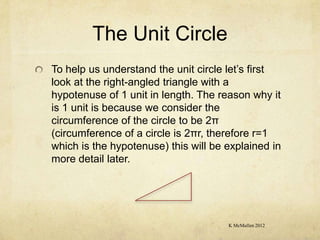
To help us understand the unit circle let’s first
look at the right-angled triangle with a
hypotenuse of 1 unit in length. The reason why it
is 1 unit is because we consider the
circumference of the circle to be 2π
(circumference of a circle is 2πr, therefore r=1
which is the hypotenuse) this will be explained in
more detail later.


                                      K McMullen 2012
The Unit Circle
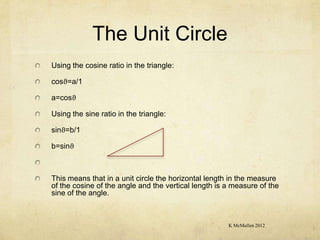
Using the cosine ratio in the triangle:

cosϑ=a/1

a=cosϑ

Using the sine ratio in the triangle:

sinϑ=b/1

b=sinϑ


This means that in a unit circle the horizontal length in the measure
of the cosine of the angle and the vertical length is a measure of the
sine of the angle.


                                                      K McMullen 2012
The Unit Circle
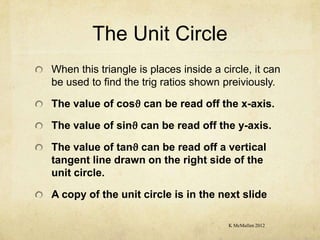
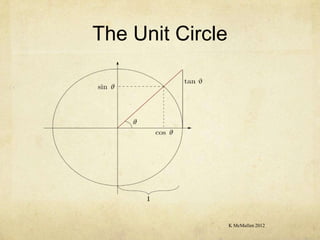
When this triangle is places inside a circle, it can
be used to find the trig ratios shown preiviously.

The value of cosϑ can be read off the x-axis.

The value of sinϑ can be read off the y-axis.

The value of tanϑ can be read off a vertical
tangent line drawn on the right side of the
unit circle.

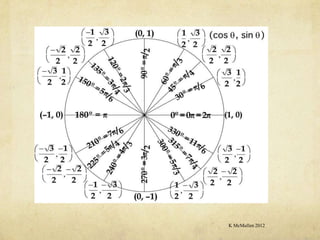
A copy of the unit circle is in the next slide

                                        K McMullen 2012
The Unit Circle


                  K McMullen 2012
Converting between radians and
            degrees
Angles are measured in degrees or radians.
To define a radian we can use a circle which has a
radius of one unit. This circle is called the unit circle.
When working with degrees we know that one
revolution of a circle is 360°. When working with
radians one revolution is 2π (this is because we are
working with a circle with a radius of 1).
Therefore:
             360°=2π
             180°=π

                                             K McMullen 2012
Converting between radians
       and degrees
The radius of the circle can be any length and can still be
regarded as a unit. As long as the arc is the same length
as the radius, the angle will always measure one radian.


An angle of 1 degree can be denoted as 1°.
A radian angle can be denoted as 1c but we usually leave
off the radian sign.


Therefore,
    1c=180°π      1°=π180


                                              K McMullen 2012
Converting between radians
       and degrees
Always make sure your calculator is in radian
mode when working with radians and degree
mode when working with degrees.


When working with radians and the unit circle we
are no longer referring to North, East, South and
West like we would with a compass. With the unit
circle we use a set of axes (the Cartesian plane)
with the x-axis as the horizontal and the y-axis as
the vertical. Remember that cosϑ=x and sinϑ=y.


                                      K McMullen 2012
Converting between radians
       and degrees
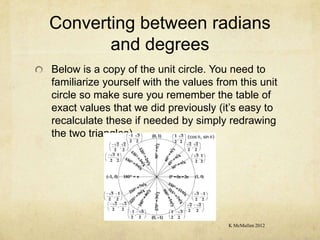
Below is a copy of the unit circle. You need to
familiarize yourself with the values from this unit
circle so make sure you remember the table of
exact values that we did previously (it’s easy to
recalculate these if needed by simply redrawing
the two triangles).


                                       K McMullen 2012
K McMullen 2012
Exact Values
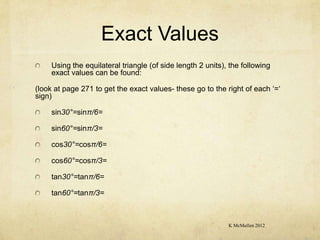
     Using the equilateral triangle (of side length 2 units), the following
     exact values can be found:

(look at page 271 to get the exact values- these go to the right of each ‘=‘
sign)

     sin30°=sinπ/6=

     sin60°=sinπ/3=

     cos30°=cosπ/6=

     cos60°=cosπ/3=

     tan30°=tanπ/6=

     tan60°=tanπ/3=


                                                             K McMullen 2012
Exact Values
Using the right isosceles triangle with two sides
of length 1 unit, the following exact values can be
found:


sin45°=sinπ/4=

cos45°=cosπ/4=

tan45°=tanπ/4=


                                      K McMullen 2012
Symmetry Formulae
   The unit circle is symmetrical so that the
   magnitude of sine, cosine and tangent at the
   angles shown are the same in each quadrant but
   the sign varies.


We’ll go over this in more detail in class


                                             K McMullen 2012
Trigonometric Identities
When a right-angled triangle is placed in the first
quadrant of a unit circle, the horizontal side has the
length of cosϑ and the vertical side has the length of
sinϑ.

Therefore, using the tan ratio
(tanϑ=opposite/adjacent):

   tanϑ=sinϑ/cosϑ

Using Pythagoras’ theorem (a2+b2=c2):

   (sinϑ)2+(cosϑ)2=12

   sin2ϑ+cos2ϑ=1
                                          K McMullen 2012
Complementary Angles
Complementary angles add to 90° or π/2 radians.
Therefore, 30° and 60° are complementary angles. In
other words π/6 and π/3 are complementary
angles, and θ and π/2-θ are also complementary
angles.

The sine of an angle is equal to the cosine of its
complement. Therefore, sin60°=cos(30°). We say that
sine and cosine are complementary functions.

The complement of the tangent of an angle is the
cotangent or cot- that is, tangent and cotangent are
complementary functions (as well as reciprocal
functions).
                                         K McMullen 2012
Complementary Angles
Copy the table from page 270 into your notes


                                    K McMullen 2012

Methods8 trigonometric functions

  • 1.
  • 2.
    The Unit Circle Tohelp us understand the unit circle let’s first look at the right-angled triangle with a hypotenuse of 1 unit in length. The reason why it is 1 unit is because we consider the circumference of the circle to be 2π (circumference of a circle is 2πr, therefore r=1 which is the hypotenuse) this will be explained in more detail later. K McMullen 2012
  • 3.
    The Unit Circle Usingthe cosine ratio in the triangle: cosϑ=a/1 a=cosϑ Using the sine ratio in the triangle: sinϑ=b/1 b=sinϑ This means that in a unit circle the horizontal length in the measure of the cosine of the angle and the vertical length is a measure of the sine of the angle. K McMullen 2012
  • 4.
    The Unit Circle Whenthis triangle is places inside a circle, it can be used to find the trig ratios shown preiviously. The value of cosϑ can be read off the x-axis. The value of sinϑ can be read off the y-axis. The value of tanϑ can be read off a vertical tangent line drawn on the right side of the unit circle. A copy of the unit circle is in the next slide K McMullen 2012
  • 5.
    The Unit Circle K McMullen 2012
  • 6.
    Converting between radiansand degrees Angles are measured in degrees or radians. To define a radian we can use a circle which has a radius of one unit. This circle is called the unit circle. When working with degrees we know that one revolution of a circle is 360°. When working with radians one revolution is 2π (this is because we are working with a circle with a radius of 1). Therefore: 360°=2π 180°=π K McMullen 2012
  • 7.
    Converting between radians and degrees The radius of the circle can be any length and can still be regarded as a unit. As long as the arc is the same length as the radius, the angle will always measure one radian. An angle of 1 degree can be denoted as 1°. A radian angle can be denoted as 1c but we usually leave off the radian sign. Therefore, 1c=180°π 1°=π180 K McMullen 2012
  • 8.
    Converting between radians and degrees Always make sure your calculator is in radian mode when working with radians and degree mode when working with degrees. When working with radians and the unit circle we are no longer referring to North, East, South and West like we would with a compass. With the unit circle we use a set of axes (the Cartesian plane) with the x-axis as the horizontal and the y-axis as the vertical. Remember that cosϑ=x and sinϑ=y. K McMullen 2012
  • 9.
    Converting between radians and degrees Below is a copy of the unit circle. You need to familiarize yourself with the values from this unit circle so make sure you remember the table of exact values that we did previously (it’s easy to recalculate these if needed by simply redrawing the two triangles). K McMullen 2012
  • 10.
  • 11.
    Exact Values Using the equilateral triangle (of side length 2 units), the following exact values can be found: (look at page 271 to get the exact values- these go to the right of each ‘=‘ sign) sin30°=sinπ/6= sin60°=sinπ/3= cos30°=cosπ/6= cos60°=cosπ/3= tan30°=tanπ/6= tan60°=tanπ/3= K McMullen 2012
  • 12.
    Exact Values Using theright isosceles triangle with two sides of length 1 unit, the following exact values can be found: sin45°=sinπ/4= cos45°=cosπ/4= tan45°=tanπ/4= K McMullen 2012
  • 13.
    Symmetry Formulae The unit circle is symmetrical so that the magnitude of sine, cosine and tangent at the angles shown are the same in each quadrant but the sign varies. We’ll go over this in more detail in class K McMullen 2012
  • 14.
    Trigonometric Identities When aright-angled triangle is placed in the first quadrant of a unit circle, the horizontal side has the length of cosϑ and the vertical side has the length of sinϑ. Therefore, using the tan ratio (tanϑ=opposite/adjacent): tanϑ=sinϑ/cosϑ Using Pythagoras’ theorem (a2+b2=c2): (sinϑ)2+(cosϑ)2=12 sin2ϑ+cos2ϑ=1 K McMullen 2012
  • 15.
    Complementary Angles Complementary anglesadd to 90° or π/2 radians. Therefore, 30° and 60° are complementary angles. In other words π/6 and π/3 are complementary angles, and θ and π/2-θ are also complementary angles. The sine of an angle is equal to the cosine of its complement. Therefore, sin60°=cos(30°). We say that sine and cosine are complementary functions. The complement of the tangent of an angle is the cotangent or cot- that is, tangent and cotangent are complementary functions (as well as reciprocal functions). K McMullen 2012
  • 16.
    Complementary Angles Copy thetable from page 270 into your notes K McMullen 2012