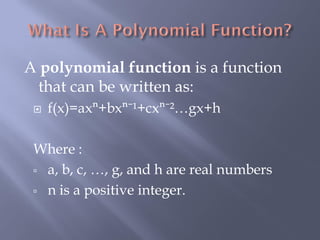
A polynomial function is a function
 that can be written as:
    f(x)=axⁿ+bxⁿˉ¹+cxⁿˉ²…gx+h

 Where :
  a, b, c, …, g, and h are real numbers

  n is a positive integer.
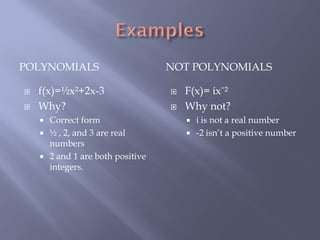
POLYNOMIALS                         NOT POLYNOMIALS

   f(x)=½x²+2x-3                      F(x)= ίxˉ²
   Why?                               Why not?
       Correct form                       ί is not a real number
       ½ , 2, and 3 are real              -2 isn’t a positive number
        numbers
       2 and 1 are both positive
        integers.
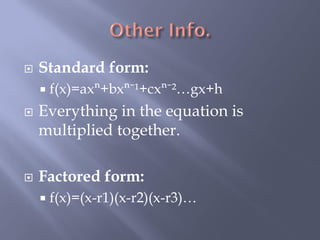
   Standard form:
       f(x)=axⁿ+bxⁿˉ¹+cxⁿˉ²…gx+h
   Everything in the equation is
    multiplied together.

   Factored form:
       f(x)=(x-r1)(x-r2)(x-r3)…
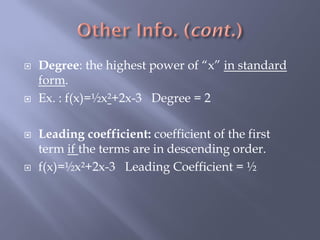
   Degree: the highest power of “x” in standard
    form.
   Ex. : f(x)=½x²+2x-3 Degree = 2

   Leading coefficient: coefficient of the first
    term if the terms are in descending order.
   f(x)=½x²+2x-3 Leading Coefficient = ½
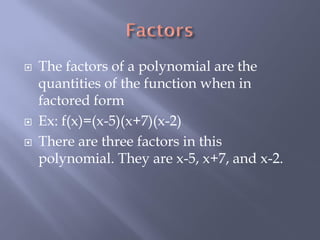
   The factors of a polynomial are the
    quantities of the function when in
    factored form
   Ex: f(x)=(x-5)(x+7)(x-2)
   There are three factors in this
    polynomial. They are x-5, x+7, and x-2.
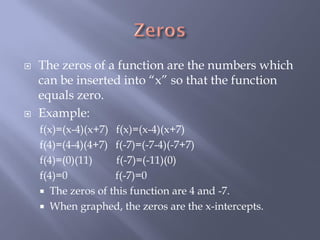
   The zeros of a function are the numbers which
    can be inserted into “x” so that the function
    equals zero.
   Example:
    f(x)=(x-4)(x+7) f(x)=(x-4)(x+7)
    f(4)=(4-4)(4+7) f(-7)=(-7-4)(-7+7)
    f(4)=(0)(11)    f(-7)=(-11)(0)
    f(4)=0          f(-7)=0
     The zeros of this function are 4 and -7.
     When graphed, the zeros are the x-intercepts.
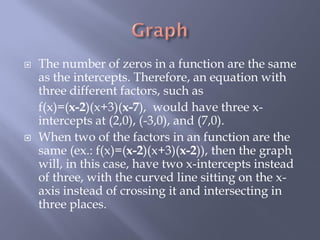
   The number of zeros in a function are the same
    as the intercepts. Therefore, an equation with
    three different factors, such as
    f(x)=(x-2)(x+3)(x-7), would have three x-
    intercepts at (2,0), (-3,0), and (7,0).
   When two of the factors in an function are the
    same (ex.: f(x)=(x-2)(x+3)(x-2)), then the graph
    will, in this case, have two x-intercepts instead
    of three, with the curved line sitting on the x-
    axis instead of crossing it and intersecting in
    three places.
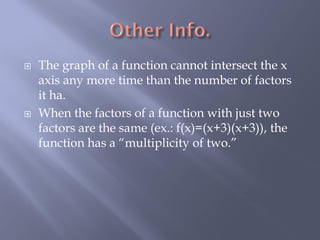
   The graph of a function cannot intersect the x
    axis any more time than the number of factors
    it ha.
   When the factors of a function with just two
    factors are the same (ex.: f(x)=(x+3)(x+3)), the
    function has a “multiplicity of two.”
Polynomial functions

Polynomial functions

  • 2.
    A polynomial functionis a function that can be written as:  f(x)=axⁿ+bxⁿˉ¹+cxⁿˉ²…gx+h Where :  a, b, c, …, g, and h are real numbers  n is a positive integer.
  • 3.
    POLYNOMIALS NOT POLYNOMIALS  f(x)=½x²+2x-3  F(x)= ίxˉ²  Why?  Why not?  Correct form  ί is not a real number  ½ , 2, and 3 are real  -2 isn’t a positive number numbers  2 and 1 are both positive integers.
  • 4.
    Standard form:  f(x)=axⁿ+bxⁿˉ¹+cxⁿˉ²…gx+h  Everything in the equation is multiplied together.  Factored form:  f(x)=(x-r1)(x-r2)(x-r3)…
  • 5.
    Degree: the highest power of “x” in standard form.  Ex. : f(x)=½x²+2x-3 Degree = 2  Leading coefficient: coefficient of the first term if the terms are in descending order.  f(x)=½x²+2x-3 Leading Coefficient = ½
  • 6.
    The factors of a polynomial are the quantities of the function when in factored form  Ex: f(x)=(x-5)(x+7)(x-2)  There are three factors in this polynomial. They are x-5, x+7, and x-2.
  • 7.
    The zeros of a function are the numbers which can be inserted into “x” so that the function equals zero.  Example: f(x)=(x-4)(x+7) f(x)=(x-4)(x+7) f(4)=(4-4)(4+7) f(-7)=(-7-4)(-7+7) f(4)=(0)(11) f(-7)=(-11)(0) f(4)=0 f(-7)=0  The zeros of this function are 4 and -7.  When graphed, the zeros are the x-intercepts.
  • 8.
    The number of zeros in a function are the same as the intercepts. Therefore, an equation with three different factors, such as f(x)=(x-2)(x+3)(x-7), would have three x- intercepts at (2,0), (-3,0), and (7,0).  When two of the factors in an function are the same (ex.: f(x)=(x-2)(x+3)(x-2)), then the graph will, in this case, have two x-intercepts instead of three, with the curved line sitting on the x- axis instead of crossing it and intersecting in three places.
  • 9.
    The graph of a function cannot intersect the x axis any more time than the number of factors it ha.  When the factors of a function with just two factors are the same (ex.: f(x)=(x+3)(x+3)), the function has a “multiplicity of two.”