z
Identifying the Inquiry and Stating the Problem
PRACTICAL RESEARCH 2
z
Designing
Research Useful
in Daily Life
QUANTITATIVE RESEARCH
z
Chapter Content
CHAPTER I
THE PROBLEM AND ITS BACKGROUND
 Introduction
 Statement of the Problem
 Significance of the study
 Scope and Delimitation of the study
z
STRUCTURE OF QUANTITATIVE
RESEARCH
CHAPTER I
CHAPTER II
CHAPTER III
CHAPTER IV
CHAPTER V
Introduction, Statement of the Problem, Hypotheses, Significance of the
study, Scope and Delimitation of the study, Definition of terms
RRL, RRS, Conceptual/Theoretical Framework, Synthesis
Research Methodology, Research design, Sampling Technique,
Instrument, Locale, Respondents/Participants, Data Gathering
Procedure, Statistical Treatment
Presentation, Analysis and Interpretation of Data
Summary of findings, Conclusions and Recommendations
z
z
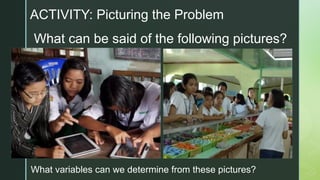
What can be said of the following pictures?
What variables can we determine from these pictures?
ACTIVITY: Picturing the Problem
z
LET’S GET STARTED
KEY QUESTIONS
 Where should a research begin?
 How is a topic chosen?
z
Do you
know
where to
begin?
z
Deciding on a Research Topic
 What area/s not covered in classroom lessons/discussions do I
still want to know/investigate in my specific track?
 If I do this research project, how useful will it be to me as a
senior high school graduate and to the community where I
belong, and even to the larger community, the Philippines,
ASEAN, and the world?
z
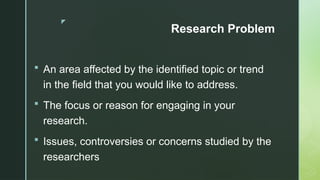
Research Problem
 An area affected by the identified topic or trend
in the field that you would like to address.
 The focus or reason for engaging in your
research.

 Issues, controversies or concerns studied by the
researchers
z
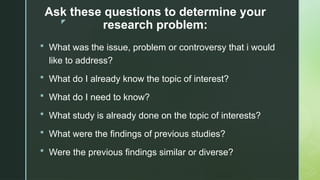
Ask these questions to determine your
research problem:
 What was the issue, problem or controversy that i would
like to address?
 What do I already know the topic of interest?
 What do I need to know?
 What study is already done on the topic of interests?
 What were the findings of previous studies?
 Were the previous findings similar or diverse?
z
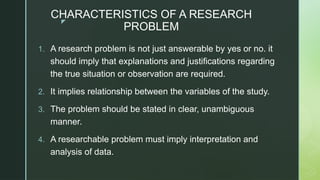
CHARACTERISTICS OF A RESEARCH
PROBLEM
1. A research problem is not just answerable by yes or no. it
should imply that explanations and justifications regarding
the true situation or observation are required.
2. It implies relationship between the variables of the study.
3. The problem should be stated in clear, unambiguous
manner.
4. A researchable problem must imply interpretation and
analysis of data.
z
RESEARCH PROBLEM
It is what the researchers aim
to answer later on as they go
through the research
endeavor.
z SOURCES OF INTEREST
DAILY LIFE EXPERIENCES
Ex: A teachers could have developed an effective teaching strategy to learn the
students because they are exposed to do these things.
ACADEMIC READINGS
Ex: Can stimulate one’s interest to explore a particular topic.
PERSONAL HOBBIES
Ex: Survey the views of people about a certain issue because they enjoy doing so.
ATTENTION-CATCHING SITUATION
Ex: Researchers can formulate questions as to how this thing became possible, how
that thing is able to do those, etc.
z
Sources of Quantitative
Research Problem
 Government agencies or any non-government
institutions
 Researcher’s observation, interests and experiences
 Previous research findings which you want to validate
or consider as studies suffering from some
inconsistencies or discrepancies
 Review of related literature
 Deduction from theories
z
Humanities and Social
Sciences (HUMSS) Strand
HUMSS is one of the Academic Track
strands that focuses on the study of human
behavior, arts, culture, literature, politics,
and society.
z
College Degree Program
Leading to programs in:
 Psychology
 Philosophy
 Political Science
 International Studies
 Languages (English and Filipino)
 Literature
 Communications
 LIACOM
 Teacher Education – Early Childhood, Elementary, Special Education & Secondary (Values, English, Filipino)
 Library & Information Science
 Journalism
 Arts
z
Possible Research Topics Related to Daily Life
 The following are the possible research topics related to daily life:
 1. Poverty alleviation
 2. Unemployment
 3. Homelessness
 4. Gender equality
 5. Population aging
 6. Childcare
 7. Development of the youth
 8. All forms of violence
 9. Online or cybercrimes
 10. Traffic situation
 11. Preservation and protection of the
 environment
 12. Livelihood projects
 13. Entrepreneurial ventures
 14. Health care
 15. Social security
z
Writing a
Research Title
QUANTITATIVE RESEARCH
z
Expectations:
 Define a research title;
 Determine the criteria in selecting
topics;
 Value the importance of research topic
in constructing a research title; and
 Writes a research title.
z
Guidelines in choosing a Topic
1.Interest in the subject matter.
2.Availability of information.
3.Timeliness and relevance of
the topic.
4.Limitations on the subject.
5.Personal resources.
z
Sources of Research Topics
1. Mass media communication-television, newspaper, ads,
radio, films, etc.
2. Books, internet, journals, government publications
3. Professional periodicals- specialized periodicals in
different fields
4. General periodicals- Reader’s Digest, Time Magazine,
Women’s Magazine, etc.
5. Previous readings
6. Work experience
z
Topics to be avoided.
1.Controversial topic
2.Highly technical subjects
3.Hard-to-investigate subjects
4.Too broad subjects
5.Too narrow subject
6.Vague subjects
z
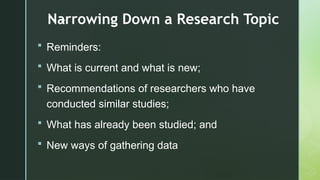
Narrowing Down a Research Topic
 Reminders:
 What is current and what is new;
 Recommendations of researchers who have
conducted similar studies;
 What has already been studied; and
 New ways of gathering data
z
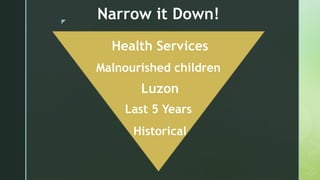
Narrow it Down!
Health Services
Malnourished children
Luzon
Last 5 Years
Historical
z
Narrow it Down!
Housing Projects
Informal settlers
Philippines
Last 6 years
Economic
z
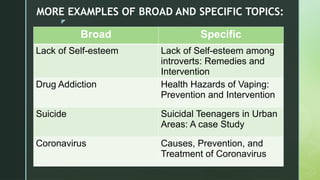
MORE EXAMPLES OF BROAD AND SPECIFIC TOPICS:
Broad Specific
Lack of Self-esteem Lack of Self-esteem among
introverts: Remedies and
Intervention
Drug Addiction Health Hazards of Vaping:
Prevention and Intervention
Suicide Suicidal Teenagers in Urban
Areas: A case Study
Coronavirus Causes, Prevention, and
Treatment of Coronavirus
z
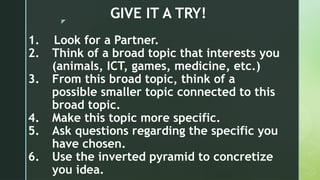
GIVE IT A TRY!
1. Look for a Partner.
2. Think of a broad topic that interests you
(animals, ICT, games, medicine, etc.)
3. From this broad topic, think of a
possible smaller topic connected to this
broad topic.
4. Make this topic more specific.
5. Ask questions regarding the specific you
have chosen.
6. Use the inverted pyramid to concretize
you idea.
z
Research Title
 A research title, also known as research
project, is a product of real world
observations, dilemmas, wide reading,
selective viewing (television programs,
films, documentaries, video, etc.)
meaningful interactions with significant
others, and deep reflection.
z Research Title
• Research problem
• Clearly reflect the topic of investigation
• Original
• Clear
• Concise
• Specific
z Research Title
According to Maxine Hairstone and Michael
Keene, a good title has several functions:
• It predicts content.
• It catches the reader’s interest.
• It reflects the tone or slant of the piece of
writing.
• It contains keywords that will make it easy
to access a computer search
z
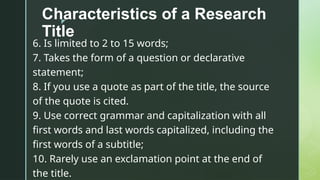
Characteristics of a Research
Title
1.Indicate accurately the subject and scope of
the study;
2.Rarely use abbreviations or acronyms unless
they are commonly known;
3.Use words that create a positive impression
and stimulate reader interest;
4.Use current nomenclature from the field of
study;
5.Reveal how the paper will be organized;
z
Characteristics of a Research
Title
6. Is limited to 2 to 15 words;
7. Takes the form of a question or declarative
statement;
8. If you use a quote as part of the title, the source
of the quote is cited.
9. Use correct grammar and capitalization with all
first words and last words capitalized, including the
first words of a subtitle;
10. Rarely use an exclamation point at the end of
the title.
z
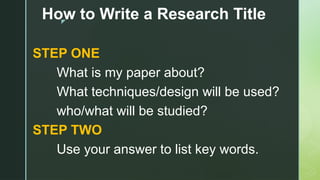
How to Write a Research Title
STEP ONE
What is my paper about?
What techniques/design will be used?
who/what will be studied?
STEP TWO
Use your answer to list key words.
z
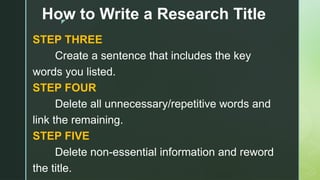
How to Write a Research Title
STEP THREE
Create a sentence that includes the key
words you listed.
STEP FOUR
Delete all unnecessary/repetitive words and
link the remaining.
STEP FIVE
Delete non-essential information and reword
the title.
z
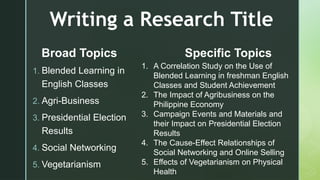
Writing a Research Title
1. Blended Learning in
English Classes
2. Agri-Business
3. Presidential Election
Results
4. Social Networking
5. Vegetarianism
Broad Topics Specific Topics
1. A Correlation Study on the Use of
Blended Learning in freshman English
Classes and Student Achievement
2. The Impact of Agribusiness on the
Philippine Economy
3. Campaign Events and Materials and
their Impact on Presidential Election
Results
4. The Cause-Effect Relationships of
Social Networking and Online Selling
5. Effects of Vegetarianism on Physical
Health
z
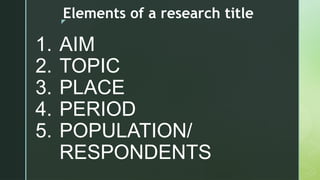
Elements of a research title
1. AIM
2. TOPIC
3. PLACE
4. PERIOD
5. POPULATION/
RESPONDENTS
z
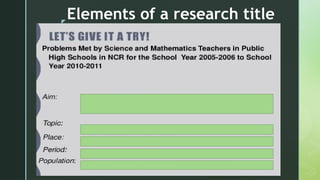
Elements of a research title
z
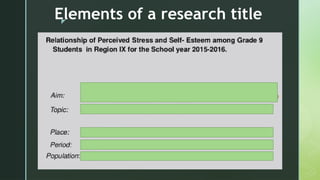
Elements of a research title
z
Assignment
From the research titles you had gathered, identify the
elements of each title.
Aim: ________________________________________
Topic:________________________________________
Place:________________________________________
Period:______________________________________
Population:____________________________________

identifying-the-inquiry-and-stating-the-problem.pptx

  • 1.
    z Identifying the Inquiryand Stating the Problem PRACTICAL RESEARCH 2
  • 2.
    z Designing Research Useful in DailyLife QUANTITATIVE RESEARCH
  • 3.
    z Chapter Content CHAPTER I THEPROBLEM AND ITS BACKGROUND  Introduction  Statement of the Problem  Significance of the study  Scope and Delimitation of the study
  • 4.
    z STRUCTURE OF QUANTITATIVE RESEARCH CHAPTERI CHAPTER II CHAPTER III CHAPTER IV CHAPTER V Introduction, Statement of the Problem, Hypotheses, Significance of the study, Scope and Delimitation of the study, Definition of terms RRL, RRS, Conceptual/Theoretical Framework, Synthesis Research Methodology, Research design, Sampling Technique, Instrument, Locale, Respondents/Participants, Data Gathering Procedure, Statistical Treatment Presentation, Analysis and Interpretation of Data Summary of findings, Conclusions and Recommendations
  • 5.
    z z What can besaid of the following pictures? What variables can we determine from these pictures? ACTIVITY: Picturing the Problem
  • 6.
    z LET’S GET STARTED KEYQUESTIONS  Where should a research begin?  How is a topic chosen?
  • 7.
  • 8.
    z Deciding on aResearch Topic  What area/s not covered in classroom lessons/discussions do I still want to know/investigate in my specific track?  If I do this research project, how useful will it be to me as a senior high school graduate and to the community where I belong, and even to the larger community, the Philippines, ASEAN, and the world?
  • 9.
    z Research Problem  Anarea affected by the identified topic or trend in the field that you would like to address.  The focus or reason for engaging in your research.  Issues, controversies or concerns studied by the researchers
  • 10.
    z Ask these questionsto determine your research problem:  What was the issue, problem or controversy that i would like to address?  What do I already know the topic of interest?  What do I need to know?  What study is already done on the topic of interests?  What were the findings of previous studies?  Were the previous findings similar or diverse?
  • 11.
    z CHARACTERISTICS OF ARESEARCH PROBLEM 1. A research problem is not just answerable by yes or no. it should imply that explanations and justifications regarding the true situation or observation are required. 2. It implies relationship between the variables of the study. 3. The problem should be stated in clear, unambiguous manner. 4. A researchable problem must imply interpretation and analysis of data.
  • 12.
    z RESEARCH PROBLEM It iswhat the researchers aim to answer later on as they go through the research endeavor.
  • 13.
    z SOURCES OFINTEREST DAILY LIFE EXPERIENCES Ex: A teachers could have developed an effective teaching strategy to learn the students because they are exposed to do these things. ACADEMIC READINGS Ex: Can stimulate one’s interest to explore a particular topic. PERSONAL HOBBIES Ex: Survey the views of people about a certain issue because they enjoy doing so. ATTENTION-CATCHING SITUATION Ex: Researchers can formulate questions as to how this thing became possible, how that thing is able to do those, etc.
  • 14.
    z Sources of Quantitative ResearchProblem  Government agencies or any non-government institutions  Researcher’s observation, interests and experiences  Previous research findings which you want to validate or consider as studies suffering from some inconsistencies or discrepancies  Review of related literature  Deduction from theories
  • 15.
    z Humanities and Social Sciences(HUMSS) Strand HUMSS is one of the Academic Track strands that focuses on the study of human behavior, arts, culture, literature, politics, and society.
  • 16.
    z College Degree Program Leadingto programs in:  Psychology  Philosophy  Political Science  International Studies  Languages (English and Filipino)  Literature  Communications  LIACOM  Teacher Education – Early Childhood, Elementary, Special Education & Secondary (Values, English, Filipino)  Library & Information Science  Journalism  Arts
  • 17.
    z Possible Research TopicsRelated to Daily Life  The following are the possible research topics related to daily life:  1. Poverty alleviation  2. Unemployment  3. Homelessness  4. Gender equality  5. Population aging  6. Childcare  7. Development of the youth  8. All forms of violence  9. Online or cybercrimes  10. Traffic situation  11. Preservation and protection of the  environment  12. Livelihood projects  13. Entrepreneurial ventures  14. Health care  15. Social security
  • 18.
  • 19.
    z Expectations:  Define aresearch title;  Determine the criteria in selecting topics;  Value the importance of research topic in constructing a research title; and  Writes a research title.
  • 20.
    z Guidelines in choosinga Topic 1.Interest in the subject matter. 2.Availability of information. 3.Timeliness and relevance of the topic. 4.Limitations on the subject. 5.Personal resources.
  • 21.
    z Sources of ResearchTopics 1. Mass media communication-television, newspaper, ads, radio, films, etc. 2. Books, internet, journals, government publications 3. Professional periodicals- specialized periodicals in different fields 4. General periodicals- Reader’s Digest, Time Magazine, Women’s Magazine, etc. 5. Previous readings 6. Work experience
  • 22.
    z Topics to beavoided. 1.Controversial topic 2.Highly technical subjects 3.Hard-to-investigate subjects 4.Too broad subjects 5.Too narrow subject 6.Vague subjects
  • 23.
    z Narrowing Down aResearch Topic  Reminders:  What is current and what is new;  Recommendations of researchers who have conducted similar studies;  What has already been studied; and  New ways of gathering data
  • 24.
    z Narrow it Down! HealthServices Malnourished children Luzon Last 5 Years Historical
  • 25.
    z Narrow it Down! HousingProjects Informal settlers Philippines Last 6 years Economic
  • 26.
    z MORE EXAMPLES OFBROAD AND SPECIFIC TOPICS: Broad Specific Lack of Self-esteem Lack of Self-esteem among introverts: Remedies and Intervention Drug Addiction Health Hazards of Vaping: Prevention and Intervention Suicide Suicidal Teenagers in Urban Areas: A case Study Coronavirus Causes, Prevention, and Treatment of Coronavirus
  • 27.
    z GIVE IT ATRY! 1. Look for a Partner. 2. Think of a broad topic that interests you (animals, ICT, games, medicine, etc.) 3. From this broad topic, think of a possible smaller topic connected to this broad topic. 4. Make this topic more specific. 5. Ask questions regarding the specific you have chosen. 6. Use the inverted pyramid to concretize you idea.
  • 28.
    z Research Title  Aresearch title, also known as research project, is a product of real world observations, dilemmas, wide reading, selective viewing (television programs, films, documentaries, video, etc.) meaningful interactions with significant others, and deep reflection.
  • 29.
    z Research Title •Research problem • Clearly reflect the topic of investigation • Original • Clear • Concise • Specific
  • 30.
    z Research Title Accordingto Maxine Hairstone and Michael Keene, a good title has several functions: • It predicts content. • It catches the reader’s interest. • It reflects the tone or slant of the piece of writing. • It contains keywords that will make it easy to access a computer search
  • 31.
    z Characteristics of aResearch Title 1.Indicate accurately the subject and scope of the study; 2.Rarely use abbreviations or acronyms unless they are commonly known; 3.Use words that create a positive impression and stimulate reader interest; 4.Use current nomenclature from the field of study; 5.Reveal how the paper will be organized;
  • 32.
    z Characteristics of aResearch Title 6. Is limited to 2 to 15 words; 7. Takes the form of a question or declarative statement; 8. If you use a quote as part of the title, the source of the quote is cited. 9. Use correct grammar and capitalization with all first words and last words capitalized, including the first words of a subtitle; 10. Rarely use an exclamation point at the end of the title.
  • 33.
    z How to Writea Research Title STEP ONE What is my paper about? What techniques/design will be used? who/what will be studied? STEP TWO Use your answer to list key words.
  • 34.
    z How to Writea Research Title STEP THREE Create a sentence that includes the key words you listed. STEP FOUR Delete all unnecessary/repetitive words and link the remaining. STEP FIVE Delete non-essential information and reword the title.
  • 35.
    z Writing a ResearchTitle 1. Blended Learning in English Classes 2. Agri-Business 3. Presidential Election Results 4. Social Networking 5. Vegetarianism Broad Topics Specific Topics 1. A Correlation Study on the Use of Blended Learning in freshman English Classes and Student Achievement 2. The Impact of Agribusiness on the Philippine Economy 3. Campaign Events and Materials and their Impact on Presidential Election Results 4. The Cause-Effect Relationships of Social Networking and Online Selling 5. Effects of Vegetarianism on Physical Health
  • 36.
    z Elements of aresearch title 1. AIM 2. TOPIC 3. PLACE 4. PERIOD 5. POPULATION/ RESPONDENTS
  • 37.
    z Elements of aresearch title
  • 38.
    z Elements of aresearch title
  • 39.
    z Assignment From the researchtitles you had gathered, identify the elements of each title. Aim: ________________________________________ Topic:________________________________________ Place:________________________________________ Period:______________________________________ Population:____________________________________