IRRIGATION
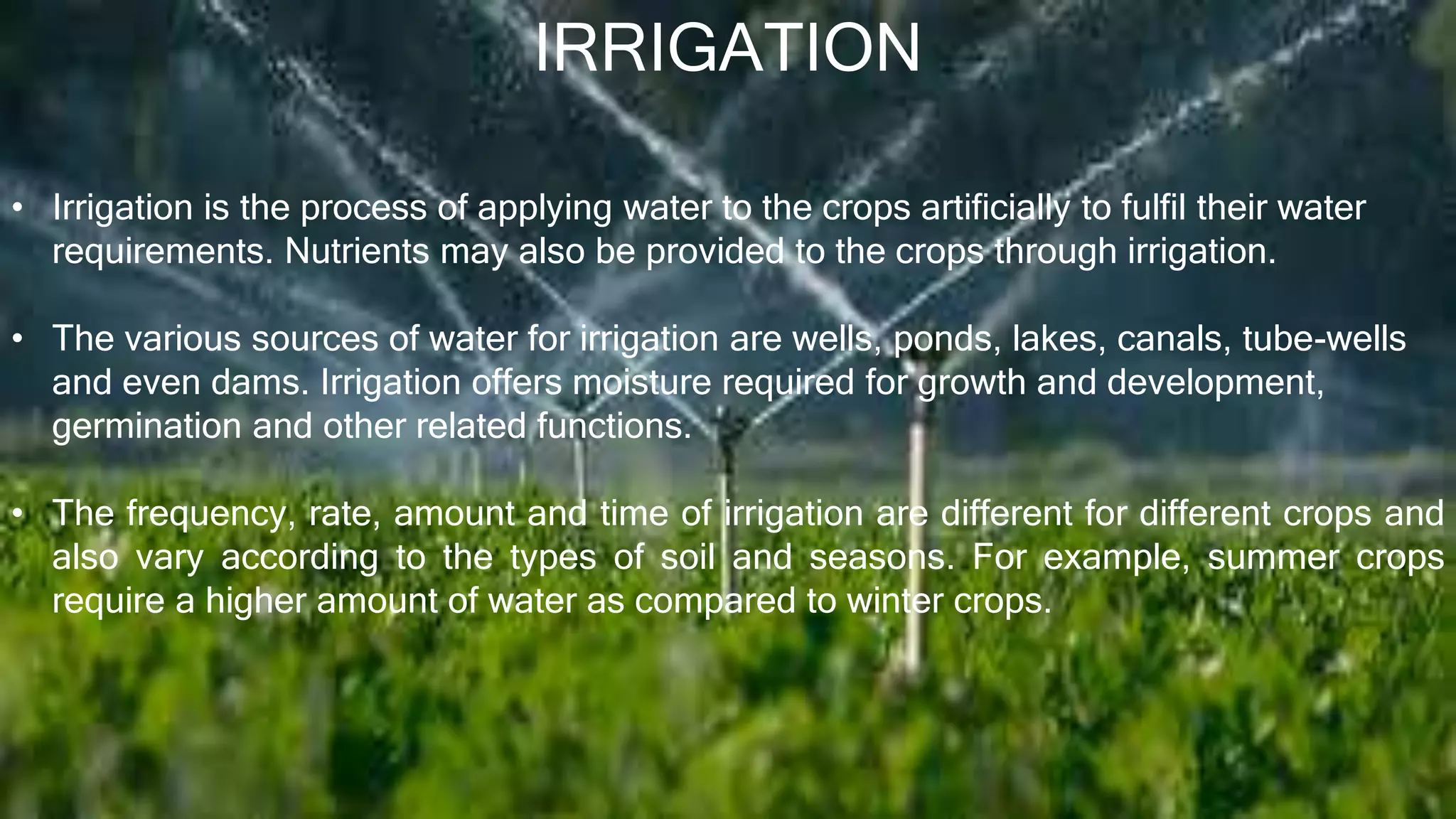
• Irrigation is the process of applying water to the crops artificially to fulfil their water
requirements. Nutrients may also be provided to the crops through irrigation.
• The various sources of water for irrigation are wells, ponds, lakes, canals, tube-wells
and even dams. Irrigation offers moisture required for growth and development,
germination and other related functions.
• The frequency, rate, amount and time of irrigation are different for different crops and
also vary according to the types of soil and seasons. For example, summer crops
require a higher amount of water as compared to winter crops.
Surface irrigation
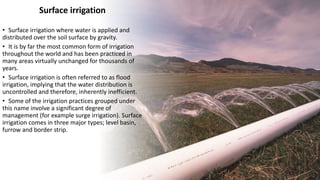
• Surface irrigation where water is applied and
distributed over the soil surface by gravity.
• It is by far the most common form of irrigation
throughout the world and has been practiced in
many areas virtually unchanged for thousands of
years.
• Surface irrigation is often referred to as flood
irrigation, implying that the water distribution is
uncontrolled and therefore, inherently inefficient.
• Some of the irrigation practices grouped under
this name involve a significant degree of
management (for example surge irrigation). Surface
irrigation comes in three major types; level basin,
furrow and border strip.
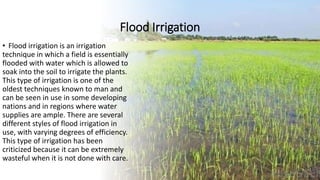
Flood Irrigation
• Flood irrigation is an irrigation
technique in which a field is essentially
flooded with water which is allowed to
soak into the soil to irrigate the plants.
This type of irrigation is one of the
oldest techniques known to man and
can be seen in use in some developing
nations and in regions where water
supplies are ample. There are several
different styles of flood irrigation in
use, with varying degrees of efficiency.
This type of irrigation has been
criticized because it can be extremely
wasteful when it is not done with care.
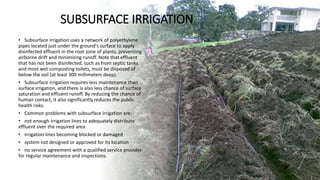
SUBSURFACE IRRIGATION
• Subsurface irrigation uses a network of polyethylene
pipes located just under the ground's surface to apply
disinfected effluent in the root zone of plants, preventing
airborne drift and minimizing runoff. Note that effluent
that has not been disinfected, such as from septic tanks
and most wet composting toilets, must be disposed of
below the soil (at least 300 millimeters deep).
• Subsurface irrigation requires less maintenance than
surface irrigation, and there is also less chance of surface
saturation and effluent runoff. By reducing the chance of
human contact, it also significantly reduces the public
health risks.
• Common problems with subsurface irrigation are:
• not enough irrigation lines to adequately distribute
effluent over the required area
• irrigation lines becoming blocked or damaged
• system not designed or approved for its location
• no service agreement with a qualified service provider
for regular maintenance and inspections.
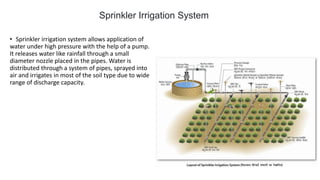
• Sprinkler irrigation system allows application of
water under high pressure with the help of a pump.
It releases water like rainfall through a small
diameter nozzle placed in the pipes. Water is
distributed through a system of pipes, sprayed into
air and irrigates in most of the soil type due to wide
range of discharge capacity.
Sprinkler Irrigation System

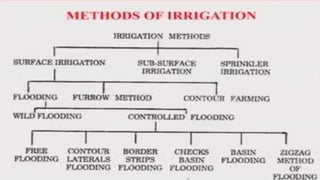
Methods of irrigation

  • 1.
    IRRIGATION • Irrigation isthe process of applying water to the crops artificially to fulfil their water requirements. Nutrients may also be provided to the crops through irrigation. • The various sources of water for irrigation are wells, ponds, lakes, canals, tube-wells and even dams. Irrigation offers moisture required for growth and development, germination and other related functions. • The frequency, rate, amount and time of irrigation are different for different crops and also vary according to the types of soil and seasons. For example, summer crops require a higher amount of water as compared to winter crops.
  • 3.
    Surface irrigation • Surfaceirrigation where water is applied and distributed over the soil surface by gravity. • It is by far the most common form of irrigation throughout the world and has been practiced in many areas virtually unchanged for thousands of years. • Surface irrigation is often referred to as flood irrigation, implying that the water distribution is uncontrolled and therefore, inherently inefficient. • Some of the irrigation practices grouped under this name involve a significant degree of management (for example surge irrigation). Surface irrigation comes in three major types; level basin, furrow and border strip.
  • 4.
    Flood Irrigation • Floodirrigation is an irrigation technique in which a field is essentially flooded with water which is allowed to soak into the soil to irrigate the plants. This type of irrigation is one of the oldest techniques known to man and can be seen in use in some developing nations and in regions where water supplies are ample. There are several different styles of flood irrigation in use, with varying degrees of efficiency. This type of irrigation has been criticized because it can be extremely wasteful when it is not done with care.
  • 5.
    SUBSURFACE IRRIGATION • Subsurfaceirrigation uses a network of polyethylene pipes located just under the ground's surface to apply disinfected effluent in the root zone of plants, preventing airborne drift and minimizing runoff. Note that effluent that has not been disinfected, such as from septic tanks and most wet composting toilets, must be disposed of below the soil (at least 300 millimeters deep). • Subsurface irrigation requires less maintenance than surface irrigation, and there is also less chance of surface saturation and effluent runoff. By reducing the chance of human contact, it also significantly reduces the public health risks. • Common problems with subsurface irrigation are: • not enough irrigation lines to adequately distribute effluent over the required area • irrigation lines becoming blocked or damaged • system not designed or approved for its location • no service agreement with a qualified service provider for regular maintenance and inspections.
  • 6.
    • Sprinkler irrigationsystem allows application of water under high pressure with the help of a pump. It releases water like rainfall through a small diameter nozzle placed in the pipes. Water is distributed through a system of pipes, sprayed into air and irrigates in most of the soil type due to wide range of discharge capacity. Sprinkler Irrigation System