Flow Sheet of Tricking Filter System
Raw
water
Screens
Grit
Primary
Settling
Sludge
Tricking filter
Returning sludge
Final settling
Treated
efficiency
Pump Excess sludge
Digester
Sludge drying
Digester
Sludge drying
1RR18CV034
Explain with a neat sketch the working of tricking filter and
highlight the common problems rising during the operation
Construction details
• It consists of a masonry or RCC tank which is circular or rectangular in plan consists of a bed of
highly permeable media to which microorganism are attached and through which waste water
is percolated or tickled .
• The filter media usually consists of rocks varying in size from 25 to 100mm in diameter . The
depth of the media varies from 0.9 to 2.5 m and 1.3m is most common .
• The filter media is crushed rock but larger gravel, blast furnace, broken bricks, cinder etc . Can
also be used .
• The four rotary distributing arms which have perforations at the bottom are provided. These
arms are fitted with a central support which is rotated by a situation device.
• A siphonic dosing tank is provided with the tricking filter for intermittent supply of effluent
over the filtering media
• The underdrainage tank is provided to collect the sewage after it has passed through the
filtering media, the floor of the filter is made of concrete and its slope is made towards the
periphery .
• The ventilation of the filter should be provided for the smooth working of the filter. The
ventilation is achieved by providing vent by providing vent pipes at the periphery
Working of tricking filter
• The liquid waste water is distributed over the top of the bed by rotary distribution as sprays
• The waste trickling from the top, comes in contact with the biological media and get rid of its
nutrients .
• Filter are constructed with an underdrain system for collecting the treatment waste water and
biological solids detached from the media
• The undrain system is important both as collection unit and as porous structure through which
air can circulates.
• The collected liquid is passed to a settling tank where the solids are separated from the treated
waste water or the channel carries the effluent to the outlet pipes through which effluent is
taken for chlorination .
1RR18CV034
1RR18CV034
1RR18CV034
The common problems arising during the operation
• The head loss through these filter is high making automatic dosing of
filters necessary
• Large are is required
• Primary treatment is a must and hence raw sewage cannot be treated
• Construction cost is high
• They develop bad smell and fly nuisance
• Clogging and channelling are two very common problems associated
with its operation
• Periodic cleaning of the bed (Biomass removal) is required to get desired
performance
• A typical trickling filter used for treating sewage uses 0.22KwH energy to
remove 7kg COD
1RR18CV034
THANK YOU
1RR18CV034
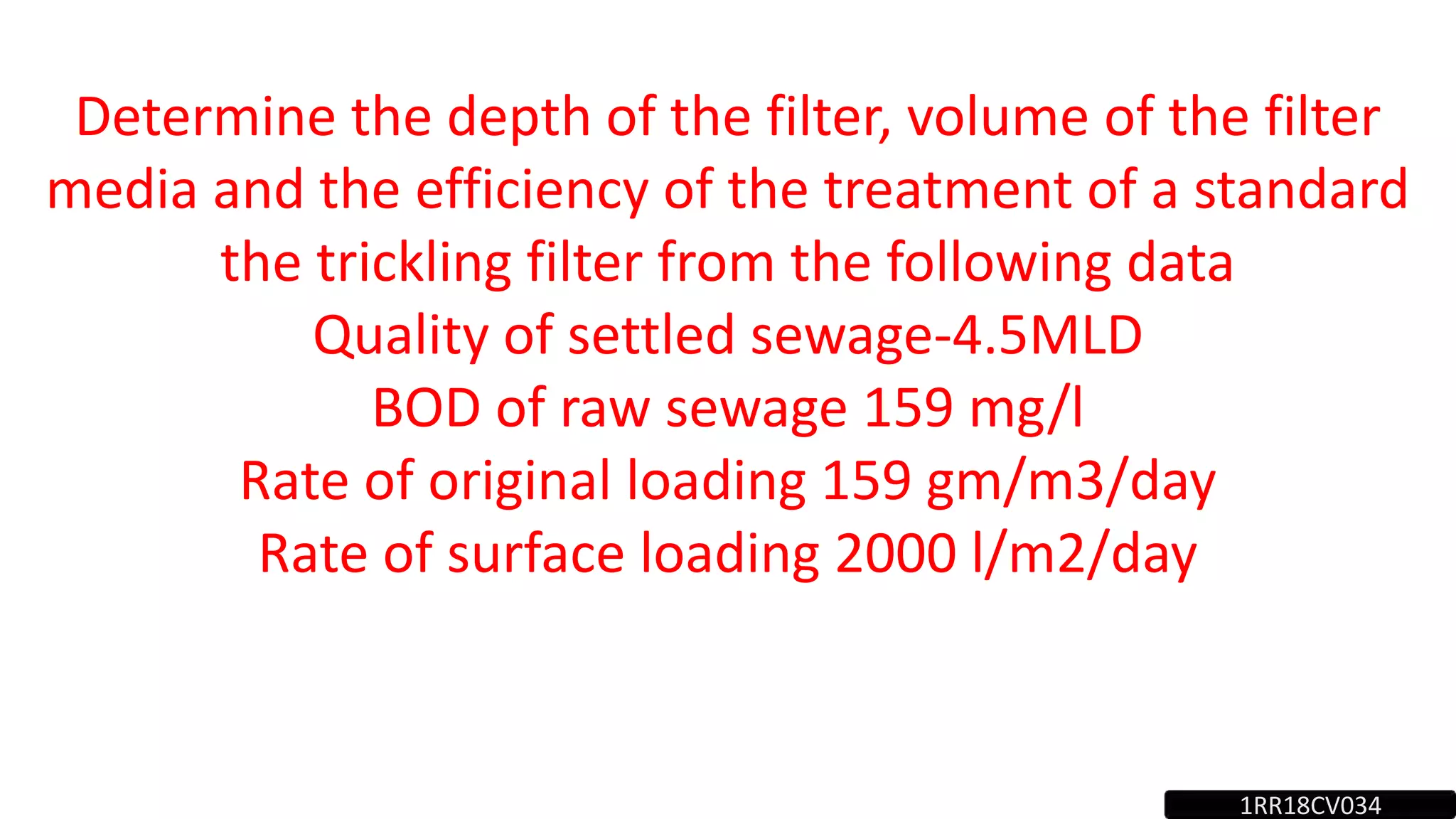
Determine the depth of the filter, volume of the filter
media and the efficiency of the treatment of a standard
the trickling filter from the following data
Quality of settled sewage-4.5MLD
BOD of raw sewage 159 mg/l
Rate of original loading 159 gm/m3/day
Rate of surface loading 2000 l/m2/day
1RR18CV034
1RR18CV034
• Total 5day BOD = Quality of settled sewage X BOD of raw sewage
present in sewage 1000
= 150X4.5X10^6 = 675000 gm/day
1000
• Volume of the filter = Total BOD = 675000
Media required Organic loading 150
= 4500m3
• Surface area required = Total Flow = 4.5X10^6
For filter Hydraulic loading 2000
= 2250m2
1RR18CV034
• Depth of the = volume = 4500 = 2m
Bed required surface 2250
• Efficiency of the filter
n = 100
1+0.0044 u
U=Organic loading in kg/ha—m/day
u= 150 X10^4
1000
1500kg/ha—m/day
n = 100
1+0.0044 1500
n=85.44%
1RR18CV034
THANK YOU

Trickling filter

  • 1.
    Flow Sheet ofTricking Filter System Raw water Screens Grit Primary Settling Sludge Tricking filter Returning sludge Final settling Treated efficiency Pump Excess sludge Digester Sludge drying Digester Sludge drying 1RR18CV034
  • 2.
    Explain with aneat sketch the working of tricking filter and highlight the common problems rising during the operation Construction details • It consists of a masonry or RCC tank which is circular or rectangular in plan consists of a bed of highly permeable media to which microorganism are attached and through which waste water is percolated or tickled . • The filter media usually consists of rocks varying in size from 25 to 100mm in diameter . The depth of the media varies from 0.9 to 2.5 m and 1.3m is most common . • The filter media is crushed rock but larger gravel, blast furnace, broken bricks, cinder etc . Can also be used . • The four rotary distributing arms which have perforations at the bottom are provided. These arms are fitted with a central support which is rotated by a situation device.
  • 3.
    • A siphonicdosing tank is provided with the tricking filter for intermittent supply of effluent over the filtering media • The underdrainage tank is provided to collect the sewage after it has passed through the filtering media, the floor of the filter is made of concrete and its slope is made towards the periphery . • The ventilation of the filter should be provided for the smooth working of the filter. The ventilation is achieved by providing vent by providing vent pipes at the periphery
  • 4.
    Working of trickingfilter • The liquid waste water is distributed over the top of the bed by rotary distribution as sprays • The waste trickling from the top, comes in contact with the biological media and get rid of its nutrients . • Filter are constructed with an underdrain system for collecting the treatment waste water and biological solids detached from the media • The undrain system is important both as collection unit and as porous structure through which air can circulates. • The collected liquid is passed to a settling tank where the solids are separated from the treated waste water or the channel carries the effluent to the outlet pipes through which effluent is taken for chlorination . 1RR18CV034
  • 5.
  • 7.
    1RR18CV034 The common problemsarising during the operation • The head loss through these filter is high making automatic dosing of filters necessary • Large are is required • Primary treatment is a must and hence raw sewage cannot be treated • Construction cost is high • They develop bad smell and fly nuisance • Clogging and channelling are two very common problems associated with its operation • Periodic cleaning of the bed (Biomass removal) is required to get desired performance • A typical trickling filter used for treating sewage uses 0.22KwH energy to remove 7kg COD
  • 8.
  • 9.
  • 11.
    Determine the depthof the filter, volume of the filter media and the efficiency of the treatment of a standard the trickling filter from the following data Quality of settled sewage-4.5MLD BOD of raw sewage 159 mg/l Rate of original loading 159 gm/m3/day Rate of surface loading 2000 l/m2/day 1RR18CV034
  • 12.
    1RR18CV034 • Total 5dayBOD = Quality of settled sewage X BOD of raw sewage present in sewage 1000 = 150X4.5X10^6 = 675000 gm/day 1000 • Volume of the filter = Total BOD = 675000 Media required Organic loading 150 = 4500m3 • Surface area required = Total Flow = 4.5X10^6 For filter Hydraulic loading 2000 = 2250m2
  • 13.
    1RR18CV034 • Depth ofthe = volume = 4500 = 2m Bed required surface 2250 • Efficiency of the filter n = 100 1+0.0044 u U=Organic loading in kg/ha—m/day u= 150 X10^4 1000 1500kg/ha—m/day n = 100 1+0.0044 1500 n=85.44%
  • 14.