




D.ANNISH JENEFA
B.Sc., Hort.
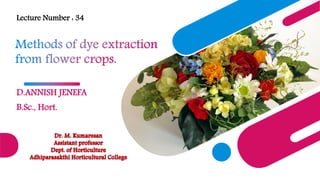
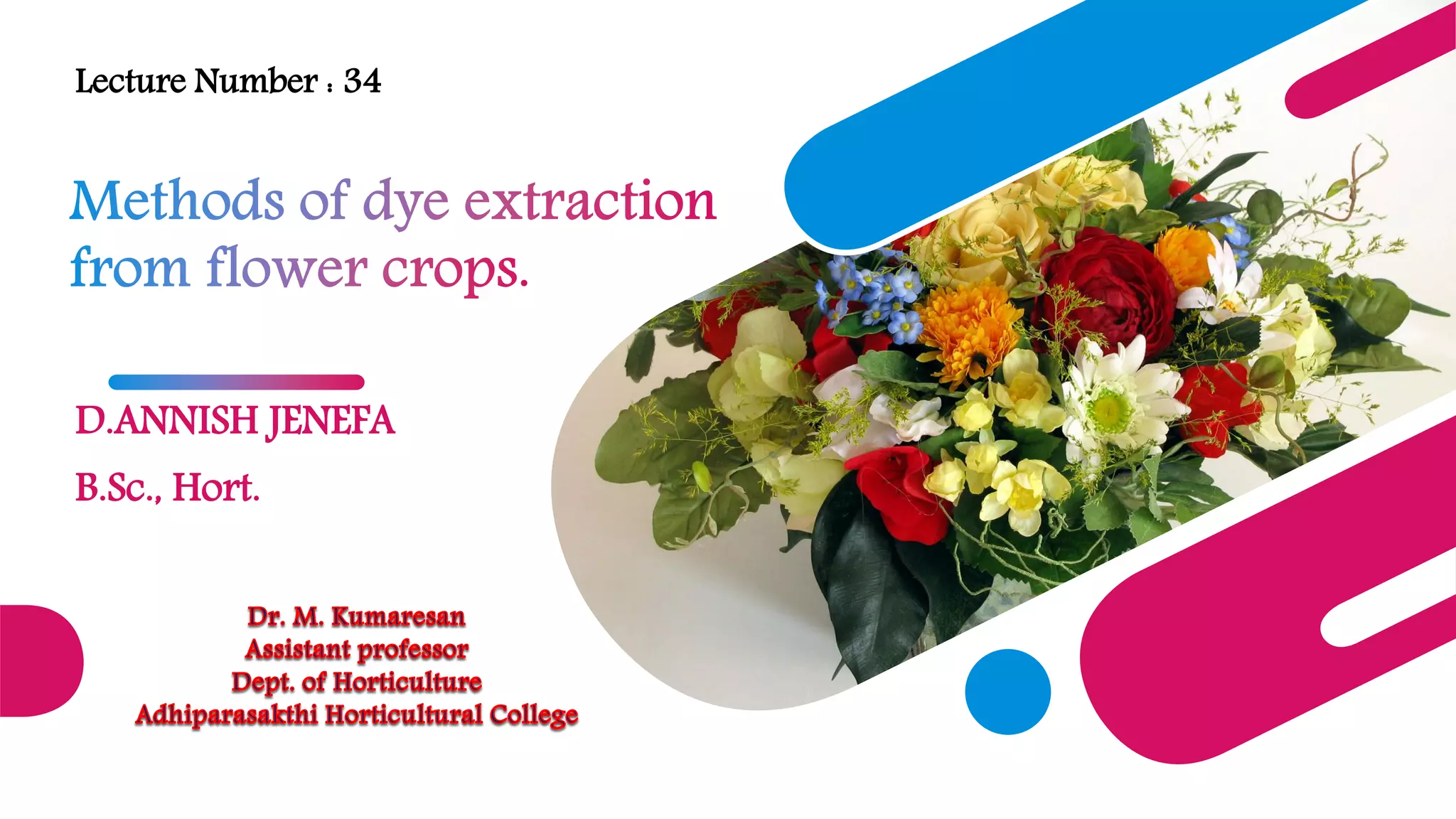
Lecture Number : 34
ADD A FOOTER 2
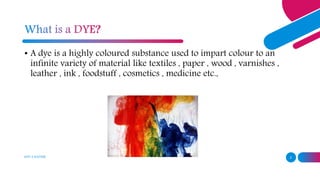
• A dye is a highly coloured substance used to impart colour to an
infinite variety of material like textiles , paper , wood , varnishes ,
leather , ink , foodstuff , cosmetics , medicine etc.,
ADD A FOOTER 3
• These days environmental protection has become a challenge for the textile
industry because it utilizes lot of chemical for colouration of textile materials.
• These chemicals are harmful for both human as well as environment.
• There is a wide range of natural products in India as it is one of the 17 mega
diverse countries.
• India is well known country of colours as it harbours a wealthy and beautiful
floral resourses
ADD A FOOTER 4
• Dyeing time
• Temperature
• Liquor ratio
• pH
• Dyeing method
• Mordant and dye concentration (lightness and darkness of the dye)
ADD A FOOTER 5
• Natural dyes require an element to create a bond between fabric and dye
particle.
• The Mordant is known as the element which can facilitate chemical reaction
taking place between textile fibre and dye.
• As a result , the dye is absorbed into the textile material.
• A Mordant is utilised to fix the dye to fabric and to incorporate colour fastness.
ADD A FOOTER 6
Metallic mordants
• Metal salts of chromium,
iron, aluminium, cupper,
tin
Oil mordants
• Turkey red oil
Natural mordants
• Tea leaves
• Myrobola
• vinegar
ADD A FOOTER 7
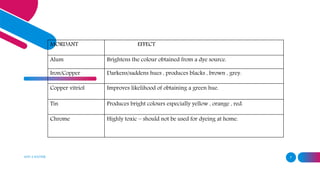
MORDANT EFFECT
Alum Brightens the colour obtained from a dye source.
Iron/Copper Darkens/saddens hues , produces blacks , brown , grey.
Copper vitriol Improves likelihood of obtaining a green hue.
Tin Produces bright colours especially yellow , orange , red.
Chrome Highly toxic – should not be used for dyeing at home.
Flowers used for dye extraction
ADD A FOOTER 8
ADD A FOOTER 9
Tagetes erecta
• Yellow colour
• Cotton and silk fabrics
• Alum and copper sulphate
ADD A FOOTER 10
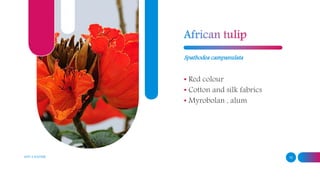
Spathodea campanulata
• Red colour
• Cotton and silk fabrics
• Myrobolan , alum
ADD A FOOTER 11
Rosa sp.
• Pink,Yellow
• Cotton,silk,wool fabrics
• Ferrous sulphate,Stannus choride
ADD A FOOTER 12
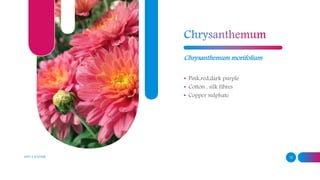
Chrysanthemum morifolium
• Pink,red,dark purple
• Cotton , silk fibres
• Copper sulphate
ADD A FOOTER 13
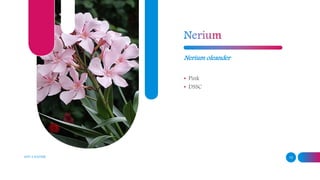
Nerium oleander
• Pink
• DSSC
ADD A FOOTER 14
Hibiscus rosa-sinensis
• Red
• Camel wool
• alum
ADD A FOOTER 15
Ixora coccinea
• Red
• Cotton
• Ferrous sulphate
ADD A FOOTER 16
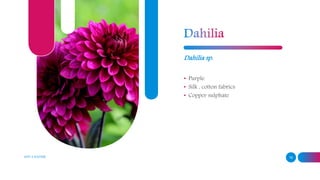
Dahilia sp.
• Purple
• Silk , cotton fabrics
• Copper sulphate
ADD A FOOTER 17
Peitophorum pterocarpum
• Yellow
• Cotton , wool
• Alum
ADD A FOOTER 18
ADD A FOOTER 19
ADD A FOOTER 20
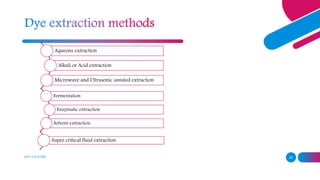
Aqueous extraction
Alkali or Acid extraction
Microwave and Ultrasonic assisted extraction
Fermentation
Enzymatic extraction
Solvent extraction
Super critical fluid extraction
ADD A FOOTER 21
• Traditional method used to extract dyes from plants and other materials.
• Material is broken into small pieces or powdered and sieved.
• They are soaked in water overnight to loosen the cell structure.
• Then they are boiled at 80 to 85 degree for 1 hour to get dye solution.
• The dye solution is filtered to remove remnants.
• ADVANTAGE: Easily applied to textile material.
• DISADVANTAGE : Long time taking process , more water required , Low dye yield
ADD A FOOTER 22
• Prepare 1% alkaline solution with 1gram Sodium carbonate or Sodium hydroxide in 100ml of
water at 100 degree .
• Experimentally it is seen that at 800 – 900C for 1 hr, the extraction is better, so this is the
optimized time & temperature for extraction process.
• Filter the dye solution.
ACID EXTRACTION
• Prepare 1% acidic solution by adding 1ml HCL in 100ml of water at 100 degree
• Experimentally it is seen that at 900 – 1000C for 1 hr, the extraction is better, so this is the
optimized time & temperature for extraction process.
• Filter the dye solution.
ADD A FOOTER 23
• When dye containing material is treated with water or any other solvent in
presence of ultrasonic very small bubbles or cavitation are formed in liquid.
• Millions of these bubbles form and collapse every second.
• The creation of very high temperature and pressure during extraction increases
extraction , efficiency and in short time.
ADD A FOOTER 24
• The materials are treated with minimum amount of solvent in
presence of microwave energy source.
• Microwave increase the rate of extraction process .
• So extraction can be completed in short time with better yield.
ADD A FOOTER 25
• Eg: Acetone , petroleum ether , chloroform , ethanol , methanol
• The water or alcohol extraction method is able to extract both water soluble and
insoluble substance from plant materials.
• DISADVANTAGES:
• Toxic residues , extraction material is not readily soluble in water.
ALCOHOL METHOD:
• 50ml of alcohol is added to 50ml of soft water .
• Alcohol enters the dye material and boil.
• Filter the dye.
ADD A FOOTER 26
• Powder is initially defatted with petroleum benzene [60-80 degree] by required
amount of ethanol by using an extractor for 72 hours.
• Extract is filtered by using filter paper and dry at 45 degree .
• Extract is kept in sterile bottle under refrigerated condition until use.
• METHANOL METHOD:
• Powder is taken and extracted by 20% aq.methanol using Soxhlet extraction
method.
• Dye powder is slightly soluble in hot water and completely soluble in alkaline
material.
ADD A FOOTER 27
• A gas function as a super critical fluid above its critical values of
temperature and pressure.
• Their viscosity is low and can diffuse better into the substrate.
• This is non toxic and high cost.
ADD A FOOTER 28
COLLECT THE PLANT MATERIAL WHEN THEY ARE AT PEAK OF THEIR
COLOUR
ADD A FOOTER 29
TESTING OF RAW MATERIALS FOR ASSESSMENT OF COLOUR CONTENTS
ADD A FOOTER 30
DRY THEM IN SHADE
ADD A FOOTER 31
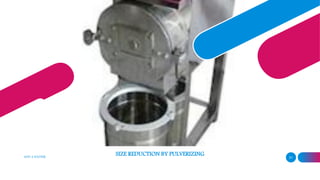
SIZE REDUCTION BY PULVERIZING
ADD A FOOTER 32
SEPARATION OF DIFFERENT SIZE BY VIBRATING SCREEN
ADD A FOOTER 33
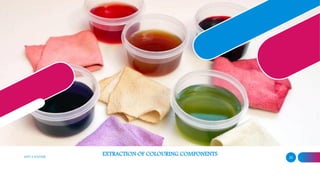
EXTRACTION OF COLOURING COMPONENTS
ADD A FOOTER 34
DRYING OF COLOURING MATTER[DYE] IN SPRAY DRYER
ADD A FOOTER 35
PACKING : LIQUID FORM , PASTE FORM / POWDER FORM
ADD A FOOTER 36
• High-performance liquid chromatography - (HPLC)
• Liquid Chromatography
• Liquid Chromatography-Mass Spectrometry - (LC MS)
• Spectrophotometer
ADD A FOOTER 37
• A weaver’s garden : growing plants for natural dyes and fabrics – Rita buchanan
• Handbook on natural dyes for industrial application
• Natural dyes for textiles : sources , chemistry , and application – padma shree
vankar
Methods of dye extraction from flower crops

Methods of dye extraction from flower crops

  • 1.
  • 2.
    ADD A FOOTER2 • A dye is a highly coloured substance used to impart colour to an infinite variety of material like textiles , paper , wood , varnishes , leather , ink , foodstuff , cosmetics , medicine etc.,
  • 3.
    ADD A FOOTER3 • These days environmental protection has become a challenge for the textile industry because it utilizes lot of chemical for colouration of textile materials. • These chemicals are harmful for both human as well as environment. • There is a wide range of natural products in India as it is one of the 17 mega diverse countries. • India is well known country of colours as it harbours a wealthy and beautiful floral resourses
  • 4.
    ADD A FOOTER4 • Dyeing time • Temperature • Liquor ratio • pH • Dyeing method • Mordant and dye concentration (lightness and darkness of the dye)
  • 5.
    ADD A FOOTER5 • Natural dyes require an element to create a bond between fabric and dye particle. • The Mordant is known as the element which can facilitate chemical reaction taking place between textile fibre and dye. • As a result , the dye is absorbed into the textile material. • A Mordant is utilised to fix the dye to fabric and to incorporate colour fastness.
  • 6.
    ADD A FOOTER6 Metallic mordants • Metal salts of chromium, iron, aluminium, cupper, tin Oil mordants • Turkey red oil Natural mordants • Tea leaves • Myrobola • vinegar
  • 7.
    ADD A FOOTER7 MORDANT EFFECT Alum Brightens the colour obtained from a dye source. Iron/Copper Darkens/saddens hues , produces blacks , brown , grey. Copper vitriol Improves likelihood of obtaining a green hue. Tin Produces bright colours especially yellow , orange , red. Chrome Highly toxic – should not be used for dyeing at home.
  • 8.
    Flowers used fordye extraction ADD A FOOTER 8
  • 9.
    ADD A FOOTER9 Tagetes erecta • Yellow colour • Cotton and silk fabrics • Alum and copper sulphate
  • 10.
    ADD A FOOTER10 Spathodea campanulata • Red colour • Cotton and silk fabrics • Myrobolan , alum
  • 11.
    ADD A FOOTER11 Rosa sp. • Pink,Yellow • Cotton,silk,wool fabrics • Ferrous sulphate,Stannus choride
  • 12.
    ADD A FOOTER12 Chrysanthemum morifolium • Pink,red,dark purple • Cotton , silk fibres • Copper sulphate
  • 13.
    ADD A FOOTER13 Nerium oleander • Pink • DSSC
  • 14.
    ADD A FOOTER14 Hibiscus rosa-sinensis • Red • Camel wool • alum
  • 15.
    ADD A FOOTER15 Ixora coccinea • Red • Cotton • Ferrous sulphate
  • 16.
    ADD A FOOTER16 Dahilia sp. • Purple • Silk , cotton fabrics • Copper sulphate
  • 17.
    ADD A FOOTER17 Peitophorum pterocarpum • Yellow • Cotton , wool • Alum
  • 18.
  • 19.
  • 20.
    ADD A FOOTER20 Aqueous extraction Alkali or Acid extraction Microwave and Ultrasonic assisted extraction Fermentation Enzymatic extraction Solvent extraction Super critical fluid extraction
  • 21.
    ADD A FOOTER21 • Traditional method used to extract dyes from plants and other materials. • Material is broken into small pieces or powdered and sieved. • They are soaked in water overnight to loosen the cell structure. • Then they are boiled at 80 to 85 degree for 1 hour to get dye solution. • The dye solution is filtered to remove remnants. • ADVANTAGE: Easily applied to textile material. • DISADVANTAGE : Long time taking process , more water required , Low dye yield
  • 22.
    ADD A FOOTER22 • Prepare 1% alkaline solution with 1gram Sodium carbonate or Sodium hydroxide in 100ml of water at 100 degree . • Experimentally it is seen that at 800 – 900C for 1 hr, the extraction is better, so this is the optimized time & temperature for extraction process. • Filter the dye solution. ACID EXTRACTION • Prepare 1% acidic solution by adding 1ml HCL in 100ml of water at 100 degree • Experimentally it is seen that at 900 – 1000C for 1 hr, the extraction is better, so this is the optimized time & temperature for extraction process. • Filter the dye solution.
  • 23.
    ADD A FOOTER23 • When dye containing material is treated with water or any other solvent in presence of ultrasonic very small bubbles or cavitation are formed in liquid. • Millions of these bubbles form and collapse every second. • The creation of very high temperature and pressure during extraction increases extraction , efficiency and in short time.
  • 24.
    ADD A FOOTER24 • The materials are treated with minimum amount of solvent in presence of microwave energy source. • Microwave increase the rate of extraction process . • So extraction can be completed in short time with better yield.
  • 25.
    ADD A FOOTER25 • Eg: Acetone , petroleum ether , chloroform , ethanol , methanol • The water or alcohol extraction method is able to extract both water soluble and insoluble substance from plant materials. • DISADVANTAGES: • Toxic residues , extraction material is not readily soluble in water. ALCOHOL METHOD: • 50ml of alcohol is added to 50ml of soft water . • Alcohol enters the dye material and boil. • Filter the dye.
  • 26.
    ADD A FOOTER26 • Powder is initially defatted with petroleum benzene [60-80 degree] by required amount of ethanol by using an extractor for 72 hours. • Extract is filtered by using filter paper and dry at 45 degree . • Extract is kept in sterile bottle under refrigerated condition until use. • METHANOL METHOD: • Powder is taken and extracted by 20% aq.methanol using Soxhlet extraction method. • Dye powder is slightly soluble in hot water and completely soluble in alkaline material.
  • 27.
    ADD A FOOTER27 • A gas function as a super critical fluid above its critical values of temperature and pressure. • Their viscosity is low and can diffuse better into the substrate. • This is non toxic and high cost.
  • 28.
    ADD A FOOTER28 COLLECT THE PLANT MATERIAL WHEN THEY ARE AT PEAK OF THEIR COLOUR
  • 29.
    ADD A FOOTER29 TESTING OF RAW MATERIALS FOR ASSESSMENT OF COLOUR CONTENTS
  • 30.
    ADD A FOOTER30 DRY THEM IN SHADE
  • 31.
    ADD A FOOTER31 SIZE REDUCTION BY PULVERIZING
  • 32.
    ADD A FOOTER32 SEPARATION OF DIFFERENT SIZE BY VIBRATING SCREEN
  • 33.
    ADD A FOOTER33 EXTRACTION OF COLOURING COMPONENTS
  • 34.
    ADD A FOOTER34 DRYING OF COLOURING MATTER[DYE] IN SPRAY DRYER
  • 35.
    ADD A FOOTER35 PACKING : LIQUID FORM , PASTE FORM / POWDER FORM
  • 36.
    ADD A FOOTER36 • High-performance liquid chromatography - (HPLC) • Liquid Chromatography • Liquid Chromatography-Mass Spectrometry - (LC MS) • Spectrophotometer
  • 37.
    ADD A FOOTER37 • A weaver’s garden : growing plants for natural dyes and fabrics – Rita buchanan • Handbook on natural dyes for industrial application • Natural dyes for textiles : sources , chemistry , and application – padma shree vankar