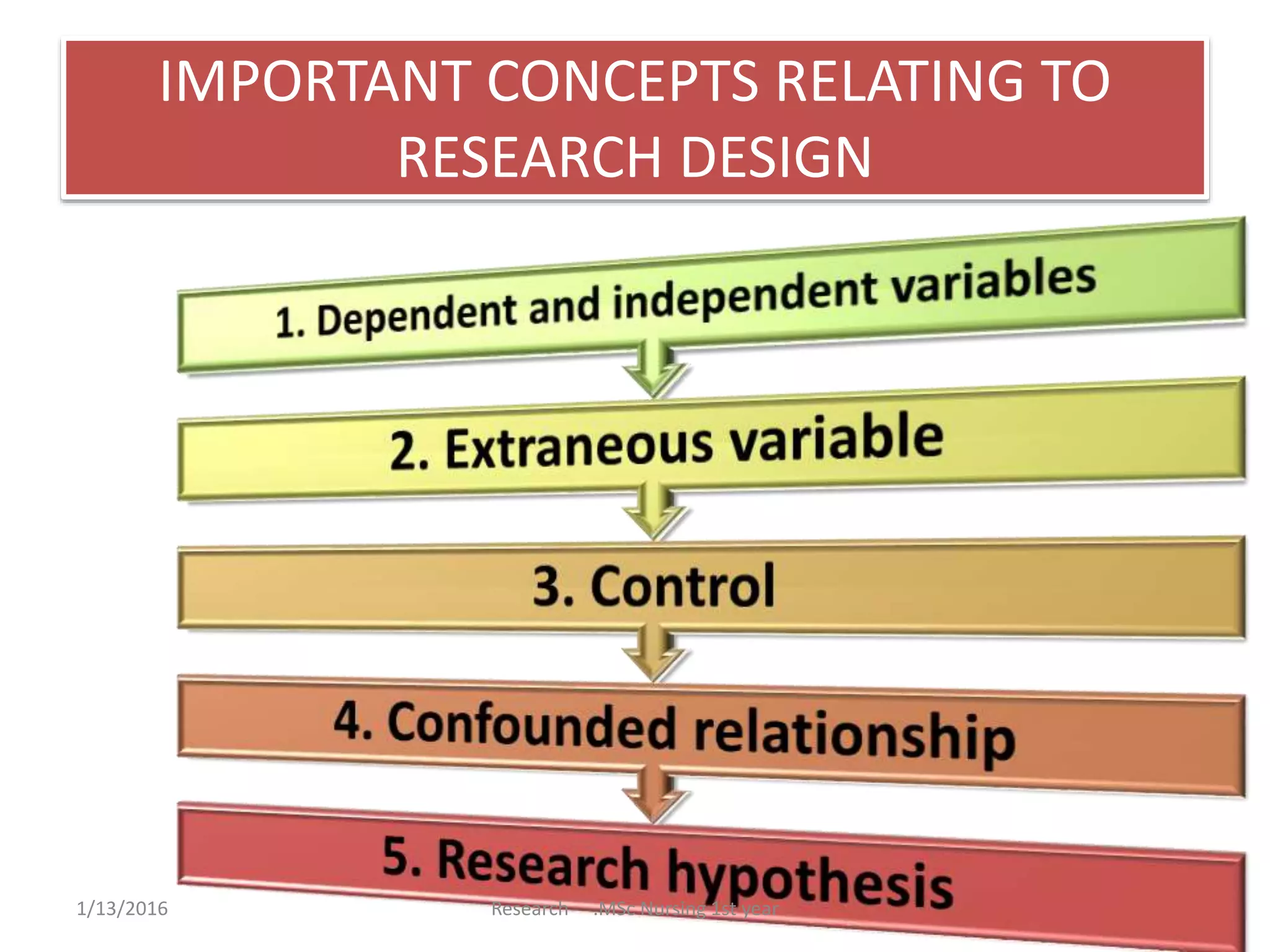
The document discusses various aspects of research design and data collection planning for nursing research. It begins by outlining the key steps an engineer would take when planning a construction project, then discusses implementing a research plan, designing the research plan, and planning for data collection. It emphasizes that a good research design and data collection plan are necessary to facilitate a smooth research process and organize ideas to identify flaws. The document provides details on various components that should be included in a research plan and guidelines for developing an effective data collection plan in multiple phases and steps.
Explains the importance of planning in research akin to constructing a building. Key steps include identifying objectives, planning, obtaining permissions, and scheduling.
Details on implementing a research plan, including design structure and essential questions guiding the research process.
Covers the necessity of a coherent research design focusing on smooth operations, planning, and organizing thoughts to identify flaws.
Outlines different research design types: descriptive, correlational, semi-experimental, experimental, review, and meta-analytic.
Emphasizes the importance of arranging ideas and developing a research plan as a foundational document.
Defines data collection planning, its benefits for ensuring reliable information, and types of data collection methods.
Describes phases and steps of a data collection plan, focusing on goal definition, methodology, achieving accuracy, and data review.
Suggests practices for effective data collection, including using various sources, ensuring timeliness, and assessing perceptions.
Enumerates the steps for identifying data needs, selecting measures, and developing appropriate instruments.
Discusses the importance of pretesting data collection tools and the process of implementing the data collection plan.
Highlights factors influencing data collection methods: nature of inquiry, financial resources, and time considerations.
Lists key references and resources related to research methods and data collection planning.
Introduction
• When constructinga building what
the engineer is doing?
• First is he ordering materials?
or
• Setting critical dates for completion
of project stages ?
1/13/2016 Research .MSc Nursing 1st year
4.
Cont…………..
First will findout what sort of
building is to be constructed?
Then sketch a plan,
Obtain permits
Work out a work schedule or order
materials.
1/13/2016 Research .MSc Nursing 1st year
5.
IMPLEMENTING RESEARCH PLAN
Researchplan design
Planning for data collection
Administration of tool
Collection of data
1/13/2016 Research .MSc Nursing 1st year
6.
RESEARCH PLAN DESIGN
•“A research design is the arrangement
of conditions for collection and analysis
of data in a manner that aims to
combine relevance to the research
purpose with economy in procedure.
1/13/2016 Research .MSc Nursing 1st year
7.
Continue……….
The research designis the
conceptual structure within
which research is conducted.
it constitutes the blueprint for
the Collection, measurement
and analysis of data.
1/13/2016 Research .MSc Nursing 1st year
8.
Answers to questions
Whatis the study about?
Why is the study being made?
Where will the study be carried out?
What type of data is required?
Where can the required data be found?
1/13/2016 Research .MSc Nursing 1st year
9.
Cont………….
What periods oftime will the study include?
What will be the sample design?
What techniques of data collection will be used?
How will the data be analyzed?
In what style will the report be prepared?
1/13/2016 Research .MSc Nursing 1st year
10.
Overall into thefollowing parts:
(a) THE
SAMPLING
DESIGN.
(b) The
observational
design .
(c) The
statistical .
(d) The operational
design.
1/13/2016 Research .MSc Nursing 1st year
11.
NEED FOR RESEARCHDESIGN
Because it facilitates the smooth sailing of the
various research operations.
Stands for advance planning of the methods to
be adopted for collecting the relevant data and
the techniques to be used in their analysis.
Helps the researcher to organize his ideas in a
form whereby it will be possible for him to look
for flaws and inadequacies.
1/13/2016 Research .MSc Nursing 1st year
12.
FEATURES OF AGOOD DESIGN
1/13/2016 Research .MSc Nursing 1st year
RESEARCH PLAN
• Afteridentifying and defining the
problem as also accomplishing the
relating task, researcher must arrange
his ideas in order and write them in
the form of an experimental plan or
what can be described as ‘Research
Plan’
1/13/2016 Research .MSc Nursing 1st year
18.
Why this isessential?
• Because :
• It helps him to organize his ideas in a form
whereby it will be possible for him to look for
flaws and inadequacies, if any.
• It provides an inventory of what must be done
and which materials have to be collected as a
preliminary step.
• It is a document that can be given to others for
comment.
1/13/2016 Research .MSc Nursing 1st year
19.
Research plan mustcontain the following
items.
1/13/2016 Research .MSc Nursing 1st year
Meaning /concept
• Datacollection planning is a process
to ensure that the data you collect
for performance improvement are
useful and reliable, without being
unnecessarily costly and time-
consuming to obtain.
1/13/2016 Research .MSc Nursing 1st year
23.
Data collection planninghas a variety
of benefits:
• It helps to ensure that the data gathered
contain real information, useful to the
improvement effort.
• It prevents errors that commonly occur
in the data collection process.
• It saves time and money that otherwise
might be spent on repeated or failed
attempts to collect useful data.
1/13/2016 Research .MSc Nursing 1st year
24.
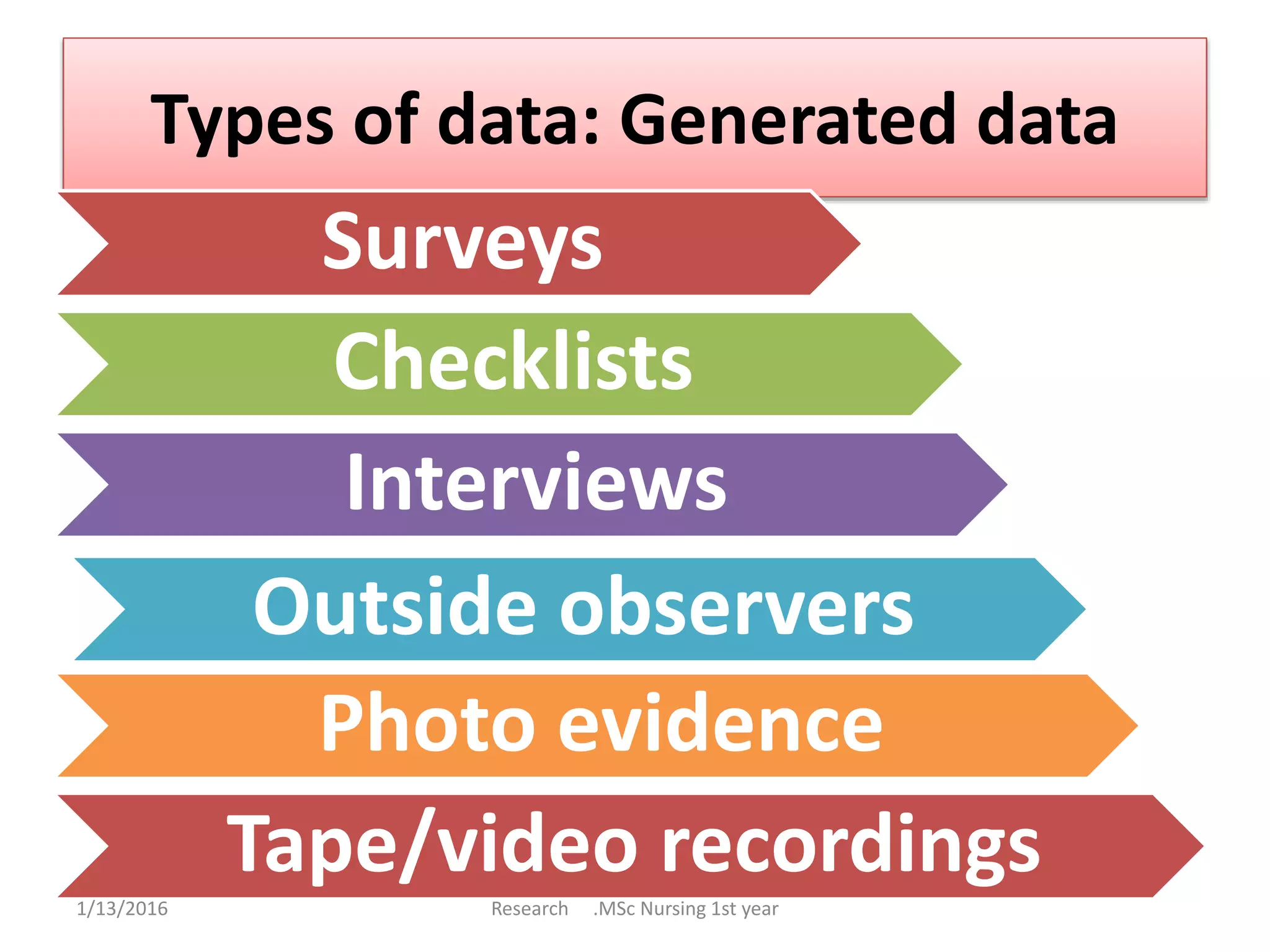
Types of data:Generated data
Surveys
Checklists
Interviews
Outside observers
Photo evidence
Tape/video recordings1/13/2016 Research .MSc Nursing 1st year
25.
Developing a datacollection plan
First write down a statement of
your question. Then answer the
following questions:
1/13/2016 Research .MSc Nursing 1st year
26.
Developing a datacollection plan
•What do you need to know?
•What types of data will provide
you with the information that you
need?
•What types of data are already
available to you (existing archival
sources and other artifacts)?
1/13/2016 Research .MSc Nursing 1st year
27.
Developing a datacollection plan
• What types of data do you need to
generate?
• What instruments will you need to
generate and collect data?
1/13/2016 Research .MSc Nursing 1st year
A SOUND DATACOLLECTION PLAN:
THREE PHASES-FIVE STEPS
1/13/2016 Research .MSc Nursing 1st year
30.
Pre-Data Collection Steps
1.Clearly define the goals and objectives
of the data collection.
2. Reach understanding and agreement
on operational definitions and
methodology for the data collection
plan.
3. Ensure data collection (and
measurement) repeatability,
reproducibility, accuracy and stability.
1/13/2016 Research .MSc Nursing 1st year
31.
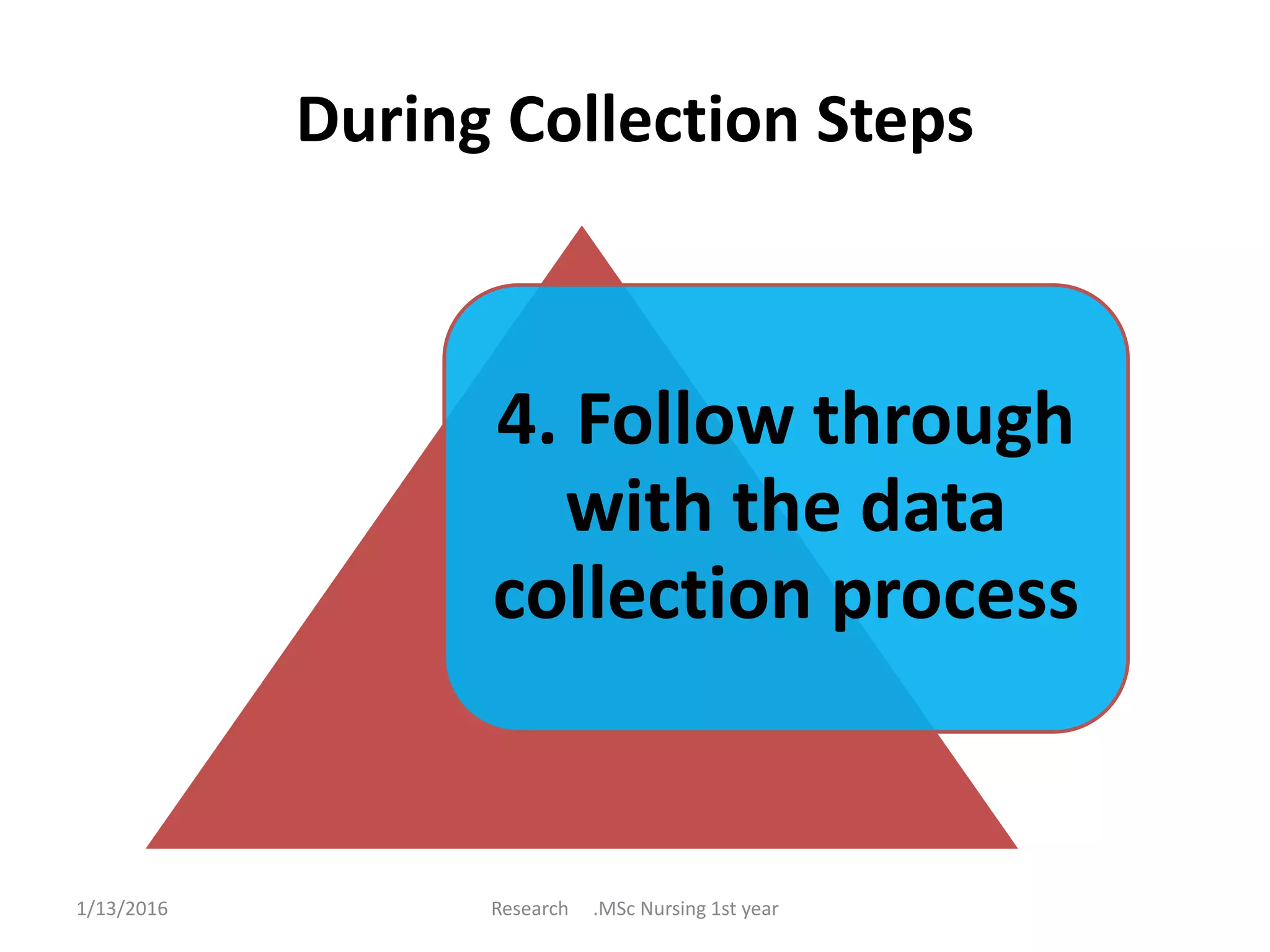
During Collection Steps
4.Follow through
with the data
collection process
1/13/2016 Research .MSc Nursing 1st year
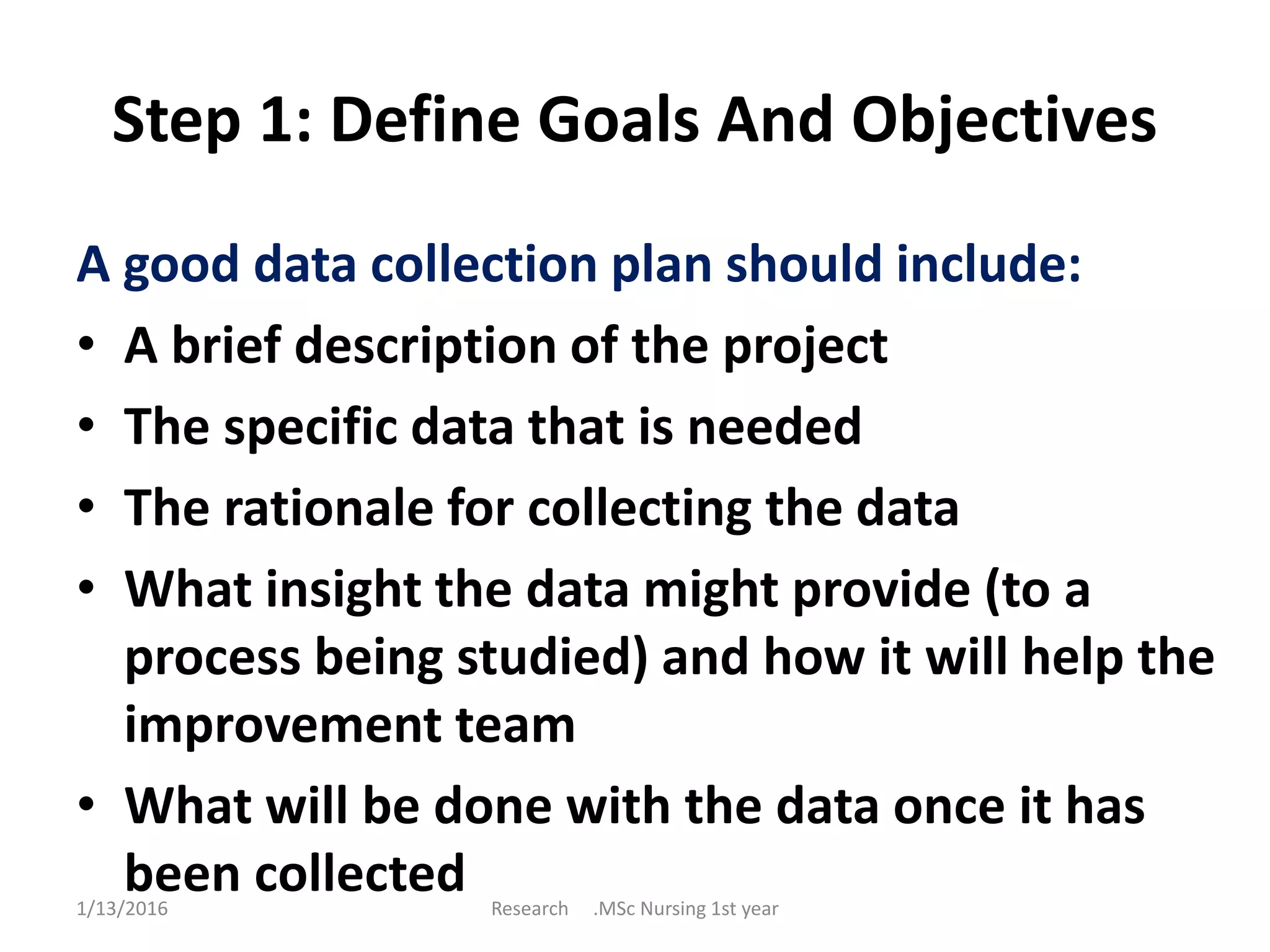
Step 1: DefineGoals And Objectives
A good data collection plan should include:
• A brief description of the project
• The specific data that is needed
• The rationale for collecting the data
• What insight the data might provide (to a
process being studied) and how it will help the
improvement team
• What will be done with the data once it has
been collected1/13/2016 Research .MSc Nursing 1st year
34.
Step 2: DefineOperational Definitions
and Methodology
Formulate the scope of the data collection:
• How many observations are needed.
• What time interval should be part of the
study.
• Whether past, present, and future data
will be collected.
• The methodologies that will be employed
to record all the data.
1/13/2016 Research .MSc Nursing 1st year
35.
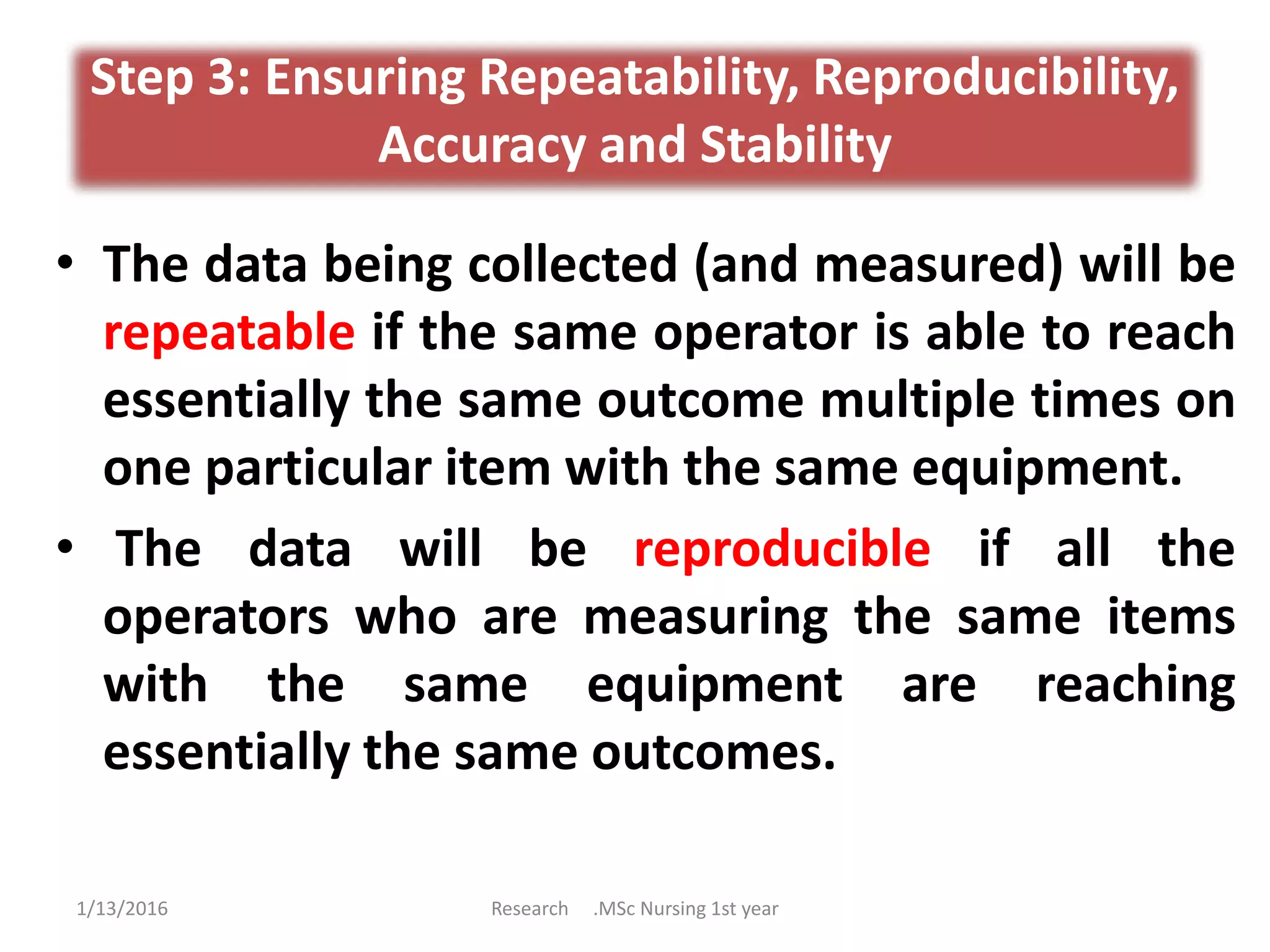
Step 3: EnsuringRepeatability, Reproducibility,
Accuracy and Stability
• The data being collected (and measured) will be
repeatable if the same operator is able to reach
essentially the same outcome multiple times on
one particular item with the same equipment.
• The data will be reproducible if all the
operators who are measuring the same items
with the same equipment are reaching
essentially the same outcomes.
1/13/2016 Research .MSc Nursing 1st year
36.
• The degreeto which the measurement
system is accurate will generally be the
difference between an observed average
measurement and the associated known
standard value.
• The degree to which the measurement
system is stable is generally expressed by
the variation resulting from the same
operator measuring the same item, with
the same equipment, over an extended
period1/13/2016 Research .MSc Nursing 1st year
37.
Step 4: TheData Collection Process
• Once the data collection process has
been planned and defined, it is best to
follow through with the process from
start to finish, ensuring that the plan is
being executed consistently and
accurately.
1/13/2016 Research .MSc Nursing 1st year
38.
Step 5: AfterThe Data Collection Process
• Referring back to the question of whether or
not the data collection and measurement
systems are reproducible, repeatable, accurate,
and stable.
• Reviewing the operational definitions and
methodology with the participants should help
to clear up any misunderstandings or
misinterpretations that may have caused the
breakdowns.
1/13/2016 Research .MSc Nursing 1st year
39.
Guidelines and Recommendationsfor Data
Collection
• Use multiple data sources.
• Collect existing archival data
immediately, then move to
conventional and inventive sources.
• Collect data regularly.
• Seek technical assistance
1/13/2016 Research .MSc Nursing 1st year
40.
Points to keepin mind
• Keep it simple;
• Pay attention to both quantitative
and qualitative data;
• Schedule time to organize data;
• Discuss the data with “critical
friends”; and
• Seek technical assistance.
1/13/2016 Research .MSc Nursing 1st year
41.
Check of datacollection plan
• Is there congruence between your
question and the data sources that you
identified?
• Are you using multiple data sources to
clarify the picture being developed?
• Are you gathering data frequently
enough so that it can be used to inform
your current practice as well as your
future actions?
1/13/2016 Research .MSc Nursing 1st year
42.
Check of datacollection plan
• Are you collecting data about how
students/faculty/administration/paren
ts feel and perceive their experiences?
• Are you collecting data about how
you feel and perceive your
experiences?
1/13/2016 Research .MSc Nursing 1st year
43.
Steps (Polit &Beck)
1. Identifying data needs
2. Selecting types of measures
3. Selecting and developing instruments
4. Pretesting the data collection package
5. Developing data collection forms
&procedures
6. Implementing data collection plan
1/13/2016 Research .MSc Nursing 1st year
44.
1.Identifying data needs
•Testing the hypothesis or addressing the
research questions.
• Describing sample characteristics.
• Controlling extraneous variables.
• Analyzing potential biases
• Understanding subgroup effects
• Interpreting results
• Checking the manipulation
• Obtaining administrative information
1/13/2016 Research .MSc Nursing 1st year
45.
2.Selecting types ofmeasures
• Select data collection methods
Self report
Observations
Physiologic measures
1/13/2016 Research .MSc Nursing 1st year
46.
3.Selecting and developinginstruments
Identifying potential data collection
instruments
Assess the appropriateness
Is it conceptually relevant?
Whether the instrument will yield data of
sufficiently high quality?
1/13/2016 Research .MSc Nursing 1st year
47.
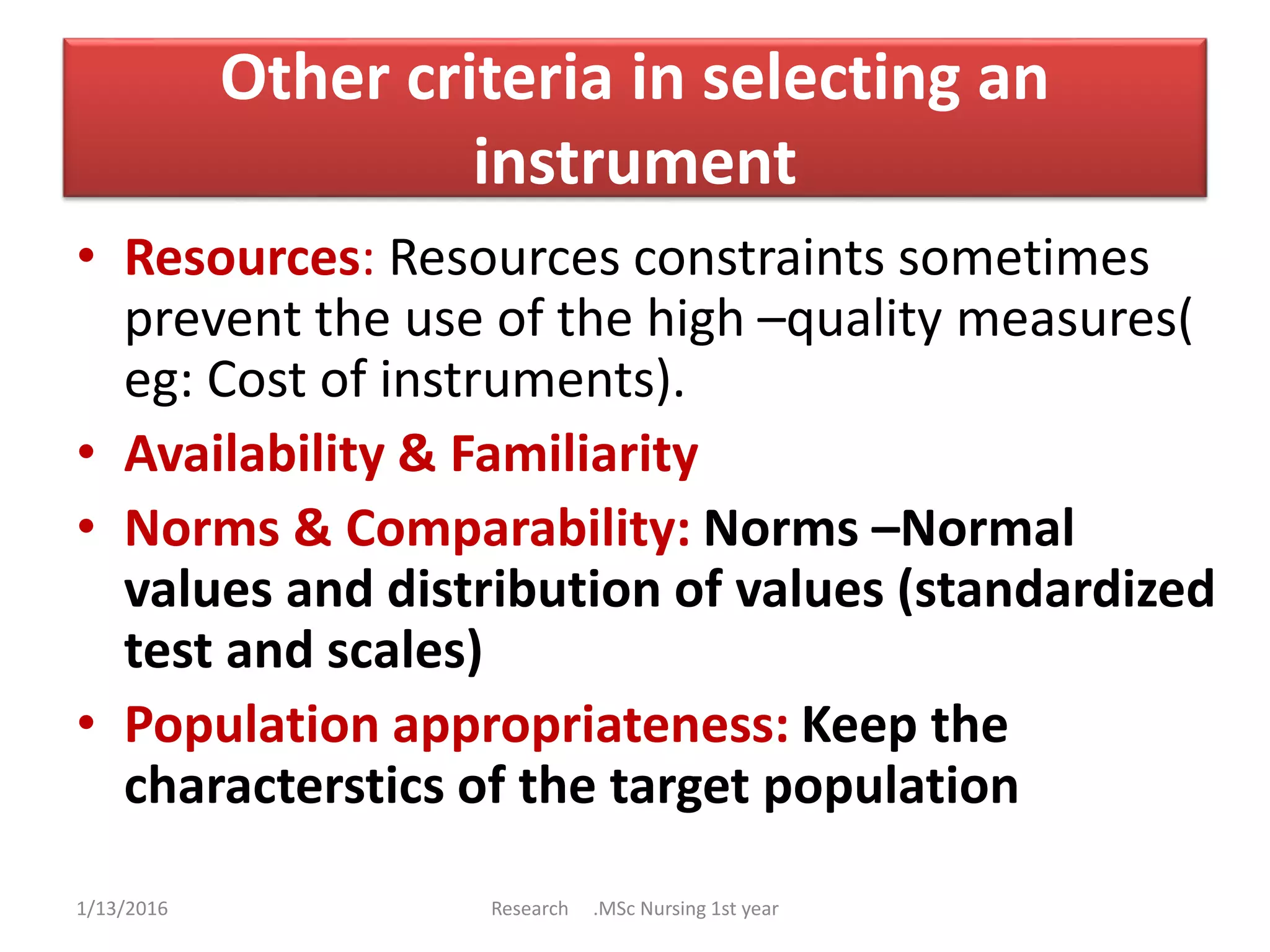
Other criteria inselecting an
instrument
• Resources: Resources constraints sometimes
prevent the use of the high –quality measures(
eg: Cost of instruments).
• Availability & Familiarity
• Norms & Comparability: Norms –Normal
values and distribution of values (standardized
test and scales)
• Population appropriateness: Keep the
characterstics of the target population
1/13/2016 Research .MSc Nursing 1st year
48.
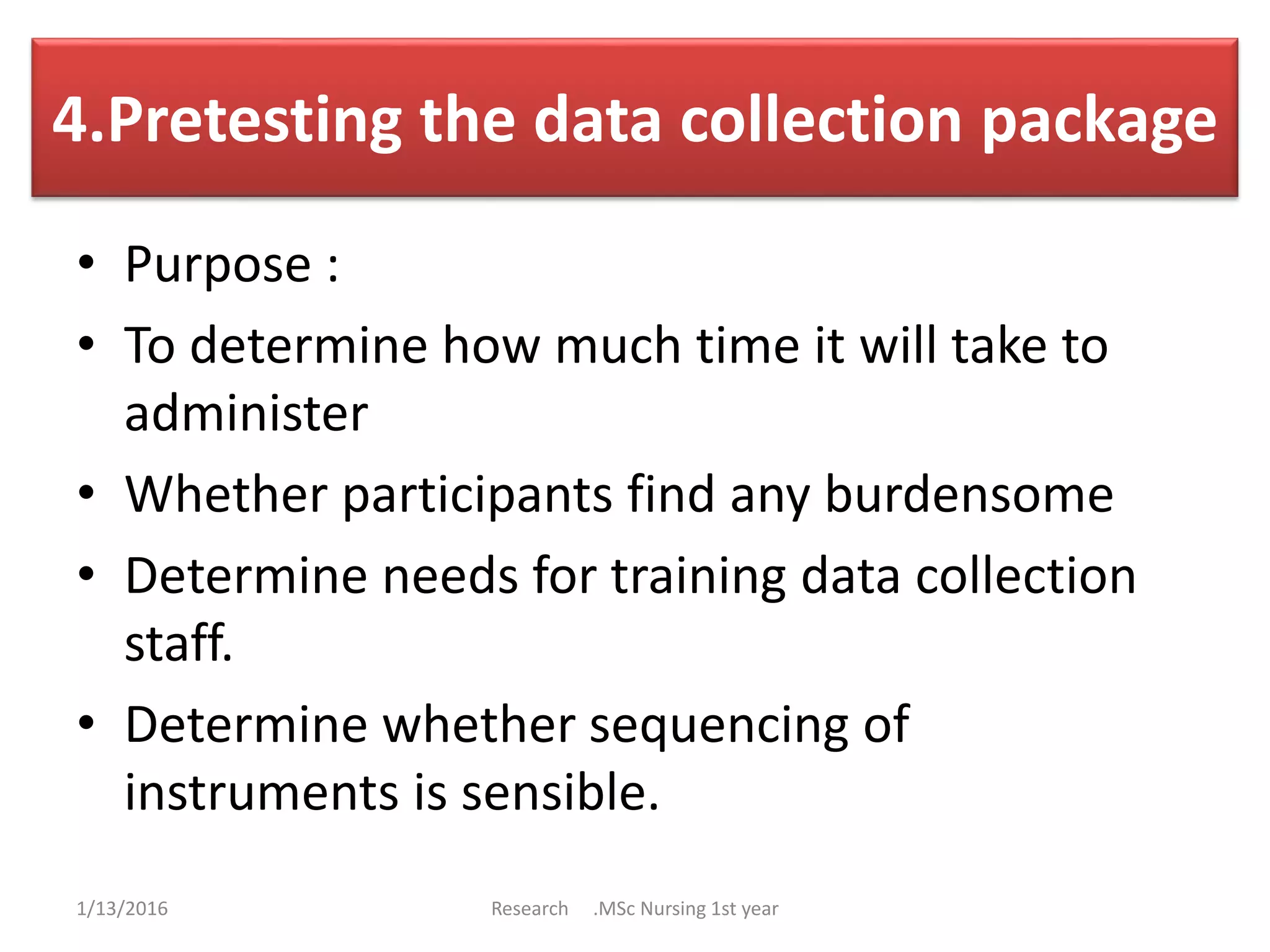
4.Pretesting the datacollection package
• Purpose :
• To determine how much time it will take to
administer
• Whether participants find any burdensome
• Determine needs for training data collection
staff.
• Determine whether sequencing of
instruments is sensible.
1/13/2016 Research .MSc Nursing 1st year
49.
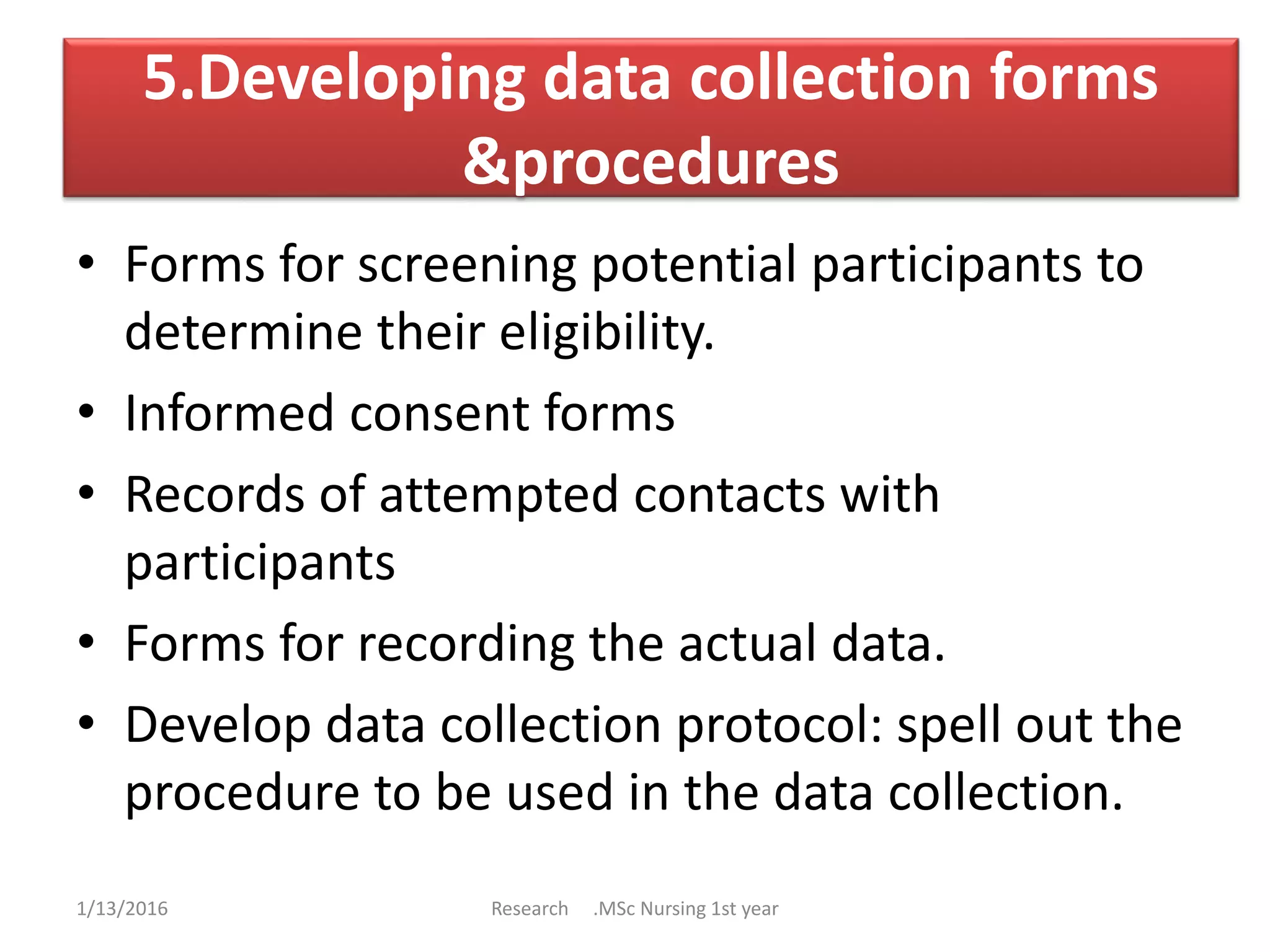
5.Developing data collectionforms
&procedures
• Forms for screening potential participants to
determine their eligibility.
• Informed consent forms
• Records of attempted contacts with
participants
• Forms for recording the actual data.
• Develop data collection protocol: spell out the
procedure to be used in the data collection.
1/13/2016 Research .MSc Nursing 1st year
50.
6.Implementing data collectionplan
Selecting research
personnel.(who will collect data?)
Training data collectors
1/13/2016 Research .MSc Nursing 1st year
SELECTION OF APPROPRIATE
METHODFOR DATA COLLECTION
• While selecting the method
keeping in view the following
factors:
1/13/2016 Research .MSc Nursing 1st year
54.
1. Nature, scopeand object of enquiry:
• This factor is important in deciding
whether the data already available
(secondary data) are to be used or the
data not yet available (primary data) are
to be collected.
1/13/2016 Research .MSc Nursing 1st year
55.
2. Availability offunds
• Finance, in fact, is a big
constraint in practice and the
researcher has to act within
this limitation.
1/13/2016 Research .MSc Nursing 1st year
56.
3. Time factor:
•Availability of time has also to be
taken into account in deciding a
particular method of data
collection.
• Some methods take relatively more
time, whereas with others the data
can be collected in a comparatively
shorter duration.1/13/2016 Research .MSc Nursing 1st year
BIBLIOGRAPHY
1. C RKothari.Research Methodology.Methods &
Techniques.New age international (p).
2. http://www.isixsigma.com/tools-templates/sampling-
data/building-sound-data-collection-plan/
3. D F Polit, C T Beck.Nursing Research :Principles and
Methods .Lippincott Williams &Wilkins .
1/13/2016 Research .MSc Nursing 1st year