*
1)Oxygen is removed from the water by chemical reactions, the decay
process and respiration.
2)Water temperature and atmospheric pressure affect oxygen
concentration in water.
3) Cold water at high atmospheric pressure holds more dissolved oxygen
than warm water at low atmospheric pressure.
4) Degree of light penetration (turbidity, color and water depth) and the
degree of water turbulence or wave action also affect oxygen
concentrations.
 Dissolved oxygen (D.O.) is reported as milligrams of oxygen per liter
of water (mg/L) .
Aquatic plants produce oxygen by photosynthesis during daylight
hours but they also use oxygen for respiration.
*
*Both plants and animals depend on
dissolved oxygen for survival.
*lack of oxygen can kill aquatic plants
and animals.
* Measuring dissolved oxygen is probably
the most significant water quality test to
determine the suitability of a stream
for fish and many other aquatic
organisms.
*
 Oxygen combines with Mangnous
hydroxide to form higher
hydroxides, which on acidification
liberate iodine equivalent to that of
oxygen fixed.
 This iodine is titrated by
standard Sodium thiosulfate
solution using starch as an indicator.
*
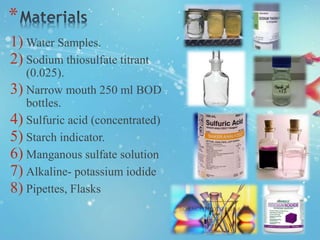
1) Water Samples.
2) Sodium thiosulfate titrant
(0.025).
3) Narrow mouth 250 ml BOD
bottles.
4) Sulfuric acid (concentrated)
5) Starch indicator.
6) Manganous sulfate solution
7) Alkaline- potassium iodide
8) Pipettes, Flasks
*
A.Collecting the Sample
B.Testing for Dissolved Oxygen
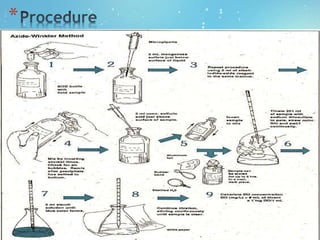
1. Remove the stopper and add 1 ml Manganous
sulfate.
2. Add 3 ml alkaline potassium iodide into the sample
and insert the stopper, and shake vigorously, holding
on to the top. If oxygen is present, a brownish-orange
precipitate will form.
3. Allow the sample to stand until the precipitate settles
halfway.
4) Remove the stopper and slowly add 2 ml sulfuric acid.
Insert the stopper and shake vigorously to dissolve the precipitate.
5) Shake and wait until all the precipitate is dissolved.
The yellow color is from iodine.
6) Take a suitable aliquot 200 ml in a flask and titrate with
Sodium thiosulfate solution till the colour changes to very light
yellow.
7) Add 3ml of starch solution.
The prepared sample will turn blue from the added starch
solution.
8) Continue adding drops and mixing until the prepared sample
turns from blue to colorless (the end point
*
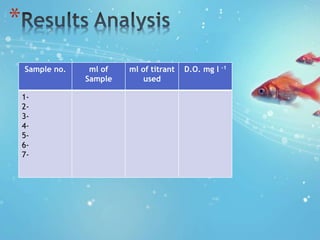
Sample no. ml of
Sample
ml of titrant
used
D.O. mg l -1
1-
2-
3-
4-
5-
6-
7-
*
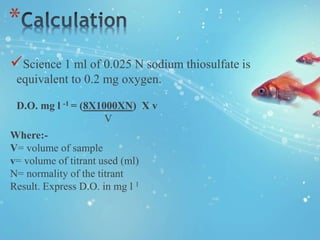
Science 1 ml of 0.025 N sodium thiosulfate is
equivalent to 0.2 mg oxygen.
D.O. mg l -1 = (8X1000XN) X v
V
Where:-
V= volume of sample
v= volume of titrant used (ml)
N= normality of the titrant
Result. Express D.O. in mg l 1
Methods and calculations for Dissolved Oxygen (DO) using Winkler's Method

Methods and calculations for Dissolved Oxygen (DO) using Winkler's Method

  • 2.
    * 1)Oxygen is removedfrom the water by chemical reactions, the decay process and respiration. 2)Water temperature and atmospheric pressure affect oxygen concentration in water. 3) Cold water at high atmospheric pressure holds more dissolved oxygen than warm water at low atmospheric pressure. 4) Degree of light penetration (turbidity, color and water depth) and the degree of water turbulence or wave action also affect oxygen concentrations.  Dissolved oxygen (D.O.) is reported as milligrams of oxygen per liter of water (mg/L) . Aquatic plants produce oxygen by photosynthesis during daylight hours but they also use oxygen for respiration.
  • 3.
    * *Both plants andanimals depend on dissolved oxygen for survival. *lack of oxygen can kill aquatic plants and animals. * Measuring dissolved oxygen is probably the most significant water quality test to determine the suitability of a stream for fish and many other aquatic organisms.
  • 4.
    *  Oxygen combineswith Mangnous hydroxide to form higher hydroxides, which on acidification liberate iodine equivalent to that of oxygen fixed.  This iodine is titrated by standard Sodium thiosulfate solution using starch as an indicator.
  • 5.
    * 1) Water Samples. 2)Sodium thiosulfate titrant (0.025). 3) Narrow mouth 250 ml BOD bottles. 4) Sulfuric acid (concentrated) 5) Starch indicator. 6) Manganous sulfate solution 7) Alkaline- potassium iodide 8) Pipettes, Flasks
  • 6.
  • 7.
    A.Collecting the Sample B.Testingfor Dissolved Oxygen 1. Remove the stopper and add 1 ml Manganous sulfate. 2. Add 3 ml alkaline potassium iodide into the sample and insert the stopper, and shake vigorously, holding on to the top. If oxygen is present, a brownish-orange precipitate will form. 3. Allow the sample to stand until the precipitate settles halfway.
  • 8.
    4) Remove thestopper and slowly add 2 ml sulfuric acid. Insert the stopper and shake vigorously to dissolve the precipitate. 5) Shake and wait until all the precipitate is dissolved. The yellow color is from iodine. 6) Take a suitable aliquot 200 ml in a flask and titrate with Sodium thiosulfate solution till the colour changes to very light yellow. 7) Add 3ml of starch solution. The prepared sample will turn blue from the added starch solution. 8) Continue adding drops and mixing until the prepared sample turns from blue to colorless (the end point
  • 9.
    * Sample no. mlof Sample ml of titrant used D.O. mg l -1 1- 2- 3- 4- 5- 6- 7-
  • 10.
    * Science 1 mlof 0.025 N sodium thiosulfate is equivalent to 0.2 mg oxygen. D.O. mg l -1 = (8X1000XN) X v V Where:- V= volume of sample v= volume of titrant used (ml) N= normality of the titrant Result. Express D.O. in mg l 1