Metamorphosis in
Insects
Kartik Mandal
MSc in Zoology
BHU, Dept of Zoology
Characteristics of Insects
Classification:
Phylum - Arthropoda
Subphylum - Hexapoda
Class - Insecta
Features: Body is divided into three regions - 1.
Head : bears a pair of antennae and a pair of
compound eyes.
2. Thorax : three pairs of jointed legs and two
pairs of wings.
3. Abdomen
The ecological success of insects:
Origin: insects came into existence 479 million yrs ago.
Factors contributing to success:
1. Hard, chitinous exoskeleton
2. Small size
3. Hexapod locomotion
4. Functional wings
5. Tracheal respiration
6. Developmental features
7. Chemical communication
8. Physiological adaptations
9. Fecundity
Types of Insects (accor. to developmental pattern)
There are three major patterns of insect development.
1. ametabolous: After a brief pronymph stage, the insect looks like a small adult, e.g; Springtail.
2. Hemimetabolus/ Incomplete metamorphosis :
Eggs → Pronymph → Nymph → Adult
e.g; Hemipter (bugs), Orthoptera (locusts, crickets), Dictyoptera (roaches, mantids).
3. Holometabolous/ complete metamorphosis :
Eggs → larva → pupa → adult
e.g; Diptera (flies), Lepidoptera (butterflies, moths), Coleoptera (beetles).
Note: Instar - The stages between moults is termed instar.
● The last larval instar moults to become a pupa. An outwardly dormant stage in which extensive internal
reorganisation takes place.
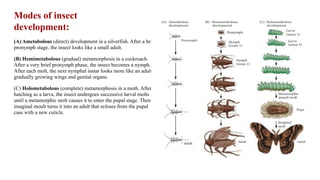
Modes of insect
development:
(A) Ametabolous (direct) development in a silverfish. After a brief
pronymph stage, the insect looks like a small adult.
(B) Hemimetabolous (gradual) metamorphosis in a cockroach.
After a very brief pronymph phase, the insect becomes a nymph.
After each molt, the next nymphal instar looks more like an adult,
gradually growing wings and genital organs.
(C) Holometabolous (complete) metamorphosis in a moth. After
hatching as a larva, the insect undergoes successive larval molts
until a metamorphic molt causes it to enter the pupal stage. Then an
imaginal moult turns it into an adult that ecloses from the pupal
case with a new cuticle.
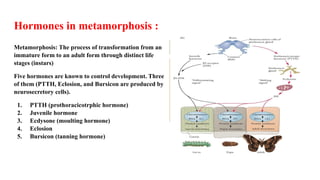
Hormones in metamorphosis :
Metamorphosis: The process of transformation from an
immature form to an adult form through distinct life
stages (instars)
Five hormones are known to control development. Three
of them (PTTH, Eclosion, and Bursicon are produced by
neurosecretory cells).
1. PTTH (prothoracicotrphic hormone)
2. Juvenile hormone
3. Ecdysone (moulting hormone)
4. Eclosion
5. Bursicon (tanning hormone)
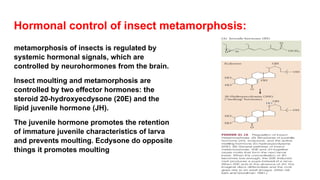
Hormonal control of insect metamorphosis:
metamorphosis of insects is regulated by
systemic hormonal signals, which are
controlled by neurohormones from the brain.
Insect moulting and metamorphosis are
controlled by two effector hormones: the
steroid 20-hydroxyecdysone (20E) and the
lipid juvenile hormone (JH).
The juvenile hormone promotes the retention
of immature juvenile characteristics of larva
and prevents moulting. Ecdysone do opposite
things it promotes moulting
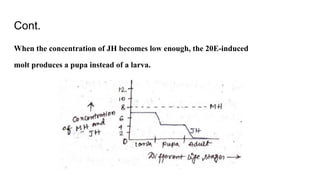
Cont.
When the concentration of JH becomes low enough, the 20E-induced
molt produces a pupa instead of a larva.

Metamorphosis in Insects .pdf

  • 1.
    Metamorphosis in Insects Kartik Mandal MScin Zoology BHU, Dept of Zoology
  • 2.
    Characteristics of Insects Classification: Phylum- Arthropoda Subphylum - Hexapoda Class - Insecta Features: Body is divided into three regions - 1. Head : bears a pair of antennae and a pair of compound eyes. 2. Thorax : three pairs of jointed legs and two pairs of wings. 3. Abdomen The ecological success of insects: Origin: insects came into existence 479 million yrs ago. Factors contributing to success: 1. Hard, chitinous exoskeleton 2. Small size 3. Hexapod locomotion 4. Functional wings 5. Tracheal respiration 6. Developmental features 7. Chemical communication 8. Physiological adaptations 9. Fecundity
  • 3.
    Types of Insects(accor. to developmental pattern) There are three major patterns of insect development. 1. ametabolous: After a brief pronymph stage, the insect looks like a small adult, e.g; Springtail. 2. Hemimetabolus/ Incomplete metamorphosis : Eggs → Pronymph → Nymph → Adult e.g; Hemipter (bugs), Orthoptera (locusts, crickets), Dictyoptera (roaches, mantids). 3. Holometabolous/ complete metamorphosis : Eggs → larva → pupa → adult e.g; Diptera (flies), Lepidoptera (butterflies, moths), Coleoptera (beetles). Note: Instar - The stages between moults is termed instar. ● The last larval instar moults to become a pupa. An outwardly dormant stage in which extensive internal reorganisation takes place.
  • 4.
    Modes of insect development: (A)Ametabolous (direct) development in a silverfish. After a brief pronymph stage, the insect looks like a small adult. (B) Hemimetabolous (gradual) metamorphosis in a cockroach. After a very brief pronymph phase, the insect becomes a nymph. After each molt, the next nymphal instar looks more like an adult, gradually growing wings and genital organs. (C) Holometabolous (complete) metamorphosis in a moth. After hatching as a larva, the insect undergoes successive larval molts until a metamorphic molt causes it to enter the pupal stage. Then an imaginal moult turns it into an adult that ecloses from the pupal case with a new cuticle.
  • 5.
    Hormones in metamorphosis: Metamorphosis: The process of transformation from an immature form to an adult form through distinct life stages (instars) Five hormones are known to control development. Three of them (PTTH, Eclosion, and Bursicon are produced by neurosecretory cells). 1. PTTH (prothoracicotrphic hormone) 2. Juvenile hormone 3. Ecdysone (moulting hormone) 4. Eclosion 5. Bursicon (tanning hormone)
  • 6.
    Hormonal control ofinsect metamorphosis: metamorphosis of insects is regulated by systemic hormonal signals, which are controlled by neurohormones from the brain. Insect moulting and metamorphosis are controlled by two effector hormones: the steroid 20-hydroxyecdysone (20E) and the lipid juvenile hormone (JH). The juvenile hormone promotes the retention of immature juvenile characteristics of larva and prevents moulting. Ecdysone do opposite things it promotes moulting
  • 7.
    Cont. When the concentrationof JH becomes low enough, the 20E-induced molt produces a pupa instead of a larva.