Going Beyond the Language……………..
© Copyrights reserved:
Dr.ShainiVarghese
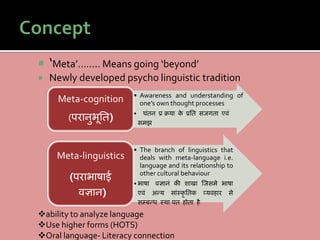
 ‘Meta’…….. Means going ‘beyond’
 Newly developed psycho linguistic tradition
• Awareness and understanding of
one’s own thought processes
• च िंतन प्रक्रिया के प्रतत सजगता एविं
समझ
Meta-cognition
(परानुभूतत)
• The branch of linguistics that
deals with meta-language i.e.
language and its relationship to
other cultural behaviour
• भाषा ववज्ञानिं की शाखा जजसमे भाषा
एविं अन्य सािंस्कृ ततक व्यवहार से
सम्बन्ध स्थावपत होता है
Meta-linguistics
(पराभाषाई
ववज्ञान)
ability to analyze language
Use higher forms (HOTS)
Oral language- Literacy connection
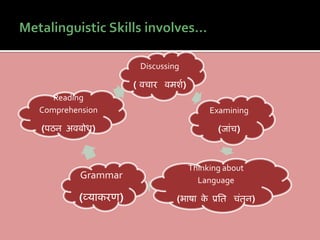
Discussing
(वव ार ववमशश)
Examining
(जािं )
Thinking about
Language
(भाषा के प्रतत च िंतन)
Grammar
(व्याकरण)
Reading
Comprehension
(पठन अवबोध)
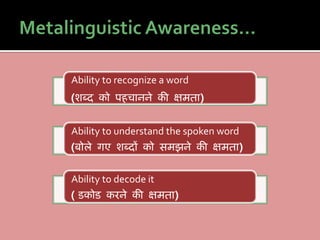
Ability to recognize a word
(शब्द को पह ानने की क्षमता)
Ability to understand the spoken word
(बोले गए शब्दों को समझने की क्षमता)
Ability to decode it
(डिकोि करने की क्षमता)
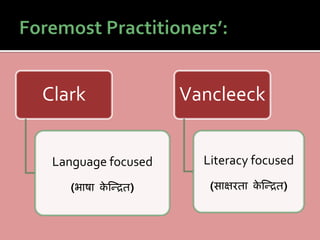
Clark
Language focused
(भाषा के जन्ित)
Vancleeck
Literacy focused
(साक्षरता के जन्ित)
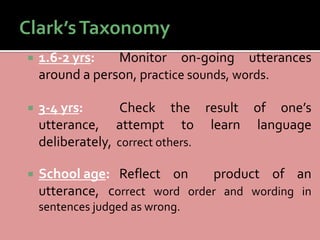
 1.6-2 yrs: Monitor on-going utterances
around a person, practice sounds, words.
 3-4 yrs: Check the result of one’s
utterance, attempt to learn language
deliberately, correct others.
 School age: Reflect on product of an
utterance, correct word order and wording in
sentences judged as wrong.
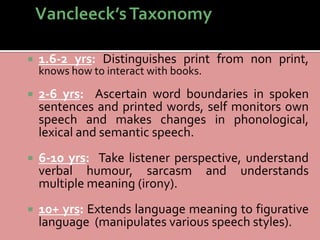
 1.6-2 yrs: Distinguishes print from non print,
knows how to interact with books.
 2-6 yrs: Ascertain word boundaries in spoken
sentences and printed words, self monitors own
speech and makes changes in phonological,
lexical and semantic speech.
 6-10 yrs: Take listener perspective, understand
verbal humour, sarcasm and understands
multiple meaning (irony).
 10+ yrs: Extends language meaning to figurative
language (manipulates various speech styles).
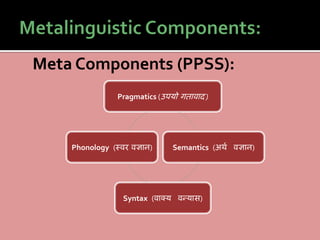
Meta Components (PPSS):
Pragmatics (उपयोचगतावाद )
Semantics (अथश ववज्ञान)
Syntax (वाक्य ववन्यास)
Phonology (स्वरववज्ञान)
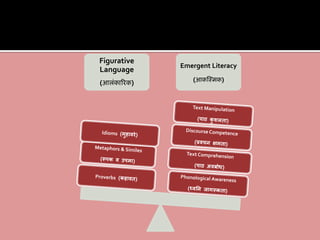
Figurative
Language
(आलिंकाररक)
Emergent Literacy
(आकस्मिक)
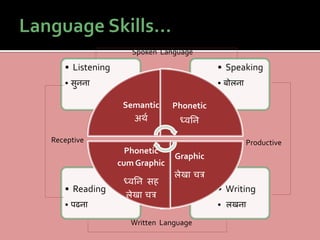
• Writing
• ललखना
• Reading
• पढना
• Speaking
• बोलना
• Listening
• सुनना
Semantic
अर्थ
Phonetic
ध्वनि
Graphic
लेखाचित्र
Phonetic
cum Graphic
ध्वनि सह
लेखाचित्र
Receptive Productive
Spoken Language
Written Language
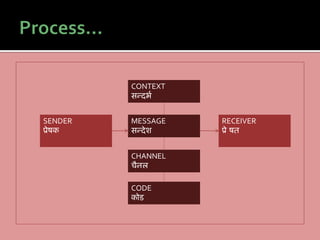
SENDER
प्रेषक
RECEIVER
प्रेवषत
MESSAGE
सन्देश
CODE
कोि
CONTEXT
सन्दभश
CHANNEL
ैनल
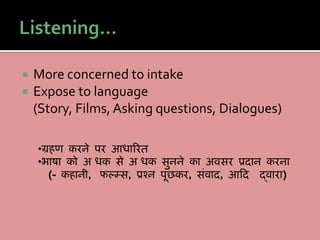
 More concerned to intake
 Expose to language
(Story, Films, Asking questions, Dialogues)
•ग्रहण करने पर आधाररत
•भाषा को अचधक से अचधक सुनने का अवसर प्रदान करना
(- कहानी, क्रिल्मम्स, प्रश्न पूछकर, सिंवाद, आदद द्वारा)
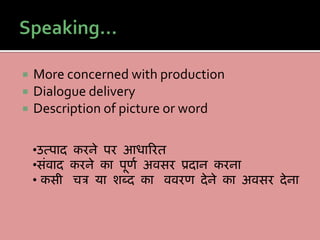
 More concerned with production
 Dialogue delivery
 Description of picture or word
•उत्पाद करने पर आधाररत
•सिंवाद करने का पूणश अवसर प्रदान करना
•क्रकसी च त्र या शब्द का वववरण देने का अवसर देना
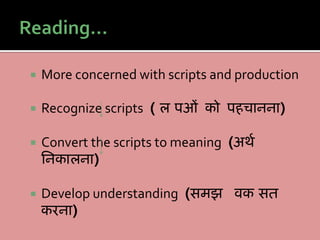
 More concerned with scripts and production
 Recognize scripts (ललवपओिं को पह ानना)
 Convert the scripts to meaning (अथश
तनकालना)
 Develop understanding (समझ ववकलसत
करना)
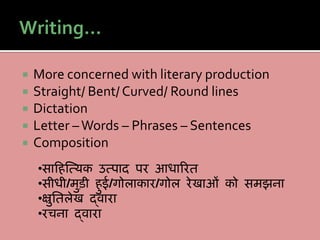
 More concerned with literary production
 Straight/ Bent/ Curved/ Round lines
 Dictation
 Letter –Words – Phrases – Sentences
 Composition
•सादहजत्यक उत्पाद पर आधाररत
•सीधी/मुड़ी हुई/गोलाकार/गोल रेखाओिं को समझना
•क्ष्रुततलेख द्वारा
•र ना द्वारा
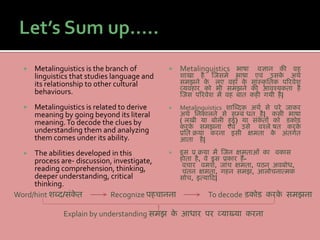
 Metalinguistics is the branch of
linguistics that studies language and
its relationship to other cultural
behaviours.
 Metalinguistics is related to derive
meaning by going beyond its literal
meaning.To decode the clues by
understanding them and analyzing
them comes under its ability.
 The abilities developed in this
process are- discussion, investigate,
reading comprehension, thinking,
deeper understanding, critical
thinking.
 Metalinguistics भाषा ववज्ञान की वह
शाखा है जजसमे भाषा एविं उसके अथश
समझने के ललए वहााँ के सािंस्कृ ततक पररवेश
व्यवहार को भी समझने की आवश्यकता है
जजस पररवेश में वह बात कही गयी है|
 Metalinguistics शाजब्दक अथश से परे जाकर
अथश तनकालने से सम्बिंचधत है| क्रकसी भाषा
(ललखी या बोली हुई) या सिंके तों को डिकोि
करके समझना एविं उसे ववश्लेवषत करके
प्रततक्रिया करना इसी क्षमता के अिंतगशत
आता है|
 इस प्रक्रिया में जजन क्षमताओिं का ववकास
होता है, वे इस प्रकार हैं-
वव ार ववमशश, जािं क्षमता, पठन अवबोध,
च िंतन क्षमता, गहन समझ, आलो नात्मक
सो , इत्यादद|
Word/hint शब्द/सिंके त Recognize पह ानना To decodeडिकोि करके समझना
Explain by understanding समझ के आधार पर व्याख्या करना
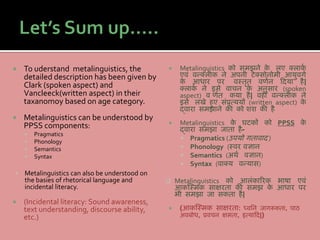
 To uderstand metalinguistics, the
detailed description has been given by
Clark (spoken aspect) and
Vancleeck(written aspect) in their
taxanomoy based on age category.
 Metalinguistics can be understood by
PPSS components:
 Pragmatics
 Phonology
 Semantics
 Syntax
 Metalinguistics can also be understood on
the basies of rhetorical language and
incidental literacy.
 (Incidental literacy: Sound awareness,
text understanding, discourse ability,
etc.)
 Metalinguistics को समझने के ललए क्लाकश
एविं वन्क्लीक ने अपनी टेक्सोनोमी आयुवगश
के आधार पर ववस्तृत वणशन ददया है|
क्लाकश ने इसे वा न के अनुसार (spoken
aspect) वर्णशत क्रकया है| वहीीँ वन्क्लीक ने
इसे ललखे हुए सिंप्रत्ययों (written aspect) के
द्वारा समझाने की कोलशश की है
 Metalinguistics के घटकों को PPSS के
द्वारा समझा जाता है-
 Pragmatics (उपयोचगतावाद )
 Phonology (स्वरववज्ञान
 Semantics (अथश ववज्ञान)
 Syntax (वाक्य ववन्यास)
 Metalinguistics को आलिंकाररक भाषा एविं
आकजस्मक साक्षरता की समझ के आधार पर
भी समझा जा सकता है|
 (आकजस्मक साक्षरता: ध्वनि जागरूकता, पाठ
अवबोध, प्रविि क्षिता, इत्यादि|)
Hope you had a better understanding…!!!

Metalinguistics

  • 1.
    Going Beyond theLanguage…………….. © Copyrights reserved: Dr.ShainiVarghese
  • 2.
     ‘Meta’…….. Meansgoing ‘beyond’  Newly developed psycho linguistic tradition • Awareness and understanding of one’s own thought processes • च िंतन प्रक्रिया के प्रतत सजगता एविं समझ Meta-cognition (परानुभूतत) • The branch of linguistics that deals with meta-language i.e. language and its relationship to other cultural behaviour • भाषा ववज्ञानिं की शाखा जजसमे भाषा एविं अन्य सािंस्कृ ततक व्यवहार से सम्बन्ध स्थावपत होता है Meta-linguistics (पराभाषाई ववज्ञान) ability to analyze language Use higher forms (HOTS) Oral language- Literacy connection
  • 3.
    Discussing (वव ार ववमशश) Examining (जािं) Thinking about Language (भाषा के प्रतत च िंतन) Grammar (व्याकरण) Reading Comprehension (पठन अवबोध)
  • 4.
    Ability to recognizea word (शब्द को पह ानने की क्षमता) Ability to understand the spoken word (बोले गए शब्दों को समझने की क्षमता) Ability to decode it (डिकोि करने की क्षमता)
  • 5.
    Clark Language focused (भाषा केजन्ित) Vancleeck Literacy focused (साक्षरता के जन्ित)
  • 6.
     1.6-2 yrs:Monitor on-going utterances around a person, practice sounds, words.  3-4 yrs: Check the result of one’s utterance, attempt to learn language deliberately, correct others.  School age: Reflect on product of an utterance, correct word order and wording in sentences judged as wrong.
  • 7.
     1.6-2 yrs:Distinguishes print from non print, knows how to interact with books.  2-6 yrs: Ascertain word boundaries in spoken sentences and printed words, self monitors own speech and makes changes in phonological, lexical and semantic speech.  6-10 yrs: Take listener perspective, understand verbal humour, sarcasm and understands multiple meaning (irony).  10+ yrs: Extends language meaning to figurative language (manipulates various speech styles).
  • 8.
    Meta Components (PPSS): Pragmatics(उपयोचगतावाद ) Semantics (अथश ववज्ञान) Syntax (वाक्य ववन्यास) Phonology (स्वरववज्ञान)
  • 9.
  • 10.
    • Writing • ललखना •Reading • पढना • Speaking • बोलना • Listening • सुनना Semantic अर्थ Phonetic ध्वनि Graphic लेखाचित्र Phonetic cum Graphic ध्वनि सह लेखाचित्र Receptive Productive Spoken Language Written Language
  • 11.
  • 12.
     More concernedto intake  Expose to language (Story, Films, Asking questions, Dialogues) •ग्रहण करने पर आधाररत •भाषा को अचधक से अचधक सुनने का अवसर प्रदान करना (- कहानी, क्रिल्मम्स, प्रश्न पूछकर, सिंवाद, आदद द्वारा)
  • 13.
     More concernedwith production  Dialogue delivery  Description of picture or word •उत्पाद करने पर आधाररत •सिंवाद करने का पूणश अवसर प्रदान करना •क्रकसी च त्र या शब्द का वववरण देने का अवसर देना
  • 14.
     More concernedwith scripts and production  Recognize scripts (ललवपओिं को पह ानना)  Convert the scripts to meaning (अथश तनकालना)  Develop understanding (समझ ववकलसत करना)
  • 15.
     More concernedwith literary production  Straight/ Bent/ Curved/ Round lines  Dictation  Letter –Words – Phrases – Sentences  Composition •सादहजत्यक उत्पाद पर आधाररत •सीधी/मुड़ी हुई/गोलाकार/गोल रेखाओिं को समझना •क्ष्रुततलेख द्वारा •र ना द्वारा
  • 16.
     Metalinguistics isthe branch of linguistics that studies language and its relationship to other cultural behaviours.  Metalinguistics is related to derive meaning by going beyond its literal meaning.To decode the clues by understanding them and analyzing them comes under its ability.  The abilities developed in this process are- discussion, investigate, reading comprehension, thinking, deeper understanding, critical thinking.  Metalinguistics भाषा ववज्ञान की वह शाखा है जजसमे भाषा एविं उसके अथश समझने के ललए वहााँ के सािंस्कृ ततक पररवेश व्यवहार को भी समझने की आवश्यकता है जजस पररवेश में वह बात कही गयी है|  Metalinguistics शाजब्दक अथश से परे जाकर अथश तनकालने से सम्बिंचधत है| क्रकसी भाषा (ललखी या बोली हुई) या सिंके तों को डिकोि करके समझना एविं उसे ववश्लेवषत करके प्रततक्रिया करना इसी क्षमता के अिंतगशत आता है|  इस प्रक्रिया में जजन क्षमताओिं का ववकास होता है, वे इस प्रकार हैं- वव ार ववमशश, जािं क्षमता, पठन अवबोध, च िंतन क्षमता, गहन समझ, आलो नात्मक सो , इत्यादद| Word/hint शब्द/सिंके त Recognize पह ानना To decodeडिकोि करके समझना Explain by understanding समझ के आधार पर व्याख्या करना
  • 17.
     To uderstandmetalinguistics, the detailed description has been given by Clark (spoken aspect) and Vancleeck(written aspect) in their taxanomoy based on age category.  Metalinguistics can be understood by PPSS components:  Pragmatics  Phonology  Semantics  Syntax  Metalinguistics can also be understood on the basies of rhetorical language and incidental literacy.  (Incidental literacy: Sound awareness, text understanding, discourse ability, etc.)  Metalinguistics को समझने के ललए क्लाकश एविं वन्क्लीक ने अपनी टेक्सोनोमी आयुवगश के आधार पर ववस्तृत वणशन ददया है| क्लाकश ने इसे वा न के अनुसार (spoken aspect) वर्णशत क्रकया है| वहीीँ वन्क्लीक ने इसे ललखे हुए सिंप्रत्ययों (written aspect) के द्वारा समझाने की कोलशश की है  Metalinguistics के घटकों को PPSS के द्वारा समझा जाता है-  Pragmatics (उपयोचगतावाद )  Phonology (स्वरववज्ञान  Semantics (अथश ववज्ञान)  Syntax (वाक्य ववन्यास)  Metalinguistics को आलिंकाररक भाषा एविं आकजस्मक साक्षरता की समझ के आधार पर भी समझा जा सकता है|  (आकजस्मक साक्षरता: ध्वनि जागरूकता, पाठ अवबोध, प्रविि क्षिता, इत्यादि|)
  • 18.
    Hope you hada better understanding…!!!