Second Floor
e-Learning Technologies
& Standards
The “e-” side of learning
2
ICT in Education (1995)
• A perceived lack of interest in mainstream
teaching in the use of ICT as a an instructional
support;
• Limited teacher skills and expertise in the use of
ICT;
• Limited access to computers in classrooms;
• Unsustainable approaches to ICT applications in
classrooms;
• Technology leading the educational debate from
an institutional and organizational viewpoint
ICT in Education (2005)
• A large number of teachers now use laptops and
computers as personal tools;
• Teachers’ and students’ levels of ICT expertise is
has developed significantly;
• There is considerable institutional and
organizational expectation that teachers will use
computers in their teaching;
• A large number of students use ICT in many ways
at home and for personal use;
• The ratio of computers to students has continued
to rise
ICT in Education (2011)
• Marginal impact of ICT on student learning
• In the business sector, ICT did not have an impact
until it was accompanied by a cluster of other
changes that transformed the economy led by
new technologies
• This shift has yet to happen in schools. The vast
majority of educational systems, schools and
classrooms around the world still participate in
the mass production paradigm
– Technology is rarely used, even when it is readily
available
Learning Content Management
Systems
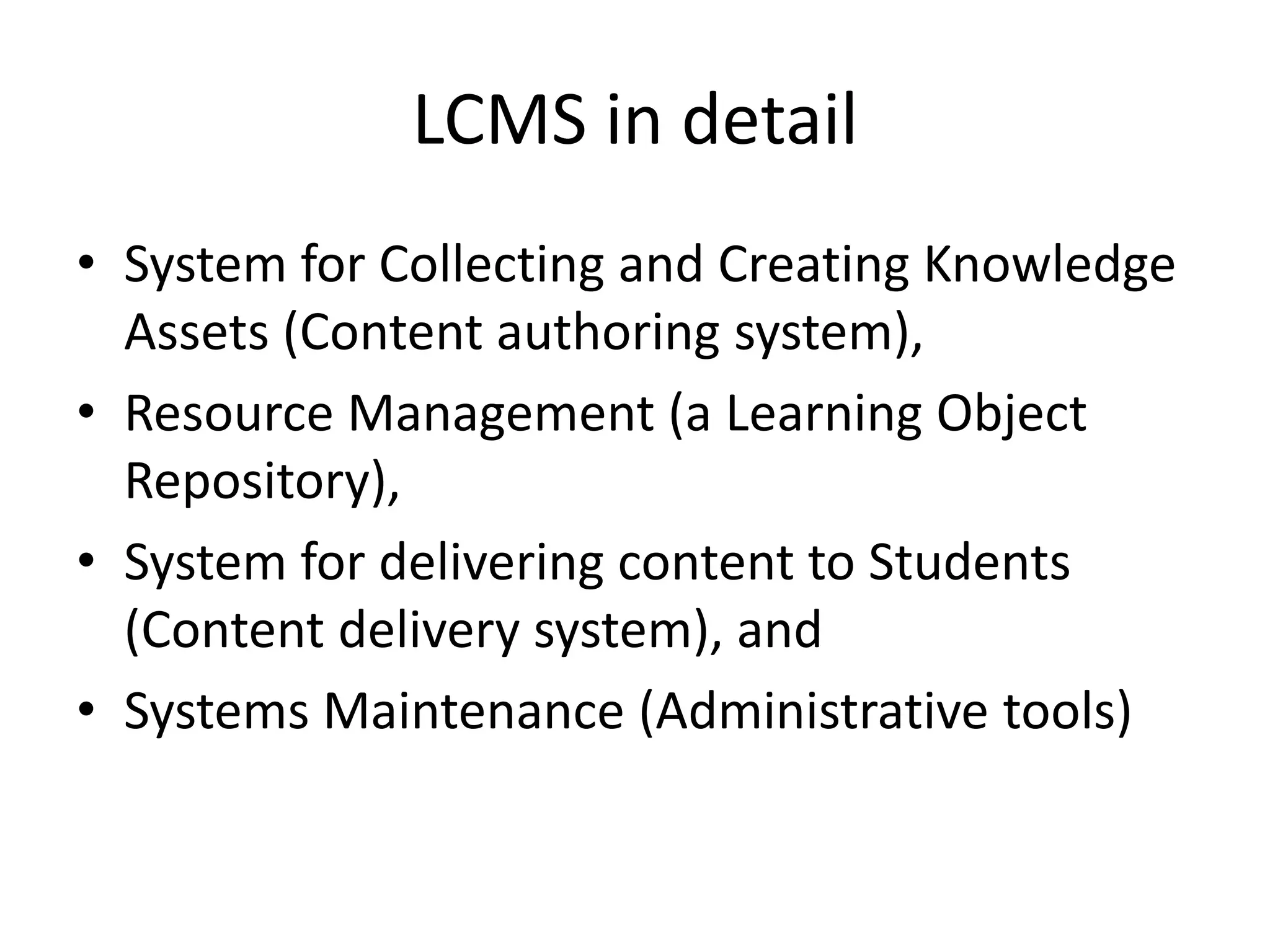
LCMS
• The term LCMS is used for systems that
contain components that support authoring,
combined with a learning object repository
and tools for delivering the objects to
students, as well as administrative tools
LCMS in detail
• System for Collecting and Creating Knowledge
Assets (Content authoring system),
• Resource Management (a Learning Object
Repository),
• System for delivering content to Students
(Content delivery system), and
• Systems Maintenance (Administrative tools)
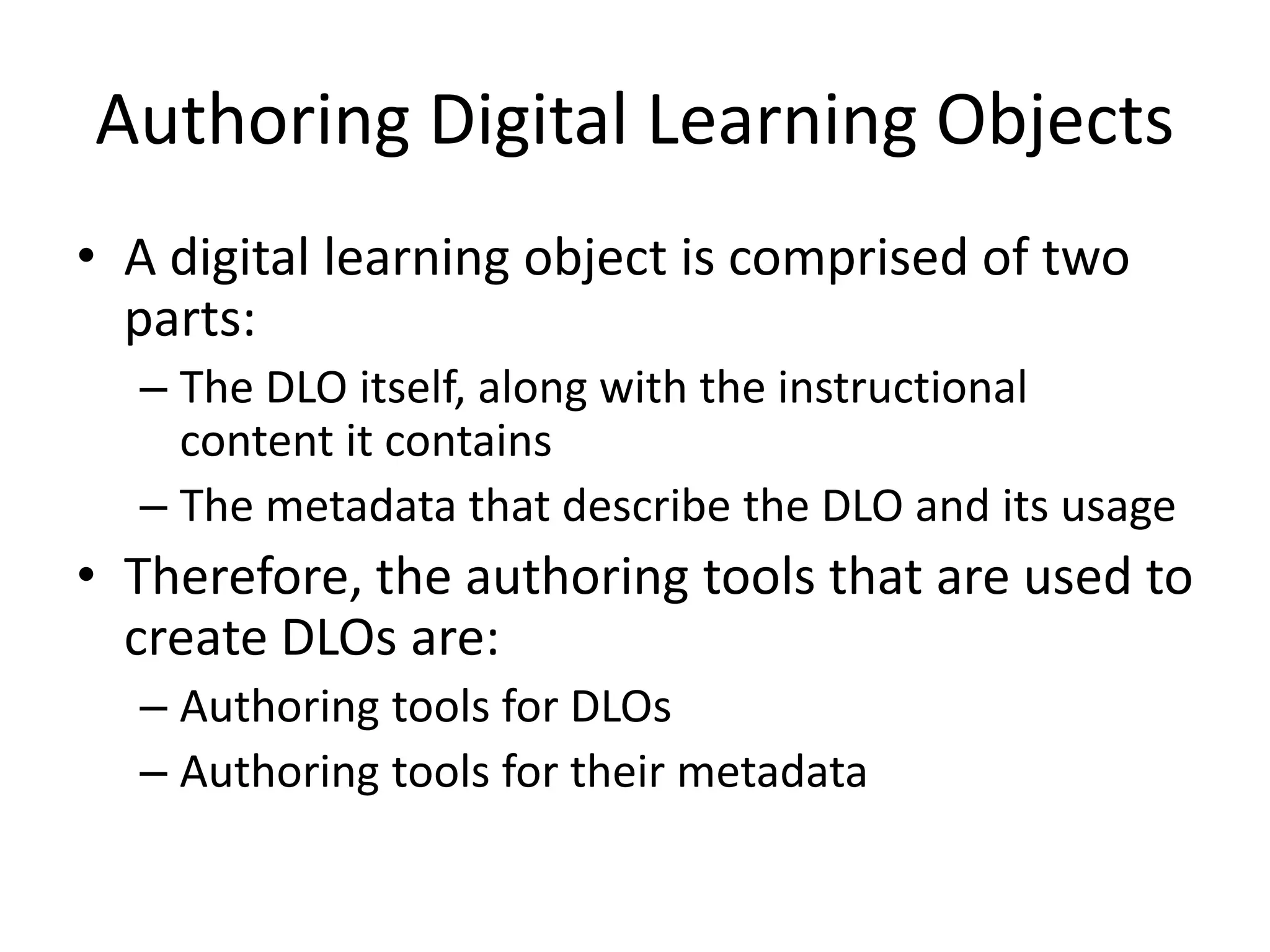
Authoring Digital Learning Objects
• A digital learning object is comprised of two
parts:
– The DLO itself, along with the instructional
content it contains
– The metadata that describe the DLO and its usage
• Therefore, the authoring tools that are used to
create DLOs are:
– Authoring tools for DLOs
– Authoring tools for their metadata
Authoring DLOs
• Hypertext Markup Language (HTML)
• Extensible Markup Language (XML)
• SGML
• Math Mark-Up Language (MML)
• Synchronized Multimedia Integration
Language (SMIL)
• Tutorial Markup Language (TML)
Authoring DLOs
• Java
• Flash
Definition
• Standards can be defined as "documented
agreements containing technical specifications
or other precise criteria to be used
consistently as rules, guidelines, or definitions
of characteristics, to ensure that materials,
products, processes and services are fit for
their purpose"
Standards in e-Learning
• In the context of e-learning technology,
standards are generally developed to be used
in systems design and implementation for the
purposes of ensuring interoperability,
portability and reusability. These attributes
should apply to both the systems themselves
and of the content and metadata they
manage.
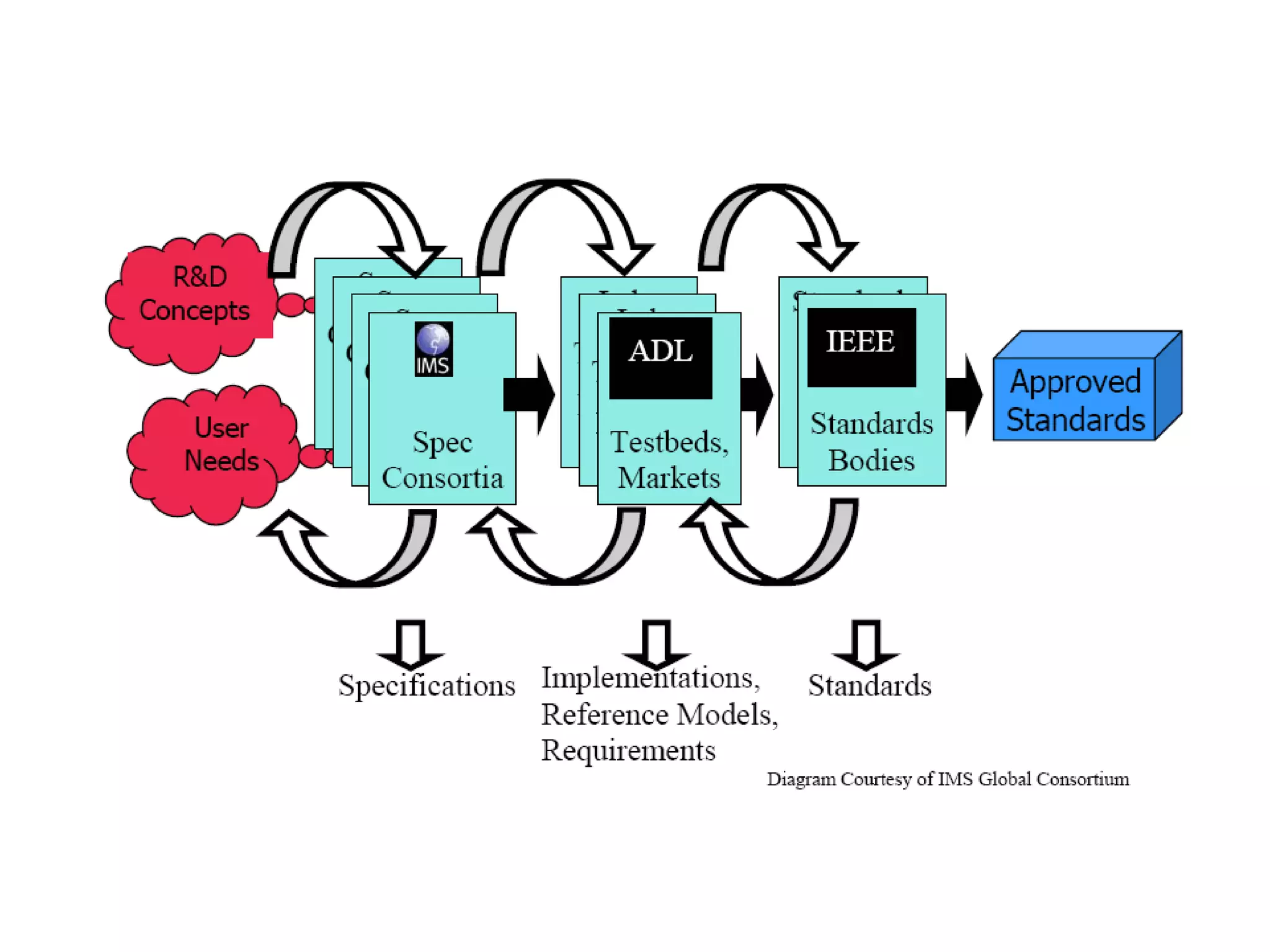
Starting from Specifications
• Specifications can be said to represent
standards early in their development, prior to
receiving approval from standards bodies, and
they tend to be experimental, incomplete and
more rapidly evolving. They capture a rough
consensus, and are meant to enable
technology development and the
management of short-term risk.
• Standards, on the other hand, are much more
conclusive, complete, and evolve much more
slowly. They should capture general
acceptance, can serve regulatory purposes,
and be used to manage long-term risk
Specifications VS Standards
Standards
• Common standards for metadata, learning
objects, and learning architecture are mandatory
for the similar success of the knowledge economy
and future. Fortunately, the work to create such
standards for learning objects and related
domains has been going on around the world for
the past few years. This includes the creation of
accredited standards from the IEEE Learning
Technology Standards Committee (LTSC) for such
areas as Learning Object Metadata, Computer
Managed Instruction, Course Sequencing,
Learner Profiles, and many more
Anatomy of Standards & Specs
• a "data model" which specifies the standard's
"normative" content in abstraction,
• 2) one or more "bindings," which specify how the
data model is expressed in a formal idiom,
• which is most often XML, and
• 3) an "API" (Application Programming Interface)
or "service definition" that is somewhat
• less often provided to define points of contact
between cooperating systems (see, for example:
• IEEE, 2004).
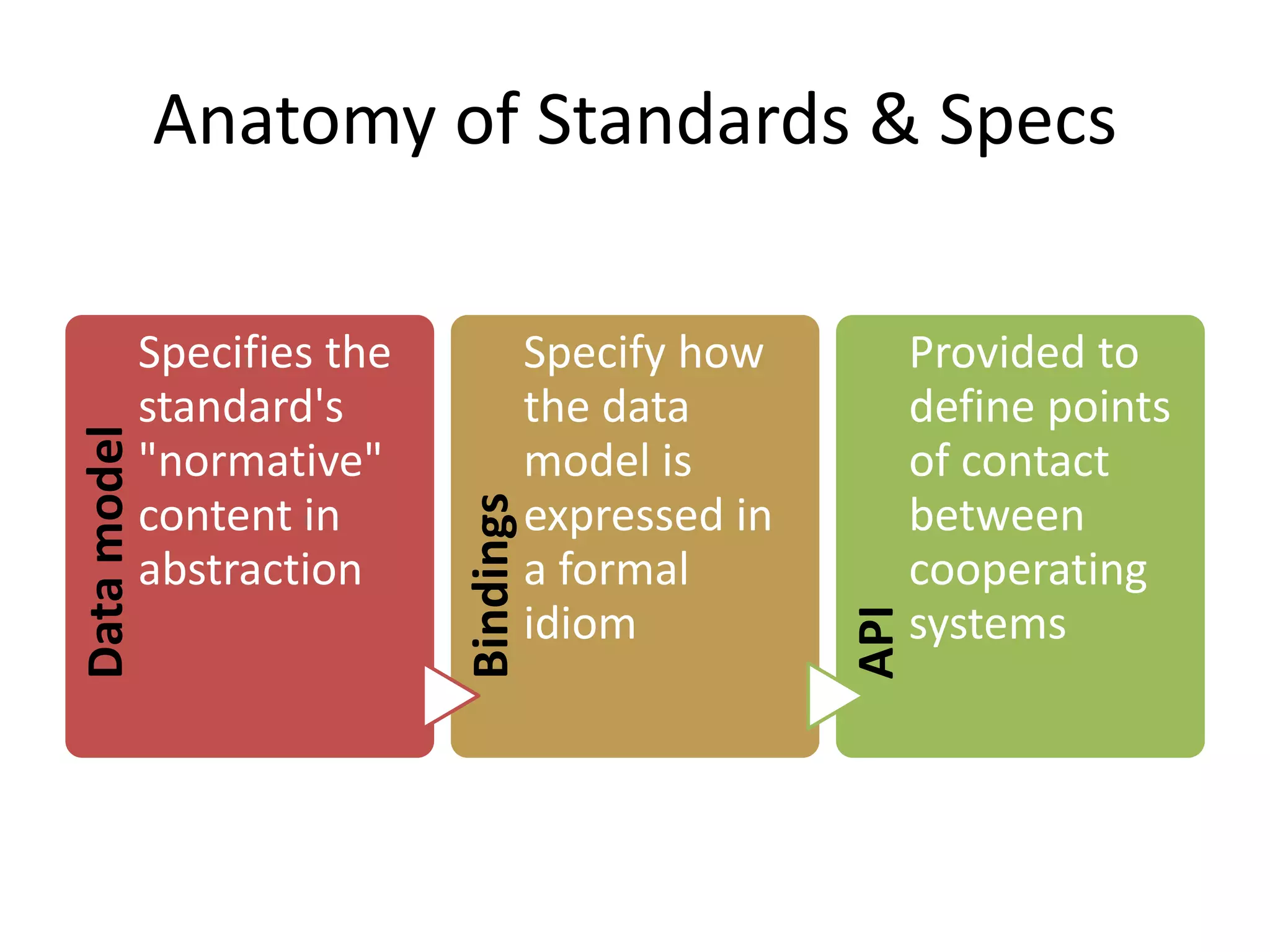
Anatomy of Standards & SpecsDatamodel
Specifies the
standard's
"normative"
content in
abstraction
Bindings
Specify how
the data
model is
expressed in
a formal
idiom
API
Provided to
define points
of contact
between
cooperating
systems
“Drivers” of Standards
• IMS Global Learning Consortium, Inc. (IMS)
• IEEE LTSC
• ISO/IEC
IMS
• Develops and promotes open specifications
for facilitating online distributed learning
activities
• Significant representation of Educational
stakeholders (ministries, etc)
IEEE LTSC
• The Learning Technology Standards Committee
within IEEE focuses on standards development
specifically in the area of
e-learning technologies
– producing “accredited technical standards,
recommended practices and guides”
• Individuals from small and large private sector
organizations, the US military, governmental
organizations and universities of various
nationalities are among its members
ISO/IEC
• Internationally and UN-recognized body for
standardization founded in 1946
• Prepares and publishes international standards
for all electrical, electronic and related
technologies
• Joint Technical Committee (JTC1)
– "develop, maintain, promote and facilitate IT
standards" in a number of areas of common interest
– SC36, was formed in 2000 with the task of developing
standards specifically for e-learning
Important National Agencies
• ANSI (American National Standards Institute),
• NISO (National Information Standards
Organisation),
• DIN (Deutsches Institut für Normung),
• BSI (British Standards Institute),
• CSA (Canadian Standards Association)
Schools Interoperability Framework
• Data sharing open specification for academic
institutions from kindergarten through twelfth
grade (K-12)
• The specification is composed of two parts:
– an XML specification for modeling educational
data,
– a Service-Oriented Architecture (SOA)
specification for sharing that data between
institutions
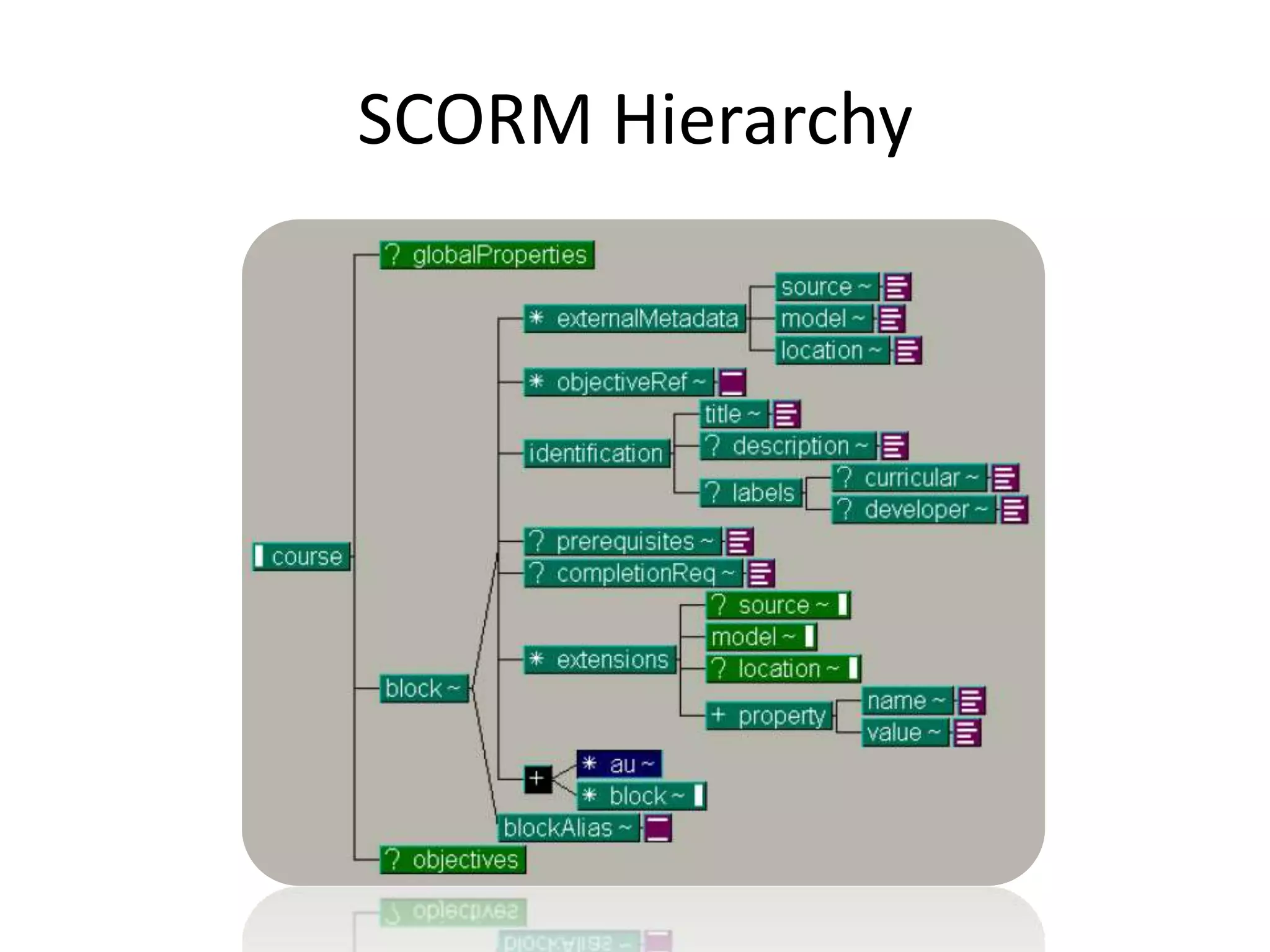
SCORM Hierarchy
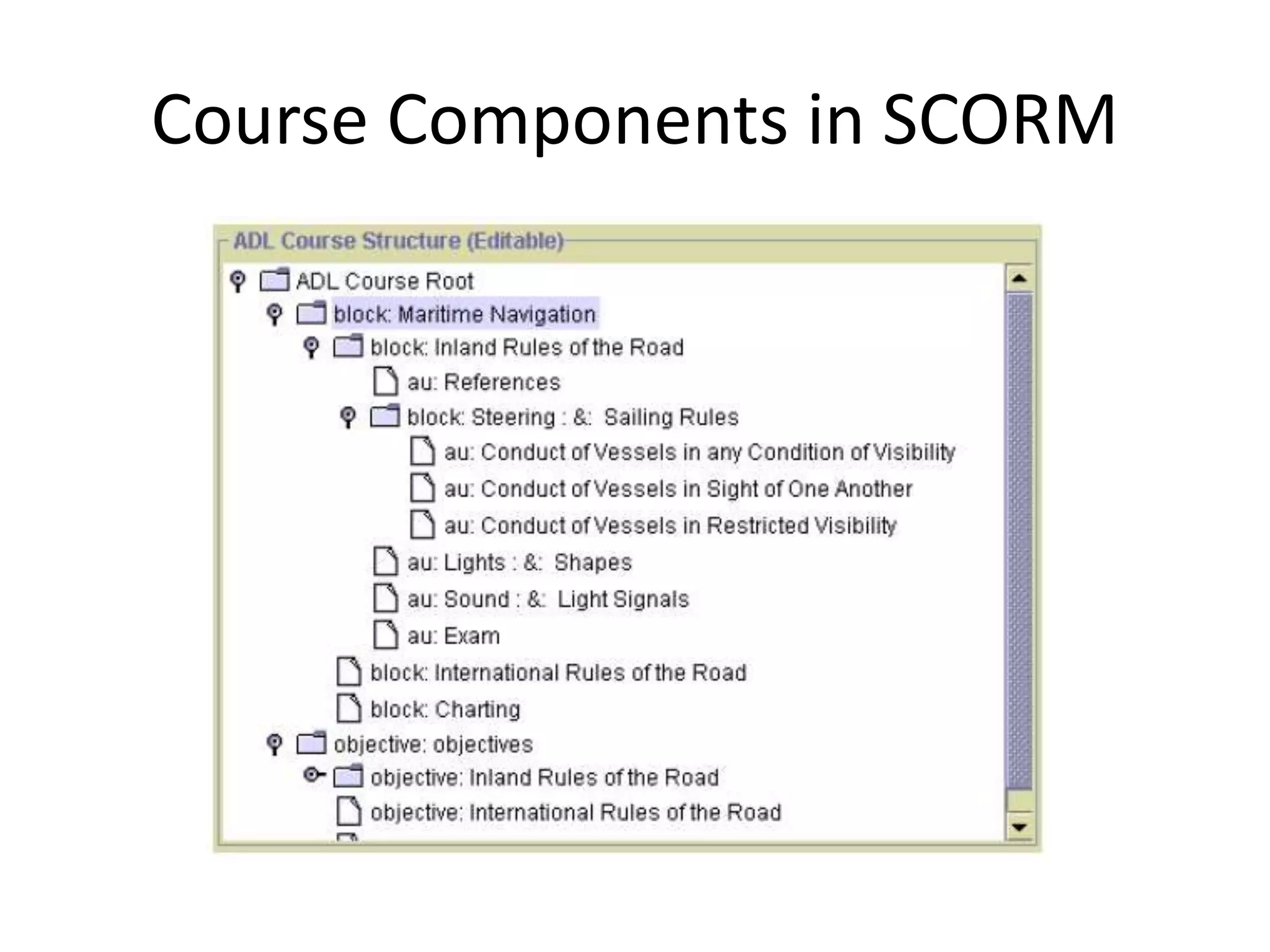
Course Components in SCORM
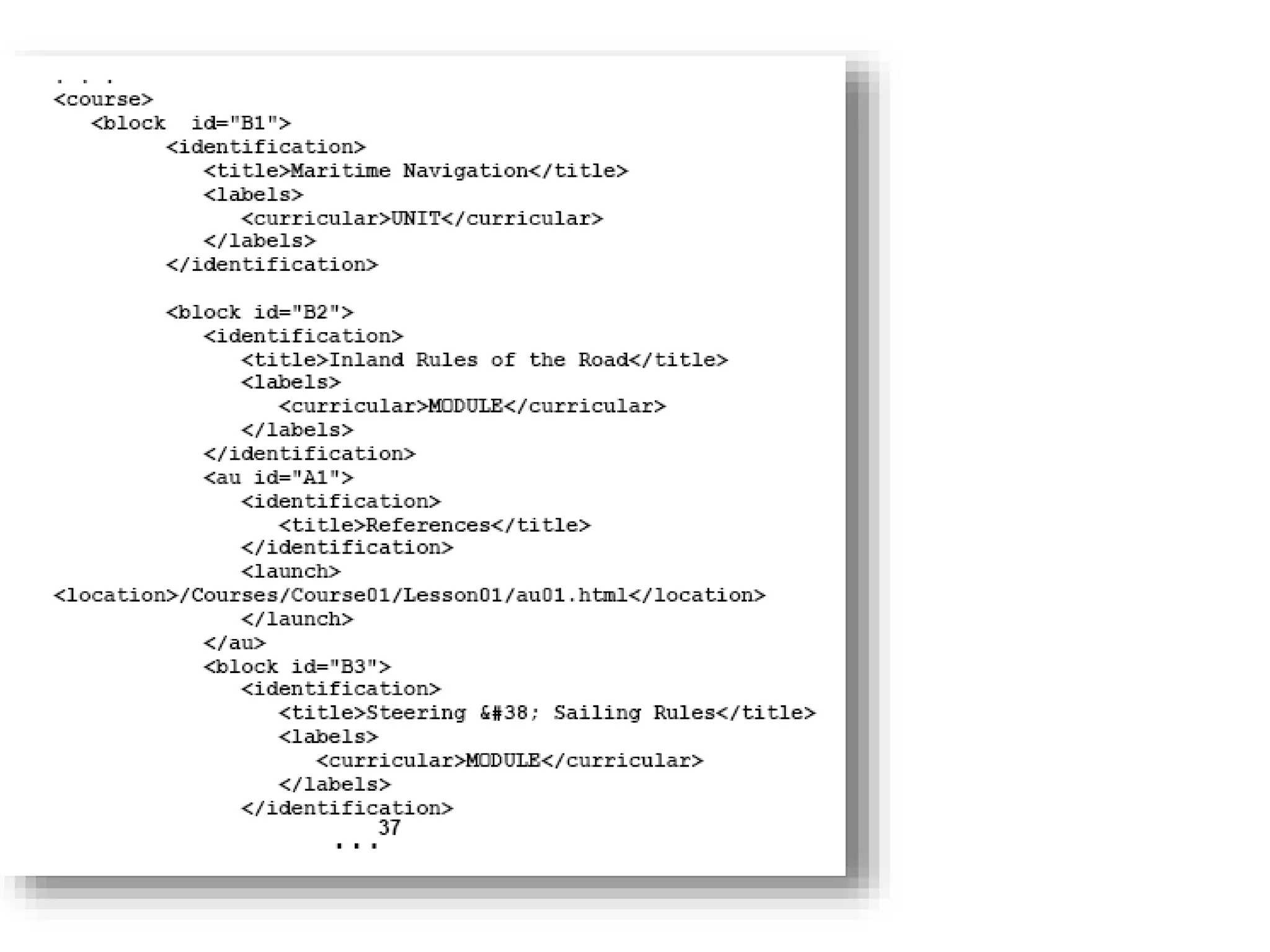
XML
• The common language adopted by IMS and
SCORM – and being adopted by database
programmers, librarians and designers around
the world – is the eXtensibe Markup
Language, or XML, developed by the World
Wide Web Consortium
• XML is a means of representing documents
according to their internal structure
Second Floor
e-Learning Technologies
& Standards
Next stop:
3rd Floor – e-Learning Standards
2

MetadataTheory: Learning Technologies (3rd of 10)

  • 1.
    Second Floor e-Learning Technologies &Standards The “e-” side of learning 2
  • 2.
    ICT in Education(1995) • A perceived lack of interest in mainstream teaching in the use of ICT as a an instructional support; • Limited teacher skills and expertise in the use of ICT; • Limited access to computers in classrooms; • Unsustainable approaches to ICT applications in classrooms; • Technology leading the educational debate from an institutional and organizational viewpoint
  • 3.
    ICT in Education(2005) • A large number of teachers now use laptops and computers as personal tools; • Teachers’ and students’ levels of ICT expertise is has developed significantly; • There is considerable institutional and organizational expectation that teachers will use computers in their teaching; • A large number of students use ICT in many ways at home and for personal use; • The ratio of computers to students has continued to rise
  • 4.
    ICT in Education(2011) • Marginal impact of ICT on student learning • In the business sector, ICT did not have an impact until it was accompanied by a cluster of other changes that transformed the economy led by new technologies • This shift has yet to happen in schools. The vast majority of educational systems, schools and classrooms around the world still participate in the mass production paradigm – Technology is rarely used, even when it is readily available
  • 5.
  • 6.
    LCMS • The termLCMS is used for systems that contain components that support authoring, combined with a learning object repository and tools for delivering the objects to students, as well as administrative tools
  • 7.
    LCMS in detail •System for Collecting and Creating Knowledge Assets (Content authoring system), • Resource Management (a Learning Object Repository), • System for delivering content to Students (Content delivery system), and • Systems Maintenance (Administrative tools)
  • 8.
    Authoring Digital LearningObjects • A digital learning object is comprised of two parts: – The DLO itself, along with the instructional content it contains – The metadata that describe the DLO and its usage • Therefore, the authoring tools that are used to create DLOs are: – Authoring tools for DLOs – Authoring tools for their metadata
  • 9.
    Authoring DLOs • HypertextMarkup Language (HTML) • Extensible Markup Language (XML) • SGML • Math Mark-Up Language (MML) • Synchronized Multimedia Integration Language (SMIL) • Tutorial Markup Language (TML)
  • 10.
  • 11.
    Definition • Standards canbe defined as "documented agreements containing technical specifications or other precise criteria to be used consistently as rules, guidelines, or definitions of characteristics, to ensure that materials, products, processes and services are fit for their purpose"
  • 12.
    Standards in e-Learning •In the context of e-learning technology, standards are generally developed to be used in systems design and implementation for the purposes of ensuring interoperability, portability and reusability. These attributes should apply to both the systems themselves and of the content and metadata they manage.
  • 13.
    Starting from Specifications •Specifications can be said to represent standards early in their development, prior to receiving approval from standards bodies, and they tend to be experimental, incomplete and more rapidly evolving. They capture a rough consensus, and are meant to enable technology development and the management of short-term risk.
  • 14.
    • Standards, onthe other hand, are much more conclusive, complete, and evolve much more slowly. They should capture general acceptance, can serve regulatory purposes, and be used to manage long-term risk
  • 15.
  • 16.
    Standards • Common standardsfor metadata, learning objects, and learning architecture are mandatory for the similar success of the knowledge economy and future. Fortunately, the work to create such standards for learning objects and related domains has been going on around the world for the past few years. This includes the creation of accredited standards from the IEEE Learning Technology Standards Committee (LTSC) for such areas as Learning Object Metadata, Computer Managed Instruction, Course Sequencing, Learner Profiles, and many more
  • 17.
    Anatomy of Standards& Specs • a "data model" which specifies the standard's "normative" content in abstraction, • 2) one or more "bindings," which specify how the data model is expressed in a formal idiom, • which is most often XML, and • 3) an "API" (Application Programming Interface) or "service definition" that is somewhat • less often provided to define points of contact between cooperating systems (see, for example: • IEEE, 2004).
  • 18.
    Anatomy of Standards& SpecsDatamodel Specifies the standard's "normative" content in abstraction Bindings Specify how the data model is expressed in a formal idiom API Provided to define points of contact between cooperating systems
  • 19.
    “Drivers” of Standards •IMS Global Learning Consortium, Inc. (IMS) • IEEE LTSC • ISO/IEC
  • 20.
    IMS • Develops andpromotes open specifications for facilitating online distributed learning activities • Significant representation of Educational stakeholders (ministries, etc)
  • 21.
    IEEE LTSC • TheLearning Technology Standards Committee within IEEE focuses on standards development specifically in the area of e-learning technologies – producing “accredited technical standards, recommended practices and guides” • Individuals from small and large private sector organizations, the US military, governmental organizations and universities of various nationalities are among its members
  • 22.
    ISO/IEC • Internationally andUN-recognized body for standardization founded in 1946 • Prepares and publishes international standards for all electrical, electronic and related technologies • Joint Technical Committee (JTC1) – "develop, maintain, promote and facilitate IT standards" in a number of areas of common interest – SC36, was formed in 2000 with the task of developing standards specifically for e-learning
  • 24.
    Important National Agencies •ANSI (American National Standards Institute), • NISO (National Information Standards Organisation), • DIN (Deutsches Institut für Normung), • BSI (British Standards Institute), • CSA (Canadian Standards Association)
  • 25.
    Schools Interoperability Framework •Data sharing open specification for academic institutions from kindergarten through twelfth grade (K-12) • The specification is composed of two parts: – an XML specification for modeling educational data, – a Service-Oriented Architecture (SOA) specification for sharing that data between institutions
  • 26.
  • 27.
  • 28.
    XML • The commonlanguage adopted by IMS and SCORM – and being adopted by database programmers, librarians and designers around the world – is the eXtensibe Markup Language, or XML, developed by the World Wide Web Consortium • XML is a means of representing documents according to their internal structure
  • 30.
    Second Floor e-Learning Technologies &Standards Next stop: 3rd Floor – e-Learning Standards 2